

 Brazil
 Argentina
 Chile
Chile Colombia
 Peru
Peru Uruguay
 Belgium
 Spain
Spain France
 Greece
 the Netherlands
 Ireland
 Italy
Italy Portugal
 the United Kingdom
 Switzerland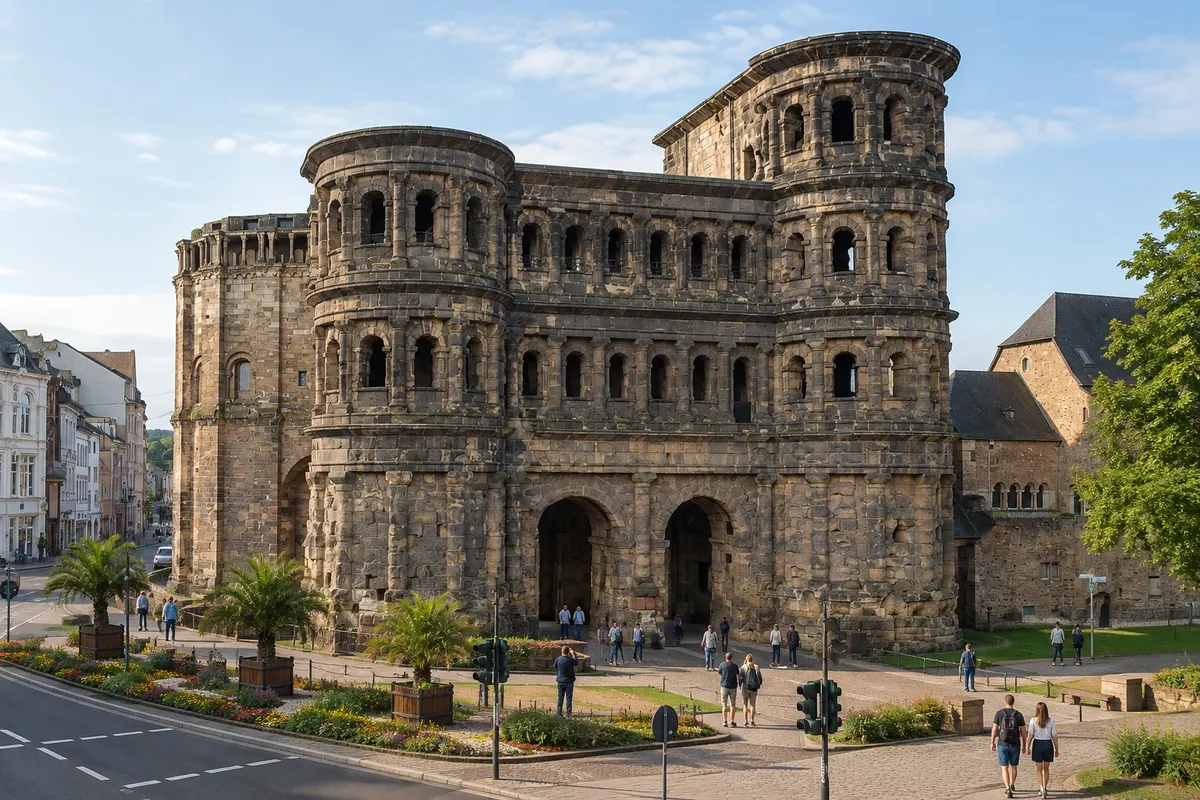
Monument · Trier, Renânia-Palatinado
Porta Nigra
Roman sandstone gate built around AD 170, the only one of the four gates of the old Augusta Treverorum still standing. It became a church in the Middle Ages and was returned to its Roman form by order of Napoleon.
Illustrative images. The pictures in this guide are illustrations based on the real place, not photographs, and may differ from it.

Discover
About Porta Nigra
The Porta Nigra guarded the northern entrance to the Roman city of Augusta Treverorum. Construction began around AD 170, using large blocks of grey sandstone fitted together without mortar, and it was never completely finished. The name, 'black gate', comes from the colour the stone acquired over time.
The gate survived thanks to a hermit. After 1028 the Greek monk Simeon lived reclusively in the ruins, and after his death and canonization in 1035 the gate was converted into two superimposed churches, with a monastery beside them. In 1804 Napoleon ordered the church additions removed and the monument returned to its Roman appearance, but the medieval apse on the east side remains.
The visit includes the upper levels, from where you can see the old town and Simeonstraße leading to the Hauptmarkt. In the warmer months there are staged visits, guided by an actor dressed as a Roman centurion. Next door, the former monastery of Saint Simeon houses the city museum and the tourist information centre.
The Porta Nigra is part of the Roman monuments, the cathedral and the Liebfrauenkirche of Trier, a UNESCO World Heritage Site since 1986. Parts of the gate may be scaffolded for conservation work, without preventing visits.
Before you go
Practical information
Cidade Turismo reviews its information regularly, but something may have changed. Check with the place before planning your trip.
How much time to set aside
About 45 minutes to 1 hour, including the climb to the upper levels.
Best time
Right at opening, before the groups, or late afternoon when the light hits the façade. At night the gate is illuminated. The staged visits usually take place in the warmer months; check the dates.
How to get there
It's about a 10-minute walk from Trier Hbf along Theodor-Heuss-Allee. From the Hauptmarkt it's a 5-minute walk along Simeonstraße.
Tip
The tourist information centre is next to the gate: stop there to pick up a map and information about combined tickets for the Roman monuments. The internal stairs are narrow.
Official website
Get your questions answered
Frequently asked questions about Porta Nigra
How old is the Porta Nigra?
Construction began around AD 170, in the Roman period. It is the only one of the four gates of the Roman city still standing.
Can you go up the Porta Nigra?
Yes. The visit includes the upper floors, with views over the old town.
Why was the Porta Nigra turned into a church?
In the 11th century the gate was transformed into two superimposed churches in honor of the hermit Simeon, who lived in the ruins. Napoleon ordered it restored to its Roman form in 1804.
Is there a guided tour at the Porta Nigra?
Yes. There are staged visits with an actor playing a Roman centurion, especially in the warmer months. Check the times before you go.