

 Brazil
 Argentina
 Chile
Chile Colombia
 Peru
Peru Uruguay
 Belgium
 Spain
Spain France
 Greece
 the Netherlands
 Ireland
 Italy
Italy Portugal
 the United Kingdom
 Switzerland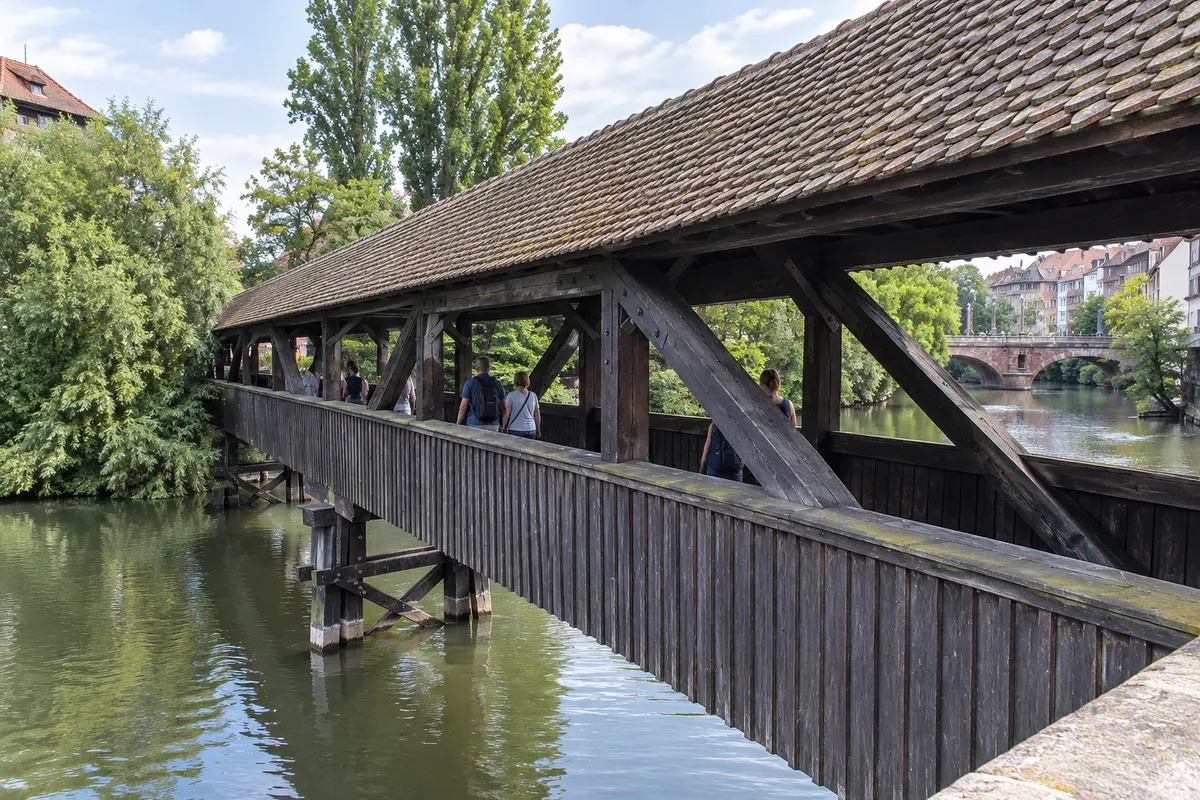
Bridge · Nuremberg, Baviera
Henkersteg
Covered wooden bridge over the Pegnitz, linking the Trödelmarkt islet to Unschlittplatz. It is named after the city's executioner, who lived in the adjacent tower.
Illustrative images. The pictures in this guide are illustrations based on the real place, not photographs, and may differ from it.

Discover
About Henkersteg
The Henkersteg, the executioner's bridge, is a covered wooden walkway over the southern arm of the Pegnitz river, between the Trödelmarkt islet and Unschlittplatz. The first bridge on the site was built in 1457.
The name comes from the city's executioner, who lived in the tower next to the bridge. In the Middle Ages the executioner was kept apart from the citizens and used the bridge to enter the city without crossing the main streets. The tower and adjacent buildings form one of Nuremberg's most photographed scenes, with the half-timbered Weinstadel, a former wine warehouse, and the Wasserturm, the water tower, on the north bank.
In January 1595 a flood destroyed the bridge and eight people watching the flood died. It was rebuilt slightly further west, already covered, and underwent several renovations. After being heavily damaged in World War II, it was rebuilt in 1954.
Before you go
Practical information
Cidade Turismo reviews its information regularly, but something may have changed. Check with the place before planning your trip.
How much time to set aside
Fifteen to thirty minutes, including the walk along the riverbank.
Best time
In the late afternoon, when the light hits the facades of the Weinstadel and the tower. Early in the morning, the riverbank is quiet.
How to get there
On foot, about a 7-minute walk from the Hauptmarkt, heading west along the Pegnitz riverbank. The Trödelmarkt islet has shops and cafés.
Tip
The best photo of the bridge, with the Weinstadel in the background, is taken from the Maxbrücke, the stone bridge just to the west.
Get your questions answered
Frequently asked questions about Henkersteg
Why is Henkersteg called that?
Henker means executioner. The city's executioner lived in the tower next to the bridge and used it to enter the city, since he was kept separate from the residents.
Where can I take the classic photo of the bridge?
From the Maxbrücke, a stone bridge to the west, from where the Henkersteg, the tower and the Weinstadel mansion are visible.
Is the bridge the original medieval one?
No. The bridge was rebuilt after the flood of 1595, repaired several times and reconstructed in 1954, after damage in World War II.