

 Brazil
 Argentina
 Chile
Chile Colombia
 Peru
Peru Uruguay
 Belgium
 Spain
Spain France
 Greece
 the Netherlands
 Ireland
 Italy
Italy Portugal
 the United Kingdom
 Switzerland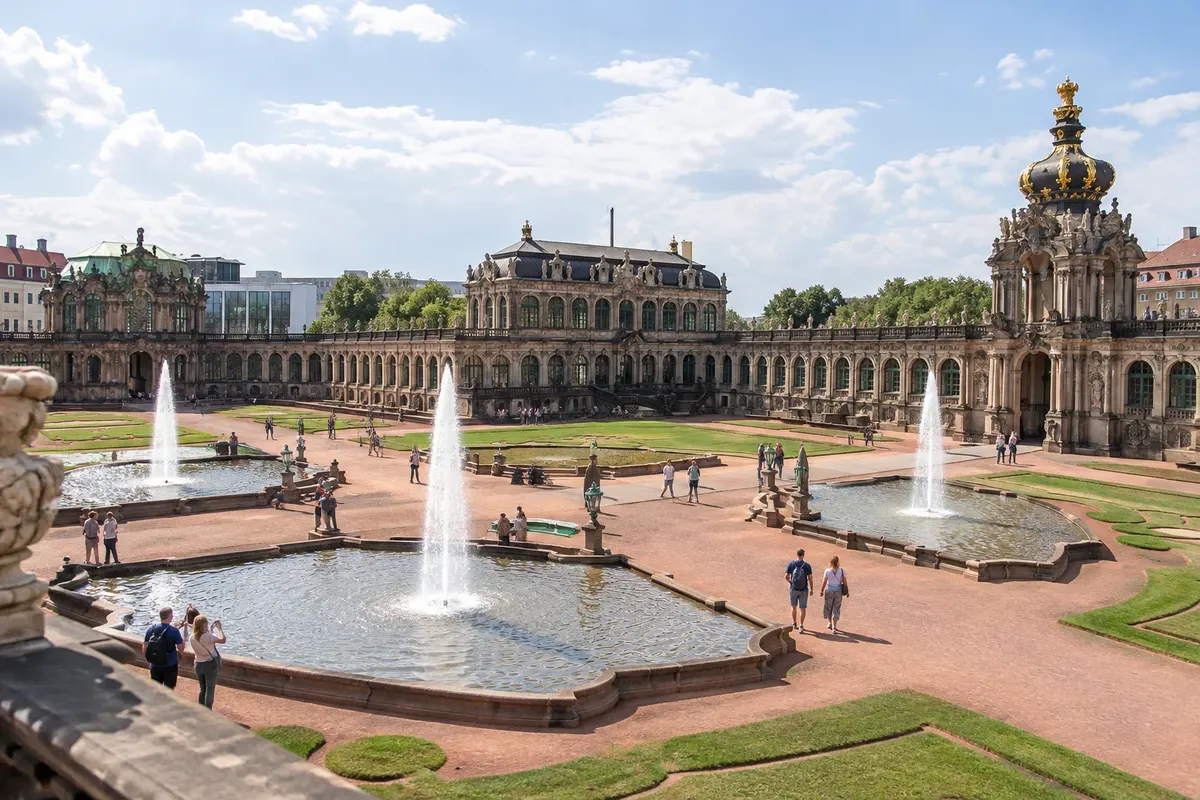
Palace · Dresden, Saxônia
Zwinger
Baroque ensemble of pavilions and gardens from the 18th century, housing the Gemäldegalerie Alte Meister, where the Madona Sistina by Rafael is located, and the porcelain collection.
Illustrative images. The pictures in this guide are illustrations based on the real place, not photographs, and may differ from it.

Discover
About Zwinger
The Zwinger is an ensemble of pavilions, galleries and gardens built between 1710 and 1728 at the command of Augusto, o Forte, Elector of Saxony and King of Poland. The project was designed by architect Matthäus Daniel Pöppelmann, with sculptures by Balthasar Permoser. It served as a setting for court festivities and to display the royal collections.
One of the entrances is the Kronentor (Crown Gate), topped by a golden crown that evokes the Polish crown. The inner courtyard, with lawns, fountains and paths, can be walked through, and from the top of the galleries you can see the entire complex. On the side facing Theaterplatz is the Semperbau, a building designed by Gottfried Semper between 1847 and 1855 to close the courtyard.
The Semperbau houses the Gemäldegalerie Alte Meister (Gallery of Old Masters), one of Europe’s leading picture galleries. The highlight is the Madona Sistina by Rafael, with the two little angels resting on the ledge, but there are also works by Giorgione, Titian, Rembrandt, Rubens and Vermeer. In the pavilions are the Porzellansammlung, a collection of Meissen and Far Eastern porcelain, and the Mathematisch-Physikalischer Salon, with clocks and scientific instruments.
The 1945 bombings destroyed much of the Zwinger, but the collections had been removed beforehand. Reconstruction began soon after the war and the complex was restored in the following decades.
Before you go
Practical information
Cidade Turismo reviews its information regularly, but something may have changed. Check with the place before planning your trip.
How much time to set aside
Half an hour for the courtyard and galleries; 2 to 3 hours if you include the Gemäldegalerie Alte Meister and the porcelain collection.
Best time
The courtyard is quieter right at opening. The Gemäldegalerie is usually calmer in the late afternoon and outside weekends. In spring and summer the lawns and fountains are at their best.
How to get there
It lies between Theaterplatz and Postplatz, in the old town. Trams that stop at Postplatz and Theaterplatz stop next to it; on foot it’s about 10 minutes from the Neumarkt.
Tip
The courtyard of the Zwinger is open and free to enter; the museums have separate tickets, and there are combined tickets for the Staatliche Kunstsammlungen Dresden (SKD). The museums are closed one day a week: check before you go. Climb the pavilion galleries to see the courtyard from above.
Official website
Get your questions answered
Frequently asked questions about Zwinger
What is the Gemäldegalerie Alte Meister?
It is the picture gallery of the old masters located in the Semperbau, the Zwinger wing facing the Theaterplatz. The best-known work is Raphael’s Sistine Madonna, and the collection includes Giorgione, Titian, Rembrandt, Rubens and Vermeer.
Do you have to pay to enter the Zwinger?
The courtyard and gardens are open and there is no fee. The museums housed in the pavilions, such as the Gemäldegalerie and the Porzellansammlung, require tickets.
How long does a visit to the Zwinger take?
Half an hour for the courtyard. With the Gemäldegalerie and the porcelain collection, allow 2 to 3 hours.
Was the Zwinger destroyed in the war?
Largely, during the February 1945 bombings. The artworks had been removed beforehand, and the complex was rebuilt in the following decades.