

 Brazil
 Argentina
 Chile
Chile Colombia
 Peru
Peru Uruguay
 Belgium
 Spain
Spain France
 Greece
 the Netherlands
 Ireland
 Italy
Italy Portugal
 the United Kingdom
 Switzerland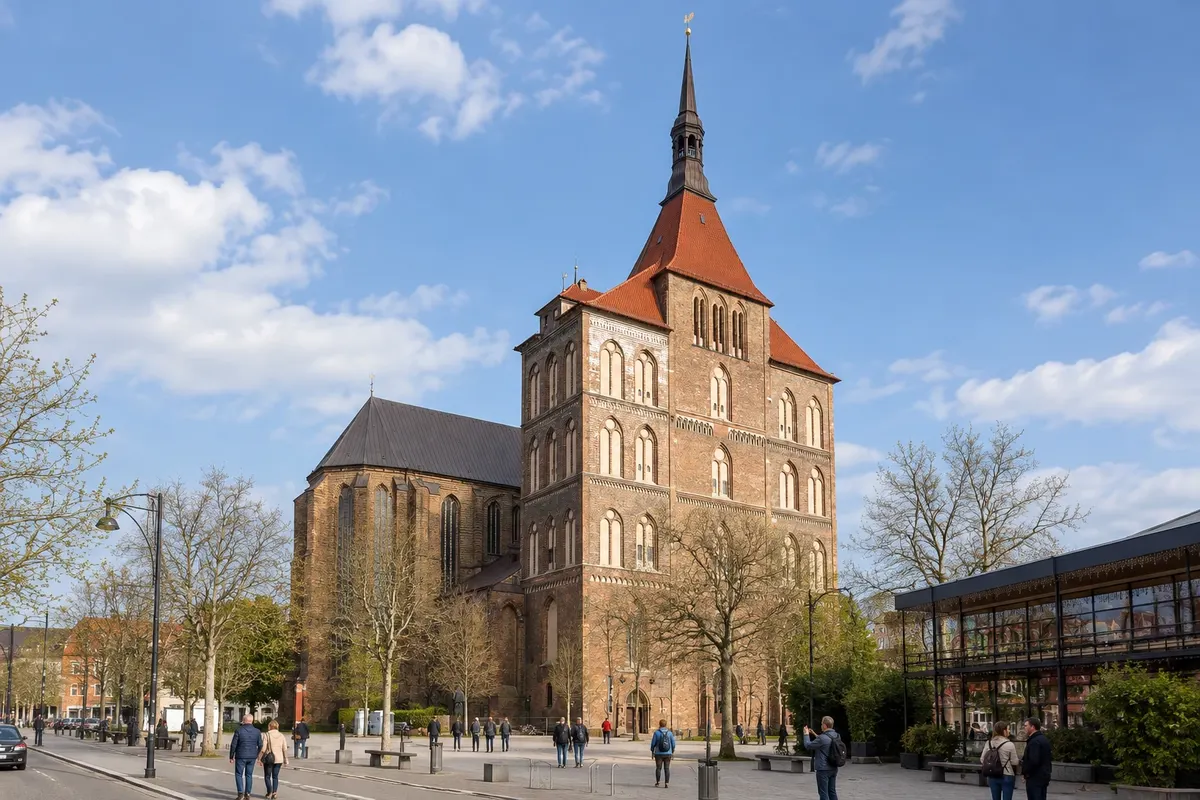
Church · Rostock, Mecklemburgo-Pomerânia Ocidental
Marienkirche Rostock
Brick Gothic church that survived World War II with relatively little damage. It houses an astronomical clock from 1472 that still works and a bronze baptismal font from 1290.
Illustrative images. The pictures in this guide are illustrations based on the real place, not photographs, and may differ from it.

Discover
About Marienkirche Rostock
The Marienkirche is Rostock’s largest church and the city’s main brick Gothic building, with a tower of about 86 metres. It was the only one of the four city centre churches to survive the 1942 and 1944 bombings relatively intact, thanks to residents who put out roof fires.
The most famous feature is the astronomical clock behind the altar, built in 1472 by Hans Düringer. It shows the hours, the phases of the Moon and the Sun’s position in the zodiac, and has a calendar disc indicating the movable dates of Easter. The current disc is valid until 2150. The mechanism still works and is adjusted manually. At noon, a procession of small figures of the apostles moves across the top of the clock.
Another highlight is the bronze baptismal font from 1290, the oldest object in the church and one of the largest of its kind in the Baltic region. The Baroque organ occupies the west wall.
The church underwent a full restoration between 1992 and 2021. Some pieces, such as the high altar, still undergo occasional restoration.
Before you go
Practical information
Cidade Turismo reviews its information regularly, but something may have changed. Check with the place before planning your trip.
How much time to set aside
About 30 minutes to an hour.
Best time
Around noon, to see the procession of figures on the astronomical clock. Check before you go, as services, concerts and prayers shorten visiting hours on some days.
How to get there
It’s in the old town, a short walk from Neuer Markt, about 20 minutes on foot from the central station (Rostock Hauptbahnhof). Trams passing Neuer Markt stop nearby.
Tip
Stand in front of the clock a few minutes before noon to see the figures move. Also look at the calendar disc at the lower part.
Official website
Get your questions answered
Frequently asked questions about Marienkirche Rostock
Does the astronomical clock of the Marienkirche still work?
Yes. Built in 1472 by Hans Düringer, it still runs and is set by hand. The current calendar disc is valid until 2150.
What's the best time to see the clock?
Around midday, when the figures of the apostles move at the top of the clock. Check before you go, as the church's schedule can change.
Was the Marienkirche destroyed in the war?
No. It was the only one of the four churches in central Rostock that came through the 1942 and 1944 bombings relatively intact.