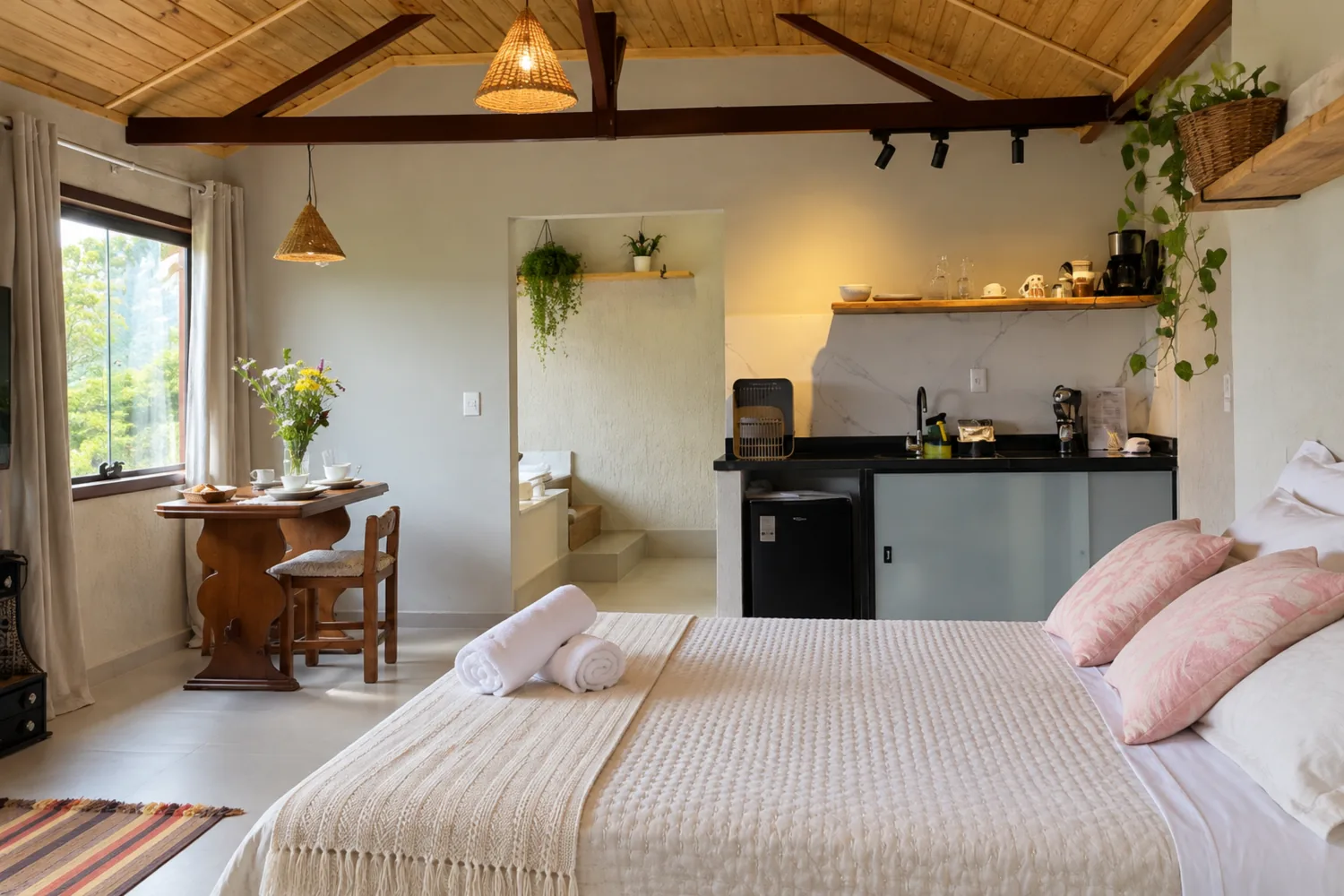
Chalé Lobo do Mato
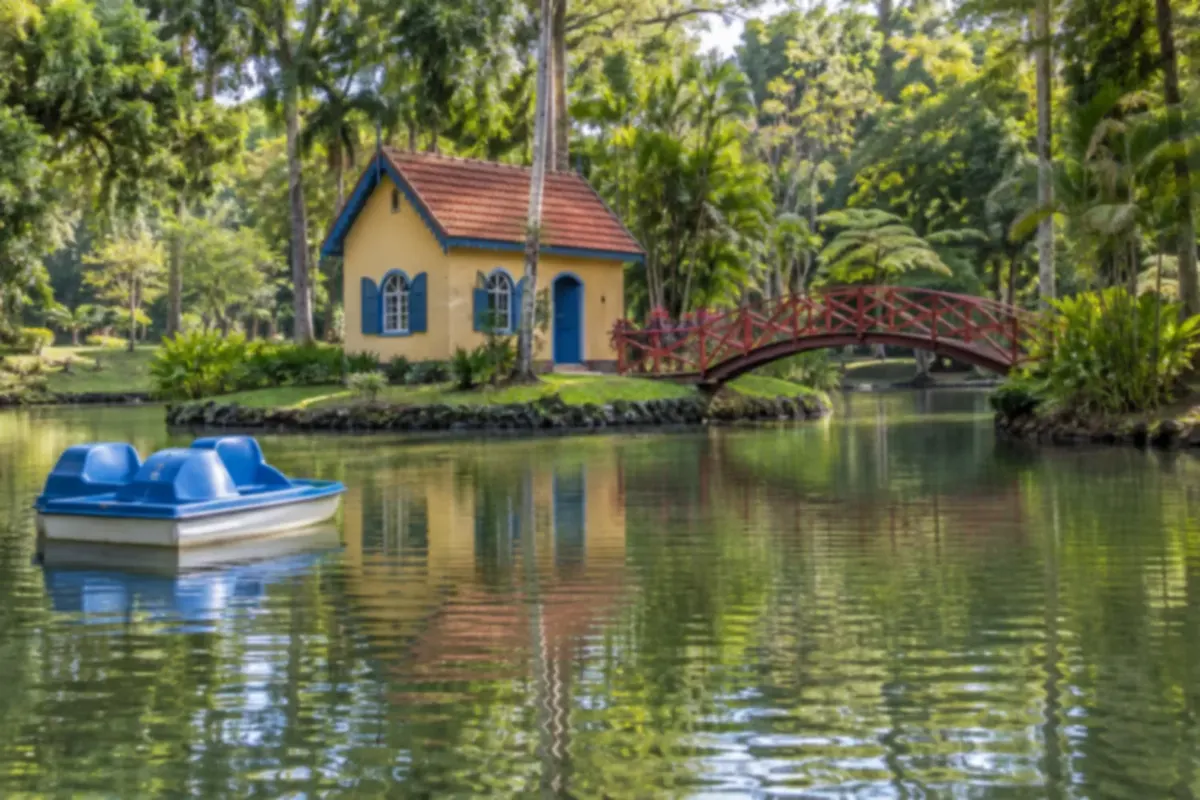
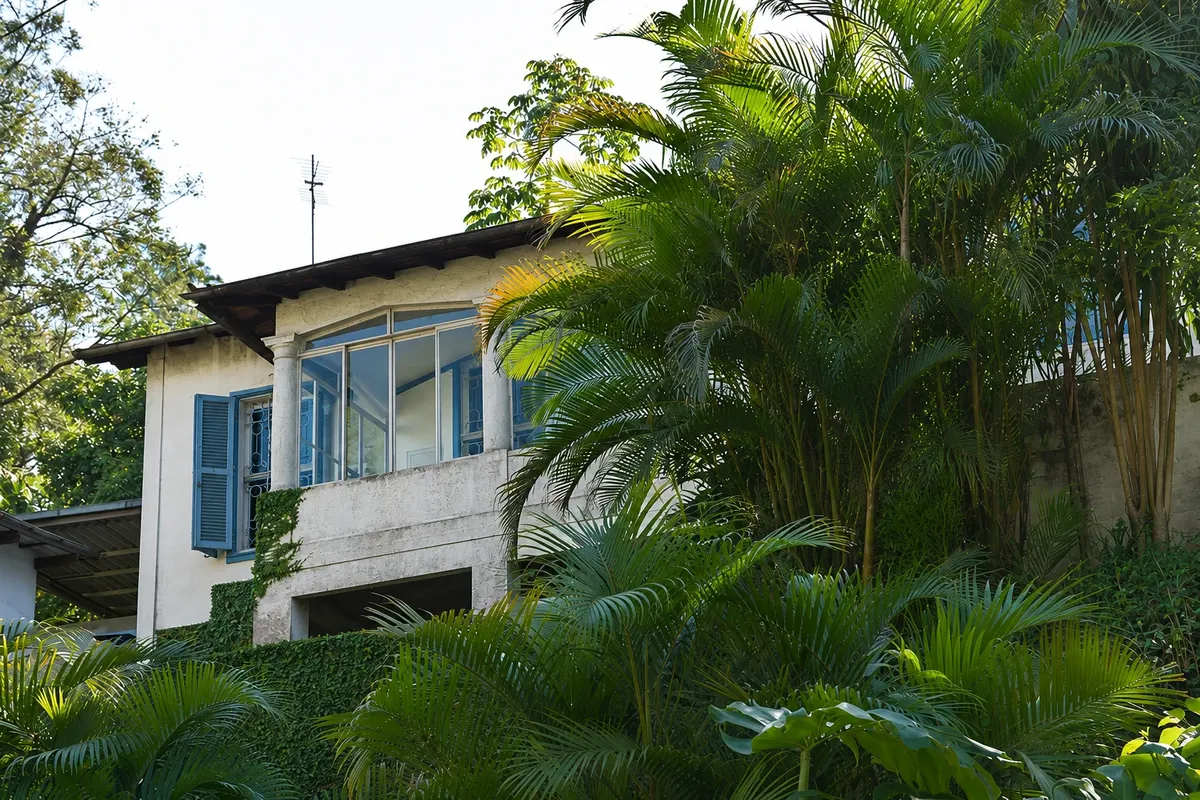
PartnerA retreat in the middle of nature in Corrêas, on the way between downtown Petrópolis and Itaipava.

 Išči
Brazilija
 Antarktika
 Argentina
 Bolivija
 Čile
 Kolumbija
 Ekvator
 Gvajana
 Francoska Gvajana
 Falklandski otoki (Malvini)
 Paragvaj
 Peru
 Surinam
 Urugvaj
 Venezuela
 Nemčija
 Avstrija
 Belgija
 Hrvaška
 Danska
 Slovaška
 Slovenija
 Španija
 Finska
 Francija
 Grčija
 Nizozemska
 Madžarska
 Irska
 Islandija
 Italija
 Luksemburg
 Norveška
 Poljska
 Portugalska
 Združeno kraljestvo
 Češka
 Švedska
 Švica
 Turčija
 Bermudi
 Kanada
 Združene države Amerike
 Grenlandija
 Mehika
 Sveta Peter in Mihael
 Dominikanska republika
 JaponskaTurčija
 Južnoafriška republika
 Egipt
 Avstralija
 Fidži
 Nova Zelandija
 Papua Nova Gvineja
Rio de Janeiro · Brazilija
Destinacija: Rio de Janeiro Mountain Region (Serra Verde Imperial).
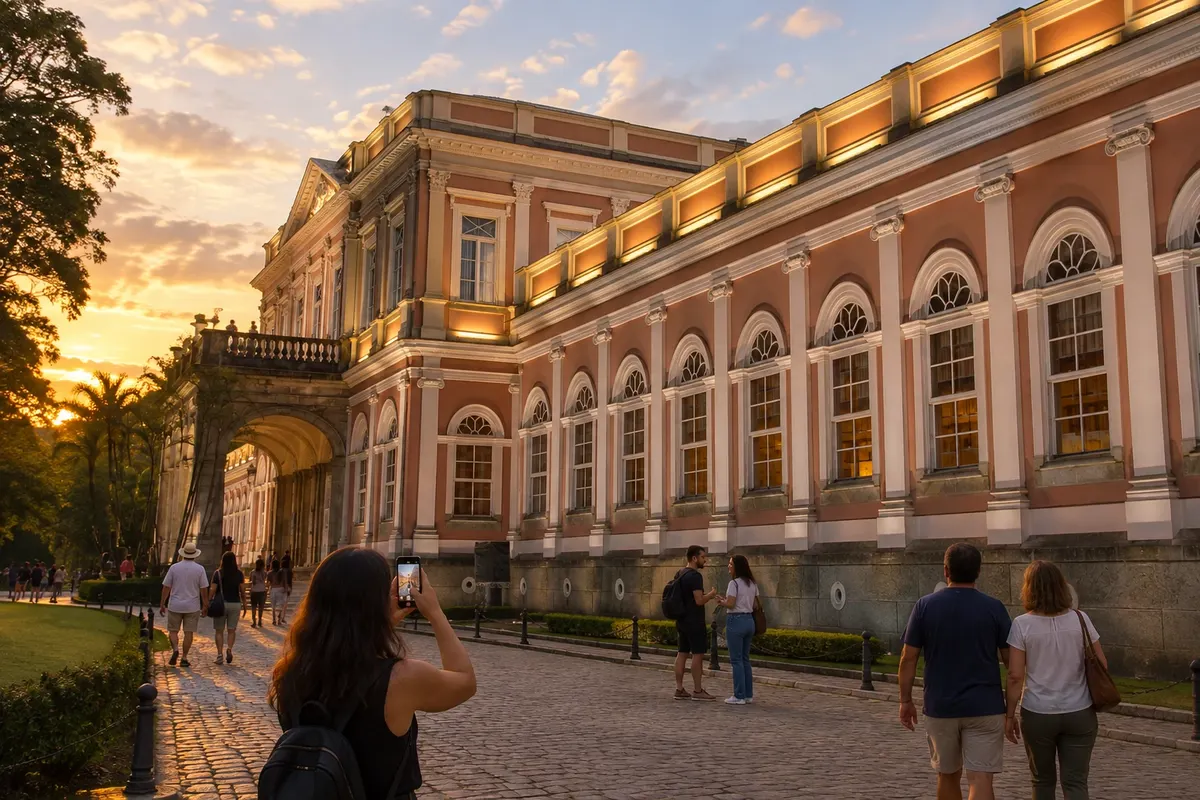
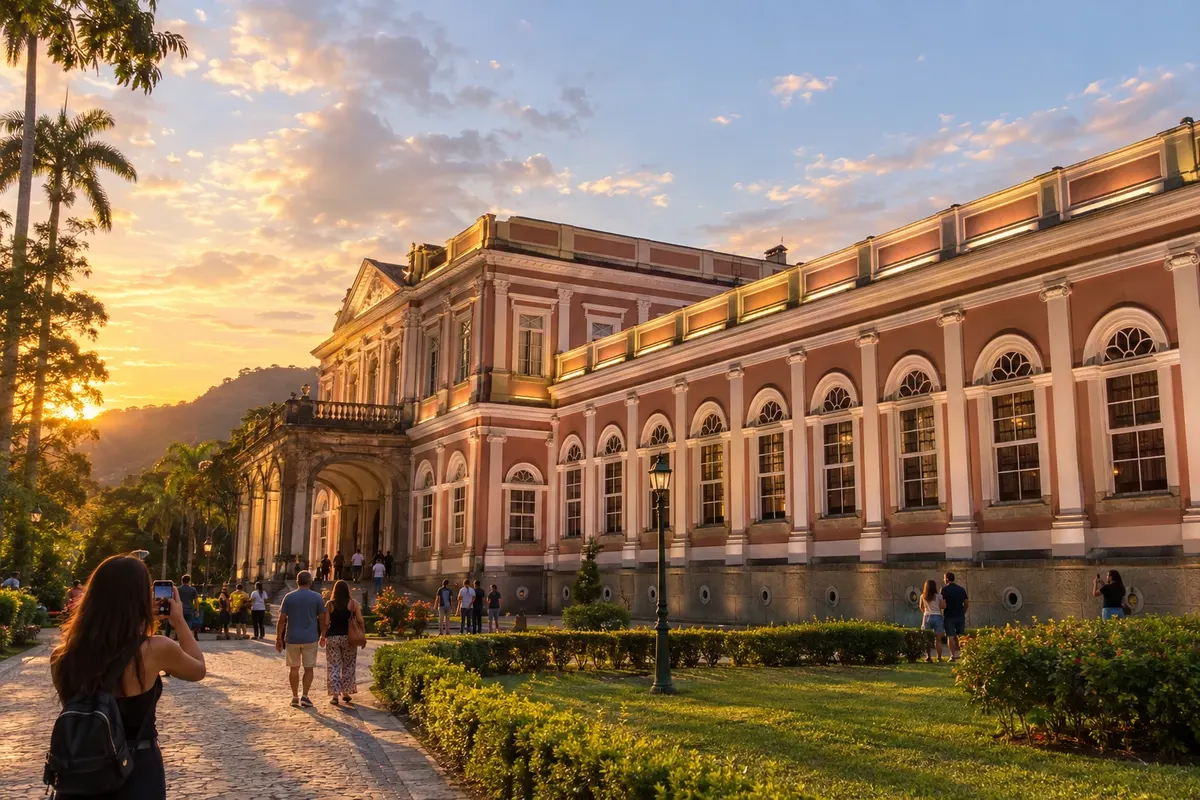
Na fotografiji: Museu Imperial
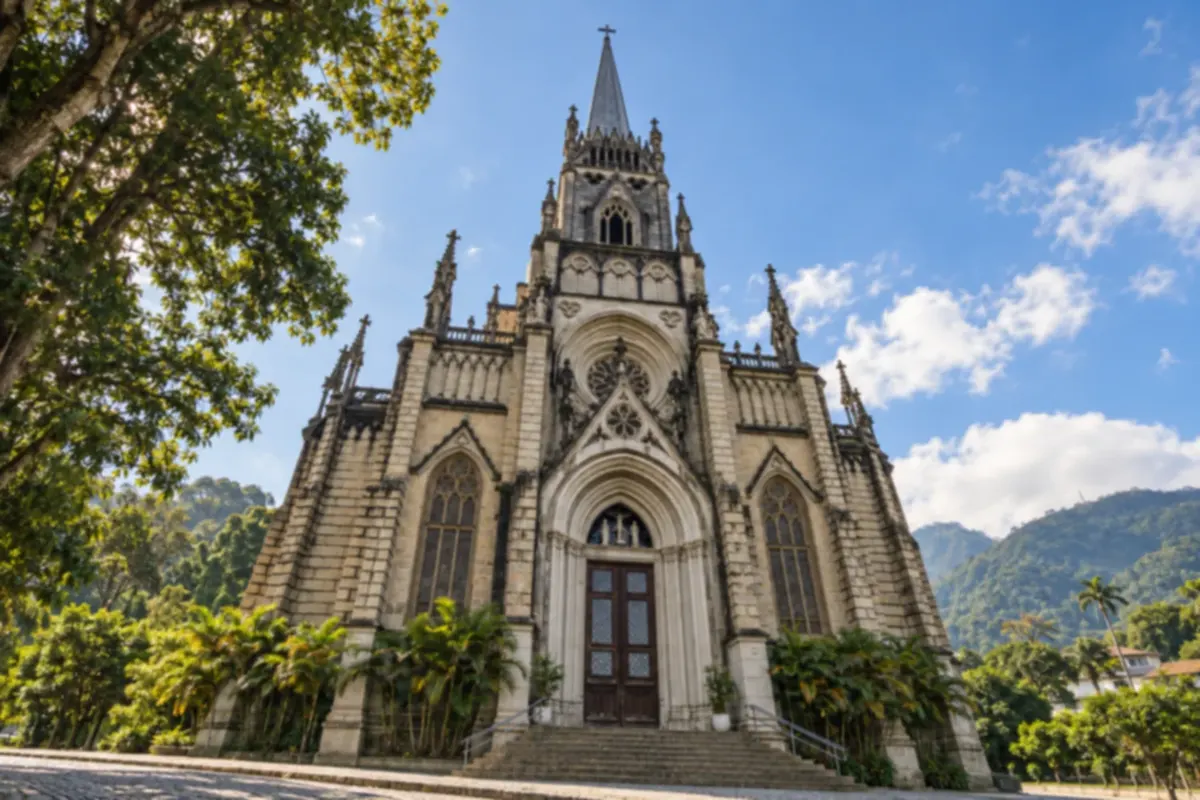
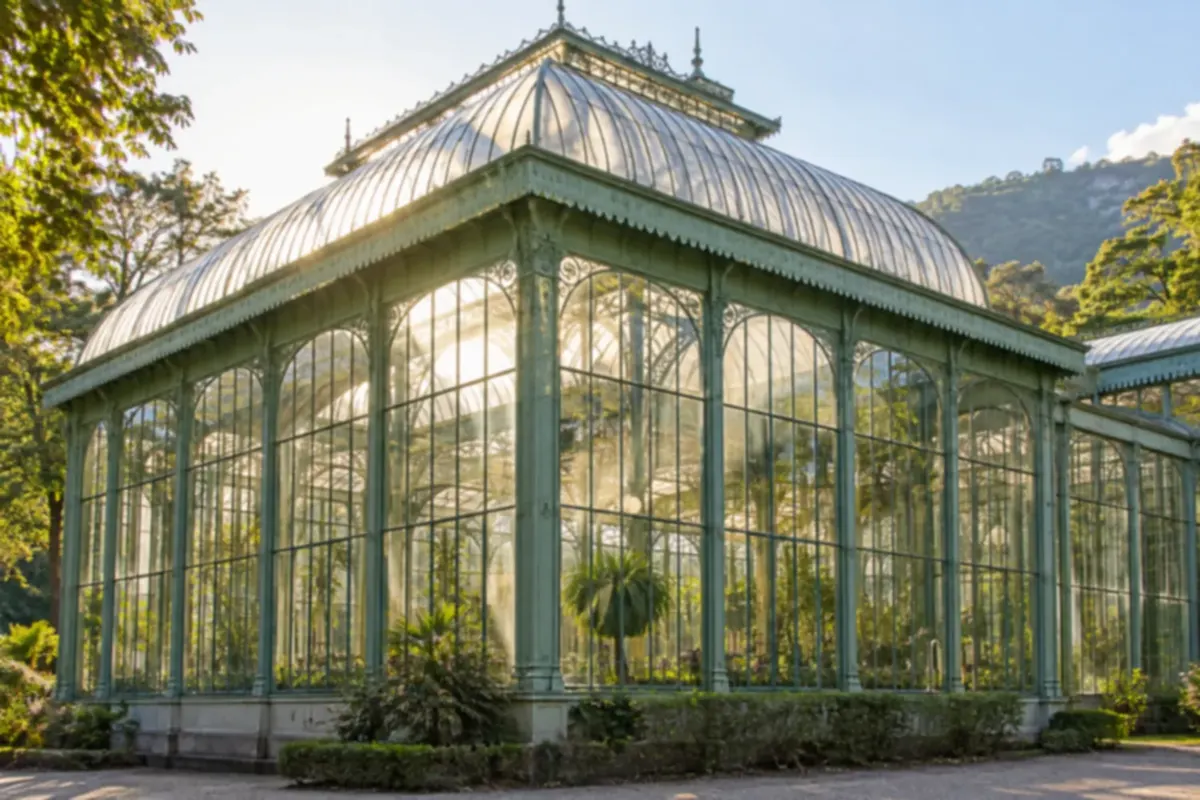
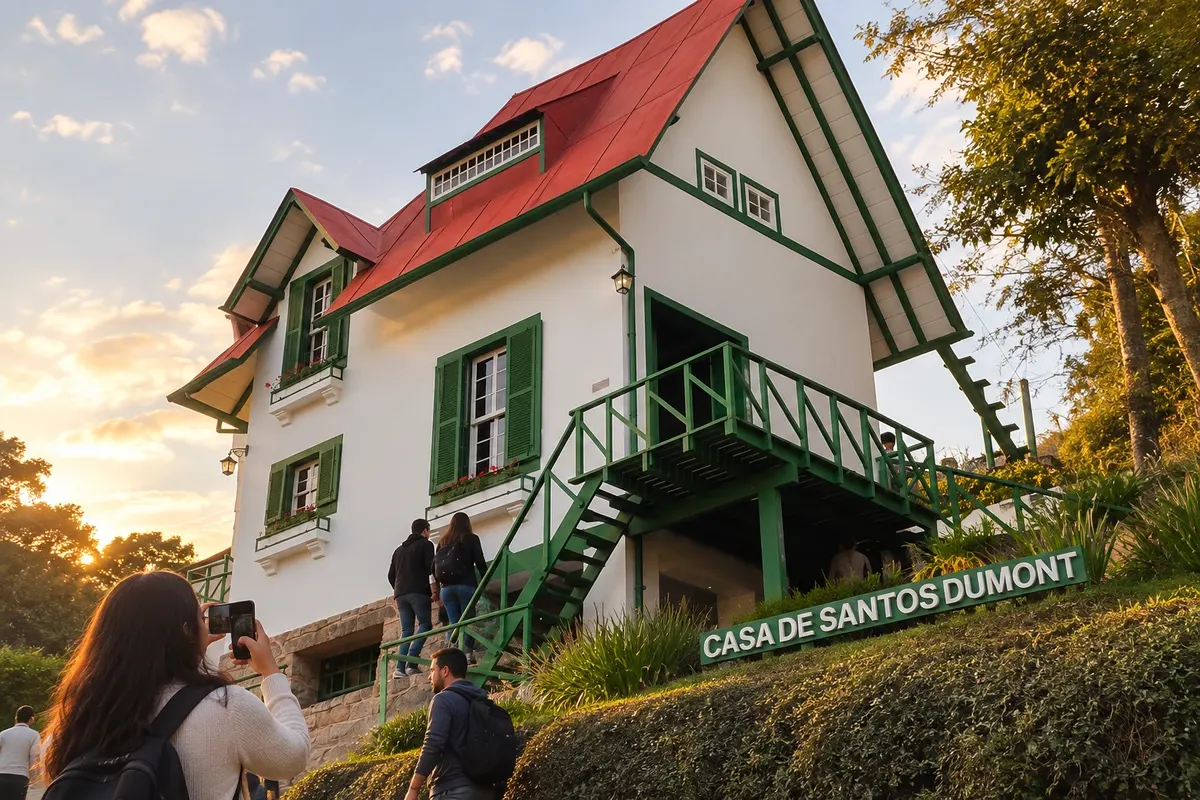
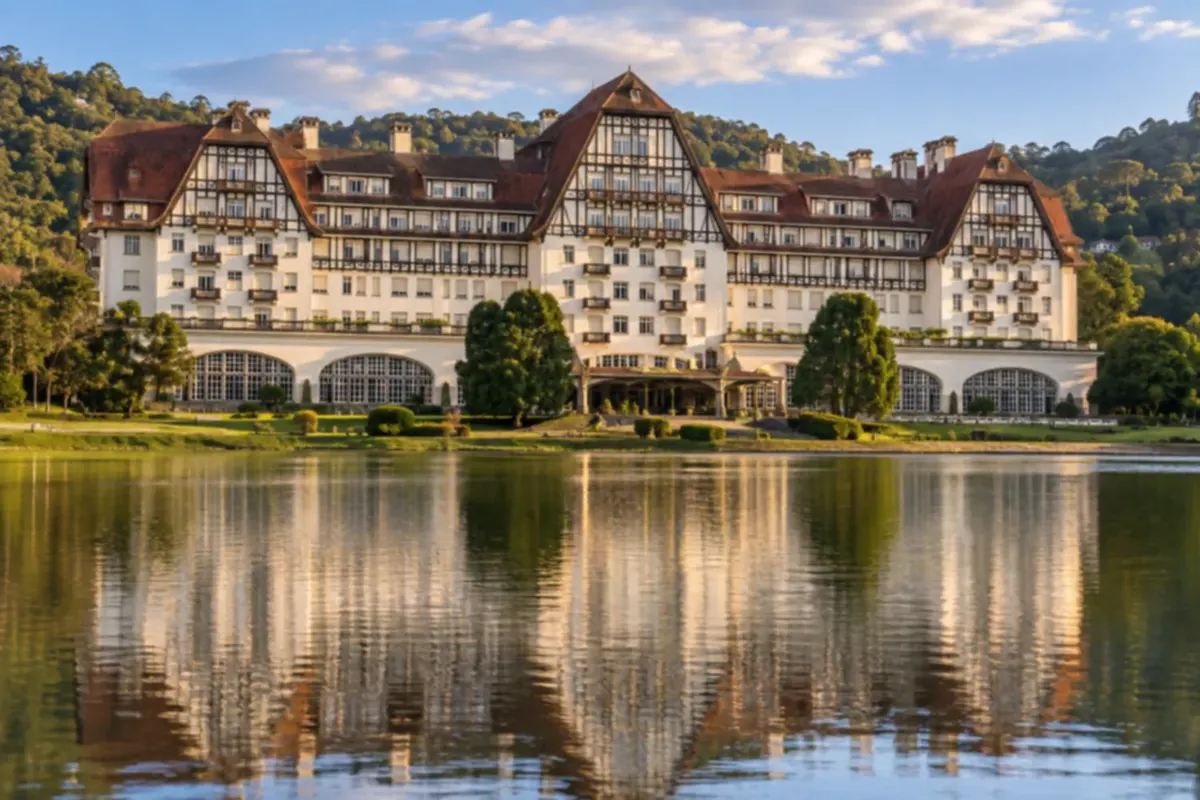
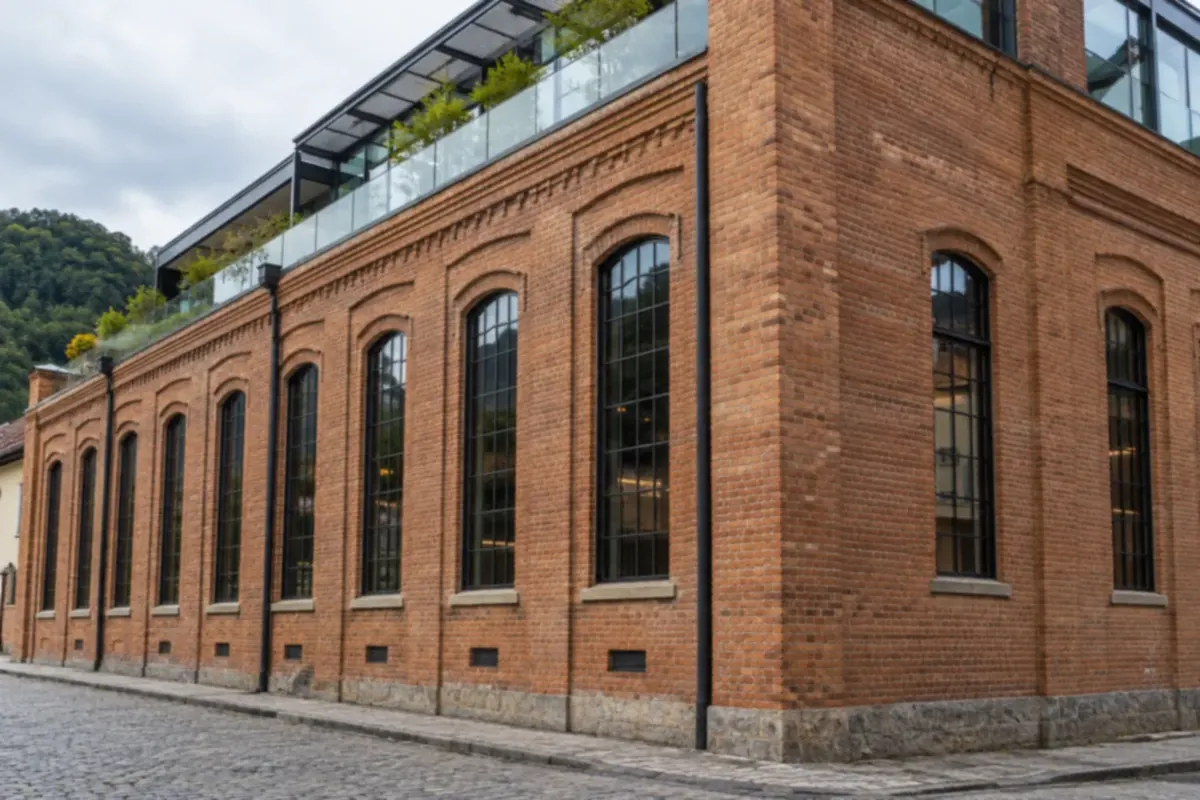
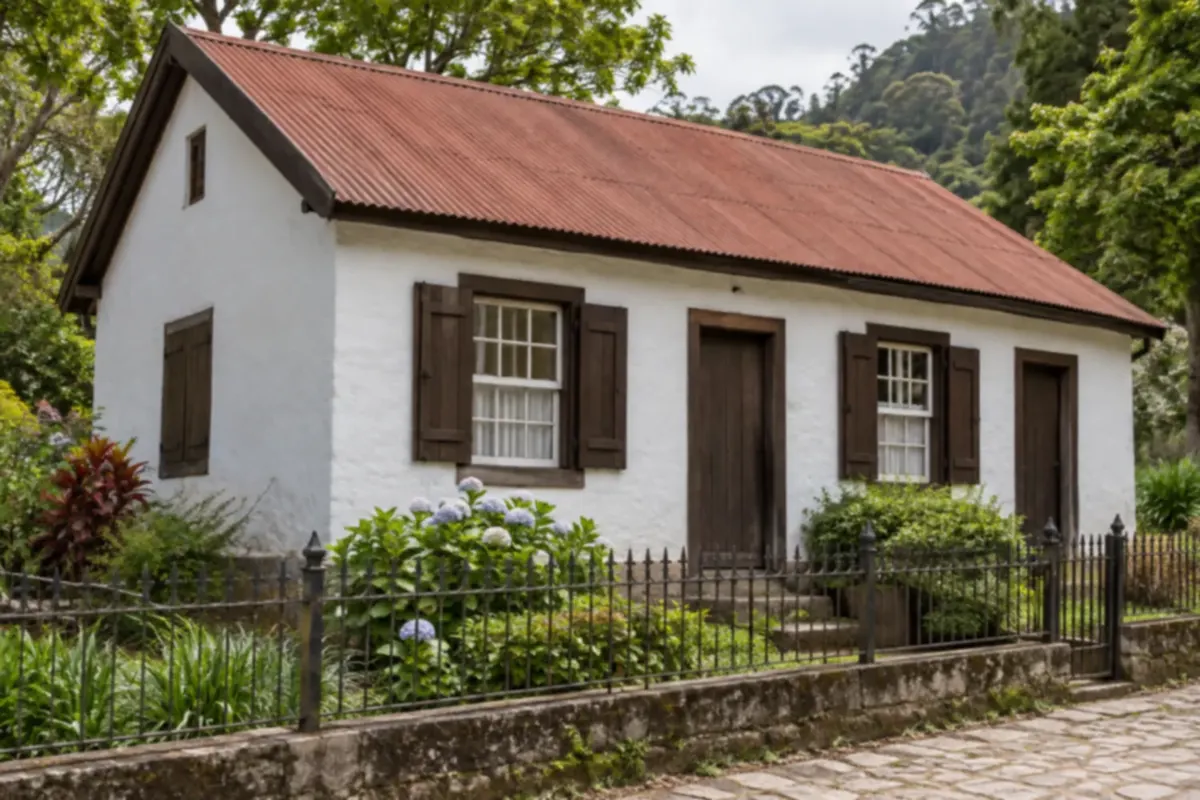
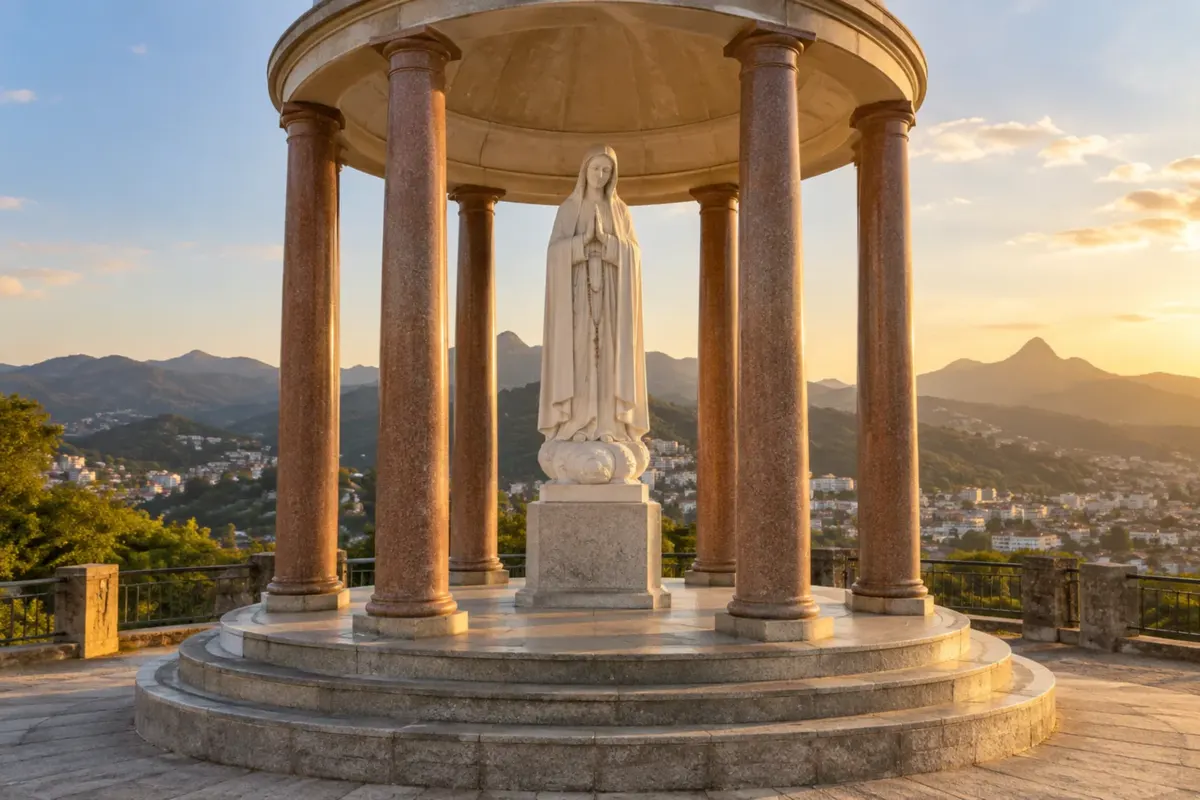
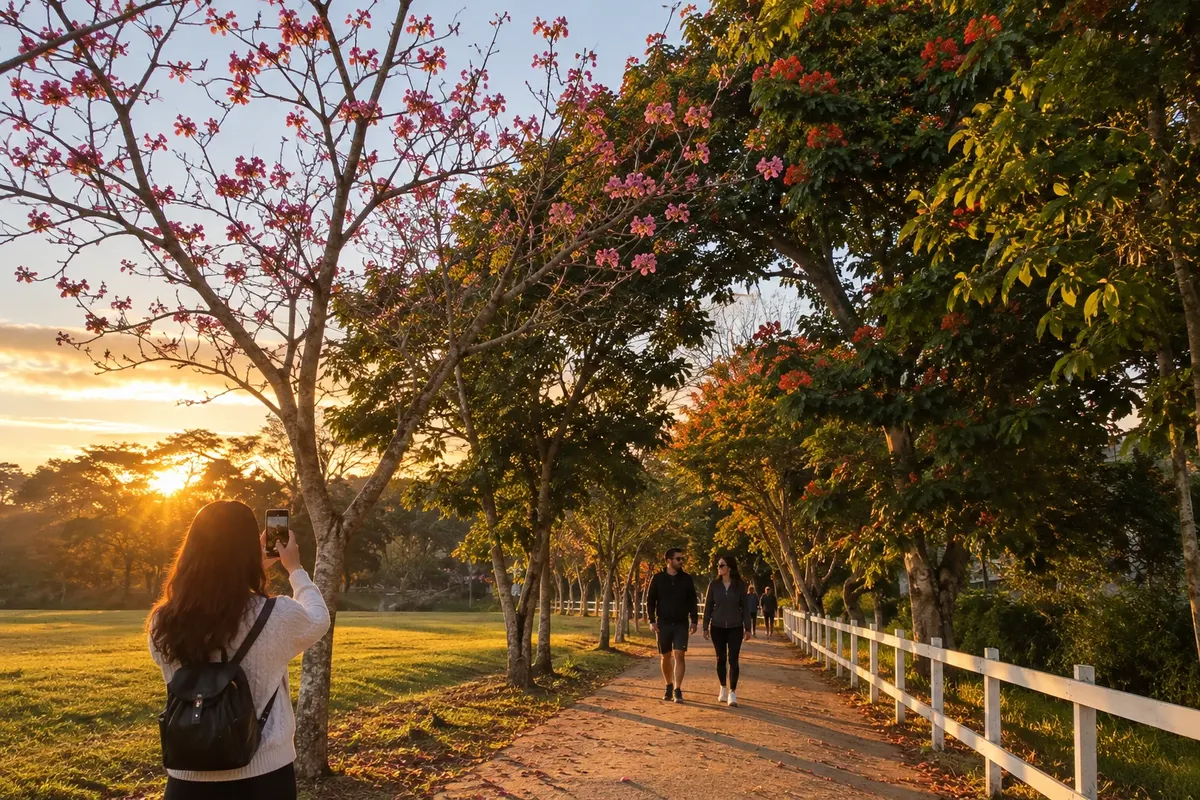
Illustrative images. The pictures in this guide are illustrations based on the real place, not photographs, and may differ from it.
Mesto
Petrópolis is a mountain town shaped by imperial history and the Atlantic Forest. Walks through the historic center can be combined with cultural visits and outings in the mountains.
Petrópolis is in the Serra dos Órgãos, in the state of Rio de Janeiro, about 70 km from the capital. The city was founded in 1843 by decision of Dom Pedro II and was planned by engineer Júlio Frederico Koeler, with streets following the rivers and houses facing them. In 1845 German settler families arrived, commemorated by the Obelisk on Rua do Imperador and the Bauernfest. The imperial court spent summers here, which is why so much of 19th-century Brazil is preserved within a few blocks.
The Historic Center is flat, tree-lined and walkable. It houses the Imperial Museum, in the emperor’s former summer palace, the Cathedral of São Pedro de Alcântara with the Imperial Mausoleum, Avenida Koeler and its mansions, the Crystal Palace, Praça da Liberdade and the Bohemia Brewery, founded in 1853. Plaques in Portuguese and English tell the story of each house and square. Just above, in Valparaíso, are Santos Dumont’s house, the house where writer Stefan Zweig lived and the viewpoint of the Throne of Fátima. In the Quitandinha neighborhood, the palace built as a hotel-casino now serves as a cultural center.
The municipality is large and changes a lot outside the center. Following Estrada União e Indústria, you pass Corrêas and Nogueira to Itaipava, about 20 km away, with restaurants, the Hortomercado, a market fair and craft breweries. From Corrêas the Bonfim road climbs to the Petrópolis headquarters of Serra dos Órgãos National Park, with swimming holes, Véu da Noiva waterfall and the start of the traverse to Teresópolis. Araras and Vale das Videiras, on the other side of BR-040, gather easily accessible waterfalls, trails and highly sought-after weekend tables. Further away, Brejal (in Posse) and Secretário (in Pedro do Rio) are rural areas with organic farms, cheese producers and sweets open to visitors.
The climate is mountainous. From May to September it rains little, days are usually stable and nights are cold; it is the season for winter festivals and long hikes. From November to March it is warmer and rains a lot, almost always in heavy afternoon showers: that is when the swimming holes fill, but it’s wise to keep mornings for outdoor activities and afternoons for museums. April and October are transitional months.
For a first visit, the Imperial Museum, the walk from the Cathedral to the Crystal Palace and Santos Dumont’s house fit into a day. With two or three days you can add Quitandinha, the breweries, Itaipava and a morning at Bonfim. A practical note: most museums are closed on Mondays.
Petrópolis – število nastanitev: 100.
Petrópolis – število lokalov: 31.
Petrópolis – nazivi in posebnosti
Partnerji vodnika Cidade Turismo
A retreat in the middle of nature in Corrêas, on the way between downtown Petrópolis and Itaipava.
Praznovanja in dogodki
Datumi se vsako leto spreminjajo. Pred potovanjem preverite letošnji datum.
 junij/julij
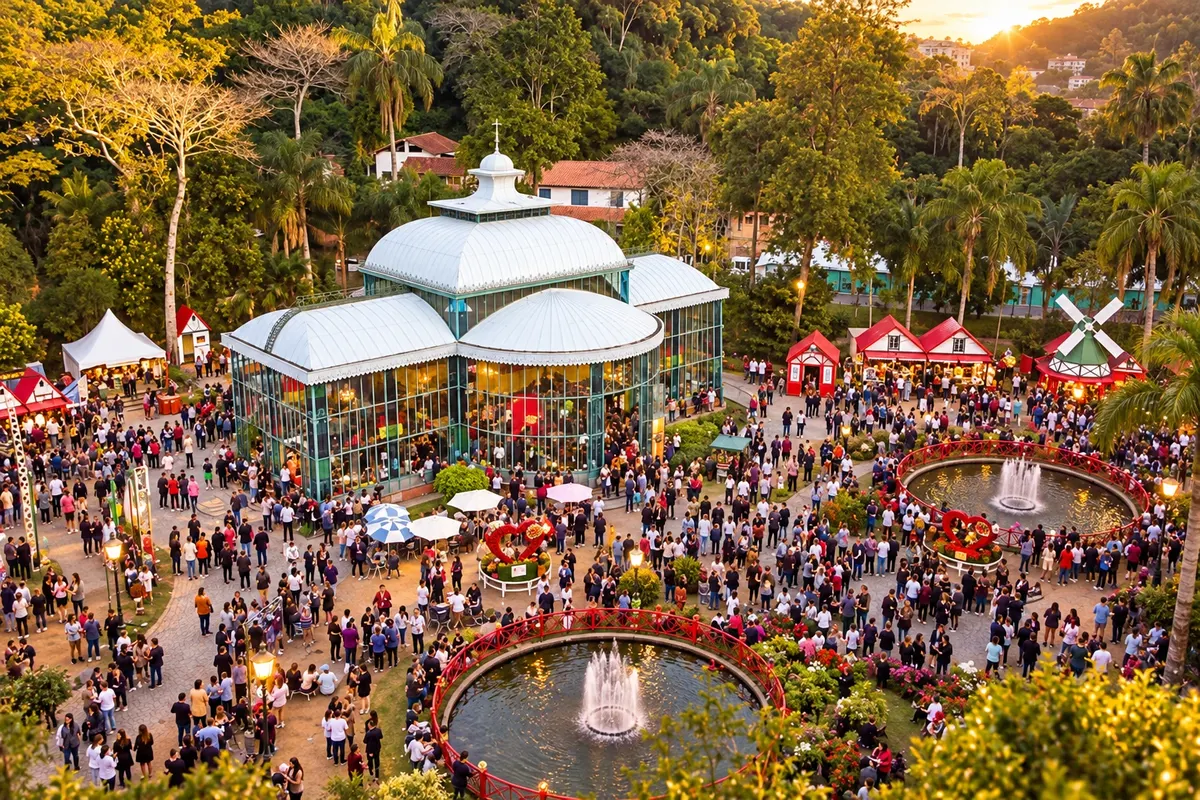
Between late June and early July, always including June 29, German Settler Day, a municipal holiday in Petrópolis.
Petrópolis’s German Settler festival, featuring traditional German food and beer, folk dance groups, and events around the Crystal Palace.
 julij/avgust
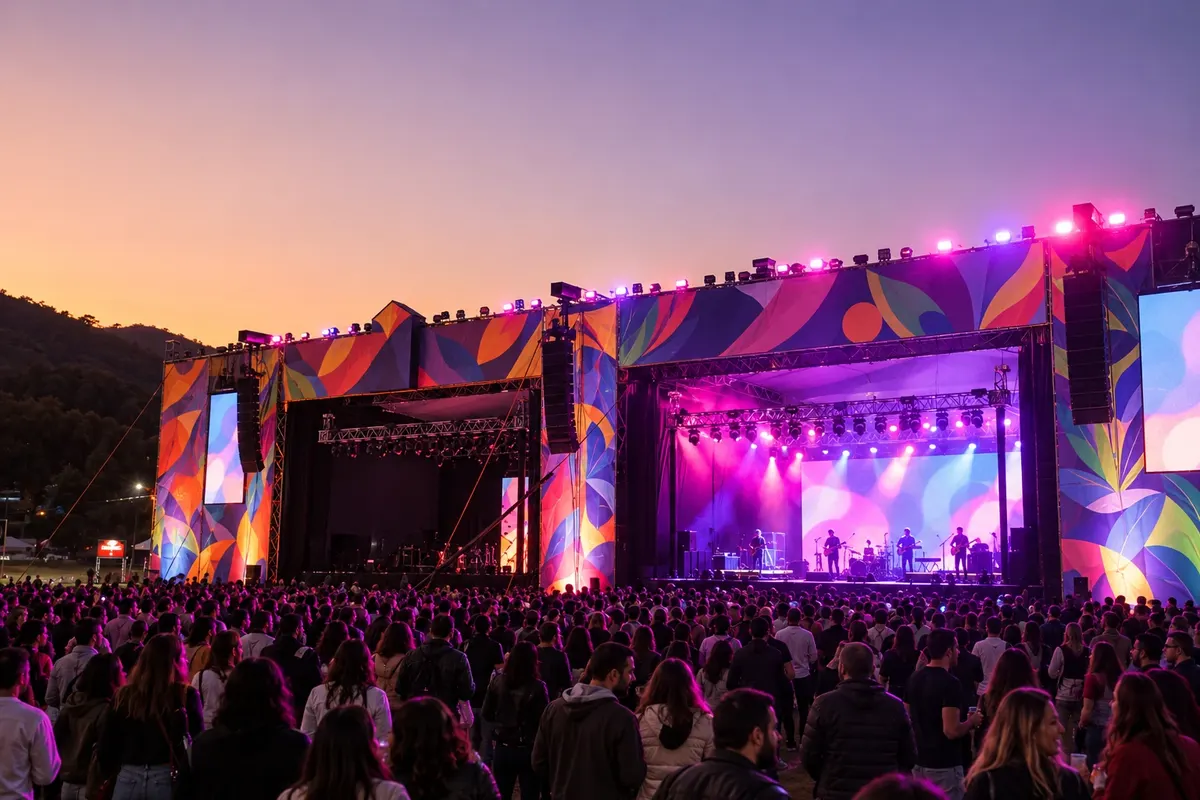
Once a year, between the second half of July and the beginning of August, during winter break.
The Sesc winter festival in the Mountain Region, with concerts, theater, dance and circus at Sesc Quitandinha, in Itaipava and other venues in Petrópolis.
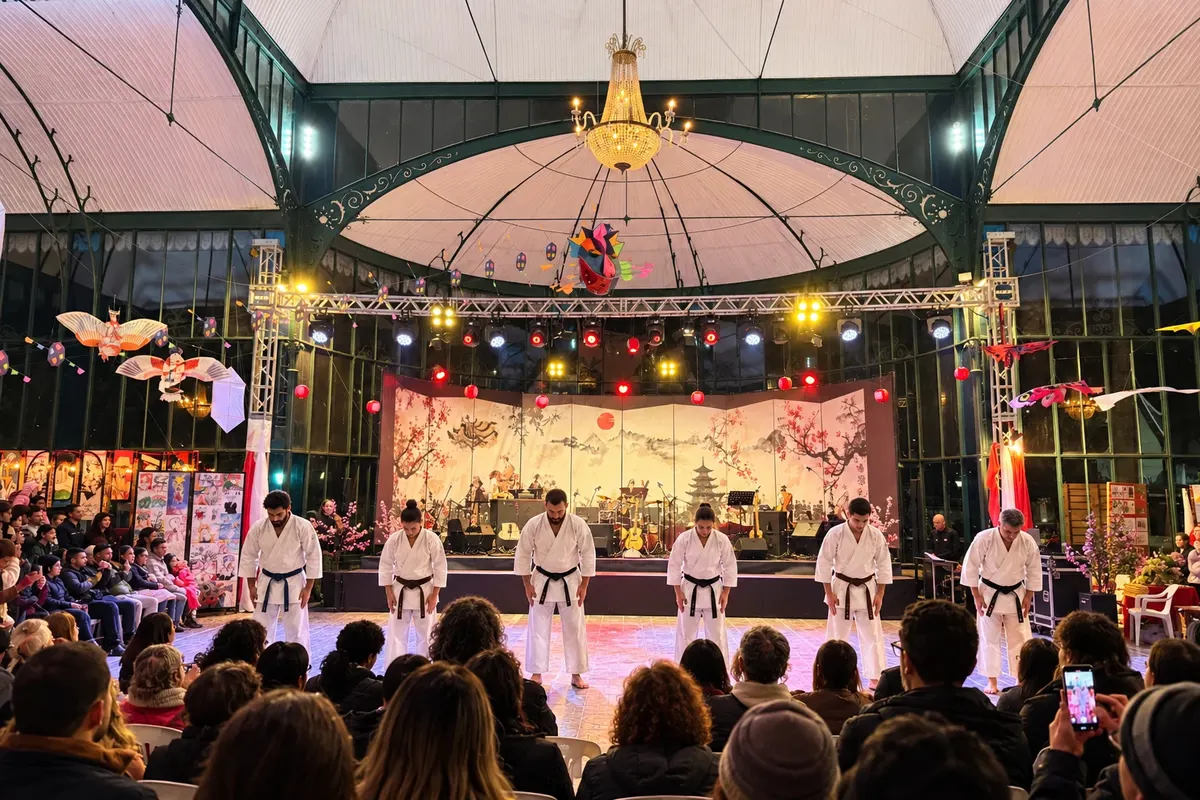 avgust
Once a year, in August, from Thursday to Sunday.
The Japanese culture festival of Petrópolis, held at the Palácio de Cristal, with traditional dances and music, martial arts, workshops, Japanese food and a cosplay contest.
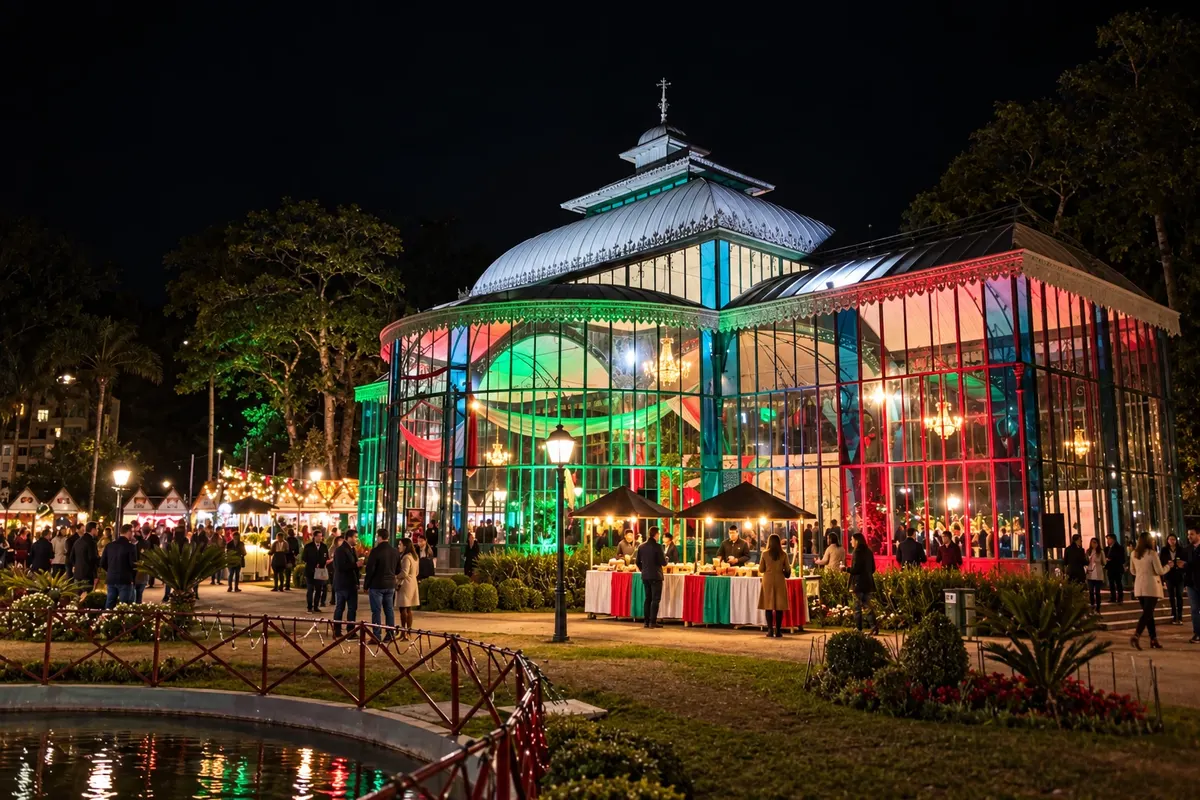 september/oktober
Once a year, usually in September, sometimes in October.
The Italian culture festival of Petrópolis at the Palácio de Cristal, with Italian food stalls, music, workshops and a masked ball.
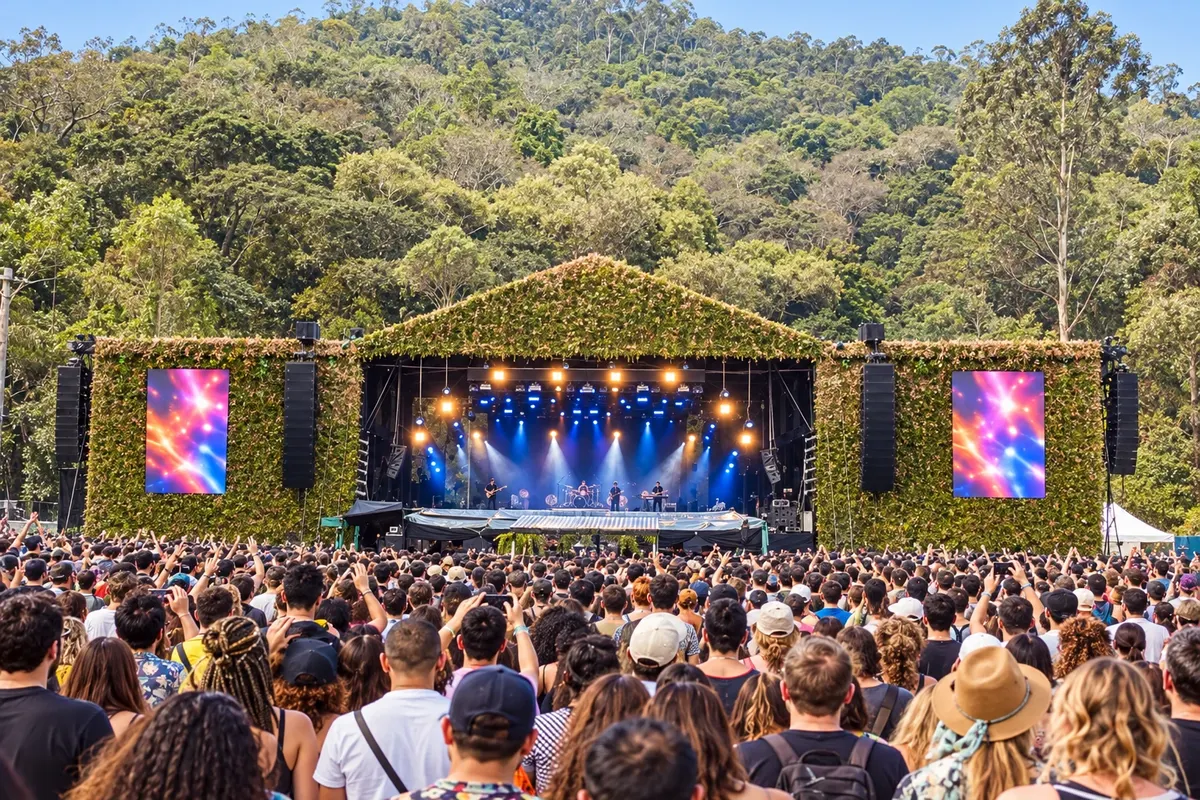 oktober/november
Once a year, across two consecutive weekends between late October and early November.
Itaipava’s music and arts festival, held in the mountains of Petrópolis, featuring multiple stages, Brazilian and international artists, and outdoor programming.
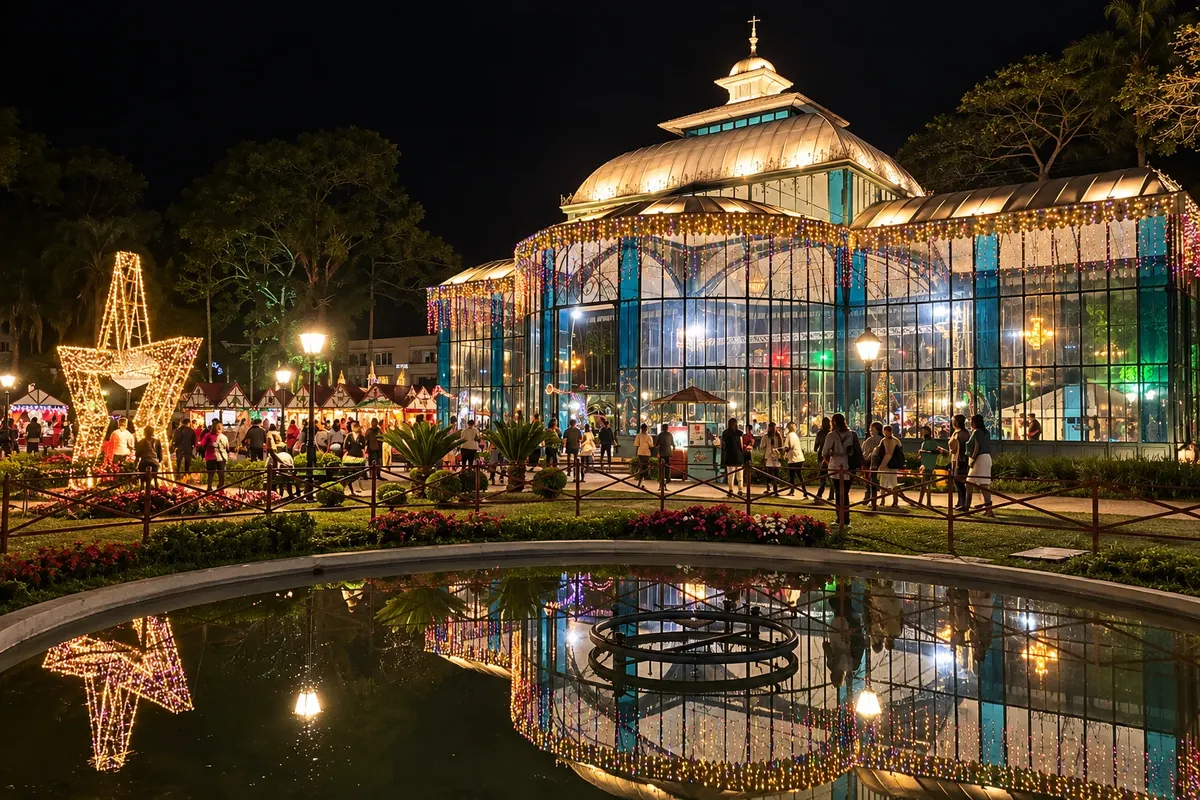 november/december/januar
From late November to early January, throughout the Christmas season.
Petrópolis’ Christmas season, with the Crystal Palace lit up, concerts, choirs and children’s attractions in the historic center of the Imperial City.
Doživite kraj
Housed in Dom Pedro II's former summer palace, it holds hundreds of thousands of items from the imperial period, including the emperor's crown. Visitors walk through the halls in felt slippers to protect the original floors.
A neo-Gothic cathedral about 70 meters tall, built over almost a century. It houses the Imperial Mausoleum, with the tombs of Dom Pedro II and Empress Teresa Cristina.
Raziščite Catedral de São Pedro de Alcântara
A cast-iron and glass pavilion assembled in 1884 for horticultural exhibitions, ordered from France and now used for cultural events. It is one of the city's most recognizable images.
A small summer house designed by the inventor himself in 1918, which he nicknamed A Encantada, full of eccentric touches such as the staircase with alternating steps. It holds personal belongings and an observatory on the terrace.
Raziščite Casa de Santos Dumont
Built in 1944 to be the largest casino in Latin America, it lost its purpose two years later, when gambling was banned in the country. Today it hosts exhibitions and events, and the lake in front is shaped like the map of Brazil.
The oldest brewery in Brazil, from 1853, turned into a beer museum in the factory's historic building. The tour covers the history and the brewing process and ends with a tasting.
A half-timbered house built by the first German immigrants around 1847 and opened as a museum in 1976. It tells the daily life of the settlers who built the city, before the imperial period it became known for.
A fourteen-meter monument with a statue of Our Lady of Fátima, on a hilltop a few minutes from downtown. It is worth it for the open view of the historic center and the surrounding mountains.
A clothing shopping street since 1916, known for knitwear sold at factory prices. There are hundreds of shops along a gentle slope, busy all year round.
More than forty thousand square meters of Atlantic Forest with a lake, pedal boats, a playground and a picnic area. It is the place for an afternoon with no plans, in the middle of the mountains.
A district about fifteen kilometers from downtown, home to many restaurants, shops and pousadas. It is usually the base for people looking for the more rural, quieter side of the mountains.
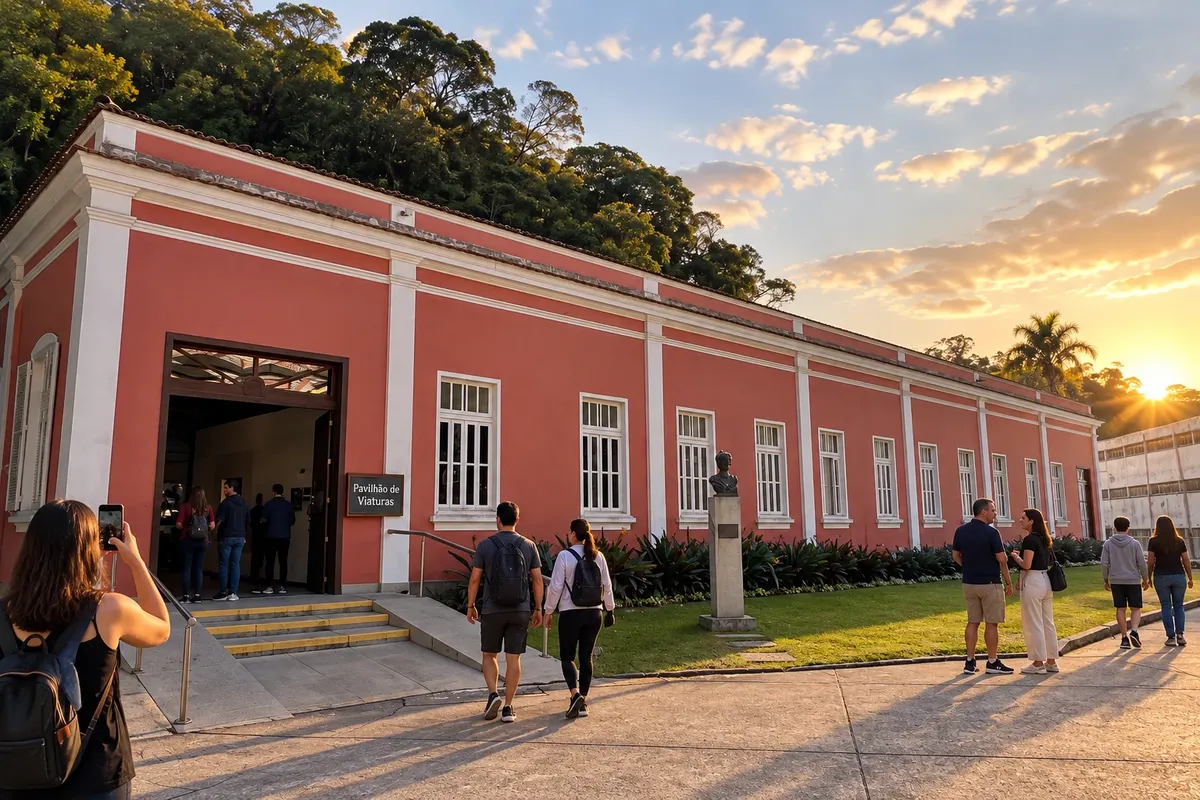
Exhibition annex of the Museu Imperial that brings together 19th-century carriages and vehicles. The highlight is the Berlinda de Aparato, the emperor's state carriage, in a space that reveals the technique, etiquette and transportation of the Brazilian court.
Raziščite Pavilhão de Viaturas
Classic mountain crossing that traverses the high Serra dos Órgãos inside PARNASO, linking the Sede Petrópolis to the Teresópolis sector. Landscapes of granite ridges, high-altitude fields and viewpoints such as Castelos do Açu and Pedra do Sino.
Raziščite Travessia Petrópolis-Teresópolis
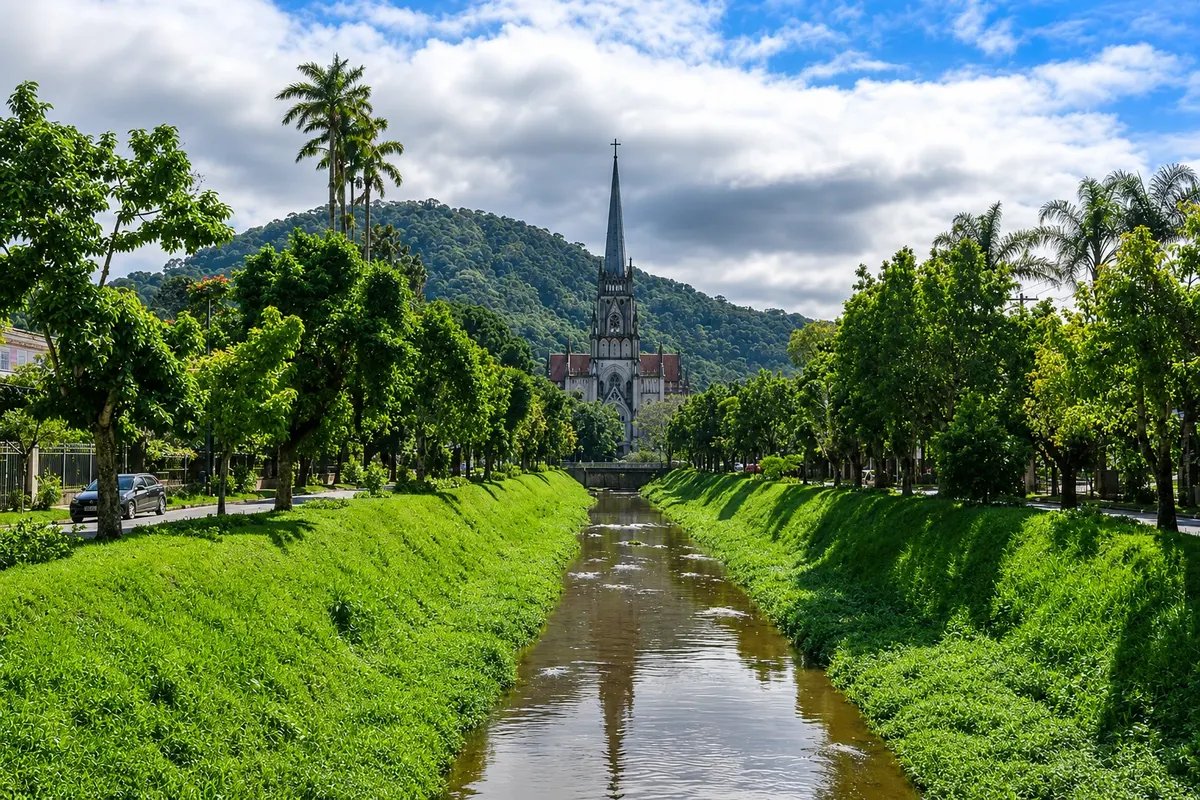
Avenue of about 300 meters along the Quitandinha River in the historic center, with 19th-century mansions, the Casa da Princesa Isabel and the Palácio Rio Negro. From the west end, the view of the canal with the Cathedral in the background is one of the city’s postcards.
Small house in the Valparaíso neighborhood where the Austrian writer Stefan Zweig lived his final months, in 1941 and 1942. Today it is a museum and a memorial to the writers, artists and scientists who went into exile in Brazil to escape Nazism.
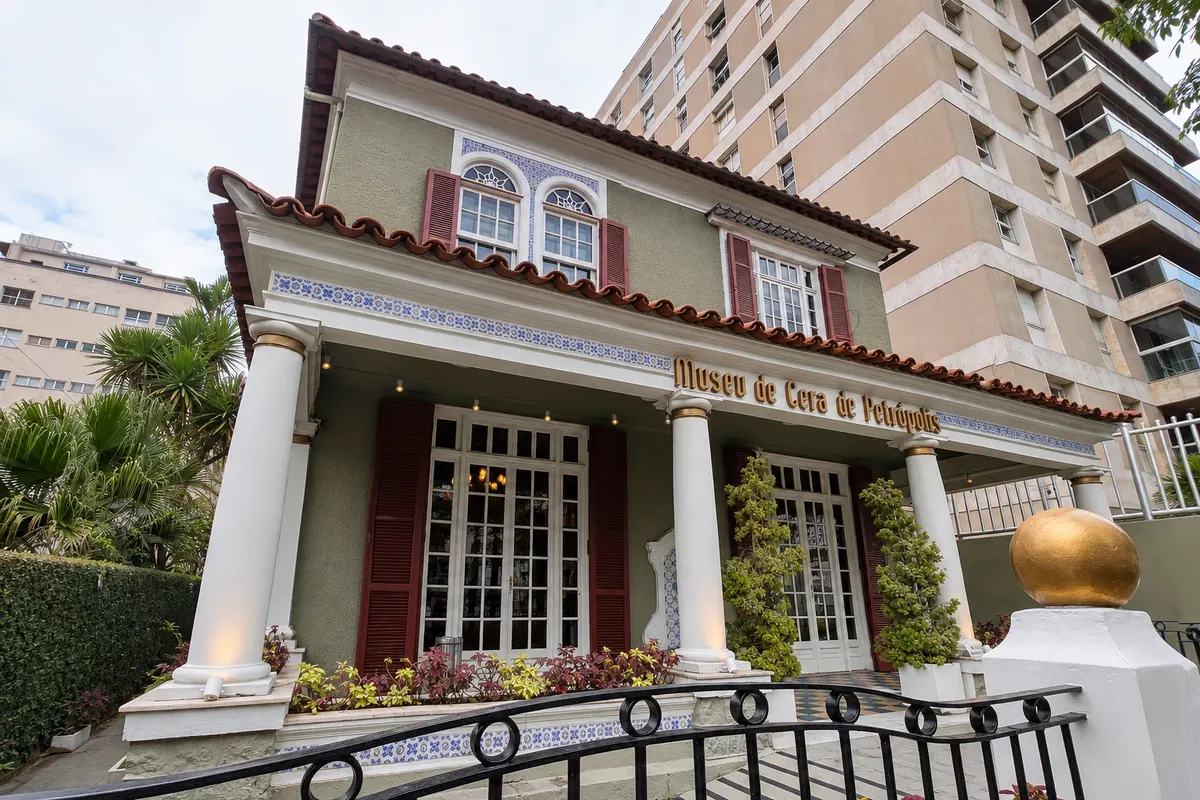
A wax museum with life-size figures in a historic mansion downtown, near Praça da Liberdade. It brings together characters from Brazil’s history, politics, sports, music and cinema, displayed in rooms across the house’s two floors.
Raziščite Petrópolis Wax Museum
Kaj izbrati pred odhodom
Izhodišče, trajanje, potek, vključene storitve in okvirna cena vsakega izleta.
The former summer palace of Dom Pedro II is the visit that explains the city. At the entrance, each visitor puts on shoe covers over their shoes to protect the floor, and moves through the rooms at their own pace. The collection includes the crowns of Dom Pedro I and Dom Pedro II, the ceremonial attire, furniture, works of art and musical instruments of the imperial family. The visit does not end in the palace. In the Pavilhão das Viaturas you’ll find carriages and other 19th-century vehicles, and in the Pátio Lourenço Luiz Lacombe a locomotive from the early 20th century is on display, from the time when the mountain was climbed by train. The gardens surrounding the building open earlier than the palace and are a good place for a pause before or after the rooms. The museum is open Tuesday through Sunday and on holidays, except Labor Day, Christmas and New Year’s Day; it is closed on Mondays. On Sundays there is free admission for everyone, so it is the busiest day. The ticket office accepts only cash and Pix. There is a wheelchair access ramp, and staff assist visitors with mobility difficulties. On Friday and Saturday evenings the museum usually offers two ticketed performances: Um Sarau Imperial, staged in the cinema-theatre, and the Sound and Light show. Confirm the schedule before relying on them.
Kraji na poti: Imperial Museum, Gardens of the Imperial Museum, Pavilhão das Viaturas, Pátio Lourenço Luiz Lacombe.
Vključuje: Entrance to the palace, the gardens, and the Pavilhão das Viaturas. There are half-price tickets and a family package on the official rate table. Evening performances require separate tickets.
Nasvet: Arrive near the palace opening time, when the rooms are less crowded, and bring cash or use Pix. If you want to see the museum at a relaxed pace, avoid Sunday.
Najboljši čas za obisk: All year. It’s the right program for rainy afternoons, from November to March.
R$ 10 · per person, full price· uradna cenaThis walk follows the layout Koeler gave the city, with streets running along the rivers and the mansions set back behind gardens. Begin at São Pedro de Alcântara Cathedral, in the French neo-Gothic style. Right at the entrance is the Imperial Mausoleum, with the tombs of Dom Pedro II and Empress Teresa Cristina. The climb to the tower is a paid visit, Tuesday through Sunday, with tickets sold at the shop next to the church. Opposite, Princess Isabel Square holds the monument to Koeler. From there runs Koeler Avenue. At Princess Isabel House, the family’s last photograph in Brazil was taken on the balcony days before the Republic; the interior opens only when there is an exhibition. Further on is the Rio Negro Palace, called the Presidents’ Palace because it served as the summer residence of heads of state; usually only the façade is seen. The Sérgio Fadel Palace, from 1872, houses the City Hall. Continuing you reach Liberty Square, landscaped in 1885 by landscaper Auguste Glaziou, which was a meeting point for freed people and abolitionist acts. From there you can walk to the Crystal Palace, the iron-and-glass structure assembled in 1884 for Princess Isabel’s flower exhibitions, considered the country’s first prefabricated building. It is open Tuesday through Sunday, has free admission and hosts city festivals. To finish, continue to the Yellow Palace, facing Visconde de Mauá Square, the former home of the Baron of Guaraciaba and the City Council seat, and to the Obelisk on Emperor Street, with the names of the families of settlers who arrived in 1845.
Kraji na poti: São Pedro de Alcântara Cathedral, Princess Isabel Square, Koeler Avenue, Princess Isabel House, Rio Negro Palace, Liberty Square, Crystal Palace, Yellow Palace, Obelisk.
Vključuje: Self-guided walk; there is no charge to enter the Cathedral or the Crystal Palace. The visit to the Cathedral tower and the exhibitions at the Princess Isabel House are paid separately: check the current price list.
Nasvet: Avoid entering the Cathedral during Mass. The walking-route signs, in Portuguese and English, tell the history of each house: it’s worth stopping to read them. If you prefer to listen, you can hire a licensed tour guide.
Najboljši čas za obisk: All year; from May to September the weather tends to be stable. In June and July the Bauernfest occupies the Crystal Palace and the surrounding streets.
Three houses and a viewpoint tell the story of 20th-century Petrópolis. The first is A Encantada, the French alpine-style chalet that Alberto Santos Dumont designed in 1918 to spend his summers. The house is minimal and full of inventions: the outdoor stair has cut steps that force you to start with your right foot, the shower heated water with alcohol and the terrace served as an observatory. The museum is open Tuesday through Sunday and charges admission. On Rua Barão do Amazonas, the Flower Clock marks the front of the former Palace Hotel, now a university. It was installed in 1972, on the 150th anniversary of Independence. Then climb up to Valparaíso. On Rua Gonçalves Dias is the house where Austrian writer Stefan Zweig lived with his wife, Lotte, between 1941 and 1942, exiled during World War II. Zweig was one of the most translated European authors in the world; the house became a museum and exile memorial, with talks and exhibitions. It is open Friday through Sunday and has free admission. The walk ends at the Trono de Fátima, a 14-meter monument designed by Heitor da Silva Costa, the same architect of Christ the Redeemer, completed in 1947. From the churchyard you can see the Historic Center from above. Access to the monument usually opens on weekends. If you like to walk, you can climb via the Caminho do Rosário, a devotional trail that the faithful walk every 13th of the month.
Kraji na poti: Santos Dumont House Museum, Flower Clock, Stefan Zweig House, Trono de Fátima, Caminho do Rosário.
Vključuje: Paid entry at Santos Dumont’s house; check the current rates. There is no charge at the Stefan Zweig House or the Throne of Fátima.
Nasvet: Do this visit from Friday to Sunday, when the Stefan Zweig House and the Throne of Fátima are usually open. Santos Dumont’s house is small and forms a line on holidays: go early.
Najboljši čas za obisk: All year. For the viewpoint, prefer mornings with clear skies, more common from May to September.
Quitandinha opened in 1944 to be the largest hotel-casino in Latin America. Gambling was banned in the country soon after, and the building took a different path: the apartments were sold to private owners and the ground-floor halls came under Sesc management, which maintains a cultural center there. From the outside, the façade is in a Norman style. Inside, the contrast is complete: enormous halls decorated in a rococo style. The visit goes through these halls, where the exhibitions are located, and can be done independently or on a guided tour that tells the story of the casino and its famous guests. The cultural center also has a performance hall, film screenings, bowling lanes and a café. Outside, the lake in front of the palace can be walked around. On some mornings there are outdoor activities on the lakeshore. The cultural center is open Tuesday to Sunday. In winter it is one of the stages of the Sesc Winter Festival, with paid concerts and plays. Nearby there is a craft brewery that offers weekend visits by appointment.
Kraji na poti: Quitandinha Palace, Sesc Quitandinha Cultural Center, Quitandinha Lake.
Vključuje: Access to the halls and exhibitions. Bowling, shows and some special tours require a ticket: check the current schedule.
Nasvet: Check the schedule before you go: on event days some halls may be reserved. It is outside the Historic Center, about a 15-minute drive away.
Najboljši čas za obisk: All year; in July, with the programming of the Sesc Winter Festival.
Beer has been part of Petrópolis’ history since the arrival of German settlers. Bohemia, founded in 1853 by the German Henrique Kremer, is the oldest brewery in Brazil still operating and occupies a complex of brick buildings on Alfredo Pachá Street, near the Crystal Palace. The visit has two formats. In the Self-Guided Visit, visitors follow the circuit on their own and have three tastings. The Master’s Key is fully guided, with four tastings and access to the production area of the nano-brewery, in small groups at scheduled times. Tours run Thursday through Sunday. Visitors under 18 do not pay and may enter only accompanied by guardians. The complex also has a bar, restaurant and shop, which operate independently of the tour. A small brewery street has formed around Bohemia. The city’s microbrewery association lists, all in the Downtown area, places such as Duas Torres, Odin, Sampler and Brewgarden, each with its own labels. You can visit two or three in the same night without a car. Outside Downtown, other breweries receive visitors by appointment, in Quitandinha, Castelânea and Itaipava, where one of the country’s largest breweries shows its production line in operation.
Kraji na poti: Bohemia Brewery, Alfredo Pachá Street, Padre Siqueira Street, 7 de Abril Avenue, Roberto Silveira Avenue.
Vključuje: In the Free Visit: self-guided circuit and three tastings. In La Chave do Mestre: guided visit and four tastings. Tickets are sold online or at the reception; check the current pricing.
Nasvet: La Chave do Mestre has limited spaces: buy in advance. Do the route on foot or by taxi and leave the car at your accommodation.
Najboljši čas za obisk: All year. From late June to early July the Bauernfest, the German settler festival, takes over Rua Alfredo Pachá.
When a summer shower ruins the afternoon, or when you have a spare half day, Petrópolis has a second line of museums that few people include in their itinerary. Two are on the same street, Barão do Amazonas. The Wax Museum displays life-size statues of personalities and movie characters, mostly made in Europe. The Porcelain Museum exhibits about 1,800 European pieces from the 19th and 20th centuries in twelve rooms, many of them animal-shaped. Both charge admission and usually open every day. On Avenida Ipiranga, Casa de Petrópolis is an 1884 small palace designed by its owner, coffee exporter José Tavares Guerra; it offers guided visits part of the week. On the same avenue is the Lutheran Church, from 1863, in a German neo-Gothic style, the oldest in the Historic Center. To learn about colonization, take a taxi to the Museu Casa do Colono, in Castelânea. The 1847 stone and wattle-and-daub house shows how a German immigrant family who worked the land lived, with objects and images from the 19th century. It is free to enter. In Retiro, the Orquidário Binot is cited as the first in Brazil: it was founded in 1870 by Jean Baptiste Binot, the same person who designed the imperial palace gardens. The greenhouses are covered, there is a small pond with carp and plants for sale.
Kraji na poti: Petrópolis Wax Museum, Porcelain Museum, Casa de Petrópolis Cultural Institute, Museu Casa do Colono, Orquidário Binot.
Vključuje: The Wax Museum, Porcelain Museum and Casa de Petrópolis charge admission; check each one's current price list. The Museu Casa do Colono and the Orquidário Binot do not charge admission.
Nasvet: Confirm opening days of each site before you go: small museums change hours more often than large ones, and some close on Mondays.
Najboljši čas za obisk: All year; it’s the plan for rainy afternoons from November to March.
Itaipava is a district of Petrópolis, about 20 km from downtown. The most pleasant route is Estrada União e Indústria, which crosses Corrêas and Nogueira. In Nogueira, the old train station became a cultural center, with the memory of the region’s railways, and 400 meters away is Lago de Nogueira, a water mirror surrounded by trees. In Itaipava, the main road is the high street. The Municipal Hortomarket brings together producers with vegetables, flowers, cheeses, sweets and handicrafts, from Friday to Sunday. Nearby is Parque Municipal Prefeito Paulo Rattes, a green area with lawn and bike path that hosts the district's large fairs and festivals. The Itaipava Market, next to BR-040, has more than 300 shops selling clothing and decoration and is open Friday to Sunday and on holidays. Along the road there are hand-painted ceramic studios, cafes and craft breweries. On the edge of BR-040 stands Castelo de Itaipava, a medieval-style building from 1920, with a design by Lúcio Costa. Those who want to hike have the Pedra de Itaipava Trail: 45 minutes to 1 hour uphill, moderate level and almost no shade, to a lookout over the district and part of the Paraíba Valley. On clear days the Mantiqueira Range appears. Another extension is BR-495, the mountain road to Teresópolis. On it is Cachoeira do Jacó, also called Macumba or do Treze, with two drops, one about 25 meters, about a 15-minute easy trail, and a viewpoint popular at late afternoon.
Kraji na poti: Nogueira, Nogueira Cultural Station, Lago de Nogueira, Itaipava, Municipal Hortomarket, Parque Municipal Prefeito Paulo Rattes, Itaipava Market, Pedra de Itaipava Trail, Cachoeira do Jacó.
Vključuje: Self-guided visit. Meals and purchases not included.
Nasvet: On Saturdays and Sundays traffic on Estrada União e Indústria slows in the afternoon: go early and return via BR-040. For the trail, bring water, a hat and sunscreen. Do not enter waterfalls during heavy rain.
Najboljši čas za obisk: All year. From May to August the cold fills the restaurants; for the trail, prefer dry days, from May to September.
Vale do Bonfim is about 18 km from the Historic Center, climbing via Corrêas. There, with the last stretch on a dirt road, is the entrance to the Petrópolis headquarters of Serra dos Órgãos National Park, created in 1939 and one of the country’s oldest. The shortest walk is the Circuito das Bromélias: about 30 minutes, easy level, passing several small drops and the pools Paraíso, das Bromélias and da Ducha. It is the recommended stretch for those with children or who just want a river swim. Those who continue reach Gruta do Presidente, a rock face used for climbing and rappelling, with a pool beside it, and then Cachoeira Véu da Noiva, a 32-meter drop. The hike takes from about an hour and a half, on a medium-level trail with steep and rocky sections. About ten minutes above is Cachoeira das Andorinhas, smaller, with a swimming pool. The park is open Tuesday through Sunday and on holidays, and closed on Mondays. At the entrance, each visitor must present a photo ID and CPF, or passport. Pets, glass bottles, fires and amplified sound are not allowed. There is a daily limit of cars, first-come first-served. Just before the park entrance, outside the park, Poço do Pinheiral is an easy-access alternative.
Kraji na poti: Vale do Bonfim, Parque Nacional da Serra dos Órgãos, Circuito das Bromélias, Poço Paraíso, Gruta do Presidente, Cachoeira Véu da Noiva, Cachoeira das Andorinhas, Poço do Pinheiral.
Vključuje: Access to the trails, pools and waterfalls of the main area. Check at the gate whether an entrance fee is charged on the day of your visit.
Nasvet: Arrive early, especially on weekends, because of the car limit. Bring snacks and water: there is no shop at the gate. The forest blocks the sun much of the day and the water is cold year‑round.
Najboljši čas za obisk: November to March for swimming, always in the morning and not on heavy-rain days; May to September for hiking in dry weather.
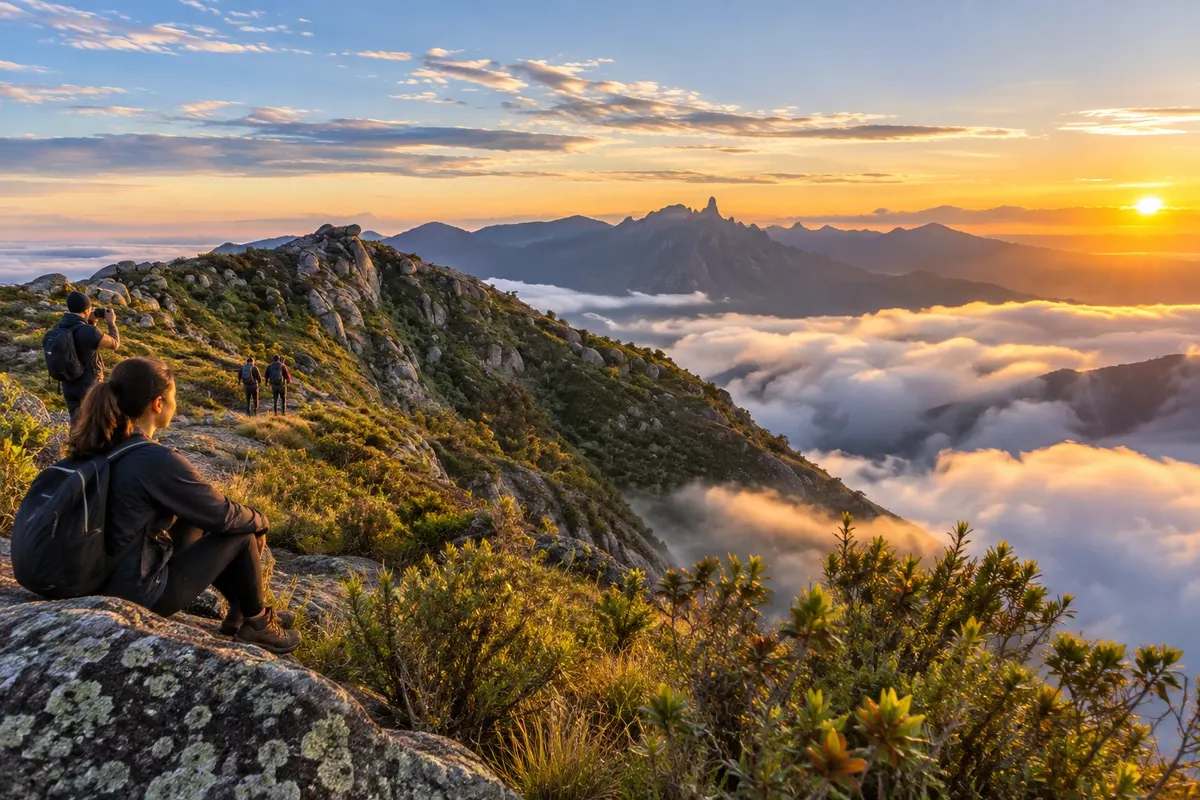
The Castelos do Açu are granite outcrops that crown the high part of the park on the Petrópolis side. Pedra do Açu, at 2,245 meters, is the highest point of the sector. The trail leaves from the Bonfim gate and covers about 7 kilometers of almost continuous ascent, roughly five hours of hiking for those who are fit. The path begins in the forest, passes Pedra do Queijo and ends on the high-altitude fields, where the low vegetation opens the view to Guanabara Bay and the surrounding ranges on clear days. At the top there is a mountain shelter, a camping area and a water collection point. Sleeping up there allows you to watch the sunrise and descend without hurry; overnight stays require scheduling with ICMBio. Those doing a day return need to set out very early and plan to descend while there is still light. This is also the first day of the Petrópolis–Teresópolis traverse, which continues across the plateau to Pedra do Sino and descends on the other side, about 30 kilometers and three days in total. The section between the Castelos do Açu and Pedra do Sino is hard to navigate, worse in fog, and requires an experienced guide. Every visitor signs a risk-awareness form at the gate and must show a photo ID and CPF. Fog often rises suddenly and the temperature drops quickly, even in summer.
Kraji na poti: Castelos do Açu, Pedra do Açu, Pedra do Queijo, Vale do Bonfim, Parque Nacional da Serra dos Órgãos.
Vključuje: Trail access. Overnight in a shelter or campsite by reservation; guide, if hired, is paid separately.
Nasvet: Bring warm, waterproof clothing, a flashlight, food and water for the first stretch. If you have no mountain experience, go with a guide accredited by the park. In rainy season, check the forecast and the gatehouse guidance before heading up.
Najboljši čas za obisk: From May to September, in the dry, cool season when the sky at the summit is usually clearer.
Araras is on the other side of the BR-040. Access is via Estrada Bernardo Coutinho, which leaves the highway and enters an area of small farms, pousadas and restaurants that attract people from Rio just for lunch. The whole stretch is part of a municipal tourism circuit, with crafts, a cachaça still and jam producers. Continuing on, the road becomes mountain and passes through the Garganta da Ponte Funda, a narrow passage between the mountains, until Vale das Videiras, a rural settlement about 18 km from Araras center, already on the border with Paty do Alferes. The small town has a square with a bandstand, shops and a few farm-style restaurants. Along the way are the waterfalls. Ponte Funda waterfall has a 20-meter drop and is a few minutes’ walk from the road, with a dammed pool for swimming. The Sete Quedas waterfall, further on, has pools at two levels; the entrance goes through a kiosk that charges a small conservation fee. Poço São Pedro is inside a private property, which also charges for visits. For hikers, the region has mountain trails such as Pedra da Cuca, starting from Ponte Funda or from Araras. They are poorly signposted and require a guide. The dirt roads of the valley are also used for cycling.
Kraji na poti: Araras, Vale das Videiras, Garganta da Ponte Funda, Cachoeira da Ponte Funda, Cachoeira das Sete Quedas, Poço São Pedro, Pedra da Cuca.
Vključuje: Self-guided outing. Waterfalls on private land charge an entrance fee; meals are extra.
Nasvet: Book lunch for weekends and holidays. The road is paved, narrow and full of curves: travel by day. From Petrópolis city center to Ponte Funda is about a 50-minute drive.
Najboljši čas za obisk: Road and dining available year-round; swimming from November to March, in the morning and not during heavy rain days.
Brejal is the most remote rural area of Petrópolis: it is in Posse, the fifth district, about a 45-minute drive from the Historic Center. The city presents it as the largest organic production hub in the state of Rio de Janeiro, and much of the organic produce that supplies the capital comes from there. The Circuito Eco Rural Caminhos do Brejal is the oldest rural circuit in the municipality and brings together more than twenty properties. Visitors choose a few and spend the day among them: gardens where you can follow the harvest and buy directly from the grower, an escargot farm, a mushroom farm, an herb and seasoning farm inspired by the south of France, a show-jumping horse stud, a community crafts studio and a small preserves and jam factory. Horto Brejal, with bromeliads and ornamental plants, serves as a stopping point. Visits are arranged in advance with the circuit itself, and several properties charge a per-person fee. The internal roads are dirt, with many junctions. Those who like this kind of experience have a second route in Secretário, a village in the district of Pedro do Rio on a stretch of the old Caminho do Ouro: a dairy with visits to milking and cheese making, farm sweets and jams, and a sales space for local producers. The village tourist information post usually opens Thursday through Sunday.
Kraji na poti: Brejal, Posse, Circuito Eco Rural Caminhos do Brejal, Horto Brejal, Secretário.
Vključuje: Visits arranged with the circuit. Each property sets its own visit fee and offerings; lunch and purchases are extra.
Nasvet: Book a few days in advance and choose four or five properties, no more. After heavy rain the dirt roads get worse: ask the circuit about conditions.
Najboljši čas za obisk: From April to October, with less rain and dirt roads in better condition.
Po dnevih
Predlogi za načrtovanje poti. Vrstni red dni prilagodite vremenu in razpoložljivosti izletov.
Arrive early and don’t come on a Monday, when museums are closed. Start at the Imperial Museum near opening time: palace, gardens and the Carriage Pavilion take about two hours. Exit via Rua da Imperatriz and walk to Catedral São Pedro de Alcântara, with the Imperial Mausoleum. Continue along Avenida Koeler, passing the House of Princess Isabel and Palácio Rio Negro, to Praça da Liberdade. Have lunch there. In the afternoon, visit Santos Dumont’s house, A Encantada, and walk down to the Crystal Palace. The Bohemia Brewery is on the same street: from Thursday to Sunday you can do the tour with tasting; on other days the bar and restaurant operate normally. If you have a car and daylight remains, stop at Palácio Quitandinha before leaving. Itaipava and Bonfim don’t fit in this day.
Morning at the Imperial Museum. Then the walk from the Cathedral to the Crystal Palace along Avenida Koeler and Praça da Liberdade, with lunch midway. At dusk, visit Bohemia Brewery and in the evening one or two of the craft breweries on the nearby streets, on foot. On Fridays and Saturdays, check if there is Sarau Imperial or Sound and Light at the Imperial Museum and schedule one before dinner.
Start at Santos Dumont’s house. If it’s Friday to Sunday, go up to Valparaíso for the Stefan Zweig House and the Trono de Fátima viewpoint. Continue by car or taxi to Quitandinha Palace, see the halls and walk around the lake. From there, take BR-040 to Itaipava for a late lunch. In the afternoon, Hortomercado, Municipal Park and Itaipava crafts market, which operate Friday to Sunday. Return to downtown via Estrada União e Indústria, stopping in Nogueira to see the old station and the lake. Without a car, swap Itaipava for the museums on Barão do Amazonas Street and shopping on Teresa Street, which opens only in the afternoon on Mondays and is closed for many shops on Sundays.
Imperial Museum in the morning. In the afternoon, Cathedral, Koeler Avenue, Liberty Square and Crystal Palace, ending at Santos Dumont’s house. Late afternoon at the Bohemia Brewery and evening at the downtown breweries. If it rains, swap the walk for the Wax Museum and the Porcelain Museum, which are on the same street.
Leave early for Vale do Bonfim, about 18 km from downtown, with photo ID and CPF. Do the Bromeliad Circuit and, if you have energy, continue to Véu da Noiva Waterfall. Bring a snack. Descend through Corrêas and continue on Estrada União e Indústria to Itaipava for lunch. In the afternoon, Hortomercado and the crafts market if it’s Friday to Sunday, or the studios and cafés along the road. With overcast conditions or heavy rain, do not go to the waterfalls: advance Quitandinha and the small museums.
City option: morning at Quitandinha Palace and a walk around the lake; in the afternoon, Stefan Zweig House and Trono de Fátima in Valparaíso, and shopping on Teresa Street before leaving. Road option: day in Araras and Vale das Videiras, with a swim at Ponte Funda Waterfall or Sete Quedas in the morning and a reserved lunch in Araras. Those returning to Rio de Janeiro drive straight on BR-040 without passing downtown again. If you have a fourth day and like rural life, you can book the Brejal circuit in Posse.
Najboljši čas za obisk
The seasons shown are the most usual ones; nature doesn't always follow the calendar.
Rainiest month · End of the Imperial Christmas · Summer school break
Mountain warmth and lots of water: lows around 21 °C, highs around 29 °C and the highest rainfall of the year, in heavy bursts, almost always in the afternoon. Do street sightseeing in the morning and save the Museu Imperial, Quitandinha and the small museums for after lunch. The pools of Bonfim and Araras fill up; don't enter the water during heavy rain or if the headwaters look stormy. It's school vacation month in Brazil.
Carnival, in February or March · Summer rain
It stays hot and rainy, with lows near 21 °C and highs near 29 °C. Carnival, in February or March depending on the year, increases activity: reserve ahead. Outside the holiday, the historic centre is quiet during the week. Waterfall swimming works in sunny mornings.
City anniversary on March 16 · End of summer
Rains remain frequent but weaken in the second half of the month; temperatures stay between 20 °C and 28 °C. March 16 is the city’s anniversary. Museums and short trails see little activity outside Holy Week, when it falls in March.
Holy Week, in March or April · Winter collections on Rua Teresa
Transition to the dry season: much less rain than in summer and nights cool down, with lows around 19 °C and highs around 26 °C. A good month to walk through the Historic Center without heat or crowds, outside the holiday. The shops on Rua Teresa change their windows to winter clothing.
Start of the dry season · Long trails
The rain stops and the sky clears: lows around 16 °C, highs around 24 °C. The best time starts to climb the Castelos do Açu and do the traverse to Teresópolis. Well water is already cold. Moderate activity, with weekends busier in Itaipava.
Bauernfest (end of June and start of July) · Colonist Day on June 29
Dry winter, with stable days and cold nights: lows around 15 °C and highs around 23 °C, less in the high areas. At the end of the month the Bauernfest, the German colonist festival, begins at the Palácio de Cristal and on the surrounding streets, with food, beer and folk groups. Book accommodation in advance for the festival weeks.
Bauernfest · Sesc Winter Festival · July school break
The coldest month and one of the driest: lows around 14 °C, highs around 23 °C, with colder early mornings in higher areas. Bauernfest usually ends at the start of the month and the Sesc Winter Festival brings concerts, theater and circus to Quitandinha and other venues. It’s high season: museums, restaurants and the Estrada União e Indústria get busy on weekends.
Bunka-Sai, Japanese culture festival · Dry winter
Still dry, with clear skies most days and temperatures between 15 °C and 24 °C. Bunka-Sai occupies the Palácio de Cristal for a few days, with dance, music, martial arts and Japanese food. Traffic drops after the holidays: a good month for the Historic Center and the Bonfim trails.
Serra Serata, Italian festival · End of the dry season
Weather stays stable for most of the month and warms slightly, with lows near 16 °C and highs near 25 °C. Serra Serata, the Italian culture festival, usually takes place at the Palácio de Cristal, generally in September. The first spring showers may appear at the end of the month. It’s still a good time for the Açu Castles.
Return of the rains · Rock the Mountain in Itaipava (late October and November)
Rains return gradually, in afternoon showers; temperatures range from 18 °C to 26 °C. The forest becomes greener and the rivers gain volume. At the end of the month, the Rock the Mountain music festival livens up Itaipava across two weekends: book accommodation in advance.
Start of the Imperial Christmas · November holidays
The rainy season settles in, with frequent stormy afternoons and temperatures between 19 °C and 26 °C. At the end of the month the city lights the Imperial Christmas decorations, with Palácio de Cristal illuminated, choirs and shows in the Historic Center. The holidays fill the city. Check the forecast before any hike.
Imperial Christmas · Summer rains · Year-end festivities
One of the rainiest months, with heavy afternoon downpours, lows near 20 °C and highs near 28 °C. The Imperial Christmas fills the town centre nights until early January. The Imperial Museum is closed on Christmas and New Year’s, and other attractions change opening times on the eves: confirm before you go.
Načrtujte pot
Petrópolis has no airport with commercial flights. Arrival is via Rio de Janeiro.
Rio de Janeiro/Galeão International Airport (Tom Jobim) handles international and domestic flights and is the closest: it is about 53 km from Petrópolis, accessible via Linha Vermelha and BR‑040. Santos Dumont Airport, in downtown Rio, concentrates flights to São Paulo and is about 68 km away.
From either airport, go by rental car, taxi, ride‑hailing app or prebooked transfer. To travel by bus, you must first get to Rodoviária Novo Rio by taxi or app and board there.
Before buying an airline ticket, confirm the route and connections with the carrier.
From Rio de Janeiro, Única‑Fácil buses depart Rodoviária Novo Rio nearly hourly, from early morning until near midnight. The trip takes about one and a half hours without traffic. There are also departures from the Menezes Côrtes terminal, in Castelo, downtown Rio.
Arrival is at Rodoviária Governador Leonel Brizola, about 6 km from the Historic Center. From there, city buses, taxis and apps take you to the Center. The terminal has a tourist information desk.
From São Paulo there is a direct overnight bus, a trip of almost seven hours. There is also an intercity line between Petrópolis and Teresópolis.
Buy in advance for holidays and for the June and July weekend periods, and check the day’s schedules with the company.
Petrópolis lies along BR‑040, the Washington Luís Highway. From Rio de Janeiro it is about 70 km via Linha Vermelha and the highway, with a mountain ascent on a winding road; without traffic it takes less than an hour and a half. There is a toll on the stretch: check the current rates. On the climb, Mirante do Cristo is a stopping point with mountain views when the weather is clear.
From São Paulo it is about 450 km via Via Dutra (BR‑116) to Rio and then BR‑040. From Belo Horizonte it is about 375 km, always on BR‑040, passing Juiz de Fora and reaching Itaipava first.
In heavy rain or fog, drive slowly and use headlights. In the Historic Center street parking is metered and on holidays and in high season it is hard to find a spot: prefer accommodation with a garage and travel on foot.
Tour agencies in Rio de Janeiro sell a one-day visit to Petrópolis that includes transportation, a guide and, usually, admission to the Imperial Museum. The tour lasts nine to ten hours and typically includes the Cathedral, the Crystal Palace and Santos Dumont’s house. It’s a solution for those staying in Rio with only one day, but it omits Itaipava, the Quitandinha and the natural areas.
Petrópolis-based companies provide transfers from Rio’s airports and hotels and offer drivers for private tours of the city, Itaipava and the rural circuits. Tours on sightseeing buses must be accompanied by a licensed tour guide.
Compare price, duration and what’s included before booking.
In the Historic Center, walk: Museu Imperial, the Cathedral, Avenida Koeler, Praça da Liberdade, Palácio de Cristal, Santos Dumont’s house and Cervejaria Bohemia are a few blocks from each other on flat ground.
For Valparaíso (Casa Stefan Zweig and Trono de Fátima), Quitandinha, Rua Teresa, Castelânea and Retiro, use a taxi, ride app or urban bus. Ride apps work well in the central area.
Itaipava is about 20 km from the Centro via Estrada União e Indústria or BR-040; there are urban buses, but points of interest are spread out and a car is more convenient. Bonfim, about 18 km away, Araras, Vale das Videiras, Brejal and Secretário depend on a car or an organized tour.
Teresópolis is about 35 km from Itaipava via BR-495, a mountain road with lookouts.
The city council maintains tourist information booths at Praça da Liberdade, Palácio de Cristal, Quitandinha, the bus station and in Itaipava.
Odgovori na vaša vprašanja
Yes. It is about an hour and a half by road each way. But the historic center alone takes a full day: if you want to see Itaipava, Quitandinha or the mountains, spend the night in town.
Avoid Monday. The city's main museums are closed that day, and you would arrive at the door of several of them only to find them closed. Tuesday to Friday downtown is quieter; on weekends it is busier and more places are open at night.
It is in the mountains, and it is colder than Rio all year round. In winter the nights get quite cold and you will need a real jacket. The rest of the year, a sweater at night is enough.
The historic center, yes: the main attractions are short distances apart and you can walk between them. For Quitandinha, Itaipava and the Vale do Cuiabá you will need a car, taxi or ride-hailing app.
One day covers the essentials in the Historic Center: the Imperial Museum, the Cathedral, Avenida Koeler, the Crystal Palace and Santos Dumont’s house. With two days you can add Palácio Quitandinha, the breweries and an afternoon in Itaipava. Three days allow for a morning hike and river bath at Bonfim or a day in Araras and Vale das Videiras.
From May to September it rains little, days are usually stable and nights are cold; it’s the season for winter festivals and long hikes. June and July are the busiest months, with the Bauernfest and the Sesc Winter Festival. From November to March it’s warmer and rains a lot, almost always in the afternoon. April and October are transition months with fewer people.
Almost the entire classic itinerary is indoors: Imperial Museum, Cathedral, Santos Dumont’s house, Palácio Quitandinha, Cervejaria Bohemia, the Wax Museum, the Porcelain Museum and the Binot Orchidarium. On days of heavy rain, avoid waterfalls and trails: mountain rivers rise quickly.
Yes, it charges admission, with half-price tickets for several categories and a family package. On Sundays no admission fee is charged for any visitor. The ticket office accepts only cash and Pix. The performances Um Sarau Imperial and Sound and Light on Fridays and Saturdays require separate tickets.
Few museums are open: the Imperial Museum, Santos Dumont’s house, the Crystal Palace and Quitandinha are closed. You can enter the Cathedral, walk along Avenida Koeler and Praça da Liberdade, visit the Wax Museum and the Porcelain Museum, which usually open every day, and shop on Rua Teresa in the afternoon. Check ahead before you go.
In the Historic Center, for those who want to do the museums on foot and go out at night without a car. In Itaipava, Corrêas or Araras, for those looking for a pousada with green grounds and restaurants nearby, and who have a car. From Itaipava to the Center it's about 20 km, and traffic gets heavy on weekends.
Itaipava is a district of Petrópolis, about 20 km from the Historic Center, in the direction of Juiz de Fora. The municipality has five districts: Petrópolis, Cascatinha, Itaipava, Pedro do Rio and Posse. Corrêas, Nogueira, Araras, Vale das Videiras, Brejal and Secretário are also within Petrópolis.
Yes. The tour runs from Thursday to Sunday and tickets can be bought online or at the reception, without prior booking. The guided option, Chave do Mestre, has few spots and fixed times, so it’s wise to secure it in advance. Minors under 18 do not pay and enter only with their guardians. The bar and the restaurant are open outside tour hours as well.
The easiest spots are the pools of the Circuito das Bromélias, in Bonfim, inside the Serra dos Órgãos National Park; the Cachoeira da Ponte Funda and the Sete Quedas waterfall, in Araras and Vale das Videiras; Cachoeira do Jacó, on the road to Teresópolis; and Poço Negro, in Rocio. The water is cold year-round. Go in the morning and never on a day of heavy rain.
For those who don’t know the route, yes: go with an experienced leader, because the stretch between the Castelos do Açu and Pedra do Sino is hard to follow, especially in fog. It’s about 30 km over three days, with overnight stays booked with ICMBio and a risk-awareness waiver signed at the gate. The season runs from May to September.
Yes. Children usually enjoy sliding in slippers at the Imperial Museum, the carriages at the Pavilhão das Viaturas, the crooked staircase at Santos Dumont’s house and the Wax Museum. Palácio Quitandinha has bowling and a lake, Parque Cremerie has a lake with pedal boats, and the first pools at Bonfim are a few minutes from the park entrance.
By car, via BR-495, which leaves from Itaipava and crosses the mountain in about 35 km of curves, with viewpoints along the way. There is also intercity bus service between the two cities. From downtown Petrópolis add the roughly 20 km to Itaipava. You can go and return the same day.
Brazilske poti
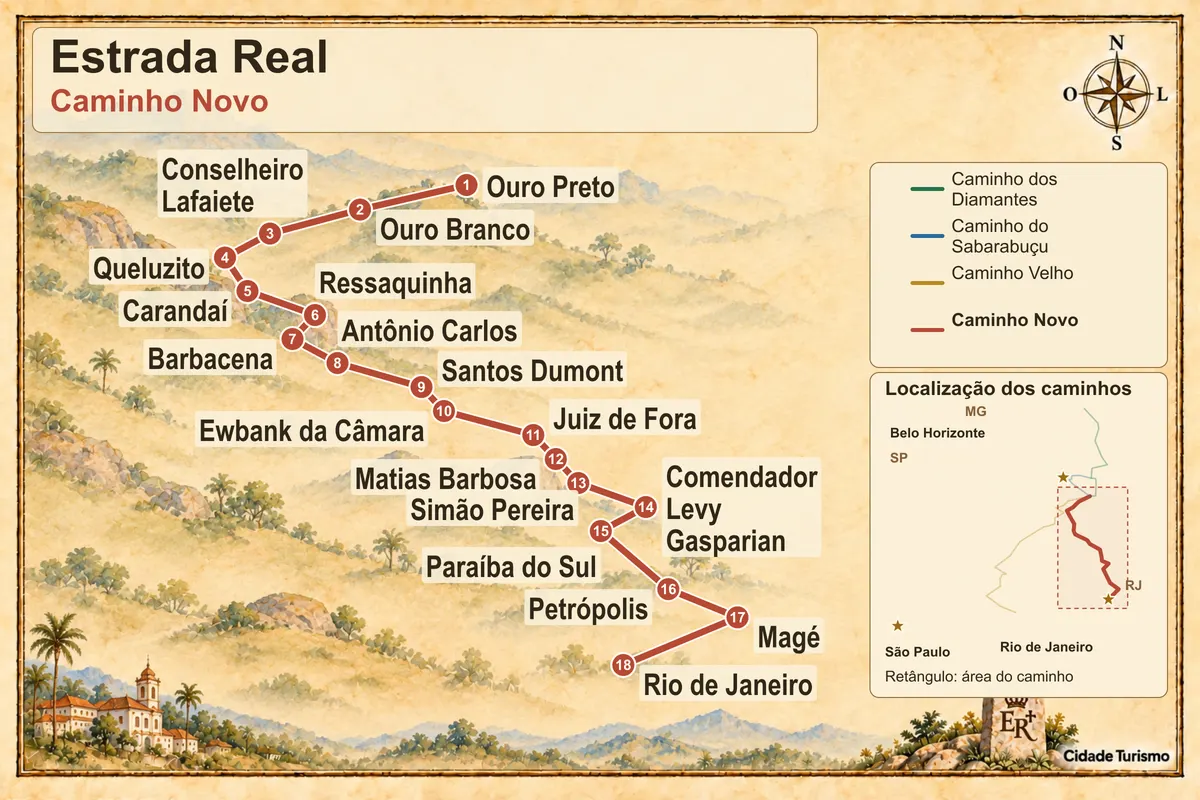
Between the mines and Guanabara Bay, the Caminho Novo connects Ouro Preto to Porto Estrela and is historically completed in Rio de Janeiro.
Več kot vodnik