

 Brazil
 Argentina
 Chile
Chile Colombia
 Peru
Peru Germany
 Belgium
 Spain
Spain France
 Greece
 the Netherlands
 Ireland
 Italy
Italy Portugal
 the United Kingdom
 Switzerland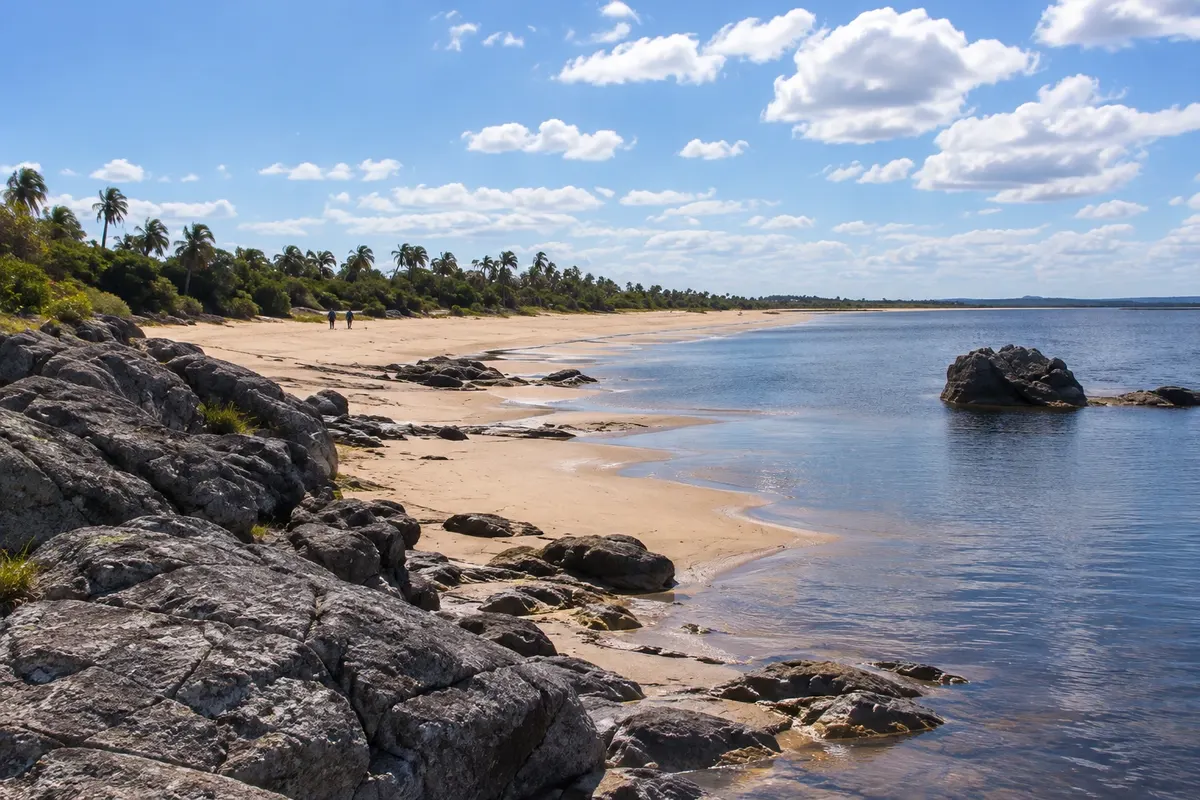
Lagoon · Punta del Diablo, Rocha
Laguna Negra
Large dark freshwater lagoon west of the Parque Nacional de Santa Teresa, a protected area with small calm-water beaches, native forest, rocky hills and many birds.
Illustrative images. The pictures in this guide are illustrations based on the real place, not photographs, and may differ from it.

Discover
About Laguna Negra
Laguna Negra is one of the largest coastal lagoons in Uruguay, with more than 17,000 hectares, and it has no connection to the sea. It is fed by rain and the streams of the region, and its fresh water is of high purity.
The name comes from the color of the water. The bottom is very fragmented peat, and the suspended particles hinder the passage of light, making the lagoon dark. It is also called Laguna de los Difuntos, because indigenous peoples buried their dead in the caves of the nearby hills.
The area is a national park within the Sistema Nacional de Áreas Protegidas. On the shore there are small calm-water beaches between rocks and native forest, and the landscape alternates marshes, fields, and rocky hills. It’s a good place for birdwatching, walking and kayaking.
Because it lies west of Parque de Santa Teresa, the lagoon often has the sunset over the water. Fortaleza de Santa Teresa is about 2 km from the shore.
Before you go
Practical information
Cidade Turismo reviews its information regularly, but something may have changed. Check with the place before planning your trip.
How much time to set aside
From two hours to half a day.
Best time
From December to March for swimming at the small beaches. The late afternoon is popular for the sunset over the lagoon.
How to get there
On Ruta 9, km 302, at the roundabout of the Parque de Santa Teresa entrance, take the road on the opposite side and follow a winding dirt road for a few kilometers to the lagoon.
Tip
The dirt road can become bad after rain. Bring water and snacks, because there are no services on the shore.
Get your questions answered
Frequently asked questions about Laguna Negra
Why is the lagoon called Negra?
The peat bottom releases particles that darken the water. The water, despite its color, is of high purity.
Can you swim in Laguna Negra?
There are small calm-water beaches on the shore. Don't rely on lifeguards or services.
How do you get to Laguna Negra?
Via Ruta 9, km 302: at the roundabout of the Parque de Santa Teresa entrance, take the road on the opposite side and follow the dirt road.
Is Laguna Negra a protected area?
Yes, it is a national park of the Sistema Nacional de Áreas Protegidas.