

 Brazil
 Argentina
 Chile
Chile Colombia
 Peru
Peru Uruguay
 Germany
 Belgium
 Spain
Spain France
 Greece
 the Netherlands
 Ireland
 Italy
Italy Luxembourg
 Portugal
 Switzerland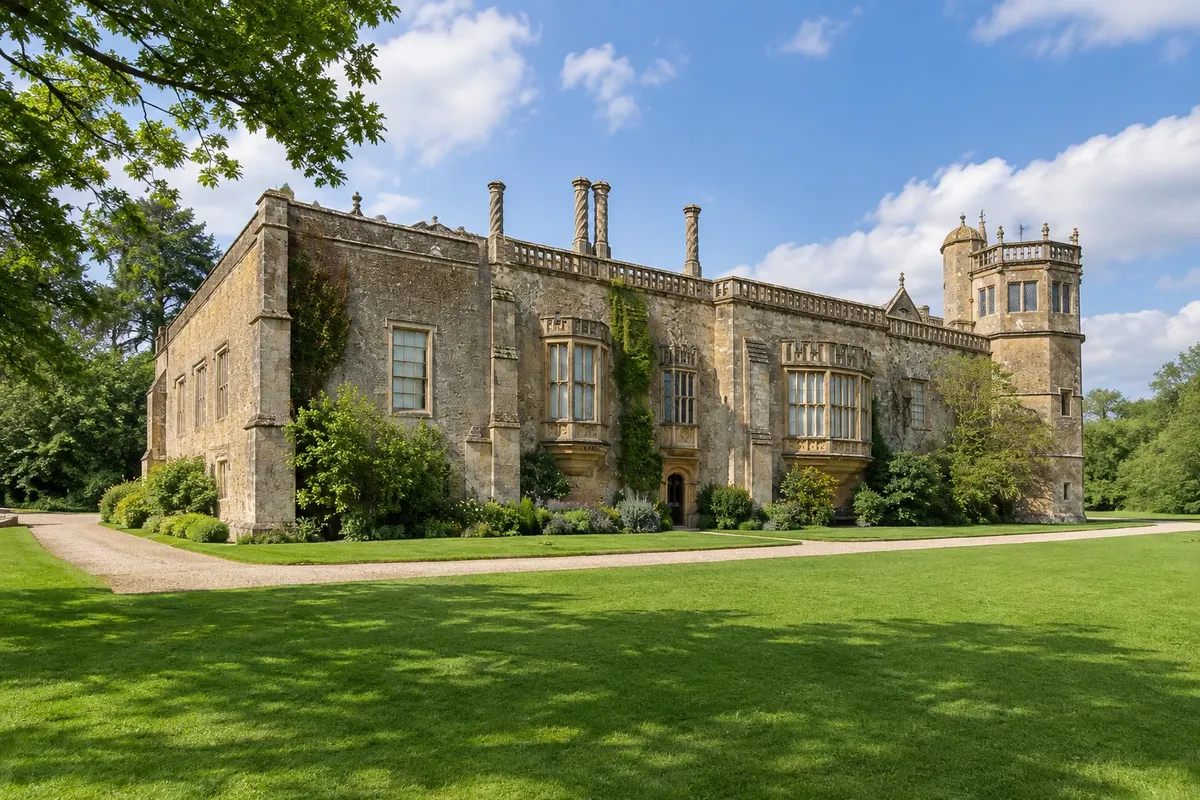
Historic building · Castle Combe, Inglaterra
Lacock Abbey
The medieval abbey turned country house in Lacock, 15 km from Castle Combe, where William Henry Fox Talbot made the earliest known photographic negative. The surrounding village belongs to the National Trust.
Illustrative images. The pictures in this guide are illustrations based on the real place, not photographs, and may differ from it.

Discover
About Lacock Abbey
Lacock Abbey is in the village of Lacock, Wiltshire, about 15 km from Castle Combe. It was founded in 1232 as an Augustinian nunnery by Ela, Countess of Salisbury, and after the dissolution of the monasteries by Henry VIII in 1539 it became a country house, retaining the cloister and medieval ground-floor rooms.
In the 19th century the house was owned by William Henry Fox Talbot, a scientist and one of the pioneers of photography. In 1835 he photographed one of the traceried windows in the south gallery and produced the earliest known photographic negative. The window is still there, and the Fox Talbot Museum at the property gate tells the story of the invention.
The cloister, with 15th-century stone vaulting, the sacristy and the chapter house were used as locations for the Harry Potter films, standing in for Hogwarts classrooms, and have also featured in period drama series. The gardens include an orchard, a Victorian botanical garden and Talbot’s greenhouse.
The village of Lacock, with stone, timber-frame and brick houses from the 13th to the 18th centuries, has largely belonged to the National Trust since 1944 and has no visible aerials or wires, which made it a location for films such as the BBC’s Pride and Prejudice and Emma. The houses are lived in; there are pubs, a bakery and a medieval church.
Before you go
Practical information
Cidade Turismo reviews its information regularly, but something may have changed. Check with the place before planning your trip.
How much time to set aside
About 2 to 3 hours for the abbey, the museum, the gardens and a walk around the village.
Best time
From spring to autumn, with the gardens in bloom; mornings are less crowded. In winter opening hours are reduced and some rooms in the house may be closed. Check the National Trust website.
How to get there
By car, about 15 km from Castle Combe, 5 km from Chippenham and 20 km from Bath, via the A350. The National Trust car park is at the village entrance. By bus, there are local services from Chippenham.
Tip
Look in the south gallery of the house for the window that appears in the first photographic negative; beside it there is a reproduction of the image for comparison. Afterwards, walk along the four streets of the village, which form a square.
Official website
Get your questions answered
Frequently asked questions about Lacock Abbey
Why is Lacock important for photography?
Because it was there that William Henry Fox Talbot made, in 1835, the oldest known photographic negative, of one of the house's windows.
Was Harry Potter filmed in Lacock?
Yes, the cloister and rooms of the abbey appear as Hogwarts rooms in the films, and the village served as the setting for Godric's Hollow.
Can you combine Lacock with Castle Combe?
Yes, they are about 15 km apart, and both can be combined with Bath, about 20 km away.