

 Brazil
 Argentina
 Chile
Chile Colombia
 Peru
Peru Uruguay
 Germany
 Belgium
 Spain
Spain France
 Greece
 the Netherlands
 Ireland
 Italy
Italy Luxembourg
 Portugal
 Switzerland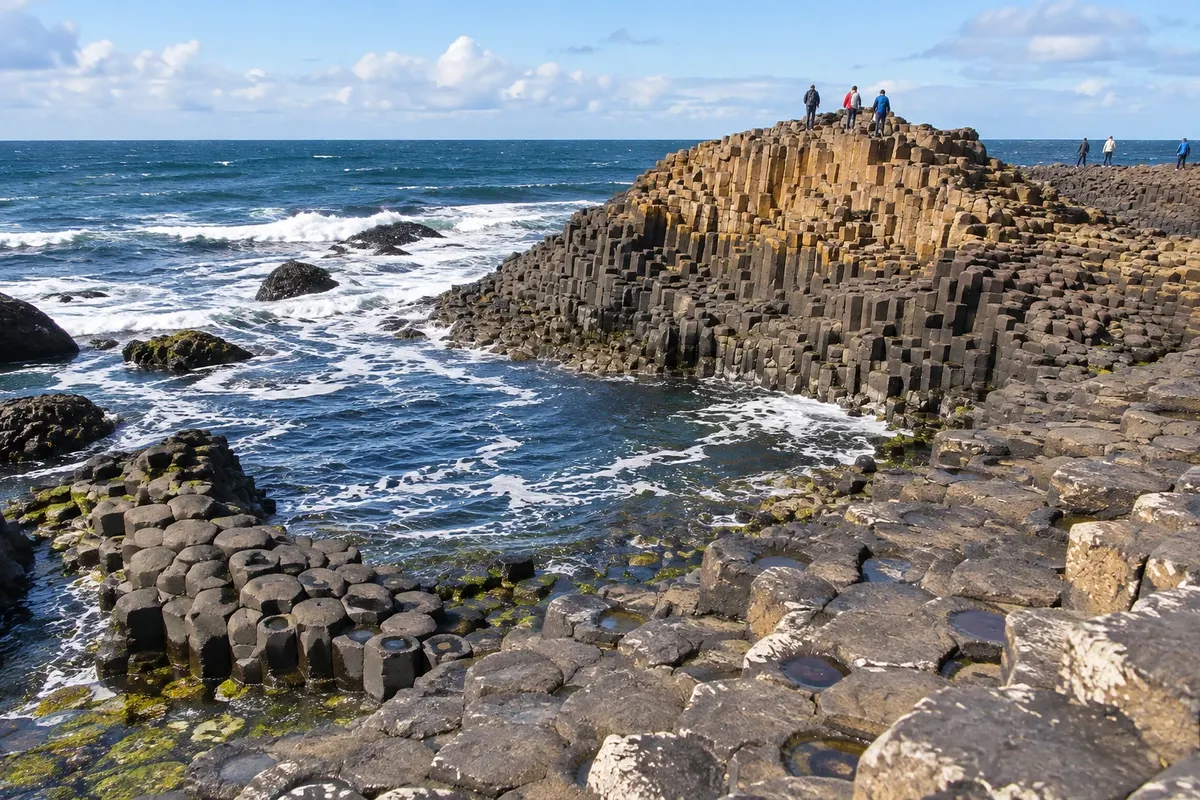
Nature · Bushmills, Irlanda do Norte
Giant's Causeway
The roughly 40,000 basalt columns, almost all hexagonal, formed by lava about 60 million years ago on the coast of Antrim, 3 km from Bushmills, with the legend of the giant Finn McCool. A UNESCO World Heritage Site and part of the National Trust.
Illustrative images. The pictures in this guide are illustrations based on the real place, not photographs, and may differ from it.

Discover
About Giant's Causeway
The Calçada dos Gigantes is a stretch of the north Antrim coast covered by around 40,000 basalt columns that fit together like steps and descend to the sea. It formed about 50 to 60 million years ago, when lava from volcanic eruptions cooled slowly and contracted, cracking into columns, most of them six-sided. It has been a UNESCO World Heritage Site since 1986 and is Northern Ireland's most visited attraction.
Local legend says the Irish giant Finn McCool built the causeway to cross the sea and face the Scottish giant Benandonner; identical columns exist across the water on the Scottish island of Staffa. Fleeing his rival, Finn is said to have disguised himself as a baby with his wife's help, and the Scottish giant, frightened by the size of the 'baby', fled and destroyed the causeway behind him. Formations with names linked to the legend, such as the Bota do Gigante, o Órgão and the Cadeira dos Desejos, can be seen along the way.
The National Trust visitor centre, opened in 2012, with a grass roof and walls of basalt columns, has an exhibition about the geology and the legend and an audio guide. From the centre a road descends to the columns, about 1 km, on foot or by minibus. Cliff-top trails, the Red Trail and the Blue Trail, show the causeway from above, and the escada do Pastor, with 162 steps, links the two.
Access to the columns and the trails is open; the visitor centre and car park charge admission. The stones become slippery in rain and from sea spray.
Before you go
Practical information
Cidade Turismo reviews its information regularly, but something may have changed. Check with the place before planning your trip.
How much time to set aside
About 2 to 3 hours, including the visitor centre, the columns and a cliff-top trail.
Best time
Early morning or late afternoon, before and after the tour buses. In summer the evening light lasts late. When the sea is rough, keep away from the shore rocks.
How to get there
It is about 3 km from Bushmills and 100 km from Belfast, roughly 1 h 15 by car. The coastal bus and the tourist steam train, in season, link Bushmills to the causeway. There are day tours from Belfast.
Tip
Descend to the columns via the road and return via the escada do Pastor and the cliff-top trail to see the causeway from above. Arrive early to avoid tour groups.
Official website
Get your questions answered
Frequently asked questions about Giant's Causeway
How was the Calçada dos Gigantes formed?
By lava from volcanic eruptions that cooled slowly about 50 to 60 million years ago and cracked into columns, most of them hexagonal.
Do you have to pay to see the Calçada dos Gigantes?
Access to the columns and the trails is open; the visitor centre, with an exhibition and audio guide, and the parking are paid.
What is the legend of the Calçada dos Gigantes?
Legend says the giant Finn McCool built the Calçada dos Gigantes to reach Scotland and face the giant Benandonner.
How much time should you allow?
2 to 3 hours, including the columns and a cliff-top trail.