

 Brazil
 Argentina
 Chile
Chile Colombia
 Peru
Peru Uruguay
 Germany
 Belgium
 Spain
Spain France
 Greece
 the Netherlands
 Ireland
 Italy
Italy Luxembourg
 Portugal
 Switzerland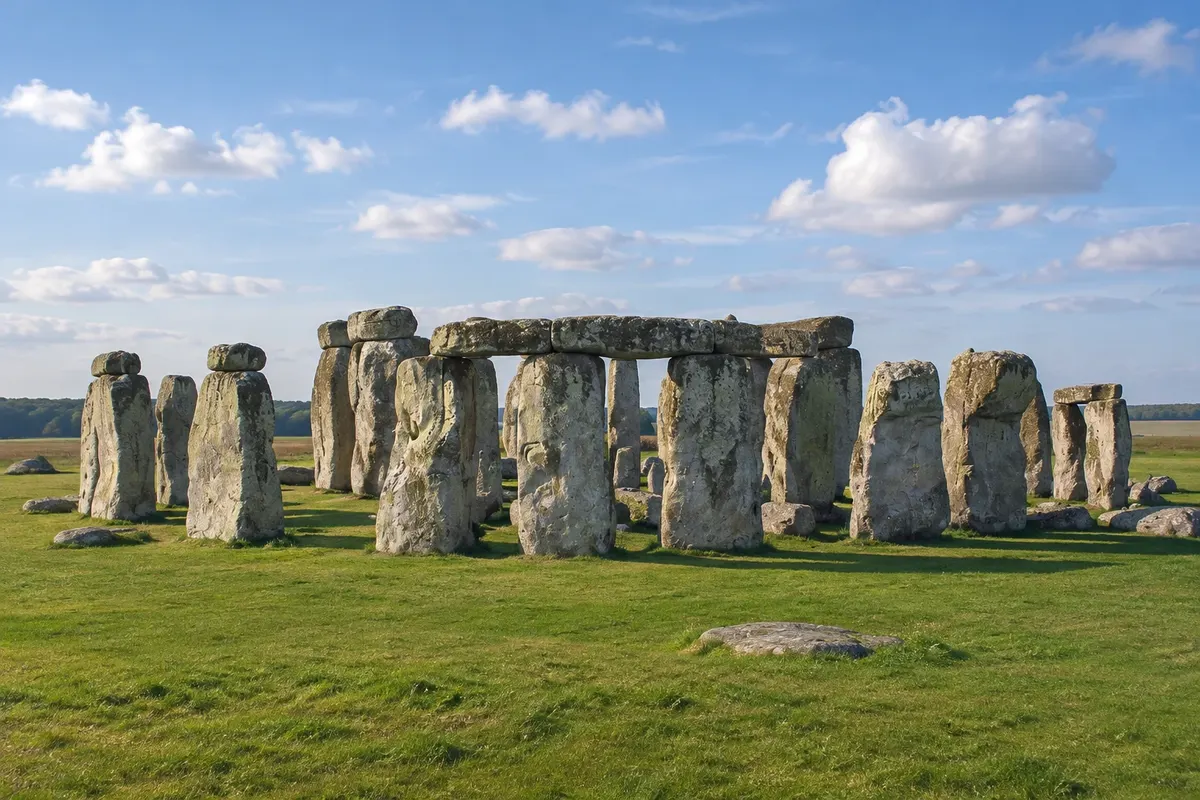
Archaeological site · Salisbury, Inglaterra
Stonehenge
The prehistoric stone circle on the Salisbury Plain, built in stages between about 3000 and 1500 BC, with large blocks of sandstone and the bluestones brought from the País de Gales. UNESCO World Heritage Site.
Illustrative images. The pictures in this guide are illustrations based on the real place, not photographs, and may differ from it.

Discover
About Stonehenge
Stonehenge is a prehistoric monument on the Salisbury Plain, in Wiltshire, about 15 km north of the city of Salisbury. It was built in stages over more than a thousand years: it began around 3000 BC as a circular ditch with an earthwork, and the large stones were raised around 2500 BC. It has been a UNESCO World Heritage Site since 1986, together with the Avebury circle and other nearby sites.
The outer circle is formed by sarsen blocks, a hard sandstone, up to about 7 metres high and 25 tonnes, supporting lintels of stone fitted with joints copied from carpentry. Inside there is a horseshoe arrangement of trilithons, the largest assemblies, and the bluestones, smaller stones brought from the Preseli hills, in the País de Gales, more than 200 km away. The monument's axis aligns with the sunrise at the summer solstice and the sunset at the winter solstice.
The visit begins at the visitor centre, about 2.5 km from the stones, with displays of objects found in the area, a Neolithic man's skeleton and reconstructions of houses from the period. From there a shuttle bus takes you to the monument, or you can walk across the fields, about 30 minutes. Around the stones there is a circular path, kept several metres away; entering the circle is only possible on special visits, by reservation, outside normal opening hours.
At the solstices, English Heritage usually opens access to the stones for those who want to see the sunrise or sunset, with large crowds; check the rules beforehand.
Before you go
Practical information
Cidade Turismo reviews its information regularly, but something may have changed. Check with the place before planning your trip.
How much time to set aside
About 2 to 3 hours, including the exhibition, the bus to the stones and the return along the circular path.
Best time
At opening, before the coach trips from London, or in the last hour of visiting, with low light over the stones. The plain is open, with no shade or shelter: bring a coat and rainwear. Tickets are timed; buy them in advance on the English Heritage website.
How to get there
From Salisbury, the Stonehenge Tour tourist bus leaves from the train station and from the centre and takes you to the visitor centre, about 15 km away. By car, via the A303 and A360, with parking at the visitor centre. Day tours run from London and from Bath.
Tip
Return from the monument to the visitor centre on foot across the fields, instead of by bus, to see the stones from a distance and the surrounding prehistoric barrows. The audio guide, in the English Heritage app, explains each stage of the construction.
Official website
Get your questions answered
Frequently asked questions about Stonehenge
Can you touch the stones at Stonehenge?
Not on the normal visit: the path stays several metres from the circle. Special access visits inside the circle, outside normal hours, require reservations and have limited places.
How to get from London to Stonehenge?
By train from Waterloo to Salisbury in about 1h30, then the tour bus to the visitor centre. Or join a day trip tour that departs from London.
Where did the stones come from?
The large sandstone blocks came from about 25 km to the north; the bluestones originated in the Preseli Hills in the País de Gales, over 200 km away.
How long does the visit take?
About 2 to 3 hours, including the visitor centre, the transfer to the stones and the return.
What happens at the solstices?
The monument’s axis aligns with the sunrise at the summer solstice and with the sunset at the winter solstice. On those dates access to the stones is often opened to the public under specific rules.