

 Brazil
 Argentina
 Chile
Chile Colombia
 Peru
Peru Uruguay
 Germany
 Belgium
 Spain
Spain France
 Greece
 the Netherlands
 Ireland
 Italy
Italy Luxembourg
 Portugal
 Switzerland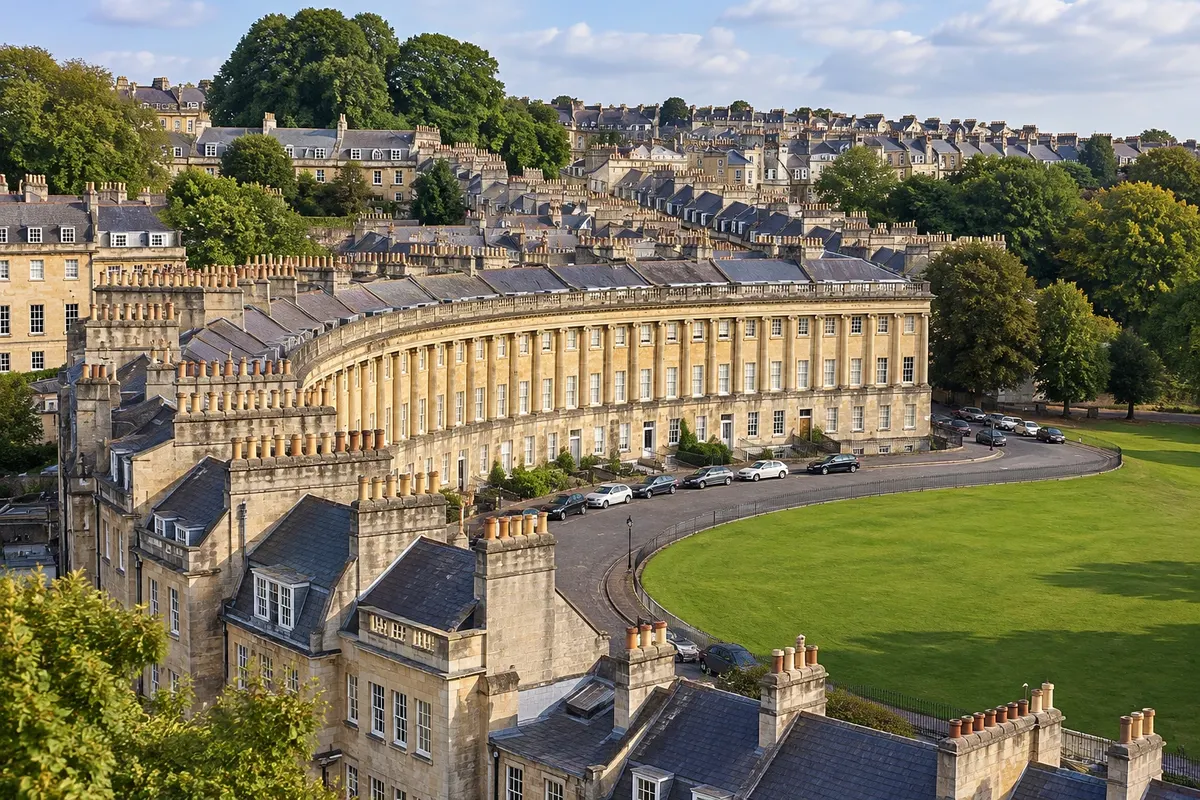
Architectural complex · Bath, Inglaterra
Royal Crescent
The crescent of 30 Georgian houses from 1767 to 1775, facing a lawn above Royal Victoria Park, with the house-museum No. 1 Royal Crescent and, nearby, the Circus by John Wood the Elder.
Illustrative images. The pictures in this guide are illustrations based on the real place, not photographs, and may differ from it.

Discover
About Royal Crescent
The Royal Crescent is a row of 30 crescent-shaped houses on the heights of Bath, built between 1767 and 1775 by the architect John Wood, the Younger. The continuous façade, with 114 Ionic columns, measures about 150 metres and opens onto a sloping lawn and Royal Victoria Park. It is the best-known Georgian ensemble in Britain.
The houses were built for the season when fashionable society came to the baths in the 18th century. Behind the uniform façade, each owner built their house as they wished, which shows in the irregular backs seen from the rear street. Today there are flats, a hotel and, in the eastern end house, No. 1 Royal Crescent, a museum that shows how a Georgian house looked between 1776 and 1796, with furnished rooms, a kitchen and servants' quarters.
A few minutes away along Brock Street is the Circus, a circle of 33 three-storey houses with columns of three classical orders, designed by John Wood, the Elder, father of the Crescent's architect, and completed in 1768. The friezes bear more than 500 carved symbols, and the painter Thomas Gainsborough lived in one of the houses. Nearby are the Assembly Rooms, 18th‑century ballrooms frequented by Jane Austen's characters.
The lawn in front of the Crescent is separated from the park by a ditch, the ha‑ha, so as not to interrupt the view; the open park has a botanic garden and benches for viewing the façade.
Before you go
Practical information
Cidade Turismo reviews its information regularly, but something may have changed. Check with the place before planning your trip.
How much time to set aside
About 30 minutes for the Crescent and the Circus; plus 1 hour for No. 1 Royal Crescent.
Best time
In the late afternoon, when the western sun lights the pale stone façade. In the morning the façade is in shadow. No. 1 Royal Crescent has its own opening hours and may be closed for part of the winter; check ahead.
How to get there
It is located on the high part of Bath city centre, about a 15‑minute walk from the Roman Baths, uphill, passing Gay Street and the Circus. The double‑decker tour buses stop nearby.
Tip
Walk up Gay Street to the Circus, follow Brock Street and get your first frontal view of the Crescent on the lawn. Then go along the rear street, Crescent Lane, to see the uneven backs of the houses.
Official website
Get your questions answered
Frequently asked questions about Royal Crescent
Can you enter the Royal Crescent?
The houses are private residences and a hotel. The house at the east end, No. 1 Royal Crescent, is a museum showing a furnished Georgian house.
What is the Circus?
A circle of Georgian houses near the Royal Crescent, designed by John Wood, o Velho, and completed in 1768.
What is the best time to photograph the Crescent?
Late afternoon, when the western sun hits the façade.
Does the Royal Crescent have a connection to Jane Austen?
She lived in Bath and mentions the city in novels such as Northanger Abbey and Persuasion; the Assembly Rooms, near the Crescent, appear in the books.