

 Brazil
 Argentina
 Chile
Chile Colombia
 Peru
Peru Uruguay
 Germany
 Belgium
 Spain
Spain France
 Greece
 the Netherlands
 Ireland
 Portugal
 the United Kingdom
 Switzerland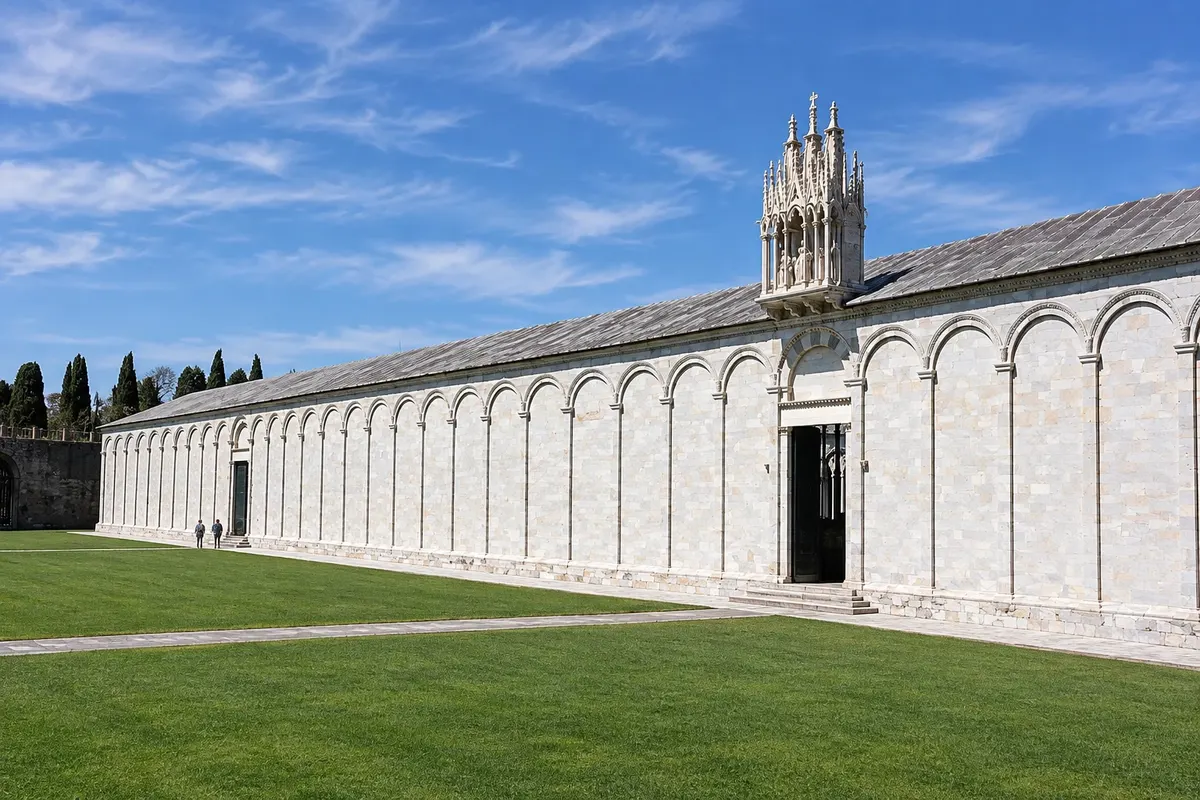
Monument · Pisa, Toscana
Camposanto Monumentale
The former monumental cemetery, a marble cloister with Roman sarcophagi and medieval frescoes such as the Triumph of Death.
Illustrative images. The pictures in this guide are illustrations based on the real place, not photographs, and may differ from it.

Discover
About Camposanto Monumentale
The Camposanto Monumentale closes the north side of the Piazza dei Miracoli. According to tradition, it was built beginning in 1277 around soil brought from Calvary by Pisan crusaders. It is a large rectangular marble cloister with open arches onto a lawn, where the city's important families were buried for centuries.
The walls were covered with frescoes from the 14th and 15th centuries. The best known is the Triumph of Death, attributed to Buonamico Buffalmacco, showing scenes of death coming for rich and poor alike. The floor and galleries preserve Roman tombstones and sarcophagi that served as models for Pisan sculptors.
In July 1944, during World War II, a fire caused by a bombing melted the lead roof and destroyed much of the frescoes. Restoration has taken decades and the recovered panels have gradually been returned to the walls. When the damaged frescoes were removed, the sinopie—the preparatory red underdrawings—were revealed.
Those sinopie are housed in the Museo delle Sinopie across the square. The Museo dell'Opera del Duomo, next to the tower, brings together the original sculptures from the monuments, works by Nicola and Giovanni Pisano, and pieces from the cathedral treasury. Both museums are included on the same Camposanto ticket.
Before you go
Practical information
Cidade Turismo reviews its information regularly, but something may have changed. Check with the place before planning your trip.
How much time to set aside
30 to 45 minutes in the Camposanto. With both museums, allow an extra hour and a half.
Best time
At midday, when the square is crowded, the cloister is usually calmer and cooler.
How to get there
It is on the north side of the Piazza dei Miracoli, behind the cathedral. The Museo delle Sinopie is on the south side of the square and the Museo dell'Opera del Duomo is next to the tower.
Tip
Do the Camposanto first and then the Museo delle Sinopie: seeing the underdrawings after the frescoes helps understand how the painters worked. The Museo dell'Opera has an audio guide.
Official website
Get your questions answered
Frequently asked questions about Camposanto Monumentale
What is the Camposanto?
It's the ancient monumental cemetery of Pisa, a marble cloister built from the 13th century, with Roman sarcophagi and medieval frescoes.
What happened to the frescoes?
In 1944, during World War II, a fire caused by a bombing destroyed much of them. Many were restored and returned to the walls; others are still under restoration.
What are the sinopie?
They are the preparatory drawings in red pigment that painters made on the wall before the fresco. Those from the Camposanto were discovered during restoration and are housed in the Museo delle Sinopie.
Does the Camposanto ticket include the museums?
The combined ticket includes the Camposanto, baptistery, Museo delle Sinopie and Museo dell'Opera del Duomo. The tower is charged separately.