

 Brazil
 Argentina
 Chile
Chile Colombia
 Peru
Peru Uruguay
 Germany
 Belgium
 Spain
Spain France
 Greece
 the Netherlands
 Ireland
 Portugal
 the United Kingdom
 Switzerland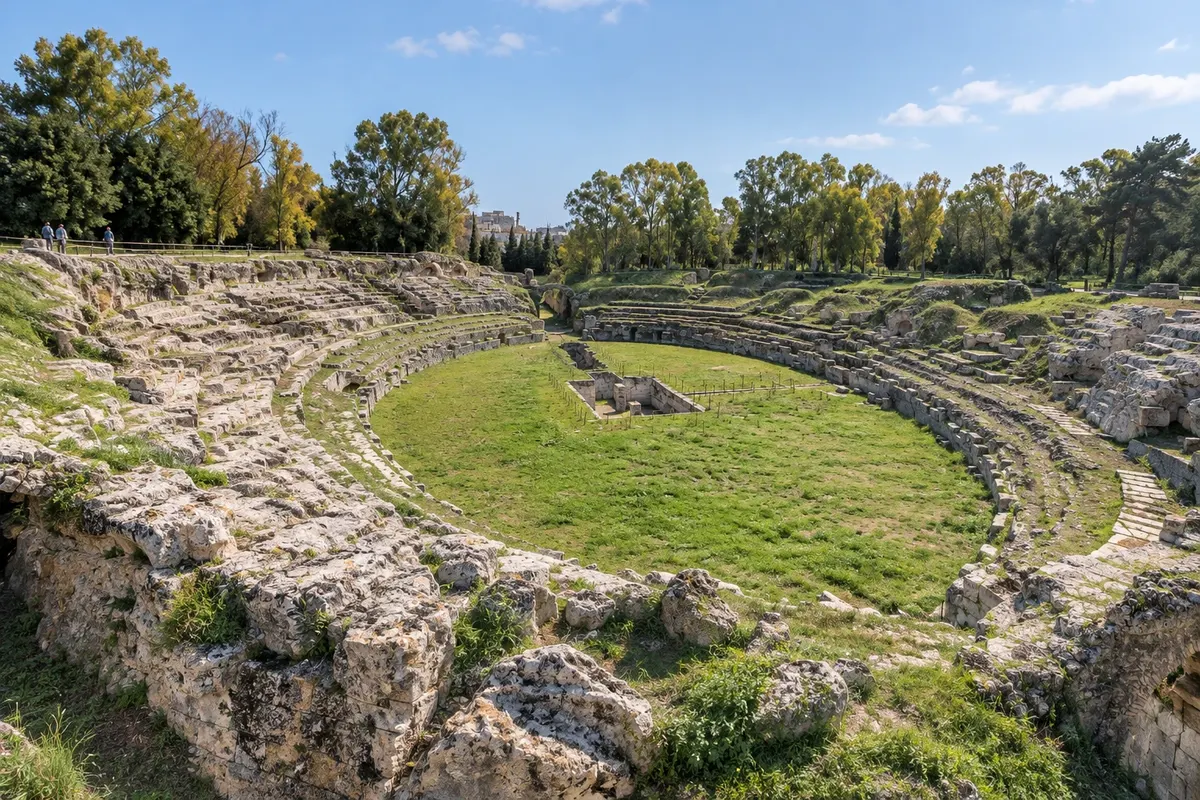
Archaeological site · Siracusa, Sicília
Parco Archeologico della Neapolis
The large archaeological park of Siracusa, with the Teatro Greco cut into the rock, the Latomia del Paradiso with the Orecchio di Dionisio, the Ara di Ierone and the Roman amphitheatre.
Illustrative images. The pictures in this guide are illustrations based on the real place, not photographs, and may differ from it.

Discover
About Parco Archeologico della Neapolis
The Parco Archeologico della Neapolis brings together the main monuments of Greek and Roman Siracusa, in the district the Greeks called Neapolis, the new city. The area was organised as a park in the 1950s and is one of the largest archaeological zones in the Mediterranean.
The Teatro Greco was cut into the rock of Monte Temenite. It existed from the 5th century BC and took its present form in the 3rd century BC under the tyrant Hierão II. The playwright Aeschylus staged plays there. Even today, from May to July, the seating hosts the classical theatre season, with Greek tragedies and comedies.
Beside it, the Latomia del Paradiso is an ancient open-air quarry, now full of vegetation. It contains the Orecchio di Dionisio, an artificial grotto about 23 metres high, ear-shaped and with a strong echo. The name is said to have been given by Caravaggio in 1608, linked to the legend that the tyrant Dionísio heard prisoners' conversations from there.
The park also includes the Ara di Ierone II, a huge altar for public sacrifices, and the Roman amphitheatre, used for gladiator fights. For safety, some areas can only be seen from the outside or from walkways, and the accessible route may change.
Before you go
Practical information
Cidade Turismo reviews its information regularly, but something may have changed. Check with the place before planning your trip.
How much time to set aside
2 to 3 hours.
Best time
Early in the morning at opening, before the heat: there is little shade in the theatre. During the classical theatre season, from May to July, visiting hours may be reduced on performance days. Check before you go.
How to get there
About a 25-minute walk from Ortigia or a few minutes by city bus or taxi. The main entrance is on the Viale Paradiso.
Tip
Bring a hat, sunscreen and water. Inside the Orecchio di Dionisio, make a low sound to hear the echo. Combine it with the Museo Paolo Orsi, about a 15-minute walk away.
Official website
Get your questions answered
Frequently asked questions about Parco Archeologico della Neapolis
Does the Teatro Greco still host performances?
Yes. From May to July there is usually a season of classical theatre, with Greek plays performed in the ancient seating. Tickets for the performances are sold separately.
What is the Orecchio di Dionisio?
An artificial cave about 23 meters high, opened in an ancient quarry, shaped like an ear and with a strong echo. The name is attributed to Caravaggio.
How long does the visit take?
2 to 3 hours for the theatre, the Latomia del Paradiso, the Ara di Ierone and the amphitheatre.
Is the whole park open?
No. For safety, some areas can only be seen from outside or from walkways, and the open route can change. Check before you go.
Is there shade in the park?
Little shade in the theatre. The latomia has trees. Go early in the hot months.