

 Brazil
 Argentina
 Chile
Chile Colombia
 Peru
Peru Uruguay
 Germany
 Belgium
 Spain
Spain France
 Greece
 the Netherlands
 Ireland
 Portugal
 the United Kingdom
 Switzerland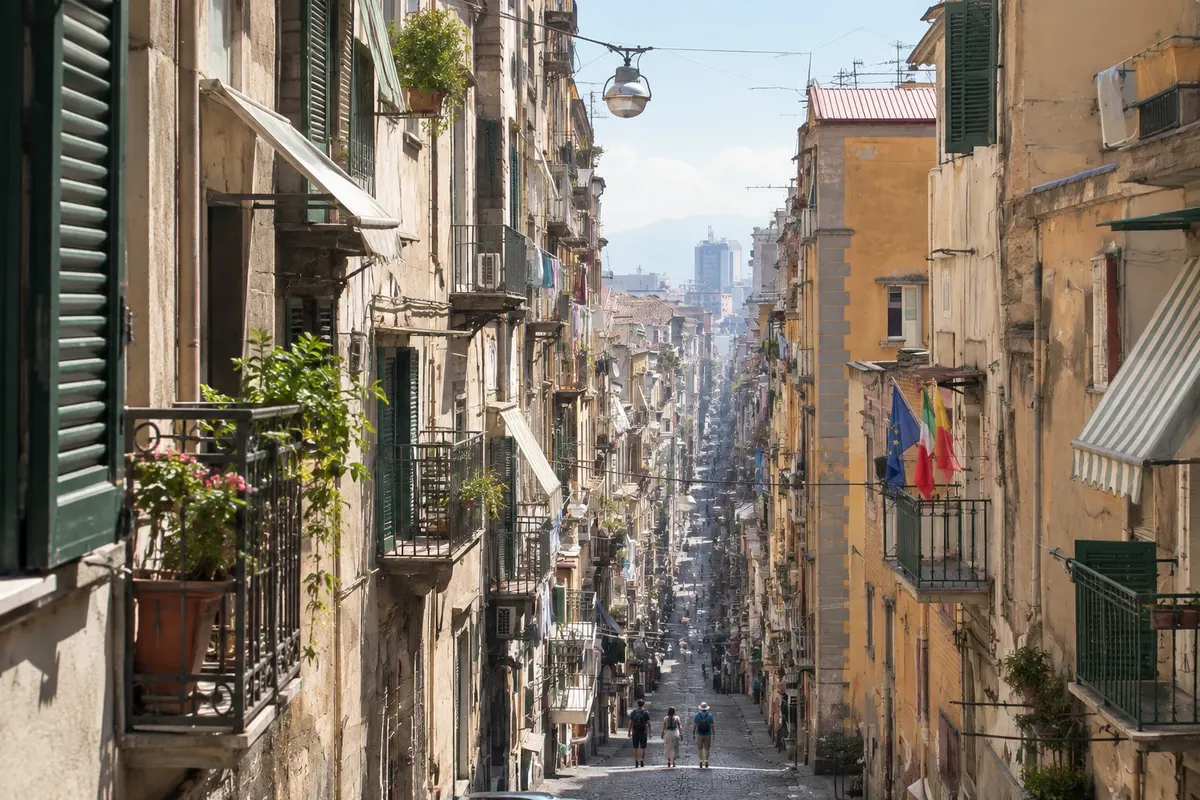
Historic neighborhood · Nápoles, Campânia
Centro storico di Napoli
The historic center of Nápoles, a UNESCO World Heritage site, preserves the layout of the Greek city of Neápolis, intersected by the Spaccanapoli and the Via dei Tribunali.
Illustrative images. The pictures in this guide are illustrations based on the real place, not photographs, and may differ from it.

Discover
About Centro storico di Napoli
The centro storico (historic center) of Naples was inscribed as a World Heritage Site by UNESCO in 1995. The streets follow the layout of Neapolis founded by the Greeks: three long east–west streets, the decumani, crossed by narrow alleys. It is one of the largest historic areas in Europe still lived in as an ordinary neighborhood, with clothes on the line, small shops and churches on every block.
Spaccanapoli is the nickname of the lower decumanus, made up of Via Benedetto Croce and Via San Biagio dei Librai. Seen from above, the street appears to 'split' the city in two, hence the name. Along it are the Piazza del Gesù, with the church of Gesù Nuovo and its diamond-point stone façade, the Santa Chiara complex with its cloister covered in glazed ceramics, and the Piazza San Domenico Maggiore.
Parallel to it runs Via dei Tribunali, the main decumanus, with arcades, churches and many traditional pizzerias. Between the two is Via San Gregorio Armeno, the street of nativity-scene craftsmen, with shops open year-round and heavier foot traffic in November and December.
The art of the Neapolitan pizzaiolo was recognized by UNESCO as intangible heritage in 2017. Pizza was born as street food and remains an everyday meal: thin in the center, high and soft crust, cooked in a wood-fired oven. Many places in the center also sell fried pizza and the folded pizza, the portafoglio, eaten standing on the pavement.
Before you go
Practical information
Cidade Turismo reviews its information regularly, but something may have changed. Check with the place before planning your trip.
How much time to set aside
Half a day walking at a relaxed pace. To enter churches and the cloister of Santa Chiara, allow a full day.
Best time
The morning is good for seeing open churches and quieter streets. In the late afternoon activity increases in the streets and pizzerias. In December, Via San Gregorio Armeno gets packed because of the nativity scenes.
How to get there
Take Metro Line 1 to Dante or Museo stations, or Line 2 to Piazza Cavour/Museo, and then walk. From Piazza del Gesù, Spaccanapoli runs straight east. The area is a limited traffic zone (ZTL): leave the car outside.
Tip
Wear comfortable shoes: the paving is volcanic stone and becomes slippery when it rains. To enter churches, shoulders and knees should be covered. Watch your belongings in crowded places, such as Via San Gregorio Armeno in December.
Get your questions answered
Frequently asked questions about Centro storico di Napoli
What is the Spaccanapoli?
It's the nickname of the lower decumanus, the straight street that crosses the historic centre, formed by Via Benedetto Croce and Via San Biagio dei Librai. It runs from Piazza del Gesù to near Via Duomo.
Where is the street of nativity scenes?
On Via San Gregorio Armeno, an alley between the Spaccanapoli and Via dei Tribunali. The nativity-craft shops are open year-round; in November and December the street gets very crowded.
Can you see the historic centre on foot?
Yes. Distances are short and the best way to see the area is walking between Piazza del Gesù, the Spaccanapoli, Via dei Tribunali and the Duomo.