

 Brazil
 Argentina
 Chile
Chile Colombia
 Peru
Peru Uruguay
 Germany
 Belgium
 Spain
Spain France
 Greece
 the Netherlands
 Ireland
 Portugal
 the United Kingdom
 Switzerland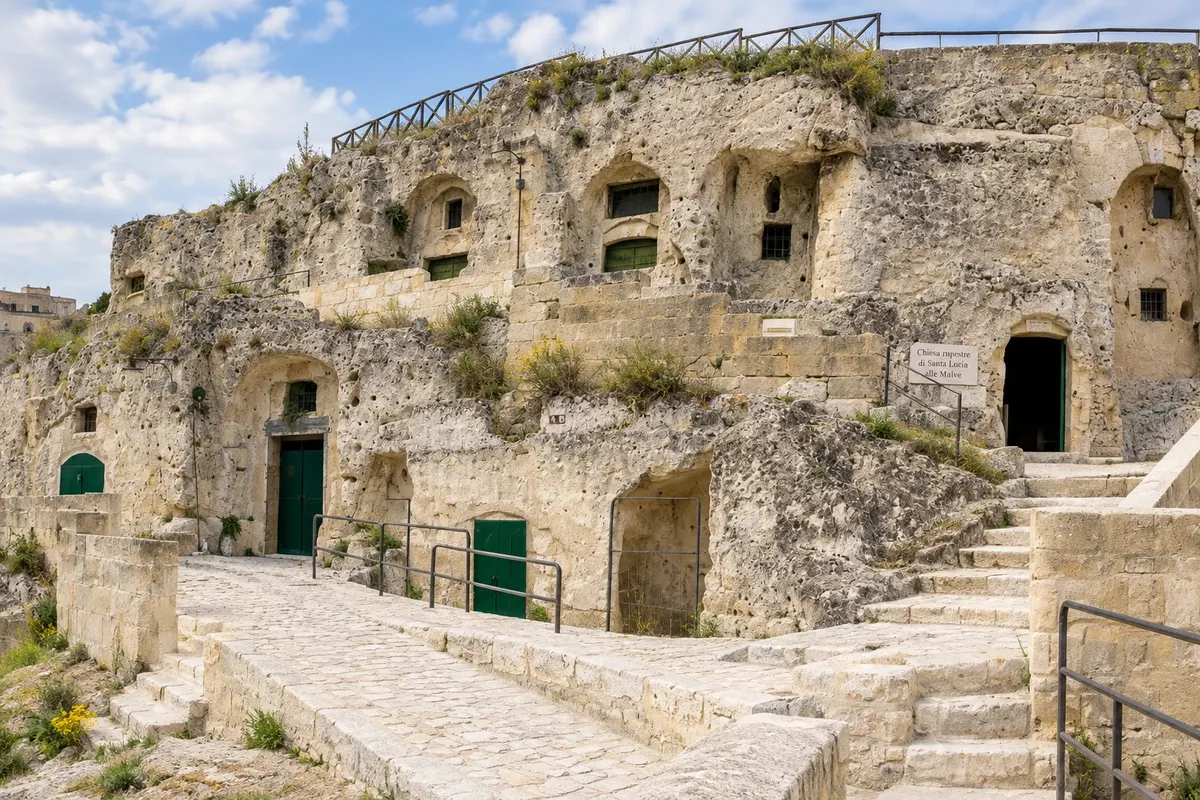
Church · Matera, Basilicata
Chiesa rupestre di Santa Lucia alle Malve
Rock‑cut church of Sasso Caveoso linked to an 11th‑century Benedictine nunnery, with 13th‑century frescoes, including a Nursing Madonna and the archangel Gabriel.
Illustrative images. The pictures in this guide are illustrations based on the real place, not photographs, and may differ from it.

Discover
About Chiesa rupestre di Santa Lucia alle Malve
Santa Lucia alle Malve was the church of a Benedictine nunnery founded in the 11th century in Sasso Caveoso. Initially dedicated to Sant'Agata, it became Santa Lucia in the 13th century. When the nuns moved to the Civita, the church turned into housing.
On the façade, three carved chalices recall the martyrdom of Santa Lucia. The church has three naves hewn into the rock, not perfectly aligned, as is common in rock churches.
The frescoes, many uncovered during the 1977 restoration, are the highlight: the archangel Gabriel treading on a dragon, from 1250; the Nursing Madonna, from 1270; as well as San Nicola, San Benedetto, St John the Baptist and Santa Scholastica.
Above the church there is a necropolis with tombs cut into the rock. On 13 December, Santa Lucia’s feast day, a mass is still celebrated there.
Before you go
Practical information
Cidade Turismo reviews its information regularly, but something may have changed. Check with the place before planning your trip.
How much time to set aside
About 20 minutes.
Best time
At any time; combine it with Santa Maria de Idris, just above.
How to get there
It is located in the Sasso Caveoso, near the Monterrone stairway, a few minutes' walk from the Piazza San Pietro Caveoso.
Tip
It is part of the circuit of rock-cut churches with a combined ticket; check before you go. Respect the rules on photographing the frescoes.
Official website
Get your questions answered
Frequently asked questions about Chiesa rupestre di Santa Lucia alle Malve
Which frescoes are the most famous?
The archangel Gabriel treading on a dragon, from 1250, and the Madonna of the Milk, from 1270.
Was the church ever a home?
Yes. After the nuns moved away, part of it was used as housing.
Is it close to other rock churches?
Yes, just below Santa Maria de Idris, in the Sasso Caveoso.