

 Brazil
 Argentina
 Chile
Chile Colombia
 Peru
Peru Uruguay
 Germany
 Belgium
 Spain
Spain France
 Greece
 the Netherlands
 Italy
Italy Luxembourg
 Portugal
 the United Kingdom
 Switzerland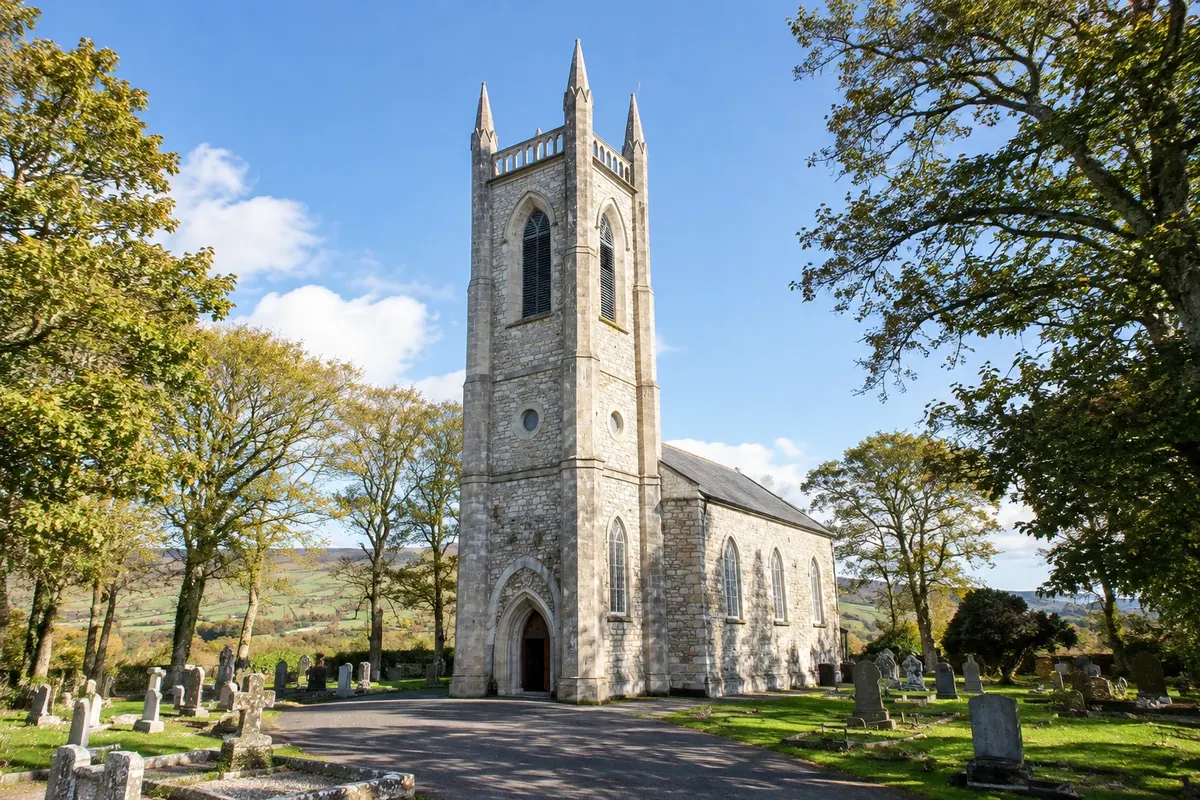
Church · Sligo, Sligo
Drumcliff
The church and cemetery where the poet W. B. Yeats is buried, at the foot of Benbulben, in an old monastery of St Columba with a tall 11th-century high cross and the stump of a round tower.
Illustrative images. The pictures in this guide are illustrations based on the real place, not photographs, and may differ from it.

Discover
About Drumcliff
Drumcliff is a village about 8 km north of Sligo, at the site where St Columba founded a monastery in the 6th century. Remains of the monastery include the 11th-century high cross of stone, with carved biblical scenes such as Adam and Eve and Daniel in the lions' den, and the stump of a round tower on the other side of the road that has lost its top.
In the churchyard of St Columba, of the Church of Ireland, is buried the poet William Butler Yeats, Nobel Prize in Literature in 1923. Yeats died in France in 1939 and was brought to Drumcliff in 1948, as he had requested in the poem 'Under Ben Bulben'. His great-grandfather had been the church's rector. The simple gravestone, with the three-line epitaph written by the poet himself, stands beside the church door with Benbulben in the background.
The 19th-century church has stained-glass windows and an exhibition about Yeats and his family. Next door, a small centre with a café welcomes visitors.
The cemetery remains in use. The place is peaceful and is often combined with the Benbulben viewpoint and the forest trail at the mountain's foot.
Before you go
Practical information
Cidade Turismo reviews its information regularly, but something may have changed. Check with the place before planning your trip.
How much time to set aside
30 to 45 minutes.
Best time
In the morning or late afternoon, with the light on Benbulben. It's accessible year-round; the church has its own opening hours.
How to get there
It lies beside the N15, about 8 km north of Sligo. Sligo–Donegal line buses stop in the village at certain times.
Tip
Look for Yeats's gravestone beside the church door and read the epitaph. Then cross the road to see the stump of the round tower.
Get your questions answered
Frequently asked questions about Drumcliff
Is Yeats really buried in Drumcliff?
Yes. The poet died in France in 1939 and was brought to Drumcliff in 1948, as he had requested.
What else is there to see besides the grave?
The 11th‑century high cross with biblical scenes, the stump of the round tower and the church of St Columba, which has an exhibition about Yeats.
Is it far from Sligo?
About 8 km to the north, via the N15.