

 Brazil
 Argentina
 Chile
Chile Colombia
 Peru
Peru Uruguay
 Germany
 Belgium
 Spain
Spain France
 the Netherlands
 Ireland
 Italy
Italy Luxembourg
 Portugal
 the United Kingdom
 Switzerland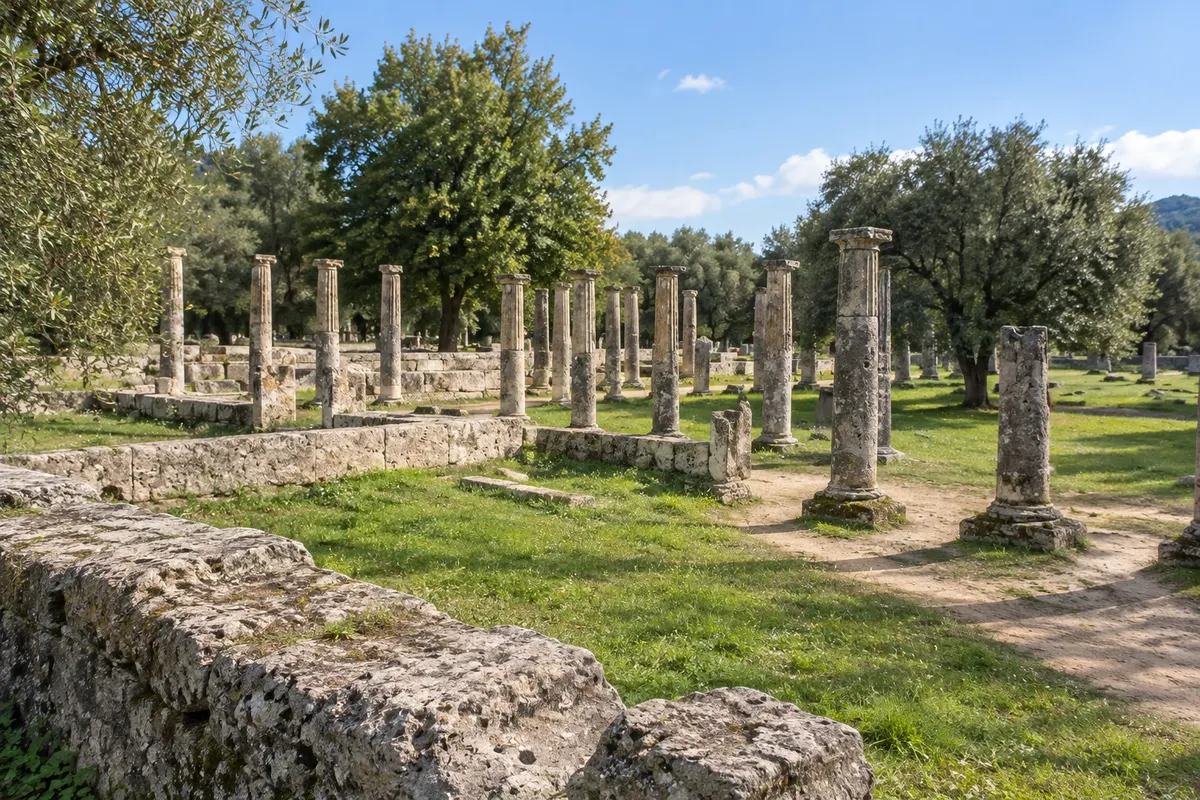
Archaeological site · Olímpia, Grécia Ocidental
Sítio arqueológico de Olímpia (Archaia Olympia)
The sanctuary of Zeus where the Olympic Games began in 776 BC: the stadium with the starting line, the fallen Templo de Zeus, the Templo de Hera where the Olympic flame is lit, Fídias's workshop and the Filipeion.
Illustrative images. The pictures in this guide are illustrations based on the real place, not photographs, and may differ from it.

Discover
About Sítio arqueológico de Olímpia (Archaia Olympia)
Olímpia was a sanctuary, not a city. In a valley between the Alfeu and Cládeo rivers, at the foot of the Cronos hill, the Greeks worshipped Zeus and, every four years from 776 BC, gathered athletes from all the cities for the Games, during which wars were suspended. The Games lasted more than a thousand years, until they were banned at the end of the 4th century AD. Earthquakes and river floods buried the sanctuary, which was rediscovered in the 18th century and excavated by Germans from 1875. It has been a World Heritage Site since 1989.
The visit follows the Altis, the sacred enclosure. The Templo de Zeus, from the 5th century BC, lies on the ground: the drums of the columns fell in a line during the earthquake, and one column was re-erected to give scale. Inside stood the statue of Zeus in gold and ivory by Fídias, one of the seven wonders, now lost. The older Templo de Hera, from around 600 BC, is where the Olympic flame for the modern Games is lit with a concave mirror before each edition. Beside it are the round Filipeion, erected by Philip of Macedonia, the Pelopion and the row of bases for the statues of the victors.
Through the Cripta arch you enter the stadium: a 192-metre earthen track between grassy embankments that held 45,000 people, with the stone starting and finishing lines still in place. Almost every visitor runs the track. On the other side of the Altis are the workshop where Fídias made the Zeus, later converted into a church, the Leonidaion, lodging for distinguished visitors, and the baths. The complex sits among pines and olive trees, with shade over much of the route.
Before you go
Practical information
Cidade Turismo reviews its information regularly, but something may have changed. Check with the place before planning your trip.
How much time to set aside
2 to 3 hours for the site; the Museu Arqueológico next door requires another hour and a half.
Best time
At opening, before the groups arriving on cruises from Katakolo, or in the late afternoon. Spring, from April to May, has flowers among the ruins. In summer the stadium is exposed to strong sun; the rest of the Altis has trees.
How to get there
The entrance is a 15-minute walk from the village of Archaia Olympia, down the main street and across the bridge over the Cládeo, with parking by the ticket office. From Athens it is about 300 km, 4 hours, via the A8 to Patras and then along the coast, or via the A7 through Trípoli. KTEL buses link Athens and Patras to Pyrgos, where you change to Olímpia, 20 km away.
Tip
The ticket usually includes the site and the museums; check at the ticket office. Start with the archaeological museum if you want to understand the sculptures before seeing the temples, or finish there to escape the midday heat. Run the stadium track — nobody can resist.
Get your questions answered
Frequently asked questions about Sítio arqueológico de Olímpia (Archaia Olympia)
Is the Olympic flame lit in Olímpia?
Yes. Before each edition of the modern Games, the flame is lit in front of the Templo de Hera, at the archaeological site, using a concave mirror that concentrates the sun, in a ceremony with actresses dressed as priestesses.
Can you run in the ancient stadium?
Yes. The stadium is a 192-meter dirt track between grass embankments, and visitors are free to run between the stone starting and finishing lines.
Where is the statue of Zeus of Olímpia?
It was lost. The gold-and-ivory statue by Fídias, one of the Seven Wonders of the Ancient World, was taken to Constantinople and destroyed, probably in a fire in the 5th century. What remains is the workshop where it was made and the cup with the sculptor's name, in the museum.
How long does it take from Athens to Olímpia?
About 4 hours by car, 300 km, via the highway to Patras or via Trípoli. By KTEL bus, you need to go to Pyrgos and change to Olímpia, taking about 5 hours in total.
Is it worth visiting Olímpia from a cruise?
Ships that call at Katakolo, 35 km away, offer the excursion, which is why many people visit. Those coming on their own would do well to arrive before or after the groups, which occupy the site in mid-morning.