

 Brazil
 Argentina
 Chile
Chile Colombia
 Peru
Peru Uruguay
 Germany
 Belgium
 Spain
Spain France
 the Netherlands
 Ireland
 Italy
Italy Luxembourg
 Portugal
 the United Kingdom
 Switzerland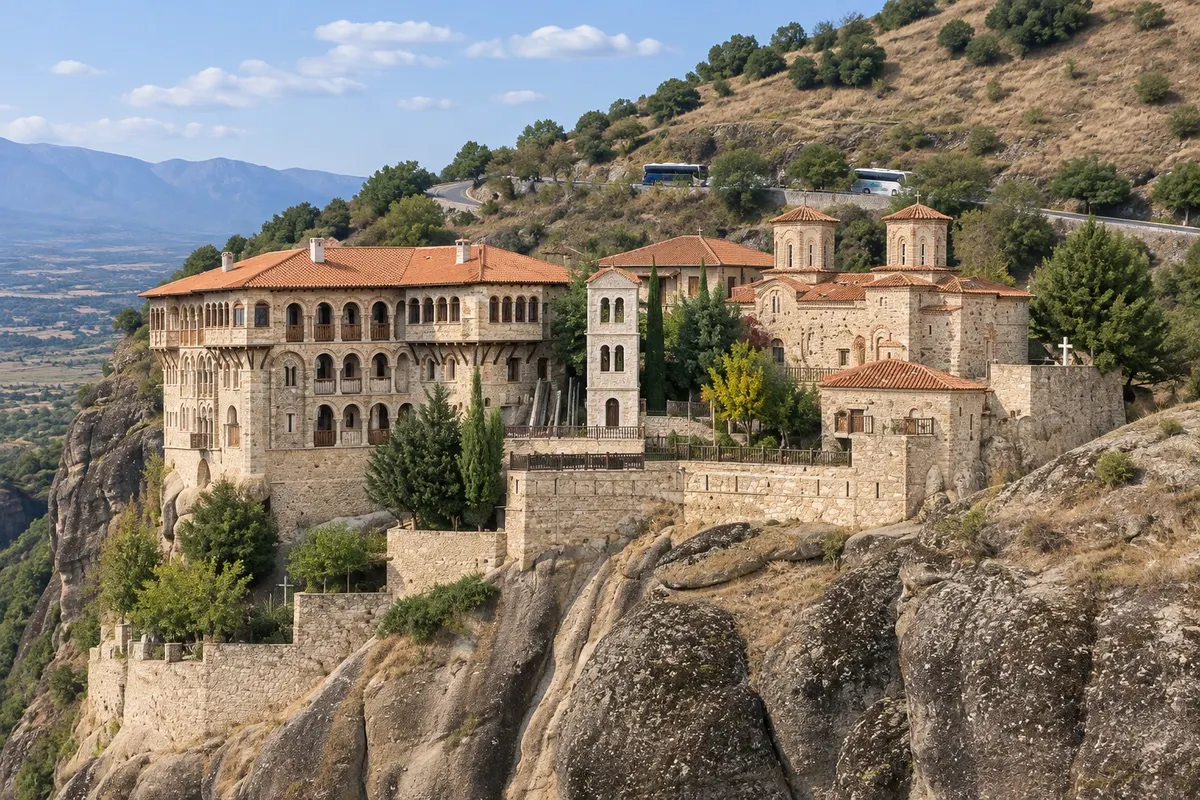
Monastery · Kalambaka, Tessália
Mosteiro do Grande Meteoro (Moni Megalou Meteorou)
The largest and highest of the Meteora monasteries, founded in the 14th century by Atanásio the Meteorite, atop the rock Platys Lithos. Church painted in 1552, refectory-museum from 1557, ancient kitchen and the monks' ossuary.
Illustrative images. The pictures in this guide are illustrations based on the real place, not photographs, and may differ from it.

Discover
About Mosteiro do Grande Meteoro (Moni Megalou Meteorou)
The Grande Meteoro, or Mosteiro da Transfiguração do Salvador, was founded around 1340 by Athanasios the Meteorite, a monk from Mount Athos, on the top of the highest rock of the group, the Platys Lithos. It was the first organized community in Meteora and gave the place its name. The main church, the katholikon, was enlarged in the 16th century and has a cruciform plan with a dome on four columns; the altar houses the smaller 14th-century church, with icons from 1483.
The paintings covering the walls of the katholikon date from 1552 and are attributed to the painter Tzortzis, linked to the Cretan school. In the same courtyard are the refectory built in 1557, now a museum with manuscripts, vestments, liturgical vessels and icons, and the old kitchen, with a dome-shaped chimney and displayed copper pots. A niche shows the ossuary, with the monks' skulls lined up on shelves.
Until the 1920s the only way up was by the hauling net, which is still in the tower and today is used to raise supplies. The current staircase, cut into the rock, has about 140 steps and begins at the bridge that links the road to the pillar. Along the way, a cavity marks the spot where Athanasios lived before building the monastery.
This monastery receives the most visitors and also requires the most time: besides the church and the museum there is the bishop's hall, the cellar with old barrels and the balconies overlooking the valley, from which you can see Varlaam just below. It usually closes on Tuesdays, and in winter also on Wednesdays; check before you go.
Before you go
Practical information
Cidade Turismo reviews its information regularly, but something may have changed. Check with the place before planning your trip.
How much time to set aside
About 1 hour 30 minutes to 2 hours, including the climb up the stairs and the museum.
Best time
Early in the morning, before the tour buses that arrive mid-morning. In the late afternoon the crowds drop, but the monastery closes early. It usually closes on Tuesdays (and on Wednesdays in winter); check the day of the week before you go.
How to get there
It sits at the end of the road that climbs from Kastraki, about 6 km from the village; there is roadside parking near the access bridge. The local bus from Kalambaka and Kastraki stops in front at certain times of day. On foot, the old trail leaves Kastraki and passes Agios Nikolaos Anapafsas before reaching here, in about 1 hour 30 minutes.
Tip
Start with this one if you want to see the museum at leisure, because it is the first to fill up. Borrowed skirts are available at the entrance for women; men should wear long trousers. Photography is not allowed inside the church. Leave the rear balcony for last: from there you can see Varlaam and the road winding below.
Get your questions answered
Frequently asked questions about Mosteiro do Grande Meteoro (Moni Megalou Meteorou)
How many steps are there on the ascent to Grande Meteoro?
About 140 steps cut into the rock, after a short bridge from the road. The climb is steep, but there are handrails and landings to rest.
What's inside Grande Meteoro?
The Church of the Transfiguration, with paintings from 1552; the refectory converted into a museum; the old kitchen with copper pots; the monks' ossuary; the wine cellar; and the tower with the crane net that served as a lift.
On which day is Grande Meteoro closed?
It usually closes on Tuesdays; in winter it also closes on Wednesdays. Days can change, so confirm before you go.
Do monks still live at Grande Meteoro?
Yes, it is an active male monastery, though with few monks. For that reason visits follow rules about clothing and silence in the churches.