

 Brazil
 Argentina
 Chile
Chile Colombia
 Peru
Peru Uruguay
 Germany
 Belgium
 Spain
Spain France
 the Netherlands
 Ireland
 Italy
Italy Luxembourg
 Portugal
 the United Kingdom
 Switzerland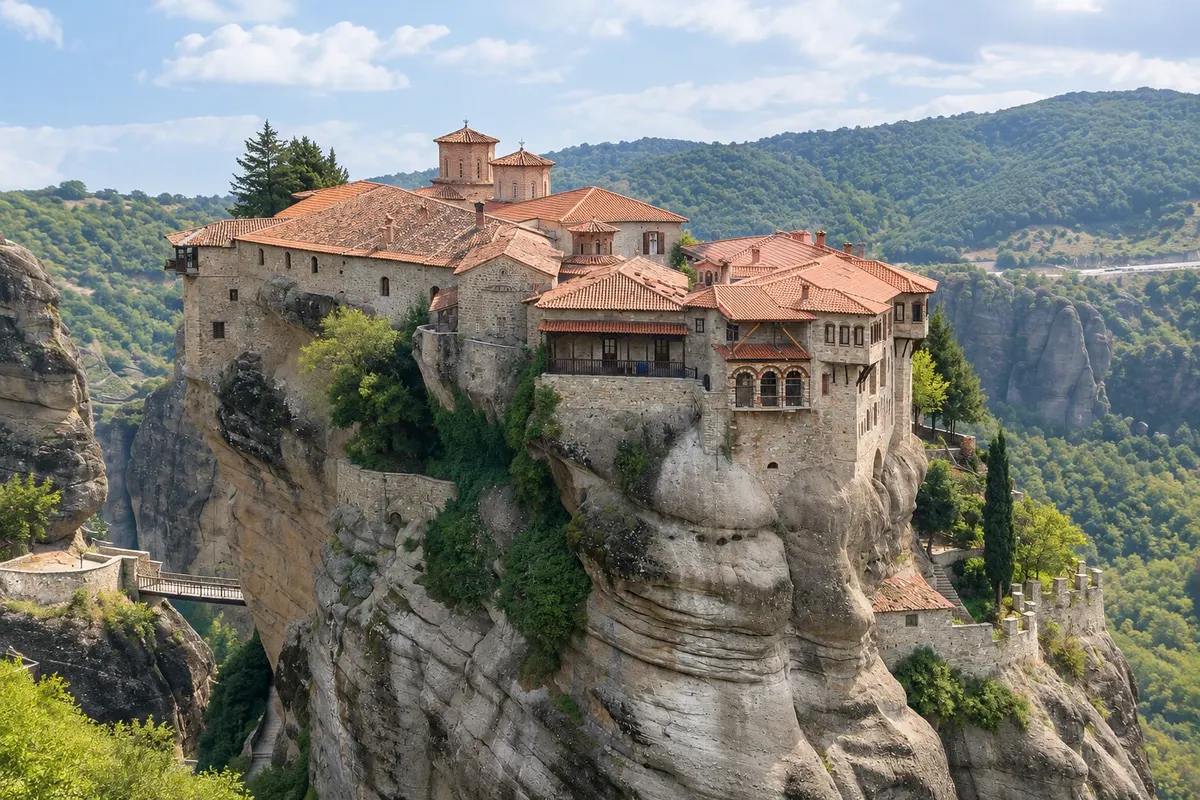
Monastery · Kalambaka, Tessália
Mosteiro de Varlaam (Moni Varlaam)
Second largest monastery in Meteora, opposite the Grande Meteoro. Church of All Saints from 1541, frescoes from 1548 attributed to Frangos Katelanos, a tower with the hauling mechanism and the old net, and a museum of manuscripts and vestments.
Illustrative images. The pictures in this guide are illustrations based on the real place, not photographs, and may differ from it.

Discover
About Mosteiro de Varlaam (Moni Varlaam)
Varlaam is named after the hermit who lived on this rock in the 14th century. The present monastery began in 1517, when the brothers Theophanes and Nectarios Apsaras, from Ioannina, climbed the pillar and rebuilt the abandoned chapel. The main church, dedicated to All Saints, was erected in 1541 and 1542, and the interior paintings bear the date 1548; they are attributed to Frangos Katelanos, a painter from Thebes. The narthex was painted in 1566 by the brothers Georgios and Frangos Kontaris.
The rock stands about 370 meters above the valley and the stone staircase has roughly 195 steps, after a bridge. Beside the entrance is the hauling tower, with the net and rope that for centuries were the only access; the wooden wheel is still used to raise supplies, and you can see the small trolley that now does that work on a cable.
The old refectory houses the museum, with manuscripts, rare books, icons, embroidered vestments and liturgical objects. In the courtyards are the cellar with a large wooden barrel, the chapel dos Três Hierarcas, with paintings from 1627, and balconies from which you can see the Grande Meteoro head-on and Rousanou below.
It is an active male monastery. It usually closes on Fridays, and in winter also on Thursdays; hours are shorter from November to March. Check before you go.
Before you go
Practical information
Cidade Turismo reviews its information regularly, but something may have changed. Check with the place before planning your trip.
How much time to set aside
From 1 hour to 1 hour 30 minutes, including the climb and the museum.
Best time
In the morning, just after the Grande Meteoro, or in the early afternoon when the groups have already descended. It usually closes on Fridays (and on Thursdays in winter); check.
How to get there
It is on the monasteries' road, about 5 km from Kastraki, just before the Grande Meteoro; the access bridge departs from a parking area by the road. The local bus stops nearby. On foot, from the Grande Meteoro it is about a 10-minute walk along the road, or via the old trail that descends from Kastraki and passes the Varlaam rock.
Tip
Look at the hauling tower right at the entrance and ask to see the wooden wheel from the inside if the gate is open. The north-side balcony is the best spot to photograph the entire Grande Meteoro. The museum is small but has pieces from the 16th century; allow half an hour for it.
Get your questions answered
Frequently asked questions about Mosteiro de Varlaam (Moni Varlaam)
Who painted the church of Varlaam?
The katholikon paintings, dated 1548, are attributed to Frangos Katelanos, a painter from Thebes. The narthex was painted in 1566 by the brothers Georgios and Frangos Kontaris.
Does the crane net still work in Varlaam?
The tower, the wooden wheel and the net are still in place and are still used to hoist supplies. People no longer climb up in it; visitor access is via the stone staircase, opened in the 1920s.
How many steps does Varlaam have?
About 195 steps, after a short bridge from the car park. There are handrails for almost the entire route.
On which day is Varlaam closed?
It usually closes on Fridays; in winter it also closes on Thursdays. Confirm before you go, as days can change.