

 Brazil
 Argentina
 Chile
Chile Colombia
 Peru
Peru Uruguay
 Germany
 Belgium
 Spain
Spain Greece
 the Netherlands
 Ireland
 Italy
Italy Portugal
 the United Kingdom
 Switzerland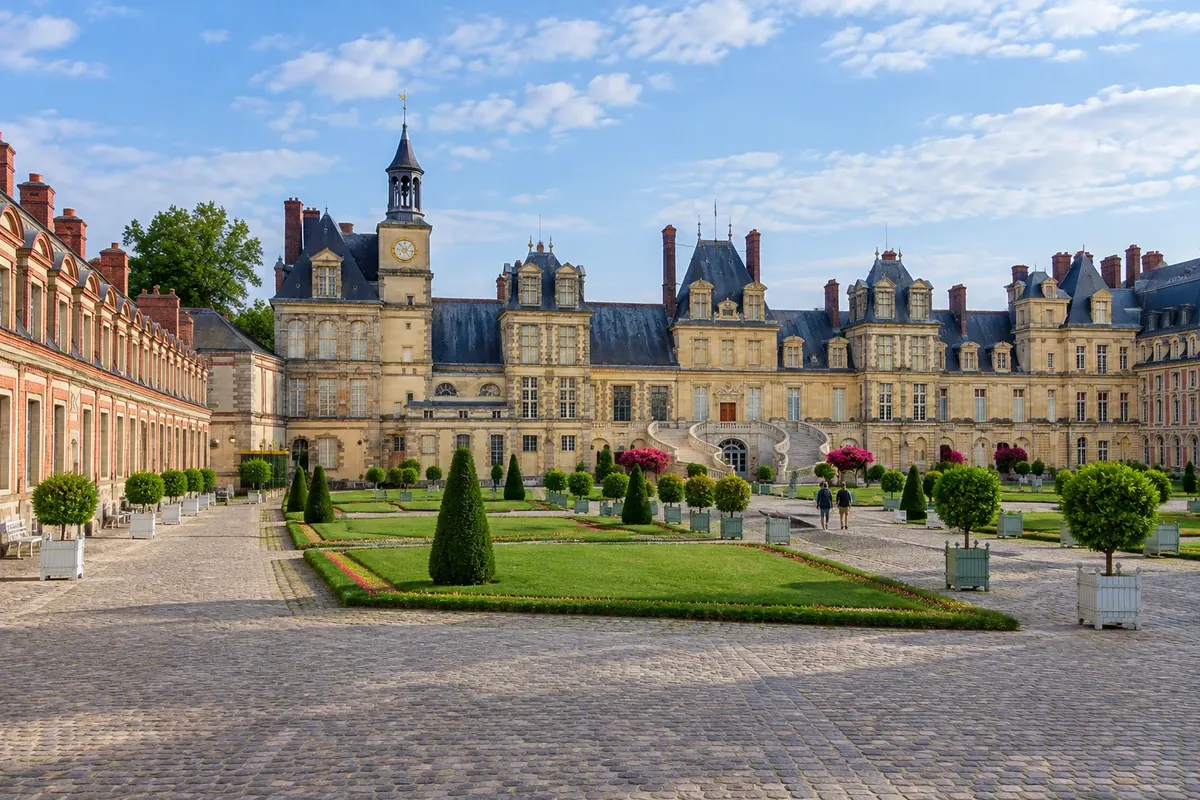
Castle · Fontainebleau, Ilha de França
Château de Fontainebleau
The castle used by the kings of France for about eight centuries, with the Galerie François Ier, the horseshoe staircase of the Cour des Adieux and Le Nôtre's gardens. Entrance to the park and gardens is free.
Illustrative images. The pictures in this guide are illustrations based on the real place, not photographs, and may differ from it.

Discover
About Château de Fontainebleau
The Château de Fontainebleau was the residence of France's kings from the medieval period up to Napoleon III. Each left his mark, so the castle combines styles from different eras. Napoleon called it the true house of kings, the house of centuries. The castle and park have been a UNESCO World Heritage Site since 1981.
Francis I brought Italian artists, such as Rosso Fiorentino and Primaticcio, to decorate the castle in the 16th century. The result is the Galerie François Ier, with frescoes, stuccoes and carved wood, which spread the Renaissance through France. The route also goes through the Ballroom, Napoleon's Throne Room, Marie Antoinette's apartments and Napoleon III's Imperial Theatre.
At the main entrance is the Cour du Cheval Blanc, better known as the Cour des Adieux. It was there, at the foot of the horseshoe staircase, that Napoleon bade farewell to the Imperial Guard on 20 April 1814, before departing into exile on the island of Elba.
The gardens are part of the visit and can be seen without entering the castle. The Grand Parterre, designed by André Le Nôtre, covers 11 hectares; the Étang aux Carpes has a pavilion in the middle of the water; the Jardin Anglais and the Jardin de Diane complete the ensemble. Behind the parterre begins the Grand Canal, which was opened in the time of Henry IV.
Before you go
Practical information
Cidade Turismo reviews its information regularly, but something may have changed. Check with the place before planning your trip.
How much time to set aside
2 to 3 hours for the castle. With the gardens and park, half a day.
Best time
On weekdays, in the morning. The castle is closed on Tuesdays and on 1 January, 1 May and 25 December. From May to September the gardens stay open later and the park is greener. Check opening times before you go.
How to get there
From Fontainebleau-Avon station, the line 1 bus takes about 15 minutes to the castle; on foot it's about 40 minutes. The station receives trains from Gare de Lyon in Paris in about 40 minutes.
Tip
Combine the castle in the morning with a walk in the park in the afternoon: the gardens and park are free, and the Grand Canal is good for relaxing. The castle has a restaurant at lunchtime; in town, the streets around the place Napoléon Bonaparte are full of cafés and restaurants.
Official website
Get your questions answered
Frequently asked questions about Château de Fontainebleau
On which day is the castle closed?
On Tuesdays and on 1 January, 1 May and 25 December. The gardens and park have their own opening hours. Check before you go.
Do you have to pay to see the gardens?
No. Entrance to the castle's gardens and park is not charged under normal conditions. The ticket is only for the interior of the castle.
Fontainebleau or Versailles: which to choose?
They are different. Versailles shows the court of Louis XIV in a single, unified project; Fontainebleau brings together eight centuries of rulers, from the Renaissance to Napoleon, and usually has far fewer visitors. If you have time you should see both on separate days.
What happened in the Cour des Adieux?
On 20 April 1814, after abdicating, Napoleon bade farewell there to the Imperial Guard before going into exile on the island of Elba. The courtyard got its name because of that farewell.