

 Brazil
 Argentina
 Chile
Chile Colombia
 Peru
Peru Uruguay
 Germany
 Belgium
 France
 Greece
 the Netherlands
 Ireland
 Italy
Italy Portugal
 the United Kingdom
 Switzerland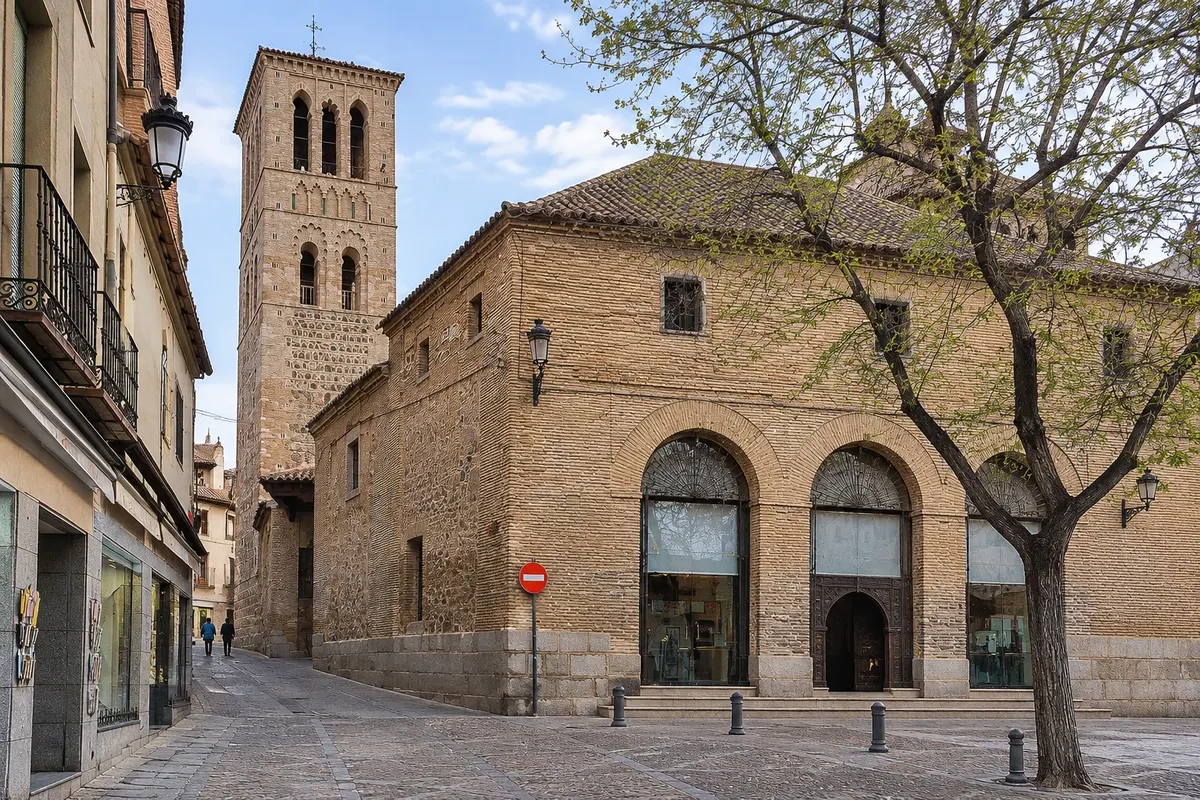
Church · Toledo, Castela-Mancha
Iglesia de Santo Tomé
Mudejar-tower church that houses The Burial of the Lord of Orgaz, painted by El Greco in 1586 for the chapel where the lord of Orgaz himself was buried.
Illustrative images. The pictures in this guide are illustrations based on the real place, not photographs, and may differ from it.

Discover
About Iglesia de Santo Tomé
The church is mentioned in the 12th century, built over an 11th-century mosque. At the beginning of the 14th century it was in ruins and was rebuilt by Gonzalo Ruiz de Toledo, lord of Orgaz and governor of the city, who transformed the old minaret into the Mudejar tower that can still be seen.
Gonzalo Ruiz died in 1323 and asked to be buried there. Legend has it that at his burial Saint Stephen and Saint Augustine descended from heaven to place him in the tomb. In 1586, the parish priest Andrés Núñez commissioned El Greco to paint a picture of that miracle for the burial chapel.
The Burial of the Lord of Orgaz, also called the Burial of the Count of Orgaz, divides the canvas into two parts: below, the burial, with contemporary Toledan nobles dressed in black; above, the heaven welcoming the soul. Beneath the painting lies the Latin tombstone, with gilded letters, written by Álvar Gómez de Castro.
The tourist visit is limited to the chapel of the painting, with entrance from the back of the church. The rest of the building, with three naves, continues to function as a parish church.
Before you go
Practical information
Cidade Turismo reviews its information regularly, but something may have changed. Check with the place before planning your trip.
How much time to set aside
About 15 to 20 minutes. The visit is only to the chapel of the painting.
Best time
Right at opening or near the end of the day. Mid-morning the queue and the room are often full of groups. Check opening hours before you go.
How to get there
It is on the Plaza del Conde, on Calle de Santo Tomé, on the route between the cathedral and the judería, about a ten-minute walk from the cathedral.
Tip
Notice the boy in black, to the left of the painting: it is often said that he is El Greco's son. Entrance is included in the Pulsera Turística.
Official website
Get your questions answered
Frequently asked questions about Iglesia de Santo Tomé
Where is 'The Burial of the Count of Orgaz'?
In the Iglesia de Santo Tomé, in the same chapel where the lord of Orgaz was buried. The painting never left the place for which it was painted.
When did El Greco paint the painting?
In 1586, commissioned by the parish priest Andrés Núñez.
How long does the visit take?
About 15 to 20 minutes. Only the chapel with the painting is open to tourists.
Why is he sometimes called 'Señor' and other times 'Count of Orgaz'?
Gonzalo Ruiz de Toledo was lord of Orgaz. The painting's popular name, however, spread as 'The Burial of the Count of Orgaz'.