

 Brazil
 Argentina
 Chile
Chile Colombia
 Peru
Peru Uruguay
 Germany
 Belgium
 France
 Greece
 the Netherlands
 Ireland
 Italy
Italy Portugal
 the United Kingdom
 Switzerland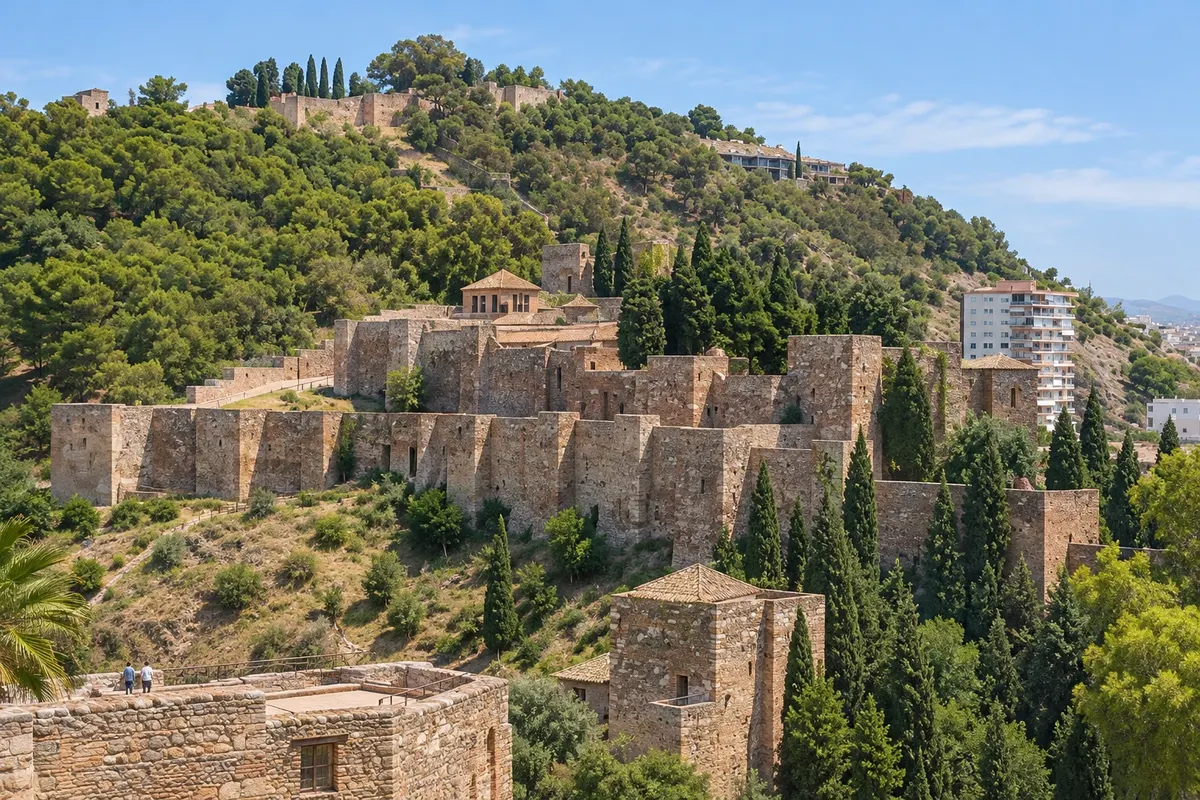
Fortress · Málaga, Andaluzia
Alcazaba de Málaga
Islamic palace-fortress from the 11th century on the slope of Monte Gibralfaro, with double walls, courtyards, gardens and fountains, next to the Teatro Romano.
Illustrative images. The pictures in this guide are illustrations based on the real place, not photographs, and may differ from it.

Discover
About Alcazaba de Málaga
The Alcazaba occupies the slope of Mount Gibralfaro, attached to the historic center. It was built in the 11th century, during the taifa period, on top of an older fortification of Phoenician and Punic origin. The Hamudí dynasty, the last caliphs of Córdoba, used the enclosure as a residence.
The architect Leopoldo Torres Balbás considered the Alcazaba the prototype of taifa military architecture because of its double line of walls and its many towers. Inside it functions like a palace: rectangular courtyards, gardens, reflecting pools and rooms such as the Cuartos de Granada, in the Nasrid tradition. Today it covers 15,000 square meters, less than half its original size.
The fortress passed to the Almoravids in 1092, to the Almohads in 1146 and to the Nasrid kingdom of Granada in 1279. In 1487 the Catholic Monarchs besieged the city from 5 May until August. The Alcazaba surrendered on 18 August, and Gibralfaro held out for two more days.
After centuries of abandonment, earthquakes and bombardment, restoration began in the 1930s with Torres Balbás and the scholar Juan Temboury. In 1931 the Alcazaba was declared a historical-artistic monument. A zigzag wall, the coracha, links it to the Castillo de Gibralfaro at the top of the hill.
Before you go
Practical information
Cidade Turismo reviews its information regularly, but something may have changed. Check with the place before planning your trip.
How much time to set aside
About 1 to 1.5 hours. Add about 1 hour if you also climb to the Castillo de Gibralfaro.
Best time
Early, at opening, to see the courtyards with fewer people and the morning light on the fountains. From June to August, avoid midday: the climb is in the sun. The Alcazaba usually opens every day.
How to get there
The main entrance is on Calle Alcazabilla, next to the Teatro Romano, a few minutes' walk from the Catedral and the Plaza de la Constitución. The route is uphill, with ramps and stone steps.
Tip
There is usually a combined ticket with the Castillo de Gibralfaro, but the two have separate entrances and are at different levels of the hill. Wear closed shoes: the surface is irregular stone and can be slippery. Opening hours vary by season; check before you go.
Official website
Get your questions answered
Frequently asked questions about Alcazaba de Málaga
How long does a visit to the Alcazaba take?
Generally, one to one and a half hours, allowing time to stroll through the courtyards and gardens. If you want to combine it with the Castillo de Gibralfaro, reserve a half day for both.
Are the Alcazaba and the Castillo de Gibralfaro the same place?
No. They are two fortifications linked by a wall, the coracha. The Alcazaba is on the hillside, next to the center, and was the palace; Gibralfaro sits on the top of the hill and housed the troops. Each has its own entrance.
Who built the Alcazaba of Málaga?
The present construction dates from the 11th century, during the taifa period. The Hammudid dynasty used it as a residence, and some sources attribute the work to King Badis ben Habus, with marbles reused from the nearby Teatro Romano.
Does the visit require a lot of physical effort?
There are climbs, ramps and stone steps, but the stretches are short. In very hot weather, from June to August, it's best to go in the morning and bring water.