

 Brazil
 Argentina
 Chile
Chile Colombia
 Peru
Peru Uruguay
 Germany
 Belgium
 France
 Greece
 the Netherlands
 Ireland
 Italy
Italy Luxembourg
 Portugal
 the United Kingdom
 Switzerland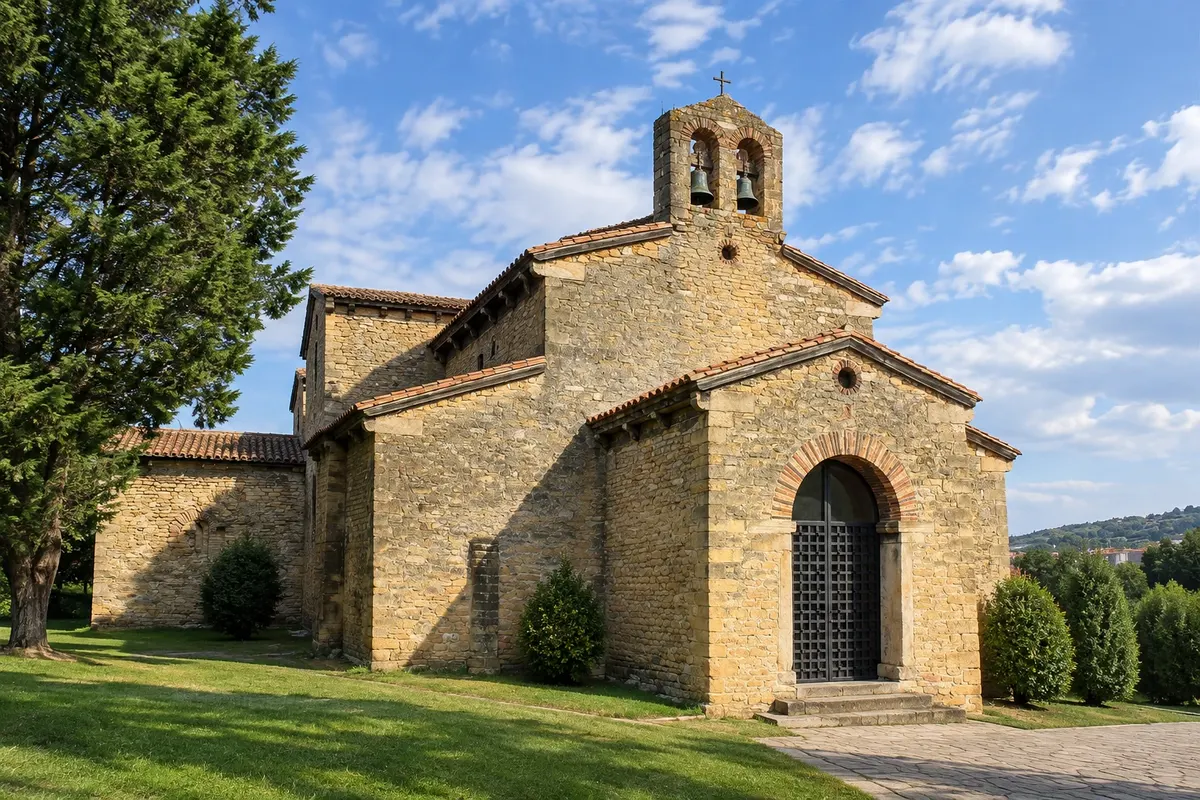
Church · Oviedo, Astúrias
San Julián de los Prados
Pre-Romanesque church from the early 9th century, commissioned by Afonso II, the largest preserved from the period, with mural paintings of architectural motifs inspired by Roman art; World Heritage.
Illustrative images. The pictures in this guide are illustrations based on the real place, not photographs, and may differ from it.

Discover
About San Julián de los Prados
San Julián de los Prados, called by locals Santullano, is one of the main works of Asturian art. It was commissioned by King Afonso II, the Chaste, in the early 9th century, then outside the city, and is dedicated to the Egyptian martyrs Julian and Basilissa. It is the largest pre-Romanesque church preserved in Spain.
It has a basilica plan with three naves, separated by square piers and round arches, and a tall transept that stands out from the complex. At the east end there are three vaulted chapels. An arch in the form of a triumphal arch separates the area reserved for the clergy from the rest of the church.
The church's great treasure is the mural paintings, which cover the walls with painted architectures, columns, curtains and buildings, inspired by Roman painting, without human figures. They form the most important ensemble of mural painting of the High Middle Ages on the Iberian Peninsula.
The church was declared a monument in 1917 and a World Heritage site in 1998. Today it stands in a neighbourhood of the city, next to a busy road.
Before you go
Practical information
Cidade Turismo reviews its information regularly, but something may have changed. Check with the place before planning your trip.
How much time to set aside
30 to 45 minutes.
Best time
At the visiting hours, which vary throughout the year; check before you go.
How to get there
It is on rua Selgas, in the Pumarín neighbourhood, about 1.5 km from the old town, roughly a 20-minute walk.
Tip
Ask to see the apse paintings at leisure: the painted architectures are the rarest part of the visit.
Get your questions answered
Frequently asked questions about San Julián de los Prados
Who built San Julián de los Prados?
King Afonso II, o Casto, in the early 9th century.
What is special about the paintings?
They are mural paintings of architectural elements and curtains inspired by Roman art, the most important ensemble of the Early Middle Ages on the Iberian Peninsula.
Why is the church called Santullano?
It is the popular form of the name San Julián in the region.