

 Brazil
 Argentina
 Chile
Chile Colombia
 Peru
Peru Uruguay
 Belgium
 Spain
Spain France
 Greece
 the Netherlands
 Ireland
 Italy
Italy Luxembourg
 Portugal
 the United Kingdom
 Switzerland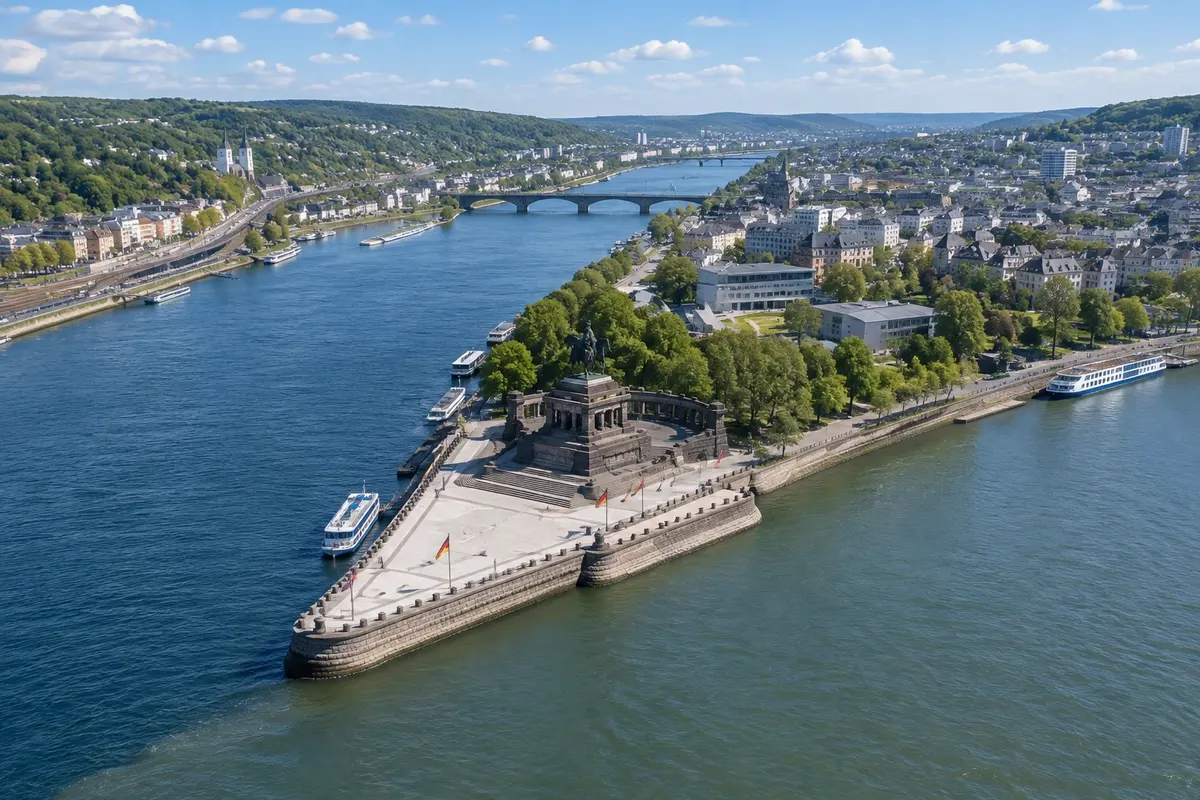
Monument · Koblenz, Renânia-Palatinado
Deutsches Eck
The point of land where the Mosela empties into the Reno, with the equestrian monument to Emperor Guilherme I atop a pedestal with steps and a viewpoint over both rivers.
Illustrative images. The pictures in this guide are illustrations based on the real place, not photographs, and may differ from it.

Discover
About Deutsches Eck
The Deutsches Eck, the German corner, is the spit of land where the Mosela meets the Reno, at the edge of Koblenz’s city centre. The name comes from the Teutonic Order, the German knights who settled there in the 13th century and whose old headquarters, the Deutschherrenhaus, stands beside it. The embankment that forms the current point was built at the end of the 19th century to receive a monument.
That monument is the equestrian statue of Emperor William I, unveiled in 1897, atop a stone pedestal with steps. In 1945, in the final months of the Second World War, the statue was knocked down by artillery fire, and the empty pedestal remained for decades as a memorial to German unity, flying the flags of the country’s states. A copper replica was returned to the top of the pedestal in 1993, after Germany’s reunification.
For visitors, the main attraction is the view. The pedestal steps lead to a terrace from which you can see the darker waters of the Mosela mixing with those of the Reno, the Ehrenbreitstein fortress on the opposite bank, and the traffic of boats. Along the shore are three blocks of the Muro de Berlim, recalling reunification, and the row of flags of the German states.
Boat tours on the Reno and Mosela depart from the Deutsches Eck, and a few steps away is the lower station of the cable car to the fortress. The basílica de São Castor and the Ludwig Museum, for modern art, are on the same block.
Before you go
Practical information
Cidade Turismo reviews its information regularly, but something may have changed. Check with the place before planning your trip.
How much time to set aside
From 30 minutes to 1 hour, including the climb up to the pedestal terrace and the walk along the riverside.
Best time
In the late afternoon, when the light hits the Ehrenbreitstein fortress across the Reno. Early in the morning the place is quieter. In the warm months the riverside has benches and outdoor cafés.
How to get there
It’s about a 10-minute walk from the old town, following the Mosela’s bank, and roughly 30 minutes on foot from the main station. City buses stop nearby. The lower station of the cable car to Ehrenbreitstein is on the route, next to the basílica de São Castor.
Tip
Combine it with the cable car: from the cabin you can see the entire tip of the Deutsches Eck, with the meeting of the rivers. Sightseeing boats depart from the quay nearby; check schedules during the season.
Get your questions answered
Frequently asked questions about Deutsches Eck
What is the Deutsches Eck?
It is the headland in Koblenz where the Mosela flows into the Reno, with the equestrian monument to Emperor Guilherme I. The name comes from the Ordem Teutônica, which had its headquarters beside it.
Is the statue at the Deutsches Eck original?
No. The 1897 statue was taken down in 1945, at the end of the Second World War. The one there now is a replica, placed in 1993.
Can you climb up the monument?
Yes. A staircase leads to the pedestal terrace, with views of the confluence of the two rivers and of the Ehrenbreitstein fortress.
What are the concrete blocks near the monument?
They are three segments of the Berlin Wall, installed on the riverbank as a memorial to German reunification.