

 Brazil
 Argentina
 Chile
Chile Colombia
 Peru
Peru Uruguay
 Belgium
 Spain
Spain France
 Greece
 the Netherlands
 Ireland
 Italy
Italy Portugal
 the United Kingdom
 Switzerland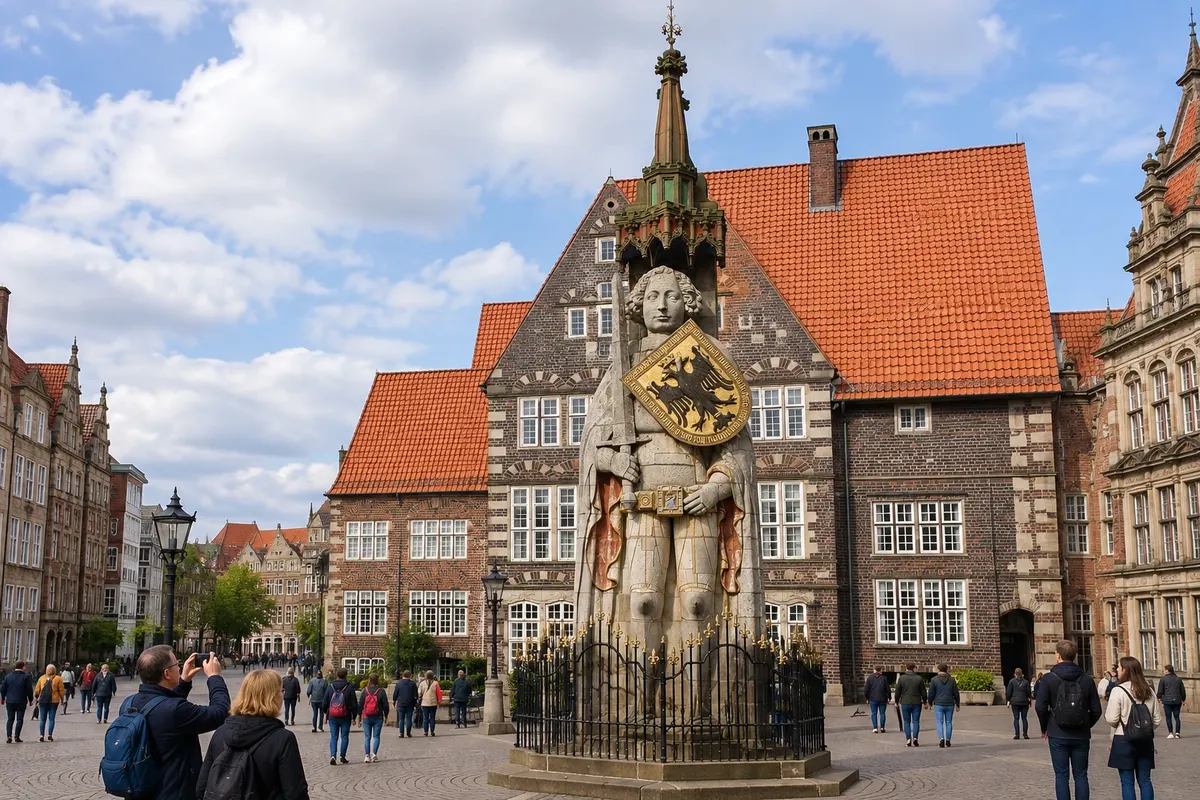
Monument · Bremen, Bremen
Bremer Roland
Stone statue from 1404 in the Marktplatz, symbol of the city's freedoms. At 5.47 meters, not counting the pedestal and baldachin, it is the largest free-standing statue of the German Middle Ages and a UNESCO World Heritage Site.
Illustrative images. The pictures in this guide are illustrations based on the real place, not photographs, and may differ from it.

Discover
About Bremer Roland
The Roland of Bremen was erected by the city council in 1404, replacing a wooden figure that was burned in 1366. The limestone statue measures 5.47 meters and, with its supporting column and Gothic baldachin, exceeds 10 meters. It is considered the oldest preserved stone Roland statue and the largest free-standing statue of the German Middle Ages.
Roland, the legendary paladin of Charlemagne, became in several towns of northern Germany a symbol of market rights and autonomy. In Bremen, the raised sword and the shield bearing the imperial eagle represent the city's claim to answer only to the emperor.
In 2004 UNESCO included the Roland, together with the town hall, on the World Heritage list. The original head was replaced by a replica in the 1980s and is housed in the Focke-Museum, the city's history museum.
A local tradition says that whoever rubs Roland's knee will return to Bremen: the dark shine on the knees shows how many people have done it. According to legend, as long as Roland stands, Bremen will remain free.
Before you go
Practical information
Cidade Turismo reviews its information regularly, but something may have changed. Check with the place before planning your trip.
How much time to set aside
Ten to fifteen minutes, taking the opportunity to see the details of the armor and shield.
Best time
Early in the morning or in the early evening, when there are fewer people around to photograph the whole statue with the town hall in the background.
How to get there
It stands in the middle of the Marktplatz, in front of the town hall, about a ten-minute walk from the central station. Trams stop at Domsheide and Obernstraße.
Tip
Notice the distance between the statue's knees: according to tradition, it served as the city's official measure of length, the Bremen rod. And if you want to follow the custom, rub the knee to ensure your return.
Get your questions answered
Frequently asked questions about Bremer Roland
Who was Roland?
A legendary paladin of Emperor Charlemagne. In several cities in northern Germany his statue came to symbolize market rights and autonomy vis-à-vis local lords.
Why do people rub Roland's knee?
Tradition says that whoever rubs the statue's knee will return to Bremen. That's why the knees are darker and smoother than the rest of the stone.
Is the statue original?
The statue dates from 1404 and has undergone restorations over the centuries. The head was replaced by a copy in the 1980s, and the original is in the Focke-Museum, Bremen's history museum.