

 Brazil
 Argentina
 Chile
Chile Colombia
 Peru
Peru Uruguay
 Belgium
 Spain
Spain France
 Greece
 the Netherlands
 Ireland
 Italy
Italy Portugal
 the United Kingdom
 Switzerland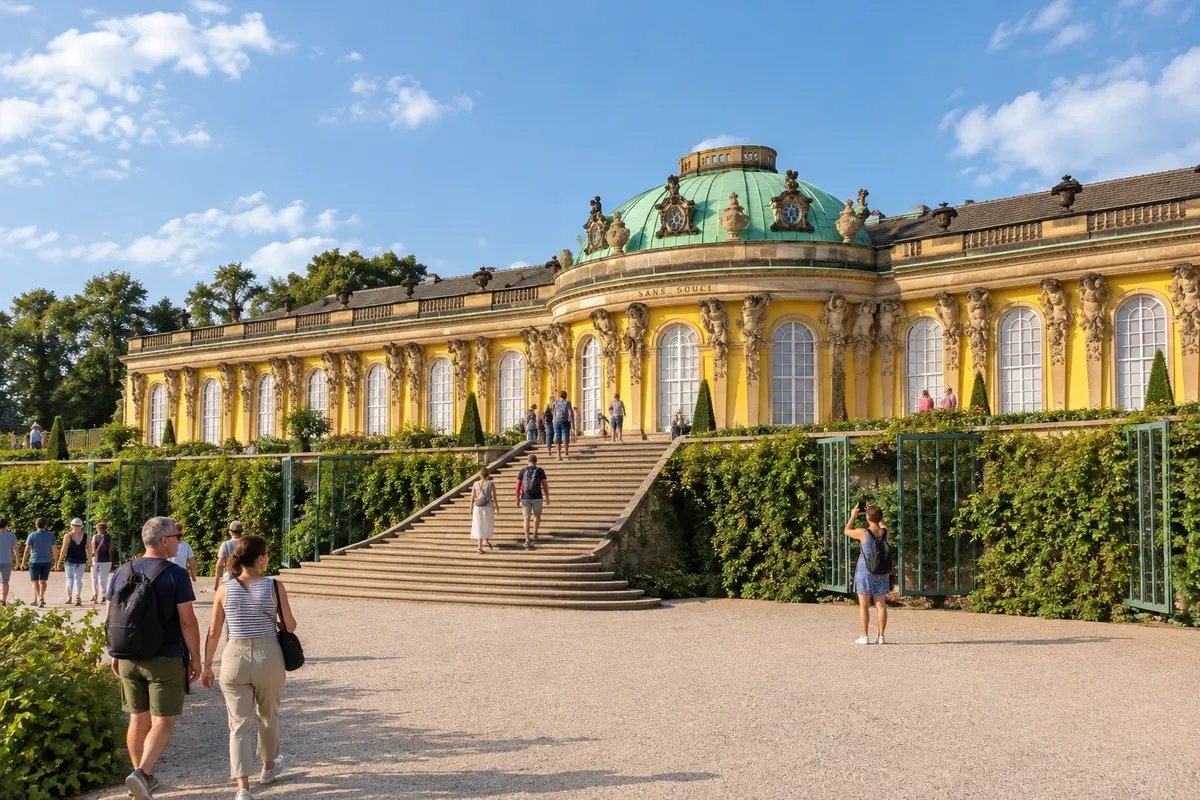
Palace · Potsdam, Brandemburgo
Schloss Sanssouci
Summer palace of Frederick the Great, atop vineyard terraces. 18th-century Rococo, original rooms and the king's tomb on the upper terrace.
Illustrative images. The pictures in this guide are illustrations based on the real place, not photographs, and may differ from it.

Discover
About Schloss Sanssouci
Schloss Sanssouci is the summer palace that Frederick II, the Great, commissioned between 1745 and 1747, designed by Georg Wenzeslaus von Knobelsdorff. The name comes from the French sans souci, "without worry", and sums up what the king wanted from the place: a retreat away from the court where he spent the warm months with his dogs, his books and his guests.
The palace has a single storey and sits atop six terraced levels planted as a vineyard. Inside, the rooms preserve 18th-century Rococo decoration: the concert hall, the king's library and the marble salon, with its dome, where he received philosophers such as Voltaire. It is part of the ensemble of palaces and parks of Potsdam and Berlin, inscribed as a UNESCO World Heritage Site in 1990.
On the upper terrace, beside the palace, is the tomb of Frederick the Great. He asked to be buried there, but the wish was only fulfilled in 1991, more than two centuries after his death. Visitors often leave potatoes on the gravestone, a reminder that it was the king who encouraged cultivation of the tuber in Prussia.
Beside it are the Bildergalerie, the picture gallery built for the king's collection, and the Neue Kammern, a former orangery converted into a guesthouse. Just behind appears the Historische Mühle, the windmill linked to a famous legend about the king and a miller who refused to demolish the building.
Before you go
Practical information
Cidade Turismo reviews its information regularly, but something may have changed. Check with the place before planning your trip.
How much time to set aside
About 1 hour for the palace interior (with a timed entry), and another hour for the terraces, the tomb and the neighbouring buildings.
Best time
In the morning, right at opening, when entry slots are still available. The terraces are most in bloom from May to September. The palace is closed on Mondays; check times before you go, because they change between the April–October season and winter.
How to get there
From Potsdam Hauptbahnhof station, buses run to the "Schloss Sanssouci" stop at the foot of the terraces (line 695 usually covers the route; check the region's journey planner). On foot, starting from Potsdam's Brandenburger Tor, it's about a 15-minute walk along the avenue that leads into the park.
Tip
Visits to the interior have fixed entry times and the number of tickets per day is limited: buy online in advance, especially in summer and on weekends. There is a combined ticket for several Potsdam palaces on the same day, which can also include the Neues Palais.
Official website
Get your questions answered
Frequently asked questions about Schloss Sanssouci
Do you need to buy tickets in advance for Sanssouci?
It's recommended. Entrance to the palace has fixed time slots and the number of tickets per day is limited. On the day itself, leftover tickets are sold at the visitor centre by the historic mill, but in high season they usually sell out early.
Can you see the terraces and the tomb without entering the palace?
Yes. The terraces, the tomb of Frederico, o Grande, and the park are open to the public during the day, and there is no charge to enter the park. The ticket is for the interior of the palace.
On which day is the palace closed?
Schloss Sanssouci is usually closed on Mondays. On that day, the Neues Palais on the other side of the park is usually open. Check before you go.
Why are there potatoes on the king's tomb?
It's a popular tribute: Frederico, o Grande, encouraged potato cultivation in Prussia in the 18th century, and visitors leave the tuber on the tombstone as a memento.