

 Brazil
 Argentina
 Chile
Chile Colombia
 Peru
Peru Uruguay
 Belgium
 Spain
Spain France
 Greece
 the Netherlands
 Ireland
 Italy
Italy Portugal
 the United Kingdom
 Switzerland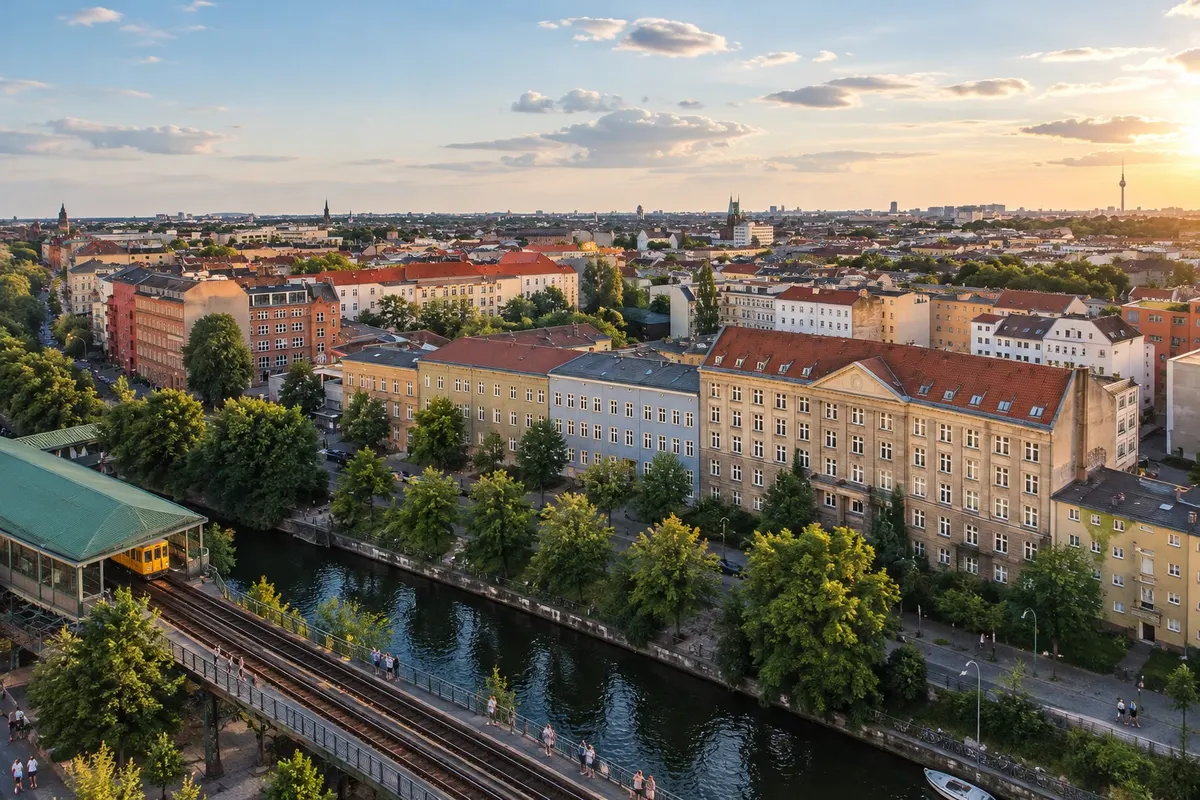
Neighborhood · Berlim, Berlim
Kreuzberg
Multicultural neighborhood south of the center, with a strong Turkish presence, cafés, bars, markets, the Landwehrkanal and the Oberbaumbrücke over the Spree.
Illustrative images. The pictures in this guide are illustrations based on the real place, not photographs, and may differ from it.

Discover
About Kreuzberg
Kreuzberg is one of Berlim’s best-known neighborhoods. During the city’s division it was in Berlim Ocidental, next to the Muro, and attracted immigrants—mainly from Turquia—students and artists, who occupied old buildings with low rents. That past explains the mix that still characterizes the neighborhood: Turkish shops, alternative culture, street art and nightlife.
The neighborhood has two halves with different characters. The eastern part, around Oranienstraße and the square Kottbusser Tor, concentrates bars, restaurants, independent shops and graffiti. The western part, near Bergmannstraße, has late-19th-century buildings, cafés with sidewalk seating and the covered market Marheineke. There is also Viktoriapark, with the hill Kreuzberg, which gives the neighborhood its name and has a monument by Schinkel at the top.
The Landwehrkanal cuts through the neighborhood and, on warm afternoons, its banks fill with people. In the east, the Oberbaumbrücke, a brick bridge with neo-Gothic towers, crosses the Spree toward Friedrichshain and the East Side Gallery. The Markthalle Neun, a 19th-century covered market, brings together producers and food stalls.
In the north of the neighborhood are the Museu Judaico and the Deutsches Technikmuseum, and within short distance are Checkpoint Charlie and Topographie des Terrors. Kreuzberg is also the neighborhood of the Berlin-style döner kebab, served in Turkish bread.
Before you go
Practical information
Cidade Turismo reviews its information regularly, but something may have changed. Check with the place before planning your trip.
How much time to set aside
Half a day to walk between Oranienstraße, the Landwehrkanal and the Oberbaumbrücke; one evening for bars and restaurants.
Best time
In the late afternoon and at night, when bars and restaurants fill up. From May to September the banks of the Landwehrkanal become lively. On Sundays most shops are closed.
How to get there
The U-Bahn stations Kottbusser Tor (U1, U3 and U8), Görlitzer Bahnhof (U1 and U3) and Schlesisches Tor (U1 and U3) serve the eastern part; Mehringdamm (U6 and U7) and Gneisenaustraße (U7) the western part.
Tip
The U1 line, between Kottbusser Tor and Schlesisches Tor, runs on an elevated viaduct and gives a good view of the neighborhood. Watch your belongings in crowded places, such as stations and parks at night.
Get your questions answered
Frequently asked questions about Kreuzberg
What to do in Kreuzberg?
Walk along Oranienstraße and Bergmannstraße, see the banks of the Landwehrkanal, cross the Oberbaumbrücke, eat at a covered market like Markthalle Neun, and enjoy the bars and restaurants at night.
Why does Kreuzberg have so much Turkish influence?
From the 1960s, many workers from Turkey settled in the neighborhood, which was next to the Wall in Berlim Ocidental and had lower rents.
Which is the most central metro station in Kreuzberg?
Kottbusser Tor, served by lines U1, U3 and U8, is in the middle of the eastern part, near Oranienstraße.