Serra dos Órgãos National Park: Suspended Trail, pools and natural swimming hole
Odhod: Teresópolis headquarters gate, Avenida Rotariana, Soberbo on foot; by car via Estrada da Barragem while parking spots are available 3 to 4 hours morning or afternoon easy
The lower sector of the Teresópolis headquarters is the park’s simplest outing and is suitable for all ages. Just after the gate are the Visitor Center, with a scale model of the trails, panels about the fauna and flora and mountaineer Mozart Catão’s belongings, and the natural swimming hole fed by the Paquequer River, the most popular bathing area. Nearby are the Poço do Castelo, reached by a short staircase, the Poço Dois Irmãos and the Bosque Santa Helena, a flat, shaded spot with stone tables and benches designed in the 1940s.
From the gate the Estrada da Barragem climbs — a cobblestone road about 3 km long, with signs every 500 meters, viewpoints, outdoor showers and small cascades. It can be done on foot in about two hours round trip, or by car. It ends at Praça da Barragem, where water from the Beija-Flor River is captured for the city; swimming is not allowed there.
The Suspended Trail starts at the square: a 1.3 km wooden boardwalk with handrails, built over an early 20th-century aqueduct, rising up to eight meters above the ground at canopy level. It is wheelchair accessible on the way in; because the exit is by stairs, wheelchair users return the same way. One of the staircases descends to Poço Ceci and Peri, named after characters from O Guarani, José de Alencar’s novel set on the banks of the Paquequer.
The park is open Tuesday through Sunday and on holidays, and closed on Mondays. Each visitor must present photo ID and CPF, or a passport. There is a daily vehicle limit, on a first-come, first-served basis. Pets, glass, campfires, barbecues and sound equipment are not permitted.
Kraji na poti: Serra dos Órgãos National Park, Visitor Center, Natural pool, Poço do Castelo, Poço Dois Irmãos, Santa Helena Grove, Barragem Road, Suspended Trail, Poço Ceci e Peri, Barragem Square.
Vključuje: Access to the Visitor Center, bathing areas and the short trails. Check at the gate whether an entrance fee and parking fee are charged on the day of your visit.
Nasvet: Arrive early on weekends and holidays because of the vehicle limit. The water is cold year-round. With overcast weather at the headwaters or heavy rain, stay out of the pools: the river level rises quickly.
Najboljši čas za obisk: November to March for swimming, in the morning; May to September for hiking in dry weather.
Park lookouts: Cartão Postal, Mozart Catão and 360 trails
Odhod: Estrada da Barragem, Teresópolis headquarters of Serra dos Órgãos National Park on foot 2 to 3 hours morning moderate
Three short trails from the Teresópolis park headquarters lead to lookouts and can be done separately or joined into a circuit. All start from Estrada da Barragem and have dirt paths with roots, stones and steps.
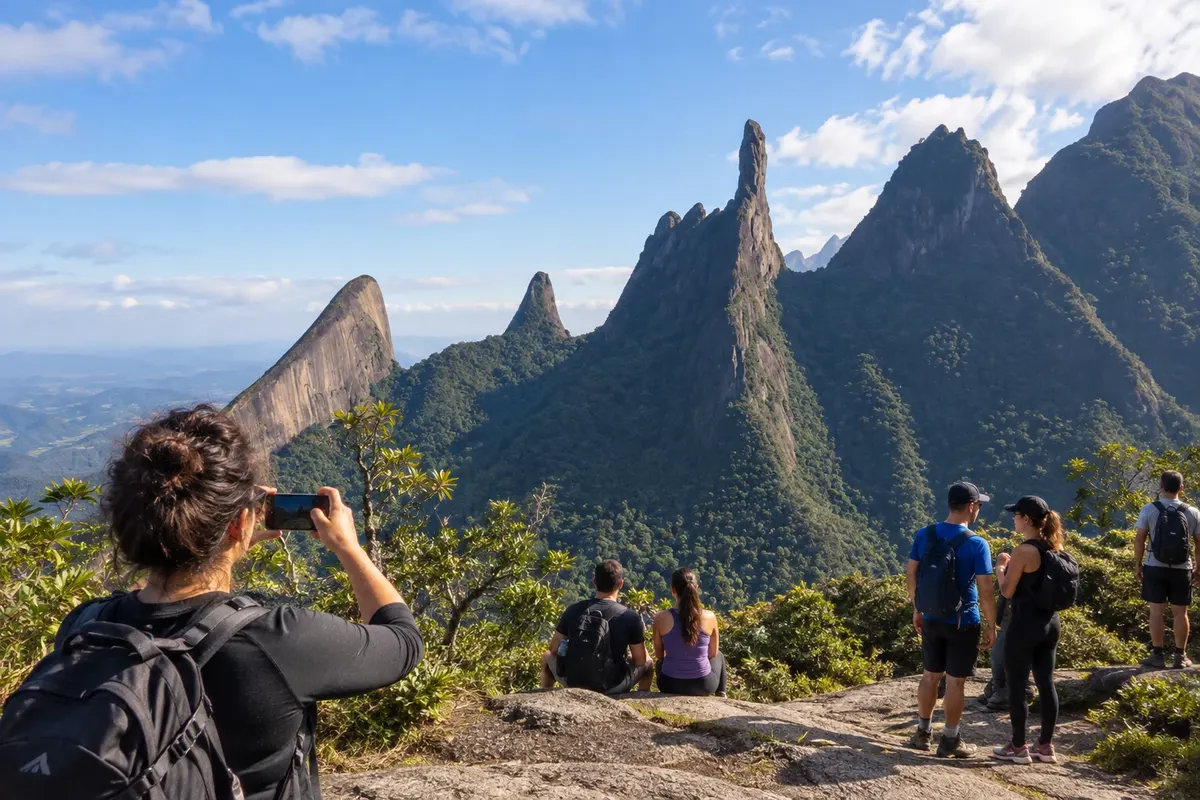
The Cartão Postal Trail is 1.2 km and takes about two hours round-trip. It crosses forest with large trees, including a jequitibá, and ends at a lookout facing the Serra dos Órgãos range, offering a view of Dedo de Deus from inside the forest.
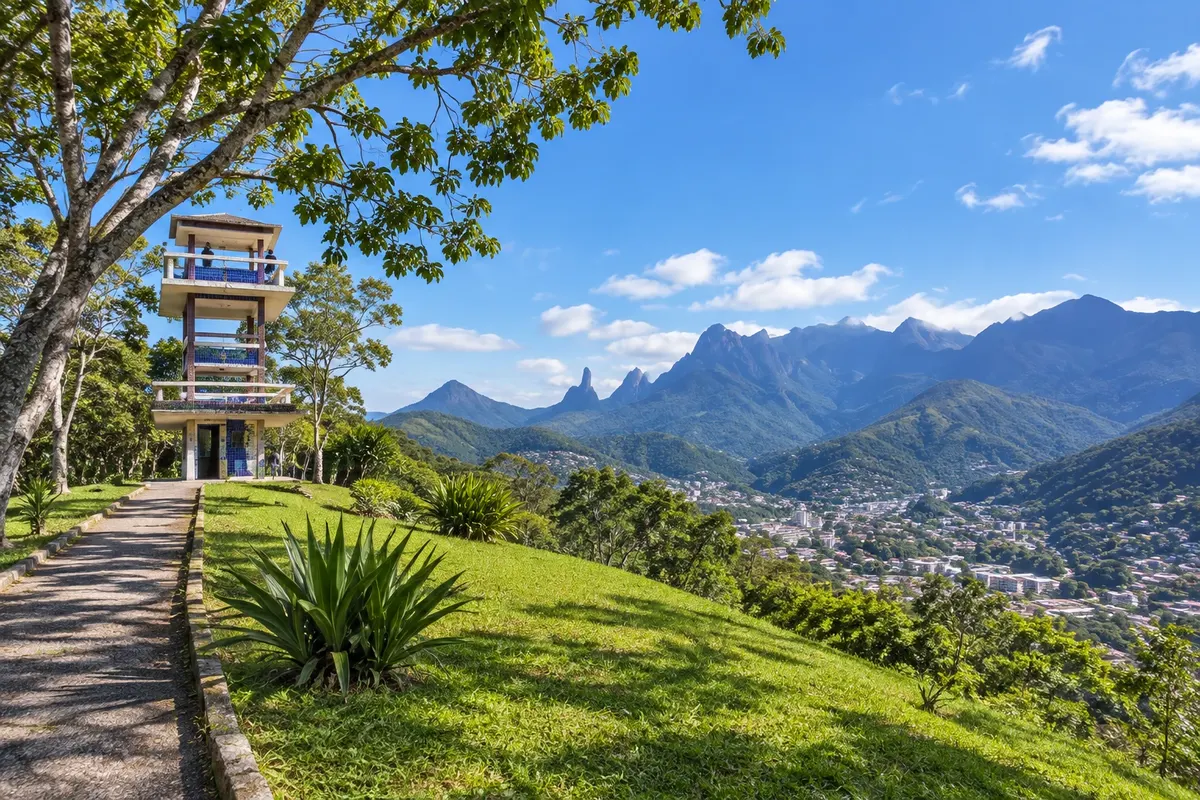
The Mozart Catão Trail is 800 meters and about one and a half hours round-trip. It crosses small streams and climbs the slope to the Mirante Alexandre Oliveira, from where you can see the town and, beyond it, the mountains of the Três Picos State Park. The names honor two mountaineers from Teresópolis who died on Aconcagua in 1998.
The 360 Trail connects the two along the ridge. The circuit is 2.6 km and takes around two and a half hours; with detours to the three lookouts it reaches 4 km and three hours. The highlight is Mirante Borandá, which on clear days shows the Serra dos Órgãos on one side and the city of Rio de Janeiro in the distance.
There is no need to book or hire a guide for these trails. Bicycles are not allowed. Park entry rules apply: photo ID and CPF, or passport; the gate is closed on Mondays.
Kraji na poti: Postcard Trail, Mozart Catão Trail, Alexandre Oliveira Viewpoint, 360 Trail, Borandá Viewpoint, Dedo de Deus.
Vključuje: Access to the three trails. Check at the gate whether an entrance fee is charged on the day of your visit.
Nasvet: Go in the morning: fog tends to rise and cover the lookouts in the afternoon, especially from November to March. Bring water and closed shoes with non-slip soles.
Najboljši čas za obisk: May to September, when skies are usually clearer.
Pedra do Sino: the ascent to the highest point of the Serra dos Órgãos
Odhod: Barragem Square, Teresópolis headquarters of Serra dos Órgãos National Park on foot, with a backpack 5 to 6 hours ascent only (about 11 km) a full day or two days strenuous
Pedra do Sino, at about 2,263 meters, is the highest point of the Serra dos Órgãos. The trail is a classic of Brazilian mountaineering: roughly 11 km of continuous ascent from the upper part of the Teresópolis headquarters, just over one thousand meters in altitude, taking five to six hours of walking for those who are fit. The first section runs inside the forest, partly over old paving, and passes two waterfalls that serve as stopping points. Above 2,000 meters the forest gives way to highland fields. From the summit, on clear days, the view reaches Guanabara Bay, the city of Rio de Janeiro and part of the Paraíba Valley.
To go and return on the same day no appointment is required. Visitors fill out the Risk and Rules Acknowledgement Form beforehand and present it at the Visitor Center within the entry window, which is early in the morning. Access to the high part has a daily limit of people, and the park’s guidance is to begin descending in the early afternoon. To sleep on the mountain, in a camping area near Abrigo 4, it is mandatory to request scheduling from ICMBio. There is no trash collection up there: everything that goes up must come back down.
Pedra do Sino is also the last section of the Petrópolis–Teresópolis crossing, about 30 km, which is usually done in three days starting from Bonfim, in Petrópolis. From the same gate other mountain trails depart, such as Agulhinha do Beija-Flor, which is shorter, and the trails to Morro da Cruz and Papudo.
A guide is not mandatory, but the park maintains a list of accredited guides. Fog can rise suddenly and the temperature drops quickly, even in summer.
Kraji na poti: Pedra do Sino, Abrigo 4, Véu da Noiva Waterfall, Barragem Square, Serra dos Órgãos National Park.
Vključuje: Trail access. Overnight stays depend on scheduling with ICMBio; a guide, if hired, is paid separately.
Nasvet: Bring a flashlight, warm layer, rain jacket, food and water for the first section. Confirm the entry window and trail conditions with the park the day before. If you lack mountain experience, go with a licensed guide.
Najboljši čas za obisk: From May to September, in the dry, cool season when the sky at the summit is usually clearer.
Mirante do Soberbo, Dedo de Deus and Pedra do Elefante
Odhod: Soberbo, at the entrance to Teresópolis on BR-116 car, taxi or rideshare; the trail is on foot 30 minutes at the lookout; about 2 hours with the trail morning easy; moderate with the trail
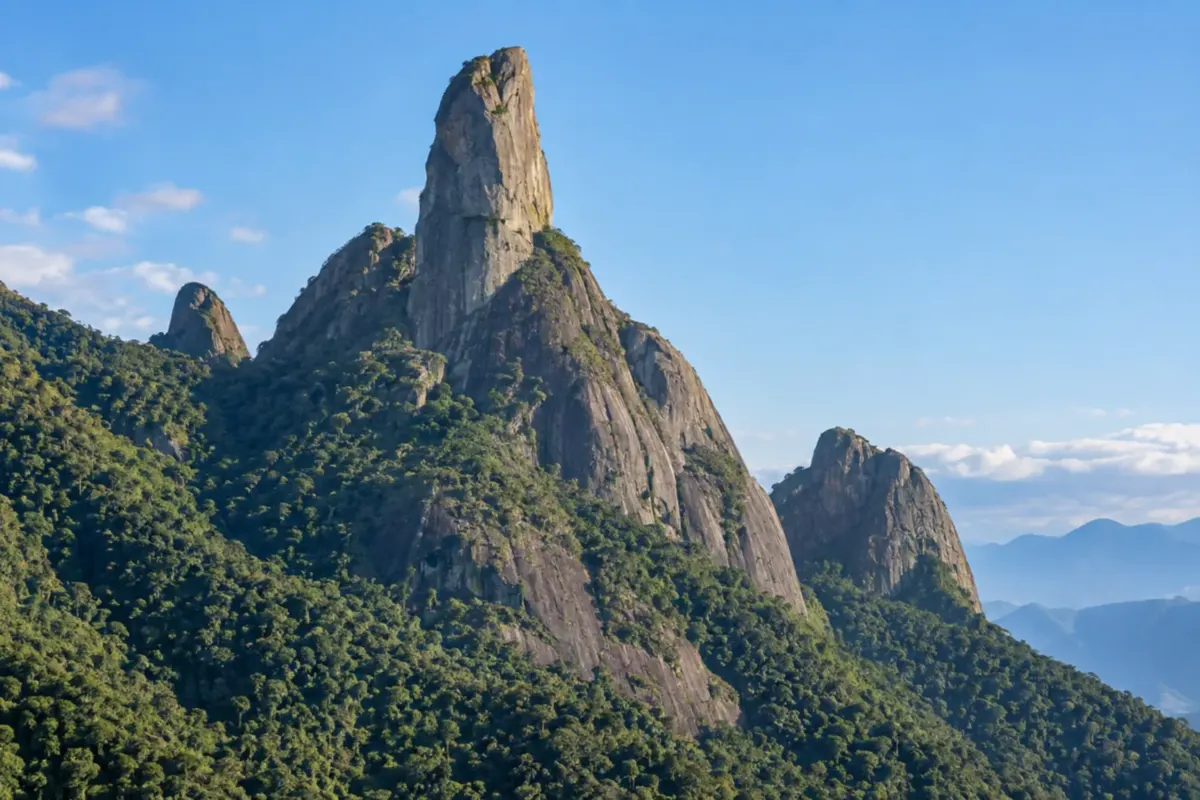
The Mirante do Soberbo sits high on the climb of the mountain along BR-116, at the point where the road reaches Teresópolis. It is the city’s best-known view: Dedo de Deus, at 1,692 meters, and the neighboring peaks of the same massif — Escalavrado, Dedo de Nossa Senhora and Cabeça de Peixe. On clear days you can also see the Baixada Fluminense and Guanabara Bay. Dedo de Deus is the symbol of Brazilian mountaineering and appears on the municipal flag, with the Latin motto meaning “under the Finger of God.”
Next to the lookout are the statue of Empress Teresa Cristina, who gave the city its name, a city-run tourist information booth open every day, and a craft shop selling goods by local producers. The entrance gate of Serra dos Órgãos National Park and Piscina Sloper, a river bathing area beside an old railway bridge, are a few minutes away on Avenida Rotariana.
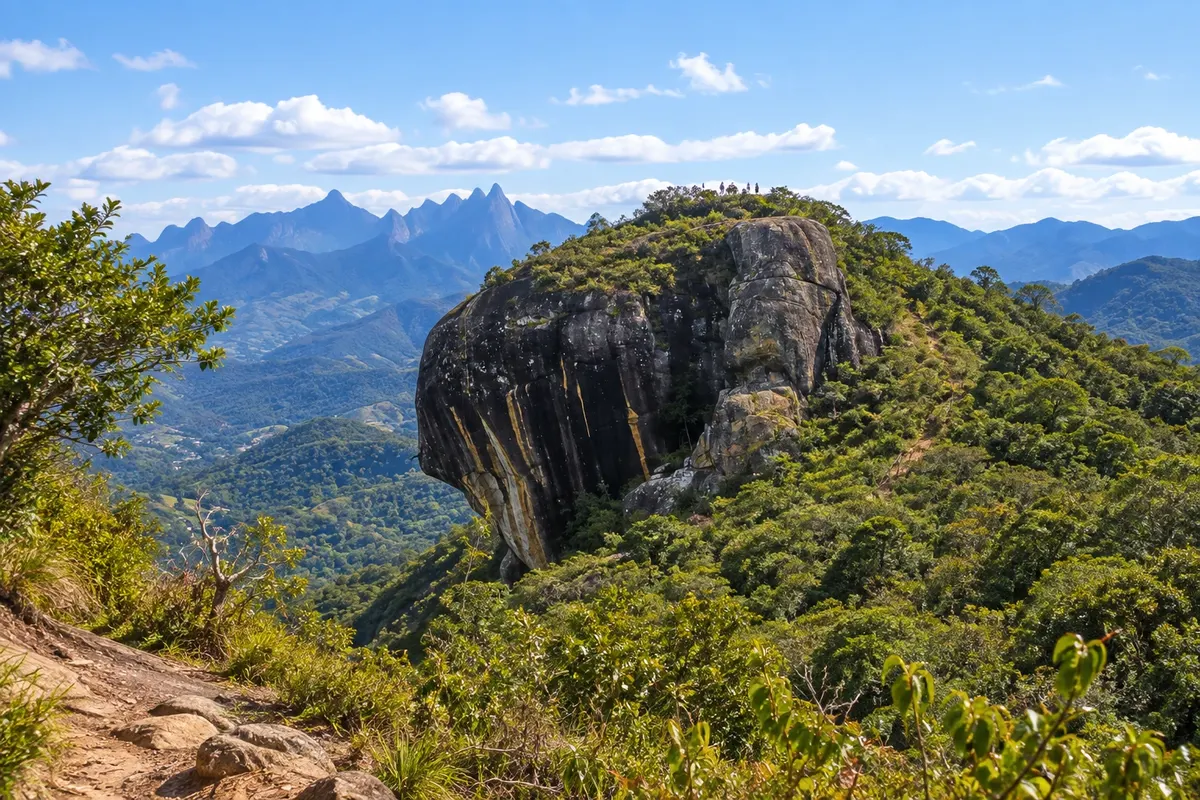
Those who want more can climb Pedra do Elefante. The trail starts beside BR-116, near the lookout, is 800 meters long and is a steep, steady ascent with some sections where you’ll use your hands. The summit, at 1,180 meters, shows the Serra dos Órgãos, Guanabara Bay, the city entrance and Lago Comary. The area belongs to the Três Picos State Park.
Climbing Dedo de Deus is another story: it’s only possible via rock-climbing routes, requiring technique, equipment and the national park’s rules.
Kraji na poti: Mirante do Soberbo, Dedo de Deus, Statue of Empress Teresa Cristina, Pedra do Elefante, Guanabara Bay.
Vključuje: Self-guided stop; there is no entrance fee for the lookout.
Nasvet: Stop by the lookout early: that’s when the mountain usually is clear. If fog rolls in, try again on your way back. On the Pedra do Elefante trail, avoid rainy days because wet rock is slippery.
Najboljši čas za obisk: May to September, when skies are clearer; in summer, the mornings.
Alto on foot: Alto Market, Feirarte and surroundings
Odhod: Higino da Silveira Square, Alto neighborhood on foot 3 to 4 hours morning or afternoon easy
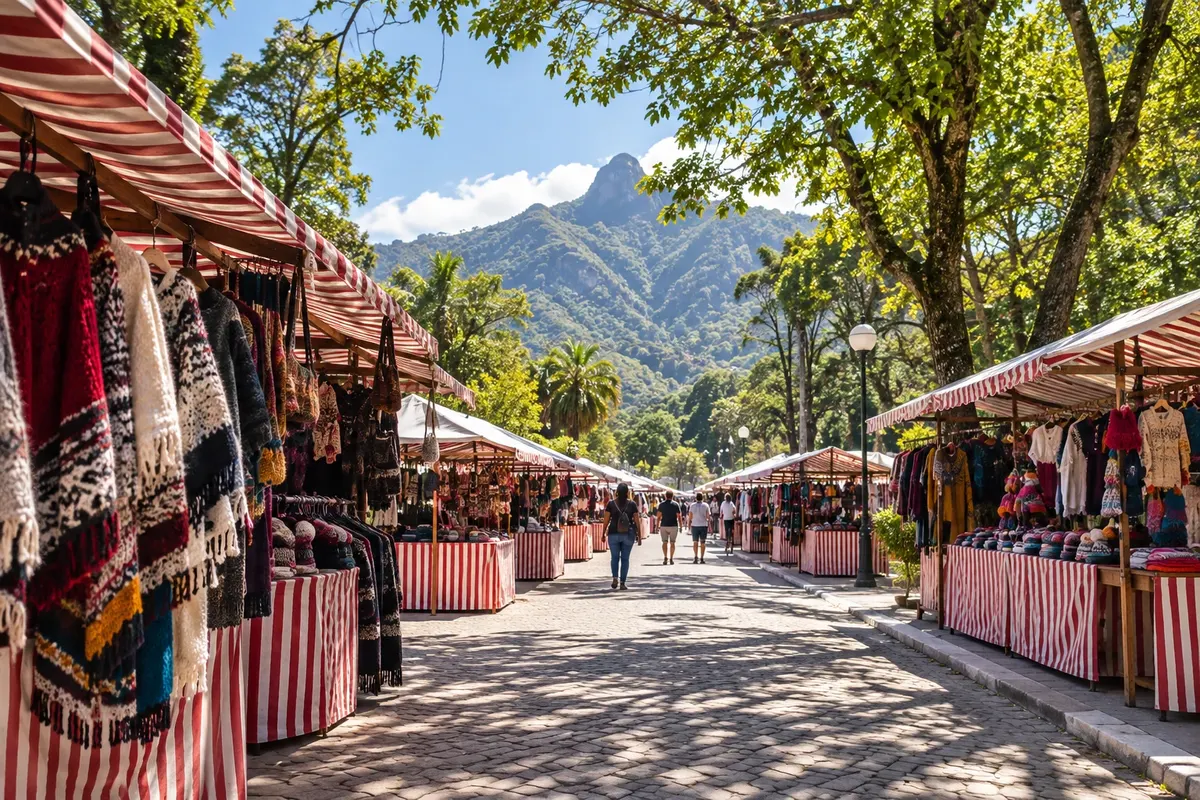
Alto is Teresópolis’s most visited neighborhood and is explored on foot. The heart of everything is the Alto Market, Feirarte, in Higino da Silveira Square. It started in 1973, when artisans began displaying their goods in the square, was formalized by the city in 1977 and is listed as the municipality’s historical and cultural heritage. There are more than 500 stalls, divided into sections: clothes and knitwear from small manufacturers, winter coats, leather, knitting, home décor, costume jewelry and woodcrafts. The food court sells regional dishes, homemade sweets, cheeses and smoked products, and there is a playground for children. The market operates on Saturdays, Sundays and national holidays, during daytime hours.
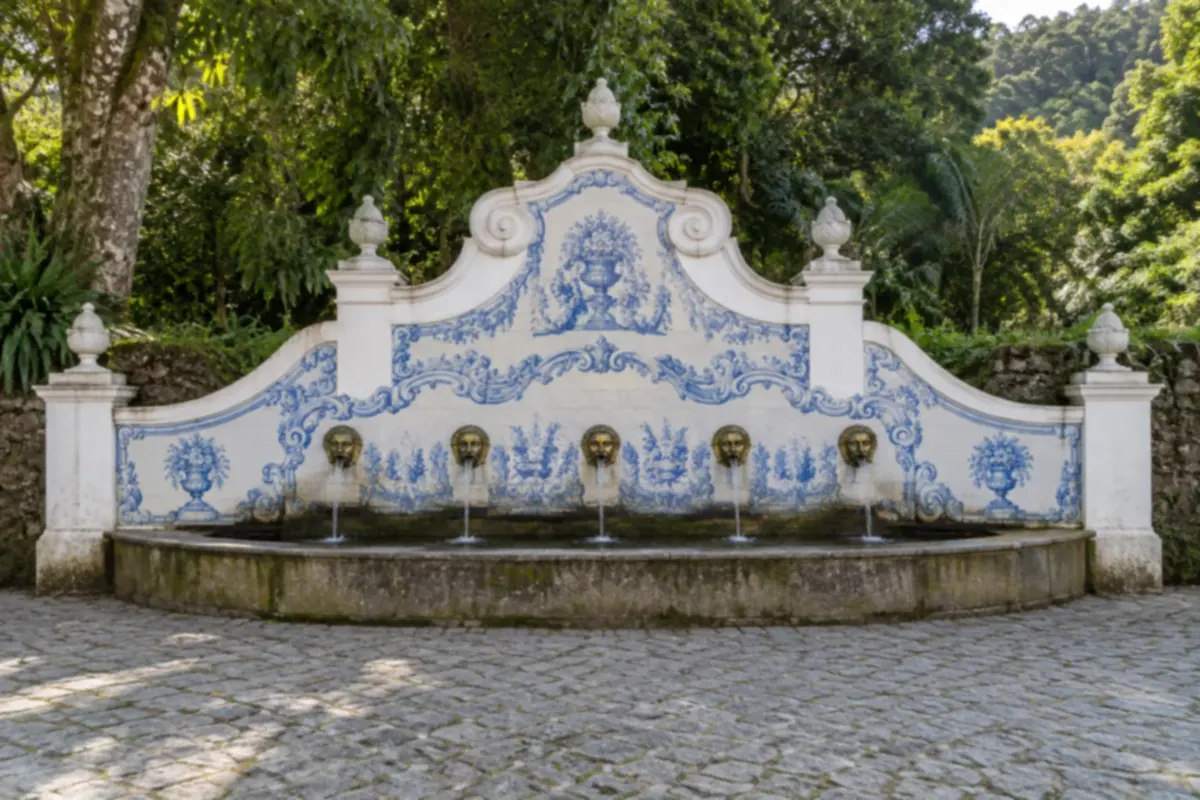
A few minutes’ walk up Dona Olga de Oliveira Street is the Judith Fountain. The spring has existed since 1920 and took its current form in 1967: a colonial-style structure covered with Portuguese tile panels by ceramist Jorge Colaço, with five water spouts in the shape of fauns. The name recalls the girl Judith, daughter of a former landowner, who according to tradition was healed by its water.
On Avenida Oliveira Botelho, the neighborhood’s main street, is the Santo Antônio do Paquequer Parish, founded in 1855, the city’s oldest religious institution. In June the saint’s festival, with a novena, procession and stalls, fills the surrounding streets; June 13 is a municipal holiday. On the same avenue stands the former Higino hotel-casino, a 1930s half-timbered building listed by the municipality, which today hosts shows and events.
To finish, the Adolpho Bloch House of Culture, in the neighboring Fátima neighborhood, has exhibition galleries, a theater and a glass façade facing the Serra dos Órgãos.
Kraji na poti: Alto Market, Feirarte, Higino da Silveira Square, Judith Fountain, Santo Antônio do Paquequer Parish, Avenida Oliveira Botelho, Adolpho Bloch House of Culture.
Vključuje: Self-guided outing. No admission is charged for the market, the Judith Fountain or the House of Culture; purchases and meals are extra.
Nasvet: On weekends in June and July Alto fills up and parking becomes difficult: arrive near the market opening or go by taxi. From Monday to Friday the square is empty; on those days the neighborhood is worth visiting for the Judith Fountain and the restaurants.
Najboljši čas za obisk: All year, on Saturdays, Sundays and public holidays; from May to August the market displays winter collections.
Comary Lake, Granja Comary and Municipal Nursery
Odhod: Carlos Guinle neighborhood car, taxi or ride-hailing to the entrance; on foot at the lake and the hortomarket 2 to 3 hours morning or afternoon easy
Comary Lake is an artificial lake of about 106,000 square meters, created in 1930 by entrepreneur Carlos Guinle when he parceled out the former Fazenda Comary. The water surface is a municipal heritage site and has the Serra dos Órgãos in the background, with Dedo de Deus. It lies inside a residential condominium: visitors enter on foot during the day and leave their car on the streets outside.
On the lake’s shore is Granja Comary, the training center of the Brazilian Football Confederation, opened in 1987. This is where the Brazilian national team assembles and trains before tournaments and friendlies. The facilities are closed to the public; what you can see is the entrance gate and the set of fields from outside. For many people, a photo at the gate of the “team’s house” already justifies the walk.
A few minutes away, in the same neighborhood, the Carlos Guinle Municipal Nursery is the plant nursery that produces the plants for the city’s squares and also a recreational park. It has a walking track, short trails, a sensory garden with aromatic and medicinal plants, a picnic area, a playground and a dog area. The Municipal Butterfly House operates inside it, a conservatory where you walk among free butterflies and observe their life stages, from egg to chrysalis, with guided visits. The nursery is open Tuesday through Sunday and on holidays, and there is a tourist information booth that operates Friday through Sunday.
Kraji na poti: Comary Lake, Granja Comary, CBF Training Center, Carlos Guinle Municipal Nursery, Municipal Butterfly House.
Vključuje: Self-guided. There is no entrance fee for the lake, the municipal nursery, or the butterfly house.
Nasvet: On days when the national team trains, access to the lake may change: check before you go. The hortomarket is a good plan for visitors with small children.
Najboljši čas za obisk: All year; from May to September, on clear days, Dedo de Deus appears behind the lake more often.


 Antarktika
 Argentina
 Bolivija
 Čile
 Kolumbija
 Ekvator
 Gvajana
 Francoska Gvajana
 Falklandski otoki (Malvini)
 Paragvaj
 Peru
 Surinam
 Urugvaj
 Venezuela
 Nemčija
 Avstrija
 Belgija
 Hrvaška
 Danska
 Slovaška
 Slovenija
 Španija
 Finska
 Francija
 Grčija
 Nizozemska
 Madžarska
 Irska
 Islandija
 Italija
 Luksemburg
 Norveška
 Poljska
 Portugalska
 Združeno kraljestvo
 Češka
 Švedska
 Švica
 Turčija
 Bermudi
 Kanada
 Združene države Amerike
 Grenlandija
 Mehika
 Sveta Peter in Mihael
 Dominikanska republika
 Japonska
 Južnoafriška republika
 Egipt
 Avstralija
 Fidži
 Nova Zelandija
 Papua Nova Gvineja