

 Brazil
 Argentina
 Chile
Chile Colombia
 Peru
Peru Uruguay
 Germany
 Belgium
 France
 Greece
 the Netherlands
 Ireland
 Italy
Italy Portugal
 the United Kingdom
 Switzerland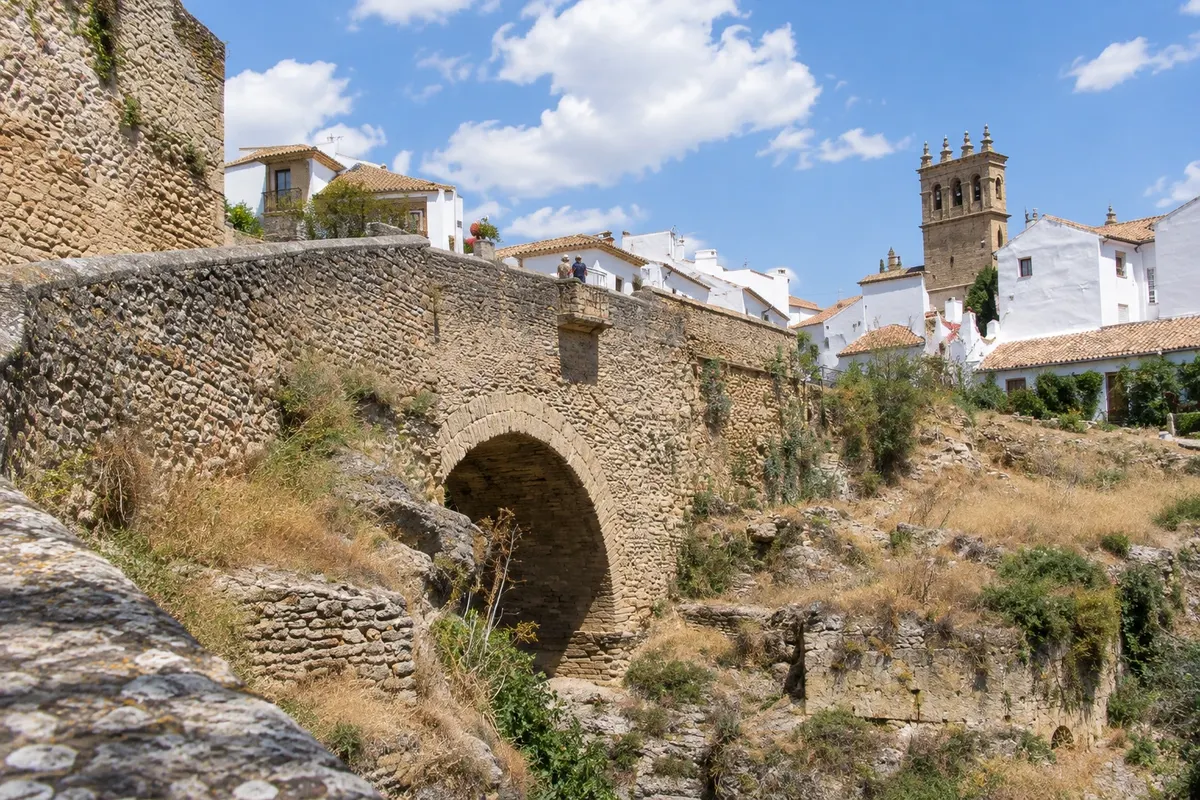
Bridge · Ronda, Andaluzia
Puente Viejo
Single-arched bridge over the Guadalevín, 31 metres above the river, rebuilt after 1616, beside the Arco de Felipe V, the old entrance gate of La Ciudad.
Illustrative images. The pictures in this guide are illustrations based on the real place, not photographs, and may differ from it.

Discover
About Puente Viejo
Before the Puente Nuevo, this bridge was the main link between the old town and the Mercadillo district. Until the 18th century it was called La Puente Nueva. When the large bridge was completed, it became known as the Puente Viejo, the old bridge.
Its origin is debated. Some authors describe a Roman bridge rebuilt by Berbers, and most consider it to be of Muslim date. After the 1485 conquest it was in ruins: in 1486 the king ordered the fortress governor to rebuild it. In 1616 a flood of the river swept it away again, and the bridge was rebuilt in the 17th century.
The bridge has a single arch with a 10-metre span, 31 metres above the river. In one restoration, the tall 17th-century parapets were lowered and four balconies overlooking the river were added, from which you can see the bottom of the Tajo and, in the distance, the Puente Nuevo.
At the city end stands the Arco de Felipe V, dated 1742. It replaced the old Puerta de la Puente, of Arabic origin, after the first Puente Nuevo collapsed in 1741 and traffic returned to this route. The arch is double, built of ashlar, with three pinnacles, the shell of the Anjous and the royal coat of arms of the Bourbons.
Before you go
Practical information
Cidade Turismo reviews its information regularly, but something may have changed. Check with the place before planning your trip.
How much time to set aside
About 15 to 20 minutes for the bridge, the balconies and the Arco de Felipe V.
Best time
On the route between the centre and the Baños Árabes, in the morning or at the end of the afternoon. In the European winter, from December to February, the low light of sunset illuminates the bottom of the gorge.
How to get there
It is about 200 metres from the Puente Nuevo, descending via Calle Santo Domingo or Calle Real to the Arco de Felipe V. The Baños Árabes are just below.
Tip
Do the loop: Puente Nuevo, Casa del Rey Moro, Arco de Felipe V, Puente Viejo, Baños Árabes and return along the wall to the old town. Stop at the bridge viewpoints to photograph the Tajo.
Get your questions answered
Frequently asked questions about Puente Viejo
How many bridges cross the Tajo of Ronda?
Three: the Puente Nuevo, the largest; the Puente Viejo, a single‑arch bridge 31 metres above the river; and the Puente Árabe, the lowest, next to the Baños Árabes.
Why is it called Puente Viejo?
It was called La Puente Nueva until the 18th century. When the large bridge was completed in 1793, the old one came to be called Ponte Velha.
What is the Arco de Felipe V?
It is the city gate at the tip of the Puente Viejo, built in 1742 on the site of the old Arab Puerta de la Puente. It has a double stone arch and the Bourbon coat of arms.