

 Brazil
 Argentina
 Chile
Chile Colombia
 Peru
Peru Uruguay
 Germany
 Belgium
 France
 Greece
 the Netherlands
 Ireland
 Italy
Italy Portugal
 the United Kingdom
 Switzerland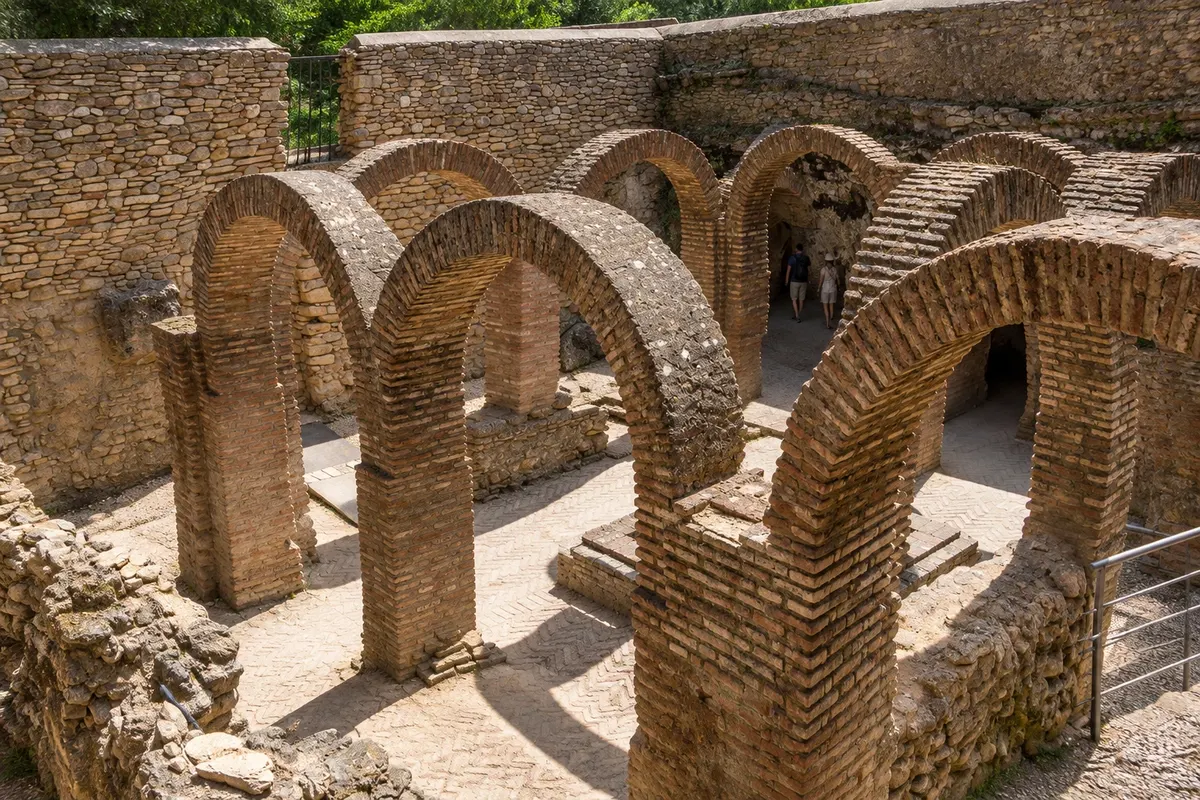
Archaeological site · Ronda, Andaluzia
Baños Árabes de Ronda
Muslim public baths from the 13th and 14th centuries, among the best preserved on the Iberian Peninsula, with vaulted rooms and star-shaped skylights, beside the river at the bottom of the town.
Illustrative images. The pictures in this guide are illustrations based on the real place, not photographs, and may differ from it.

Discover
About Baños Árabes de Ronda
The baths are located in the old lower suburb of the Muslim ronda, today the San Miguel neighbourhood, outside the medina. They were built in the 13th and 14th centuries next to the Arroyo de las Culebras, near where it meets the Guadalevín: inside the town, on top of the rock, there was no running water. The site stood at the foot of the old Puerta de la Puente, and travellers passed there before entering the town.
The layout follows Roman baths, but the bathing was steam-based rather than immersion. There is a cold room, a warm room and a hot room, in addition to the boiler room and the reception. The central hall is the largest: it has three aisles separated by horseshoe arches on columns, barrel vaults and small domes with star-shaped skylights.
The water system survives almost intact. A noria (water wheel) hauled water from the stream up to a tower. From there it ran along a small arched aqueduct to the boiler. After the Christian conquest, the boiler area became a tannery. An audiovisual display explains how the bath worked in the Andalusian period.
Outside two bridges begin. The Puente Árabe, of stone, crosses the stream right next to the baths. A little higher up are the Puente Viejo and the Arco de Felipe V, the town's former entrance.
Before you go
Practical information
Cidade Turismo reviews its information regularly, but something may have changed. Check with the place before planning your trip.
How much time to set aside
About 30 to 45 minutes, including the audiovisual.
Best time
In the morning, before the heat of the return climb, especially from June to August. Opening days and times change throughout the year: check before you go.
How to get there
It is in the lower part of the town, by the river. From the Puente Nuevo, go down Calle Santo Domingo or the Cuesta de Santo Domingo, pass the Arco de Felipe V and the Puente Viejo: it’s about a 10-minute walk, with a steep climb on the return.
Tip
Capacity is limited, with small groups in the audiovisual room: in high season there may be a wait. Admission is included in the municipal tourist pass. Combine it with Casa del Rey Moro and the Puente Viejo, which are on the same route.
Official website
Get your questions answered
Frequently asked questions about Baños Árabes de Ronda
From when do the Baños Árabes of Ronda date?
They date from the 13th and 14th centuries, from the period when Ronda was under Muslim rule. They are among the best‑preserved Arab baths on the Iberian Peninsula.
Why are the baths located down there, outside the old town?
Because they required running water, which was only available by the Arroyo de las Culebras and the Guadalevín river. A noria carried the water to the baths via a small aqueduct.
Is the descent to the baths difficult?
Going down is easy, along downhill streets. The return is a steep climb of about 10 to 15 minutes. Wear comfortable shoes and take water in summer.
What is the Puente Árabe?
It is the lowest stone bridge in Ronda, crossing the stream next to the baths. It used to be the passage to the San Miguel neighbourhood.