

 Brazil
 Argentina
 Chile
Chile Colombia
 Peru
Peru Uruguay
 Germany
 Belgium
 France
 Greece
 the Netherlands
 Ireland
 Italy
Italy Portugal
 the United Kingdom
 Switzerland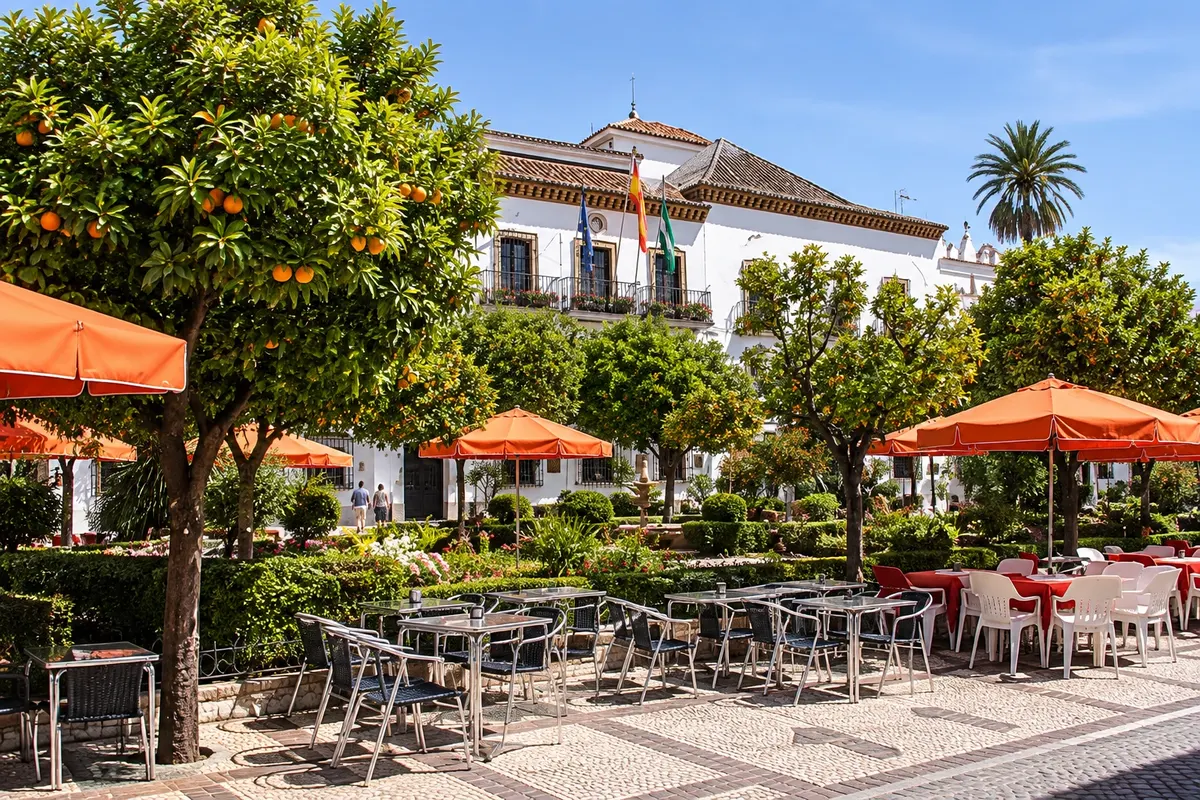
Historic neighborhood · Marbella, Andaluzia
Casco Antiguo de Marbella
Marbella's old town, within the layout of the former Arab wall, with white, flower-filled streets, the Plaza de los Naranjos, the Iglesia de la Encarnación and the remains of the 10th-century castle.
Illustrative images. The pictures in this guide are illustrations based on the real place, not photographs, and may differ from it.

Discover
About Casco Antiguo de Marbella
The Casco Antiguo occupies the area of the old Muslim medina, surrounded by a wall with three gates: the del Mar, the de Ronda and the de Málaga. The street layout is practically the same as in the 16th century. Today there are narrow alleys of whitewashed houses, with flowerpots on the façades, shops and small restaurants.
The centre of everything is the Plaza de los Naranjos. It was opened after the Christian capture of the city by Ferdinand the Catholic on 11 June 1485, demolishing part of the medina to create a larger square in the Castilian model. It has been called Plaza Mayor, Plaza de la Constitución and Plaza de la República, among other names. The orange trees that give it its current name were planted in 1941, replacing palms. In the middle stands a Renaissance fountain.
Three historic buildings surround the square. The Casa Consistorial, the town hall, dates from 1568 and has a sundial and inscriptions in old Castilian on the façade. The Casa del Corregidor, from 1552, has a stone façade with coats of arms and a balcony with three arches. The Ermita de Santiago, from the 15th century, is the oldest temple in the city and lies off the square's alignment, a sign that it existed before the square.
A few steps away is the Iglesia de Nuestra Señora de la Encarnación, probably built on top of the main mosque. The tower dates from 1618, as a plaque on the side façade records, and the main door, in ochre stone, is Rococo, from the second half of the 18th century. Inside is the Órgano del Sol Mayor, from 1975. At the church square begin the remains of the castle, of caliphal origin from the 10th century, with Roman capitals fitted into one of the towers.
Before you go
Practical information
Cidade Turismo reviews its information regularly, but something may have changed. Check with the place before planning your trip.
How much time to set aside
From 1.5 to 2 hours to stroll unhurriedly through the alleys, the square, the church and the wall remains. More time if you include a lunch or the Museo del Grabado, which is in the same neighborhood.
Best time
Early in the morning the streets are empty and cool, good for photos. In the late afternoon and at night the terraces of the square fill up. In spring, from March to May, the flowers on the façades are usually at their best.
How to get there
The neighborhood is in the centre of Marbella, about 1 km from the Estación de Autobuses, roughly a 15–20 minute walk downhill through the town. From the beach, go up Avenida del Mar and cross Avenida Ramón y Cajal: Plaza de los Naranjos is about 300 metres from the sea. Do not enter by car: the streets are narrow and there are underground car parks on the edge of the centre.
Tip
The terraces of the Plaza de los Naranjos are convenient, but the side streets often have quieter options. Remember that lunch in Spain starts around 14:00 and dinner after 21:00. The Iglesia de la Encarnación has hours tied to mass: check before you go. Wear comfortable shoes, because the paving is stone and there are hills.
Get your questions answered
Frequently asked questions about Casco Antiguo de Marbella
Why is the square called Plaza de los Naranjos?
Because of the orange trees planted in 1941, which replaced the palm trees that were there before. The square was opened after 1485, with the Christian conquest, and has had several other names, such as Plaza Mayor and Plaza de la Constitución.
Which is the oldest church in Marbella?
It's the Ermita de Santiago, on the Plaza de los Naranjos itself, from the 15th century. It predates the square, so it does not follow the same alignment as the other buildings.
Does Marbella's castle still exist?
There are remains of the castle's walls and towers, of 10th‑century caliphal origin, next to the Iglesia de la Encarnación. It is not a castle to visit inside, but ruins integrated into the streets of the old town, such as those on calles Portada and Carmen.
Is the old town a good place to stay?
For those who want to walk to restaurants and the beach, yes. The beach is about 300 metres along the Avenida del Mar. The streets are narrow and almost traffic-free, so arriving with luggage by car can be complicated.