Heiligen-Geist-Hospital and the Koberg: the 1286 hospital and the little wooden cubicles
Odhod: Koberg, northern tip of the Altstadt Walking visit to the building and the square Približno 1 uro Dopoldne ali popoldne Lahko
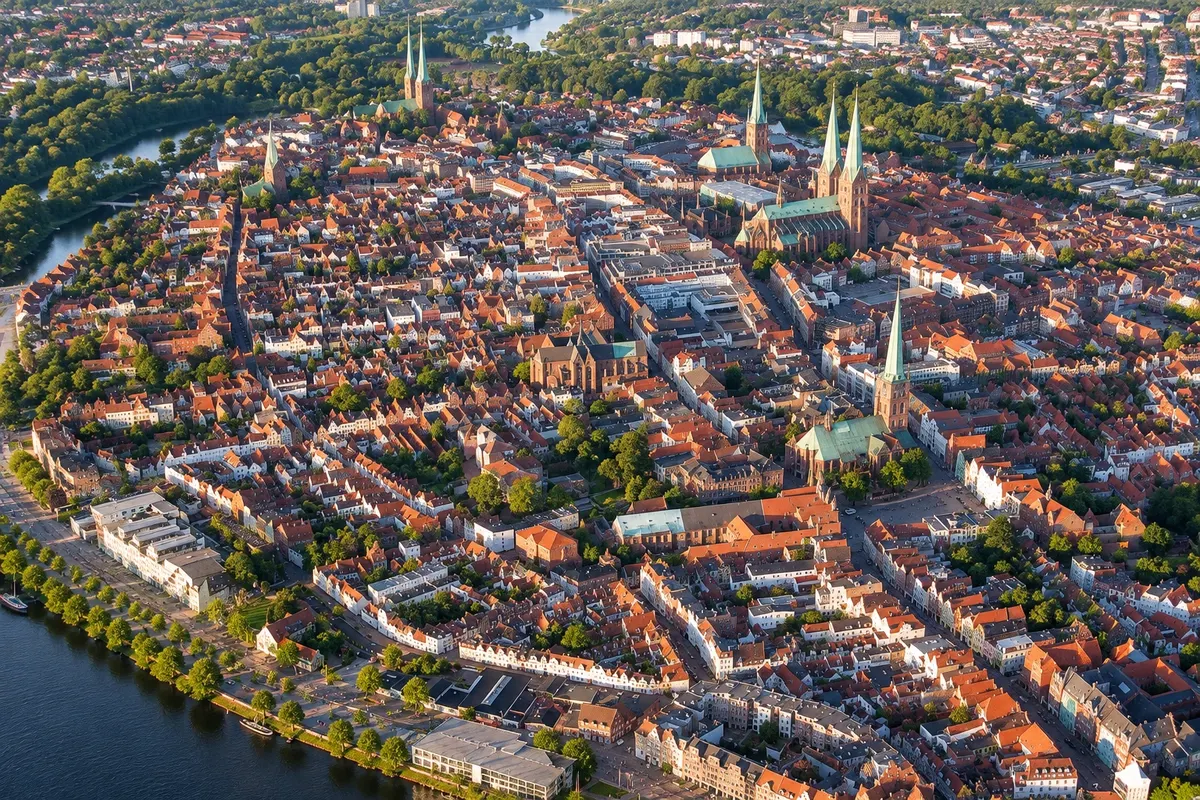
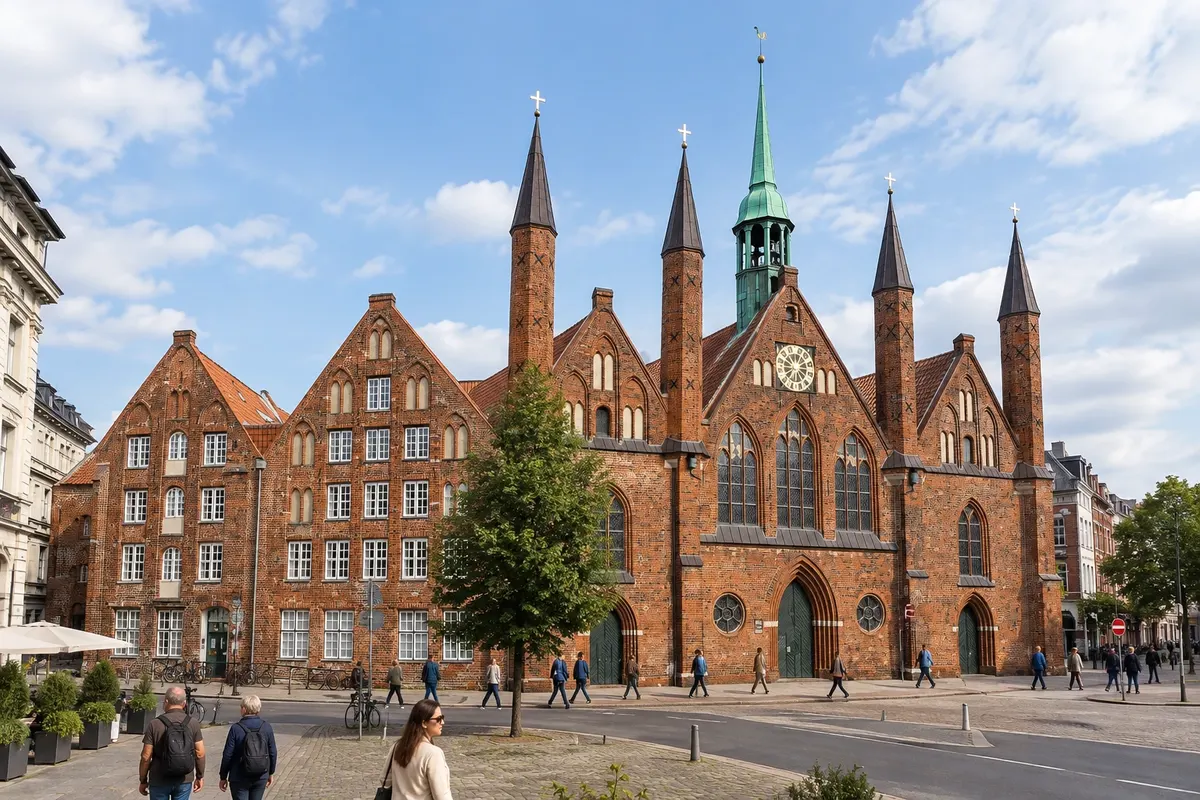
The Heiligen-Geist-Hospital (Hospital of the Holy Spirit) stands on the Koberg, the square at the northern tip of the island, and is one of the oldest hospitals/almshouses for the sick and elderly in Europe that still survives: it was founded in 1286 by Lübeck merchants, who supported it with donations. The brick façade has five pointed gables with three slender towers, and behind it you first enter the church hall, a high room of Gothic vaults with 14th-century wall paintings and a wooden choir screen separating the altar. Behind the church lies the Langes Haus, the long hall where residents slept in rows of beds; in 1820 the hall was divided into small wooden cubicles, called Kabäuschen, one for each resident, which remained in use until 1970. Today the old section is visited as a museum, and the adjacent building continues as a nursing home. In front, on the Koberg, are Jakobikirche, the sailors’ church with two historic organs and a lifeboat from the sailing ship Pamir, wrecked in 1957, and the Schiffergesellschaft, the captains’ guild house from 1535, which has served as a restaurant since then.
Kraji na poti: Heiligen-Geist-Hospital.
Vključuje: Entrance to the church hall and the Kabäuschen is usually free, but there are visiting hours and closed days; check before you go. There are paid guided tours organized by the city. Jakobikirche is open to visitors outside of worship services.
Nasvet: Combine it with the Hanse Museum, five minutes away, to cover the northern part of the island in one go. Enter the Langes Haus and open the door of an empty Kabäuschen to see its size. At the end of November the hospital usually hosts the Christmas craft market, which fills the hall.
Najboljši čas za obisk: All year. In late November and early December the craft market usually occupies the building for about 10 days; confirm the dates.
Dom zu Lübeck: Henry the Lion’s cathedral, and Bernt Notke’s crucifix
Odhod: Domkirchhof, southern tip of the Altstadt Walk to the cathedral and the southern quarter Približno 1 uro Dopoldne ali popoldne Lahko
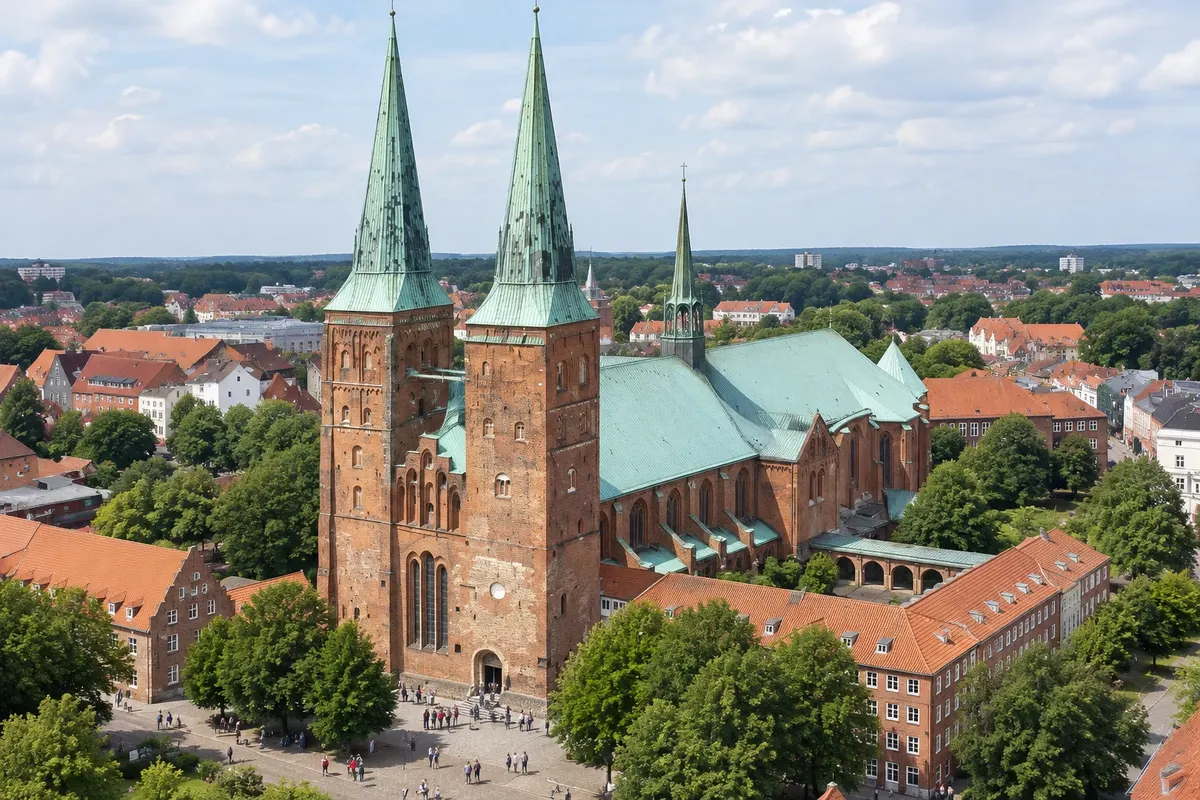
The Dom (cathedral) stands on the southern tip of the island, a 15-minute walk from the Markt, in a quieter part of the Altstadt, with the Mühlenteich (mill pond) beside it. The church was founded in 1173 by Duke Henry the Lion as the seat of the bishop of Lübeck, completed in Romanesque style around 1230 and consecrated in 1247; between 1266 and 1335 the Gothic choir was added, giving it a length of 131 meters. The two towers of about 105 meters are lower than those of the Marienkirche, by the merchants’ decision, who wanted their church to be larger than the bishop’s. Inside, in the middle of the nave, is Bernt Notke’s 17-meter-high triumphal cross from 1477, commissioned by Bishop Albert Krummendiek, with figures of Mary, John, Adam and Eve at the foot of the cross; there is also the Paradies portal from the 13th century and bishops’ tombstones in the floor. During the March 1942 bombing the towers collapsed and Arp Schnitger’s organ was lost in the fire; reconstruction was not completed until 1982. After your visit, walk around the Mühlenteich and through the St. Aegidien quarter, with low 18th-century houses.
Kraji na poti: Dom zu Lübeck.
Vključuje: Entrance to the cathedral is usually free, with a donation box; winter opening hours are reduced and it closes during services. Organ concerts require a separate ticket. Check the times before you go.
Nasvet: Go via the southern route between the Markt and the station to avoid returning the same way. The view of the cathedral reflected in the Mühlenteich is best in the morning. In summer, the Museum für Natur und Umwelt next door is an option for children on a rainy day.
Najboljši čas za obisk: Year-round. From April to October the opening hours are longer; in December there are Advent concerts, which tend to sell out.
Boat on the Trave: the circuit around the Altstadt island and Lübeck harbour
Odhod: Holstentorterrassen pier (Obertrave) or the MuK bridge (Untertrave) Scheduled boat tour with narration Približno 1 uro Popoldne Lahko
The simplest way to see that Lübeck’s old town is an island is to circumnavigate it by boat. Scheduled boats depart from the pier opposite the Salzspeicher, on the Holstentor side (Obertrave), and from the pier next to the MuK concert hall on the north side (Untertrave), and they follow the Trave river and the canals surrounding the Altstadt, passing the salt warehouses, the station bridge, the Museumshafen with historic sailing boats moored, the Burgkloster and the Hansemuseum, the industrial harbour and riverside houses with gardens along the Trave, with narration about the city’s history. The full loop takes about 1 hour. In the main season, from mid-May to mid-September, there are departures every half hour during the day; outside that season departures are reduced and depend on the operator, and on days with very high or very low water the trip can be cancelled. There are also longer trips: one of about 2 hours to Dassow and the Schellbruch bird reserve, another that passes through three locks on the Elbe–Lübeck Canal, and the boat ride to Travemünde of about 1 h 30, departing from the pier beside the Hansemuseum. If you prefer to row, you can rent an electric boat for up to six people without a licence.
Kraji na poti: Lübecker Altstadt, Holstentor.
Vključuje: Ticket paid separately, bought at the pier or on the operator’s website; check the current fare. Narration is usually in German, sometimes with an English summary. The boat has a covered area and an open deck.
Nasvet: Prefer the open deck on the right side when departing from the Obertrave to get the Holstentor and the Salzspeicher in your photo. On very windy or rainy days, opt for the Petrikirche tower instead. Confirm times by calling the operator outside the high season.
Najboljši čas za obisk: The main season usually runs from mid-May to mid-September, with departures every half hour; between October and April check before you go.
Travemünde: the Baltic beach, the promenade, the 1539 lighthouse and the sailing ship Passat
Odhod: Lübeck Hauptbahnhof, regional train RB 86 to Travemünde Strand (about 25 min) Regional train and walk along the waterfront; ferry to the Priwall half day or full day Ves dan easy (flat waterfront)
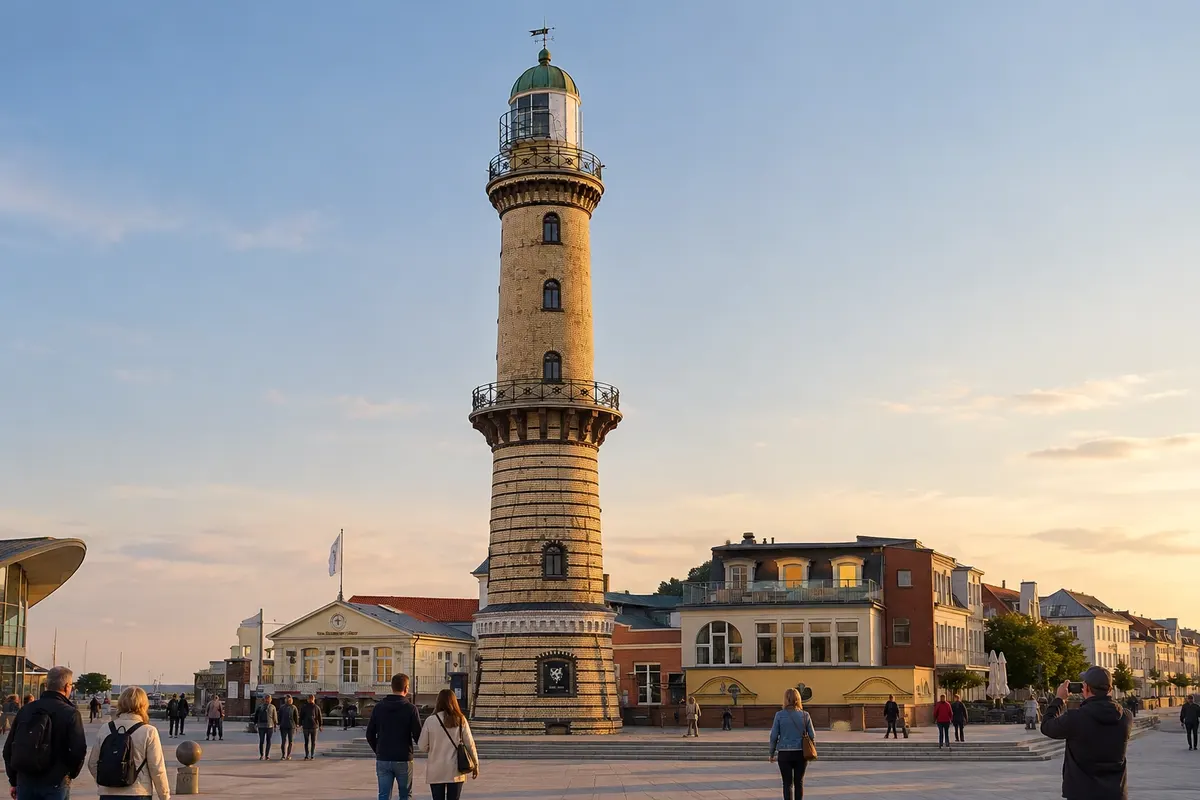
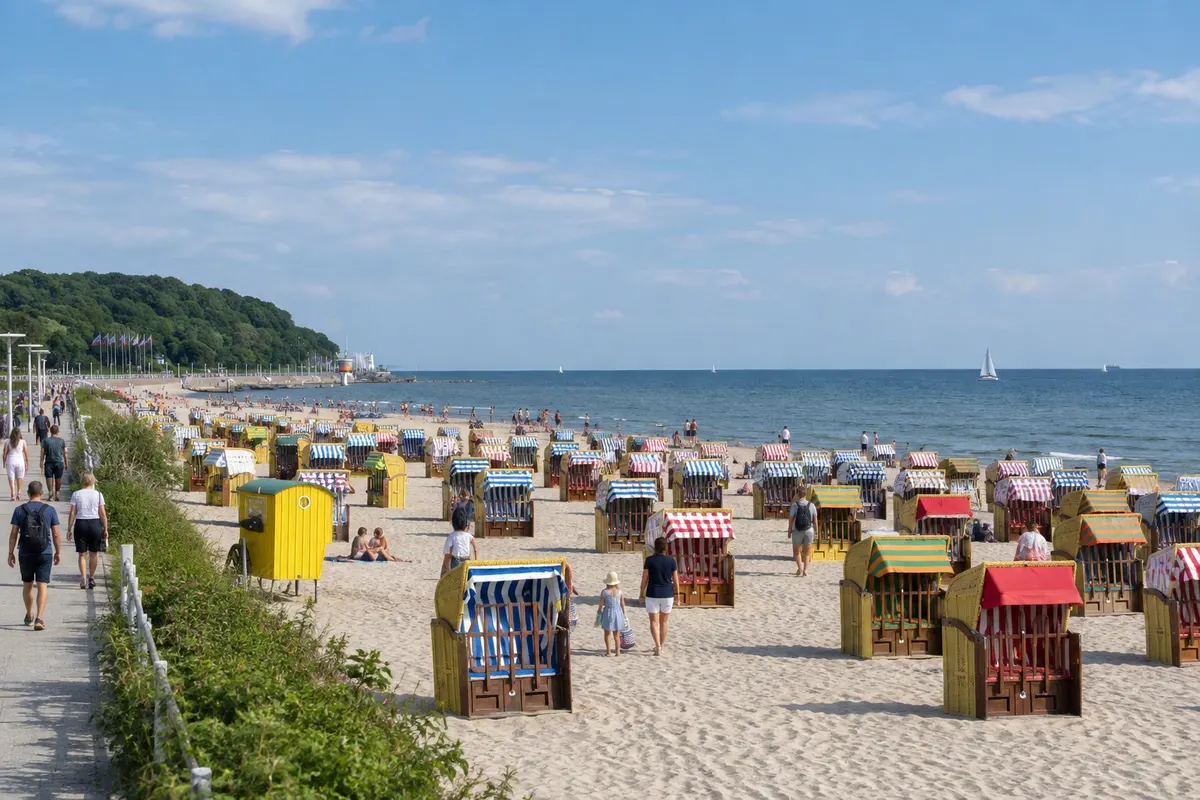
Travemünde is Lübeck’s beach quarter, at the mouth of the Trave River on the Ostsee (Baltic Sea), about 20 km from the center. The regional train RB 86 departs the main station and takes about 25 minutes to Travemünde Strand station, an art nouveau building from 1911 a few steps from the sand. The beach is about 1.7 km of light sand, with rows of Strandkörbe, the hooded wicker chairs rented by the day in season. Along the Strandpromenade are the Alter Leuchtturm, a 1539 lighthouse 31 meters high with 142 steps, which operated until 1972 and is now a maritime museum, and the Maritim hotel tower, from 1974, with 35 floors and 119 meters, which replaced the lighthouse. Along the Vorderreihe, the street on the riverfront, cargo ships and ferries to Sweden and Finland pass just meters from the promenade. The passenger ferry crosses the canal to the Priwall peninsula, where the Passat is moored — a four-masted sailing ship 115 meters long built in 1911 in Hamburg for the Chile nitrate route, purchased by the city in 1959 and open as a museum ship from April to October; the visit covers the deck, the holds and the cabins. North of the beach begins the Brodtener Ufer, a clay cliff with a roughly 4 km trail to Niendorf, taking about 1 to 1.5 hours on foot.
Kraji na poti: Travemünde.
Vključuje: The regional train is included in the Deutschlandticket and in regional day tickets. The beach and promenade are open access; there may be a beach fee on some stretches during the season. Strandkorb, the Priwall ferry, the old lighthouse and the Passat are paid separately. Check the current timetable.
Nasvet: On summer weekends, leave early: the train gets crowded and the beach fills up. See the Passat first thing in the morning and leave the beach for the afternoon. During Travemünder Woche, a regatta of about 10 days in July, the waterfront gets crowded and hotels fill up: check the dates.
Najboljši čas za obisk: From June to early September for sea swimming, with July and August warmer; the Passat usually opens from April to October. In winter the outing is just the walk along the waterfront, with strong wind.
Rostock old town on foot: Neuer Markt, Kröpeliner Straße, Universitätsplatz and Kröpeliner Tor
Odhod: Rostock Hauptbahnhof, tram to Neuer Markt (about 10 min) Walk through the pedestrian zone Približno 2 uri in pol Dopoldne ali popoldne easy (flat terrain)
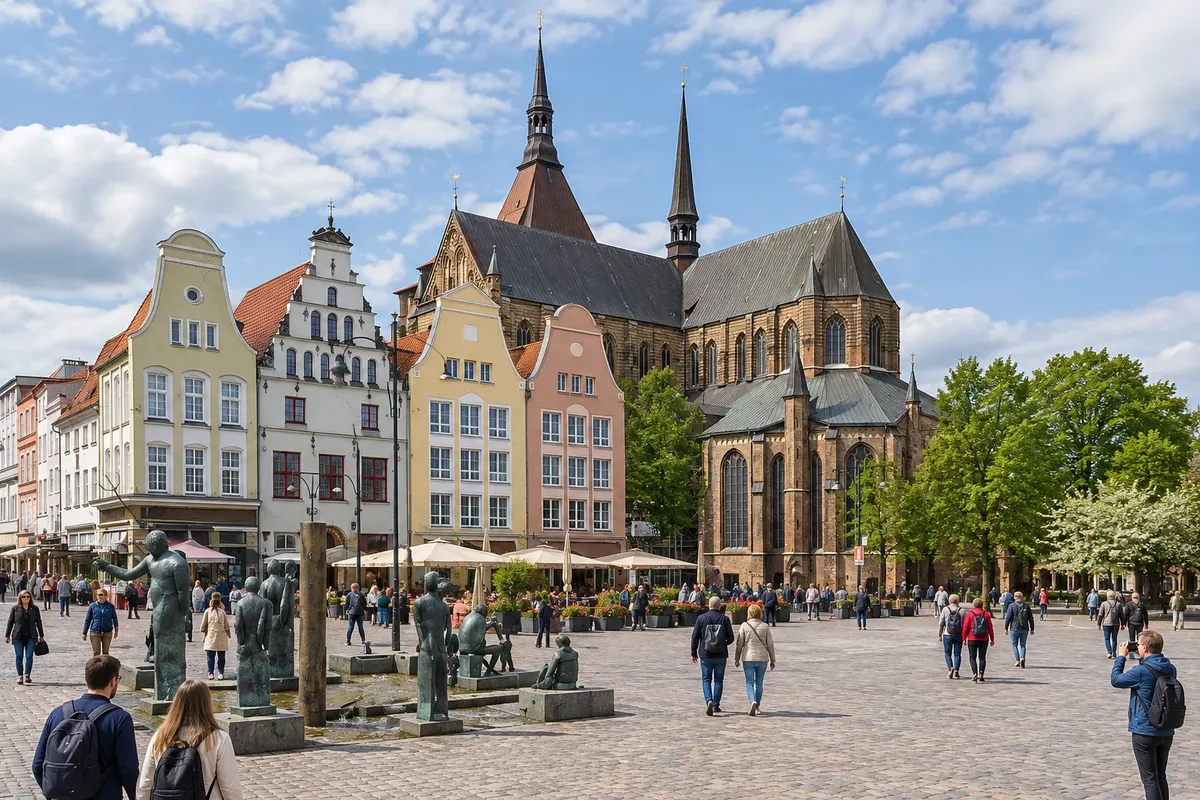
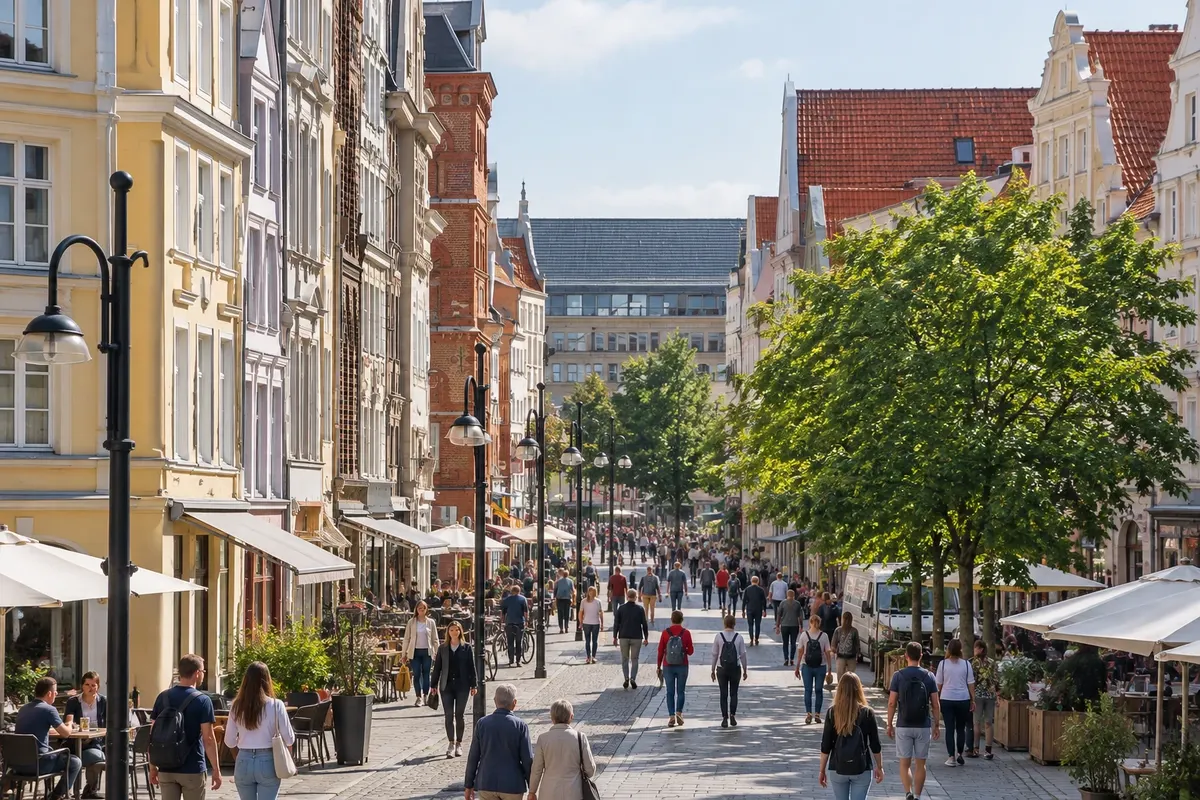
Rostock received city rights in 1218, joined the Hanseatic League in 1251 and in 1419 founded the first university in the Baltic region. The old town sits on a hill above the River Warnow, surrounded by stretches of wall, and was partly destroyed in the 1942 bombings; the postwar reconstruction during the GDR period mixed what remained with new buildings. Start at Neuer Markt, the square with the Rathaus (town hall), a 13th-century brick Gothic building hidden behind an 18th-century pink Baroque façade, and the row of reconstructed gabled houses on the north side. From there runs Kröpeliner Straße, the main pedestrian street, with shops, cafés and gabled houses from the 15th to the 19th centuries, up to the Kröpeliner Tor, the 14th-century city gate, now the city history centre. Halfway is Universitätsplatz, with the university’s main building from 1870 in brick and terracotta, and the Brunnen der Lebensfreude fountain from 1980 in bronze, a city meeting point. Beside it, the Kloster zum Heiligen Kreuz, a 13th-century convent, houses the cultural history museum with free admission. Return via the Wallanlagen, the park on the old wall, to the Steintor, the 16th-century Renaissance gate.
Kraji na poti: Neuer Markt, Kröpeliner Straße.
Vključuje: Streets, squares and the park on the ramparts are open. The Kloster zum Heiligen Kreuz museum does not charge admission; the Kröpeliner Tor has an exhibition with a separate paid ticket. Rostock trams and buses are covered by the Deutschlandticket and local day tickets.
Nasvet: Do the walk in the morning and climb the tower of Petrikirche at the end, with Marienkirche on the way. On Saturday mornings the Neuer Markt usually has a market. A day transport ticket covers trams, buses, the S-Bahn to Warnemünde and the ferries on the Warnow.
Najboljši čas za obisk: All year round. From May to September tables spill onto Kröpeliner Straße; in December the Christmas market usually occupies Neuer Markt and Kröpeliner Straße until near Christmas.
Marienkirche of Rostock and Petrikirche: the 1472 astronomical clock and the tower with viewpoint
Odhod: Neuer Markt, behind the Rathaus Visit to the two churches and climb to the tower Približno 1 uro in 30 minut late morning (clock) or afternoon easy (elevator at Petrikirche)
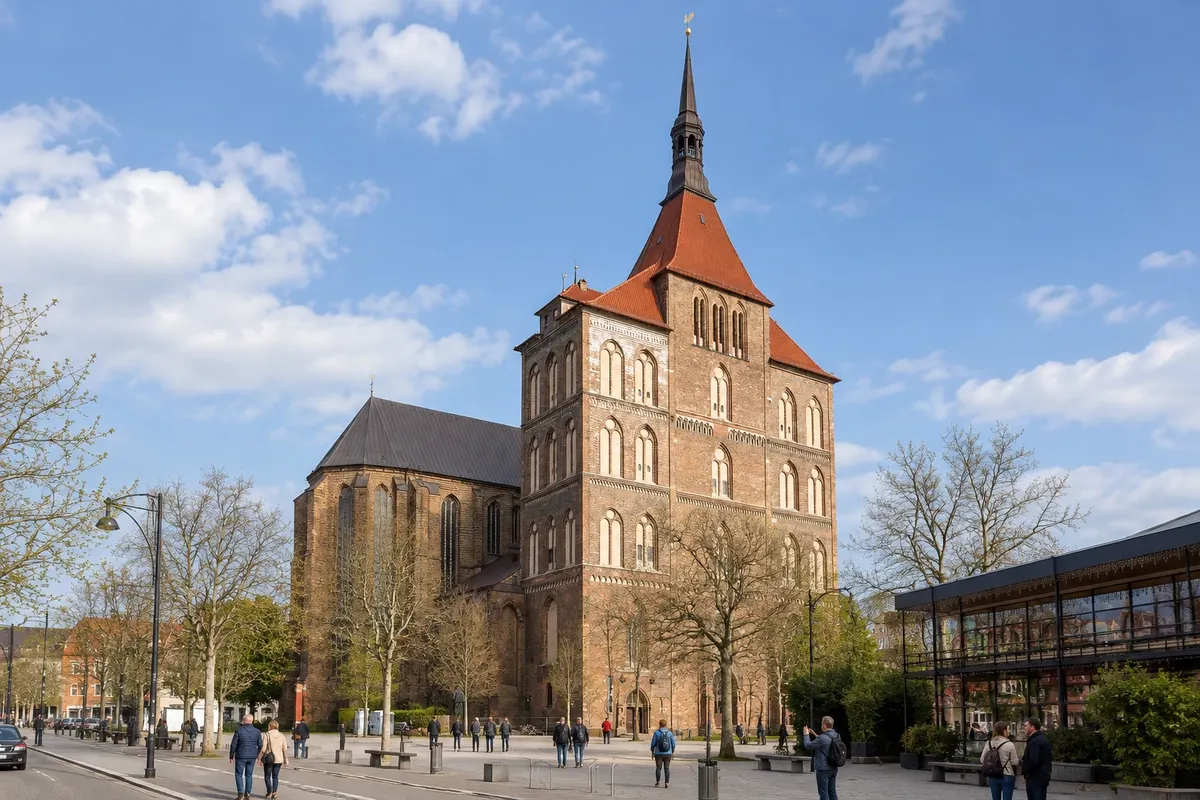
Marienkirche (Church of St. Mary) is the largest of the three brick churches in downtown Rostock, a three‑aisled cruciform basilica begun in the 13th century and rebuilt at the end of the 14th; the broad tower was only completed at the end of the 18th century. Inside, behind the altar, is the 1472 astronomical clock made by Hans Düringer of Nuremberg: it is the only medieval clock of this type still running with its original mechanism. The upper dial shows hour, moon phase and zodiac; the calendar disk below was calculated through 2150; and at the top, on each full hour, the figures of the apostles parade before Christ, with Judas left out when the door closes. Also note the bronze font of 1290, the 1770 baroque organ with about 5,700 pipes, and the 26‑meter south transept stained glass. The church survived the 1942 bombings with minor damage. A 10‑minute walk east in the center, Petrikirche (Church of St. Peter) is the oldest of the three, from the 13th century, with the 117‑meter tower that lost its spire in 1942 and regained it in 1994; an elevator, or 196 steps, takes you to the platform at 45 meters, where you can see the center, the Warnow River, the Stadthafen and, on clear days, the Baltic at Warnemünde.
Kraji na poti: Marienkirche Rostock.
Vključuje: Marienkirche requests a visitor contribution, payable at the entrance; check the current rates. The climb to Petrikirche’s tower requires a separate ticket. Both churches close during services and on some holidays.
Nasvet: Arrive at Marienkirche about 10 minutes before noon to see the apostles’ procession on the clock; it usually draws a crowd—if you miss it, it repeats every hour. Climb the tower of Petrikirche in the late afternoon: the sun hits the harbor from the west.
Najboljši čas za obisk: All year. From May to September Petrikirche’s tower stays open later; from October to April it closes in mid-afternoon and visits must be done earlier.
Rostock Stadthafen: the old harbour on foot and the river boat on the Warnow to Warnemünde
Odhod: Stadthafen, at Schnickmannstraße, a 10-minute walk from Neuer Markt Walk along the quay and regular river boat about 3 hours, including the return by S-Bahn Popoldne Lahko
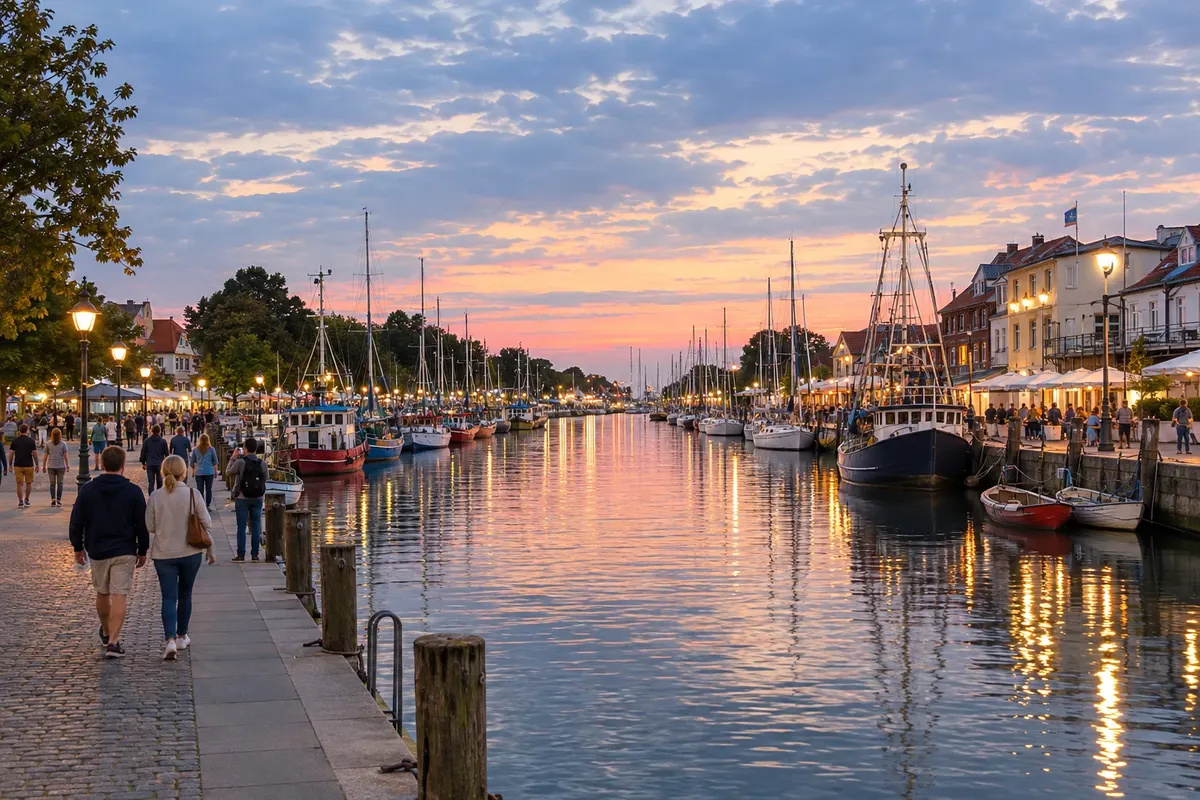
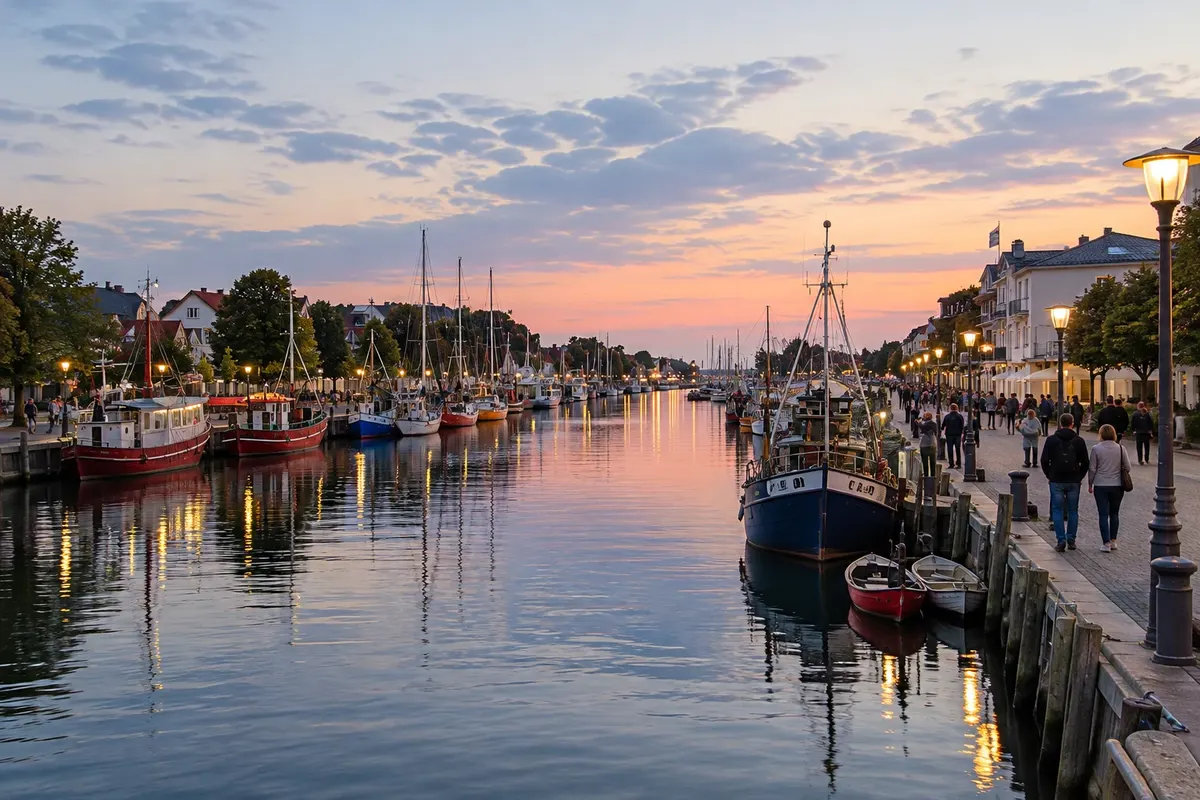
The Stadthafen (city harbour) is Rostock’s former commercial port, on the bank of the Warnow just below the city centre; until the opening of the seaport in 1960, all cargo passed through here. Today the quay is a promenade open all day, with the old cranes preserved as monuments, converted brick warehouses, restaurants, a craft brewery, the icebreaker Stephan Jantzen from 1967 moored as a museum ship, and the Museumshafen with historic sailing yachts and fishing boats. The view of the complex is from the Kanonsberg, near the Fischerbastion, where three old cannons mark the former defence of the harbour entrance. From the quay at Schnickmannstraße depart the regular boats of the so-called Blaue Flotte, which run down the Warnow to Warnemünde, passing shipyards, the container and ferry port and the cruise terminal, with commentary; there are also short harbour tours without disembarkation. In August the Stadthafen is the centre of the Hanse Sail, a gathering of traditional sailing ships that usually brings together more than a hundred vessels from various countries over four days, with paid departures aboard them. Return from Warnemünde by S-Bahn in about 20 minutes to the central station.
Kraji na poti: Stadthafen Rostock, Warnemünde.
Vključuje: Walking along the quay is free. The regular boat and the harbour round trip require separate fares; check the timetable and the season, which usually runs from spring to autumn. The return S-Bahn is included in the Deutschlandticket and in regional day tickets.
Nasvet: Go by boat and return by train, so you don’t repeat the same route. Sit on the right side when heading downstream: the shipyards and the cruise terminal are on that bank. At the Hanse Sail in August, book hotels months ahead and buy sailing departures in advance.
Najboljši čas za obisk: From May to September, when the regular boats operate more frequently; the Hanse Sail typically takes place the second weekend of August, from Thursday to Sunday. Outside the season, confirm schedules.
Warnemünde: Alter Strom, the 1898 lighthouse, Teepott and the west mole (breakwater)
Odhod: Rostock Hauptbahnhof, S-Bahn S1 to Warnemünde (about 20 min) S-Bahn and walk through the fishing village and along the waterfront Približno 3 ure Dopoldne ali pozno popoldne easy (135 steps in the lighthouse)
Warnemünde is Rostock’s beach district, at the mouth of the Warnow River on the Ostsee (Baltic Sea), about 12 km from the center; the S-Bahn S1 departs the main station every 15 minutes and arrives in about 20. The station is on the bank of the Alter Strom, the old river arm that became a fishing and pleasure port, with fishing boats selling smoked fish and herring sandwiches, tour boats and restaurants on Am Alten Strom street. On the other side, Alexandrinenstraße preserves the low houses of the old fishing village, with the Heimatmuseum, a local museum in a 1767 house. The Alter Strom ends at the Seepromenade, where the Leuchtturm (lighthouse) of 1898 stands, 31 meters tall, clad in glazed white brick: 135 steps lead to the two galleries, with views of the beach, the harbor and the sea, from Easter to early October. At the foot of the lighthouse is the Teepott (teapot), the 1968 pavilion with the curved concrete roof by engineer Ulrich Müther, now hosting restaurants and cafés. From there the Westmole, a roughly 550-meter breakwater with a small lighthouse at the tip, extends into the sea; from it you can see cruise ships and ferries to Denmark entering the channel, very close. Return along the beach or promenade to the station.
Kraji na poti: Warnemünde, Leuchtturm Warnemünde.
Vključuje: The S-Bahn is covered by the Deutschlandticket and by Rostock day tickets. The lighthouse climb requires a separate paid ticket, only in season; check availability. Alter Strom, the promenade and the breakwater are open.
Nasvet: Go late in the afternoon to see the sun set behind the breakwater, or early in the morning, before cruise passengers disembark — the village fills up on ship days. Smoked fish from the boats on the Alter Strom is the simple local lunch.
Najboljši čas za obisk: From April to early October, when the lighthouse is open. On cruise ship days, from May to September, the village fills up around midday.
Warnemünde Beach: swimming in the Baltic, Strandkorb and the walk to the Stoltera cliff
Odhod: Warnemünde station (S‑Bahn S1), 10 minutes’ walk to the sand Beach day and walk along the shore full day morning and afternoon easy (sand; cliff trail)
Warnemünde Beach has about 3 km of fine, light sand and is one of the widest beaches on the German Baltic coast. It starts at the west pier, beside the lighthouse, and continues west to the Stoltera, a roughly 20‑meter cliff covered in woodland. The sea is shallow at the entrance, without big waves or strong tide, and the water is cold even in summer: swimming typically runs from June to early September, with July and August the peak months for swimmers; lifeguard stations operate in season. The local custom is to rent a Strandkorb, the double wicker chair with a hood, which shelters from the wind and reserves a spot on the sand; there are sections for families, a signposted nudist section and a dog area. Behind the beach run the promenade and the dunes. For those who want more than sun, the walk to the Stoltera and back, via the sand or the high trail, takes about 2 hours; the full return to Diedrichshagen is about 12 km. Outside summer the beach is for long, windy walks, and in winter the town organizes collective sea baths on specified dates.
Kraji na poti: Warnemünde, Leuchtturm Warnemünde.
Vključuje: The beach is open and free to enter. Strandkorb, showers, toilets and changing rooms are charged separately in season; check the current price list. The S‑Bahn from Rostock is covered by the Deutschlandticket and by day tickets.
Nasvet: Bring sunscreen and a light jacket: the sea wind is deceptive. Go on weekdays or before 10:00 on July and August weekends, when the sand near the lighthouse gets crowded. Jellyfish appear on some summer days; ask at the lifeguard station.
Najboljši čas za obisk: July and August for swimming in the sea; June and September for fewer people and colder water. From October to April only walks.
Round-trip to Schwerin: the Schloss on the lake island (World Heritage)
Odhod: Rostock Hauptbahnhof, IC or RE to Schwerin Hbf (about 45 min to 1 h) Train and walk to the castle island about 7 hours, including trains Ves dan easy (20 min walk from the station)
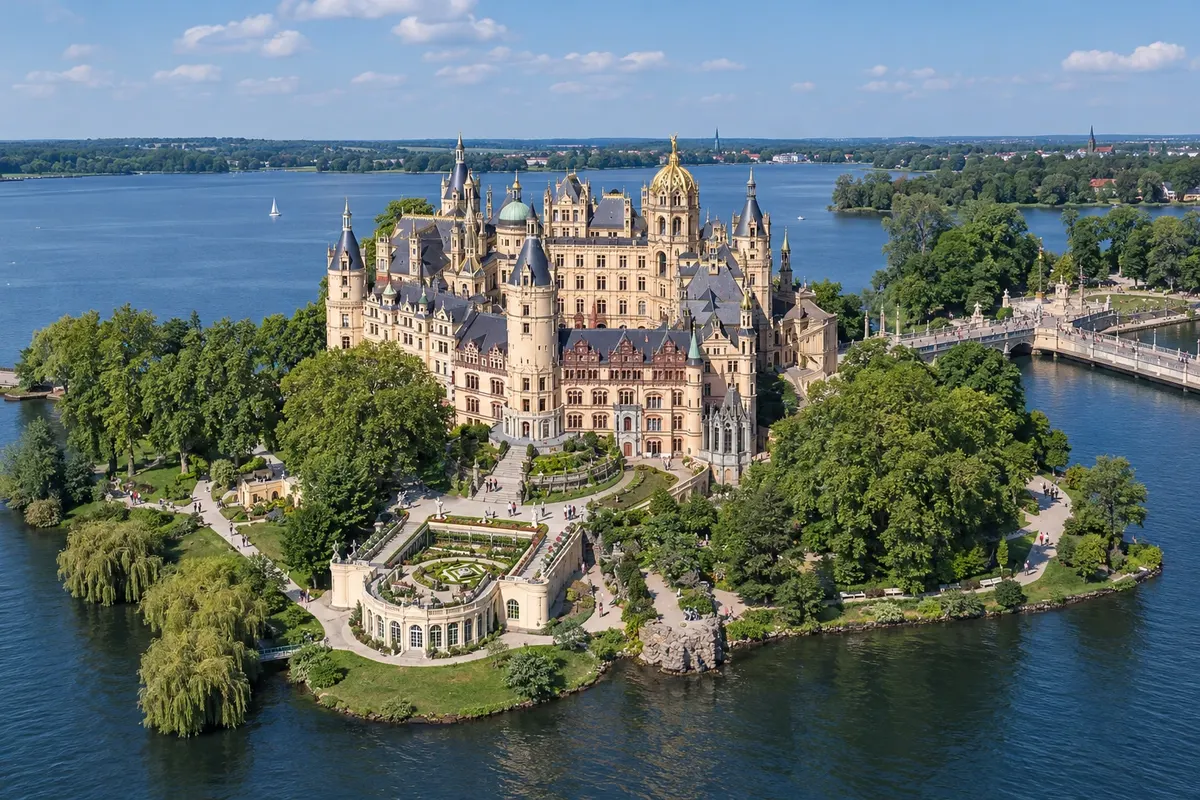
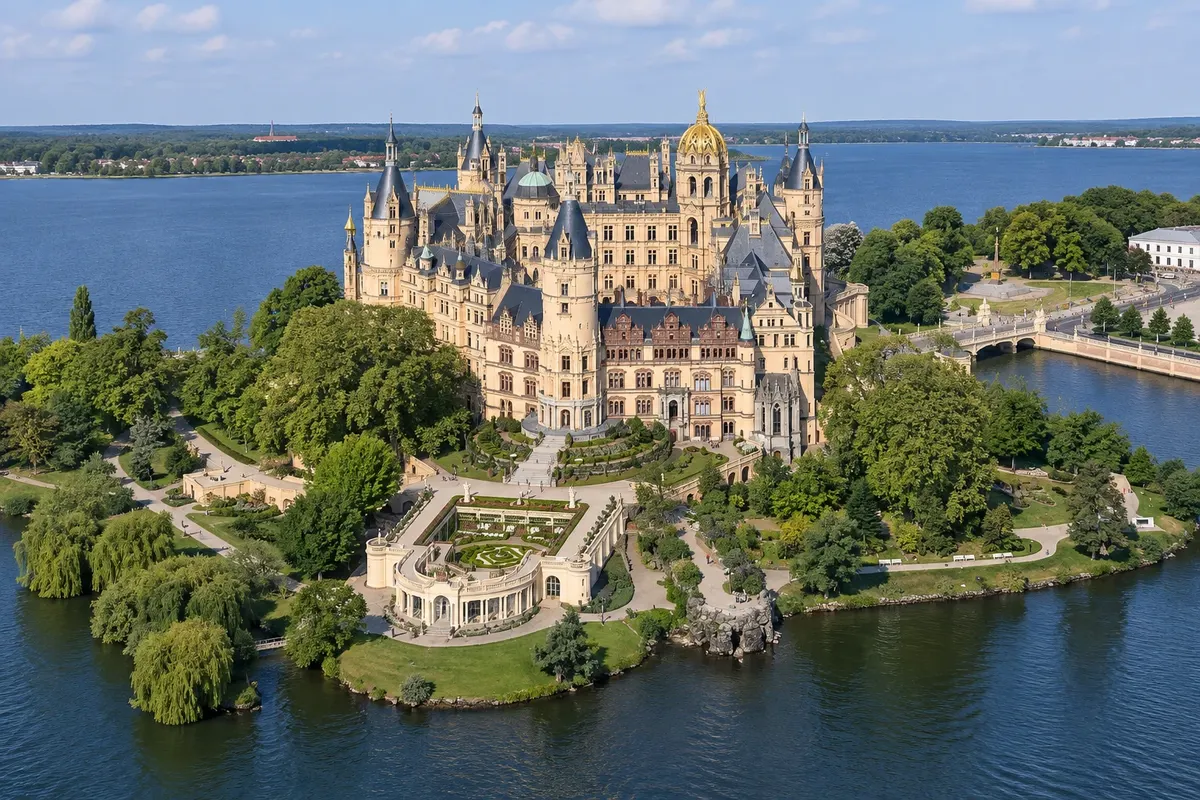
Schwerin is the capital of the state of Mecklenburg-Vorpommern and is about 45 minutes by train from Rostock, with direct IC trains in 43 minutes and regional trains in just under 1 hour. The Schloss (palace) sits on an island in the Schweriner See, linked by bridges to the town center and the garden; the complex of the grand ducal residence of Mecklenburg-Schwerin, with 38 elements including palace, gardens, theatre, museum and lakes, is a UNESCO World Heritage Site since 2024. The present palace was built between 1845 and 1857 for Grand Duke Friedrich Franz II, by architects Georg Adolf Demmler and Friedrich August Stüler, with consultations from Gottfried Semper, in a historicist style inspired by Loire castles, with many towers and gilded domes; a fire in 1913 destroyed about one third, which was later rebuilt. Since 1990 it has housed the state parliament, and the palace museum displays the throne room, the banqueting halls and the ducal apartments, with the legend of the Petermännchen, the guardian goblin, whose 1856 statue stands at the entrance. Around it is the Burggarten, with the orangery and the terrace over the lake, and on the other side of the bridge the baroque Schlossgarten, with a canal and tree-lined avenues. In the center, a 10-minute walk away, are the Gothic cathedral with a viewing tower, the Markt and the Pfaffenteich, the urban lake with a ferry.
Kraji na poti: Schweriner Schloss.
Vključuje: The palace museum has a separate admission fee and is closed on Mondays; check prices and opening times. Gardens, bridges and the island are open. The regional train is covered by the Deutschlandticket; the IC is not.
Nasvet: Go Tuesday to Sunday, because of the museum. Do the palace in the morning, have lunch in town and return via the Schlossgarten. From Lübeck you can also get there with one train change in about 1 h 40, which allows including Schwerin on a travel day between the two cities.
Najboljši čas za obisk: From May to September, with gardens in bloom and boats on the lake. Between November and March the museum has reduced hours; confirm before you go.


 Brazilija
 Antarktika
 Argentina
 Bolivija
 Čile
 Kolumbija
 Ekvator
 Gvajana
 Francoska Gvajana
 Falklandski otoki (Malvini)
 Paragvaj
 Peru
 Surinam
 Urugvaj
 Venezuela
 Avstrija
 Belgija
 Hrvaška
 Danska
 Slovaška
 Slovenija
 Španija
 Finska
 Francija
 Grčija
 Nizozemska
 Madžarska
 Irska
 Islandija
 Italija
 Luksemburg
 Norveška
 Poljska
 Portugalska
 Združeno kraljestvo
 Češka
 Švedska
 Švica
 Turčija
 Bermudi
 Kanada
 Združene države Amerike
 Grenlandija
 Mehika
 Sveta Peter in Mihael
 Dominikanska republika
 Japonska
 Južnoafriška republika
 Egipt
 Avstralija
 Fidži
 Nova Zelandija
 Papua Nova Gvineja