Sunnegga, the Leisee and the Rothorn (3,103 m)
Odhod: Sunnegga funicular station, in central Zermatt Underground funicular, gondola and cable car about 3 to 4 hours Dopoldne ali popoldne easy (altitude 3,103 m)
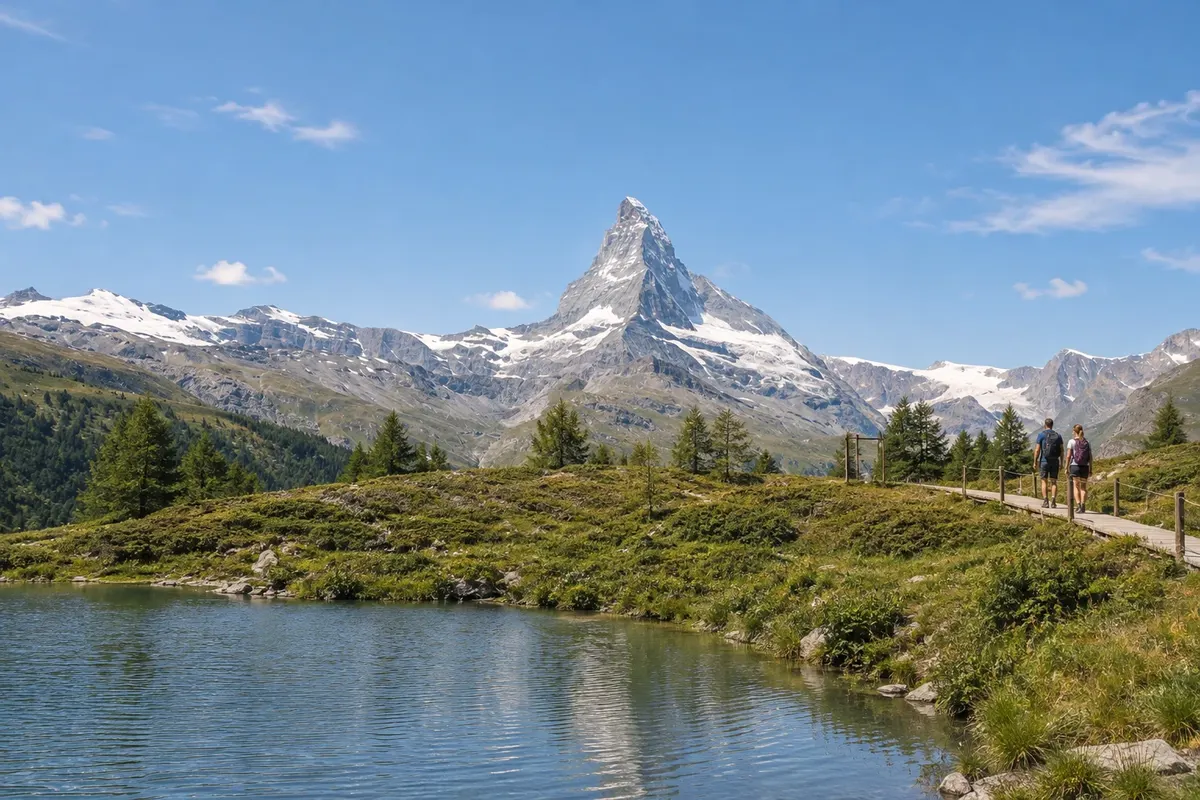
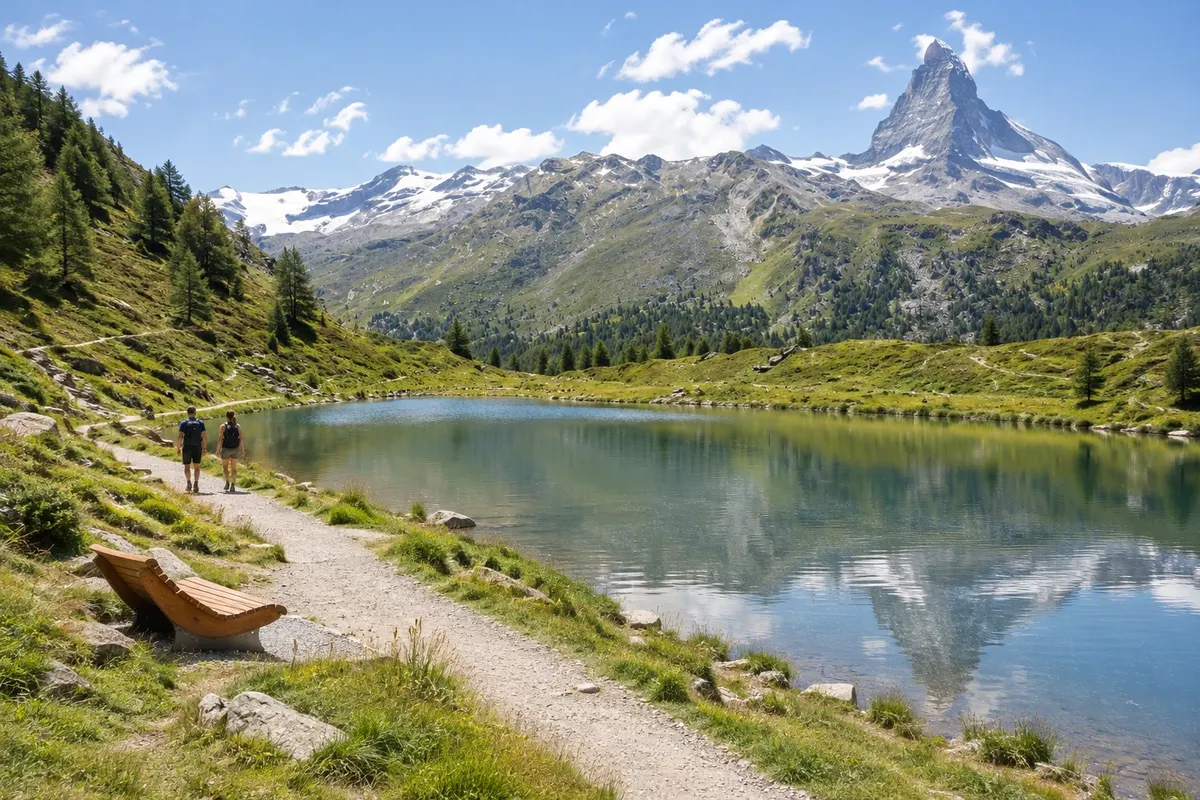
This is Zermatt’s sunny side, good for families. An underground funicular climbs through the mountain in about 5 minutes to Sunnegga, at 2,288 m. Near the station is the Leisee, a lake where swimming is allowed in summer and which is crossed on a raft pulled by rope; there is a small shuttle between the station and the lake. Sunnegga also hosts the Wolli Abenteuerpark, a playground with slides, swings and water play. From Sunnegga a gondola (small-cabin cable car) rises in about 7 minutes to Blauherd (2,571 m), and a cable car (Seilbahn) takes another ~7 minutes up to the Rothorn, at 3,103 m, where there is a restaurant and 18 metal sculptures representing mountains of the region. The full trip from Zermatt to the Rothorn takes about 35 minutes. In summer you can ride a mountain scooter (trottinette) down to Zermatt from Sunnegga.
Kraji na poti: Sunnegga, Leisee, Blauherd, Rothorn, Wolli Abenteuerpark, Matterhorn.
Vključuje: The transport ticket covers the purchased sections. The playground and the Leisee are next to the station. Meals and scooter rental are charged separately. Check the current fare table.
Nasvet: Sunnegga is the start of the 5-Seenweg. The cable cars in this sector often stop for maintenance during parts of spring and autumn; check before you go.
Najboljši čas za obisk: From July to September for the Leisee and walks; from December to April, with snow, for skiing.
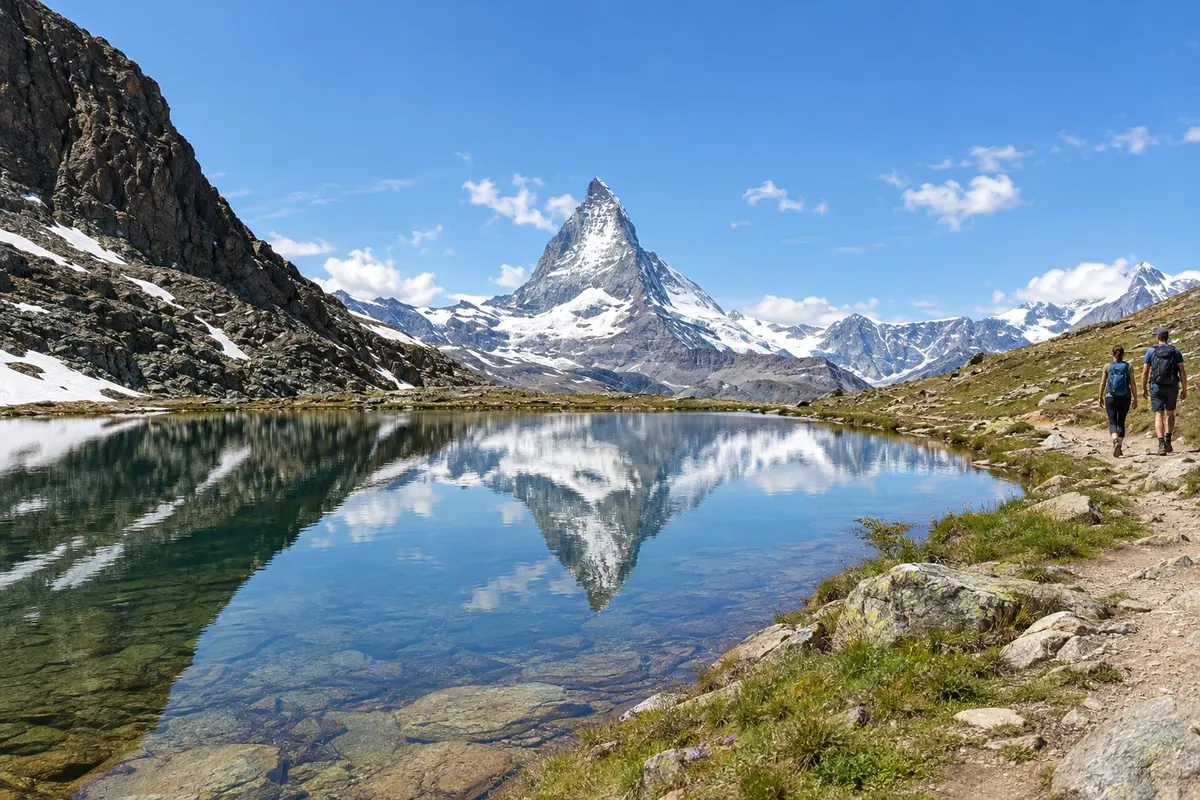
5-Seenweg: the five-lakes trail between Blauherd and Sunnegga
Odhod: Blauherd station (2,571 m) Funicular to Sunnegga, cable car to Blauherd and hike about 3 to 4 hours of walking Ves dan Zmerno zahtevno
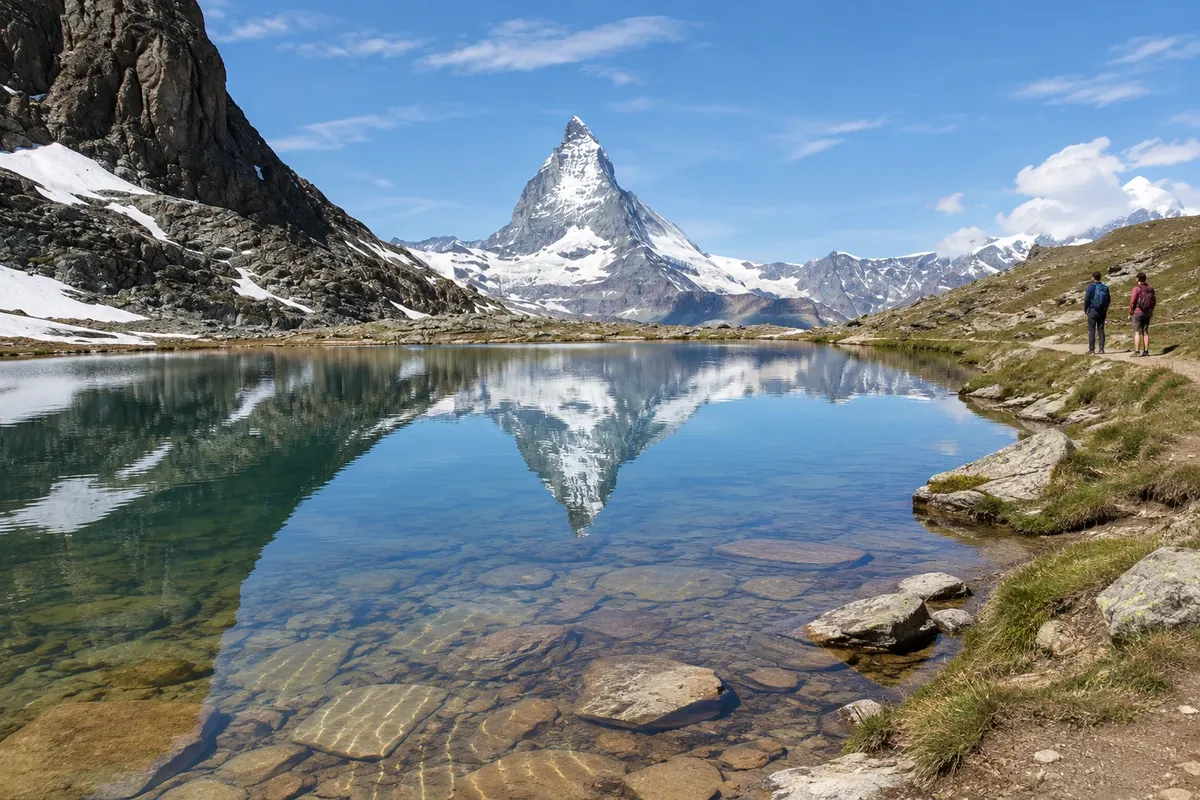
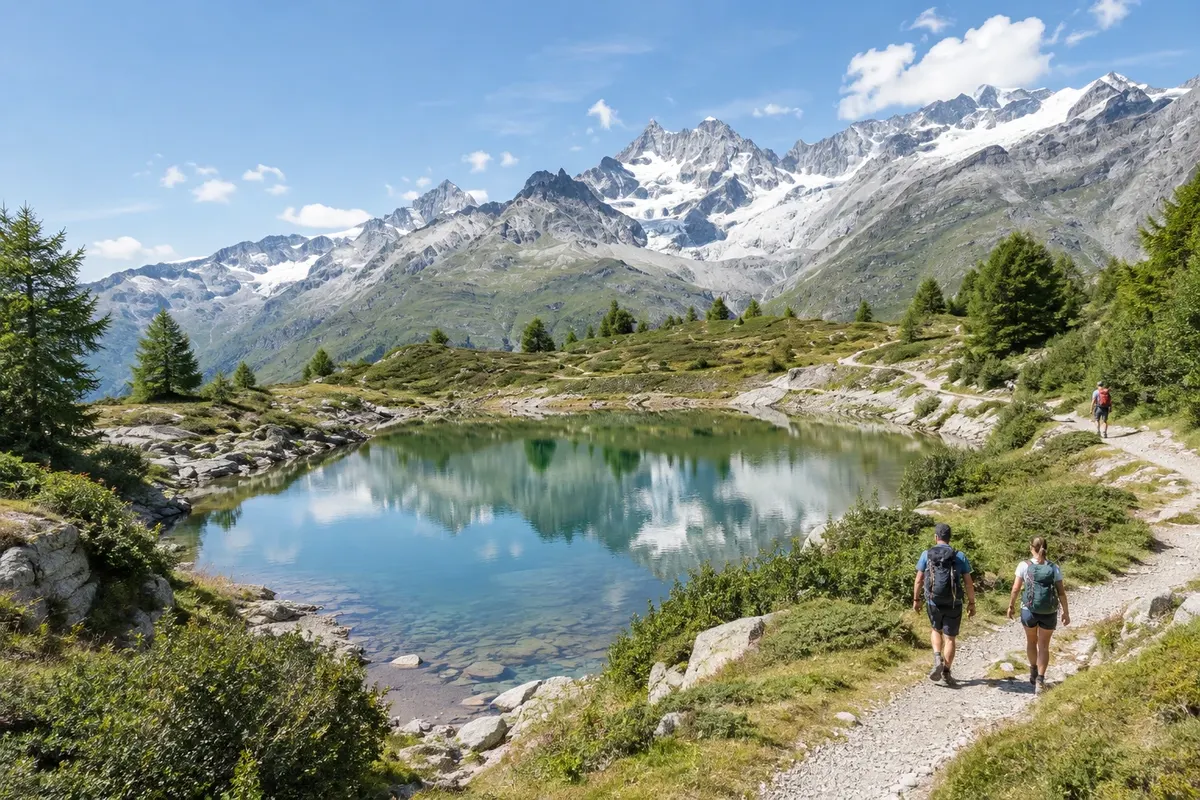
This is the classic summer hike on the Sunnegga side. You take the funicular to Sunnegga (2,288 m) and the cable car to Blauherd (2,571 m), where the trail begins. In about 20 minutes you reach the Stellisee, the lake where the Matterhorn often appears reflected on windless days. After that come Grindjisee, Grünsee — where you can swim — Moosjisee, with milky blue water, and finally Leisee, near the Sunnegga station, where the funicular returns you to Zermatt. It’s about 11 km, with roughly 380 m of ascent and 660 m of descent, around 3 hours 15 minutes of walking, not counting stops. The final section between Moosjisee and Leisee is the steepest. If you don’t want the full route you can go only from Blauherd to Stellisee and back.
Kraji na poti: Blauherd, Stellisee, Grindjisee, Grünsee, Moosjisee, Leisee, Sunnegga, Matterhorn.
Vključuje: Use the funicular and cable car tickets. The trail has no fee. Check the current timetable/prices.
Nasvet: Start early to catch the Stellisee with calm water. Bring snacks and water: there are few support points along the way. The trail can be blocked by snow at the beginning and end of the season.
Najboljši čas za obisk: From July to September, when the trail is usually snow-free.
Zermatt center on foot: Bahnhofstrasse, Hinterdorf and Bergsteigerfriedhof
Odhod: Bahnhofplatz, in front of Zermatt station Peš Približno 2 uri Popoldne Lahko
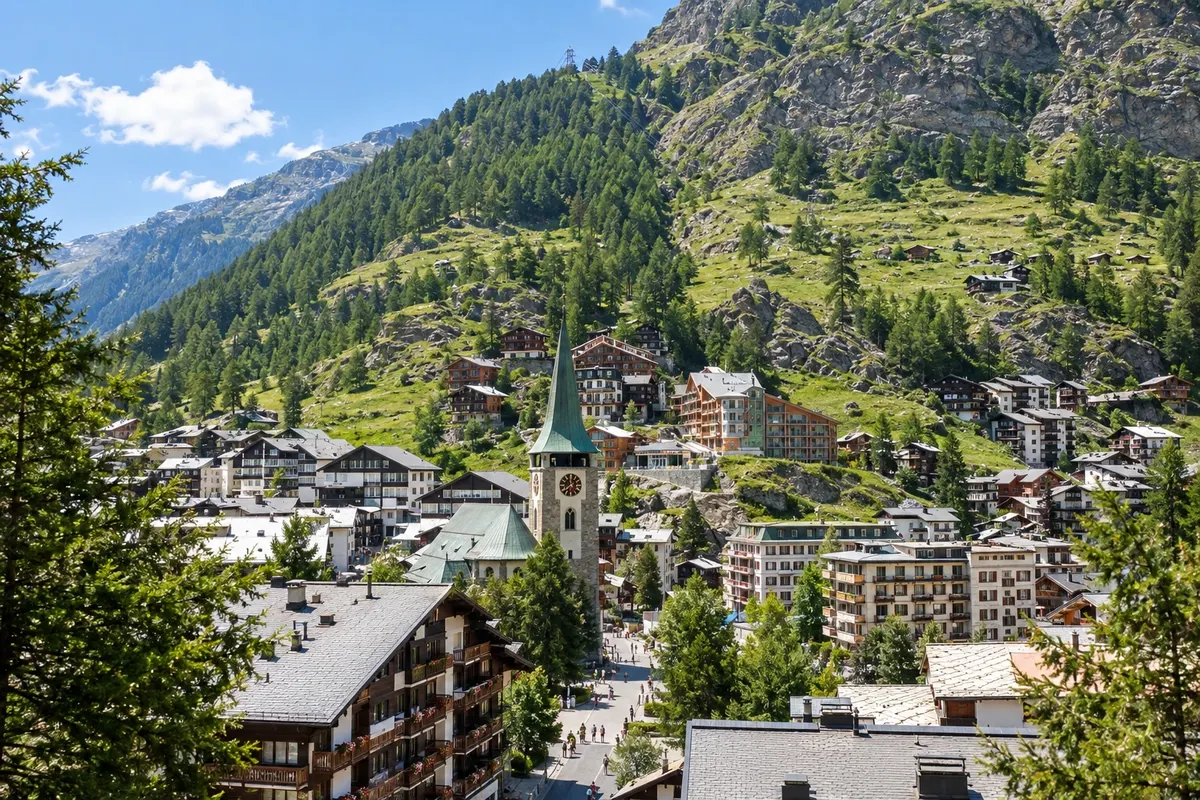
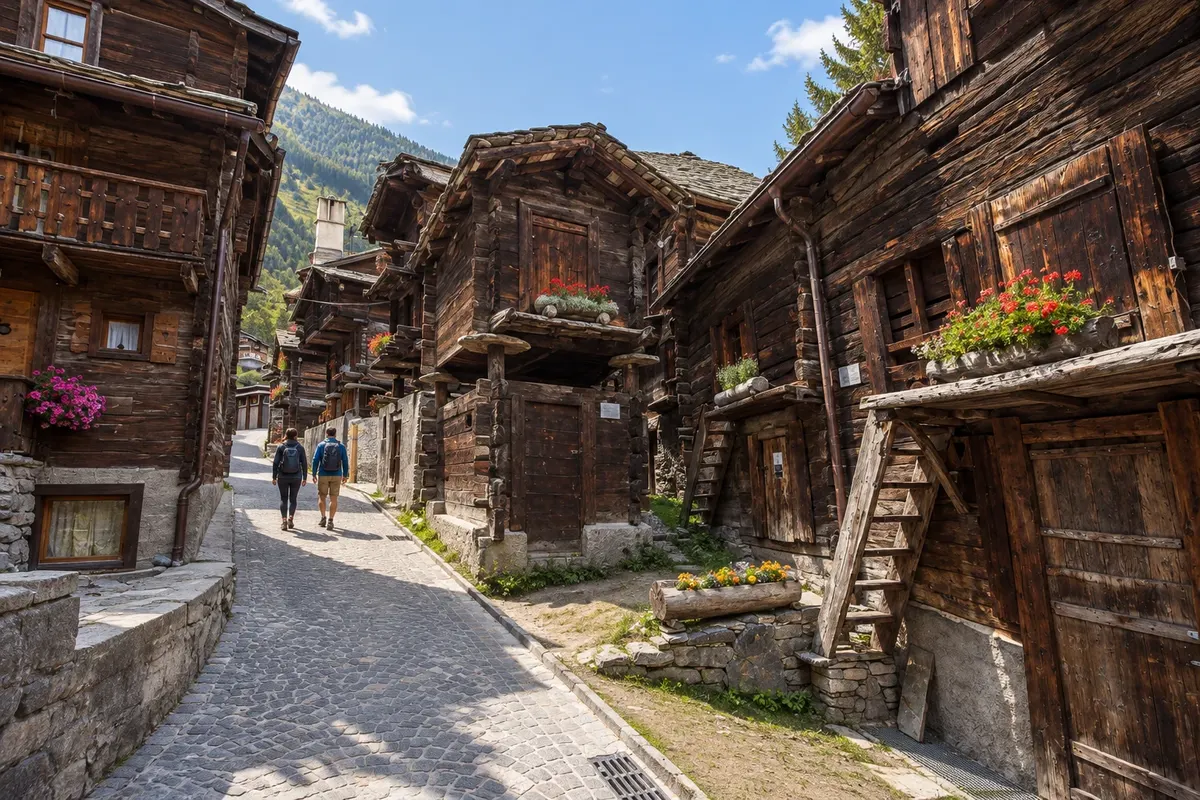
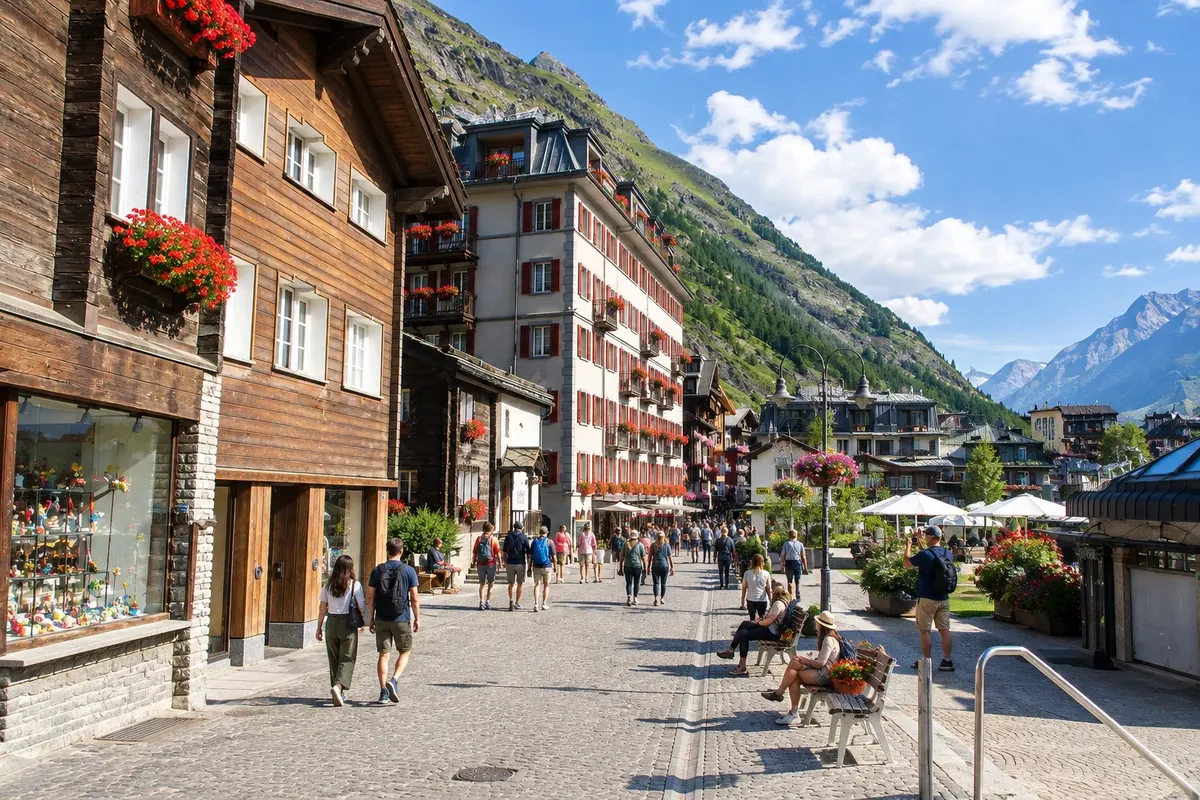
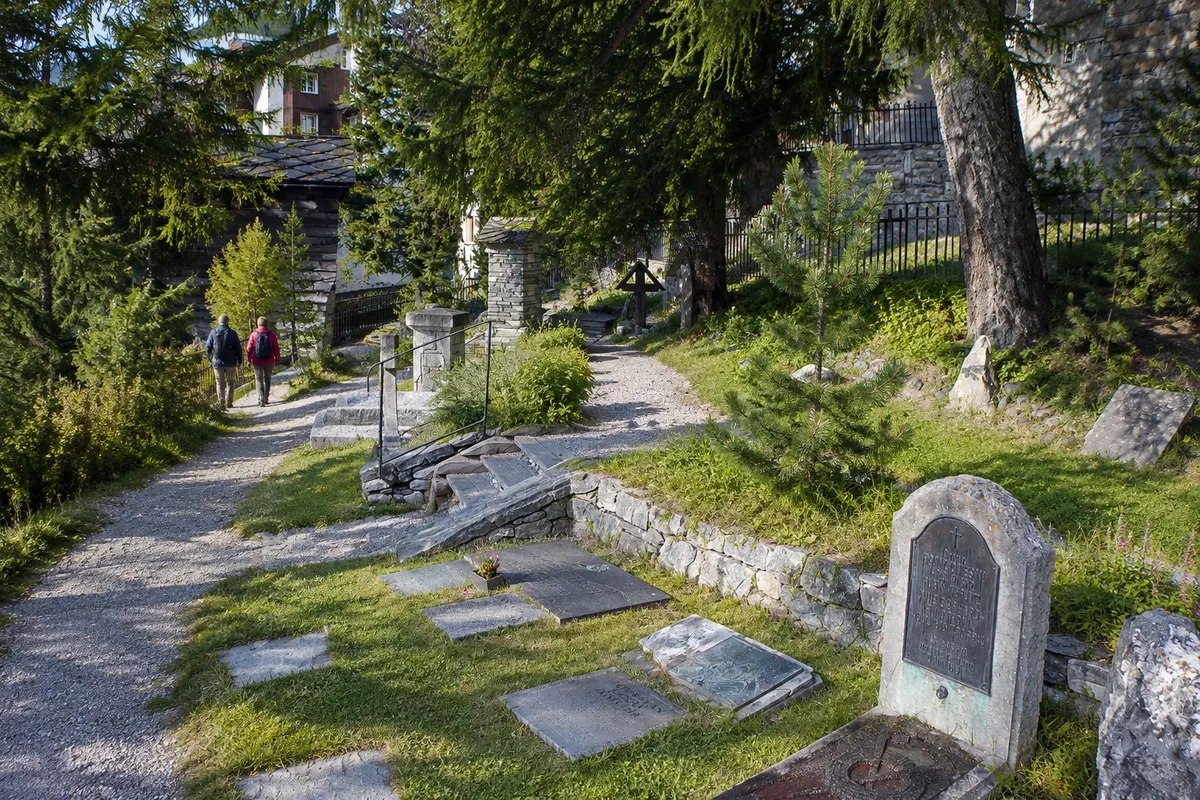
Zermatt has no private cars: only small electric vehicles, electric taxis and horse-drawn carriages operate, and most things are done on foot. The walk starts at Bahnhofplatz and follows Bahnhofstrasse, the main street with shops and cafés, to Kirchplatz, the square of the Catholic church St. Mauritius. Nearby, on Hinterdorfstrasse, is the Hinterdorf (the rear village), the old core, with more than 30 wooden buildings from upper Valais, raised between the 16th and 18th centuries; some barns are over 500 years old. There are two main types: the Stadel, a hay barn with one door, and the Speicher, a food store such as dried meat, generally with four doors, one for each family. Many rest on round stone slabs on posts to prevent rats from entering. The wood is larch and darkens with age; the roofs are stone slabs. Linked to the parish is the Bergsteigerfriedhof (mountaineers' cemetery), with about 50 graves of climbers who died in the surrounding mountains, mostly from the 19th century, including the guide Michel-Auguste Croz, who died on the descent from the first ascent of the Matterhorn in 1865.
Kraji na poti: Bahnhofstrasse, Hinterdorf, Kirchplatz, Pfarrkirche St. Mauritius, Bergsteigerfriedhof, Matterhorn Museum – Zermatlantis.
Vključuje: The walk and the cemetery visit are free. The Tourist Office organizes guided tours of the village in German, English and French; check the current schedule.
Nasvet: The cemetery is a place of remembrance: speak quietly and do not climb on the graves. Combine the visit with the Matterhorn Museum, which is located at Kirchplatz.
Najboljši čas za obisk: All year; in late summer afternoons the center becomes livelier.
Matterhorn Museum – Zermatlantis
Odhod: Kirchplatz, in central Zermatt Peš about 1 hour to 1½ hours Popoldne Lahko
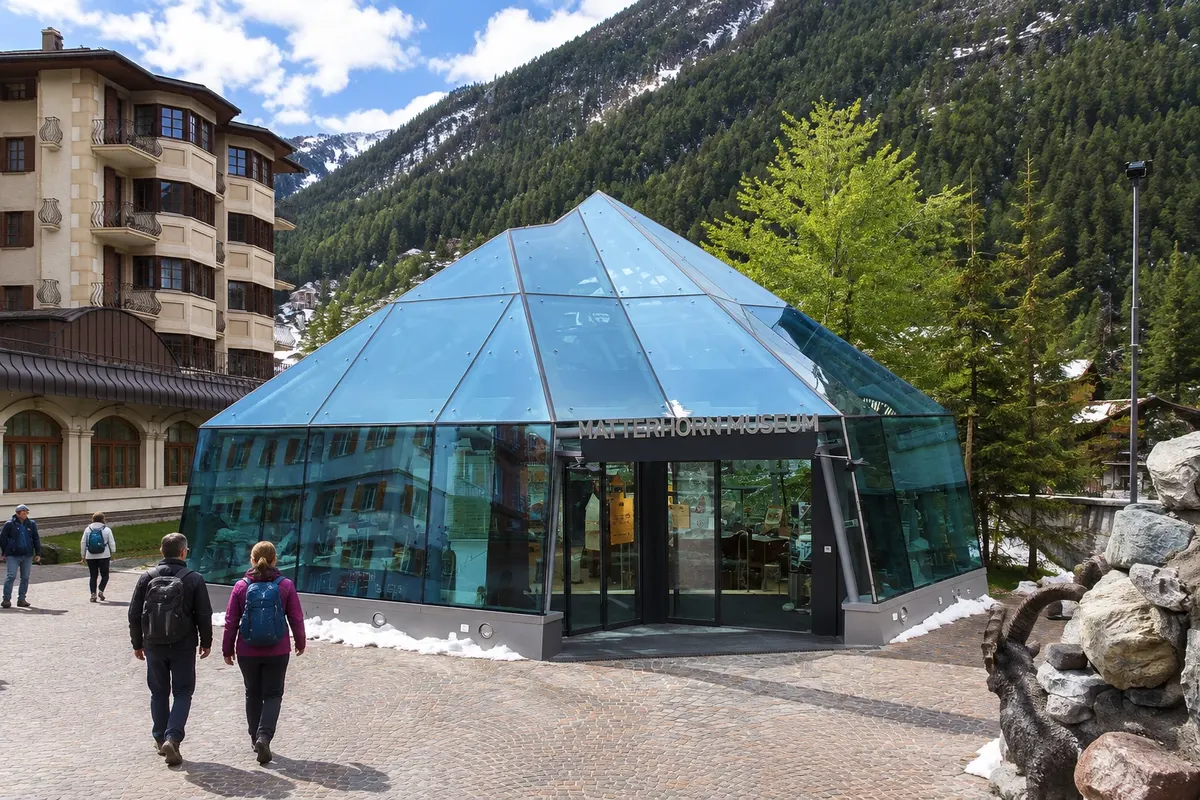
The museum is located beneath Kirchplatz and shows, in an underground space, how Zermatt evolved from a mountain farming village into a mountaineering and tourist destination. There are reconstructed original houses and interiors, with everyday objects from residents and the early climbers. The central section is the Matterhorn room: it tells the story of the first ascent, on July 14, 1865, by Edward Whymper’s seven-man team, and the descent in which four of them died. The original rope that broke is on display, along with belongings of the deceased climbers. There is also a stone axe from the Neolithic period, finds from a 16th-century mercenary soldier, a scale model of the Matterhorn with the ascent routes, and a multimedia room with clips from the film Der Berg ruft, shot in Zermatt in 1937 and 1938. An audio guide is available in English, German, French and Japanese. The museum has wheelchair access.
Kraji na poti: Matterhorn Museum – Zermatlantis, Kirchplatz, Matterhorn.
Vključuje: There is an admission fee. Some tourist transport passes and the Swiss Museum Pass grant access; check the current price table.
Nasvet: The museum usually opens in the afternoon and closes for a few weeks at the end of autumn; check the seasonal hours. It’s a good option for a cloudy day, when the viewpoints aren’t worthwhile.
Najboljši čas za obisk: All year round, especially on overcast days.
Gornerschlucht: the walkways in the Gorner Gorge
Odhod: Zermatt town centre On foot, or cable car to Furi and descent on foot about 1.5 hours, returning via Blatten Dopoldne ali popoldne easy (stairs and narrow walkways)
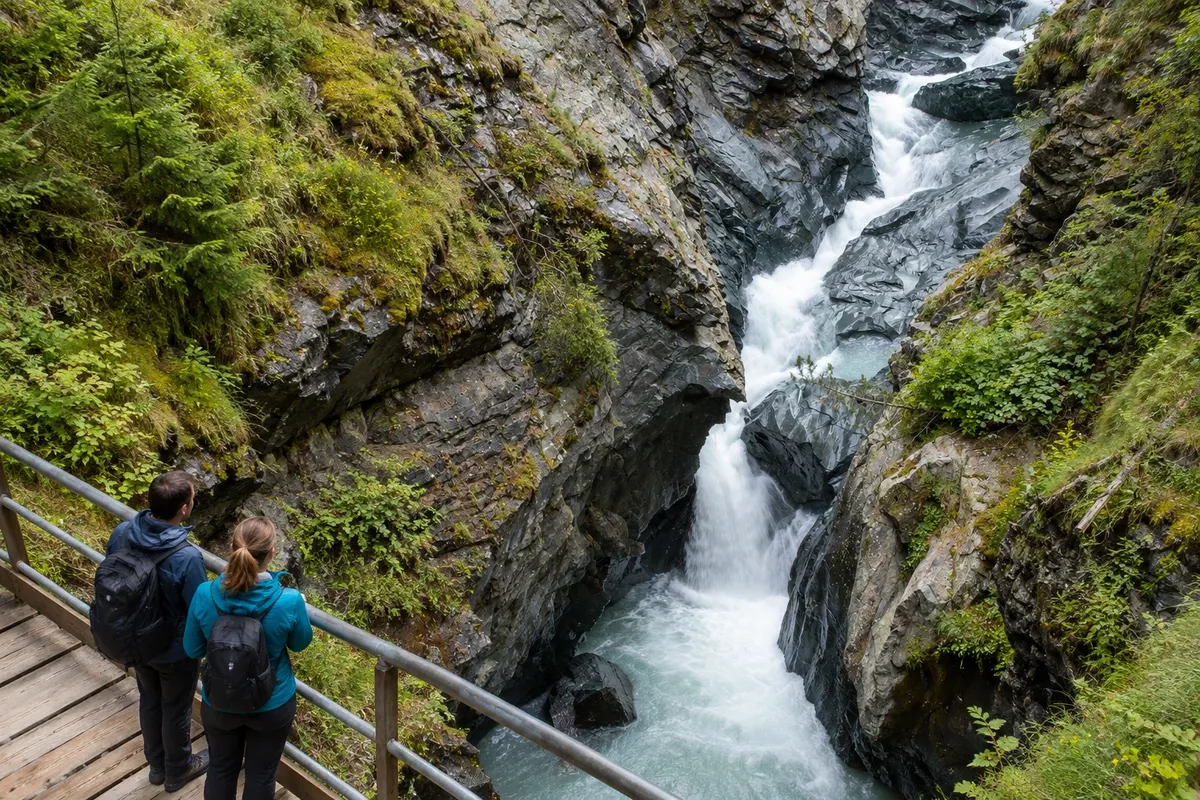
The Gornerschlucht (Gorner Gorge) is at the southern exit of the village, about a 15-minute walk from the town centre. The Gornera river, which flows from the Gorner Glacier, has cut a narrow channel in a greenish rock, serpentinite, about 220 million years old. Wooden walkways and stairs fixed to the rock follow the water for roughly 200 m, rising about 40 m; walking through the gorge takes around 20 minutes. On exiting, a suggested loop continues through the village of Blatten, about 15 minutes away, and returns down to Zermatt in a circuit of about 2.75 km. Another option is to take the cable car up to Furi and walk down to the gorge. For those wanting more, there is a guided via ferrata inside the gorge, bookable in advance.
Kraji na poti: Gornerschlucht, Blatten, Furi, Gornera.
Vključuje: There is an entrance fee for the walkways. The guided via ferrata requires a separate ticket, with equipment available to rent on site. Check the current price list.
Nasvet: The walkways get wet and slippery: wear footwear with a firm sole. It may close for a few days in heavy rain. It’s a short excursion to fit into an arrival day or a day with poor visibility at the summit.
Najboljši čas za obisk: From late May to mid-October, when it is usually open.
Glacier Express: from Zermatt to St. Moritz on a panoramic train
Odhod: Zermatt Station Glacier Express panoramic train (seat reservation required) about 8 hours Ves dan Lahko
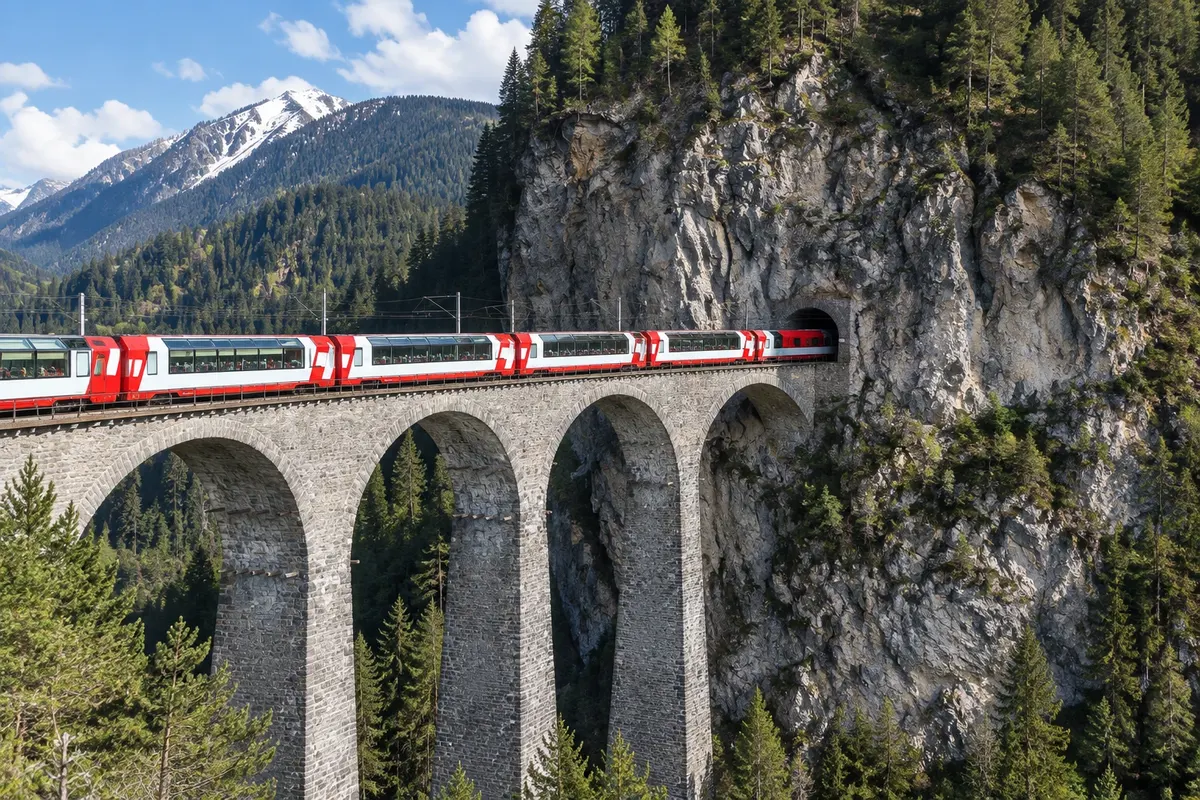
The Glacier Express links Zermatt to St. Moritz in the Engadine in about 8 hours, crossing 291 bridges and 91 tunnels. It departs Zermatt descending the Mattertal (Matter valley), partially using a rack system, down to Visp and Brig. It passes through the Furka Tunnel, 15.4 km long, goes by Andermatt and climbs to the Oberalppass at 2,033 m, the highest point on the route. In Disentis/Mustér the locomotive is changed and the train enters the section operated by the Rhätische Bahn. It continues through the Rheinschlucht (Rhine Gorge), reaches Chur where the train reverses direction, and crosses the Landwasserviadukt, a curved viaduct near Filisur, before descending to St. Moritz. The carriages have panoramic windows and meals are served at your seat. For travelers continuing into the Engadine, it is a transfer journey; those who just want a taste can ride a shorter section, such as Zermatt–Brig or Zermatt–Andermatt.
Kraji na poti: Zermatt, Mattertal, Visp, Brig, Furkatunnel, Andermatt, Oberalppass, Disentis/Mustér, Rheinschlucht, Chur, Landwasserviadukt, Filisur, St. Moritz.
Vključuje: Train ticket plus mandatory seat reservation, including for those with a rail pass. Onboard meals are paid separately. Check the current schedule.
Nasvet: Book in advance: reservations open about 93 days beforehand and summer tends to sell out. The train usually has an annual pause between mid-October and early December; confirm the dates.
Najboljši čas za obisk: From June to September for long days; from December to March for snowy scenery.
Round-trip day to Saas-Fee and Mittelallalin (3,500 m)
Odhod: Zermatt Station Train to the Saas valley and PostAuto bus to Saas-Fee about 9 hours, with roughly 2 hours travel each way Ves dan easy (altitude around 3,500 m)
Saas-Fee is the neighboring village, in the Saastal (Saas Valley), also without private cars, at about 1,800 m and surrounded by 18 summits over 4,000 m. From Zermatt, the trip takes roughly 2 hours, with a change from train to the PostAuto bus. In Saas-Fee you walk from the bus station to the cable cars. The Alpin Express climbs to the Metro Alpin station at about 3,000 m, and from there the Metro Alpin, an underground funicular, takes you to the Mittelallalin at about 3,500 m. Up there is a revolving restaurant, which makes one full turn per hour, and the ice pavilion, with a grotto carved into the glacier. In summer a glacier ski area operates between 3,000 and 3,600 m. On the way back there is time to stroll the village streets.
Kraji na poti: Saas-Fee, Saastal, Felskinn, Mittelallalin, Allalin, Metro Alpin, Feegletscher.
Vključuje: Train and bus transport and the Saas-Fee cable cars have separate tickets; the ice pavilion and meals are paid separately. Check the current timetable/prices.
Nasvet: Leave Zermatt early to have time up top. Check the cable car season in advance: the Metro Alpin often stops for part of spring. Bring winter clothing for Mittelallalin.
Najboljši čas za obisk: From June to April, when the Metro Alpin is usually operating.


 Brazilija
 Antarktika
 Argentina
 Bolivija
 Čile
 Kolumbija
 Ekvator
 Gvajana
 Francoska Gvajana
 Falklandski otoki (Malvini)
 Paragvaj
 Peru
 Surinam
 Urugvaj
 Venezuela
 Nemčija
 Avstrija
 Belgija
 Hrvaška
 Danska
 Slovaška
 Slovenija
 Španija
 Finska
 Francija
 Grčija
 Nizozemska
 Madžarska
 Irska
 Islandija
 Italija
 Luksemburg
 Norveška
 Poljska
 Portugalska
 Združeno kraljestvo
 Češka
 Švedska
 Turčija
 Bermudi
 Kanada
 Združene države Amerike
 Grenlandija
 Mehika
 Sveta Peter in Mihael
 Dominikanska republika
 Japonska
 Južnoafriška republika
 Egipt
 Avstralija
 Fidži
 Nova Zelandija
 Papua Nova Gvineja