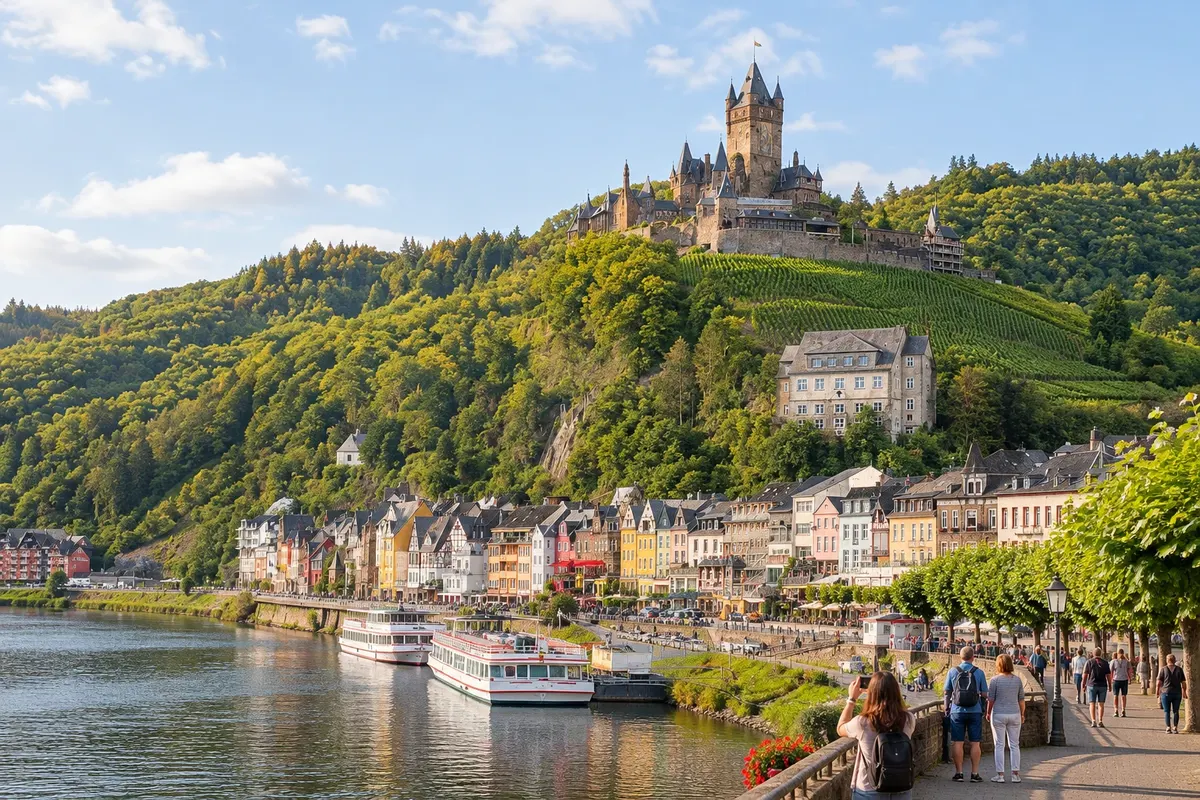
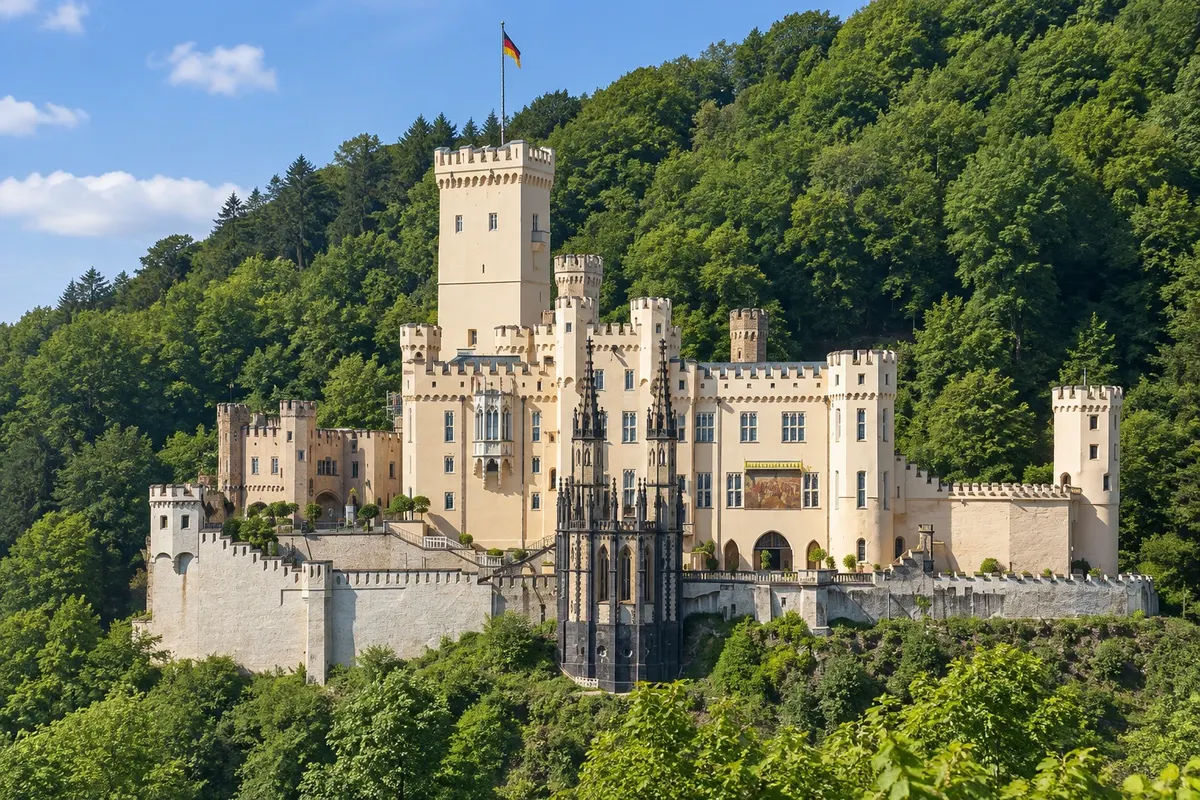
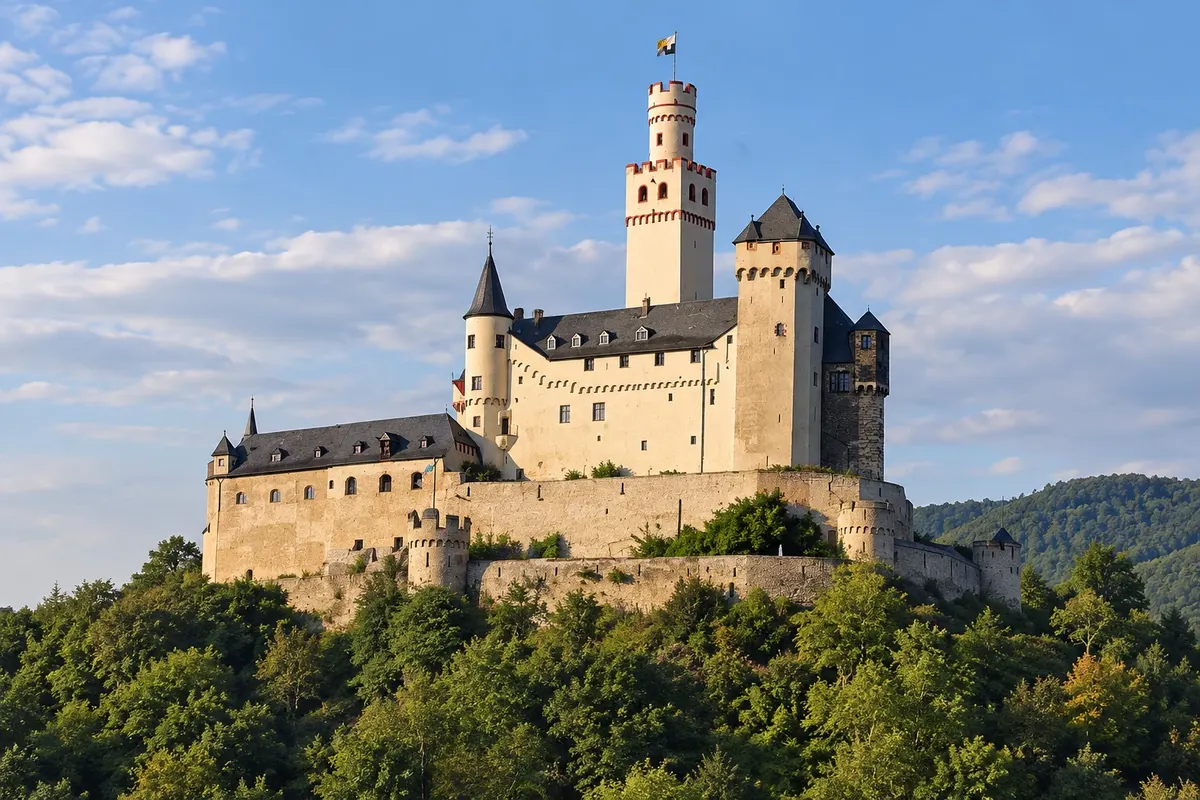
Reichsburg Cochem: the neo‑Gothic castle more than 100 m above the Mosel
Odhod: Marktplatz, Cochem On foot uphill (about 20 min) or Reichsburg shuttle bus about 2 hours, with the guided tour Dopoldne moderate (steep uphill walk)
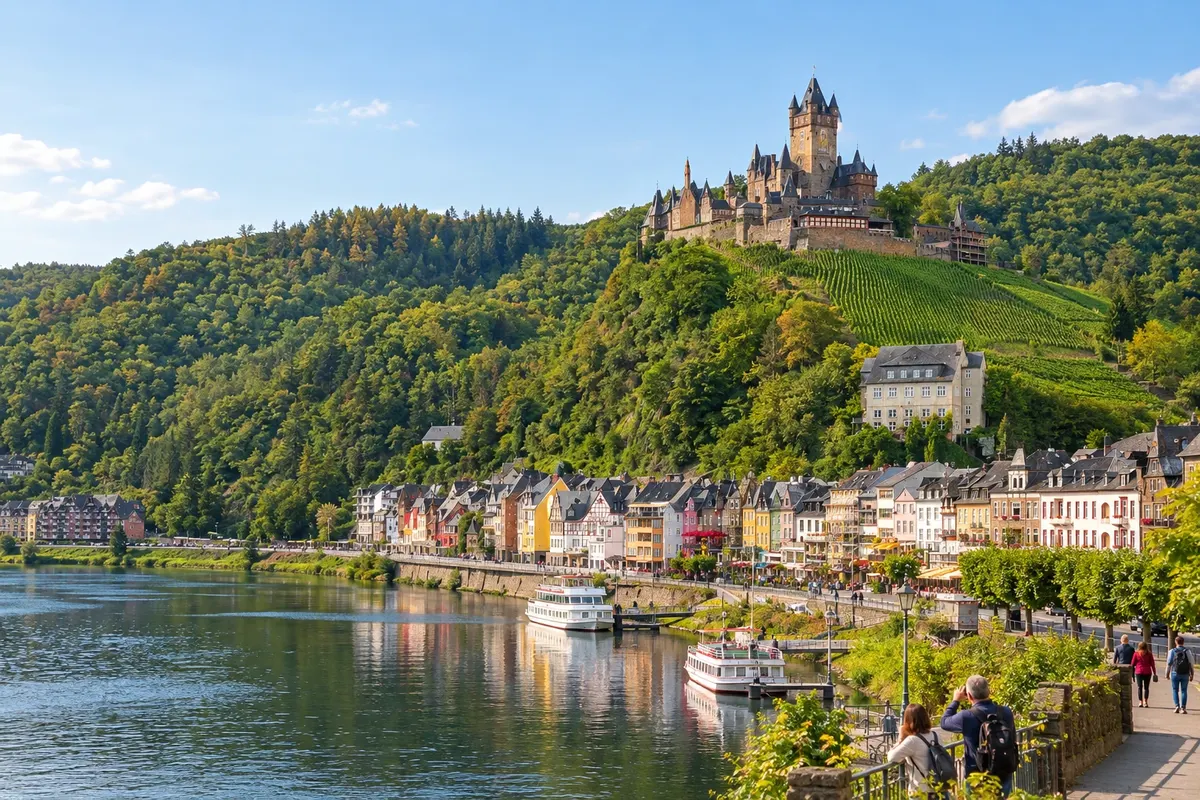
Reichsburg dominates Cochem from a rock more than 100 m above the Mosel. The original castle dates to the 11th century, first documented in 1051, and belonged to the prince-electors of Trier. On May 19, 1689, during the Palatinate Succession War, French troops set fire to and blew up the fortress, which remained in ruins for almost 180 years. In 1868 the Berlin businessman Louis Ravené bought the rubble and rebuilt the castle in a neo-Gothic style with architects from Berlin; the new castle opened in 1877, with towers, steep roofs and carved wooden interiors in the 19th-century taste. For that reason what you see today is a romantic summer residence, not a medieval fortress. The interior and inner courtyards can only be seen on guided tours, with regular departures in German and generally one per hour in English; printed texts in several languages are provided. Rooms include the knights’ hall, banquet rooms, bedrooms and the kitchen, with views over the river’s bends. There is no parking at the castle: you walk up the marked path from the center in about 20 minutes uphill, or take the Reichsburg shuttle bus. The castle is open daily in the main season, from mid-March to early November, with reduced hours in winter.
Kraji na poti: Reichsburg Cochem.
Vključuje: Admission paid separately, only with guided tours, sold online and at the ticket office. The Reichsburg shuttle has its own fare. Themed tours, such as the 1877 servants tour and the lantern tour, are paid extras.
Nasvet: Arrive for the first visit of the morning, before excursion buses, and buy the ticket online on summer days and public holidays. Ask for the printed text in your language at the entrance. On the way down, stop at the viewpoint on the path for a photo of the castle with the river behind. In December the castle usually holds Christmas market days in the courtyards.
Najboljši čas za obisk: From mid‑March to early November, with tours all day. In winter there are tours only until mid‑afternoon and, in January and February, on some weekdays: check before you go.
Cochem on foot: Marktplatz, Enderttor and the Mosel promenade
Odhod: Cochem station (Bahnhof) Walk through the old town and the riverbank Približno 2 uri late afternoon Lahko
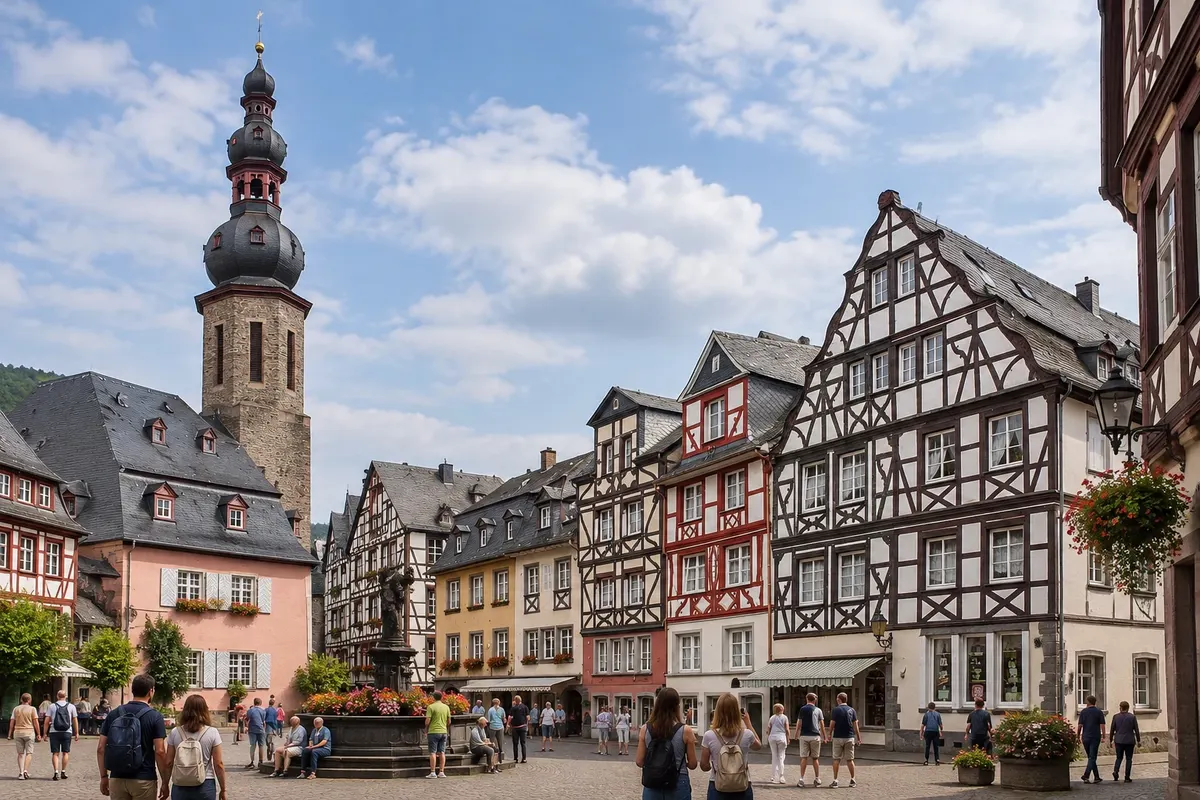
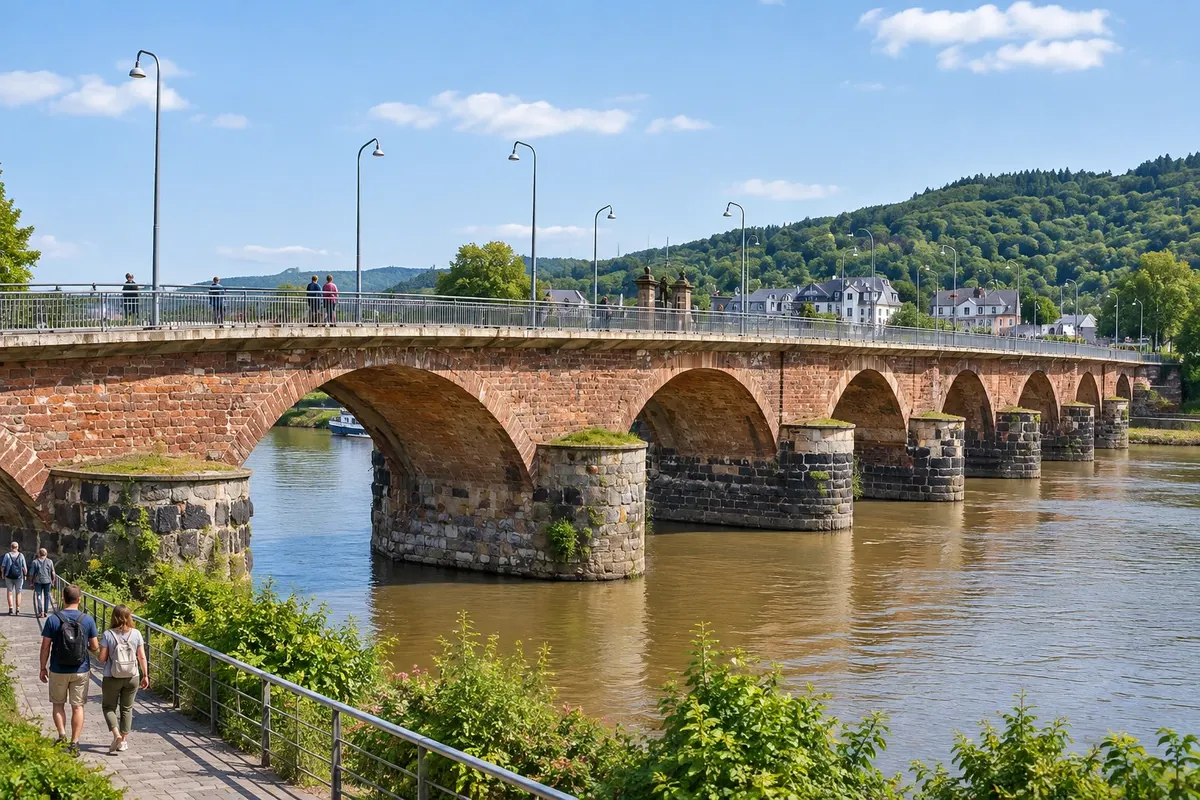
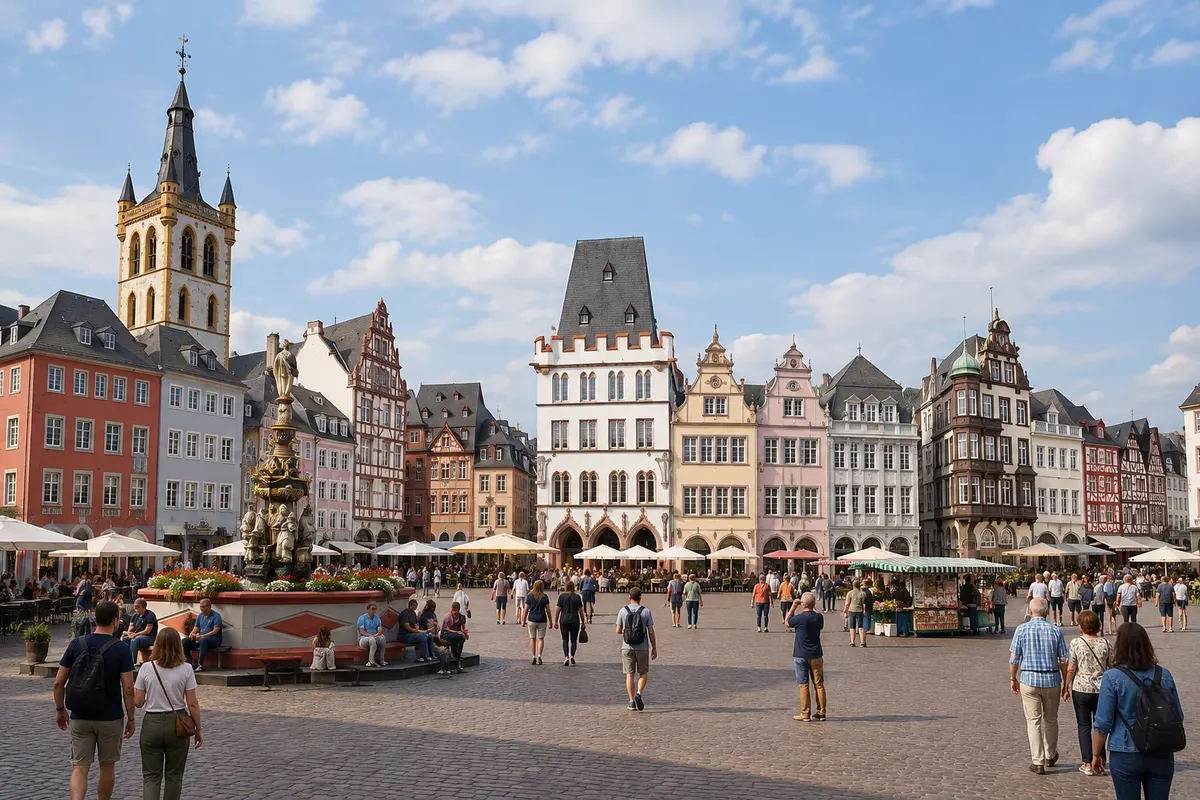
Cochem is the gateway town of the lower Mosel. From the station, about a 10-minute walk, you reach the Marktplatz, a rectangular square with the St. Martin fountain (Martinsbrunnen) in the middle and the baroque Rathaus (town hall) with a mansard roof: the 1620 building was destroyed in the 1689 fire and rebuilt in 1739 according to the old plans, and the ground floor used to be a covered market. Around the square and in the nearby lanes are half-timbered houses, cafés and shops selling regional products. The town once had eleven gates; the Enderttor, Martinstor and Balduinstor survive, along with stretches of wall and small towers such as the Zuckertürmchen. The Enderttor, at the north exit, still has the guard’s house. From the Marktplatz, walk down to the Mosel promenade, the riverside walkway, from which you can see the Reichsburg above and the bridge over the Mosel. Cross the bridge to the Cond quarter: from the opposite bank, the view of the center with the castle on the hill is the town’s most photographed image. Sightseeing boats depart from the promenade quay. The church of St. Martin, with its tower between houses, completes the picture.
Kraji na poti: Marktplatz Cochem.
Vključuje: Free walk, no ticket. There are paid guided city tours organized by the tourist information office, and a seasonal tourist train.
Nasvet: Save the walk for late afternoon, when tour groups have left and the light comes from behind the castle. On summer weekends and public holidays the center fills up: go early or late. The bridge to Cond is the place to see the castle illuminated at night.
Najboljši čas za obisk: All year. From April to October there are tables on the sidewalks and boats at the quay; in late August the town usually holds its wine festival with fireworks; in December there is a Christmas market.
Cochemer Sesselbahn: the chairlift to the Pinnerkreuz
Odhod: Valley station, Endertstraße, Cochem Double-chair cable car Približno uro in pol Dopoldne ali popoldne easy (return on foot is moderate)
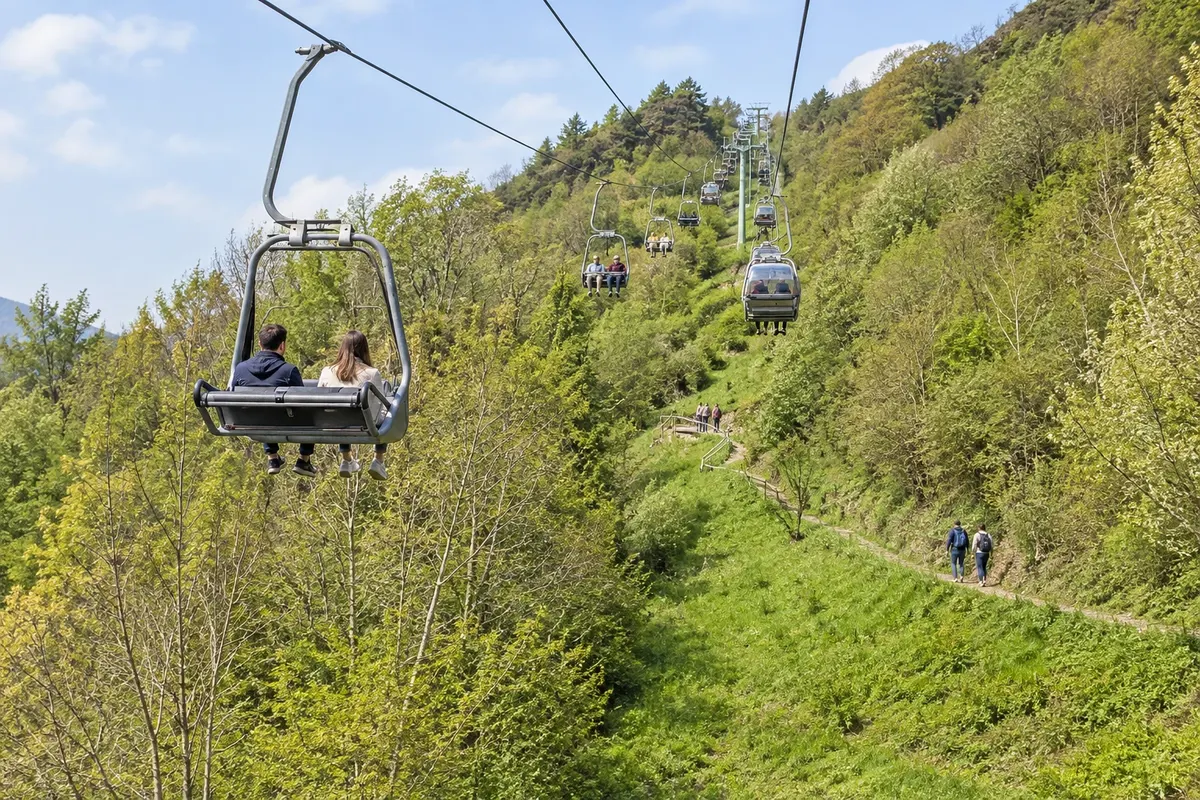
The Cochemer Sesselbahn is the only chairlift on the Mosel. Operating since 1955, it departs from Endertstraße, about a 10-minute walk from the Marktplatz, near the Enderttor. The open double chairs cover 360 m of route and 158 m of elevation in about 7 minutes, from an elevation of roughly 100 m up to the upper station at about 258 m, next to the Pinnerkreuz, the stone cross on the hillside. From the viewpoint you can see all of Cochem below, the Reichsburg level with your eyes, the bridge and the river bend among vineyards. There is a restaurant with a terrace at the top. If you wish, you can return on foot via waymarked trails, descending through forest and vineyards to the castle or down to the center, or walk about 20 minutes across the plateau to the Wild- und Freizeitpark Klotten, a park with animals and rides. The chairlift season typically runs from March or April until mid-November, with longer hours in July and August and shorter hours in October and November; in heavy rain the operating times are reduced.
Kraji na poti: Cochemer Sesselbahn.
Vključuje: Ticket sold separately, round-trip or one-way for those who walk down. The viewpoint and trails are open. The Klotten park has its own admission.
Nasvet: Ride early in the morning, when the line is short and the light hits Cochem, or in the late afternoon for the castle against the sun. Bring a jacket even in summer: the chair is open and the wind at the top is chilly. If you are afraid of heights, sit on the inside of the chair, facing away from the valley.
Najboljši čas za obisk: From April to October. In July and August it opens earlier and closes later; from November to March check whether it is operating.
Cochem to Beilstein boat: the Fankel lock and the village of narrow lanes
Odhod: Moselpromenade pier, Cochem Scheduled boat with passage through the lock half day (about 2 h 30 by boat, plus the stop) Dopoldne ali popoldne easy (hills in Beilstein)
The most popular boat trip from Cochem goes up the Mosel to Beilstein, about 11 km away, passing through the Fankel lock where the boat is lifted by about 7 m. The outbound trip takes longer than the return because it goes against the current; the whole route, round trip, is about 2 hours 30 minutes of sailing, with stops to disembark in the village. The river here makes tight bends between vineyard-covered slopes, with villages of slate-roofed houses on the banks. Beilstein is called Dornröschen der Mosel, the Sleeping Beauty of the Mosel, because it has hardly changed: steep cobbled lanes, half-timbered houses, the market square with a fair on Tuesdays since 1322 and, above, the ruin of Burg Metternich, destroyed by the French in 1689, whose tower serves as a viewpoint over the village and the river. Above the square is the Carmelite convent, with the baroque church of St. Josef, begun in 1691, with an organ and 18th-century paintings. The boat runs in season, from April to November, with several departures per day; check return times before getting off. If you prefer, you can go by boat and return by bus, or cycle the section along the riverside bike path.
Kraji na poti: Marktplatz Cochem.
Vključuje: Boat fare paid separately, either return or one-way. The village, the ruin and the church are open; the climb to Burg Metternich’s tower may have its own fee—check locally. There are combined boat-and-walk visits.
Nasvet: Take the first morning departure and get off at Beilstein before the tour-bus groups; climb to Burg Metternich on arrival while the alleys are empty, and return on a mid-afternoon boat. Bring a hat: the upper deck has no shade.
Najboljši čas za obisk: From April to October, during the boat season; in September, at harvest time, the vineyards are golden. On days of high water or severe drought the boat may not run: confirm before you go.
Burg Eltz: day trip by train and walk through the Elzbach valley
Odhod: Cochem station (Bahnhof) Regional train to Moselkern (about 15 min) and a walk of about 5 km full day morning and afternoon moderate (trail with climbs and rocks)
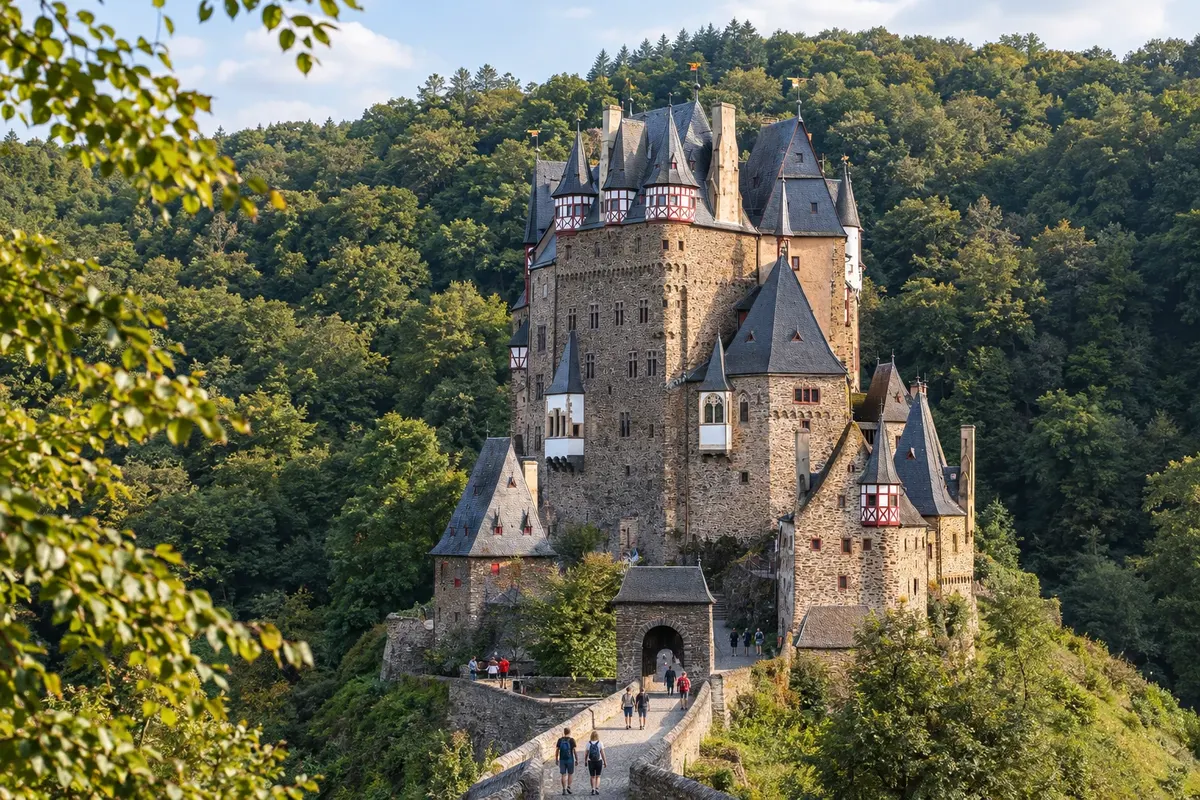
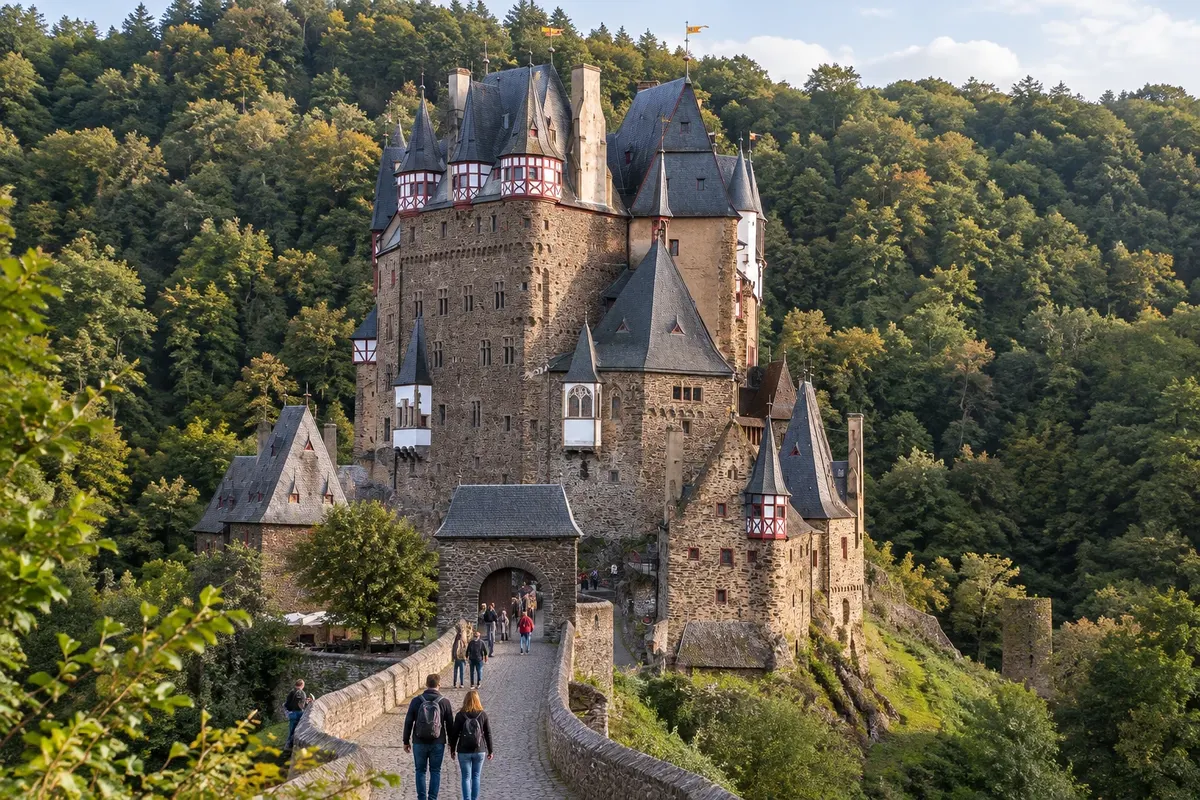
Burg Eltz is hidden in a side valley of the Mosel, on a rock about 60 m high surrounded on three sides by the Elzbach stream, and therefore only appears in the last meters of the path. It is one of the few castles in the region that was never destroyed: the Eltz family has lived there for about 900 years, and the building grew between 1150 and 1650, with eight towers up to 35 m, lookout points and half-timbering, because there was no room to expand sideways. Three branches of the family—Rübenach, Rodendorf and Kempenich—divided the inner courtyard, reaching up to 180 inhabitants. The guided tour, about 35 to 40 minutes, in German and English, goes through the armory, the Rübenach halls from 1311, the knights’ hall, the children’s room and Rodendorf’s kitchen; photography inside is not allowed. The treasure chamber, with more than 500 items from nine centuries, is viewed independently. The simplest way to get there without a car is by train to Moselkern and, from the station, on foot along the Elzbach valley, passing the Ringelsteiner Mühle: about 5 km and 1 hour 15 minutes of gentle uphill, on dirt and stone trail. In season there is also a regular bus from Hatzenport station to the castle parking lot. If you go by car you leave the vehicle in the parking lot and continue on foot or by minibus. The castle is open daily from late March to early November; it is closed in winter.
Kraji na poti: Burg Eltz.
Vključuje: Separate paid admission, which includes the guided visit, the courtyard and the treasury chamber; without it you cannot enter the courtyard or the restaurants. Parking and the shuttle minibus from the car park are paid separately, in cash. There are leaflets with the tour text in Portuguese.
Nasvet: Allow 2 hours 30 to 3 hours at the castle, plus the walk. Leave Cochem early in the morning to arrive before the buses and avoid a queue for the visit. On the return, the path via Rotherhof to Treis-Karden has a viewpoint over the Mosel, but it is longer and steeper; if in doubt, return via Moselkern. Hiking shoes are necessary after rain.
Najboljši čas za obisk: From April to October, when the castle is open; May and June offer a green valley and fewer people than July and August. From November to March the castle is closed.
Bernkastel on foot: Marktplatz, Spitzhäuschen and Graacher Tor
Odhod: Mosel bridge between Kues and Bernkastel Walk through Bernkastel old town Približno 2 uri Dopoldne ali pozno popoldne Lahko
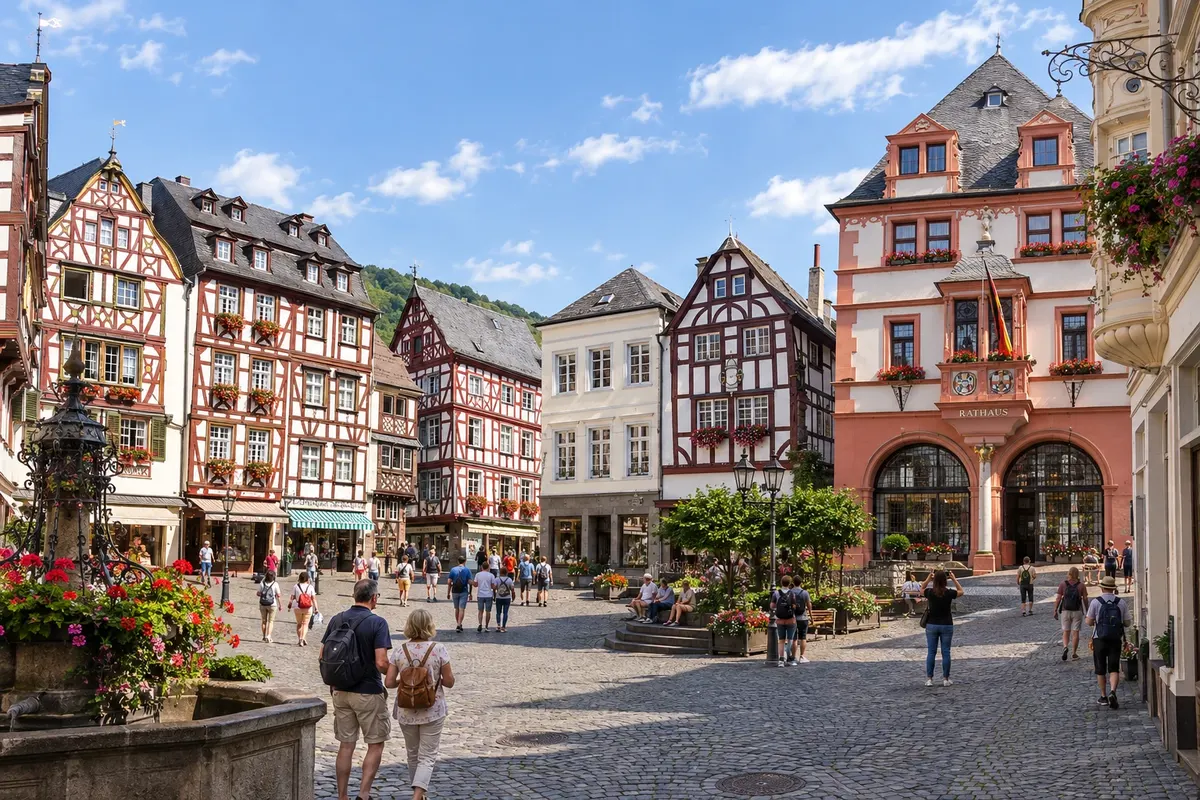
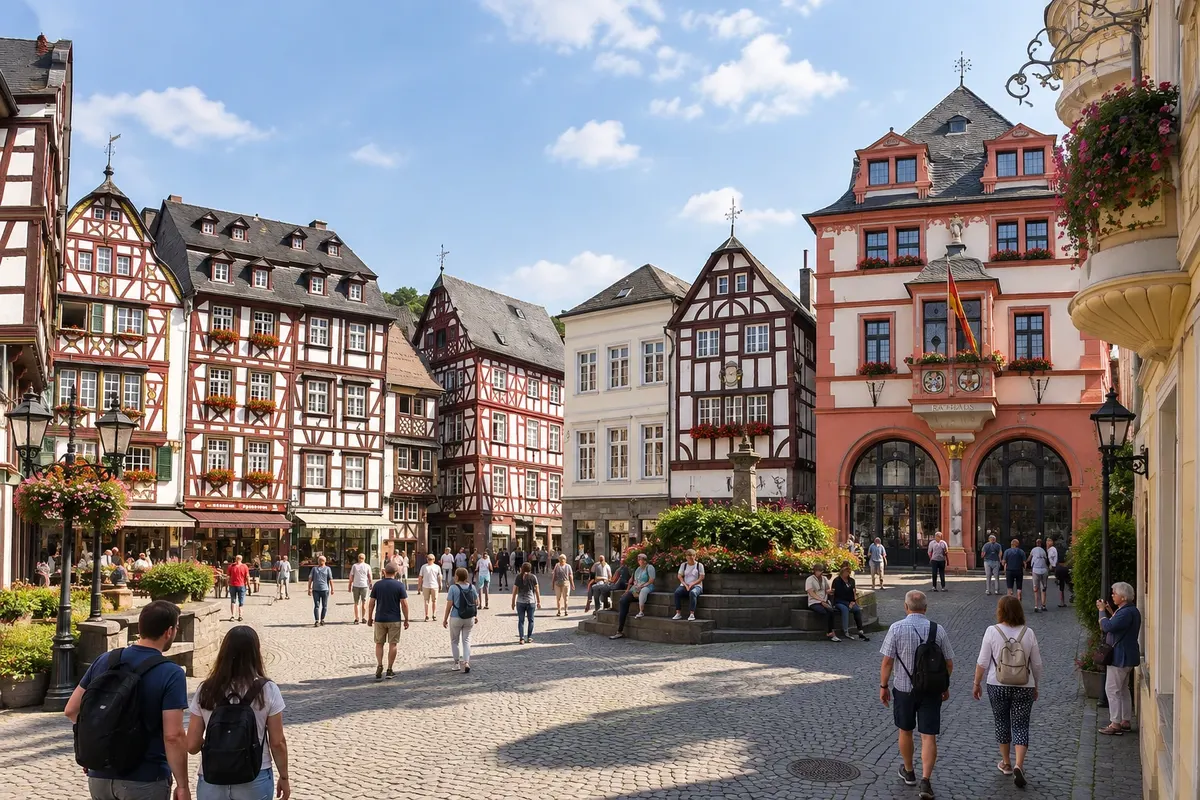
Bernkastel-Kues are two towns joined in 1905, one on each bank of the Mosel: Kues, flatter, where buses arrive, and Bernkastel, with its medieval centre clinging to the Burgberg slope. Bernkastel received town rights in 1291. The Marktplatz is a small, steep square, surrounded by 16th- and 17th-century half-timbered houses with gables facing the square, the St. Michael fountain (Michaelsbrunnen) from 1606 and the Renaissance Rathaus (town hall) of 1608, built of stone with three floors, which had an open market arcade on the ground floor. On Karlstraße, at the exit of the square, is the Spitzhäuschen, the little house of 1416 whose upper floor juts out over the street and whose roof ends in a narrow point, the image that appears on every postcard of the town. The church of St. Michael, from the second half of the 14th century, has a 56 m tower that was part of the town's defences. Of the eight gates in the wall only the Graacher Tor remains, from around 1300, which now houses a small local history museum. Above the last houses begins the Bernkasteler Doctor vineyard, one of the best-known vineyards of the Mosel, on a steep slope just behind the church. From the bridge over the river the view brings together the centre, the vineyard and the ruin of Burg Landshut on the heights.
Kraji na poti: Marktplatz Bernkastel.
Vključuje: Free walk, no ticket required. The Graacher Tor museum and guided city tours offered by the tourist office are paid separately.
Nasvet: Go early or late in the day: in summer afternoons the square fills with tour and boat groups. Morning light comes down Karlstraße and lights the Spitzhäuschen. Combine this with the climb to Burg Landshut, which starts on the streets above the square.
Najboljši čas za obisk: From April to October, with flowers in the windows and tables in the square. In early September the town usually has the Middle Mosel wine festival, with fireworks; in December there is a Christmas market in the square.
Burg Landshut and the Moselsteig: the ruin and the vineyards above Bernkastel
Odhod: Marktplatz Bernkastel Uphill walk (about 1 h) or Burg-Landshut-Express bus Približno 3 ure Dopoldne ali popoldne moderate (steep ascent)
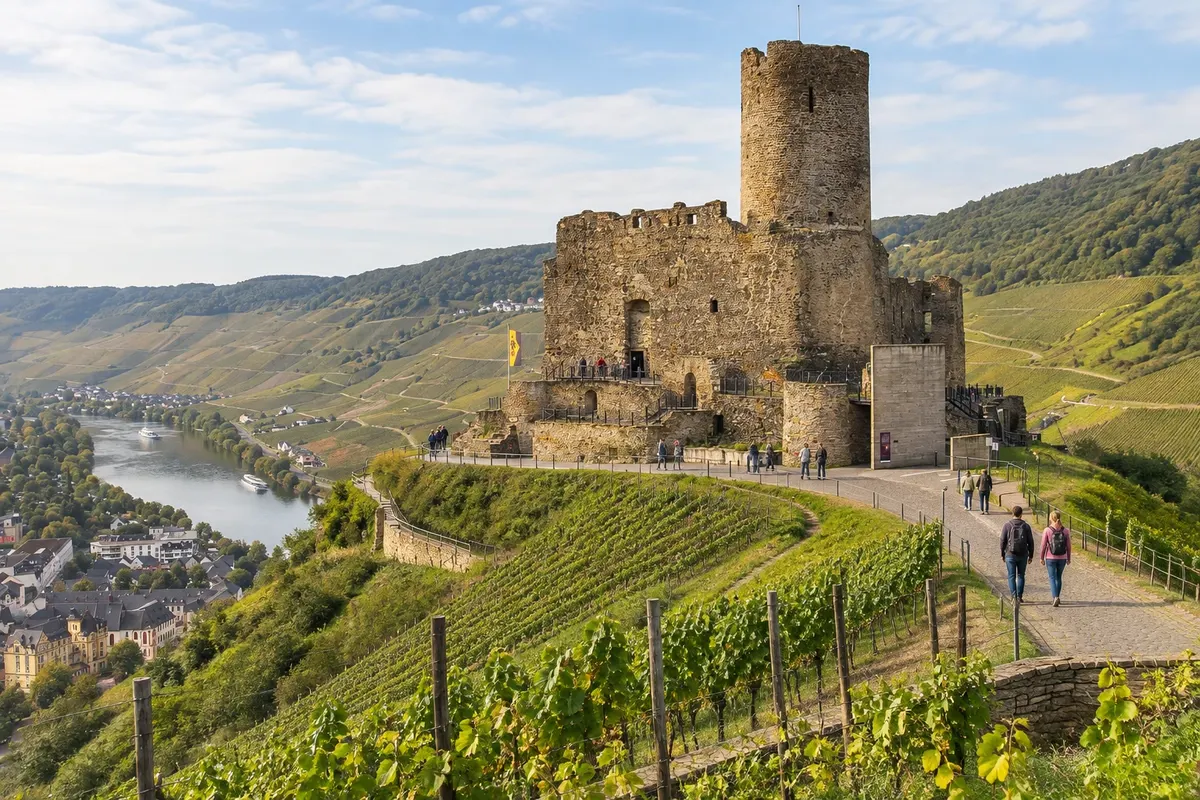
Burg Landshut is the ruin on top of the Burgberg above Bernkastel. The castle was begun in 1276 by the Archbishop of Trier Heinrich von Finstingen and completed around 1320 under Balduin as the archbishops’ residence; the name Landshut appears in 1505. On January 8, 1692, an accidental fire destroyed the castle, which was abandoned and never rebuilt. In 2012 works on the outer wall revealed that below there was a late Roman fort from the 4th–5th centuries, about 60 by 30 m, one of the 19 height forts that protected the Mosel valley; a Roman sarcophagus found nearby is displayed on site. Today there is a step-free path around the walls with information panels about the history, a keep (Bergfried) open to climb and a restaurant with a panoramic window. From the top you can see Bernkastel town center, Kues on the opposite bank, the bridge and the river’s bends. Two marked trails leave the town: the Burgberg-Rundweg, about 1 hour, steeper, and the Familien-Rundweg, about 1 h 30, gentler; in summer the yellow Burg-Landshut-Express bus ascends from the landing (Gestade) in about 20 minutes. Stage 10 of the Moselsteig, the 365 km, 24-stage trail from Perl to Koblenz, passes the ruin before descending to the Marktplatz, and stage 11 continues from Bernkastel-Kues to Ürzig along the Doctor vineyard to the Maria Zill viewpoint. For a short loop with views there is the Bernkasteler Bärensteig, one of the circuits linked to the Moselsteig.
Kraji na poti: Burg Landshut.
Vključuje: Access to the ruin and the surrounding path is free; the Burg-Landshut-Express has its own fare and the restaurant is paid separately. Guided tours of the ruin are sold by the tourist information office.
Nasvet: Walk up in the morning via the Burgberg-Rundweg and descend via the family path that passes the vineyards; or take the bus uphill and return on foot. Bring water: there is no shade in the vineyards. The Bergfried is the highest viewpoint for photos of the valley.
Najboljši čas za obisk: From April to October; in September and early October, during the harvest, the slopes turn yellow. The bus usually operates only in the summer season; outside it, the ascent is on foot.
St. Nikolaus-Hospital (Cusanusstift): the 1458 foundation in Kues
Odhod: Mosel Bridge, Kues side On foot, 5 minutes via the Kues riverside Približno uro in pol Dopoldne Lahko
On the Kues bank, facing the river, stands the St. Nikolaus-Hospital, founded by charter on December 3, 1458 by Nikolaus von Kues (Nicholas of Cusa), a philosopher, theologian, mathematician and cardinal born there in 1401. He created the hospital as an asylum for 33 poor and elderly men from the region, one for each year of Christ’s life, and when he died in Todi, Italy, in 1464 he left all his possessions to the foundation. The old people’s home has operated in the same place without interruption for more than 500 years.
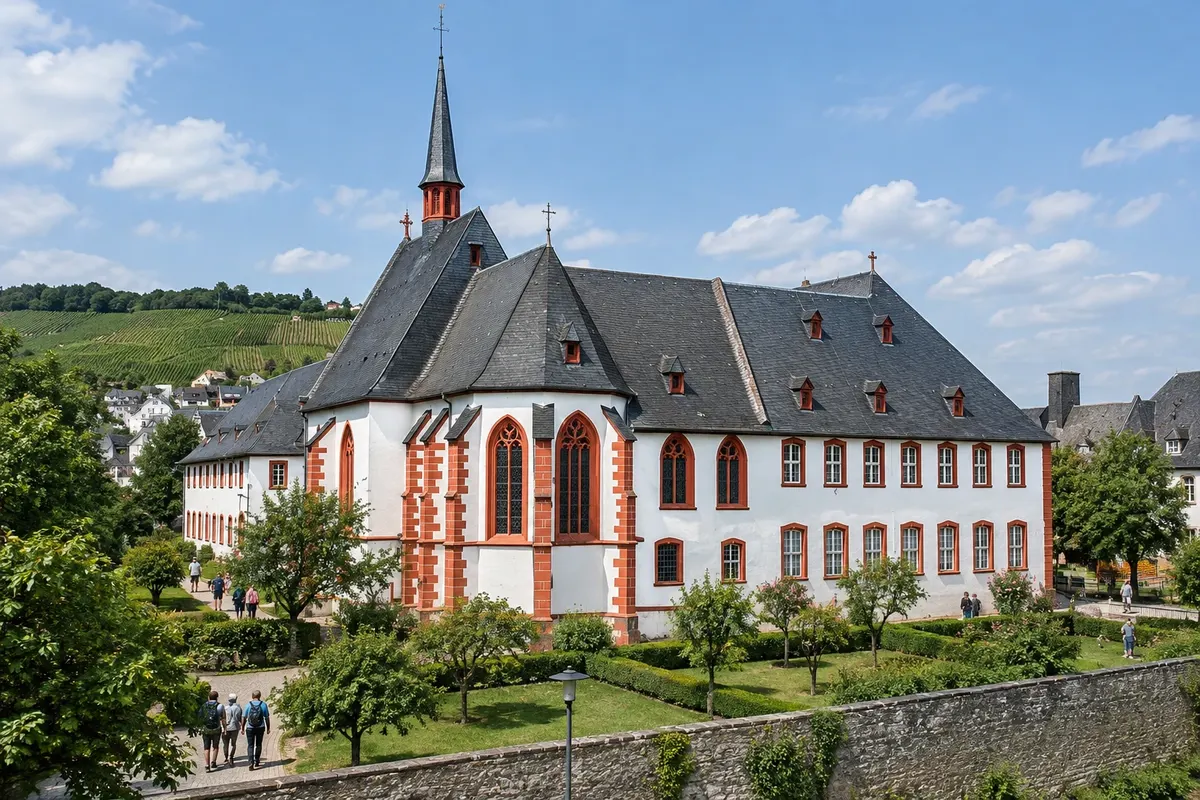
Visitors enter the late Gothic cloister and the chapel, with a square nave supported by a single octagonal column, a model for many churches in the region. In the choir, in front of the altar, a brass plaque from 1488 marks the place where the cardinal’s heart is buried; his body remained in Rome. The altarpiece triptych, painted in Cologne around 1460, shows Nikolaus kneeling as donor, with the crab coat of arms, one of the oldest portraits of him.
The library, with the cardinal’s own manuscripts, can only be seen on a guided tour: from April to October there are open visits on Tuesday mornings and Friday afternoons, and groups book year-round. The exhibition about Nikolaus von Kues’s legacy runs in season. The complex also includes a winery and the Mosel Wine Museum, with separate admission.
Kraji na poti: St. Nikolaus-Hospital (Cusanusstift).
Vključuje: The chapel and cloister have free entry. The guided tour of the library and exhibition requires a separate paid ticket, with fixed times in season and reservations for groups. The wine museum has its own admission.
Nasvet: If you want to see the library, plan to visit Bernkastel-Kues on a Tuesday or Friday between April and October and arrive a little before the tour time. The chapel closes earlier on Saturdays. The church is small: 20 minutes are enough, plus the cloister.
Najboljši čas za obisk: From April to October, when open guided tours run and the exhibition is installed; the chapel is open year-round.
Mosel‑Radweg: the bike valley, from Bernkastel‑Kues to Traben‑Trarbach
Odhod: Bernkastel‑Kues (bike rental in the center) Bicycle along the river bike path, about 24 km half day to full day morning and afternoon easy (flat, paved)
The Mosel‑Radweg is the bike path that follows the river for 248 km in the German section, from Perl on the border with Luxembourg and France to the mouth in Koblenz, in 10 stages. It is almost entirely flat, paved and separated from traffic, marked in green and white, with bank changes by bridges and ferries, which makes it possible for people who don’t cycle often. The stretch from Bernkastel‑Kues to Traben‑Trarbach, about 24 km downstream, is one of the easiest to arrange without a car: the path passes the wine villages of Wehlen, Zeltingen‑Rachtig and Ürzig, with the Ürziger Würzgarten vineyard on a red‑rock slope, and the meander at Kröv, always with vineyards on one side and the river on the other. Traben‑Trarbach at the end is a town of Jugendstil (art nouveau) villas and warehouses built in the early 20th century, when it was one of Europe’s wine trading centres, with the bridge and Brückentor gate over the river. To return there are regular buses to Bernkastel‑Kues and, in season, a scheduled boat taking half a day between the two towns that also carries bicycles. Another short, pretty section is between Cochem and Beilstein, about 11 km, with a boat return. There are shops renting conventional and electric bikes in Bernkastel‑Kues, Cochem and Trier. Bicycles are allowed on regional trains in the area with a separate ticket.
Kraji na poti: Marktplatz Bernkastel.
Vključuje: Bike rental paid separately, with helmet and lock; the bike path is open to the public. Return boat or bus fare paid separately, with a bike fee on the boat and on trains.
Nasvet: Cycle downstream from Bernkastel‑Kues to Traben‑Trarbach; the wind often helps, and book your bike the day before in July and August. Stop in Ürzig to see the red rock slope. Check the timetable for the last boat or bus back before you leave. On hot days, start early: the bike path has few shaded sections.
Najboljši čas za obisk: From May to September, with long days and ferries and boats in operation; in April and October the bike path is open but check ferry services. In winter many rental shops close.


 Brazilija
 Antarktika
 Argentina
 Bolivija
 Čile
 Kolumbija
 Ekvator
 Gvajana
 Francoska Gvajana
 Falklandski otoki (Malvini)
 Paragvaj
 Peru
 Surinam
 Urugvaj
 Venezuela
 Avstrija
 Belgija
 Hrvaška
 Danska
 Slovaška
 Slovenija
 Španija
 Finska
 Francija
 Grčija
 Nizozemska
 Madžarska
 Irska
 Islandija
 Italija
 Luksemburg
 Norveška
 Poljska
 Portugalska
 Združeno kraljestvo
 Češka
 Švedska
 Švica
 Turčija
 Bermudi
 Kanada
 Združene države Amerike
 Grenlandija
 Mehika
 Sveta Peter in Mihael
 Dominikanska republika
 Japonska
 Južnoafriška republika
 Egipt
 Avstralija
 Fidži
 Nova Zelandija
 Papua Nova Gvineja