Parque da Estação
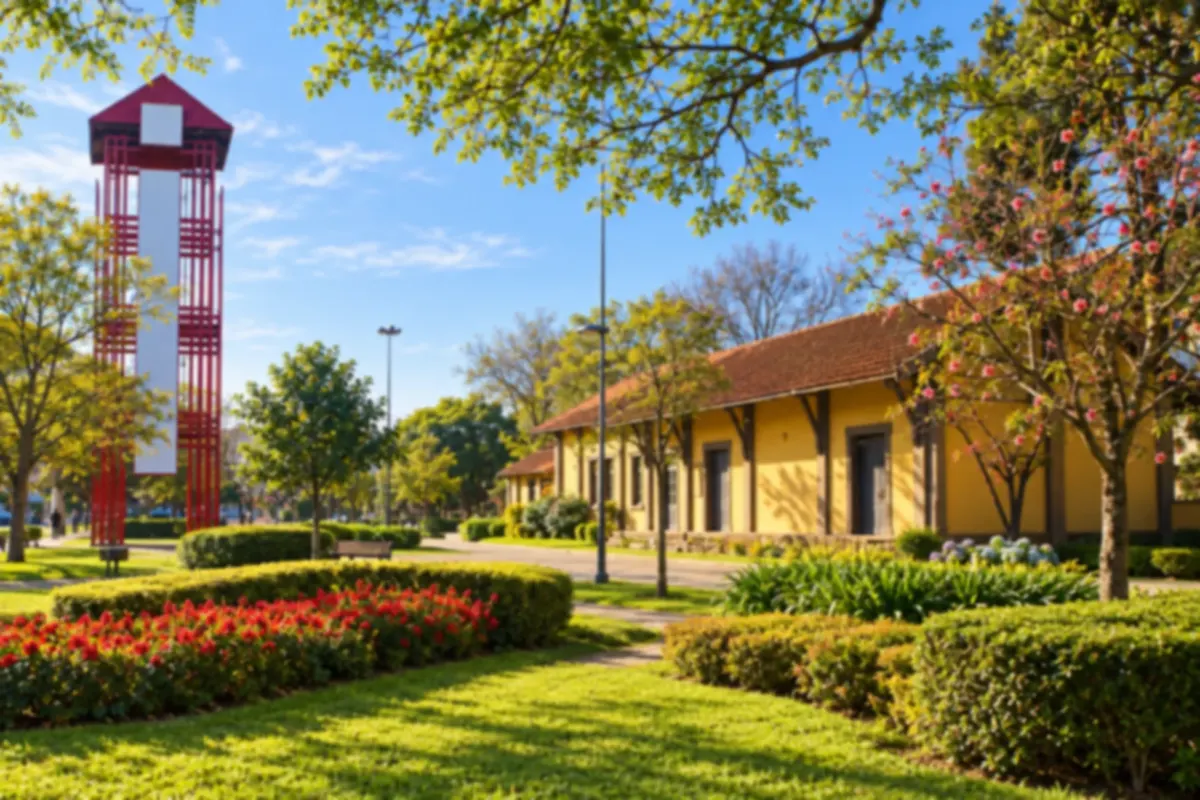
The park is laid out around the railroad station opened in 1909, a building listed as a municipal heritage site. The tree-lined lawn has benches and a playground and hosts events throughout the year.
Antarktika
Rio Grande do Sul · Brazilija
Destinacija: Serra Gaúcha.
Illustrative images. The pictures in this guide are illustrations based on the real place, not photographs, and may differ from it.
Mesto
Carlos Barbosa brings together railroad memory and immigrant traditions in Serra Gaúcha. You can stroll through the Parque da Estação and explore the center, the local crafts and the town's rural roads.
Carlos Barbosa is in the Serra Gaúcha, in Rio Grande do Sul, about 100 km from Porto Alegre, roughly 8 km from Garibaldi and less than half an hour from Bento Gonçalves. It’s a small industrial city of Italian colonization that travelers usually visit for three reasons: cheese, the railway and the knives and pans made here.
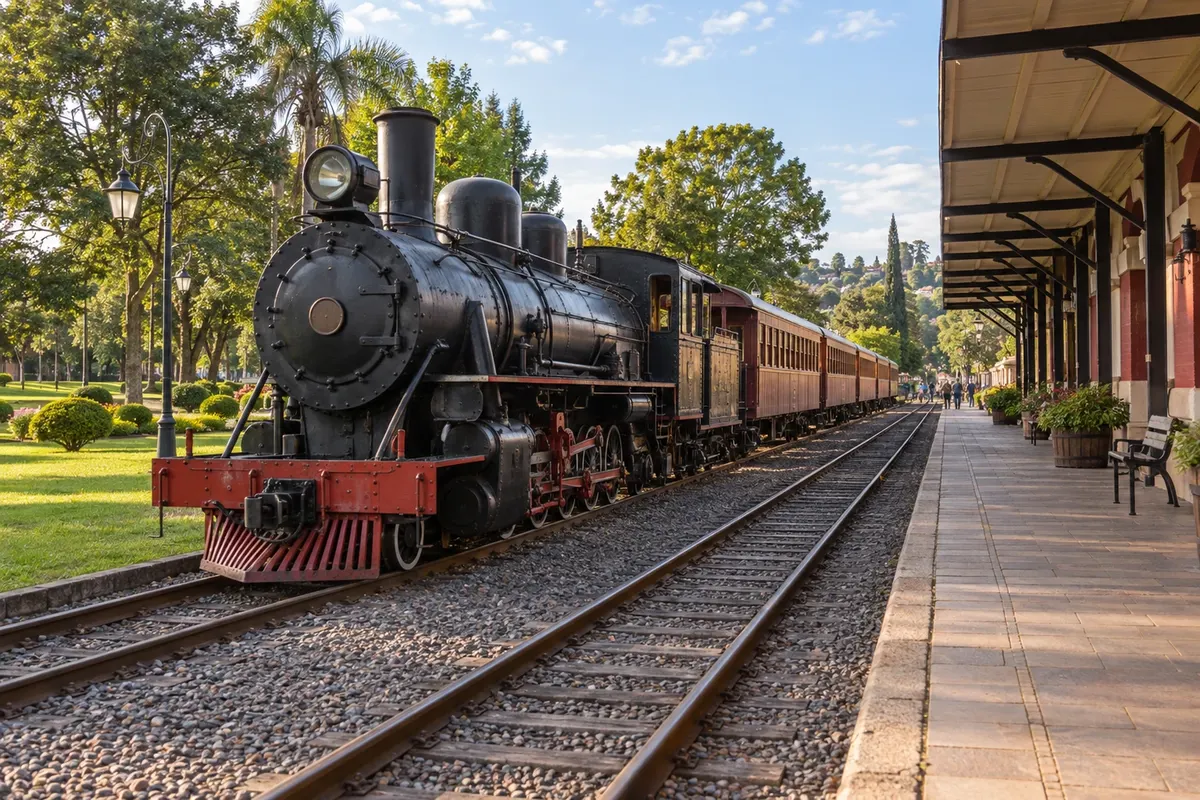
The town grew around the tracks. The name, adopted in 1910, honors the state governor at the time of construction of the railway between Montenegro and Caxias do Sul. The old station, from the early 20th century, has been preserved and today is the center of Parque da Estação, the city’s main green space. It is from there that the Maria Fumaça, the tourist steam train, departs and arrives on the 23 km route to Bento Gonçalves, stopping in Garibaldi.
The center is compact. Next to the park are Praça da Matriz and the Igreja Matriz Nossa Senhora Mãe de Deus, from 1943, whose tower houses four bells. The Tramontina factory outlet, producer of kitchenware and tools founded in the city in 1911, is also in the center and a usual stop for visitors.
The cheese comes from the countryside. The municipality is one of the country’s best-known dairy basins, with cooperatives and cheesemakers, and celebrates the product at FestiQueijo, which runs across five weekends from late June to late July. Ticket holders for the main hall eat and drink unlimited cheeses, wines, sparkling wines and immigrant cuisine while listening to live music. It’s the period when the city receives the most visitors.
Two hills complete the visit. Morro do Calvário has the 14 Stations of the Cross on the ascent, a church at the top and city views; on Good Friday it hosts the final scenes of the Passion of Christ dramatization. Morro do Diabo, in the rural area at 665 meters altitude, is a paragliding takeoff and viewpoint over the valley, visits by appointment.
The climate is mountainous: cold winter from June to August, with highs near 18 °C, nights that can approach 0 °C and frost on some days; mild summer, with highs around 26–27 °C and afternoon showers. April and May tend to be drier, and October wetter.
Half a day is enough for the center, and a full day allows adding both hills. Most travelers visit Carlos Barbosa together with Garibaldi and Bento Gonçalves, by car or on the train trip. During FestiQueijo, it’s worth staying in the city or nearby and booking in advance.
Carlos Barbosa – število nastanitev: 15.
Carlos Barbosa – število lokalov: 15.
Carlos Barbosa – nazivi in posebnosti
Doživite kraj
The park is laid out around the railroad station opened in 1909, a building listed as a municipal heritage site. The tree-lined lawn has benches and a playground and hosts events throughout the year.
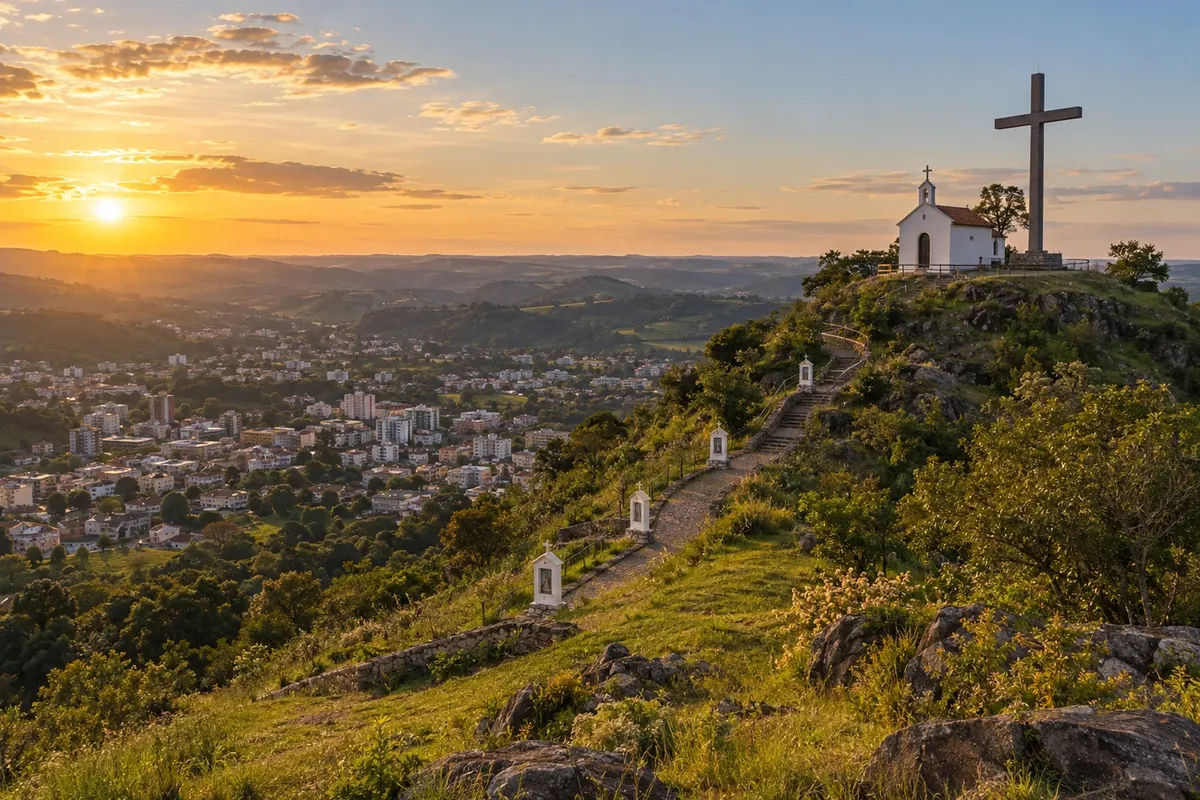
At the top of the hill stands the Igreja Nossa Senhora das Dores, reached by a path lined with the Stations of the Cross. The site hosts the final scenes of the annual Passion of Christ reenactment and has a panoramic view of the town.
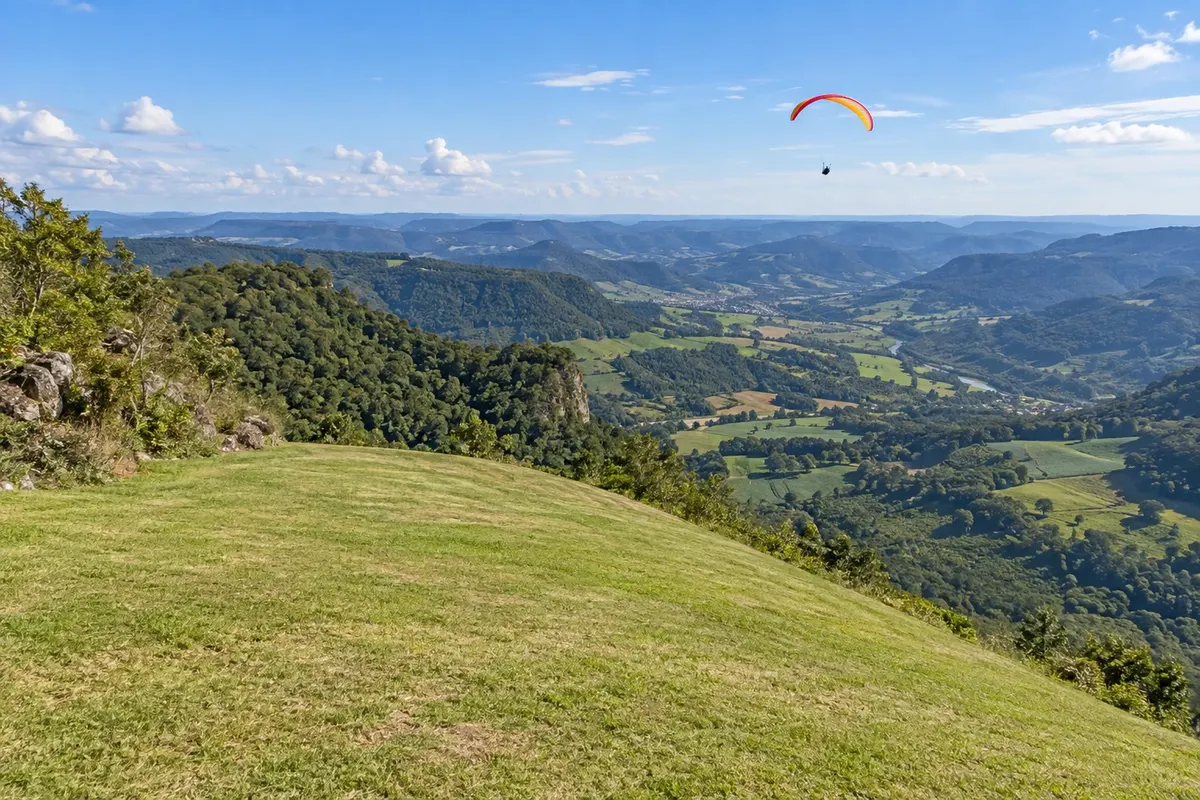
At 665 meters above sea level, it's one of the state's free-flight ramps, used for paragliding and hang gliding practice. From the top there's a wide view of the valley and the surrounding landscape; visits require an appointment.
Kaj izbrati pred odhodom
Izhodišče, trajanje, potek, vključene storitve in okvirna cena vsakega izleta.
The starting point is Parque da Estação, arranged around the old railway station building, which is listed as a municipal historic landmark. The station recalls the time when the train connected the Italian colonies in the highlands to the capital; on days when the Maria Fumaça (steam train) operates, the platform becomes active again with the arrival and departure of the steam locomotive. The park has lawns, trees, benches, a playground, and the Casa do Artesanato, which sells pieces made by local artisans. The terrain is flat. Right next door is Praça da Matriz, with the Igreja Matriz Nossa Senhora Mãe de Deus. The church was built in 1943 with the help of the community, and the tower houses four bells. The walk continues along the downtown streets to the Tramontina factory outlet, a company founded in Carlos Barbosa in 1911 and known for cutlery, knives, pots, and tools. It is said to be the brand’s largest store in Brazil and brings together thousands of items from its factories, with a wider variety than other stores. The route is short and fits well before or after the train ride.
Kraji na poti: Parque da Estação, Praça da Matriz, Igreja Matriz Nossa Senhora Mãe de Deus, Tramontina factory outlet.
Vključuje: There is no charge to enter the park, the square, or the church. Purchases and meals are paid separately.
Nasvet: If you want to see the Maria Fumaça at the station, check with the operator the days and times the train passes through Carlos Barbosa. In the church, respect religious services and prefer visiting outside Mass times. The factory shop is closed on Sundays; confirm before you go.
Najboljši čas za obisk: All year, on days with good weather. Between late June and July the center is decorated and busier because of FestiQueijo.
FestiQueijo is Carlos Barbosa’s food festival, held every year across five weekends from late June to late July. It began in 1987 as a side activity of the old Festa do Leite and ended up becoming the city’s main celebration. The heart of the event is the hall at Centro Cultural Mãe de Deus. A ticket is valid for one shift and grants the right to eat and drink as much as you like: dozens of types of cheese from regional producers, wines, sparkling wines and grape juices from Serra wineries, and dishes from immigrants’ cuisine such as fried polenta, roast piglet, pizza and cheese pastries. Visitors circulate among the tasting islands with live music playing throughout. The festival also has spaces outside the hall, which may change each edition. The Piazza FestiQueijo, in the covered street next to the Cultural Center, has food and drink stalls and musical performances; anyone can enter there without a ticket and pays only for what they consume. The Mercato FestiQueijo brings together exhibitors of crafts, fashion, decor and regional products. During the festival the town is decorated and very busy, with tours and visitors from hundreds of cities. Tickets are sold in advance through the official channel, by date and shift.
Kraji na poti: Centro Cultural Mãe de Deus, Piazza FestiQueijo, Mercato FestiQueijo.
Vključuje: The hall ticket includes unlimited tasting of the cheeses, drinks and dishes served at the tasting islands, plus the shows. At the Piazza and the Mercato, consumption and purchases are paid separately. Check the current price list on the festival’s official channel.
Nasvet: Buy tickets before you travel and book lodging early: the town has few places to stay. Take a taxi, rideshare or join an excursion, since alcohol is included. Bring a jacket: it’s the coldest time of year.
Najboljši čas za obisk: From late June to late July, only on the festival’s weekends.
Calvary Hill is in the São Paulo neighborhood, about 3 km from the Main Church. It is both a place of devotion and a viewpoint. The path to the summit is marked by the 14 stations of the Stations of the Cross that line the slope, and ends at the Church of Our Lady of Sorrows, next to a large cross. From the top you have a wide view of the town and the surrounding hills. There are benches on the lawn to rest after the climb, which is steep and requires some stamina. The hill is the final setting for the Passion of Christ reenactment, held every year on Good Friday by community volunteers. The procession departs from the Main Church downtown and covers the roughly 3 km to the Calvary, attended by thousands. For the rest of the year the place is peaceful. If you’re up for it, you can walk the entire route from the center, as in the procession.
Kraji na poti: Morro do Calvário, Church of Our Lady of Sorrows.
Vključuje: There is no admission fee. Transport to the hill is the visitor’s responsibility.
Nasvet: Bring water and shoes with good grip and choose a day without rain, when the path is dry and the view is clear. On Good Friday, arrive early and walk from the city center.
Najboljši čas za obisk: All year, on clear days. On Good Friday, between March and April, a Passion of Christ reenactment takes place.
Morro do Diabo is located in the rural area, southeast of the town center, near the border with the municipality of São Vendelino. At 665 meters of altitude, it is one of the most well-known free-flight ramps in Rio Grande do Sul, used by paragliding and hang-gliding pilots for training and competitions. For those who do not fly, the attraction is the view. From the top you can see the valley and the sequence of surrounding hills, and on a day with favorable wind you can watch the takeoffs and see the sails gain altitude. The hill has two ramps and hosts competitions throughout the year; on those occasions pilots take off there and land on the São Vendelino side. Access is via RS-446, and the final stretch to the summit is on an unpaved road. A car is required. Visits are arranged in advance through the Carlos Barbosa Municipal Secretariat of Tourism Development, which provides information on access conditions.
Kraji na poti: Morro do Diabo.
Vključuje: Transport is the visitor’s responsibility.
Nasvet: Book in advance and check the weather forecast: without suitable wind there are no flights, and with fog there is no view. Bring water, a snack, and warm clothing. After rain, ask about the condition of the unpaved road.
Najboljši čas za obisk: Days with clear skies, in any season; April and May tend to be the driest months.
Po dnevih
Predlogi za načrtovanje poti. Vrstni red dni prilagodite vremenu in razpoložljivosti izletov.
Begin the morning at Parque da Estação. See the old railway station building, pass by the Casa do Artesanato and cross to Praça da Matriz to visit Igreja Matriz Nossa Senhora Mãe de Deus. Then walk to the Tramontina factory outlet. Have lunch in the center. In the afternoon, take a car or taxi to Morro do Calvário, about 3 km away, and climb on foot along the Via Sacra stations up to the church and the viewpoint. If you have a scheduled visit, continue afterwards to Morro do Diabo in the rural area and stay until late afternoon to watch the valley and, with favorable winds, the paragliders. Without a booking or in bad weather, swap the second hill for more time in the center. Visitors arriving on the Maria Fumaça have less time: the stop at the station is brief, and you’ll only have time for a walk through the park. To follow this itinerary, come by car or arrange your return transport in advance. Garibaldi is about 8 km away for those who want to end the day at its wineries.
Najboljši čas za obisk
The seasons shown are the most usual ones; nature doesn't always follow the calendar.
Summer · Maria Fumaça almost every day · Holidays
Highs near 27 °C and lows around 18 °C, with showers, especially late in the afternoon. The Maria Fumaça usually runs almost every day, which enlivens the season. It is grape harvest time in neighboring towns. Save the hills for the morning, before the heat and showers, and the town center for the afternoon.
Summer · Carnival
Highs of 26 °C and lows around 18 °C, with frequent rain. The train runs on fewer days of the week than in January: check the schedule. Outside the Carnival holiday, the town sees few visitors.
End of summer · Passion of Christ when Good Friday falls in March
Highs around 25 °C and lows around 17 °C, with less rain and cooler nights. When Holy Week falls in March, the Passion of Christ performance draws thousands from the Igreja Matriz to Morro do Calvário on Good Friday. On other days, it’s a calm month with pleasant temperatures for walking.
Autumn · Passion of Christ on Good Friday
Highs of 23 °C and lows near 14 °C, in one of the driest months of the year. Most years Good Friday falls in April, with the procession and reenactment of the Passion of Christ on Morro do Calvário. Skies tend to be clearer, which favors both viewpoints. At night a jacket is already necessary.
Autumn · Dry Days
Highs of 19 °C and lows around 11 °C, with little rain. It’s one of the best periods for Morro do Diabo and Morro do Calvário, due to the higher chance of clear skies. The town receives few visitors and strolling the center is relaxed. The cold begins to set in.
Start of FestiQueijo · Winter
Highs of 18 °C and lows near 10 °C, with chilly mornings and frost on some days. FestiQueijo usually starts on the last weekend of the month, and the downtown is decorated with a cheese theme. If you plan to attend the festival, buy tickets and book accommodations in advance. On weekdays the town stays quiet.
FestiQueijo · Colder temperatures · School holidays
This is the coldest month, with highs of 18 °C, lows around 9 °C and early mornings that can approach 0 °C. The FestiQueijo occupies the weekends through the end of the month and is the busiest period of the year, compounded by Brazilian school holidays. The steam train also runs on most days of the month. Bring a heavy coat, gloves and a hat.
Winter · Quieter town
Highs of 20 °C and lows near 10 °C, with little rain. After FestiQueijo ends, activity falls noticeably. August is among the driest months, which helps at the viewpoints. It’s a good time if you prefer the town without events and with accommodation easier to find.
Spring
Highs of 21 °C and lows around 11 °C. Rain increases compared with winter, but days lengthen. Parque da Estação becomes more pleasant for outdoor time. For Morro do Diabo, choose the date looking at the weather forecast.
Rainy spring
Highs of 22 °C and lows around 13 °C. This tends to be the rainiest month of the year, with several cloudy days, and the viewpoints are more prone to fog. The town center and the factory outlet are the go‑to options on rainy days. In October the sparkling wine festivals in nearby Garibaldi draw visitors to the region.
Spring · Maria Fumaça almost daily
Highs of 24 °C and lows around 14 °C, with less rain than in October. The Maria Fumaça returns to near-daily operation, and the station is busier. Longer afternoons make it possible to combine the town center and one of the hills on the same day without rushing.
Christmas decorations · Early summer
Highs of 26 °C and lows around 17 °C, with afternoon rain showers. The city usually has Christmas decorations and events, and the steam train often runs special Christmas trips between November and December, sold through the operator. On Christmas and New Year’s Eve, shops and restaurants operate on special hours; confirm in advance.
Načrtujte pot
Carlos Barbosa does not have an airport. The main gateway is Salgado Filho International Airport (POA) in Porto Alegre, about 100 km away, close to a 2-hour drive. It is the busiest airport in the region; travelers arriving from abroad generally connect through a larger Brazilian airport.
The regional Hugo Cantergiani Airport (CXJ) in Caxias do Sul is about 50 km away, but flight availability is limited and varies by season. Check with the airline before relying on it.
From either airport the final leg is by land: rental car, transfer, taxi, ride-hailing app, or intercity bus from the bus station. Plan a buffer between landing and onward departure by road.
There are scheduled buses between Porto Alegre Bus Station and the Carlos Barbosa bus terminal, with several departures per day. The trip takes around 2 hours.
If you arrive by plane, check at purchase whether the selected time includes boarding at the airport; if it does not, you’ll need to go first to Porto Alegre bus station by taxi or rideshare app. Tickets are sold online and at ticket booths.
On weekends during FestiQueijo many people come on tours organized by agencies. Outside the festival, check the current bus timetable, especially on Sundays and holidays when there are fewer departures.
From Porto Alegre it’s about 100 km. The usual route follows BR-116, RS-240, RS-122 and RS-446, which climbs the mountains and reaches Carlos Barbosa, where it meets RST-470. From there, Garibaldi is about 8 km on RST-470, and Bento Gonçalves follows.
From Caxias do Sul it’s about 50 km, passing through Farroupilha. From Gramado it’s about 100 km.
In the cold months the mountains often have fog, especially at dawn and at night: drive with low beams and reduced speed. Morro do Diabo is reached via RS-446, with the final stretch on an unpaved road.
The center is walkable: Parque da Estação, Praça da Matriz, the church and the Centro Cultural Mãe de Deus, home of FestiQueijo, are close to each other. For Morro do Calvário, about 3 km away, you can drive, take a taxi, or walk. For Morro do Diabo, in the rural area, you need a car.
The Maria Fumaça links Carlos Barbosa to Bento Gonçalves, stopping in Garibaldi, in about 1h30. It’s a tourist ride, not a transport line: tickets are sold by the operator and usually include the shuttle bus between the two stations, and the meeting point is often Bento Gonçalves station even when the train departs from Carlos Barbosa. Confirm the boarding location when you buy.
To reach Garibaldi and Bento Gonçalves on your own there are cars, taxis, ride‑hailing apps and regular buses.

Odgovori na vaša vprašanja
Yes. The train also runs in the opposite direction, from Carlos Barbosa to Bento Gonçalves, stopping in Garibaldi. Check the operating days beforehand.
Yes. Visits are by appointment, through the contact listed on the city's tourism website.
Between late June and July, on weekends, with cheese and wine tastings.
Half a day is enough for Parque da Estação, the Mother Church and the factory outlet. A full day allows you to include Morro do Calvário and, by appointment, Morro do Diabo. During FestiQueijo, it’s worth spending a night to enjoy the festival without driving afterward. Most travelers combine the town with Garibaldi and Bento Gonçalves.
In the center, no: the park, the square, the church and the FestiQueijo hall are close to each other. You can reach Morro do Calvário by taxi or on foot, about 3 km. For Morro do Diabo, in the rural area, a car is necessary. Visitors who come only for FestiQueijo can arrive by bus or tour.
For those who want parties, late June to late July, on FestiQueijo weekends; it is also the coldest and most crowded period. For the viewpoints, April and May usually have less rain and clearer skies. January, July and November are months when the Maria Fumaça usually runs almost every day. October tends to be the rainiest month.
The festival takes place over five weekends from late June to late July at the Centro Cultural Mãe de Deus in the center. Tickets are purchased for a date and a session and entitle you to unlimited consumption inside the hall of cheeses, wines, sparkling wines, juices and typical dishes, with shows. Outside, the Piazza FestiQueijo offers food, drinks and music without a ticket: you pay for what you consume.
That is the safest option. Tickets are sold by date and session through the festival’s official channel, and many are gone before it opens. Those who don’t get a hall ticket can still enjoy the Piazza, which has free entry.
Stroll through Parque da Estação and see the old railway station, visit Igreja Matriz Nossa Senhora Mãe de Deus, shop at the Tramontina factory store and taste regional cheeses. Outside the center, climb Morro do Calvário via the Via Sacra and, by appointment, view the valley from the top of Morro do Diabo. The town is also one terminus of the Maria Fumaça train ride.
Not long. According to the operator’s itineraries, passengers spend about 40 minutes at Carlos Barbosa station to board the train or the bus that completes the route, depending on the direction. You can see the station and the surrounding park, but not properly get to know the town. Visitors who want to explore the center and the hills should come separately at another time.
The municipality is one of Brazil’s best-known dairy regions, with milk and cheese production spread across small rural properties and a large dairy cooperative based in the town. The tradition led to the Festa do Leite in 1976 and, in 1987, to FestiQueijo, which today serves dozens of types of cheese to the public.
Every year on Good Friday, which falls between March and April. The reenactment is performed by community volunteers: it departs from Igreja Matriz in the center and proceeds in procession for about 3 km to Morro do Calvário, where the final scenes take place. The event draws thousands of people and has no admission.
Carlos Barbosa is about 8 km from Garibaldi via RST-470. Bento Gonçalves comes right after Garibaldi, less than half an hour from Carlos Barbosa. By rail, the Maria Fumaça travels 23 km between the stations of Carlos Barbosa and Bento Gonçalves. The three towns are often visited on the same trip.
Because of ACBF, Associação Carlos Barbosa de Futsal, founded in 1976 and one of the most successful futsal clubs in South America, with several continental titles. The club is based at the Centro Municipal de Eventos. If you like the sport, check whether there’s a match on your travel dates.
Več kot vodnik