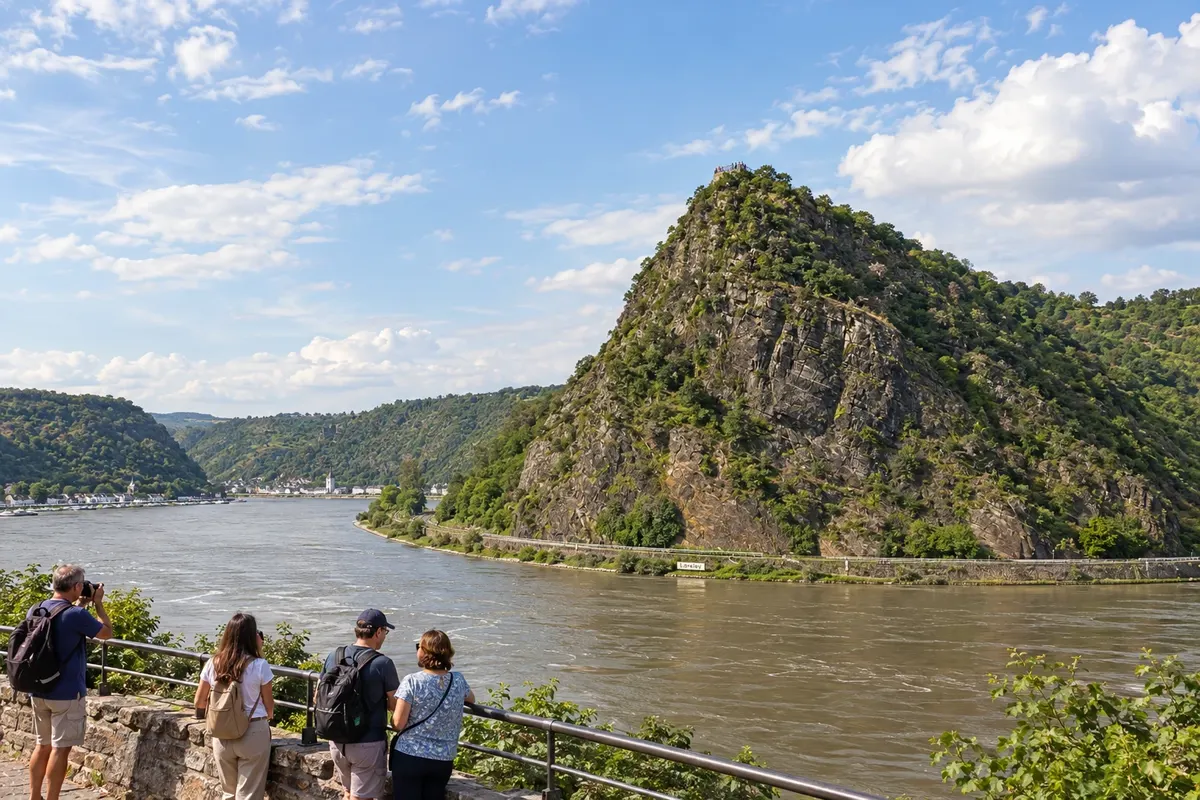
Loreley: the rock, the plateau and the village of St. Goarshausen
Odhod: St. Goarshausen, station or ferry quay Walk or bus ride up to the plateau Približno 3 ure Dopoldne ali popoldne moderate on foot; easy by bus
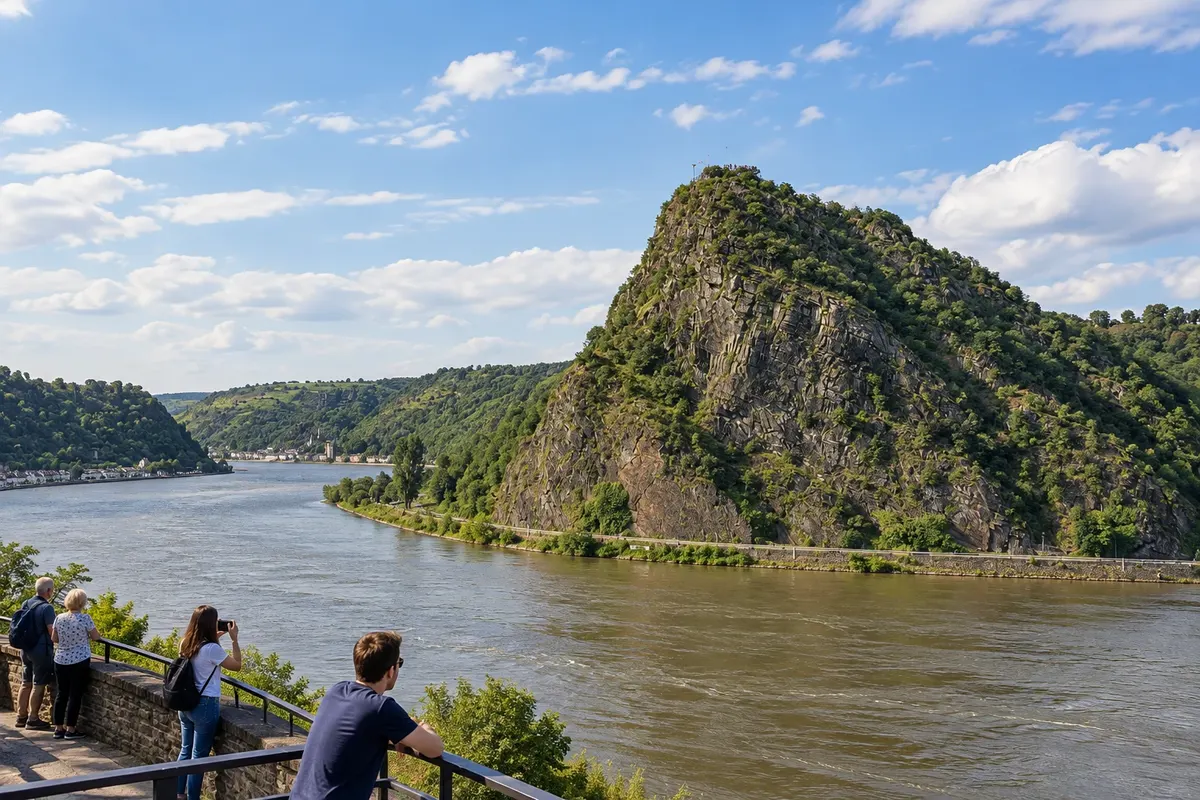
The Loreley is a 132 m slate cliff on the right bank of the Rhine, just past St. Goarshausen, at the point where the river is narrowest and deepest. For centuries it was a difficult stretch for navigation because of reefs and currents, and from that came the legend of the maiden who, singing atop the rock, distracted boatmen; Clemens Brentano invented her in 1801 and Heinrich Heine made her famous in the 1824 poem, set to music by Friedrich Silcher in 1837. On the top there is a plateau with the cultural and landscape park opened in 2019, a visitor center with an exhibition about the valley and the legend, viewpoints over the river bend and Burg Katz, and the 1939 open-air amphitheater used for large shows. You can climb on foot from St. Goarshausen via a trail with stairs, which requires good fitness, or by bus from the station in season. At the tip of the harbor jetty below stands the Loreley statue, seen by all passing boats. St. Goarshausen is linked to St. Goar on the opposite bank by a ferry that crosses in a few minutes throughout the day.
Kraji na poti: Loreley.
Vključuje: The plateau, viewpoints and trail are open and there is no entrance fee. The visitor center exhibition is paid separately. The bus to the top and the ferry have separate fares.
Nasvet: Combine it with Burg Rheinfels on the opposite bank: St. Goar ferry, ascent to the Loreley and return. Bring water and hiking shoes for the walk up. The lookout at the tip of the plateau is the place to watch boats make the turn.
Najboljši čas za obisk: From April to October, with the visitor center and plateau bus operating; confirm in advance. In September there are often the Rhine in Flames fireworks in St. Goar and St. Goarshausen.
Bacharach on foot: old town, ramparts, Wernerkapelle and the climb to Burg Stahleck
Odhod: Bacharach, train station (left bank) Stroll through the village and climb up to the castle Približno 3 ure Dopoldne ali popoldne moderate (short uphill to the castle)
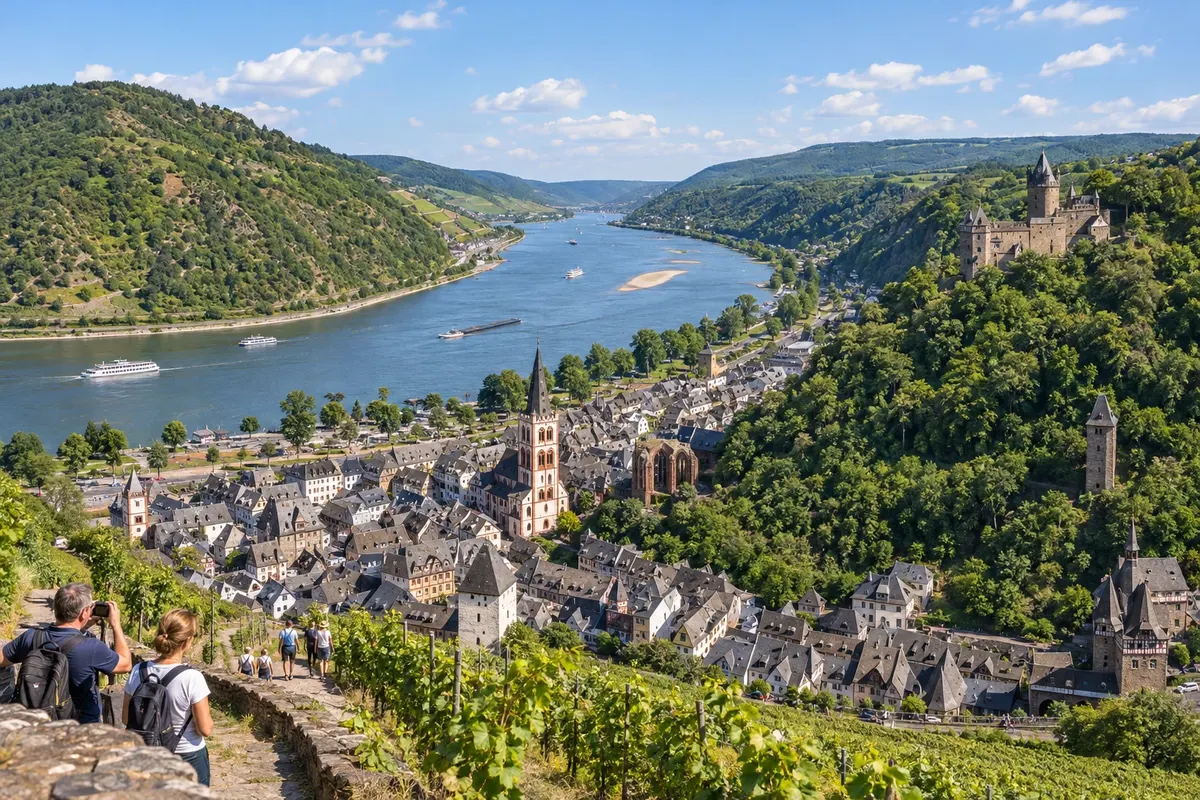
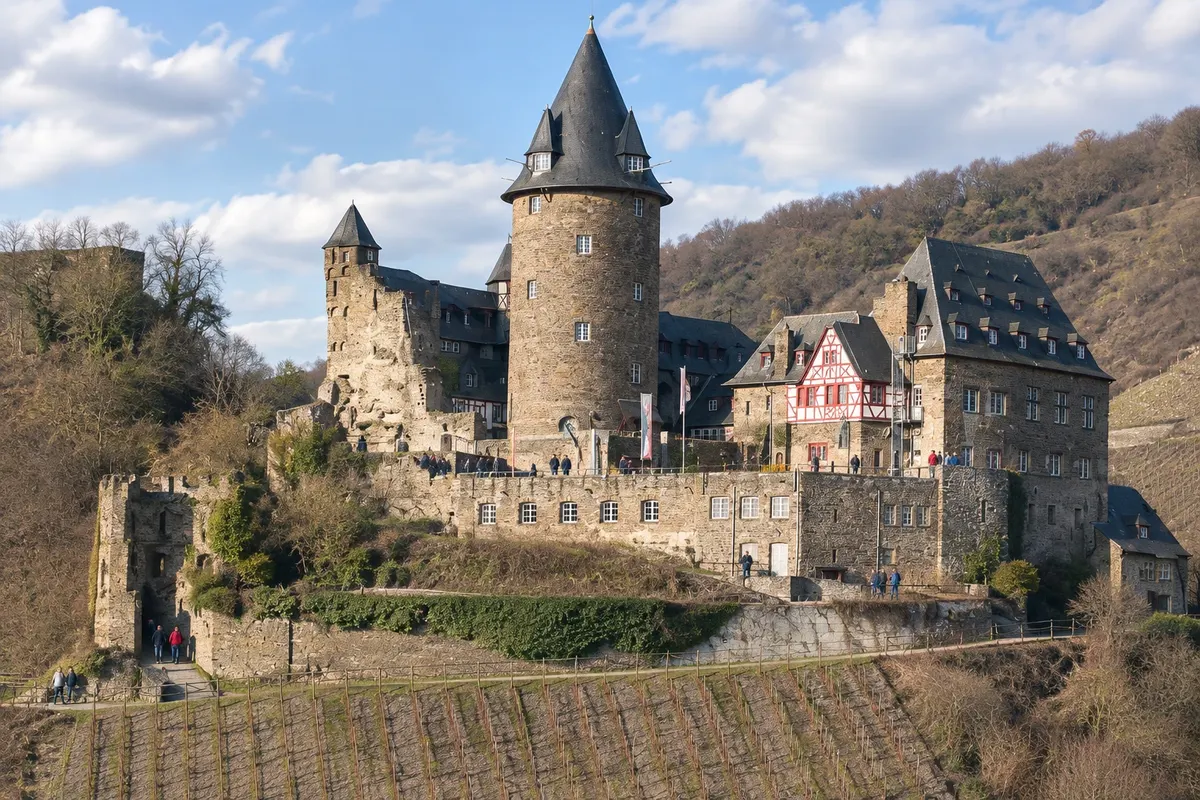
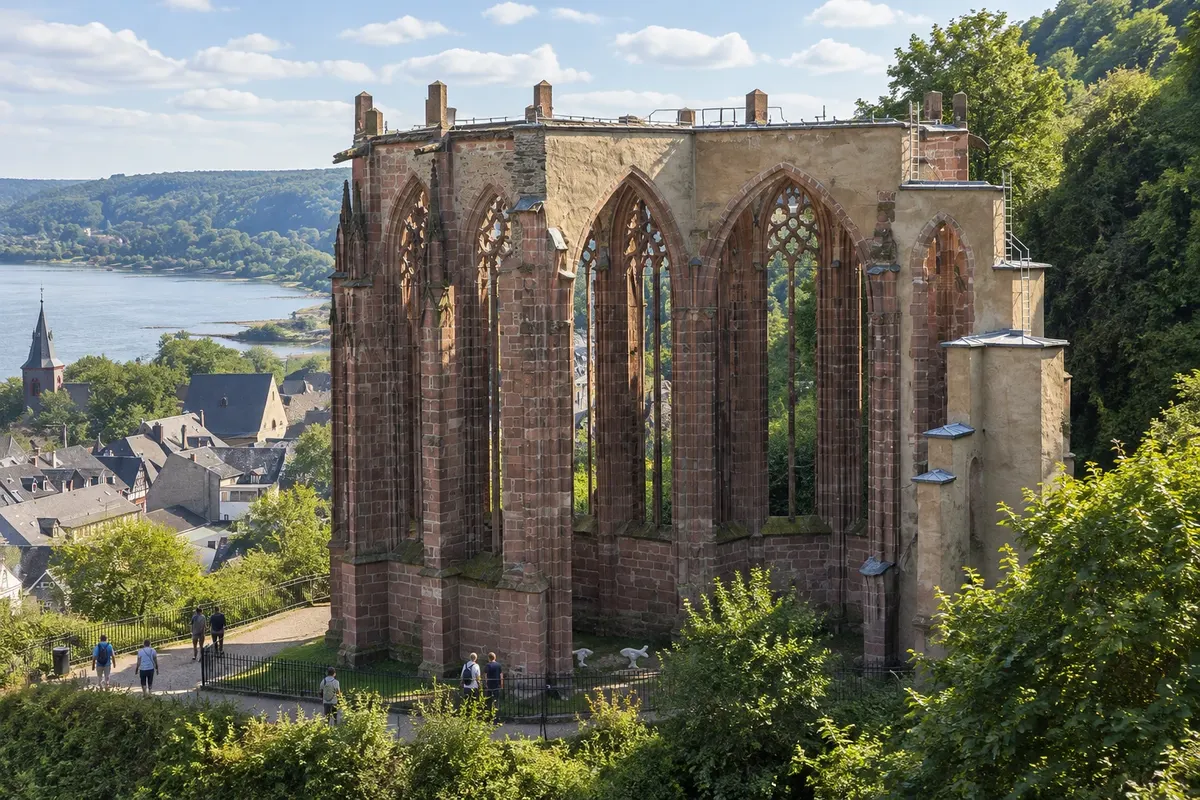
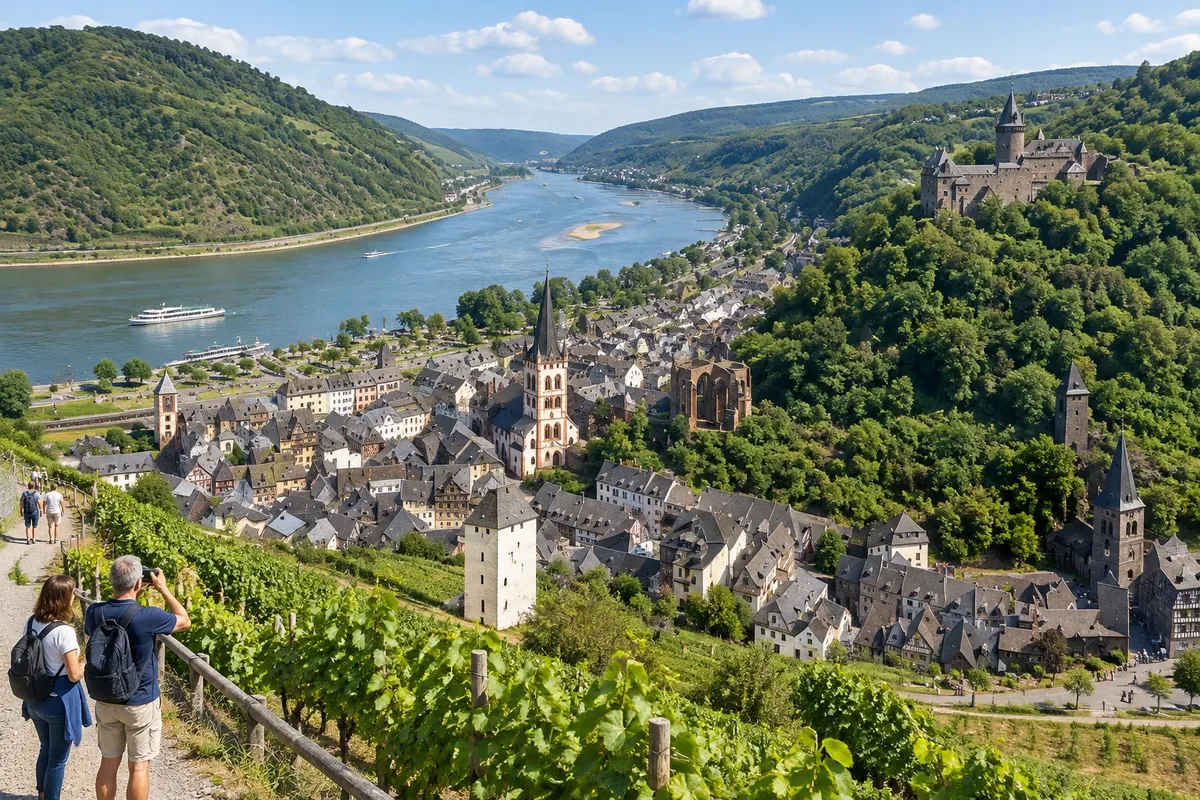
Bacharach is a village of about 1,500 residents on the left bank of the Rhine, 48 km south of Koblenz, which received town rights in 1356 and lived from the wine trade: barrels were transferred here and the wine came to be called Bacharacher. The town wall, started in 1344 and finished around 1400, is among the best preserved in Rhineland-Palatinate, with towers such as the Postenturm and the Marktturm; there is a walkway on top. Bacharach’s Altstadt is a group of half-timbered houses along the Oberstraße, including the Altes Haus from 1368 and the Peterskirche, an Evangelical church. Above the market stands the Wernerkapelle, a Gothic ruin of red sandstone with a cloverleaf plan, begun soon after 1287 and completed after 1426; it was destroyed in 1689 and today is a place of remembrance, with a 1996 plaque bearing a prayer by Pope John XXIII for reconciliation between Christians and Jews, because the legend of the boy Werner was used as a pretext for persecutions. From there a trail climbs in 15–20 minutes to Burg Stahleck, a late 11th‑century castle that was the seat of the Palatine County of the Rhine from 1142, blown up by French troops in 1689 and rebuilt between 1925 and 1927 as a youth hostel, which it still is. The courtyard is open and the south terrace looks over the valley toward Lorch and Burg Fürstenberg.
Kraji na poti: Altstadt Bacharach, Wernerkapelle, Burg Stahleck.
Vključuje: Streets, ramparts and the trail are open and there is no entrance fee. The courtyard of Burg Stahleck is open; the buildings are part of a youth hostel and are not open to visits. Wernerkapelle is visible from outside behind the railings. Guided tours of the village are charged separately.
Nasvet: Climb to the castle in the late afternoon, when the sun hits the far bank. Victor Hugo visited in the 19th century and wrote about the village; panels along the route quote his text. Bacharach makes a good base for those who want to sleep in the valley and see the castles by boat and by train.
Najboljši čas za obisk: From April to October, with boats operating and taverns open; in winter the village is very quiet. September and October bring the grape harvest and autumn colours.
Burg Rheinfels, in St. Goar: the largest fortress ruin of the Middle Rhine
Odhod: St. Goar, train station (left bank) Walk up on foot and self-guided or guided visit about 2 to 3 hours Dopoldne ali popoldne moderate (ascent of 15 to 20 min)
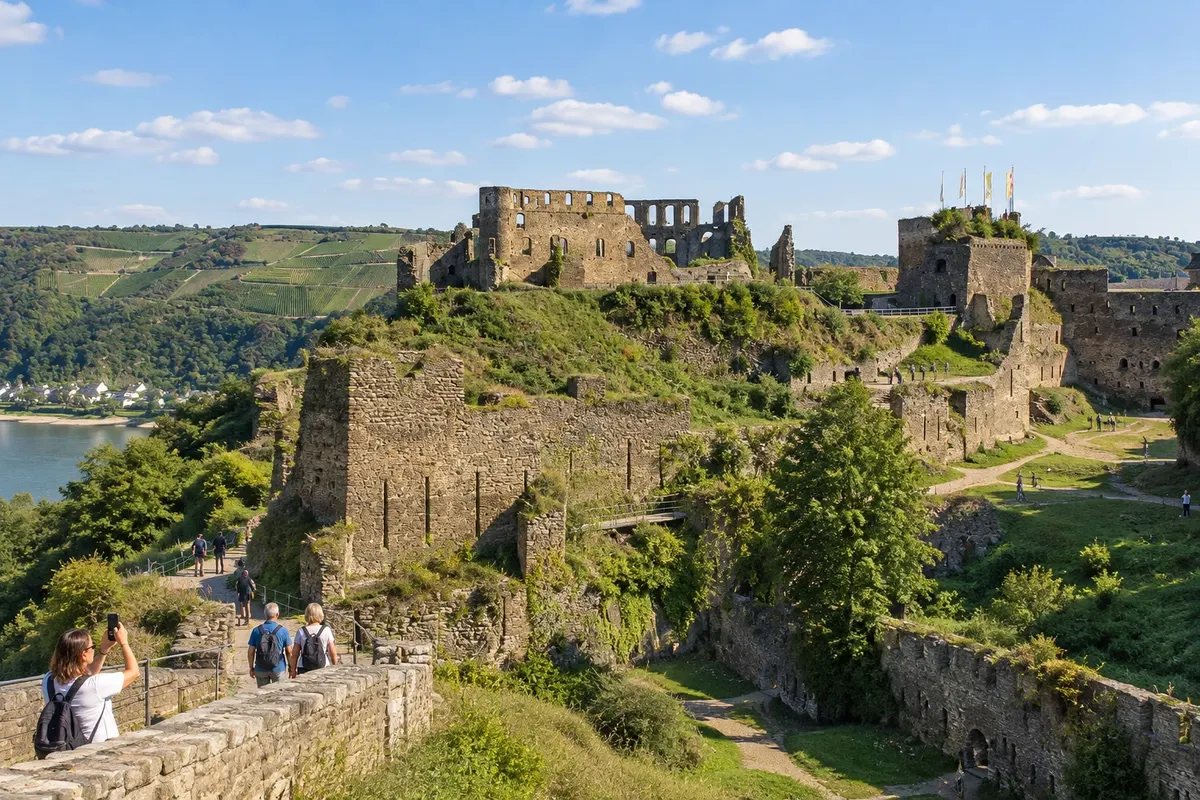
Burg Rheinfels towers above St. Goar on the left bank of the Rhine, almost opposite the Loreley. Count Diether V of Katzenelnbogen began building it in 1245 to collect tolls from passing ships; enlarged by the landgraves of Hesse, it became the largest fortress in the valley between Koblenz and Mainz and withstood sieges during the Thirty Years’ War and the Palatinate Succession War, when a French army of 28,000 men failed to take it. In 1797 revolutionary French troops dismantled it, and what remains is a maze of walls, courtyards, towers and underground galleries, owned by the town of St. Goar. The museum is in the old chapel, the only finished room of the original castle, and contains a model of the fortress before its destruction. The self-guided visit includes the ruins and the large vaulted wine cellar, built between 1587 and 1589, which holds 400 people and hosts concerts. The mine galleries, dug for defense, and the lower parts are only visited in guided groups with a flashlight, and are the highlight for those who like to explore. Part of the outer buildings has been converted into a hotel and restaurant. The castle is usually open daily from morning until late afternoon from mid-March to November, and may close on bad-weather days.
Kraji na poti: Burg Rheinfels.
Vključuje: Separate paid admission; check the current price list. The guided tour of the galleries has its own schedule and may have an additional cost. The walk up on foot is unrestricted; there is parking at the top.
Nasvet: Bring a flashlight or use your phone light in the galleries, and wear sturdy shoes: the floor is stone and there are dark sections. From the top you can see Burg Katz and the Loreley on the other side. Combine this with the ferry to St. Goarshausen and the trek up to the Loreley plateau on the same day.
Najboljši čas za obisk: From mid-March to November, when the castle is usually open every day; confirm before you go. On summer weekends there are more guided groups.
Marksburg, in Braubach: the medieval castle that was never destroyed
Odhod: Braubach, train station (right bank, RB10 line) Regional train, hike and guided tour about 3 hours, including the climb Dopoldne ali popoldne moderate (90 m climb; stairs)
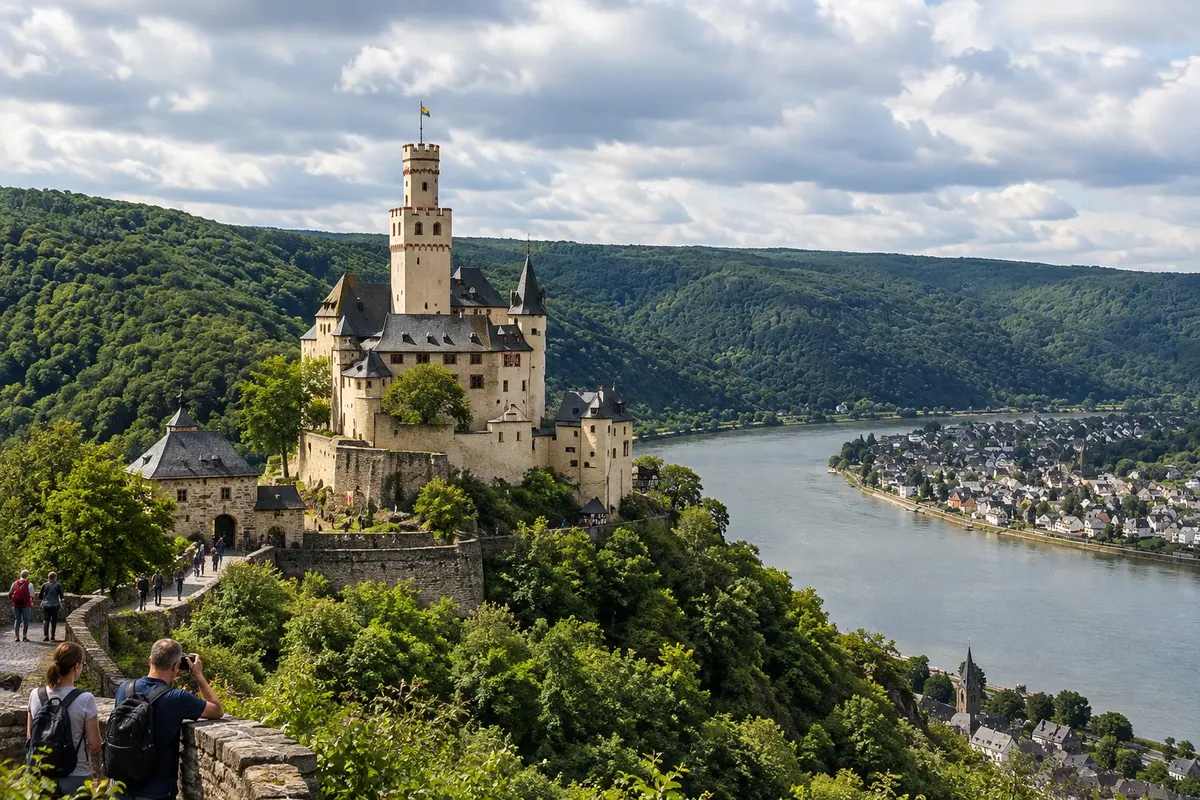
Marksburg sits above Braubach on the right bank of the Rhine, about 12 km upstream from Koblenz, atop a slate cone at 160 m. It is mentioned in documents from 1231 and is the only high medieval fortress in the Middle Rhine that was never destroyed, so it best shows what a lived-in castle looked like: roughly 40 castles were built between Bingen and Koblenz and almost all became ruins in the wars of the 17th and 18th centuries. In 1900 the German Castles Association bought the building for 1,000 gold marks and has been based there since 1931. Entry is only with a guided tour of about 50 minutes, which goes through the knights’ staircase carved into the rock, the cannon batteries, the kitchen, the chapel, the knights’ hall, the cellar, the medicinal herb garden and the armor collection. There are guided tours in English at fixed times. The castle is open every day of the year except December 24 and 25, with shorter hours in winter. From Braubach center the walk up takes about 20 minutes; there is also parking near the top.
Kraji na poti: Marksburg.
Vključuje: Separate paid ticket, with the guided tour included; sold at the castle shop. Check the current price list. Special visits with actors or by lantern require reservation.
Nasvet: Arrive close to the start of an English-language tour, which usually has fixed times in the morning and afternoon during summer. The castle has many stairs and narrow passages: it is not suitable for those with mobility difficulties. Combine it with Boppard on the opposite bank, or with the boat from St. Goar.
Najboljši čas za obisk: All year; from late March to early November there are more tours per day and in more languages. In winter tours run hourly and English tours are only on weekends.
Burg Pfalzgrafenstein, in Kaub: the ship-castle in the middle of the Rhine
Odhod: Kaub (ferry from Bacharach or RB10 train) Small ferry to the island Približno 1 uro in 30 minut Dopoldne ali popoldne easy (narrow stairs in the castle)
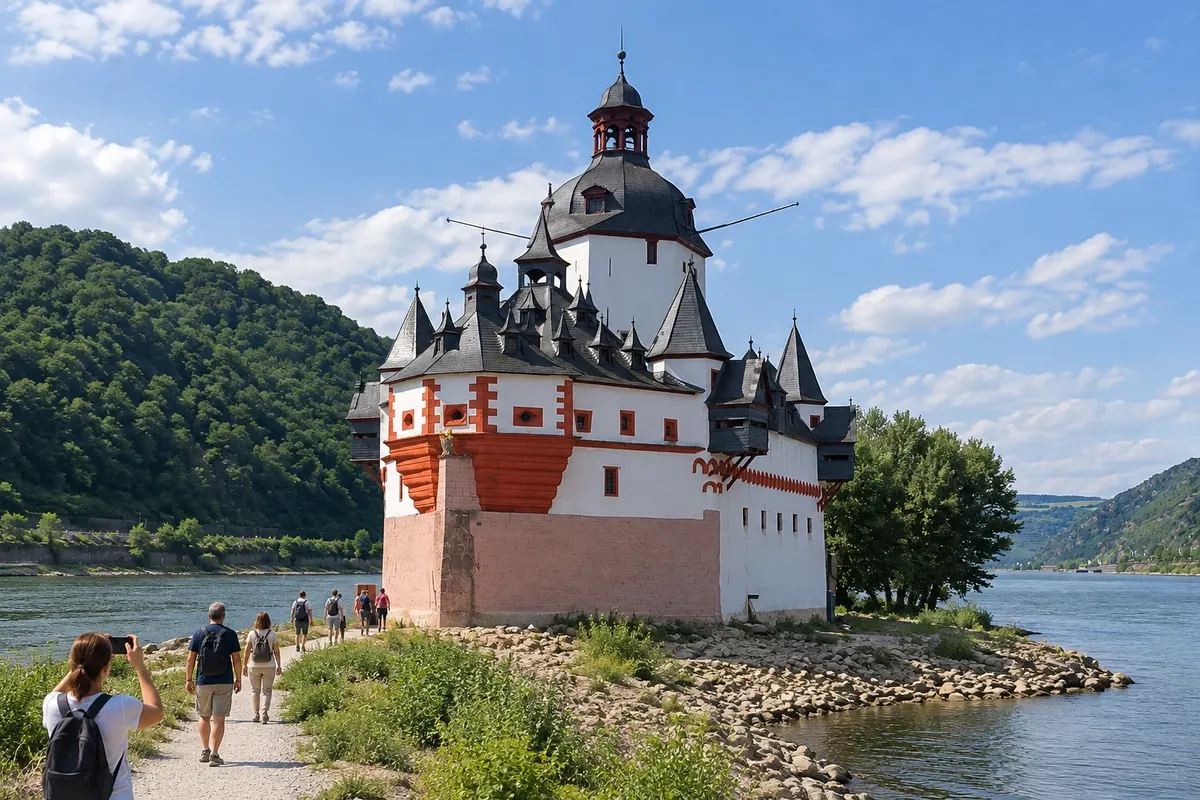
Burg Pfalzgrafenstein occupies a narrow island in the middle of the Rhine, opposite Kaub on the right bank, almost facing Bacharach. King Ludwig IV of Bavaria had the pentagonal tower built in 1326 and 1327 to collect tolls from boats, despite protests from bishops and the pope who were losing income; around 1340 the tower gained the six-sided curtain wall with watch turrets that gives it the look of a stone ship, with the bow facing the current. The tower is 36 m tall and has six floors. The castle withstood a 39-day siege in 1504 and was never destroyed; at the turn of 1813 to 1814 Blücher’s Prussian army crossed the Rhine here on a pontoon bridge during the campaign against Napoleon. It belongs to the state of Rhineland-Palatinate, and a small boat runs from Kaub to the island when the river level allows. Inside you can see the courtyards, wooden galleries, the cistern, the guardroom and the tower, with views over the vineyards and Burg Gutenfels above Kaub. The castle is usually open from mid-March to October, Thursday to Sunday, and in November only on weekends; it is closed in December and January.
Kraji na poti: Burg Pfalzgrafenstein.
Vključuje: Castle admission is paid separately and the ferry crossing separately; there is a combined ticket. Check the current timetable. In very low or very high river conditions the crossing is suspended.
Nasvet: Check the navigation notice before you go: access depends on Rhine level. From Bacharach the car-and-foot ferry crosses to Kaub in a few minutes. A good photo angle is from Kaub’s riverbank in the afternoon, or from the KD boat.
Najboljši čas za obisk: From mid‑March to October, Thursday to Sunday, when the castle is usually open; confirm before you go, including the river level.
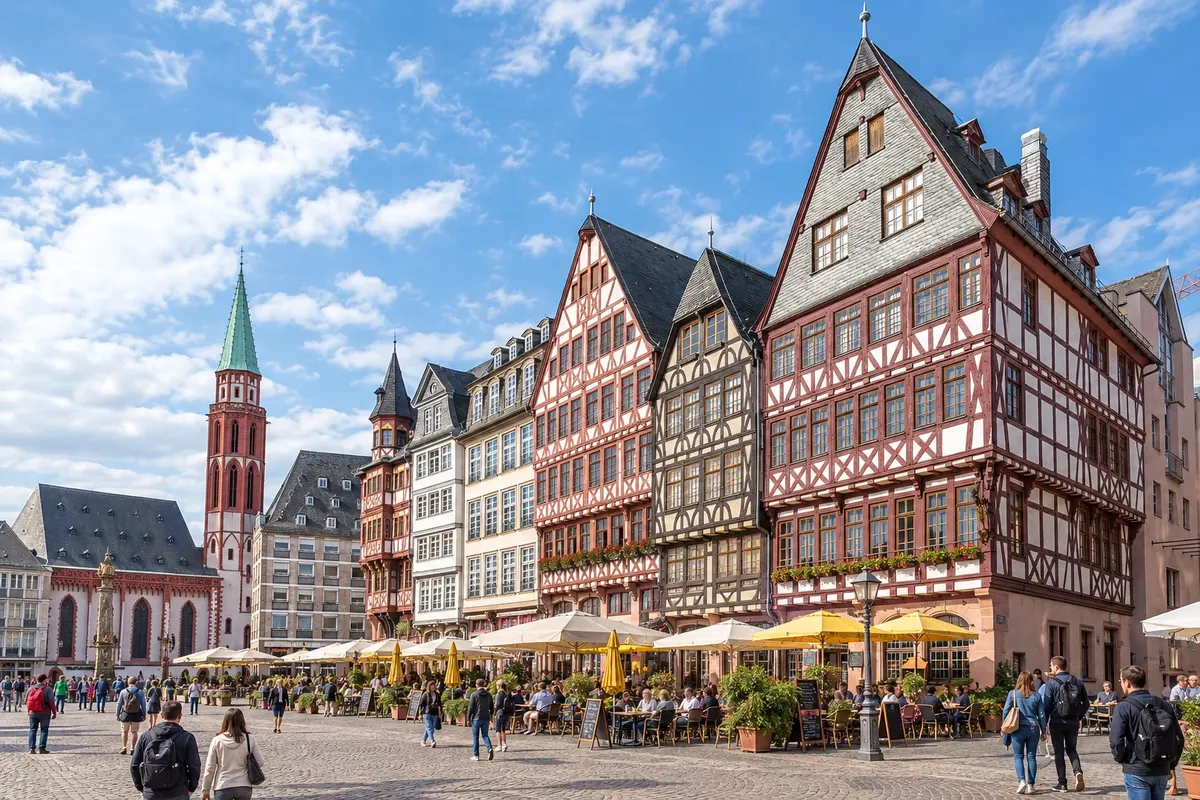
Frankfurter Goethe-Haus and Deutsches Romantik-Museum
Odhod: Großer Hirschgraben (U-Bahn Willy-Brandt-Platz or Hauptwache station) Walking tour, guided visit included Približno 2 uri Dopoldne ali popoldne easy (stairs; no elevator in the house)
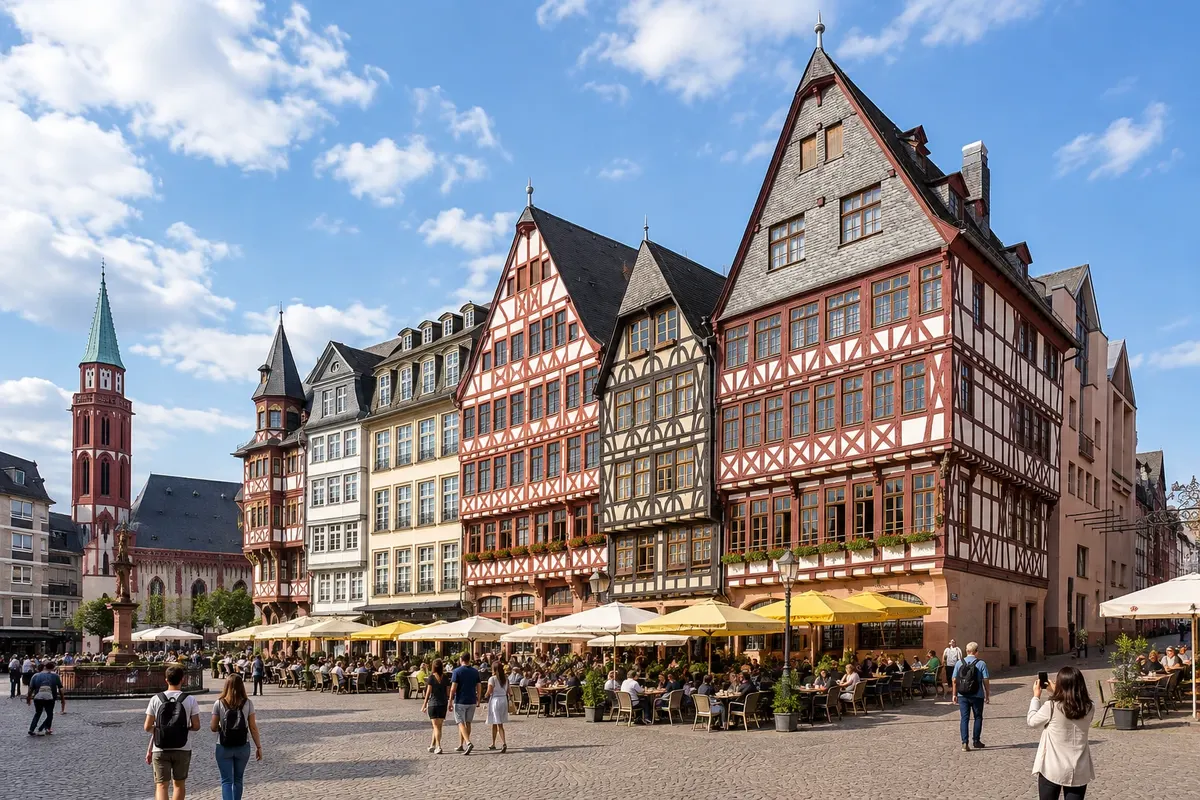
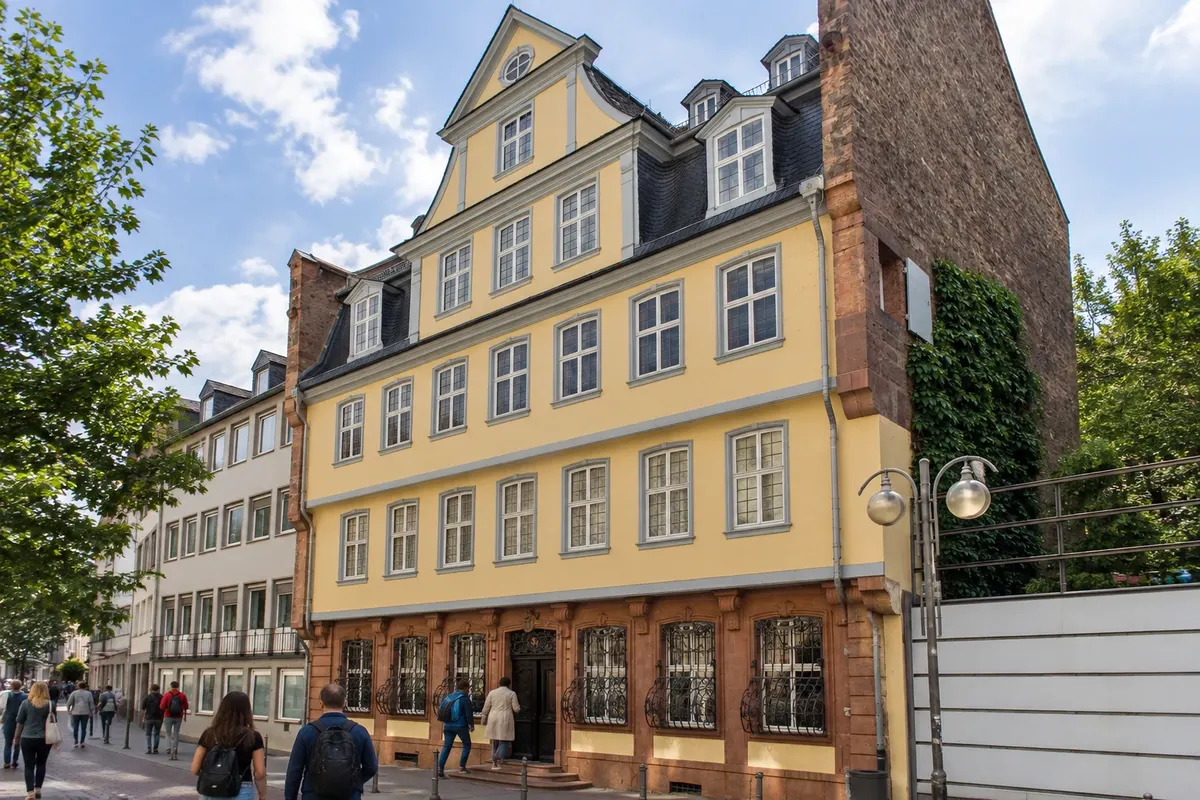
Johann Wolfgang von Goethe was born on August 28, 1749 in the family house on Großer Hirschgraben, a few minutes from the Römerberg, and there he wrote his early works, including the beginning of The Sorrows of Young Werther. The house has been a museum since 1863, when the Freies Deutsches Hochstift foundation bought it. It was destroyed in the bombing of March 22, 1944 and rebuilt between 1947 and 1951, with the original façade and layout: four floors and 18 rooms, furnished as in the 18th century, with the kitchen, the music room, the father’s library, the room where the poet wrote, the astronomical clock and the puppet theatre the grandmother gave the children. Next door, the Deutsches Romantik-Museum, opened in 2021, is the first museum dedicated to German Romanticism as a movement: manuscripts, paintings and objects by Novalis, Brentano, Eichendorff and the Schlegel brothers, with rooms that work with light and sound. One ticket gives access to both, and German guided tours of about 50 minutes are included in the afternoons from Tuesday to Sunday and also in the mornings at weekends. The museum is open every day, with late opening on Thursdays.
Kraji na poti: Frankfurter Goethe-Haus.
Vključuje: Separate paid ticket sold only at the ticket office; it covers the house and the Romanticism museum and includes the guided tour in German. Temporary exhibitions may have a combined ticket. Check the current schedule.
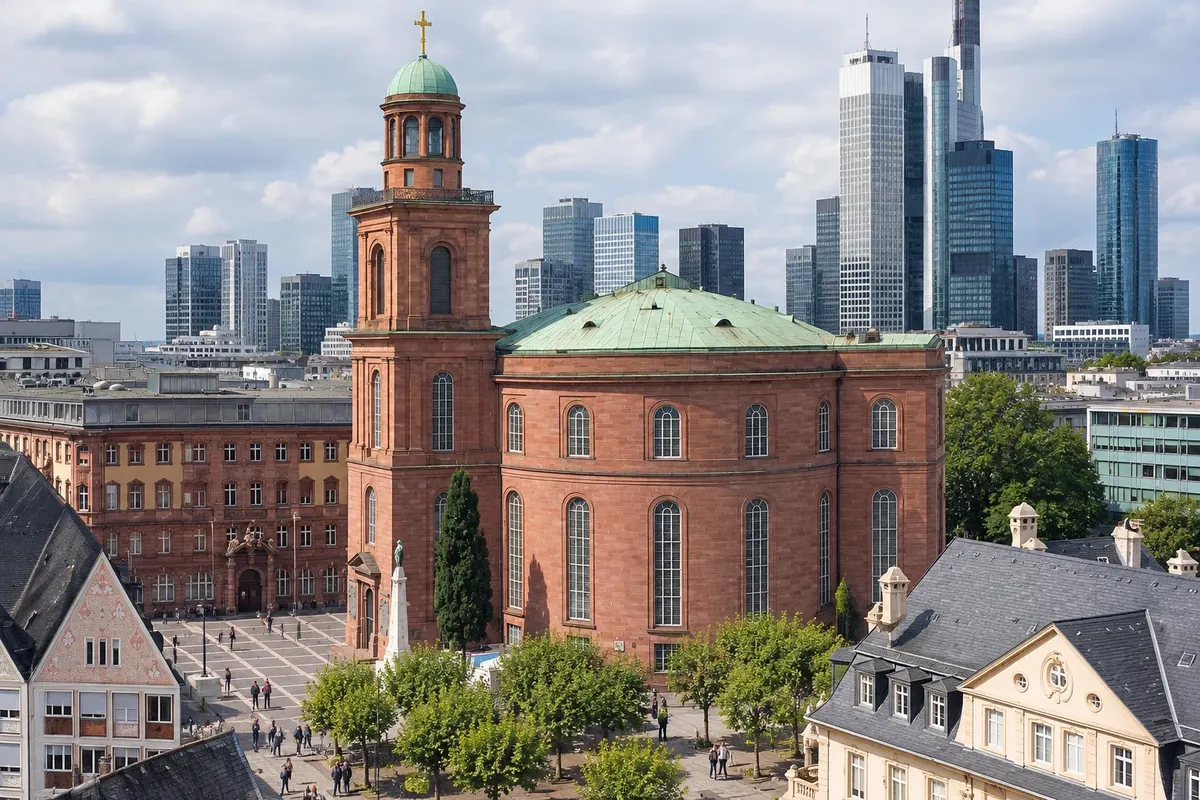
Nasvet: Pick up the English leaflet at the entrance and start with the house, from bottom to top; the Romanticism museum requires more time than it appears. The house has no elevator. Combine it with Paulskirche and the Römerberg, five minutes on foot.
Najboljši čas za obisk: All year, a good option for rainy days. On August 28, Goethe’s birthday, there is usually special programming.
Palmengarten: greenhouses and gardens in the Westend
Odhod: Siesmayerstraße (U-Bahn Westend) or Palmengartenstraße Walk through the garden and the greenhouses about 2 to 3 hours Dopoldne ali popoldne Lahko
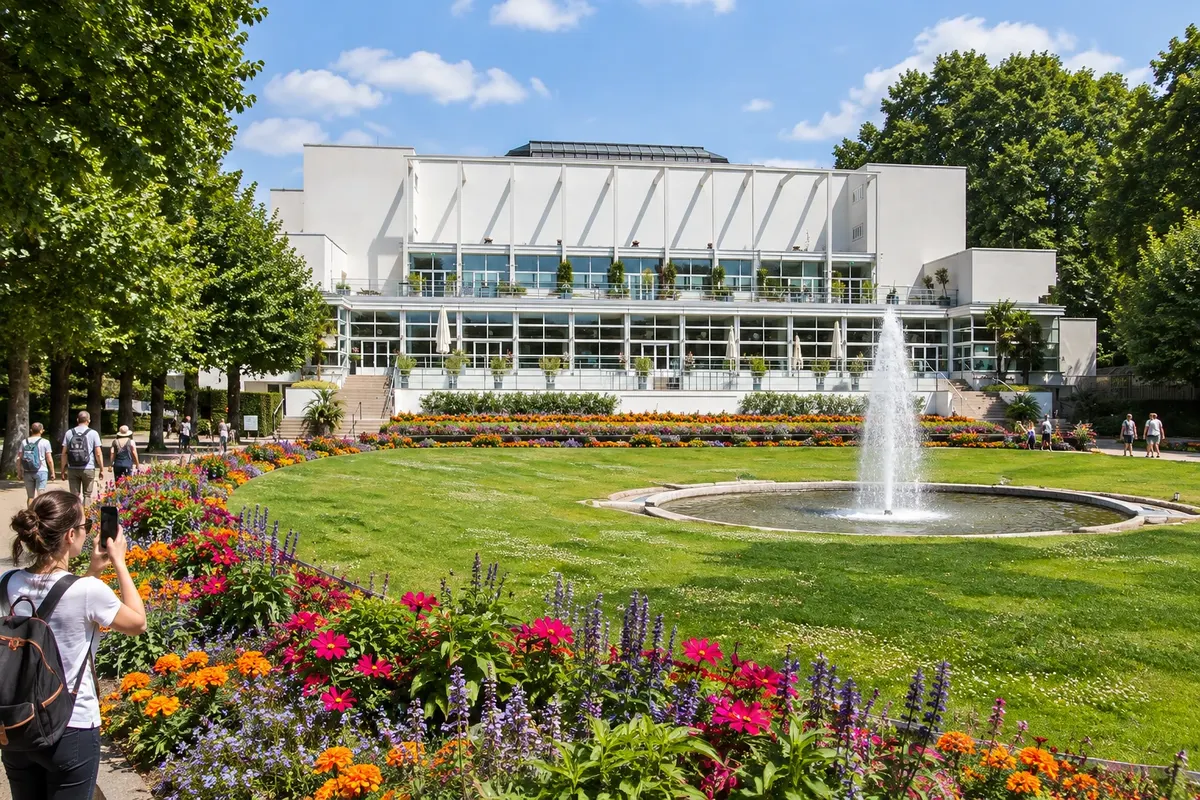
The Palmengarten is Frankfurt’s botanical garden, opened on March 16, 1871 in the Westend neighborhood, designed by landscaper Heinrich Siesmayer, and covers 22 hectares between Siesmayerstraße and Palmengartenstraße. The centerpiece is the Palmenhaus, the palm greenhouse, from 1869, with subtropical palms, tree ferns, a waterfall and aquariums. The Tropicarium includes 14 glass houses divided between the humid tropics, with orchids, bromeliads and mangrove plants, and the dry tropics, with cacti and succulents; there is also the flower house, about 200 m², with flowering plants year-round, and a butterfly house. Outside the greenhouses there is a lake with rowboats in season, a rose garden, rock gardens, large lawns and a playground; concerts and temporary exhibitions take place throughout the year. The garden is open daily, from morning until early evening between March and October and until mid-afternoon from November to February, and the greenhouses close one hour after the ticket office. It’s the city spot for a rainy or cold day, because much of the visit is covered.
Kraji na poti: Palmengarten.
Vključuje: Admission is paid separately, sold at the entrance without reservation; there is a late-afternoon ticket on weekdays. Check the current schedule. Boat rides on the lake and guided tours are extra.
Nasvet: Enter via Siesmayerstraße, which is near Westend station, and leave the Tropicarium for last, when it has cooled down outside. From May to June the rose garden is in bloom; in winter the heated greenhouses are the main attraction and the garden closes earlier. Some houses may be closed for maintenance; check the notices at the entrance.
Najboljši čas za obisk: All year. From April to September the outdoor garden is at its best; from November to February the heated greenhouses are the focus and the garden closes earlier.
Sachsenhausen: the Apfelwein tavern quarter and the south bank of the Main
Odhod: Eiserner Steg, south side of the river Walk around the neighborhood about 2 to 3 hours late afternoon or evening Lahko
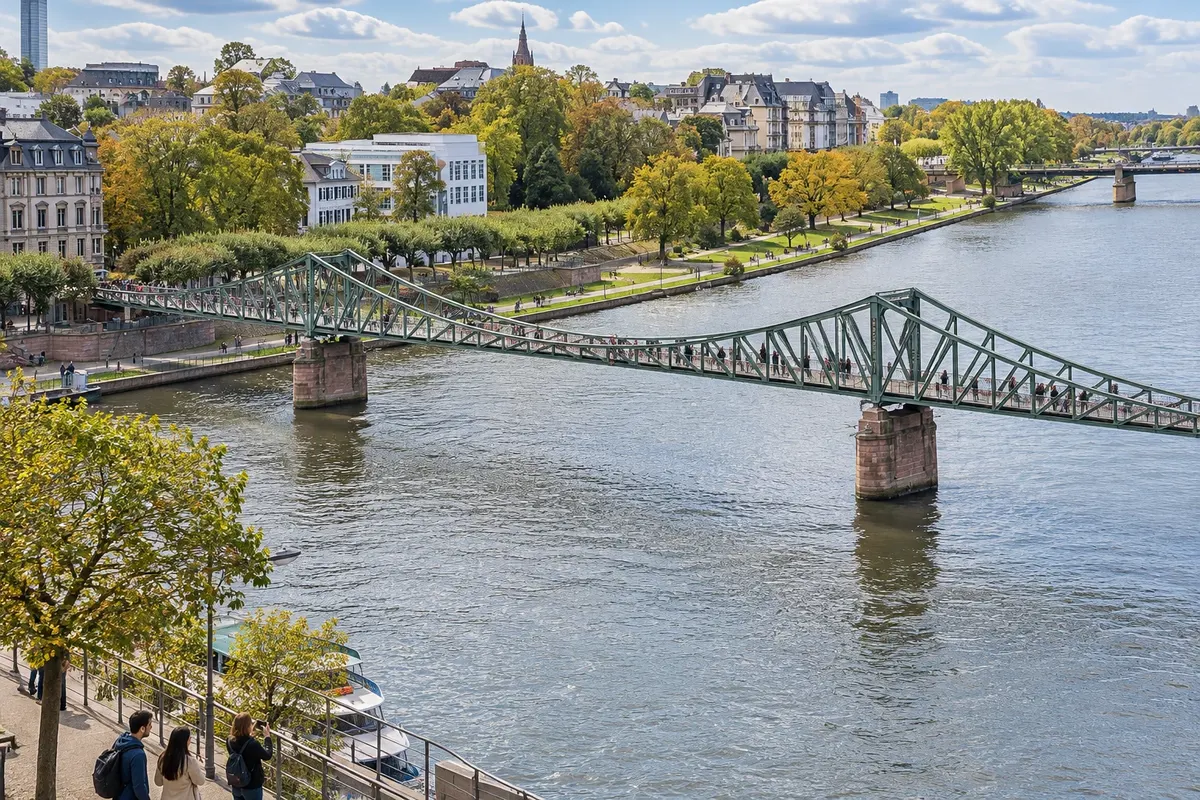
Sachsenhausen is the neighborhood on the south bank of the Main, founded in the 12th century as a bridgehead of Frankfurt and documented since 1193. Unlike the Altstadt, some of its old buildings survived the 1944 bombings, and it is home to Frankfurt’s most local tradition: Apfelwein, apple wine, called Ebbelwoi in the local dialect, served in gray-and-blue ceramic jugs (Bembel) and in faceted glass cups (Gerippte). Taverns that make their own Apfelwein hang a pine wreath on the door. In Alt-Sachsenhausen the alleys around Klappergasse and Große Rittergasse gather more than two dozen places, with long shared tables and regional dishes such as Handkäse mit Musik, cheese with onion and vinegar, and Grüne Soße, the green sauce of seven herbs; Schweizer Straße, farther south, has traditional houses like Zum Gemalten Haus and Wagner. The neighborhood also includes the Museumsufer, along the river, and viewpoints such as the Goetheturm and the Henninger Turm. You can walk from the center via the Eiserner Steg, the 1869 footbridge. A historic tram, the Ebbelwei-Express, runs a city circuit departing the neighborhood on weekends.
Kraji na poti: Sachsenhausen, Eiserner Steg.
Vključuje: Free walk through the neighborhood; drinks and food in the taverns are paid separately. The Ebbelwei-Express tram has its own ticket, paid separately, and runs on limited schedules; check before you go.
Nasvet: Go at the start of the evening, when the taverns fill with locals; at the shared tables it’s common to sit with strangers. The interest here is the house, the custom and the regional food. By day, combine the walk with the Museumsufer on the same bank.
Najboljši čas za obisk: All year round. From May to September the taverns’ courtyards and gardens are open; in winter life moves indoors to the wooden rooms.
Kleinmarkthalle: Frankfurt’s covered market
Odhod: Hasengasse (U-Bahn Hauptwache or Dom/Römer station) Walking visit to the market Približno 1 uro Dopoldne Lahko
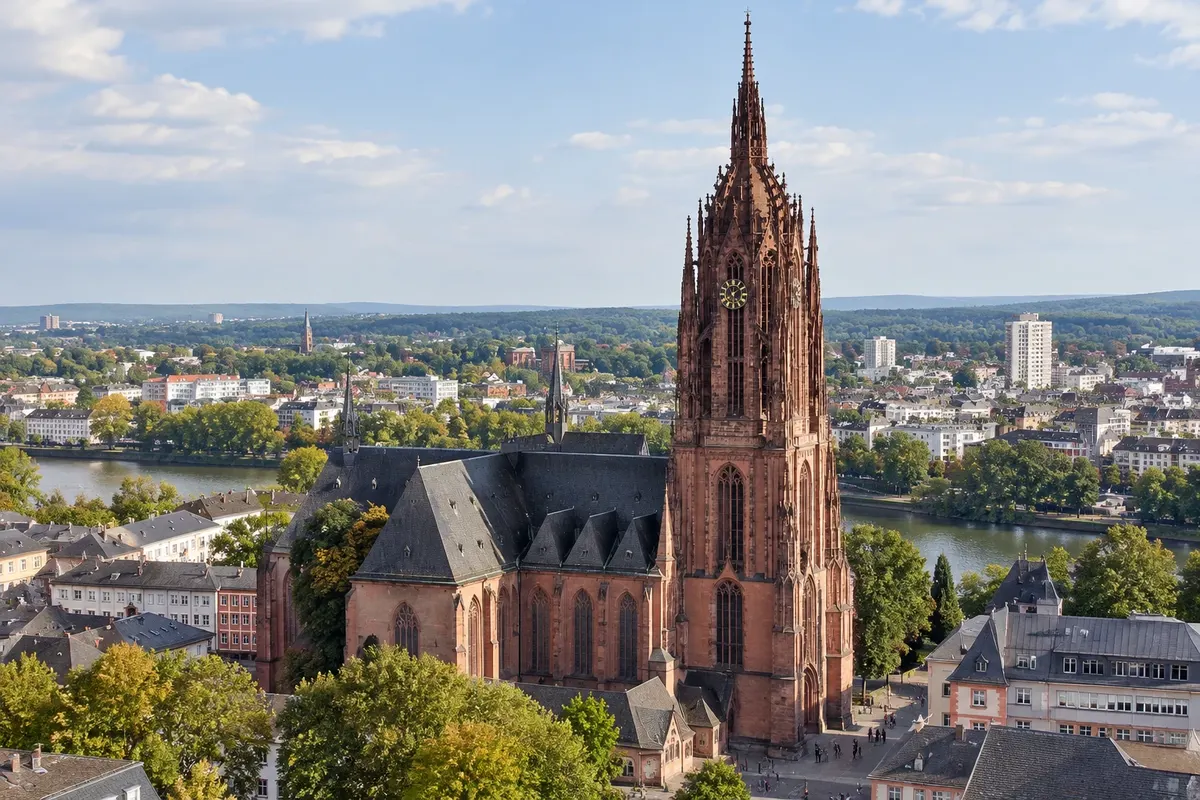
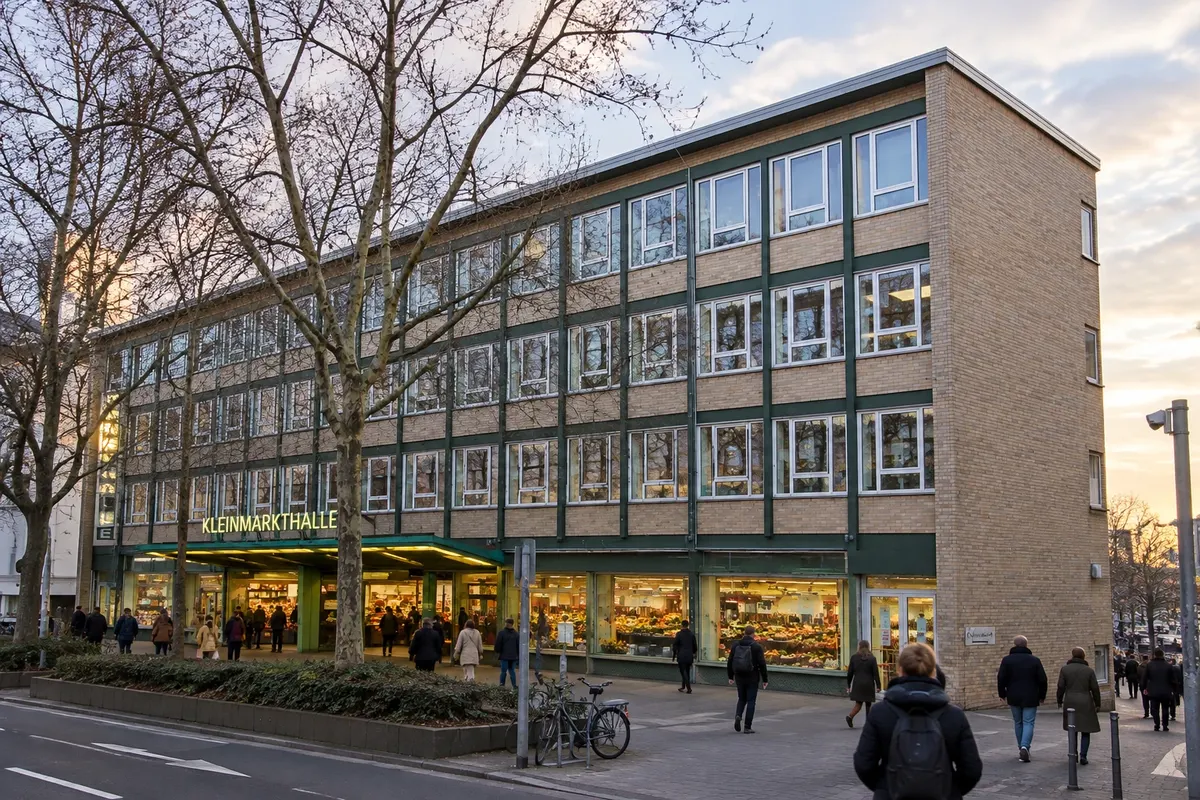
The Kleinmarkthalle is the covered market in central Frankfurt, on Hasengasse, between the cathedral and the shopping street Zeil. The first municipal market, from 1879, was destroyed in the war; the current building, from 1954, was erected in eleven months 200 m from the original site and has about 1,500 m² on two levels, with 156 stalls and more than 60 traders. It sells everything: fruit and vegetables, meats and sausages, fish, cheeses, breads, flowers, spices and products from many parts of the world, with around 5,000 items. It’s the place to discover what the city eats: Grüne Soße, the green sauce made with seven herbs (parsley, chives, watercress, borage, salad burnet, sorrel and chervil), Handkäse, Frankfurter Würstchen and Apfelwein, as well as counter food for a standing lunch. The market is open Monday to Saturday, morning until late afternoon, and closed on Sundays and public holidays. Saturday mornings get crowded with locals doing their shopping.
Kraji na poti: Kleinmarkthalle.
Vključuje: Entrance is free; purchases and food are paid separately. The market is undergoing phased renovations and remains open during the work; confirm before you go.
Nasvet: Go on Saturday morning to see the market full, or on a weekday in the early afternoon to have a standing lunch at a counter. In spring, fresh Grüne Soße is everywhere; the sauce even has an annual festival in the city in May. It is five minutes from the Römerberg.
Najboljši čas za obisk: All year round, Monday through Saturday. From April to June is the season for the herbs used in Grüne Soße and for white asparagus.
Abtei St. Hildegard: the Benedictine abbey above the vineyards of Eibingen
Odhod: Rüdesheim, town centre (about a 30-minute walk or taxi) Walk among vineyards and visit to the church Približno 2 uri Dopoldne ali popoldne easy (gentle uphill walk through the vineyards)
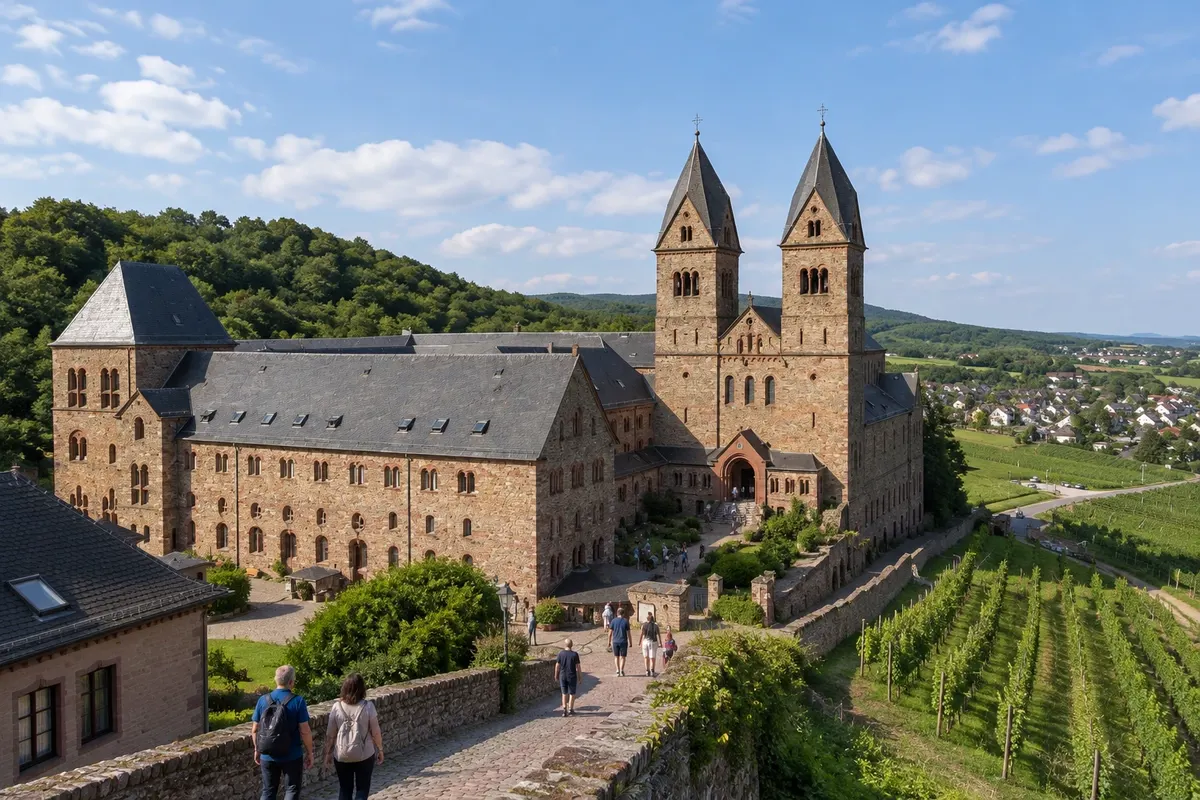
Abtei St. Hildegard is a Benedictine nuns’ abbey high on the vineyards of Eibingen, a district of Rüdesheim, with views over the Rhine and Bingen. The light-stone neo-Romanesque building with two towers was built between 1900 and 1904 with funds from Prince Karl zu Löwenstein, and the first nuns arrived from Prague on 17 September 1904; the community continues the tradition of the convents founded by Hildegard von Bingen (1098–1179), abbess, composer, physician and mystic, who founded a convent in Eibingen in 1165. The abbey church was painted by monks of the Beuron art school, with gold-backed frescoes, and is open to visitors outside service times; the nuns’ chants can be heard at the hours of prayer. The sisters were expelled by the Gestapo in 1941 and returned in 1945. The community supports itself with wine from its own vineyards, art studios and a shop selling abbey products, open from March to December. Down below, in the parish church of Eibingen, is Hildegard’s reliquary, a pilgrimage site with a festival in September. The walking route from Rüdesheim crosses the vineyards and is part of the Hildegard trail.
Kraji na poti: Abtei St. Hildegard.
Vključuje: The church and grounds are open and there is no entrance fee; silence is requested. Guided tours of the church and tastings at the vinotheque are charged separately. The shop is closed from late December through February.
Nasvet: Go late in the morning and, in silence, attend the midday service when the nuns sing. Combine this with the parish church of Eibingen below, which houses the reliquary. If you have a car or an extra day, continue to Kloster Eberbach, a Cistercian monastery from 1136 about 15 km away, where The Name of the Rose was filmed.
Najboljši čas za obisk: From March to October, when the shop is open and the vineyards are green; in September the Hildegard festival usually takes place in Eibingen. The walking route is best in dry weather.
Along the Rhine by train: from Frankfurt to Rüdesheim and Bacharach via both banks
Odhod: Frankfurt (Main) Hauptbahnhof Regional trains along both banks, ferry between them about 8 hours, including trains and ferries Ves dan Lahko
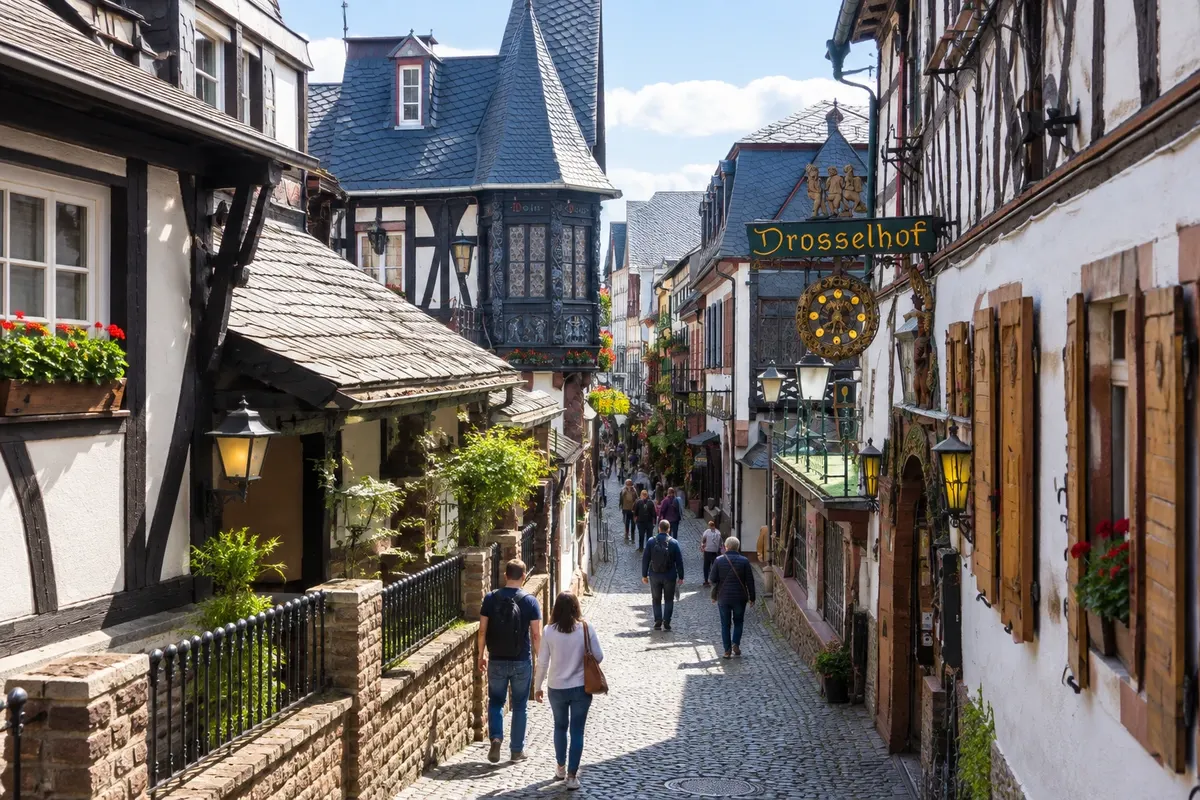
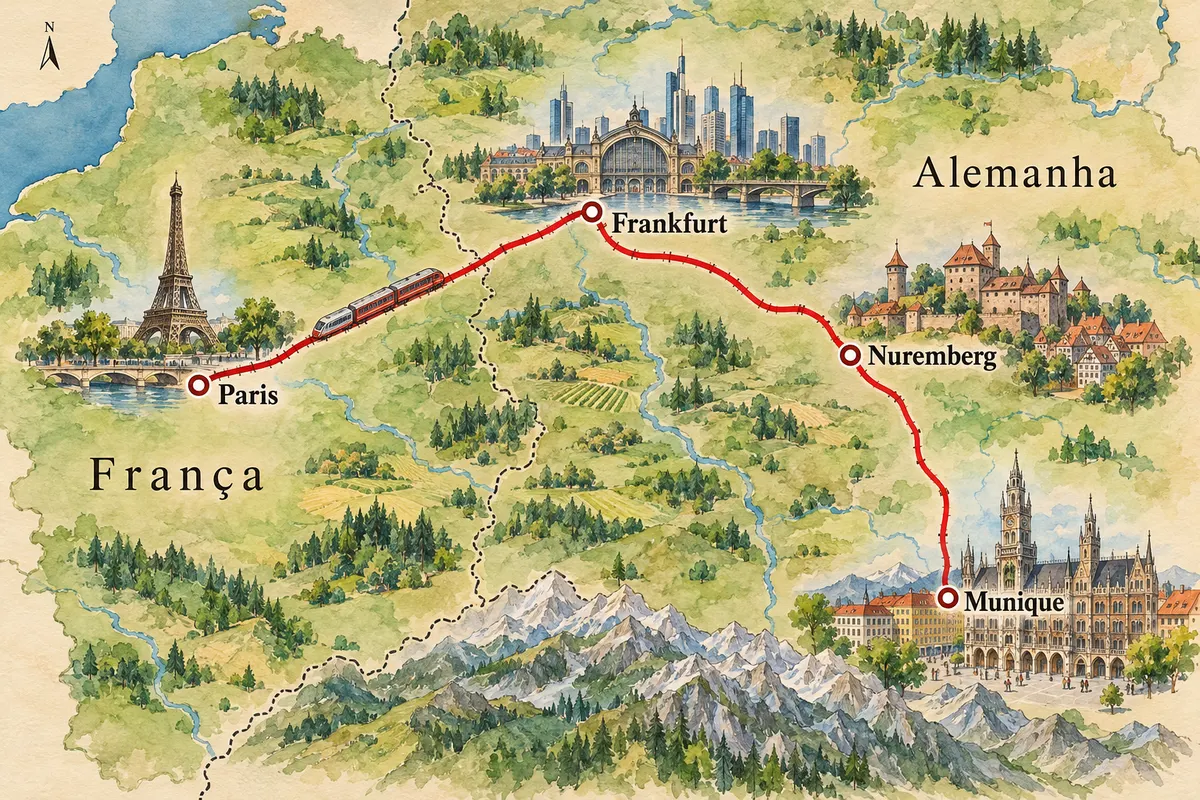
Both banks of the Middle Rhine have a train line along the waterfront, and the regional trains are an attraction in themselves: the windows show the castles, vineyards and villages that the boat shows, in less time and in any season. On the right bank runs the RB10, from Frankfurt Hauptbahnhof via Wiesbaden, Eltville, Rüdesheim, Lorch, Kaub, St. Goarshausen and Braubach to Koblenz; hourly; from Frankfurt to Rüdesheim is about 1 h 10. On the left bank runs the RB26, the MittelrheinBahn, from Mainz via Bingen, Bacharach, Oberwesel, St. Goar and Boppard to Koblenz; from Frankfurt to Bacharach is about 1 h 30, with a change in Mainz. Ferries cross the river between Rüdesheim and Bingen, Bacharach and Kaub, and St. Goar and St. Goarshausen, so you can make a loop: go along one bank, cross by ferry and return via the other. A full day can start in Rüdesheim at the Drosselgasse, cross to Bingen by ferry, continue by train to Bacharach for the Altstadt and the town walls, and finish in St. Goar or St. Goarshausen, facing the Loreley, returning to Frankfurt via the right bank. During maintenance work on one of the lines, buses may replace the trains; check the day's route before you leave.
Kraji na poti: Drosselgasse, Altstadt Bacharach, Loreley.
Vključuje: Tickets paid separately; the Deutschlandticket, a monthly pass, is valid on all these regional trains and on local buses, and there are day tickets from RMV and Hessen. Ferries have their own fare. Sit on the river side.
Nasvet: Buy your ticket in the DB app before boarding and sit on the river side: on the RB10, on the left when heading to Koblenz; on the RB26, on the right. On summer weekends the trains fill with cyclists and hikers. In winter, when the boats stop running, this is the way to see the valley.
Najboljši čas za obisk: All year round. September and October show the colors of the vineyards; from April to October you can combine it with a stretch by boat.


 Brazilija
 Antarktika
 Argentina
 Bolivija
 Čile
 Kolumbija
 Ekvator
 Gvajana
 Francoska Gvajana
 Falklandski otoki (Malvini)
 Paragvaj
 Peru
 Surinam
 Urugvaj
 Venezuela
 Avstrija
 Belgija
 Hrvaška
 Danska
 Slovaška
 Slovenija
 Španija
 Finska
 Francija
 Grčija
 Nizozemska
 Madžarska
 Irska
 Islandija
 Italija
 Luksemburg
 Norveška
 Poljska
 Portugalska
 Združeno kraljestvo
 Češka
 Švedska
 Švica
 Turčija
 Bermudi
 Kanada
 Združene države Amerike
 Grenlandija
 Mehika
 Sveta Peter in Mihael
 Dominikanska republika
 Japonska
 Južnoafriška republika
 Egipt
 Avstralija
 Fidži
 Nova Zelandija
 Papua Nova Gvineja