Praia do Rosa
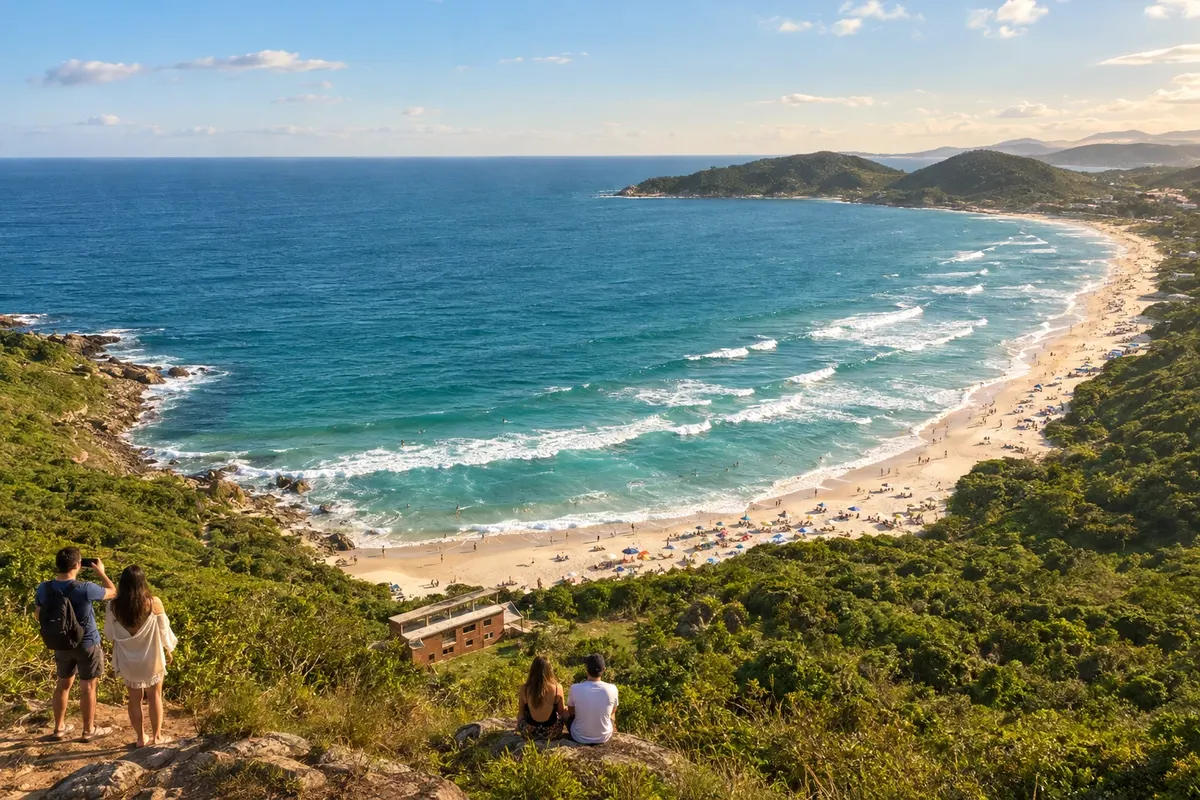
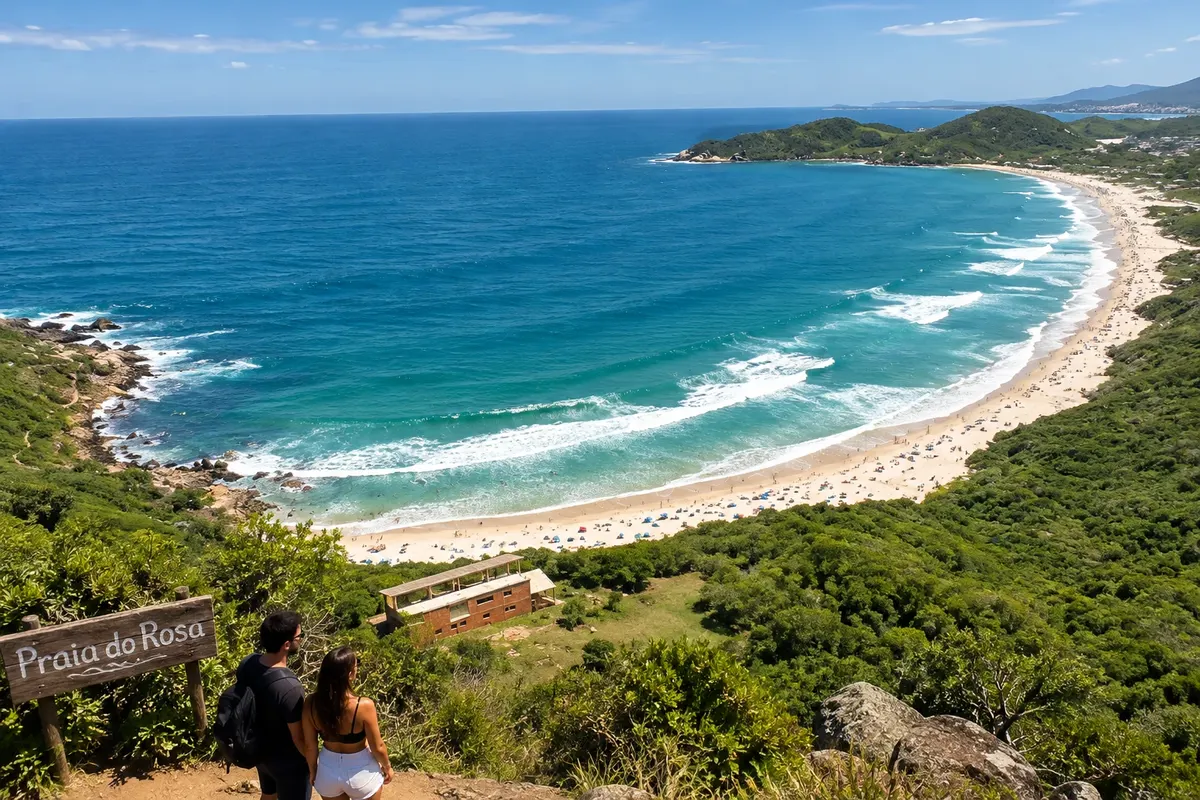
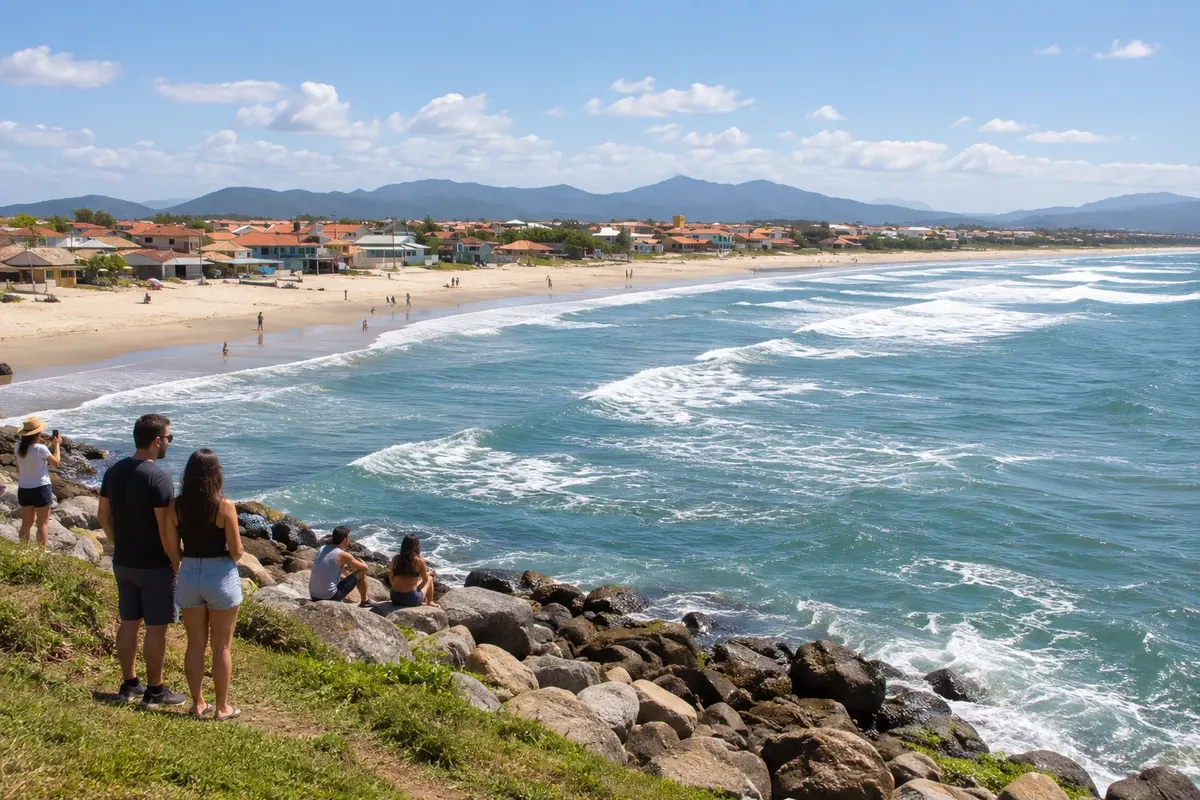
Praia do Rosa, in the municipality of Imbituba, brings together a cove surrounded by rocky headlands and is one of the surfing landmarks on the Santa Catarina coast. The setting also invites walking and enjoying the scenery.
Antarktika
Saint Catherine · Brazilija
Destinacija: Southern Charms.
Na fotografiji: Praia do Rosa, Imbituba (SC)
Illustrative images. The pictures in this guide are illustrations based on the real place, not photographs, and may differ from it.
Mesto
Imbituba brings together beaches with varied profiles on the southern Santa Catarina coast. Rosa mixes a cove and open coasts, Ibiraquera connects beach and lagoon, and Vila is linked to surfing. Itapirubá expands the route to the southern part of the municipality, offering a different setting for walks and relaxation.
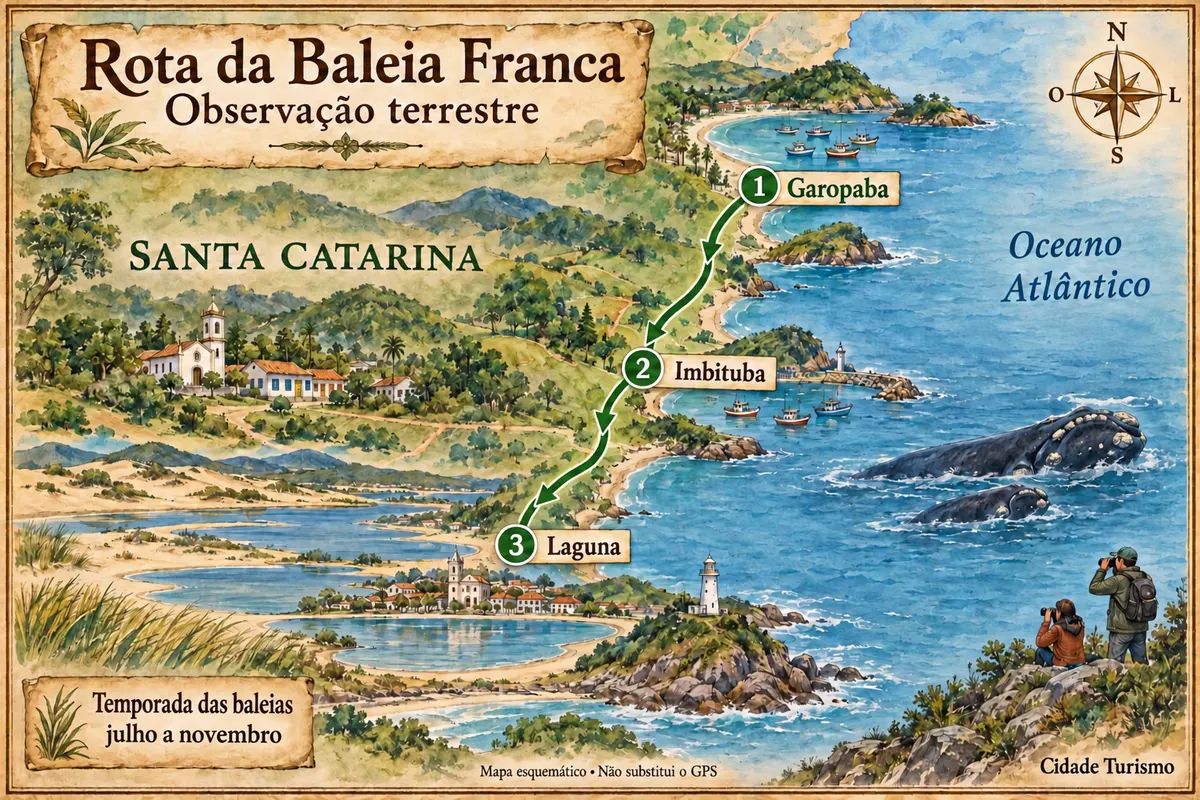
Imbituba is on the southern coast of Santa Catarina, between Garopaba and Laguna, about 90 km from Florianópolis via BR-101. The municipality stretches for roughly 30 km of coastline cut by hills, lagoons and dunes, from Praia do Rosa in the north to Itapirubá on the border with Laguna. It’s not a town you explore on foot: points of interest are spread out, and where you choose to stay changes the trip.
There are three areas. In the north is Praia do Rosa, a crescent-shaped cove about 2 km long, enclosed by green hills, with Lagoa do Meio in the center of the sand strip. The village grew on the hilltop, with dirt streets, pousadas and a small cluster of restaurants about a 15-minute walk from the beach. It’s about 25 km from downtown Imbituba and 15 km from Garopaba, the neighboring town where many visitors arrive from.
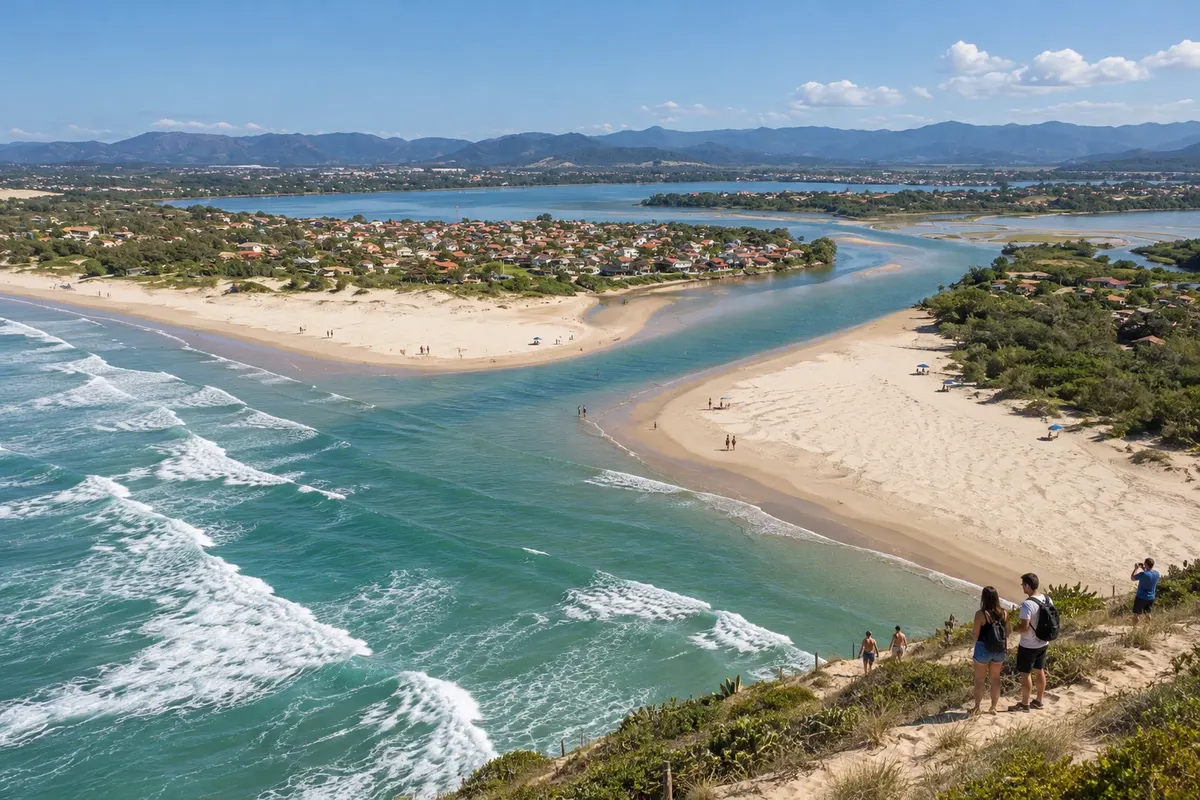
Just south of Rosa are Praia do Luz and Ibiraquera, where the lagoon meets the sea at Barra de Ibiraquera. The lagoon water is shallow and still, good for children, kayaking and stand up paddle, and the steady wind makes the region a spot for kitesurfing and windsurfing. Next come Praia da Ribanceira, with the municipality’s largest dunes right behind the sand, and the small Praia d’Água, reached by trail.
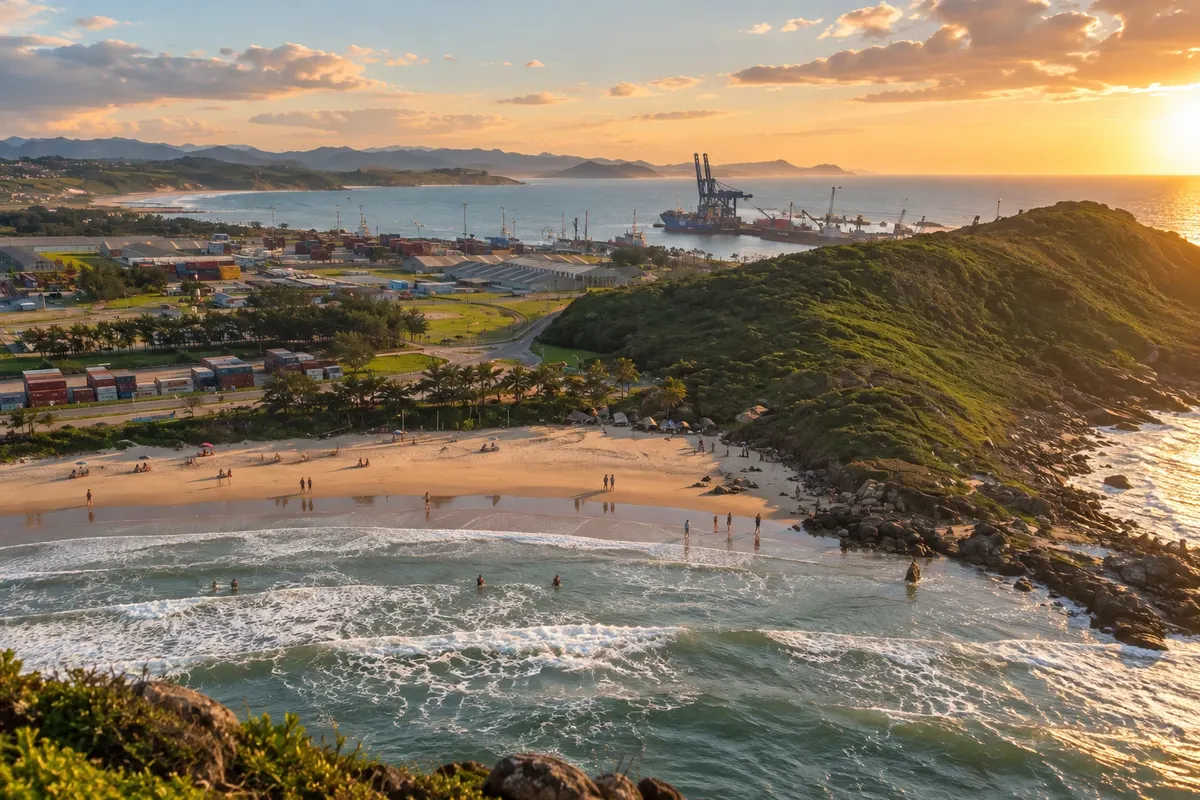
The third area is the town itself. Praia do Porto ends at Imbituba’s port, long linked to coal shipping since the 19th century; Praia da Vila, in the center, has a promenade, the islands Santana de Dentro and Santana de Fora offshore, and waves that have hosted stages of the world surfing tour. Between them, a hill with a small lighthouse is the most popular walk from the center. Further south are Vila Nova, with the Sant’Ana church dating to 1747, and Itapirubá, divided with Laguna by a hill of light-colored rocks.
By federal law Imbituba is the National Capital of the Southern Right Whale. From July to November, right whales often approach the coves to give birth and nurse their calves, with more records in September, and whale watching is done from land—from headlands, dunes and the beach itself. The visitors’ center of the institute that researches the species operates at Itapirubá Norte. The region’s last whaling station operated at Praia do Porto until 1973.
The climate is subtropical, with rain in every month. From December to March it’s hot, with highs between 25 °C and 27 °C, showers and the sea at its most pleasant temperature; this is high season, and Rosa fills up at New Year. From June to August highs are near 19 °C, nights require a jacket and the sea is cold, but these are the driest months and the start of whale season. April, May, October and November are mild and less crowded.
Three days allow you to see Rosa, the lagoon and the town without hurry. Bring closed shoes for the headland trails, a windbreaker outside summer, and leave some flexibility: wind and sea decide each day’s program.
Imbituba – število nastanitev: 108.
Imbituba – število lokalov: 15.
Imbituba – nazivi in posebnosti
Doživite kraj
Praia do Rosa, in the municipality of Imbituba, brings together a cove surrounded by rocky headlands and is one of the surfing landmarks on the Santa Catarina coast. The setting also invites walking and enjoying the scenery.
Praia de Ibiraquera combines the sea landscape with the proximity of the lagoon in Imbituba. The area is associated with sports like windsurfing and kitesurfing, as well as sightseeing excursions along the barra.
Praia da Vila is part of Imbituba's coastline and is linked to the practice of surfing. The visit allows you to enjoy the stretch of sand and the sea, combining walking and rest depending on the weather.
Praia de Itapirubá adds another landscape to the Imbituba itinerary. The northern stretch lies within the municipality and can be part of a visit with walking, sightseeing, and time to relax by the sea.
Kaj izbrati pred odhodom
Izhodišče, trajanje, potek, vključene storitve in okvirna cena vsakega izleta.
Praia do Rosa is a cove about 2 km long between two hills, and each end has its own character. The village sits on the hill: from the center to the sand it’s about a 15-minute walk, along streets or well-worn trails, and the return is uphill. The northern end hosts the kiosks, chair and umbrella rentals, and the waves most sought by surfers. Cars stop on the hill, and the last stretch is on foot. A few minutes from there, at the beginning of the trail that continues to Praia Vermelha, a stone path descends to the natural pool of Rosa Norte, water held between the rocks with a view of the entire cove. In the middle of the beach, Lagoa do Meio separates the two ends. The water is still and warmer than the sea, and there you can rent stand-up paddle boards, kayaks and pedal boats. Without waves, this is the section preferred by people with children. Rosa Sul has parking close to the sand and restaurants that serve the beach; the sea tends to be slightly calmer and there are fewer surfers. It’s also the side where you see the end of the day, before climbing back up to the village, where the evening restaurants are concentrated.
Kraji na poti: Praia do Rosa, Rosa Norte, Lagoa do Meio, Rosa Sul, Natural pool of Rosa Norte.
Vključuje: Access to the beach and the lagoon is free. Private parking, chair and umbrella rentals, and equipment are paid separately; check the current rates on site.
Nasvet: In summer, go on foot or arrive early: the streets are narrow, many unpaved, and public parking fills quickly. Wear sturdy shoes for the rocks at the natural pool and only descend to it at low tide and calm sea.
Najboljši čas za obisk: December to March for swimming; the rest of the year to walk with an empty beach. Whale season: July to November.
This is the most popular walk for those staying in Rosa. The trail starts at the northern end of the beach, on a wooden boardwalk, and skirts the hill along the rocky point until Praia Vermelha, a stretch of sand without kiosks or buildings that can only be reached on foot. The route is just under 1.5 km and takes about 30 minutes. It is well signposted, with stairs and boardwalks on steeper sections and some parts shaded by trees. Near the start, a rocky detour leads to Rosa Norte’s natural pool. Further on, the path opens up views of the entire Rosa cove. There are no places to buy water or food at Praia Vermelha. If you plan to spend a few hours there, bring what you need and carry your trash back. To return there are two options: retrace the trail or continue ahead, along another stretch of rocky point and hill, to Praia do Ouvidor, toward Garopaba, from where you can call a car. The full route, from Rosa Norte to Ouvidor, usually takes a little over 2 hours with stops. From July to November, it’s worth looking at the sea from the top of the point: southern right whales often swim near the breakers.
Kraji na poti: Rosa Norte, Rosa Norte natural pool, Praia Vermelha, Praia do Ouvidor.
Vključuje: There is no fee to do the trail on your own. Guide and return transport, when hired, are paid separately.
Nasvet: Leave early, with water, sunscreen and sneakers. After rain, the rocks and steps become slippery. If you go as far as Ouvidor, arrange your return beforehand.
Najboljši čas za obisk: Year-round, on dry days and with calm seas. Whale season: July to November.
From the southern end of Rosa, a trail crosses the hill that closes the cove and descends to Praia do Luz. The start is next to a wooden gate and climbs through a grassy area where cattle often graze. There are two routes. The shorter one goes over the top of the hill and takes about 20 minutes. The longer one, signposted, goes around the hill on the seaside and takes about 40 minutes, with viewpoints to look at the coast. From the top, you can see the whole stretch of Praia do Luz, Barra de Ibiraquera just beyond, and, on the other side, Lagoa de Ibiraquera. Praia do Luz is wide, with few buildings, a slope of native forest and some dunes. The corner near the hill has calmer water; further on the waves rise and surfers appear. You can drive very close to the sand, which is why many locals use this beach on weekends. If you have the energy, continue along the sand to Barra de Ibiraquera, where the lagoon meets the sea and the water is shallow and still. There are restaurants and equipment rentals there. The return can be by the same path or by car on the road.
Kraji na poti: Rosa Sul, King’s Path, Praia do Luz, Barra de Ibiraquera, Lagoa de Ibiraquera.
Vključuje: There is no fee to do the trail. A local guide, when hired, is paid separately; check the current rate table.
Nasvet: There is almost no shade: avoid midday in summer and bring water and a hat. The trail crosses pasture areas; leave gates as you found them. After rain, the descent becomes slippery.
Najboljši čas za obisk: All year, on days without rain. Whale season: July to November.
Ibiraquera is the stretch of Imbituba where beach and lagoon lie side by side. At the Barra de Ibiraquera, a few meters apart, you can choose between the open sea and the still water of the lagoon, which remains shallow for a long distance. It’s the municipality’s most used spot by families with small children. The lagoon does not allow motorboats. On the shores, rental points offer kayaks and stand-up paddleboards, and the morning—when the wind is usually weaker—is the easiest time to paddle. When the wind picks up, the landscape changes: the region is one of the best-known kitesurfing and windsurfing spots in the south of the country, and local schools give beginner lessons in the lagoon’s shallow area and rent equipment. September to November usually has the most consistent wind. On the sea side, Praia de Ibiraquera has waves for surfing. The area by the estuary mouth concentrates restaurants and pousadas and is one of the municipality’s three lodging bases, quieter than Rosa. At sunset, the sun goes down over the lagoon side.
Kraji na poti: Barra de Ibiraquera, Ibiraquera Lagoon, Praia de Ibiraquera, Praia do Luz.
Vključuje: Access to the beach and the lagoon is free. Equipment rental, lessons and parking are paid separately; check each school’s current price list.
Nasvet: On windy days, people rowing should stay close to the shore and away from the kiteboarding area. Children must wear life jackets. Book lessons in advance on holidays and ask the school which activities the day’s wind allows.
Najboljši čas za obisk: December to March for swimming; September to November for wind sports.
Ribanceira sits between Ibiraquera and the town center and combines two landscapes in one place. In front, an open, wave-exposed beach used by surfers and fishers. Behind it, the largest dune area in Imbituba, about 3 km long. Climbing the dunes is the main activity. From the top you can see the beach on one side and the plain with the lagoons on the other. The sand slopes are used for sandboarding and for descending seated on a board, an activity locals call esquibunda. From July to November, the dunes and the headland serve as a lookout: Ribanceira is among the Imbituba coves where southern right whales often stay with their calves, not far from the surf zone. At the southern corner of the beach, a roughly 300-meter trail along the headland leads to Praia dos Amores, a narrow strip of sand a few dozen meters long wedged between the hills. Further on, between Ribanceira and Praia do Porto, lies Praia d'Água, a deserted beach reached by trails of about 1 km from the road.
Kraji na poti: Ribanceira Beach, Ribanceira Dunes, Praia dos Amores.
Vključuje: Access to the beach and the dunes is unrestricted. Rental of boards for dune rides, when available, is paid separately.
Nasvet: The sand gets very hot at midday: go late afternoon, wear flip-flops or closed shoes, and bring water. Walk only on bare sand; do not step on vegetation that stabilizes the dunes. For whale watching, bring binoculars.
Najboljši čas za obisk: Year-round, on days without strong wind. Whale season: July to November.
Praia da Vila is the town’s main beach: it has a promenade, parking, restaurants and, offshore, the Santana de Dentro and Santana de Fora islands, which help shape the waves at the beach’s corner. For several years the Vila hosted stages of the world surfing circuit because of them and it remains on the competition calendar. Henrique Lage Square and the main church face the sea. At the left end of the beach the Lighthouse trail begins, about 1.2 km long. There are two paths: one skirts the headland, the other climbs the higher part of the hill. The best plan is to go out by one and return by the other, about 30 minutes each way. The lighthouse is small; the attraction is the view, which covers the Vila, the islands, Praia do Porto and the pier. On the other side of the hill, Praia do Porto is about 2.5 km long. The right-hand point is occupied by Imbituba’s port, linked since the 19th century to coal shipping from the south of the state, and it was there that, until 1973, the southernmost whaling station in Brazil operated. The central stretch is next to a neighborhood, and the left-hand end, quieter, has hills, dunes and a lookout atop the cliff. From July to November, the lighthouse and the Vila’s sand are observation points for southern right whales.
Kraji na poti: Praia da Vila, Imbituba Lighthouse, Santana de Dentro and Santana de Fora islands, Praia do Porto, Praia do Porto lookout.
Vključuje: There is no fee to walk on the beach or to do the trail. Parking, chair rentals and purchases at the kiosks are paid separately.
Nasvet: Wear sneakers on the trail: there are loose rocks and uneven sections. If you prefer not to go around the headland, take the higher route, which is easier.
Najboljši čas za obisk: All year, on days without rain. Whale season: July to November.

The southern right whale breeding season in Brazil runs from July to November, peaking in September; by number of animals, the highest sightings occur between the second half of August and the first half of October. During this period, females and calves often stay for several days in the same cove, swimming near the surf, so they can be followed from solid ground. A good starting point is Itapirubá Norte Beach, home to the National Center for Southern Right Whale Conservation, the institute that has studied the species for more than forty years. The visitor center has panels about whale biology and migration, a video room, a life-size calf replica and an observation deck facing the cove. An adult southern right whale skeleton of 14 meters is displayed in the annex. The visit lasts about 1 hour on average. From there, follow the route to the municipality’s natural viewpoints according to recent sightings: the sand and lighthouse of Praia da Vila, the dunes and the Ribanceira headland, Ibiraquera and the headlands of Rosa. Local agencies run the same circuit with a guide and binoculars, picking visitors up at their accommodation. Sightings depend on the weather: with rough seas or rain, visibility falls even when animals are close. Boat trips to see whales require authorization from the federal agency that manages the protected area and are not guaranteed; the regional rule is to watch from shore.
Kraji na poti: National Center for Southern Right Whale Conservation, Itapirubá Norte Beach, Praia da Vila, Praia da Ribanceira, Headlands of Praia do Rosa.
Vključuje: The visitors’ center charges no entrance fee and operates Tuesday through Saturday in two shifts, with appointments for groups; confirm before you go. Guided tours are paid separately; check the agency’s current rates.
Nasvet: Look for a high vantage point on a calm sea day and be patient: the easiest sign to spot is the V-shaped blow. Bring binoculars and a windbreaker. The institute publishes a map with recent sightings, useful for choosing the beach of the day.
Najboljši čas za obisk: Whale season: July to November, with more sightings from the second half of August to the first half of October.
Itapirubá is the southernmost beach of Imbituba and keeps a quiet feel. A grassy hill with light-colored rocks juts into the sea and divides the sand into two stretches: the northern half belongs to Imbituba, the southern half to Laguna. At the ends of the two beaches, next to the headland, trails lead to the tip of the hill; the trail on the Imbituba side is about 700 meters. From the top you can see the coast in both directions, and from July to November the cove on the northern side is one of the places in the country with the most southern right whale sightings. The water is clear and cold, and the headland is popular for freediving and fishing. Near the main access there is a dune area that, when windy, can advance onto the road; a second, larger dune area stretches between the BR-101 and the Lagoa do Timbé. Itapirubá pairs well with a visit to the whale visitor center, which is on the same beach, and with a trip to Laguna, the neighboring town further south along the same highway.
Kraji na poti: Itapirubá Beach, Itapirubá Hill, Itapirubá Dunes.
Vključuje: Access to the beach, the hill and the dunes is unrestricted.
Nasvet: It’s very windy on the hilltop: bring warm clothing even on sunny days, plus water and a snack.
Najboljši čas za obisk: Year-round. Whale season: July to November.
Po dnevih
Predlogi za načrtovanje poti. Vrstni red dni prilagodite vremenu in razpoložljivosti izletov.
With only one day, stay in the northern part of the municipality, where distances are short. Arrive early at Praia do Rosa and go down to the northern end; in a few minutes along the trail to Praia Vermelha you can reach the natural pool, if tide and sea conditions allow. Cross the beach along the sand, passing Lagoa do Meio, to Rosa Sul, and climb the Caminho do Rei by the short route: in about 20 minutes you reach Praia do Luz. If you left your car at Rosa, return by the same trail and follow the road to Barra de Ibiraquera for lunch and to go into the lagoon. At the end of the afternoon, go to the Ribanceira dunes. From July to November, look at the sea from above: it’s one of the coves where southern right whales often stay. Imbituba town center and the lighthouse are about 25 km from Rosa and require another day.
Start on the trail from Rosa Norte to Praia Vermelha while the morning is still cool: about 30 minutes each way, with a stop at the natural pool. Return the same way. Spend the rest of the day at Praia do Rosa. Lagoa do Meio, in the center of the cove, has still water and rentals for boards and kayaks; Rosa Sul has restaurants by the sand and the best angle for the late afternoon. At night, activity concentrates on the two streets of the village center, on top of the hill.
In the morning, while the wind is still light, go to Barra de Ibiraquera to bathe in the lagoon or to paddle. Those who want to try kitesurfing or windsurfing should schedule lessons with a school for the period when the wind comes in. After lunch, stop at the Ribanceira dunes and then head to the center. At Praia da Vila, do the Lighthouse trail, going along the headland and returning over the top of the hill, about 1 hour in total. Finish the day on the promenade, facing the Santana islands. In whale season, from July to November, reverse the order according to daily whale sightings: Ribanceira, Vila and the lighthouse are observation points.
A full day at Rosa. In the morning, the trail from Rosa Norte to Praia Vermelha, with a stop at the natural pool on the way there or back. Bring water and snacks: Praia Vermelha has no kiosks. In the afternoon, stay between Lagoa do Meio and Rosa Sul. Those who still have energy can climb the first section of Caminho do Rei to see the cove from above at the end of the day. Dinner in the village center.
Take the Caminho do Rei by the long route, about 40 minutes, to Praia do Luz, and continue along the sand to Barra de Ibiraquera. Have lunch at the barra and spend the early afternoon at the lagoon, in a kayak, on a board or just in the shallow water. At the end of the afternoon, drive to the Ribanceira dunes. If you have time left, the roughly 300-meter trail on the southern corner leads to the small Praia dos Amores. Without a car, arrange transportation in advance between the barra, Ribanceira and your accommodation.
Go in the morning to the town center: Praia da Vila, the lighthouse trail and, on the other side of the hill, the Praia do Porto lookout, with a view of the pier. After lunch, take BR-101 down to Itapirubá. Visit the southern right whale visitor center in Itapirubá Norte, open Tuesday to Saturday, and climb the short trail up the hill that divides the beach. From July to November, the visitor center deck and the hill are observation points. If you have a fourth day, use Itapirubá as a route to Laguna, the neighboring city to the south, with a historic center and dolphin-assisted fishing.
Najboljši čas za obisk
The seasons shown are the most usual ones; nature doesn't always follow the calendar.
Summer and high season · Rainiest month
Hot with sudden showers: lows near 22 °C, highs around 26 °C and about 180 mm of rain, the highest volume of the year. The sea is at its most pleasant phase for swimming. This is the busiest month, especially at Rosa and Ibiraquera: book accommodation in advance and arrive early at the beach, because spots near the sand fill up quickly. Leave cliffside trails for early morning.
Warmer sea · Carnival
Highs near 27 °C, lows around 22 °C and about 150 mm of rain. Sea and lagoon waters are usually at their warmest of the year, good for kayaking, stand-up paddle and swimming at Barra de Ibiraquera. Carnival, when it falls in February, fills the beaches again. After heavy rain, Rosa’s dirt roads have puddles and potholes.
End of summer · Less busy
Temperatures still summery, between 22 °C and 26 °C, with about 140 mm of rain. After the first weeks, the beaches empty and the sea remains pleasant. It’s a good month for those who want Rosa without long lines of cars. Holy Week, when it falls in March, again concentrates visitors.
Mild autumn · One of the driest months
One of the months with the least rain, about 95 mm, and temperatures between 20 °C and 24 °C. Stable weather favors the Praia Vermelha, Caminho do Rei and lighthouse trails, and you can still enter the sea on sunny days. Beaches are empty outside the Holy Week holiday. At night a light jacket is advisable.
Start of mullet fishing season · Cool nights
Highs near 21 °C and lows around 17 °C, with about 125 mm of rain. The artisanal mullet fishing season begins, lasting until July. The sea water cools. Sunny days are great for long walks on the sand; bring a jacket for morning and night.
Mild cold · First whale sightings
Highs near 19 °C, lows around 15 °C and about 100 mm of rain. The sea is cold and there is little swell. The first southern right whales may appear, but the season actually starts in July. It’s time for inns with fireplaces, midday hikes and beach walks.
Whale season: July to November · Driest month
Month with the least rain, about 85 mm, highs near 19 °C and lows around 14 °C. The southern right whale season begins, accompanied by headlands, dunes and sand. Sea water ranges between 17 °C and 20 °C. Clear-sky days and calm seas are the best for whale watching; bring a windbreaker, because it’s windy on high points.
Whale season: July to November · Dry days
About 90 mm of rain, highs near 20 °C and lows around 14 °C. From the second half of the month the number of southern right whales in the coves increases, with females and calves near the surf. Itapirubá Norte, Ribanceira, Vila and the headlands of Rosa are the most used spots. Beaches are empty and nights are cold.
Peak of the whale season · Southern Right Whale Month
Highs near 20 °C, lows around 16 °C and rain back to about 130 mm. This is the month with the most southern right whale sightings and whale-related activities in town. The wind becomes more constant, and the best period for kitesurfing and windsurfing in Ibiraquera begins. Have a plan for rainy days, when sea visibility drops.
Whale season: July to November · Wind in Ibiraquera
About 130 mm of rain, highs near 22 °C and lows around 18 °C. Southern right whales remain along the coast, with more sightings in the first half of the period. The steady wind favors sailing sports on the lagoon, and the water begins to warm. Outside long holidays, the pace is still calm.
End of whale season · Spring
Temperatures between 19 °C and 23 °C, with about 115 mm of rain. The southern right whale season ends, with fewer animals than in September. Days get longer, the sea already allows swimming on sunny days and the wind still serves kitesurfing. It’s a balanced month to combine trails, lagoon and beach, with moderate activity.
Start of summer · Busy New Year period
Highs near 25 °C, lows around 21 °C and about 120 mm of rain, mostly in downpours. The sea warms and crowds grow week by week. Between Christmas and New Year’s, Rosa receives the largest number of visitors of the year: book in advance and prefer to move on foot.
Načrtujte pot
Imbituba has no airport with regular scheduled flights. The most used is Florianópolis International Airport – Hercílio Luz (FLN), which receives domestic and international flights and is about 95 km from downtown Imbituba and 80–90 km from Praia do Rosa.
There is no direct bus from the airport to Imbituba. From the terminal you continue by rental car, transfer, taxi or ride-hailing; those who prefer the regular bus must first go to Florianópolis bus station in the city center.
To the south, the Regional Sul Airport (JJG) in Jaguaruna serves southern Santa Catarina, with a small route network that changes over the year. Confirm routes and days of operation before buying.
If your flight arrives at night, leave the car or transfer reserved.
Imbituba’s bus station is in the center and receives buses from Florianópolis, Tubarão, Criciúma and Porto Alegre. From Florianópolis bus station the journey takes 1h30 to 2 hours, depending on time and stops. Some lines also stop in Araçatuba, at the BR-101 junction that gives access to Garopaba and Rosa.
The bus station serves well those staying in the center or Praia da Vila. For Praia do Rosa, which is about 25 km from the terminal, the final stretch is by taxi or ride-hailing. Another option is to get off in Garopaba, 15 km from Rosa, where there is a local bus to the village.
On holidays and summer weekends, buy your ticket in advance, including the return.
The BR-101, duplicated on this stretch, is Imbituba’s road for those coming from the north or the south. From Florianópolis it’s about 90 km, generally 1h15 to 1h30, with one toll on the way, in Palhoça. Those leaving Florianópolis airport reach the BR-101 via BR-282.
For Praia do Rosa and Ibiraquera, take the Araçatuba junction exit, the same for Garopaba, following SC-434. For the center, Praia da Vila and the port, continue on BR-101 to the main city access. Itapirubá has its own access further south.
From the south, Imbituba is about 35 km from Laguna, 52 km from Tubarão and 115 km from Criciúma; from Porto Alegre the route is also BR-101.
In Rosa, many streets are unpaved, narrow and without sidewalks, with potholes after rain, and parking is scarce near the beach in high season.
Local agencies and transport companies run the stretch between Florianópolis airport and the inns of Rosa, Ibiraquera and downtown Imbituba, as shared or private transfer services. Some also serve Jaguaruna airport.
Shared transfers usually require a minimum number of passengers and may wait after deplaning; private transfers depart at the agreed time. It’s common to have a baggage limit per person and to require booking one day in advance.
Give your flight number and the exact address of your lodging: in Rosa many streets are narrow and unpaved. Check what is included and each company’s current rate schedule.
The three areas of the municipality are far from each other: from Rosa to the center is about 25 km. With a car you can combine the lagoon, the dunes and Praia da Vila in the same day; without a car, choose your base according to what you want to do and treat the rest as outings.
Within Rosa you walk: from the small center to the sand is about 15 minutes, and trails connect the cove to neighboring beaches on both sides. Between Rosa, Ibiraquera, Ribanceira and the center, taxis and ride-hailing cars are used; they operate even in high season, with some waiting. There is also a local bus to Garopaba from Rosa.
Local agencies sell a half-day beach circuit with a guide and hotel pickup, useful if you don’t have a car and want to see the area before choosing where to return.
On the return from remote beaches and from trails that end at a different point, arrange transport before you leave.
Odgovori na vaša vprašanja
Prioritize Praia do Rosa and Praia de Ibiraquera. With more time, include Praia da Vila and Praia de Itapirubá, distributing visits according to travel times.
We suggest two to three days to do the excursions with breaks. On a short visit, reduce the number of trips between locations.
A car makes it easier to combine different areas. If you prefer to travel without a car, confirm local transport and the return from the tours before leaving.
One alternative is to use Aeroporto Internacional de Florianópolis - Hercílio Luz, in Florianópolis, and arrange the land leg to your accommodation. Check flights for your travel dates.
Check the conditions and operation of each excursion. Reorder visits, allow time for rest, and avoid keeping an outdoor program when conditions are unsuitable.
It’s in Imbituba, at the northern tip of the municipality. The confusion is common because Rosa is about 15 km from Garopaba and about 25 km from downtown Imbituba, and access via BR-101 uses the same junction as Garopaba. If you arrive by bus you can get off in either town.
Praia do Rosa concentrates most of the pousadas and restaurants, has trails starting from the cove and some nightlife; in return, the streets are unpaved and the village fills up in summer. Barra de Ibiraquera is quieter, with a shallow lagoon next to the sea, and suits families and those who practice kitesurfing and windsurfing. The downtown area, next to Praia da Vila, has a promenade, shops, the bus station and paved access, and is closer to Itapirubá and Laguna.
It depends on your reason for going. For beach and swimming, December to March, with hot weather, heavy showers and a lot of activity between Christmas and Carnival. To see southern right whales, July to November, with more sightings from the second half of August to the first half of October; it’s cold and rains less in winter. For trails and empty beaches with mild temperatures, April, May, October and November. From September to November the wind is steadier for sailing sports in Ibiraquera.
Whale watching in Imbituba is done from land. Boat trips to see whales in the protected area were suspended more than a decade ago and depend on authorization from the federal environmental agency, which is still unresolved. It isn’t necessary: during the season, July to November, mothers and calves often swim close to the surf and are seen from the headlands, dunes and sand. There are guided land tours with binoculars that visit spots with recent sightings.
The National Center for Southern Right Whale Conservation is on Praia de Itapirubá Norte and is the headquarters of the institute that researches the species in Brazil. The visit, about 1 hour, includes panels about the whales, a video room, a life-size calf replica, the skeleton of a 14-meter adult whale and an observation deck. There is no entrance fee. It’s open Tuesday through Saturday in two time slots; groups must book. Confirm opening hours before you go.
It’s about 25 km. By car, take BR-101 north to the Araçatuba junction and then SC-434. Without a car, the stretch is done by taxi or ride-hailing. If you arrive by intercity bus you can get off in Garopaba, 15 km from Rosa, where there is a local bus. Arrange your return in advance at night and on holidays.
Barra de Ibiraquera is the most suitable: the lagoon meets the sea there, and the water is shallow and still for a good distance. At Praia do Rosa, Lagoa do Meio, in the center of the cove, also has wave-free water, and the south corner usually has calmer water than the north. Open beaches like Ribanceira, Vila and Luz have waves; enter the sea where lifeguards are on duty and follow the signage.
Praia da Vila, in the center, is the best known: the islands offshore help form powerful waves at one corner of the beach, and it has hosted world tour stages. The north and south corners of Praia do Rosa have waves much of the year and schools for beginners. Ribanceira, Luz, Ibiraquera, Porto and the small Praia d'Água complete the list. Conditions change with swell and wind each day: ask local schools before entering the water.
Yes, and it’s common. Garopaba is about 15 km from Praia do Rosa, with beaches like Ferrugem and Silveira and a beachfront town center. Laguna is about 35 km from downtown Imbituba via BR-101, with a historic center, the channel where dolphins and fishermen work together and the Farol de Santa Marta. If you’re at Rosa you can go to Garopaba in half a day; Laguna requires a full day and is closer to those staying downtown.
Covered options are limited, because almost everything happens outdoors. The southern right whale visitor center in Itapirubá Norte takes about 1 hour and is open Tuesday through Saturday. The Rosa village center and downtown Imbituba have cafes, restaurants and shops. With light rain and no wind you can still walk on the sand; the headland trails get slippery and should be postponed. Laguna, about 35 km away, has historic houses and museums.
Brazilske poti
Garopaba, Imbituba and Laguna on a coastal trip, with land-based whale watching during the season.
Več kot vodnik