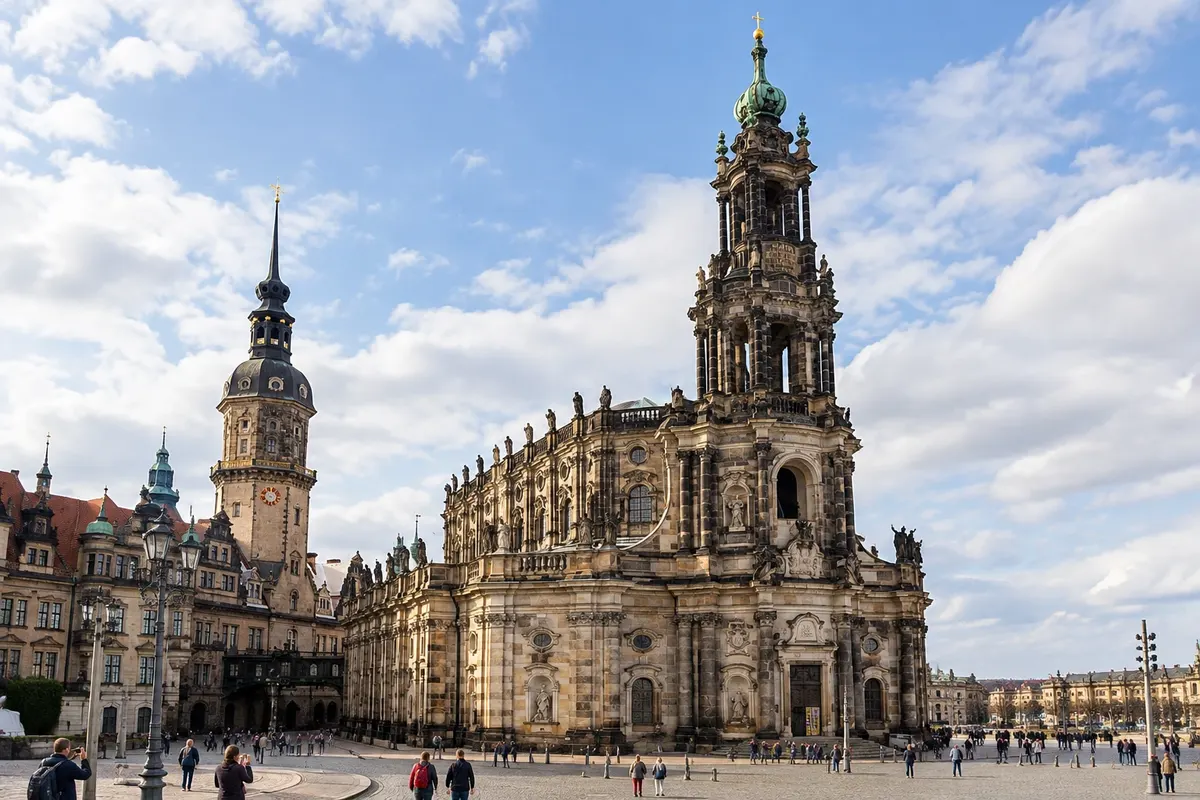
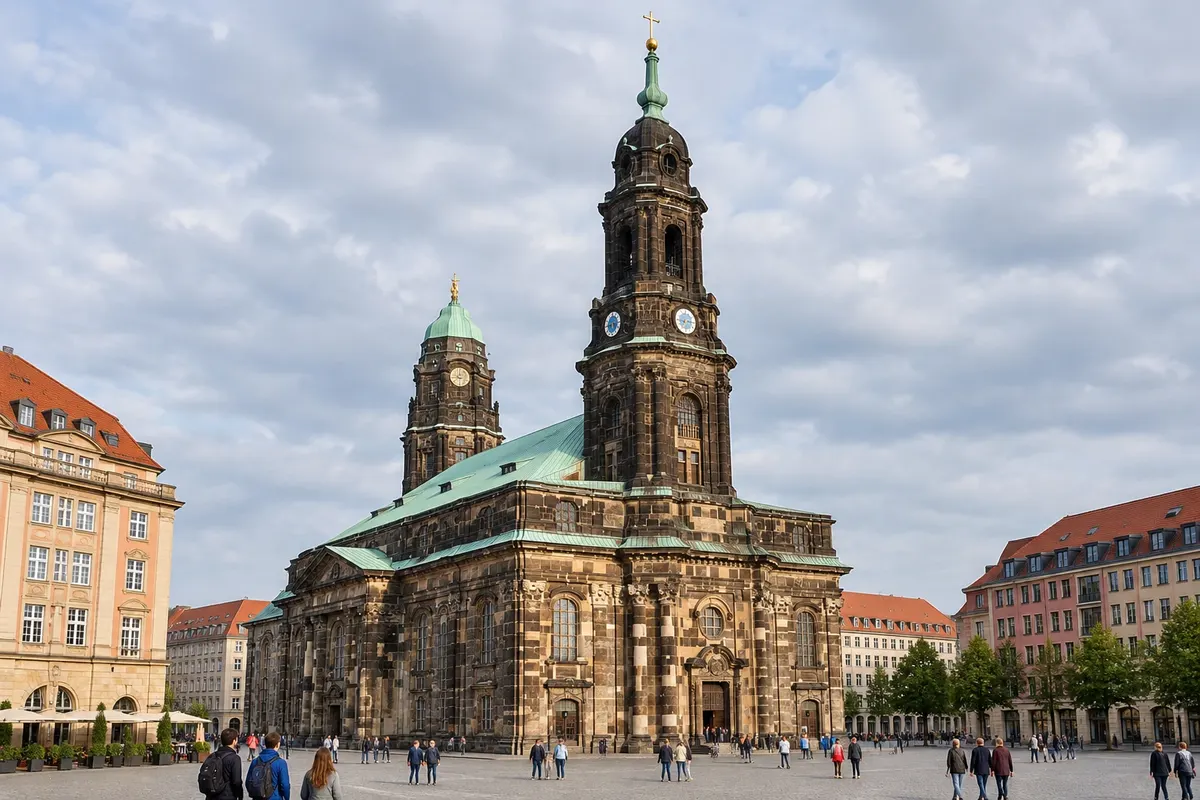
Kreuzkirche and Altmarkt: the viewing tower and the Kreuzchor choir
Odhod: Altmarkt (trams 1, 2, 4) Church, tower climb and square Približno uro in pol Popoldne moderate (256 steps)
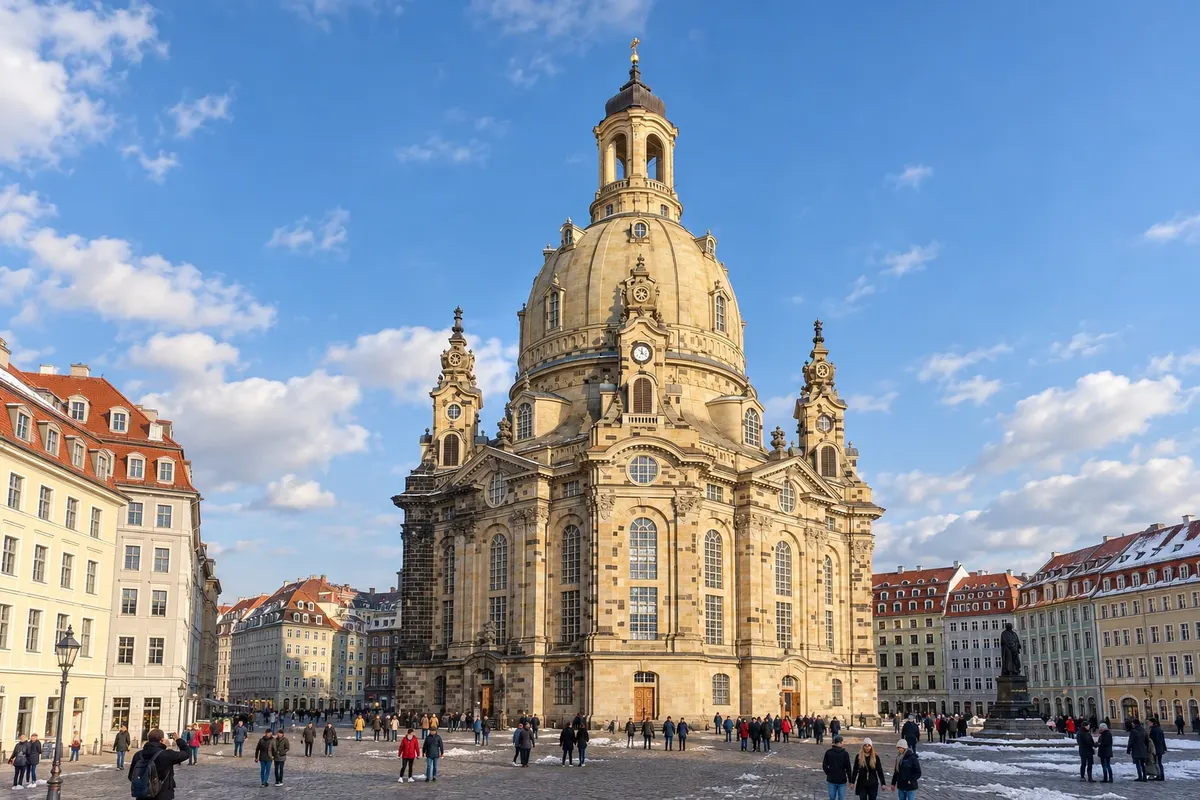
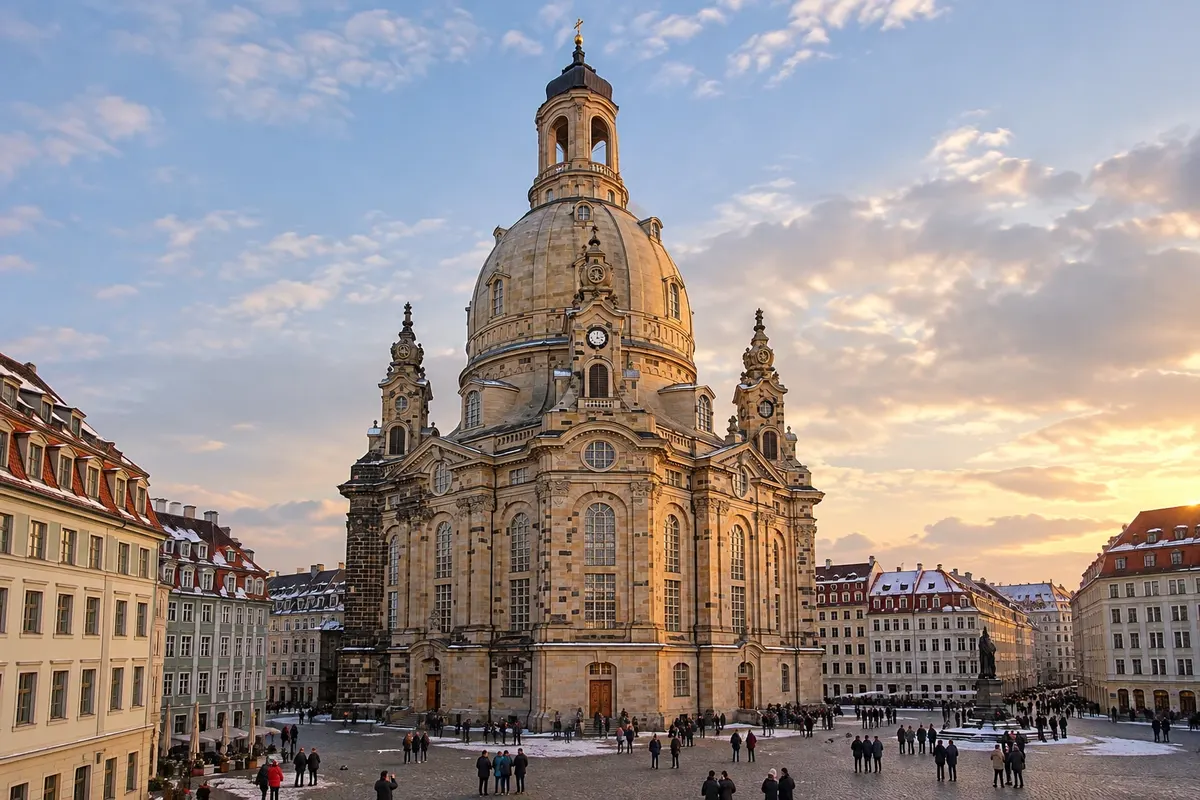
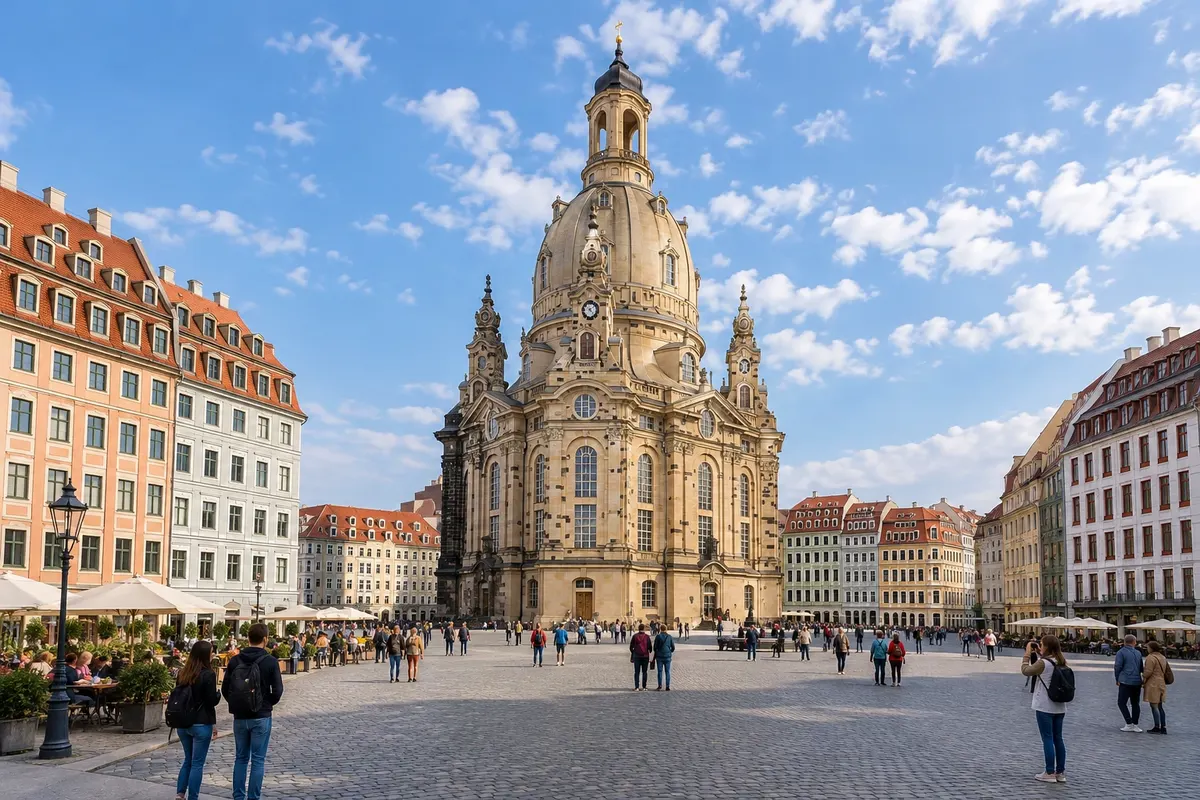
The Kreuzkirche (Church of the Holy Cross) stands on the corner of the Altmarkt (old market), the city’s main square since the Middle Ages. It is the largest church in Saxony, with more than 3,000 seats, and the home of the Dresdner Kreuzchor, a boys’ choir with a recorded history since the 13th century. It burned on February 13, 1945 and was reopened in 1955 with the interior left in rough plaster, unadorned, as a mark of the destruction; that choice became one of the church’s features. The tower is 94 meters tall; the viewing platform at 54 meters is reached by 256 steps that pass the former tower watch room. From the top you can see the Altmarkt, the Kulturpalast, the Frauenkirche and, on clear days, the Elbe hills. The Kreuzchor often sings vespers in the church on weekends, as well as giving concerts; the schedule changes through the year. On the Altmarkt are the Kulturpalast, a concert hall from the GDR era refurbished inside, housing the philharmonic orchestra and the municipal library, and, from late November to December 24, the Striezelmarkt.
Kraji na poti: Kreuzkirche.
Vključuje: Entrance to the church is free, with a requested contribution. The tower climb is paid separately; check the current price table. Vespers and Kreuzchor concerts may have their own tickets.
Nasvet: Climb the tower in the mid‑afternoon, when the light comes from the west and illuminates the Frauenkirche. Check the vespers schedule beforehand: hearing the Kreuzchor in the church is a short, inexpensive thing to fit in. On Saturdays the tower often closes earlier.
Najboljši čas za obisk: All year. From late November until December 24 the Altmarkt hosts the Striezelmarkt and the square fills up.
Äußere Neustadt and Pfunds Molkerei: the neighborhood of courtyards, bars and tiles
Odhod: Albertplatz (trams 3, 6, 7, 8, 11) Walk around the neighborhood Približno 3 ure late afternoon and early evening Lahko
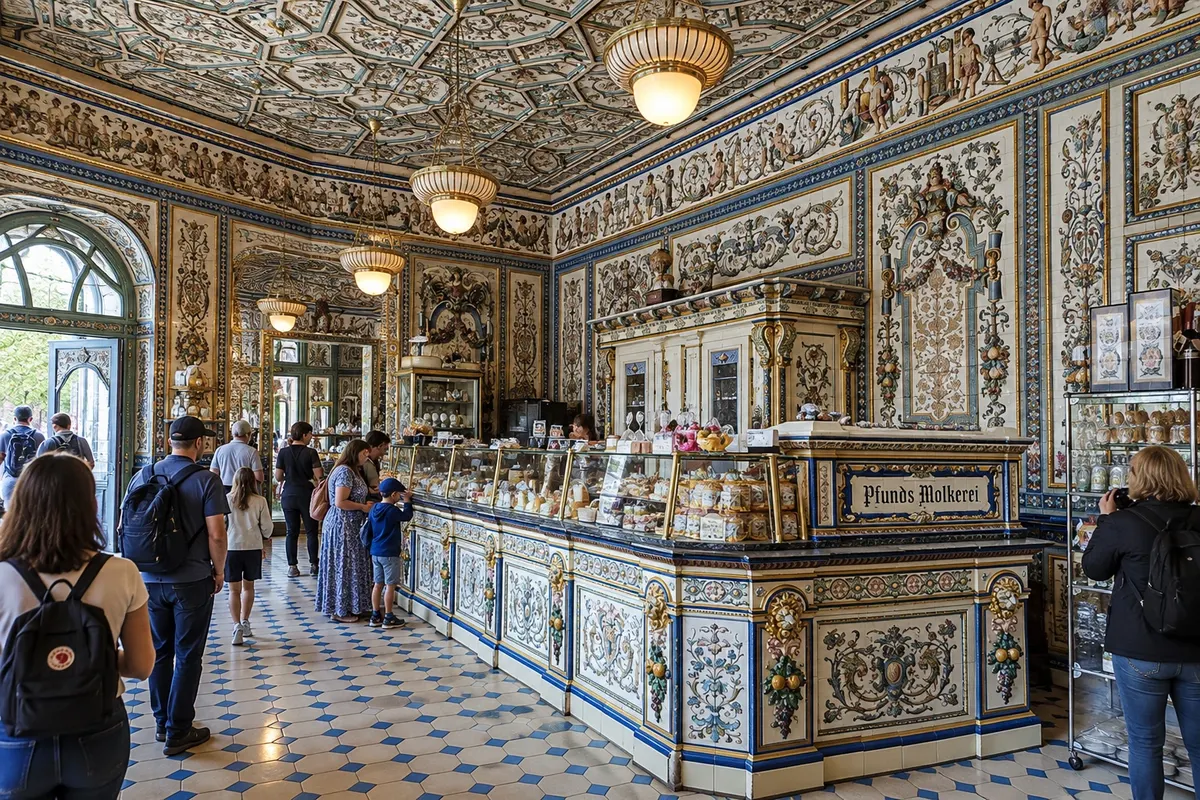
The Äußere Neustadt (outer Neustadt) lies on the right bank of the Elbe, north of Albertplatz. The neighborhood was laid out in the 1830s and built mostly between 1885 and 1905, and forms one of the largest surviving complexes of residential buildings from the industrialization era in Germany; the writer Erich Kästner grew up there. At the end of the GDR, the unrestored buildings attracted students and artists, and in 1990 residents jokingly proclaimed the Bunte Republik Neustadt (colorful republic), a street festival usually held in June. Today Alaunstraße, Görlitzer Straße and Louisenstraße are full of bars, cafés, restaurants from many countries and small shops. At Görlitzer Straße 21–25 is the Kunsthofpassage, five inner courtyards decorated by artists: in the Hof der Elemente the downspouts on the blue façade become instruments when it rains. Alaunpark is the lawn where the neighborhood gathers on sunny days. On Bautzner Straße is Pfunds Molkerei, a dairy shop opened in 1892 by the Pfund brothers, with walls, counter and ceiling covered by almost 248 m² of hand-painted tiles by Villeroy & Boch; it entered the record books as the most beautiful milk shop in the world and sells cheeses, milk and souvenirs, with a small bistro. On the return, the Innere Neustadt has the tree-lined Hauptstraße, the gilded statue of Augustus, the Fortress, the Goldener Reiter and the baroque Königstraße.
Kraji na poti: Äußere Neustadt, Pfunds Molkerei.
Vključuje: Self-guided walk; the Kunsthofpassage is open and free to enter. Pfunds Molkerei is a shop: entry is free, but the visit is short and there is often a queue at the door on weekends; it is closed on Sundays outside Advent. There are paid guided tours available separately.
Nasvet: Go to Pfunds Molkerei in the early afternoon, before it gets busy, and don’t expect photos: the shop does not allow photography inside. Leave the neighborhood for the end of the day, when the bars open. The gutters of the Kunsthofpassage only play when it’s raining.
Najboljši čas za obisk: All year. From May to September the tables spill onto the sidewalks; in June the Bunte Republik Neustadt often closes streets for a weekend, so check before you go.
Schloss Pillnitz: the Chinese-style palaces and the park on the Elbe riverbank
Odhod: Dresden, bus 63 to Pillnitzer Platz or tram 2 and ferry Bus or tram and ferry, then on foot Pol dneva Dopoldne ali popoldne Lahko
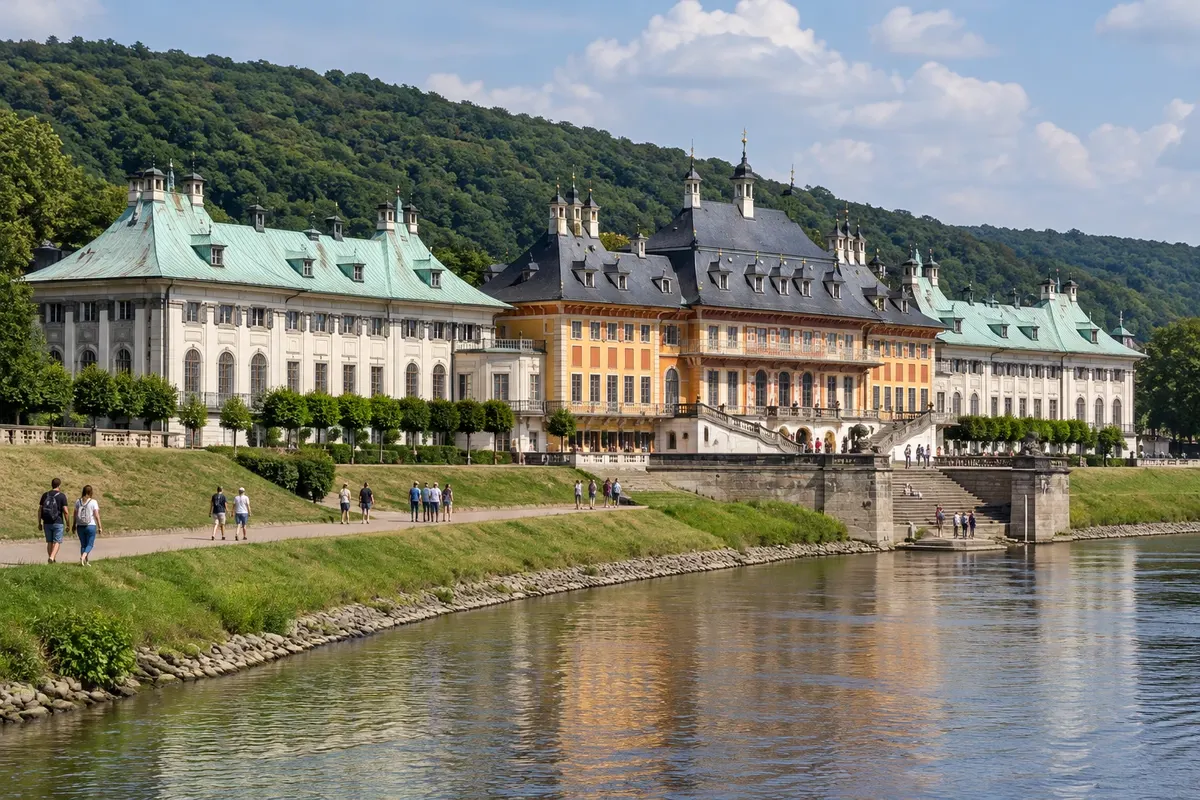
Schloss Pillnitz (Pillnitz Palace) stands on the right bank of the Elbe at the eastern tip of Dresden, between the river and the vineyards. It was the summer residence of the electors and kings of Saxony until 1918. Augustus the Strong commissioned the Wasserpalais (water palace) from 1720 to 1721, facing the river, with the landing staircase of 1725, and the Bergpalais (mountain palace) from 1722 to 1723, both designed by Matthäus Daniel Pöppelmann in a Chinese style, with curved roofs and Asian scenes painted on the eaves. The Neues Palais (new palace), neoclassical, was built between 1819 and 1826 after a fire and connects the two. The park covers 28 hectares, with a baroque garden, an English garden, a Chinese pavilion and the Palmenhaus (palm house), built 1859–1861, with 660 m². The Japanese camellia planted in 1801 by the court gardener is about 8.9 meters tall and 12 meters in diameter and usually flowers from mid-February to April; in cold weather a movable glass greenhouse of 54 tons is rolled over it. Inside the palaces, the Kunstgewerbemuseum (applied arts museum) and the Schlossmuseum display furniture, porcelain and the royal family’s rooms; the museums usually open only in season, from May to October. It was at Pillnitz that, in 1791, Austria and Prussia signed the declaration against the French Revolution.
Kraji na poti: Schloss Pillnitz.
Vključuje: The park charges admission in the main season; the palace museums have separate tickets, and there is a combined ticket. Check the current price list. The bus or tram ride is covered by the Dresden local transport ticket.
Nasvet: Take the bus or tram and return by steam boat, or vice versa, to see the palace from the river as it was meant to be seen. From February to April ask about the camellia in bloom. Bring a snack: there are shaded benches by the river.
Najboljši čas za obisk: From May to October, when the museums are open and the gardens are in bloom. From mid-February to April the camellia usually flowers; check before you go.
Steamship on the Elbe: from the Terrassenufer to Pillnitz with the historic fleet
Odhod: Terrassenufer, quay below the Brühlsche Terrasse Paddle-wheel steamship about 3 hours, round trip Popoldne Lahko
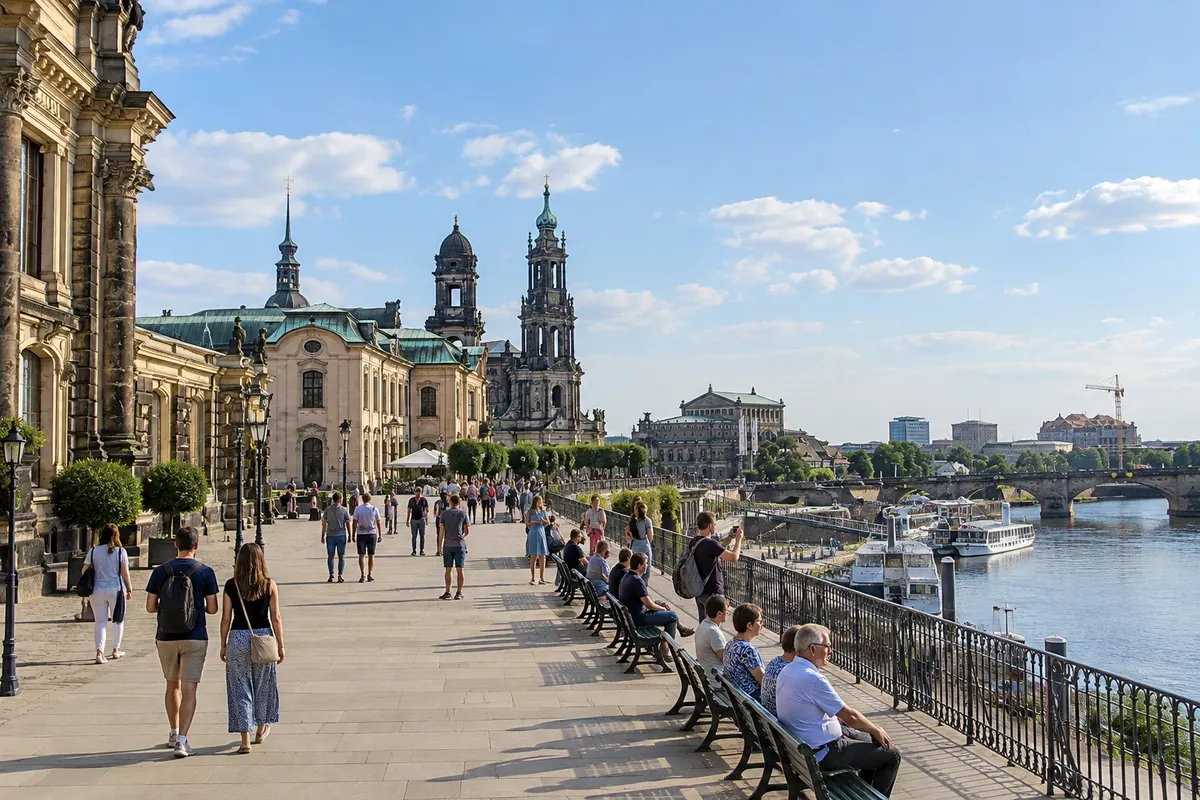
The Sächsische Dampfschiffahrt, known as the Weiße Flotte Sachsen (White Fleet of Saxony), has been operating on the Elbe since 1836 and maintains nine historic paddle-wheel steamers—the oldest and largest fleet of its kind still in operation worldwide. The Stadt Wehlen is the oldest, the Meissen dates from 1885, the Kurort Rathen has sailed since 1896, and the Diesbar still burns coal. Boats depart from the Terrassenufer quays at the foot of the Brühlsche Terrasse. The most popular route is the palaces line, upriver to Pillnitz, with a stop in Blasewitz: the boat passes under the Blaues Wunder (Blue Wonder), the 1893 steel bridge, and in front of the three Elbe castles and the Loschwitz vineyards, arriving at the landing steps of the Wasserpalais in Pillnitz; the full round trip takes up to about 3 hours. You can disembark at Pillnitz, visit the park and return by bus. Other lines go upriver to Saxon Switzerland, passing Pirna, Stadt Wehlen, Kurort Rathen, Königstein and Bad Schandau, and downriver follow the wine route to Radebeul and Meißen. The engine room is open to view on the lower deck, and the upper deck has outdoor benches. In winter there are short trips with a heated steamer and Christmas programs.
Kraji na poti: Brühlsche Terrasse, Schloss Pillnitz.
Vključuje: Ticket paid separately, available at pier 2 of the Terrassenufer or online; check the current timetable. Food and drink on board are paid separately. Urban transport tickets are not valid on the boats.
Nasvet: Arrive half an hour early to get a place on the upper deck, on the river side facing the vineyards (right bank when heading upstream). Prefer one of the historic steamers to the motor boat: ask at the quay which vessel makes the departure. The line to Saxon Switzerland is long; to see the Bastei from the river it’s better to take the short section from Bad Schandau or go by S-Bahn.
Najboljši čas za obisk: The main season typically runs from April to October, with daily departures to Pillnitz; from November to March there are few departures, with a winter boat. Confirm before you go.
Bastei and Basteibrücke: the bridge among the rocks from Kurort Rathen
Odhod: Dresden Hbf, S-Bahn S1 to Kurort Rathen and ferry S-Bahn, ferry and walk about 2 hours 30 minutes of trail Dopoldne moderate (190 m ascent, stairs)
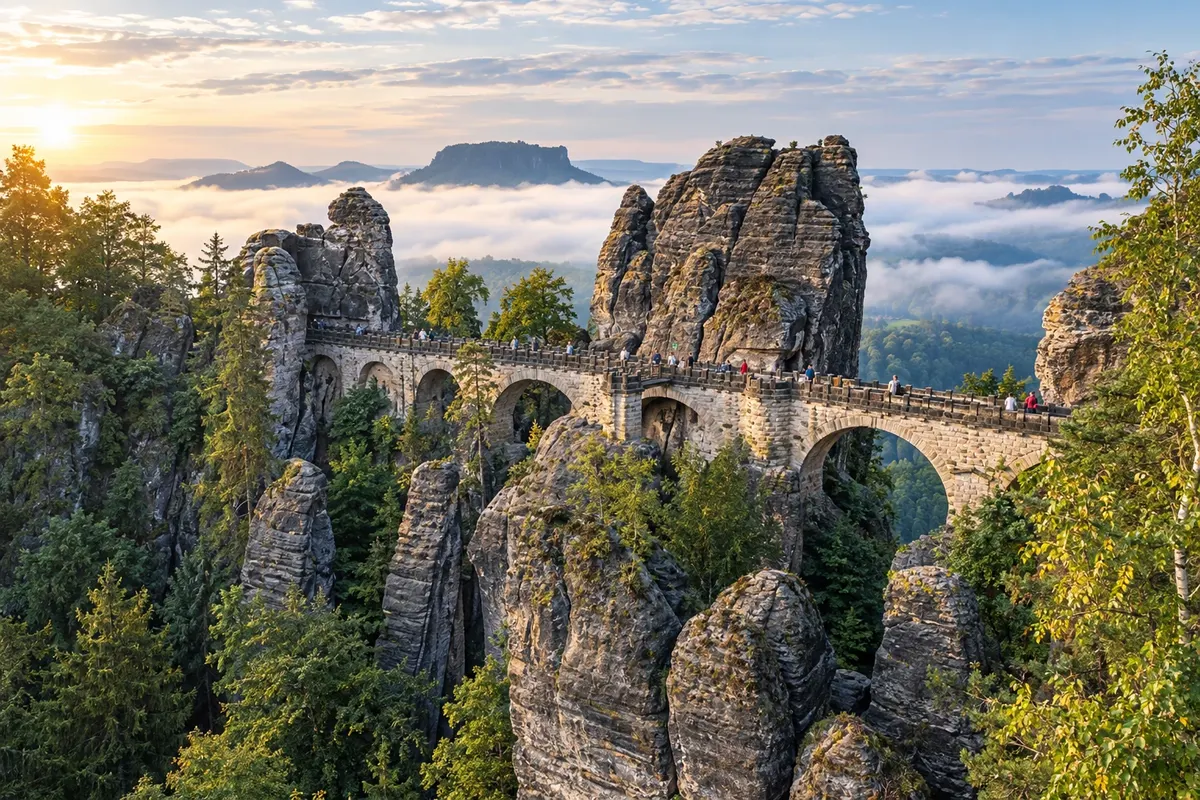
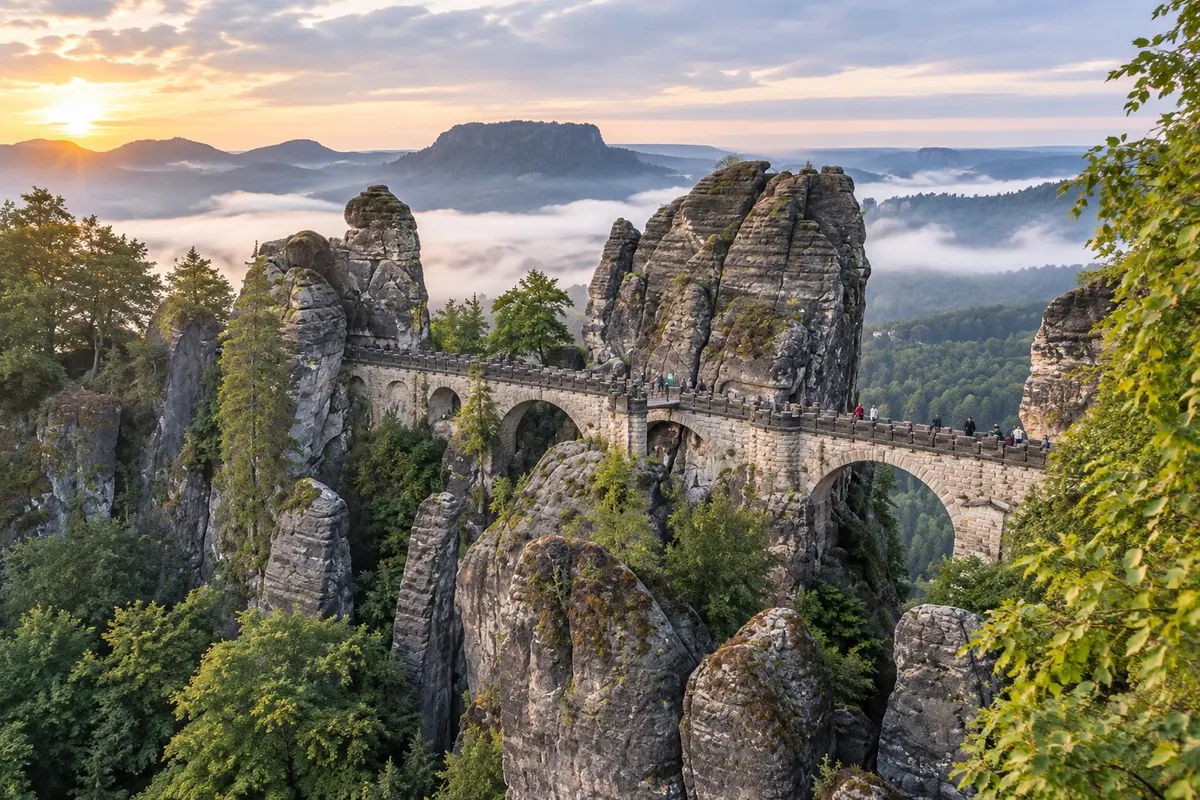
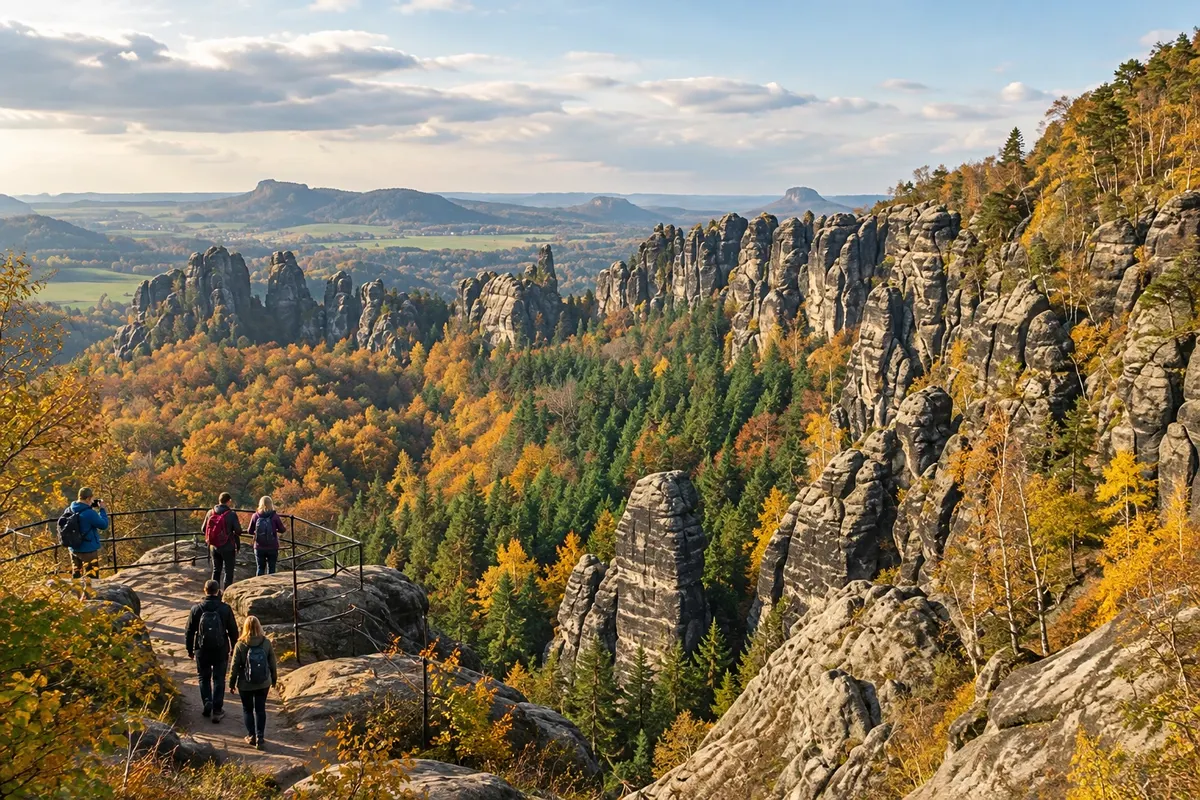
The Bastei is the sandstone tower formation rising above the Elbe near Kurort Rathen, and it is the image that defines the Sächsische Schweiz (Saxon Switzerland). The restaurant at the top sits 194 meters above the river. The Basteibrücke (Bastei Bridge) links the stone needles: the first, wooden bridge was built in 1824; the current sandstone bridge, 76.5 meters long with seven arches, dates from 1851 and has been the park’s most photographed stone bridge ever since. On the far side of the bridge are the ruins of Felsenburg Neurathen, a medieval rock-hewn castle with walkways over the abyss; due to conservation work it can only be seen from outside for now. A new panoramic platform, opened in 2023, projects over the void and gives the classic view of the bridge with the Elbe valley, the 415-meter Lilienstein, and the Festung Königstein in the background. The easiest way to reach it without a car is the S-Bahn S1 from Dresden Hbf to Kurort Rathen (about 35–40 minutes), the cable ferry across the Elbe (paid separately), and the climb of roughly 190 meters of elevation via the trail from the village. The most common circuit, 6.4 km, climbs to the Bastei, passes seven viewpoints and descends via the Schwedenlöcher (Swedes’ Holes), a narrow gorge with about 700 steps and two iron ladders, down to Amselsee and back to Rathen; it takes about 2 hours 30 minutes. Those who prefer to avoid stairs can return the same way they came.
Kraji na poti: Bastei.
Vključuje: The trail, bridge and viewing platform are open and there is no entrance fee. The Rathen ferry is paid separately, in cash, and is not included in the public transport ticket. Restaurant and toilets at the top. There are buses from Pirna (line 237) and paid parking on the plateau, with shuttle buses from April to October.
Nasvet: Take the first S-Bahn of the morning: after 10 a.m. the bridge becomes crowded, especially on weekends from May to October. Wear boots or sneakers with a firm sole; the descent through the Schwedenlöcher is slippery when wet. Bring water—there is little for sale along the route. Return to Dresden to sleep or continue on the S1 to Bad Schandau.
Najboljši čas za obisk: From April to October, when days are long. In autumn, from mid-September to October, the beeches turn yellow. In winter the trail often has ice on the steps; check conditions before you go.
Festung Königstein: the fortress atop the sandstone plateau
Odhod: Dresden Hbf, S-Bahn S1 to Königstein (Sächs Schw) S‑Bahn, then a connecting bus or a walk uphill about 3 hours at the fortress Ves dan easy to moderate (stairs or elevator)
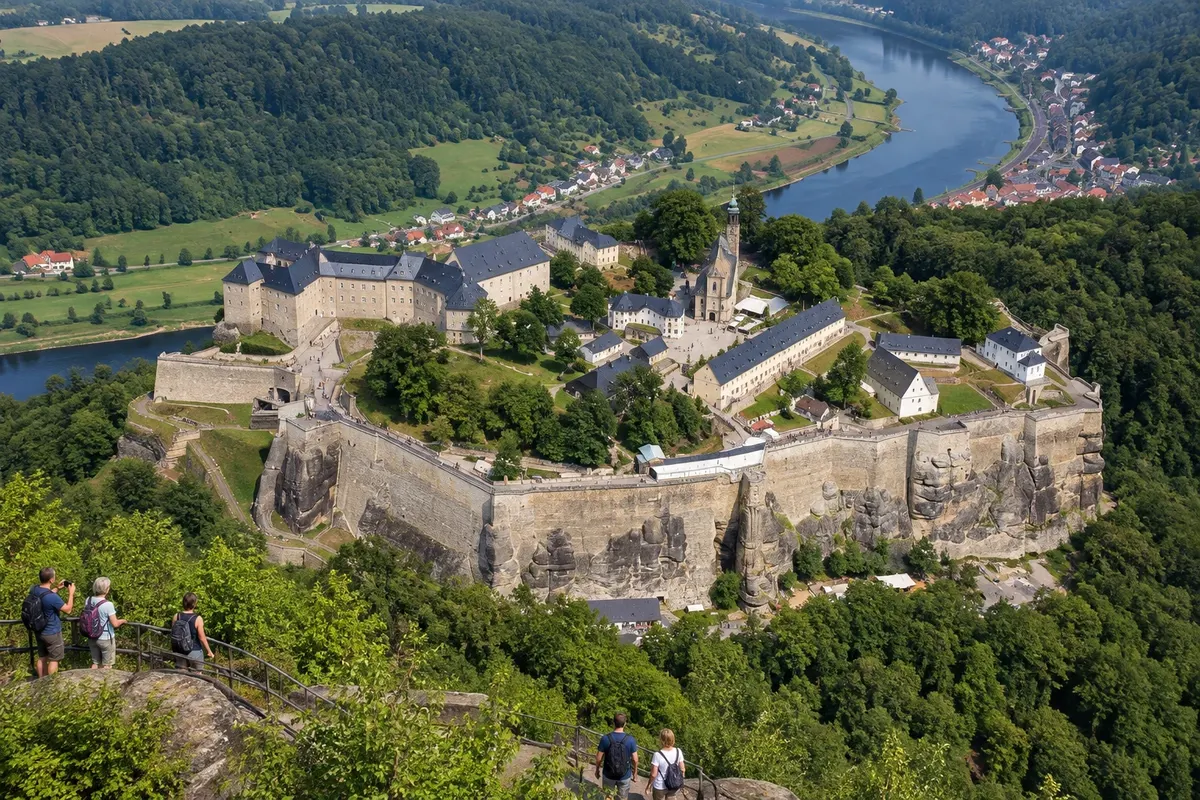
Festung Königstein sits on the top of a sandstone plateau rising 240 meters above the Elbe, near the town of Königstein. The rock is mentioned in documents from 1241, and the fortress as seen today began construction in 1589 under Elector Christian I; it was never taken. The plateau covers 9.5 hectares and contains more than 50 buildings, surrounded by walls up to 42 meters high, with a curtain walk of roughly 1.8 km that circles the site and shows the Elbe valley, the Lilienstein and the sandstone mesas up to the Czech border. The well, dug into the rock between 1563 and 1569, is 152.5 meters deep, the deepest in Saxony, and is operated during demonstrations. The fortress served as a court refuge, a wartime treasury depot and a state prison: Johann Friedrich Böttger, the alchemist who helped discover European porcelain, was imprisoned here between 1706 and 1707, and the Russian anarchist Bakunin in 1849 and 1850. Since 1955 it has been a museum, with the permanent exhibition In Lapide Regis in 33 rooms covering eight centuries of history, plus the Magdalenenburg, the barracks, the garrison church and the cellar that housed a giant barrel. A panoramic elevator rises along the wall from the foot. The S1 runs from Dresden Hbf to Königstein station in about 40 minutes; from there the Festungsexpress bus or a 25-minute walk takes you up. Open every day of the year.
Kraji na poti: Festung Königstein.
Vključuje: Separate paid ticket required, giving access to the plateau, exhibitions, and the elevator; check the current price list. The Festungsexpress from the station is paid separately. Restaurants and snack bars are located inside the fortress.
Nasvet: Allow 2–3 hours; the circuit walk is worth the time. Go early and only combine with the Bastei the same day if you’re prepared to walk a lot—the two are three S‑Bahn stops apart. On Advent weekends the fortress usually hosts Christmas markets in the courtyards; check before you go.
Najboljši čas za obisk: Open year-round, daily. From April to October the hours are longer; in winter valley fog can obscure the view.
Schrammsteine: the rock ridge via the Wildschützensteig
Odhod: Bad Schandau, Kurpark Ostrau (bus 252) Trail with iron stairs about 3 hours 30 minutes Dopoldne difficult (stairs, requires sure footing)
The Schrammsteine are the cleft sandstone rock chain that stretches east of Bad Schandau, within the Nationalpark Sächsische Schweiz (Saxon Switzerland National Park), established in 1990 and covering 93.5 km². The Schrammsteinaussicht, the viewpoint at the top, sits at about 417 meters altitude and looks over the Elbe valley, the Falkenstein, the Lilienstein, the Affensteine and the Großer Winterberg, the park's highest point at 556 meters. The classic route is the Wildschützensteig (poachers' path), a sequence of iron stairs, wooden walkways and handrails that climbs through narrow fissures between the walls; it is ascent-only, and the descent is made via the Jägersteig or another marked path. The circuit starting from Kurpark Ostrau, the upper district of Bad Schandau, is 9.1 km and takes about 3 hours 30 minutes, with roughly 310 meters of ascent, returning via Mittelwinkel, Schießgrund and Zschiehädelweg; those who get off the bus at the Schrammsteinbaude stop shorten it to about 5 km. On the top, the Gratweg (ridge way) follows the tops of the rocks, with carved steps and exposed sections. The park asks visitors to stay on marked trails, not to light fires and not to climb on wet rock; it is the birthplace of free climbing on sandstone, governed by rules dating from the early 20th century.
Kraji na poti: Schrammsteine.
Vključuje: The national park trails are open and there is no admission charge. Bus 252 from Bad Schandau to Ostrau is included in the regional ticket. There are no toilets or food on the route, except at the Schrammsteinbaude at the trailhead.
Nasvet: Do not attempt it in rain, ice or strong wind: the stairs become slippery. It is not a route for those afraid of heights or for dogs. Carry 1.5 liters of water per person, snacks and a downloaded map; cell signal fails in the gaps. Start early to have shade on the climb.
Najboljši čas za obisk: From May to October, with dry rock. In July and August afternoon downpours are common; from November to March there is ice on the steps and the trail is only for experienced hikers.
Kirnitzschtalbahn, Lichtenhainer Wasserfall and the Kuhstall cavern
Odhod: Bad Schandau, Kurpark stop Historic tram and walk Približno 4 ure Dopoldne ali popoldne moderate (45 min ascent to the Kuhstall)
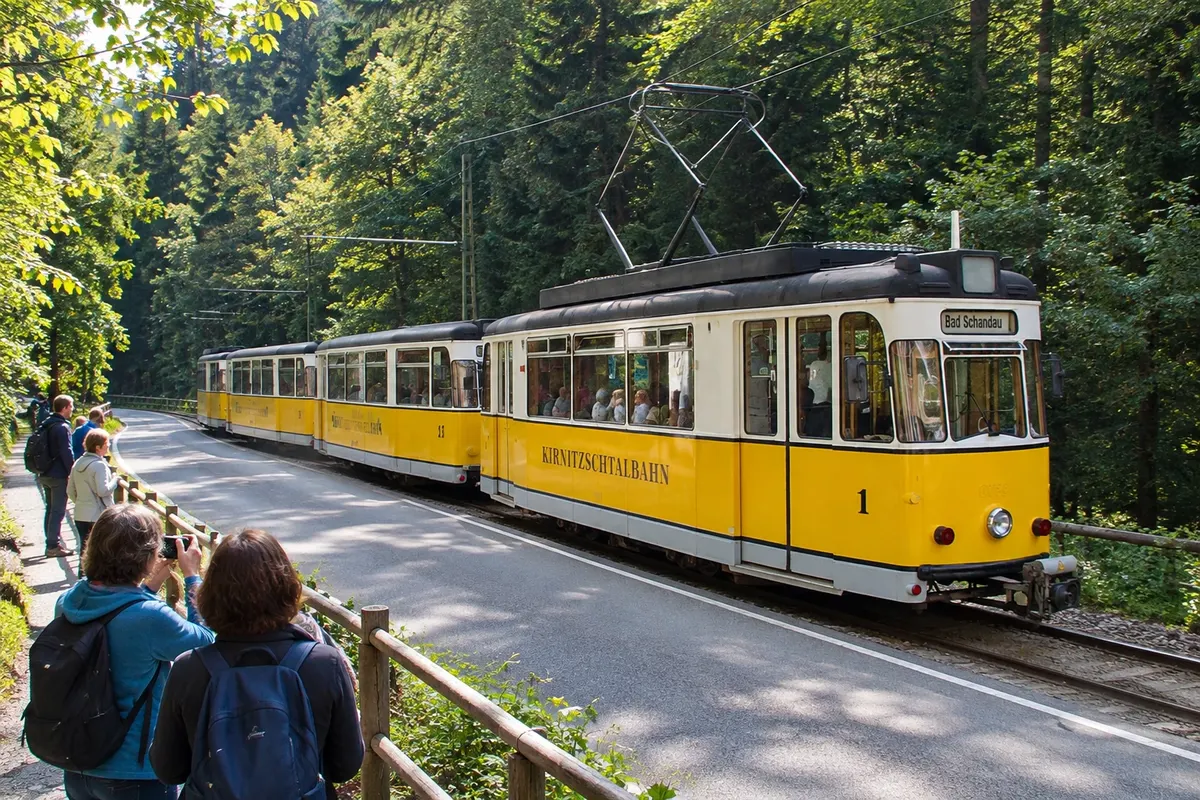
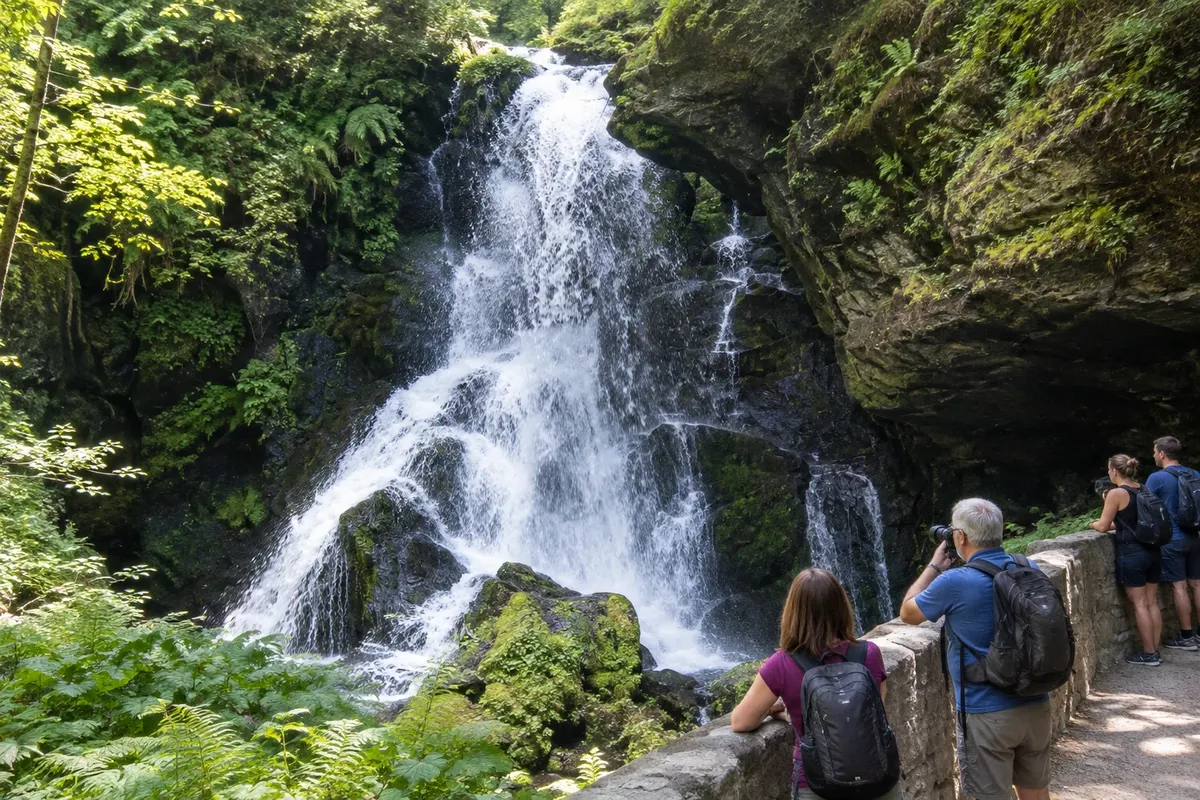
The Kirnitzschtalbahn is the tram that climbs the Kirnitzsch stream valley since 1898, from Bad Schandau to the Lichtenhainer Wasserfall, over 8 km of single track inside the national park. The yellow, historic cars depart from the Kurpark in central Bad Schandau and stop nine times along the valley; each stop has a trail; about 30 percent of the energy comes from solar panels at the depot. In summer departures are typically every 30 minutes, in winter every 70; on the holidays of May 1, Pentecost, October 3 and at the valley festival even older cars run, including one from 1928. The terminus is the Lichtenhainer Wasserfall, a small fall that for about 200 years has been dammed and released at intervals for the public, a tradition started when the innkeeper, whose inn opened in 1853, charged to open the sluice; today the waterfall and the inn next to it, with a beer garden, are 3 minutes from the stop. From there you climb in about 45 minutes to the Kuhstall (cow stable), the park’s largest rock arch, 11 meters high, 17 meters wide and 24 meters deep, opened in the Neuer Wildenstein plateau; the name comes from cattle that hid there during the Thirty Years’ War. Via the Himmelsleiter (stairway to heaven), a narrow iron ladder set in a fissure, you reach the top of the rock and a view of the Bärenfang walls. Return by the same way and the tram, or on foot through the valley.
Kraji na poti: Kirnitzschtalbahn, Lichtenhainer Wasserfall.
Vključuje: Tram fare is paid separately, in cash on board, with its own tariff; the Deutschlandticket and the regional guest card are accepted. Check the current fare table. The waterfall, trail and Kuhstall are open and there is no admission charge.
Nasvet: Sit on the creek side. The waterfall’s release follows a daily schedule; ask at the inn. At the Kuhstall, the Himmelsleiter is narrow and one-way in sections: avoid it with small children and on busy days. The trams get crowded on summer weekend afternoons; aim for the morning.
Najboljši čas za obisk: From April to October, departures every half hour and the waterfall operating. From November to March the tram runs a reduced schedule; confirm before you go.
Bad Schandau: the 1904 elevator, Ostrau and the national park center
Odhod: Bad Schandau, Elbufer (center) Historic elevator and short walk Približno 2 uri late afternoon Lahko
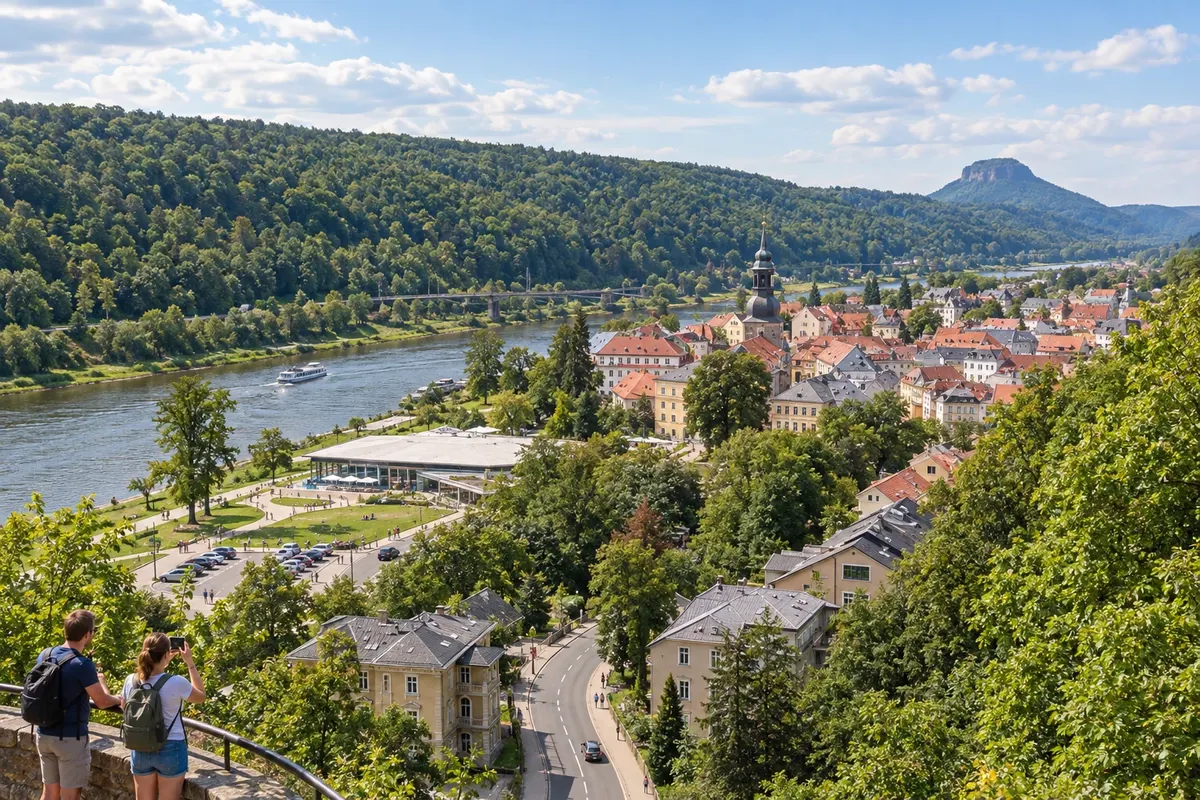
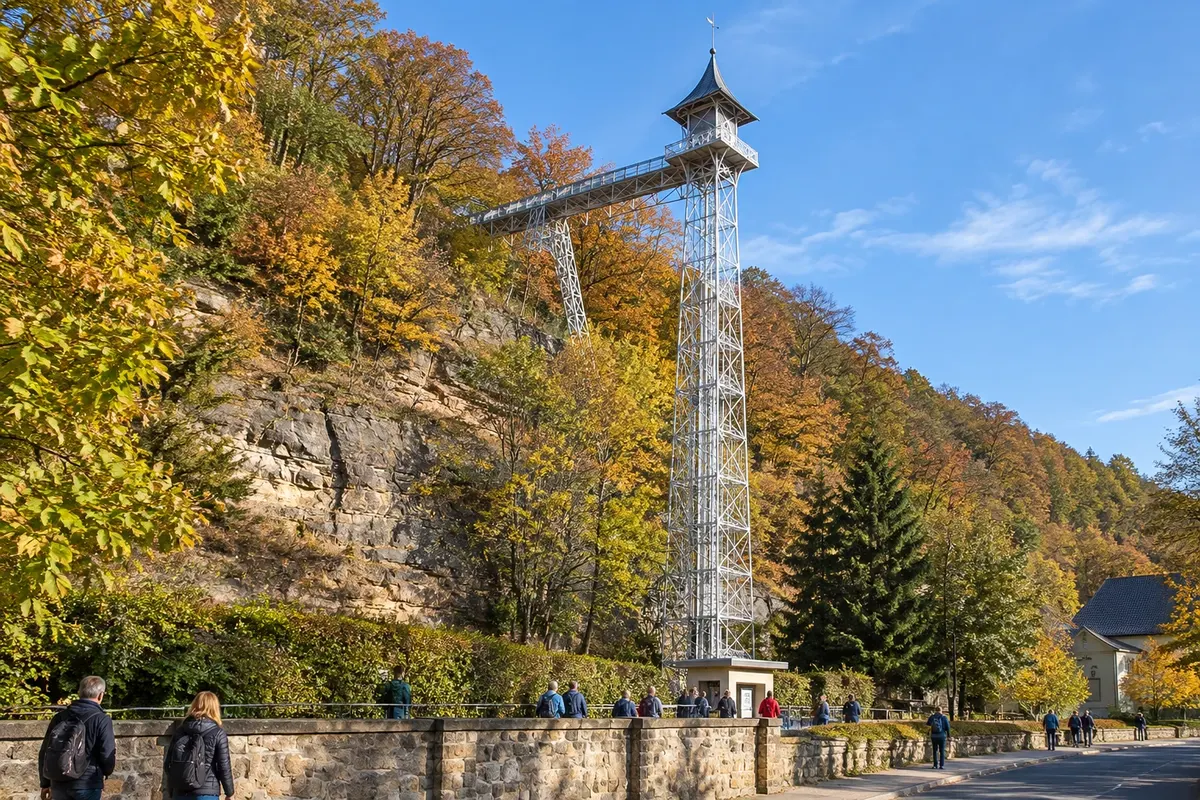
Bad Schandau is the base town for Saxon Switzerland, on the right bank of the Elbe, about 45 minutes by S-Bahn from Dresden Hbf and close to the Czech border. The station is on the opposite bank; buses and a ferry link to the center, where the market square, the Kurpark and the Kirnitzschtalbahn departure are located. On the riverbank, the Historischer Personenaufzug (historic passenger elevator) has operated since 1904: a 52-meter steel tower in Jugendstil (art nouveau) style, listed as a technical monument, with a glazed cabin that rises in less than a minute. At the top a 28-meter walkway crosses to the hillside and leads to the Ostrau district on the plateau, with holiday homes, views over the Elbe valley and the sandstone tablelands, and the starting point for the Schrammsteine trails. In Ostrau there is an easy forest path to the district Kurpark. Back in the center, the NationalparkZentrum, the park visitor center, explains sandstone formation, wildlife and park rules in its exhibits, and helps choose trails depending on the weather. The walk along the Elbufer, the avenue beside the river, shows the paddle steamers mooring at the quay and, in the late afternoon, the light on the walls of the Lilienstein.
Kraji na poti: Historischer Personenaufzug Bad Schandau.
Vključuje: Elevator ticket paid separately, per section or round trip; discount with the region’s guest card. National park center has its own admission. Check current timetables. Streets, the footbridge and the Elbufer are open.
Nasvet: Use the elevator to go up and return on foot via Ostrau, descending along the trail, so you do not pay for both sections. From May to September the elevator commonly runs until early evening, good for watching the sunset from above. If you sleep in Dresden you can fit this walk at the end of the day after visiting the Schrammsteine.
Najboljši čas za obisk: All year. From May to September the elevator runs longer hours; in winter it closes in the late afternoon. Confirm before you go.
Malerweg between Stadt Wehlen and Kurort Rathen: the painters’ section to the Bastei
Odhod: Dresden Hbf, S-Bahn S1 to Stadt Wehlen S-Bahn, ferry and trail Približno 2 uri hoje Dopoldne ali popoldne moderate (many stairs)
The Malerweg (painters’ way) is the 116 km long-distance trail that starts in Pirna, follows the Elbe up to Schmilka and returns on the other bank in eight stages, through the places Caspar David Friedrich and other Romantic painters depicted in the 19th century. The section between Stadt Wehlen and Kurort Rathen is the easiest part to fit into a short trip and covers the Bastei by a route different from the usual one. Get off the S1 at Stadt Wehlen, about 30 minutes from Dresden Hbf, and cross by ferry to the right bank, where the village square is. The trail climbs via the Schwarzbergweg, with stone steps, to the Steinerner Tisch (stone table), a 1710 sandstone table where the court of Augustus the Strong held hunting picnics, and continues among the rocks to the Basteibrücke, with viewpoints over the Elbe. Then it descends by steps to Kurort Rathen, a car-free village on the right bank, and ends at the cable ferry to the station. It is 5.8 km and about 2 hours, with roughly 250 meters of ascent, on a route suitable for children used to walking. In Rathen there is the Amselsee, a dammed lake with rowboats, and the open-air theatre Felsenbühne, set into the rocks, which usually runs from May to September. Malerweg markers are a white M on a green background; on the descent from the Bastei follow the blue markers, because the Malerweg splits toward the Amselgrund.
Kraji na poti: Bastei.
Vključuje: Trail is open and free. Ferries at Stadt Wehlen and Kurort Rathen are paid separately, in cash. Restaurant and restrooms at the Bastei; in Rathen, riverside cafés. The S1 is included on the regional ticket and the Deutschlandticket.
Nasvet: Do it from Wehlen toward Rathen: the approach to the bridge through the woods is prettier and the stair descent ends at the ferry. Avoid going by car; Rathen has no visitor access. In Stadt Wehlen buy bread and fruit at the village square before you go up.
Najboljši čas za obisk: From April to October. Autumn afternoons, until mid-October, have low light over the rocks; the Felsenbühne usually has performances from May to September, check before you go.
Dresdner Striezelmarkt: the Altmarkt Christmas market in December
Odhod: Altmarkt (trams 1, 2, 4) Walk through the market Približno 2 uri late afternoon and evening Lahko
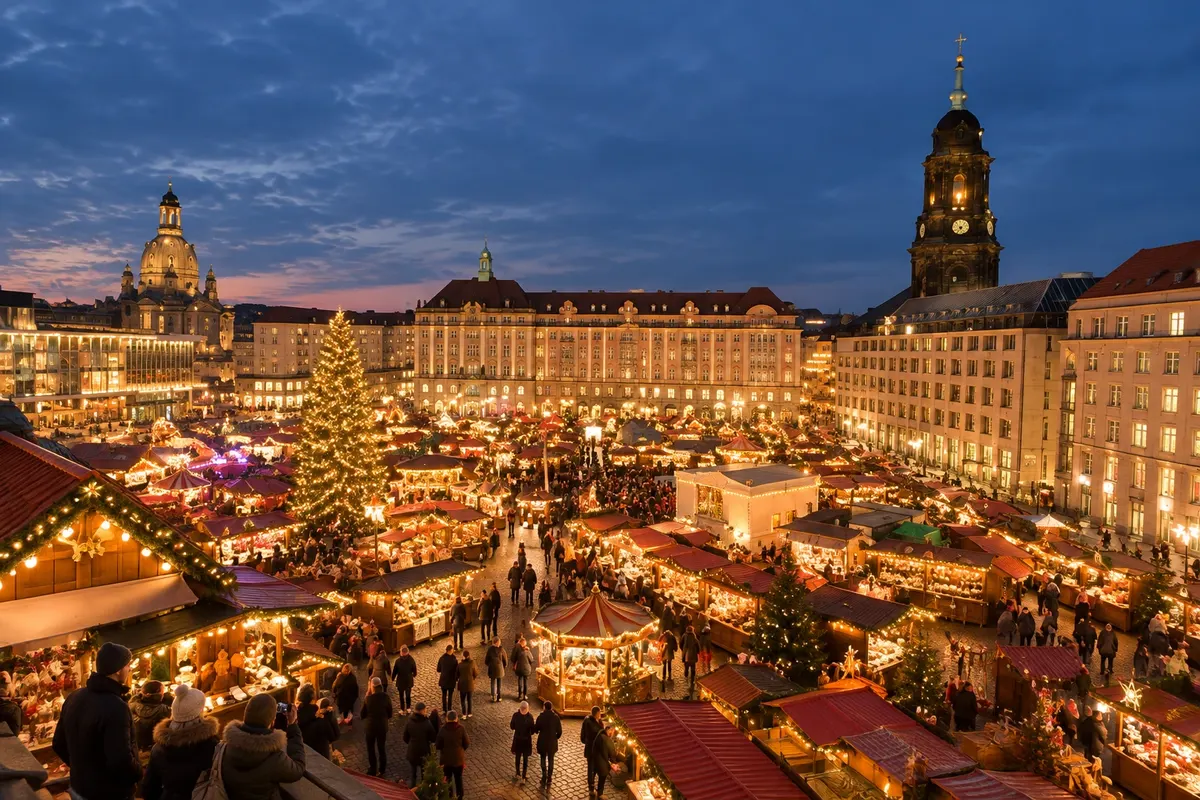
The Striezelmarkt is Dresden’s Christmas market, the oldest recorded in Germany: it began in 1434, by license of Elector Frederick II, as a one‑day market on the Monday before Christmas at the Altmarkt. The name comes from Strüzel, the old name for Stollen, the rich Christmas fruit cake with butter that is Dresden’s specialty; the city holds its own Stollen festival on an Advent Saturday, with a giant cake carried in procession to the square. The market fills the Altmarkt, opposite the Kulturpalast and the Kreuzkirche, with more than 200 wooden stalls, a 14.6‑meter Erzgebirge (Ore Mountains) Christmas pyramid—the largest of its kind—a house‑sized Advent calendar and a wooden candle arch that serves as a gate. Wood toys and nutcrackers from the Ore Mountains, decorations, Stollen, gingerbread and the season’s hot drinks are sold. In 2026 the season runs from November 25 to December 24, with early closing on Christmas Eve; subsequent years usually follow the same schedule, from late November to the 24th. At the same time, the Neumarkt, the Stallhof, Prager Straße and Hauptstraße host other markets, each with its own style, and shops stay open later.
Kraji na poti: Dresdner Striezelmarkt, Kreuzkirche.
Vključuje: Market entry is free. Food, drink and purchases are paid separately; the cup for hot drinks is charged as a deposit and refunded when returned. Check the dates for each year.
Nasvet: Go on a weekday late in the afternoon, when the lights come on and the stalls are not yet crowded; Advent weekends have queues to enter the square. Bring gloves and closed shoes, the stone pavement gets very cold. Try the Stollen at a city bakery, where it is cheaper than at the market.
Najboljši čas za obisk: Only from late November to December 24, the Advent season; crowds are usually smaller Monday–Thursday and in the early days.


 Brazilija
 Antarktika
 Argentina
 Bolivija
 Čile
 Kolumbija
 Ekvator
 Gvajana
 Francoska Gvajana
 Falklandski otoki (Malvini)
 Paragvaj
 Peru
 Surinam
 Urugvaj
 Venezuela
 Avstrija
 Belgija
 Hrvaška
 Danska
 Slovaška
 Slovenija
 Španija
 Finska
 Francija
 Grčija
 Nizozemska
 Madžarska
 Irska
 Islandija
 Italija
 Luksemburg
 Norveška
 Poljska
 Portugalska
 Združeno kraljestvo
 Češka
 Švedska
 Švica
 Turčija
 Bermudi
 Kanada
 Združene države Amerike
 Grenlandija
 Mehika
 Sveta Peter in Mihael
 Dominikanska republika
 Japonska
 Južnoafriška republika
 Egipt
 Avstralija
 Fidži
 Nova Zelandija
 Papua Nova Gvineja