Ghent

East Flanders · Belgija

Ghent

University city in Flandres, with the Van Eyck altarpiece, a medieval castle surrounded by water and lively quays along the river Leie.

Flanders

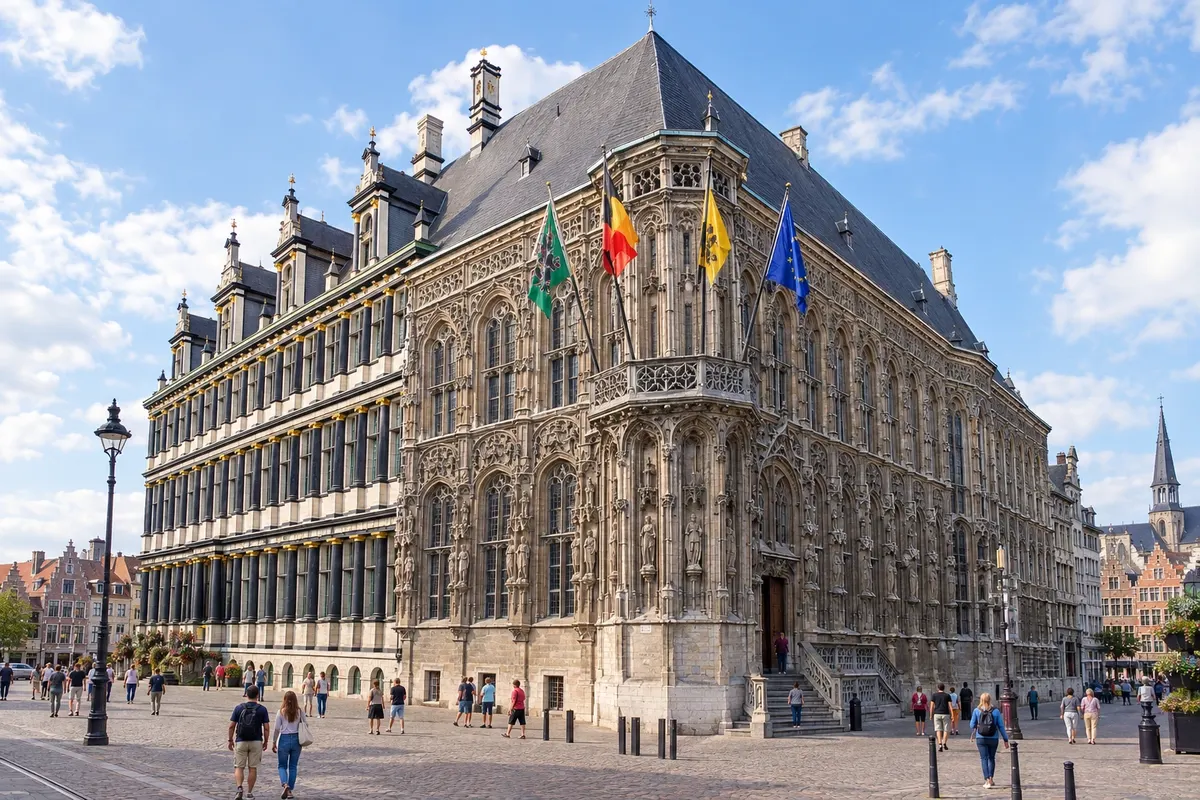
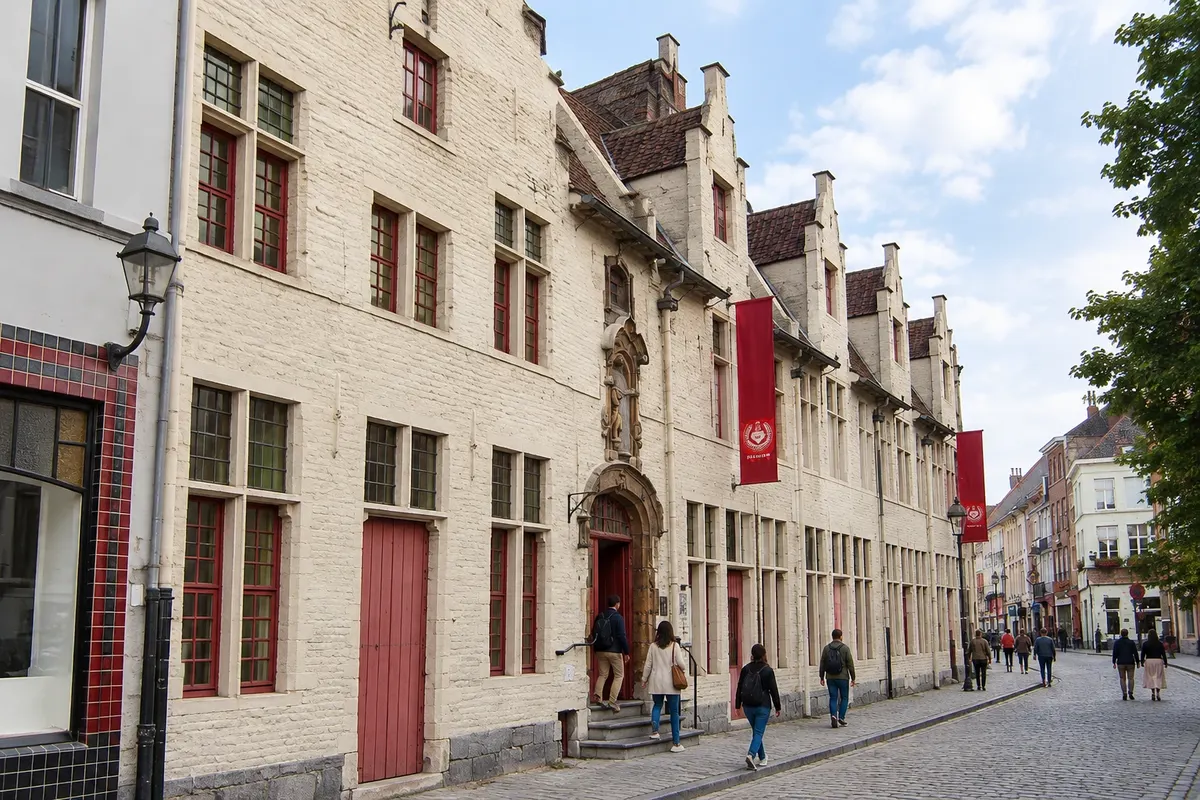
Na fotografiji: Stadhuis de Gante

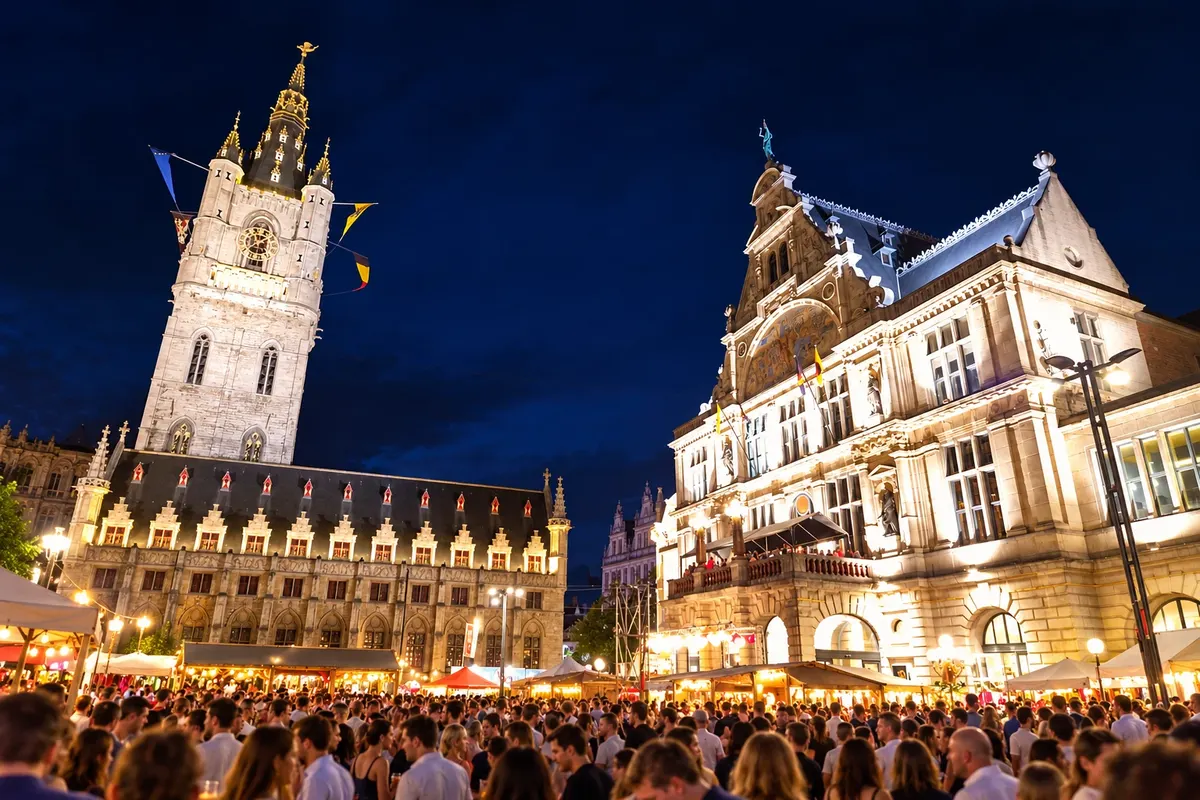
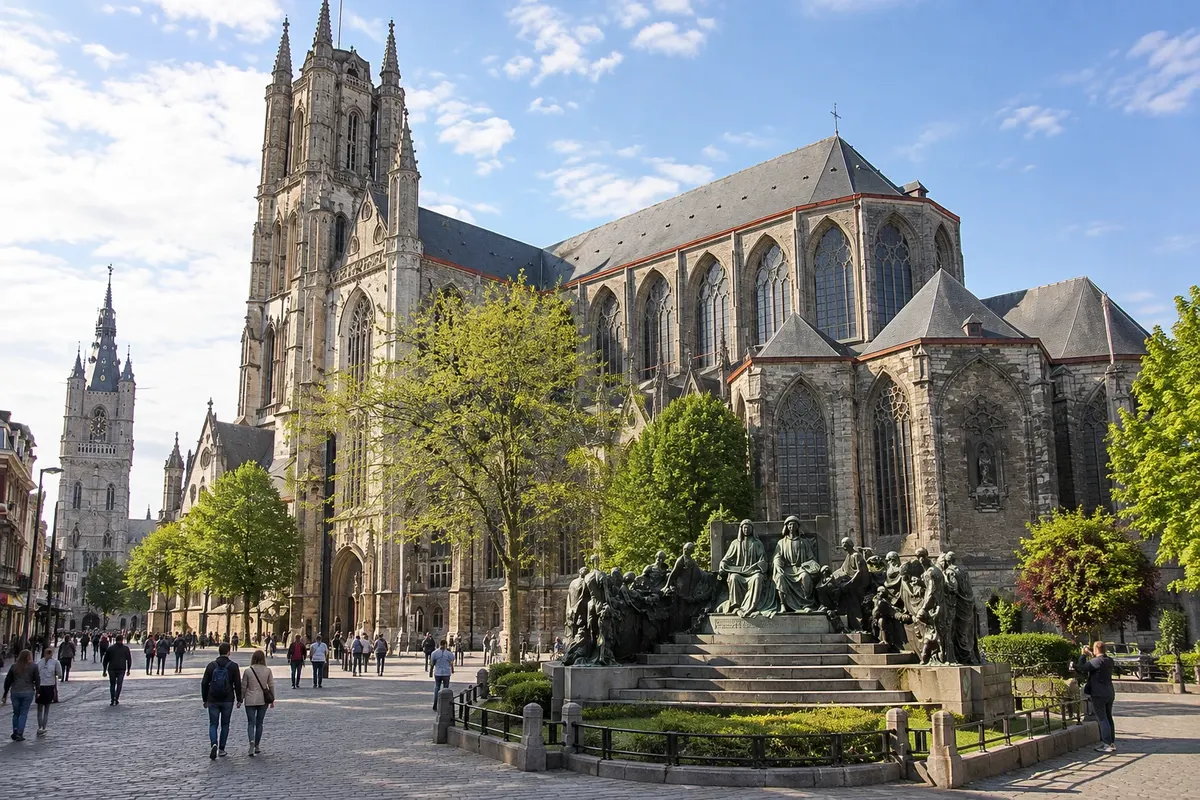
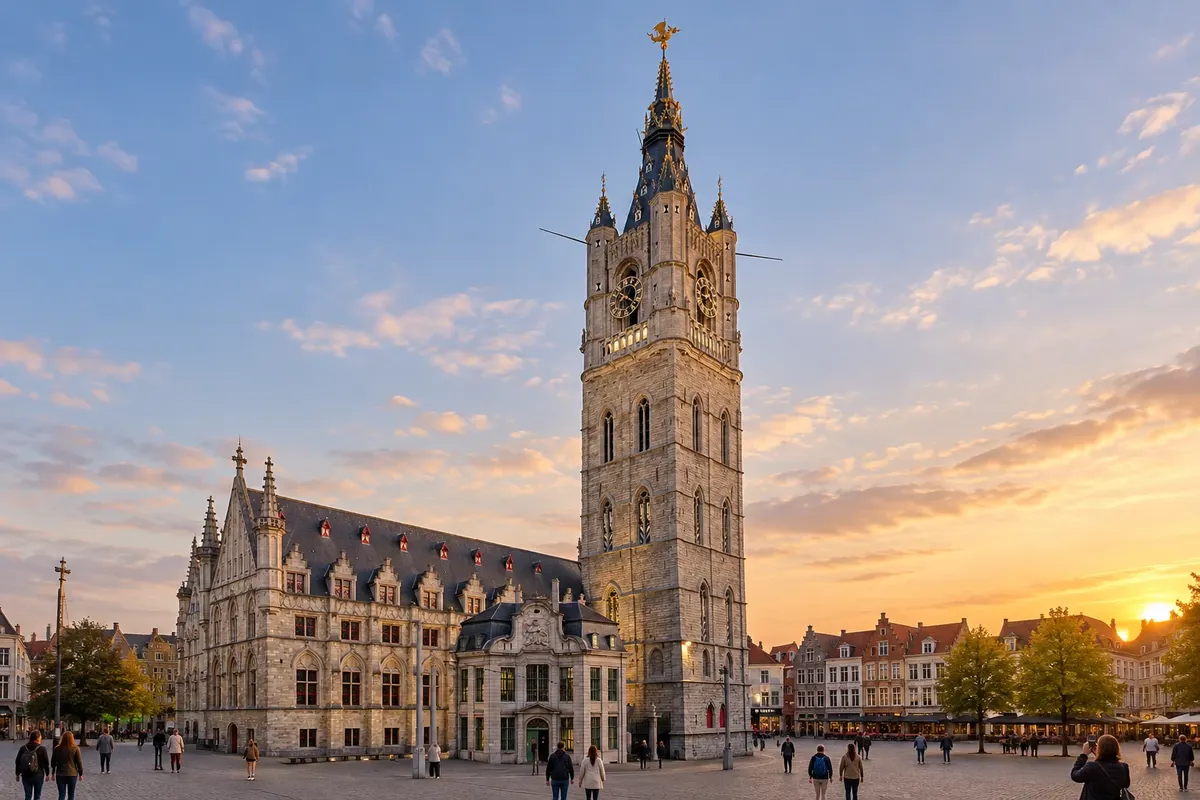
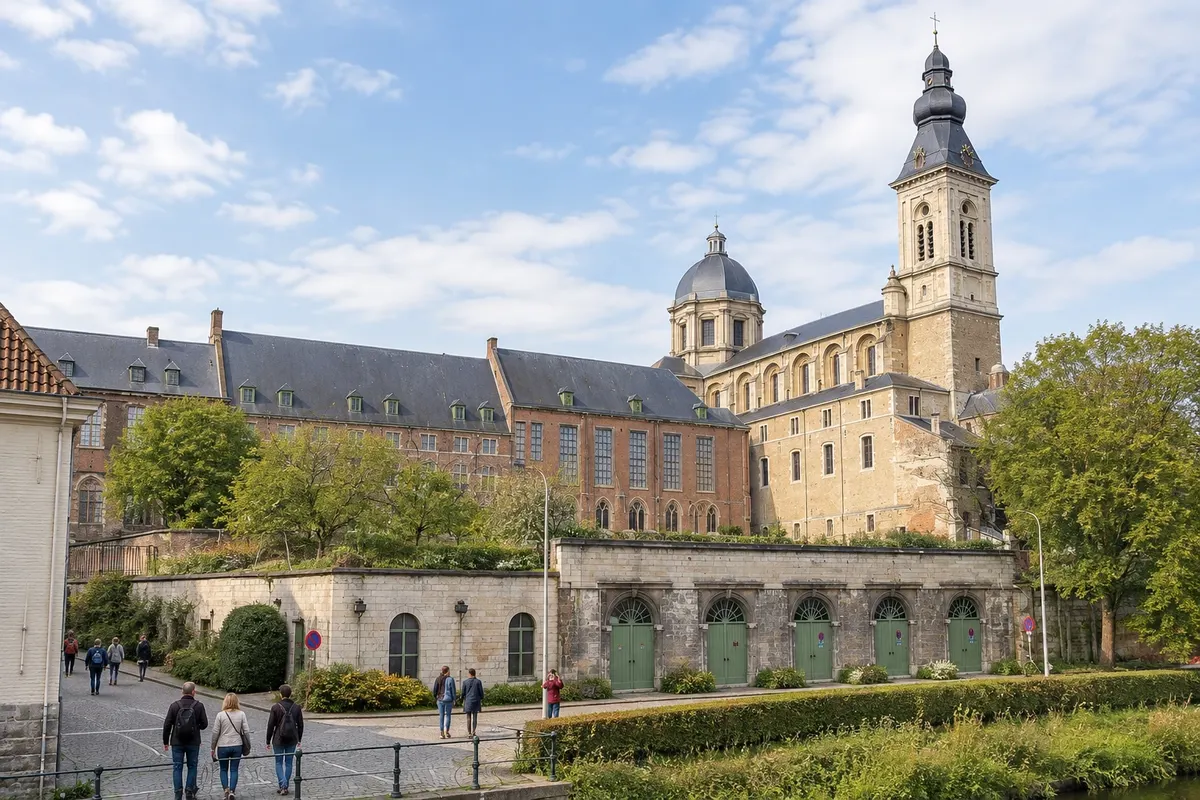
Illustrative images. The pictures in this guide are illustrations based on the real place, not photographs, and may differ from it.

Na voljo v trgovini Google Play Pošljite svoje fotografije

Spoznajte kraj

Pokrajina, ki jo doživite
v svojem ritmu.

Gante is in Flandres, the northern region of Belgium, where Flemish is spoken, the Dutch spoken in Belgium. It is the capital of the province of East Flanders and lies at the meeting of the Leie and Escalda rivers, about half an hour by train from Bruxelas. With over 260,000 residents and a large university, it blends a medieval center with student-city life.

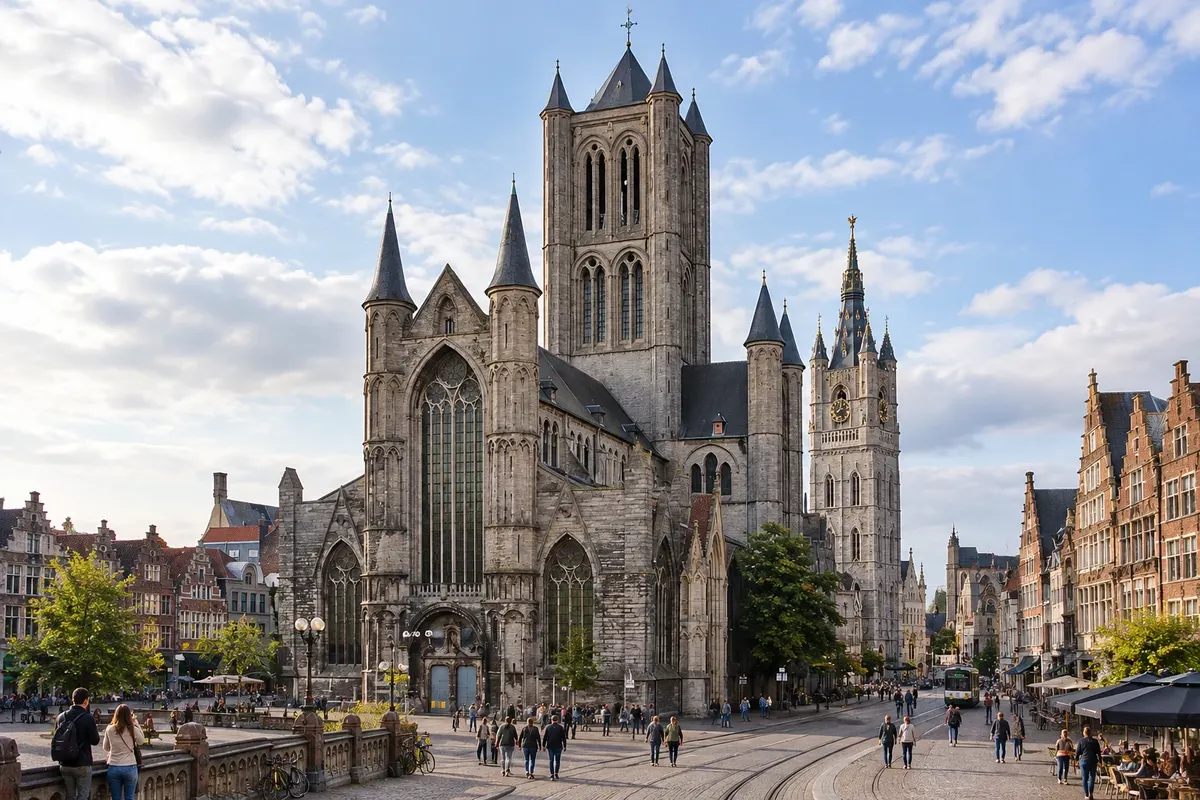
In the Middle Ages, Gante was one of the richest cities in northern Europe thanks to the trade in wool and textiles. From that era remain three towers that dominate the city's skyline: the Sint-Niklaaskerk, the Belfort and the Sint-Baafskathedraal. In the cathedral is the altarpiece The Adoration of the Mystic Lamb, painted by the Van Eyck brothers and completed in 1432.

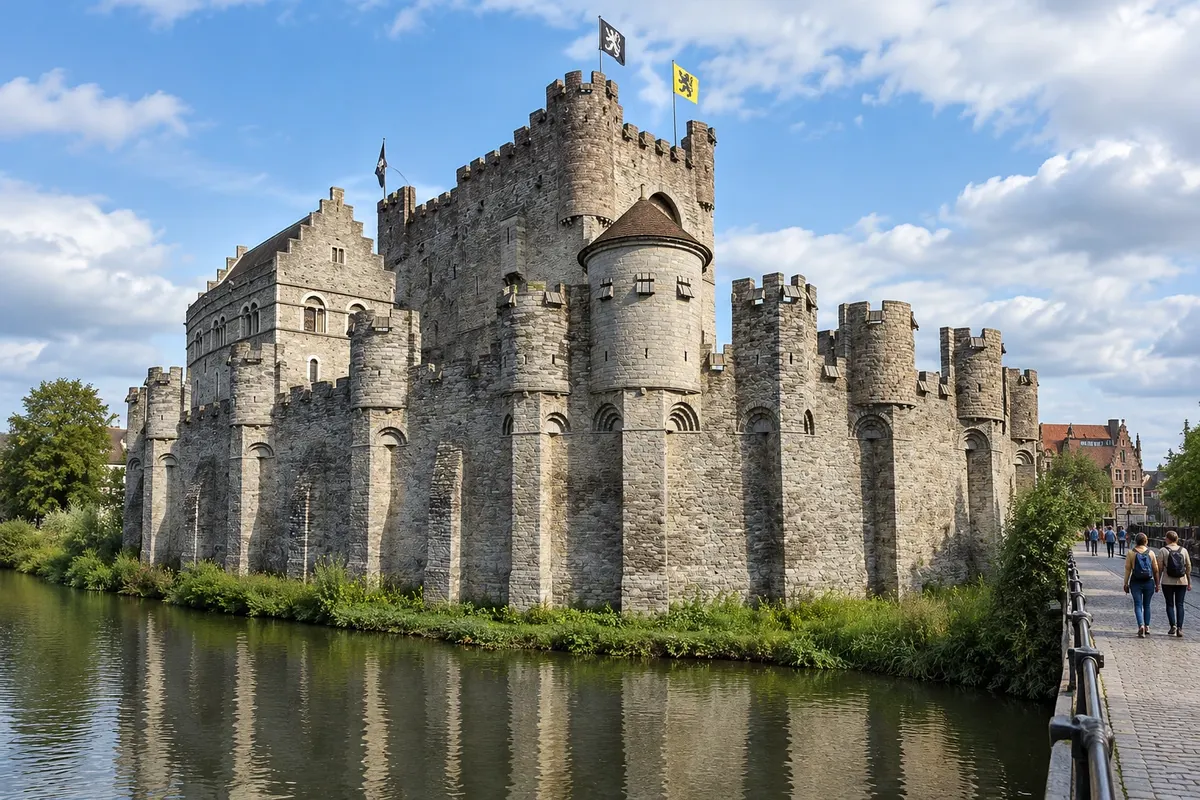
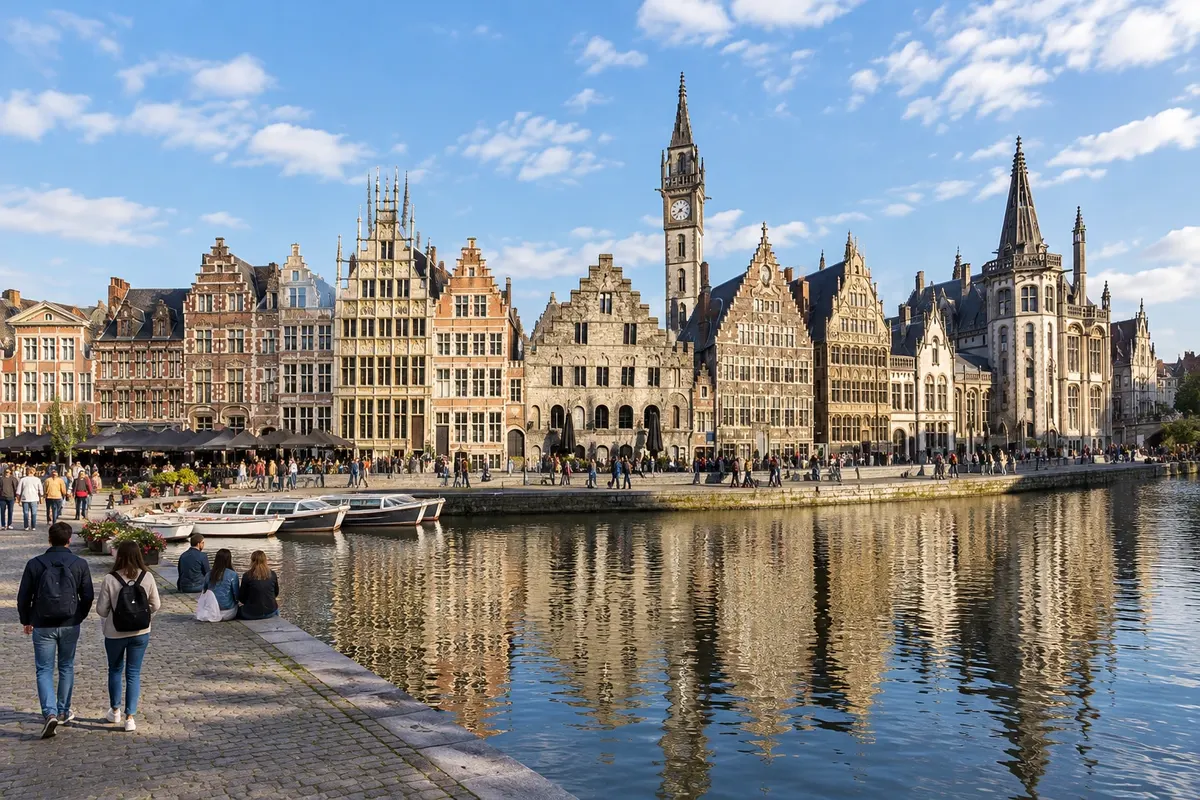
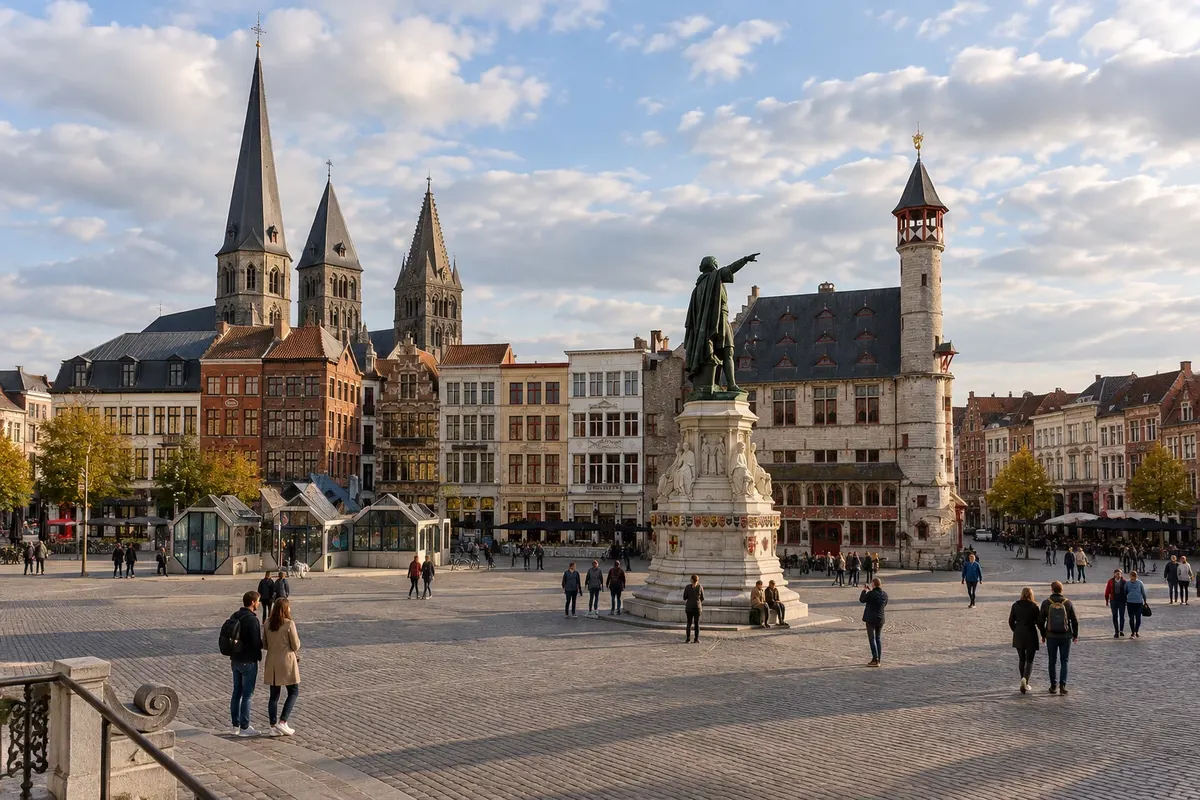
Nearby, the Gravensteen, the Castle of the Counts of Flandres, raises its walls above a moat. The Graslei and Korenlei quays, of the old port, gather guild houses and riverside tables, and passenger boats depart from there. Behind the castle, the Patershol concentrates restaurants in stone lanes, and the Vrijdagmarkt holds the statue of Jacob van Artevelde.

For art lovers, the Museum voor Schone Kunsten, in the Citadelpark, has Bosch, Rubens and Ensor. Gante is a good base for exploring Flandres by train: Bruges, Bruxelas and Antuérpia are less than an hour away.

Delite: WhatsApp

Kje prenočiti

V vodniku še ni nastanitev – Ghent.

Kje jesti

V vodniku še ni restavracij – Ghent.

Poznate dobro možnost? Priporočite nam jo

Vaše potovanje

kako do tja · koliko dni · načrt poti · vprašanja

Delite svoja popotniška doživetja s fotografijami Pošljite fotografije vsakega kraja, ki ste ga obiskali. Največje število fotografij na kraj: 5.

Kako do tja:Ghent

Confirm before booking. From Bruxelas airport there is a direct train to Gent-Sint-Pieters station. From Bruxelas, the train journey takes about half an hour.

Praznovanja in dogodki

Praznovanja – vGhent

Datumi se vsako leto spreminjajo. Pred potovanjem preverite letošnji datum.

Koledar praznovanj – in Belgija

Doživite kraj

Kaj početi – Ghent

Saint Bavo's Cathedral
Ghent · East Flanders · Cerkev

Saint Bavo's Cathedral

Gothic cathedral of Gante, where the altarpiece The Adoration of the Mystic Lamb by the Van Eyck brothers, completed in 1432, is displayed. It also houses a painting by Rubens and a rococo pulpit in oak and marble.

Ghent Belfry
Ghent · East Flanders · Monument

Ghent Belfry

Medieval tower of 91 metres in the middle of Gante's center, with a golden dragon on top and a carillon of 53 bells. It is a UNESCO World Heritage site and offers views over the city's roofs and towers.

Gravensteen
Ghent · East Flanders · Grad

Gravensteen

Castle of the Counts of Flanders, from 1180, surrounded by a moat fed by the river Leie. The visit goes through the keep, the courtroom halls, a collection of torture instruments and reaches the ramparts.

Graslei and Korenlei
Ghent · East Flanders · Canal

Graslei and Korenlei

The two quays of Ghent's old medieval port, opposite each other on the river Leie, with guild houses, stepped gables and tables along the water. Many pleasure boats depart from there.

Ghent – prikaži dodatne kraje (8)
Saint Nicholas Church (Sint-Niklaaskerk)
Ghent · East Flanders · Cerkev

Saint Nicholas Church (Sint-Niklaaskerk)

Igreja de São Nicolau, on the Korenmarkt, built from the 13th century in gray-blue stone from Tournai. It is the main example of Scheldt Gothic and houses a 19th-century Cavaillé-Coll organ.

Patershol
Ghent · East Flanders · Neighborhood

Patershol

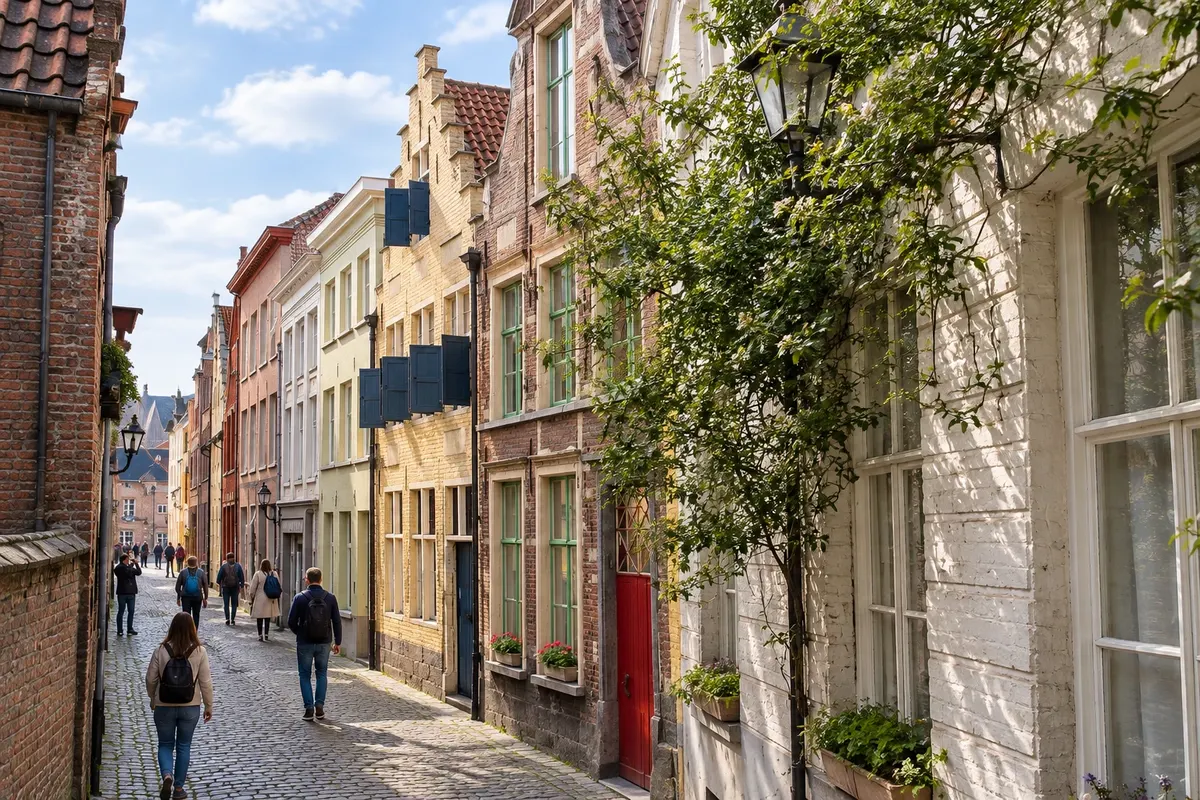
Medieval neighbourhood of stone lanes behind the Gravensteen, once home to friars, tanners and labourers. Today it concentrates small restaurants and cafés and houses the museum Huis van Alijn.

Vrijdagmarkt
Ghent · East Flanders · Trg

Vrijdagmarkt

Square of about 100 by 100 meters, with a market on Fridays since 1199 and the statue of Jacob van Artevelde in the center. It is surrounded by guild houses that are now bars and restaurants.

Museum of Fine Arts Ghent (MSK)
Ghent · East Flanders · Muzej

Museum of Fine Arts Ghent (MSK)

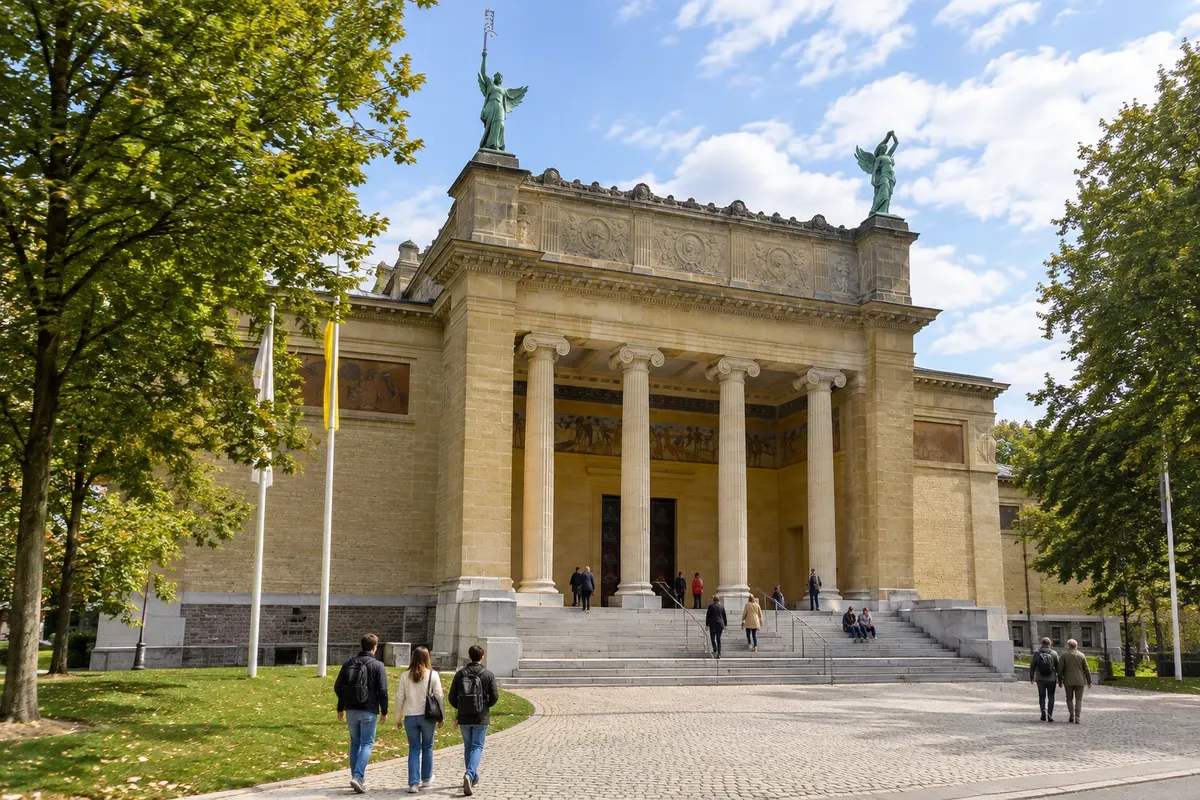
Gante's museum of fine arts, on the edge of Citadelpark, with about 20,000 works from the Middle Ages to the early 20th century: Bosch, Rubens, Van Dyck, Ensor and Magritte. Panels of the Lam Gods were restored there.

S.M.A.K.
Ghent · East Flanders · Muzej

S.M.A.K.

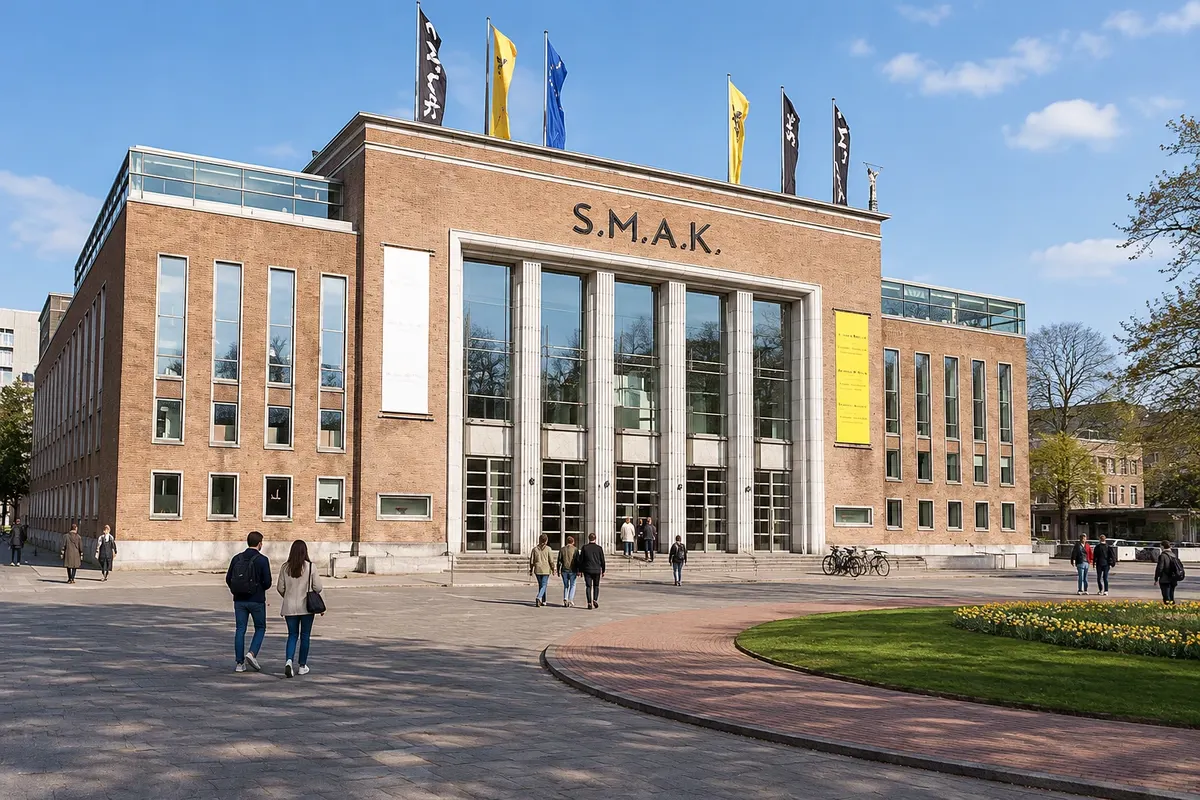
Gante's municipal museum of contemporary art, in Citadelpark, opposite MSK. It brings together art made after 1945, including pop art, minimalism, conceptual art, arte povera and Belgian artists, and mounts temporary exhibitions.

Design Museum Gent
Ghent · East Flanders · Muzej

Design Museum Gent

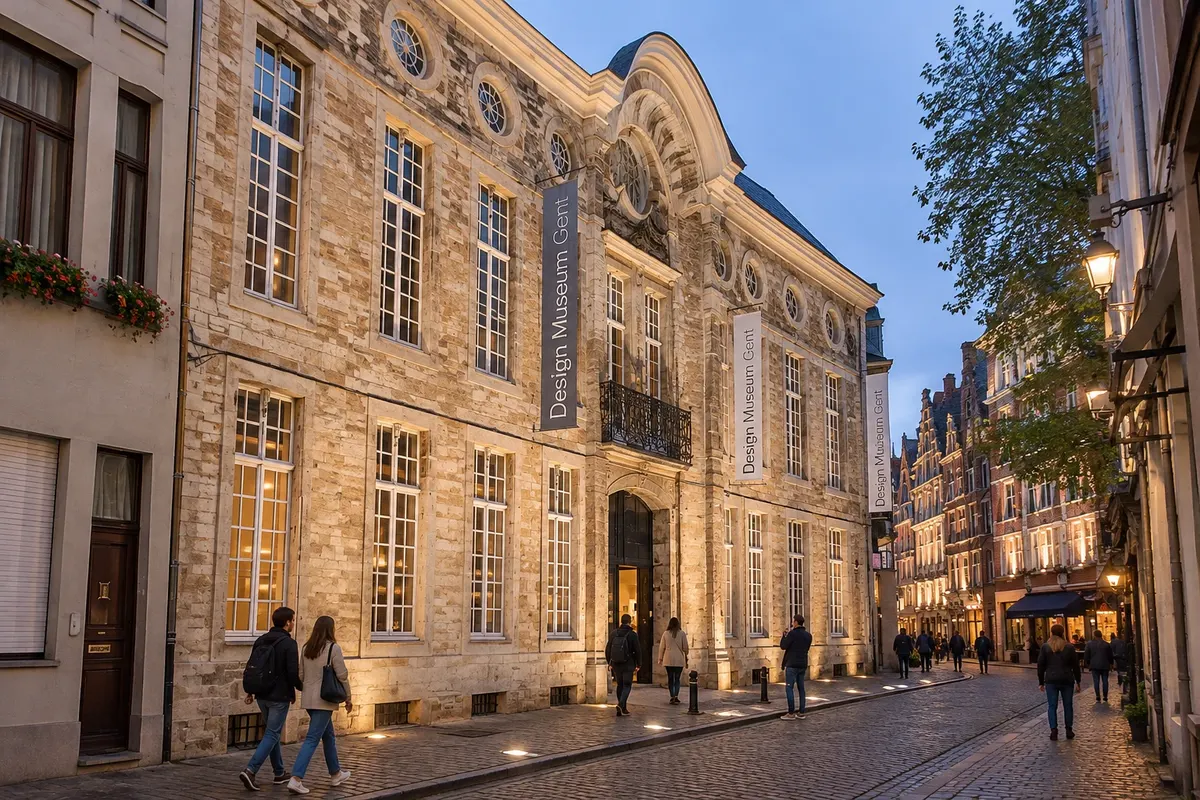
Design museum in central Gante, founded in 1903, with a collection that ranges from the 14th century to contemporary design, Belgian Art Nouveau by Victor Horta and Henry van de Velde, and a new wing with a terrace overlooking the Gravensteen.

House of Alijn
Ghent · East Flanders · Muzej

House of Alijn

Museum about everyday life in Flanders in the 20th century, housed in the former almshouse of the Filhos de Alijn on the Kraanlei, opposite the Groentenmarkt. It has little houses around a garden courtyard, a puppet theatre and an old-fashioned bar.

St. Peter's Abbey (Sint-Pietersabdij)
Ghent · East Flanders · Abbey

St. Peter's Abbey (Sint-Pietersabdij)

Ancient Benedictine abbey founded in the 7th century by Saint Amand on the Blandijn hill, south of the center. It has a cloister, a medieval refectory, a garden with a vineyard and ruins, and hosts large temporary exhibitions.

Kaj izbrati pred odhodom

Izleti – Ghent

Izhodišče, trajanje, potek, vključene storitve in okvirna cena vsakega izleta.

Sint-Baafskathedraal and the altarpiece Het Lam Gods (Adoration of the Mystic Lamb)

Odhod: Ghent city centre Peš Približno 2 uri Dopoldne Lahko

Ghent (Gent) is the capital of East Flanders, where Flemish is spoken—the variety of Dutch used in Belgium. The Sint-Baafskathedraal (Saint Bavo Cathedral) stands on Sint-Baafsplein in the historic centre. It began as a church of Saint John the Baptist, built over a 10th-century church and a 12th-century Romanesque one, and became a Gothic cathedral in the 15th and 16th centuries. In the crypt, the central nave still shows Romanesque style. The main work is Het Lam Gods (Adoration of the Mystic Lamb), the altarpiece by the brothers Hubert and Jan van Eyck, completed in 1432. It is a polyptych of 12 panels, viewable open or closed. The work suffered thefts and wars: it was taken by the Germans in World War I and hidden in a salt mine in World War II; the panel of the Just Judges, stolen in 1934, was never found, and a copy stands in its place. The restored altarpiece is displayed in the cathedral visitor centre along with other original works. In the crypt the visit continues with augmented reality glasses that tell the story of the altarpiece and the church; there is a Portuguese version. In the nave, note Rubens’s painting of Saint Bavo entering the Ghent convent, the rococo pulpit in oak and marble, and the baroque altar.

Kraji na poti: Sint-Baafskathedraal, Het Lam Gods, Sint-Baafsplein.

Vključuje: Entry to the cathedral nave is free. The visitor centre, with the altarpiece and the augmented reality route in the crypt, requires a separate paid ticket; check the current pricing. There is a family audio guide and tablets for those who prefer not to use the glasses.

Nasvet: Book your time slot online in advance, especially on weekends. At the first and last time slots of the day it is often possible to see the altarpiece open and closed. The cathedral tower is only open to visitors during the Gentse Feesten in July.

Najboljši čas za obisk: Year round. In July and August and on weekends there are more visitors; from November to March queues are usually shorter.

Belfry (Belfort) of Ghent and Lakenhalle

Odhod: Ghent city centre On foot, with an elevator to the upper levels Približno 1 uro Dopoldne easy (no accessibility)

The Belfry is the middle tower of the three that shape Ghent’s skyline, between the Sint-Baafskathedraal and the Sint-Niklaaskerk. It is 91 meters tall and was built between 1313 and 1380. It is part of the group of belfries of Belgium and France inscribed on the UNESCO World Heritage List in 1999. It served as the city’s watchtower and kept, in a chest, the documents recording Ghent’s privileges. At the top, a golden dragon—symbol of the city—has watched over Ghent since 1377. The visit includes the carillon of 53 bells and the history of the tower’s bells. The former alarm bell, nicknamed Roland, now stands near Emile Braunplein. An elevator runs up from the first floor, and from there you can see the whole center, with its towers and canals. Attached to the tower is the Lakenhalle, the cloth hall, in Brabantine Gothic, a reminder of the time when Ghent lived off the textile industry. Between them stands the Mammelokker, from 1741, the former entrance to the city jail, with a relief of the Roman legend of Cimon, saved from hunger by his daughter.

Kraji na poti: Belfry, Cloth Hall, Mammelokker, Emile Braunplein.

Vključuje: Climb the tower, with the carillon and the viewpoint. There is a separately paid ticket with a scheduled time; check the current rates. A child-friendly guide for families is available.

Nasvet: Buy the ticket online. CityCard Gent holders enter without a time reservation. The carillonneur plays on Sunday mornings; in July and August there are carillon concerts on Saturday evenings.

Najboljši čas za obisk: All year. From May to September the view is usually clearer and the days are long; in winter it gets dark early.

Korenmarkt, Sint-Niklaaskerk and Sint-Michielsbrug: the view of the three towers

Odhod: Ghent city centre Peš Približno 1 uro Popoldne Lahko

The Korenmarkt, the former grain market, was Ghent’s commercial centre. Beside it stands Sint-Niklaaskerk (St. Nicholas’ Church), begun in the early 13th century in blue Tournai stone. It is one of the examples of Scheldt Gothic, a style named after the river. The tower sits over the crossing of the nave and transept and served as a watch post and bell tower before the Belfry. Inside, the chapels belonged to the craft guilds, which commissioned much of the church’s art. Above the west portal is the romantic organ by Aristide Cavaillé-Coll from 1856, one of Belgium’s most important. The stained glass tells the life of Mary and the Crucifixion. A few steps away, the Sint-Michielsbrug (St. Michael’s Bridge) crosses the river Leie (Lys). It was once a flat swing bridge and gained stone arches in the early 20th century. In the middle, a post holds a bronze statue of the archangel Michael with the dragon at his feet. From the bridge you can see the Graslei and the Korenlei, the Gravensteen in the distance, Sint-Michielskerk and the three aligned towers — a composition only this bridge provides.

Kraji na poti: Korenmarkt, Sint-Niklaaskerk, Sint-Michielsbrug, Sint-Michielskerk.

Vključuje: Sint-Niklaaskerk has free entry. The bridge and the square are open public spaces.

Nasvet: Return to the bridge after dark: the surrounding buildings are illuminated. At the church, respect the mass times.

Najboljši čas za obisk: All year. From May to September the late-afternoon light lasts longer; in December the Christmas market reaches the Korenmarkt.

Graslei and Korenlei, the old medieval quay

Odhod: Ghent city centre Peš Približno 1 uro Popoldne Lahko

The Graslei and the Korenlei are the two facing quays on the Leie (Lys) river, between the Sint-Michielsbrug and the Grasbrug. Boats have moored there since the 11th century, and the quay buildings show the wealth of the grain trade and navigation in the Middle Ages. On the Graslei, ’t Spijker, a grain warehouse with a stepped gable, has stood since the 13th century and today houses a restaurant and a café. Next to it are the Korenmetershuis, the official grain measurer’s house, and the house of the guild of free boatmen, with a restored façade. Across the river, on the Korenlei, the 16th-century De Swaene mansion has two golden swans on its façade. The quays are the city’s meeting point: students and residents sit at the water’s edge on sunny days, and several sightseeing boats depart from there. At night the facades are lit up.

Kraji na poti: Graslei, Korenlei, Grasbrug, Leie.

Vključuje: Walk in open space, no ticket required.

Nasvet: Cross the Grasbrug and view the Graslei from the Korenlei, where the row of facades appears whole. On warm days, the steps along the river fill up in the late afternoon.

Najboljši čas za obisk: All year. From May to September the quays are livelier and it gets dark late.

Boat trip along the canals and the Leie River

Odhod: Graslei and Korenlei Guided boat tour about 40 minutes Popoldne Lahko

Seeing Ghent from the water is one of the city’s classic activities. Open boats depart from the Graslei and Korenlei quays and follow the Leie (Lys) and the Lieve canal, passing under low bridges, beside the facades of old warehouses, next to the Gravensteen and through the Patershol neighbourhood. On the traditional tours, the boatman tells the history of the buildings in several languages, usually Flemish, English and French. Several companies run the route, with frequent departures throughout the day. There are other ways to navigate: from April to October a boat operates as a water tram with stops where you can get on and off along the river; there are also boats with a boatman for groups, electric boats you can drive without a licence, and kayaks.

Kraji na poti: Graslei, Korenlei, Leie, Lieve, Gravensteen.

Vključuje: On the traditional tours: the boat route with explanations by the boatman. There is a separately paid ticket; check the current price list. The water tram is included in the CityCard Gent.

Nasvet: Bring a jacket: it can be windy on the boat, even in summer. In rain, some boats have a cover and others do not. If you use a wheelchair, you should notify the company in advance.

Najboljši čas za obisk: All year round, with more departures from April to October. The water tram runs from April to October.

Gravensteen, the castle of the Counts of Flanders

Odhod: Ghent city centre Peš Približno uro in pol Dopoldne easy (narrow stairs)

The Gravensteen (Castle of the Counts) was built in 1180 by Count Philip of Alsace, as the Latin inscription above the entrance states. It is the only medieval castle with a moat that remains in Flanders. It may have been inspired by the castles the count saw on the Crusades. When the counts left in 1353, the castle became a court and prison, served as a mint and, later, a cotton-spinning mill. The city bought and began restoring the complex from 1893, and the curtain wall, the keep and the count’s palace took on the appearance seen today. The visit follows the gatehouse, the curtain walls, the keep, the count’s residence and the stables. In a former pantry there is a collection of torture instruments arranged as the executioner’s cabinet, and the old courtroom houses objects of justice. From the top of the keep, between the battlements, the view covers the Patershol and the city centre.

Kraji na poti: Gravensteen, Sint-Veerleplein.

Vključuje: Castle entry with audio guide; there is a short route covering the five main stops, about half an hour. A separate paid ticket may be required; check the current price list.

Nasvet: Arrive at opening, before the tour groups. The long audio guide has a light-hearted narration in Flemish and other languages. The torture instruments may be upsetting to very young children. From one of the turrets you can see a mural inspired by a portrait by Jan van Eyck.

Najboljši čas za obisk: All year. In December and early January the castle usually hosts winter programming.

Prikaži dodatne izlete (10)

Patershol, Kraanlei and Huis van Alijn

Odhod: Ghent city centre Peš Približno 2 uri Popoldne Lahka pot po kamnitih ulicah

Patershol is the medieval quarter just north of the Gravensteen, between the Leie river and the Lieve canal. The name likely comes from a Carmelite friary that once stood there. In the 19th century it was a poor working-class quarter, with tanneries and small workshops; from the 1980s the houses were restored and the cobbled lanes filled with restaurants. It is still a residential neighbourhood, with its own street festival. The Kraanlei, on the banks of the Leie, is the most photographed street in the quarter. The Huis van Alijn is located there, a museum set in an old asylum, the only one in the city that has been preserved. The museum shows everyday life in the 20th century: baby photos, street games, first love, summer holidays. There are activities for children, an inner garden and a café in the style of old popular bars. The museum also has a puppet theatre. The Caermersklooster, a restored former convent that hosts visual art exhibitions, is also in the neighbourhood.

Kraji na poti: Patershol, Kraanlei, Huis van Alijn, Caermersklooster.

Vključuje: The neighbourhood is freely accessible. The Huis van Alijn has a separately paid entrance, and the puppet theatre has its own ticket; check the current price list.

Nasvet: Book a table for dinner in Patershol at weekends. Many restaurants do not open for lunch on weekdays, and some close on Monday or Tuesday.

Najboljši čas za obisk: All year round. In winter the candlelit cafés are part of the atmosphere; in summer the Kraanlei looks lovely in the late afternoon.

Vrijdagmarkt, Werregarenstraat (graffiti street) and Ghent flavours

Odhod: Ghent city centre Peš Približno 2 uri Dopoldne Lahko

The Vrijdagmarkt (Friday Market) is one of Ghent’s oldest squares. There the city received kings in solemn entries, held celebrations and, until 1863, carried out public executions. In the centre, the statue of Jacob van Artevelde points toward England: in the 14th century, during the Hundred Years’ War, he reopened access to English wool and saved the city’s textile industry. 't Toreken, from the 15th century, is the oldest building on the square; the socialist headquarters Bond Moyson, from the early 20th century, has a rooster on its façade. The square hosts a fresh-produce and goods market on Fridays. In the historic centre is Werregarenstraat, a narrow street where graffiti is tolerated. Artists paint over each other, and the walls change from week to week. The walk is good for sampling the city’s food. Waterzooi is a creamy stew of chicken or fish with vegetables; stoverij in the Ghent style is meat braised in a dark sauce, served with fries. Cuberdons, called neuzekes, are purple cone-shaped candies filled with raspberry syrup, sold at stalls on the Groentenmarkt. Tierenteyn mustard, kroakemandels (fried peas) and Gruut beer, brewed with herbs instead of hops, complete the list.

Kraji na poti: Vrijdagmarkt, Werregarenstraat, Groentenmarkt.

Vključuje: Walk through open spaces, no admission required. Food and drink are paid separately.

Nasvet: On Werregarenstraat, respect residents: avoid noise at night. Cuberdons soften over time; buy them close to when you will eat them.

Najboljši čas za obisk: All year. Waterzooi is especially suitable for the cold months, from November to March.

STAM (city museum) and the Bijloke complex

Odhod: Ghent city centre On foot or by tram Približno 2 uri Dopoldne Lahko

STAM is Ghent’s city museum and tells the story of Ghent from the Middle Ages to the present. It is in the Bijloke complex, a former abbey with 14th-century buildings, a 17th-century convent and a 21st-century building, in the city’s arts district. The visit starts on top of a giant aerial photo of Ghent, which you walk across looking for your own street. Interactive models, 3D renderings and building materials you can touch show how the city grew over the centuries. An app displays the city in four historical periods. There is a route for children and a space with temporary exhibitions that are free to access. Next door, the old infirmary of the Bijloke hospital, with a timber-beam ceiling, was converted into a concert hall known for its acoustics.

Kraji na poti: STAM, Bijloke, Godshuizenlaan.

Vključuje: Museum admission, with a printed guide to the 15 main items in the collection. There is a separate paid ticket; check the current schedule. Concerts at the Bijloke have their own tickets.

Nasvet: Do the STAM at the start of your visit: the aerial photo and the models help you understand the city before you walk around. Check Bijloke’s concert schedule for the evening.

Najboljši čas za obisk: All year; it’s a good option for rainy days.

MSK (Museum of Fine Arts) and Citadelpark

Odhod: Ghent city center or Gent-Sint-Pieters station On foot or by tram about 2 hours and 30 minutes Popoldne Lahko

The MSK (Museum voor Schone Kunsten, Museum of Fine Arts) is located in Citadelpark, a park near Gent-Sint-Pieters station. The building was designed by the city architect Charles van Rysselberghe around 1900. The collection has about 9,000 works, from the Middle Ages to the 20th century, with roughly 600 on permanent display: painting, sculpture, drawing, printmaking and tapestry, with a focus on Flemish art. The museum houses two paintings by Hieronymus Bosch, Saint Jerome in Prayer and Christ Carrying the Cross; canvases by Rubens; James Ensor’s Children in the Morning Toilet and Perspective II, Manet’s balcony, and works by René Magritte. There is also European painting, especially French, and many sculptures. Citadelpark has lawns, ponds, grottos and large trees. In front of the MSK is S.M.A.K., the museum of contemporary art, and you can combine both in the same day.

Kraji na poti: MSK, Citadelpark.

Vključuje: Museum admission. There is a separate paid ticket; check the current price list. The park is free to access.

Nasvet: From the center, trams 1 and 3 stop near the park; if you arrive by train you can visit the museum before heading to the center.

Najboljši čas za obisk: All year. The park is most attractive from April to October.

S.M.A.K., the contemporary art museum

Odhod: Citadelpark On foot or by tram Približno 2 uri Popoldne Lahko

S.M.A.K. (Stedelijk Museum voor Actuele Kunst, the municipal museum of contemporary art) was founded in 1999 and occupies a former casino building in Citadelpark, opposite the MSK. The collection holds over 5,000 works, from the post–Second World War period to the present, including pieces from CoBrA, pop art, minimal art, conceptual art and arte povera. The museum displays parts of the collection on rotation alongside works by living artists, and mounts several new exhibitions each year. That means every visit is different. There is a café, a shop and activities for children.

Kraji na poti: S.M.A.K., Citadelpark.

Vključuje: Admission to the museum and current exhibitions. There are separate paid tickets, with prices that vary by exhibition; check the current list. Under-19s have free admission.

Nasvet: Check the programme before you go to see which exhibitions are on. The MSK is across the street: if time is short, choose one of the two.

Najboljši čas za obisk: All year; it’s a good option for rainy days.

Design Museum Gent

Odhod: Ghent city centre Peš Približno 2 uri Popoldne Lahko

Design Museum Gent is located in the historic centre, near the Graslei and the Gravensteen. It is the largest design museum in Belgium and the only one in Flanders. It began in 1903 as an educational project and has a collection of 24,000 items spanning more than 700 years. The museum brings together parts from the 18th and 20th centuries and a new wooden wing that links the older buildings. The façade uses bricks made in Ghent with construction waste, and from the fourth floor you can see the city. The collection is known for Belgian Art Nouveau, with pieces by Victor Horta, Henry van de Velde, Paul Hankar and Philippe Wolfers, and for Belgian design from the 1970s onwards. About 500 objects are on display, arranged by themes. There is a family trail with interactive stations and play areas for young children.

Kraji na poti: Design Museum Gent.

Vključuje: Admission to the permanent collection and temporary exhibitions. There are separately paid tickets; check the current rates. The courtyard, the new wing with the viewpoint, and the shop are freely accessible.

Nasvet: Reserve a time online to guarantee entry. The museum is closed on Wednesdays, with exceptions on public holidays and school vacations.

Najboljši čas za obisk: All year; it’s a good option for rainy days.

Begijnhofs of Ghent: Klein Begijnhof and Groot Begijnhof

Odhod: Ghent city centre On foot or by tram Približno 2 uri Dopoldne Lahko

The beguinages (begijnhofs) were communities where women lived in a religious way without taking vows as nuns. They emerged in the 13th century, usually next to a church and enclosed by walls with gates. Ghent has three, and two are part of the Flemish beguinages group inscribed as a UNESCO World Heritage Site. The Klein Begijnhof Onze-Lieve-Vrouw ter Hoyen, in the south of the center, was founded in 1235 by the Countess of Flanders and is the pre-French Revolution beguinage that has been best preserved. It has a neoclassical gate from 1819 as its only entrance, a lawn with lindens and beeches, white houses with green gates and small gardens, convents named after saints and a baroque church. There are still residents, and silence is part of the visit. The Groot Begijnhof Sint-Elisabeth is in Sint-Amandsberg, outside the center. It was built in 1873 and 1874 and at one time housed about 600 beguines; the last beguine of Ghent died in 2008. The Oud Begijnhof Sint-Elisabeth, near the center, is known as the sacred corner, with Catholic, Orthodox and Protestant churches side by side.

Kraji na poti: Klein Begijnhof Onze-Lieve-Vrouw ter Hoyen, Groot Begijnhof Sint-Elisabeth, Oud Begijnhof Sint-Elisabeth.

Vključuje: The beguinages have free access, as open spaces.

Nasvet: Keep your voice low and do not enter the houses’ gardens: they are private residences. For the Groot Begijnhof, go by tram or by bicycle.

Najboljši čas za obisk: All year. From April to June the trees and lawns are greener.

Sint-Pietersabdij (Abbey of Saint Peter) and the vineyard

Odhod: Ghent city centre On foot or by tram Približno uro in pol Popoldne Lahko

Sint-Pietersabdij is a Benedictine abbey founded in the 7th century by Saint Amand, regarded as one of the origins of Ghent. In the 14th and 15th centuries it became a small settlement, with farms, gardens, houses and lands that reached the port. Its wealth came from privileges and taxes levied on those lands. The medieval refectory wing is original. On the ground floor the cloister, courtyard and abbey garden can be visited without a ticket. The garden includes a vineyard and a ruin and is a resting spot for students. The abbey hosts temporary exhibitions every year, each with its own ticket. It is on Sint-Pietersplein, between the centre and Gent-Sint-Pieters station, near the university district.

Kraji na poti: Sint-Pietersabdij, Sint-Pietersplein.

Vključuje: The ground floor, the cloister and the garden have free access. The exhibitions require a separate ticket; check the current price list.

Nasvet: Combine the abbey with the MSK and Citadelpark, which are on the same side of the city.

Najboljši čas za obisk: All year. The garden and the vineyard are greener from May to September.

Museum Dr. Guislain, the history of psychiatry

Odhod: Ghent city centre By tram or bus Približno 2 uri Dopoldne Lahko

The Museum Dr. Guislain tells the history of psychiatry. It is housed in the building of Belgium’s first modern psychiatric hospital, founded by physician Joseph Guislain and opened in 1857. The complex is protected as heritage and continues to function as a psychiatric centre alongside the museum. The permanent collection shows how society has treated people with mental illness over time. Temporary exhibitions bring together art and science and question the idea of what is normal. It’s a visit to take slowly and with respect: the subject is serious, and the museum is about people, not just objects.

Kraji na poti: Museum Dr. Guislain.

Vključuje: Admission to the permanent collection and temporary exhibitions. There is a separate paid ticket; check the current price list.

Nasvet: The museum is outside the historic center, to the northwest. Keep in mind the campus is an active health center: behave discreetly and do not photograph patients.

Najboljši čas za obisk: Vse leto.

Illuminated Ghent: night walk along the lighting plan

Odhod: Kouter, in central Ghent On foot, on your own or with a guide Približno 2 uri night Lahko

Ghent has a lighting plan for the historic centre that lights up facades, towers and quays after dark. The basic route is about 3.2 km and passes 80 numbered points, including the Kouter, the Graslei and Korenlei, the Belfry and the Lakenhalle, the Sint-Michielsbrug and the opera house. You can follow the route with the leaflet, which is available in Flemish, French, English, German and Spanish, or join one of the city’s guide associations that run night tours. Decorative lighting is replaced by the regular lighting at midnight, so start early.

Kraji na poti: Kouter, Graslei, Korenlei, Belfort, Sint-Michielsbrug.

Vključuje: Walk in open spaces, no ticket required. Guided tours are paid separately; check the current price list.

Nasvet: Pick up the paper leaflet at the tourist information centre. In summer it gets dark late; in winter the walk can start in the late afternoon.

Najboljši čas za obisk: All year. From October to March it gets dark early, and you can do the walk before dinner.


Po dnevih

Ghent – načrt poti. Število dni: 2, 3in5

Predlogi za načrtovanje poti. Vrstni red dni prilagodite vremenu in razpoložljivosti izletov.

2 dni · Ghent in two days: cathedral, towers and canals

ZaWho includes Ghent on a trip through Belgium and wants to see the essentials of the historic center. · Izhodišče:Ghent
  1. Dan 1 · Arrival, the three towers and Ghent lit up

    From Brussels Airport, take the train to Gent-Sint-Pieters and catch the tram to the center. After dropping your bags, visit the Korenmarkt, Sint-Niklaaskerk and the Sint-Michielsbrug bridge, with the view of the three towers, and walk along Graslei and Korenlei. In the evening, do the light plan walk at an easy pace for those arriving on a long flight.

  2. Dan 2 · Lam Gods, Belfry, Gravensteen and boat

    Start with Sint-Baafskathedraal and the altarpiece Het Lam Gods, with a reserved time slot. Climb the Belfry and see the Lakenhalle. After lunch, visit Gravensteen and finish with the boat tour of the canals departing from Graslei. Dine in Patershol.

3 dni · Ghent in three days, with museums and neighborhoods
ZaWho wants the historic center at a relaxed pace, one or two museums and time for the medieval neighborhoods. · Izhodišče:Ghent
  1. Dan 1 · Arrival, three towers and Graslei

    Arrive by train from Brussels Airport to Gent-Sint-Pieters and take the tram to the center. In the afternoon, stroll through the Korenmarkt, go into Sint-Niklaaskerk, cross Sint-Michielsbrug and continue along Graslei and Korenlei. End the day with the nighttime walk along the light plan.

  2. Dan 2 · Lam Gods, Belfry, Gravensteen and boat

    In the morning, visit Sint-Baafskathedraal and Het Lam Gods and climb the Belfry. In the afternoon, do Gravensteen and the boat tour on the canals. At the end of the day, walk through Patershol and Kraanlei and have dinner in the neighborhood.

  3. Dan 3 · Vrijdagmarkt, STAM and Design Museum Gent

    Start at Vrijdagmarkt and Werregarenstraat, the graffiti street, and try cuberdons at the Groentenmarkt. Take the tram to the STAM in the Bijloke to learn about the city’s history. In the afternoon, return to the center for the Design Museum Gent or the Huis van Alijn.

5 dni · Ghent in five days, unhurried
ZaWho wants Ghent as a base, with the major museums, the beguinages and time to recover from the flight. · Izhodišče:Ghent
  1. Dan 1 · Arrival and first walk around the center

    From Brussels Airport, take the train to Gent-Sint-Pieters and the tram to the center. In the afternoon, walk along the Korenmarkt, across Sint-Michielsbrug and along Graslei and Korenlei, without a fixed schedule, to recover from flight fatigue. Sleep early.

  2. Dan 2 · The Ghent Altarpiece, Belfry and Ghent lit up

    In the morning, visit Sint-Baafskathedraal and Het Lam Gods. Climb the Belfry and view the Lakenhalle. In the afternoon, enter Sint-Niklaaskerk and take the boat tour on the canals. At night, follow the light plan route.

  3. Dan 3 · Gravensteen, Patershol and Vrijdagmarkt

    Start the day at Gravensteen. Then walk through Patershol and Kraanlei and visit the Huis van Alijn. In the afternoon, go to Vrijdagmarkt and Werregarenstraat and try waterzooi and cuberdons.

  4. Dan 4 · STAM, Sint-Pietersabdij, MSK and Citadelpark

    Begin at the STAM in the Bijloke. Continue to Sint-Pietersabdij and the vineyard garden. In the afternoon, visit the MSK and walk through Citadelpark; if you like contemporary art you can swap the MSK for the S.M.A.K., across the street.

  5. Dan 5 · Beguinages and Design Museum Gent

    In the morning, visit Klein Begijnhof and, by tram, Groot Begijnhof in Sint-Amandsberg. In the afternoon, return to the center for the Design Museum Gent or, if you’re interested in the subject, the Museum Dr. Guislain. End the trip with a late afternoon on the steps of the Graslei.

Najboljši čas za obisk

Kdaj se odpraviti:Ghent po mesecih

From May to September, with long days and mild temperatures. July hosts the Gentse Feesten, a ten-day festival in the center. From December to early January, the Christmas market usually sets up stalls in the squares. Winter is cold and rainy and it gets dark in the late afternoon; bring an umbrella in any season.

The seasons shown are the most usual ones; nature doesn't always follow the calendar.

januar Zmerne padavine

cold winter · quiet museums

In Ghent, average highs are around 7 °C and lows about 1 °C, with rain on roughly 13 days. Days are short and it gets dark in the late afternoon. At the start of the month there is still a Christmas market; afterward the city becomes calm, good for museums.

februar Zmerne padavine

damp cold · short days

Still winter: average highs near 8 °C and lows of 1 °C, with rain on about 12 days and often gray skies. Days are starting to lengthen, but it still gets dark early. Bring a heavy coat, a hat and waterproof footwear.

marec Malo padavin

end of winter · daylight saving time

Transition to spring: average highs around 11 °C and lows of 3 °C, with rain on about 11 days. You will still need warm clothing.

april Malo padavin

spring · driest month

The driest month of the year in Ghent, with about 46 mm of rain. Average highs are around 15 °C and lows around 5 °C. Days become much longer, and the water tram returns to run on the river. Easter fills the city.

maj Malo padavin

mild spring · quay terraces

Average highs around 19 °C and lows of 9 °C, with rain on about 10 days, usually in showers. It gets dark late, and the Graslei and Korenlei quays fill up at the end of the day. In some years the city hosts the Floraliën, a large flower exhibition; check if there is an edition in your travel year.

junij Zmerne padavine

early summer · bright nights

European summer begins: average highs around 21 °C and lows of 12 °C, with rain on about 10 days. These are the longest days of the year, with daylight late into the night. A good month for the boat and for walking, still without the peak holiday crowds.

julij Zmerne padavine

summer · Gentse Feesten

Warmest month, together with August: average highs around 23 °C and lows of 13 °C, with showers. Around July 21, the Gentse Feesten take over the center for ten days, with music and theater stages in the squares until late; most shows are open to the public. The city gets crowded: book everything early or avoid those dates.

avgust Veliko padavin

summer · showers

Average highs around 23 °C and lows of 13 °C. It is one of the rainiest months, about 91 mm, usually in quick-passing showers. European holidays: museums, boats and the Gravensteen are busier. Buy timed-entry tickets.

september Zmerne padavine

late summer · student city

Average highs around 20 °C and lows of 10 °C, with rain on about 10 days. With the end of holidays, tourism decreases, and with the return to classes the city fills with university students. It still gets dark late, and the weather is good for walking.

oktober Zmerne padavine

autumn · colored leaves

European autumn: average highs around 15 °C and lows of 7 °C, with rain on about 12 days. Parks such as Citadelpark change color.

november Veliko padavin

rainy autumn · short days

A gray, wet month with average highs near 10 °C and lows of 4 °C and rain on about 14 days. It gets dark in the late afternoon, which makes an evening walk through the light plan before dinner appealing. Museums and cafés are the main activities.

december Veliko padavin

winter · Christmas market

European winter begins: average highs around 7 °C and lows of 2 °C. It is the wettest month of the year, with about 93 mm of precipitation, and the days are the shortest. From the start of the month until early January, the Christmas market spreads from Sint-Baafsplein to Korenmarkt, with an ice rink and a Ferris wheel.

Načrtujte pot

Kako do tja:Ghent

From the airport and from Brussels by train

From Brussels Airport there are direct trains to Gent-Sint-Pieters, the city’s main station, with journeys of about 1 hour to 1 hour 30 minutes; at other times change at Brussel-Zuid (Brussels-Midi). From Brussels, trains are direct and frequent and take about 30 to 40 minutes, departing from Brussel-Zuid, Brussel-Centraal and Brussel-Noord. Ghent has a second station, Gent-Dampoort, east of the center, used by trains to and from Antwerp. Buy your ticket before boarding via the app, ticket machines or the ticket office.

By train from Paris, London, Amsterdam or Cologne

International high-speed trains arrive at Brussel-Zuid (Brussels-Midi): the Eurostar comes from Paris, London and Amsterdam, and the ICE comes from Cologne. At the same station, take the SNCB/NMBS train to Gent-Sint-Pieters. The Eurostar does not stop in Ghent. From France you can also change trains at Lille, from where a direct train departs to Ghent. Compare schedules and connections before buying.

Z avtom

Ghent sits at the junction of motorways E40 and E17. The E40 links Brussels to Ghent, about 55 km, and continues to Brugge and the coast; the E17 connects Antwerp to Ghent and continues to Kortrijk and Lille. Arriving on the E40, follow signs for Antwerpen (E17) at the Zwijnaarde interchange and exit at Gent Centrum. The historic center is closed to cars and the inner ring is a low-emission zone: vehicles with foreign plates must be registered before entering, even when allowed. The most practical option is to leave the car at a park-and-ride on the city edge and continue by tram.

How to get around Ghent

The historic center is compact, car-free, and walkable, with priority for pedestrians and cyclists. From Gent-Sint-Pieters station, De Lijn trams 1 and 3 depart every 10 minutes for the center. From Gent-Dampoort, buses go to the Korenmarkt, and the walk takes about 15 minutes. Bicycles are the city’s main transport mode, with bike lanes and rental shops. On the river, from April to October, a water tram links points in the center.

Tickets and CityCard Gent

Gent’s museums and monuments, such as the Belfort, the Gravensteen, the STAM, the MSK, the S.M.A.K. and the Design Museum Gent, have separate tickets, and several require timed reservations. The CityCard Gent bundles admission to the main museums and monuments and the water tram, and at some sites it removes the need for a timed reservation. The nave of the Sint-Baafskathedraal and the Sint-Niklaaskerk have free entry; the Het Lam Gods visitor centre is charged separately. Check the current schedule before you go.

Pred odhodom

Praktične informacije

Z nekaj načrtovanja boste imeli več časa za uživanje na poti.

Kdaj se odpraviti

From May to September, with long days and mild temperatures. July hosts the Gentse Feesten, a ten-day festival in the center. From December to early January, the Christmas market usually sets up stalls in the squares. Winter is cold and rainy and it gets dark in the late afternoon; bring an umbrella in any season.

The seasons shown are the most usual ones; nature doesn't always follow the calendar.

Koliko dni ostati

Two days allow you to see the cathedral, the Belfort, the Gravensteen, the quays, the Patershol, the Vrijdagmarkt and the MSK at a relaxed pace. With just one day, focus on the historic center. Three or four days make sense for those who use Gante as a base and take train trips to Bruges, Bruxelas or Antuérpia.

V katerem mestu prenočiti

The historic center, between the Korenmarkt, the Graslei and the Sint-Baafsplein, puts everything within walking distance and is the most sought-after. The Patershol and the Vrijdagmarkt area are good options for those who want restaurants and bars on the doorstep. Near Gent-Sint-Pieters station and the Citadelpark, the neighborhood is more residential, with easy access to trains and museums, and the center is a few minutes away by tram. During the Gentse Feesten in July, book well in advance.

Spoštujte kraj

Odnesite svoje odpadke, upoštevajte oznake in podprite lokalne ponudnike. V naravi upoštevajte navodila za obiskovalce.

Odgovori na vaša vprašanja

Pogosta vprašanja – Ghent

Can you visit Gante on a day trip from Bruxelas?

Yes. The train takes about half an hour and runs frequently. In one day you can see the cathedral with the Lam Gods, the Belfort, the Gravensteen and the quays. To see the Patershol at night and the MSK, it's worth staying overnight in the city.

What is the climate like in Gante?

Oceanic, humid and with rain distributed throughout the year. Summers are mild, and winters are cold with short days: in December it gets dark in the late afternoon. Bring a waterproof jacket and closed shoes at any time of year.

Is Gante a good base for exploring Flandres?

Yes. It's midway between Bruges and Bruxelas, and Antuérpia is also accessible by train. Staying in Gante allows day trips and returning at night to the Leie quays.

Poti – in Belgija

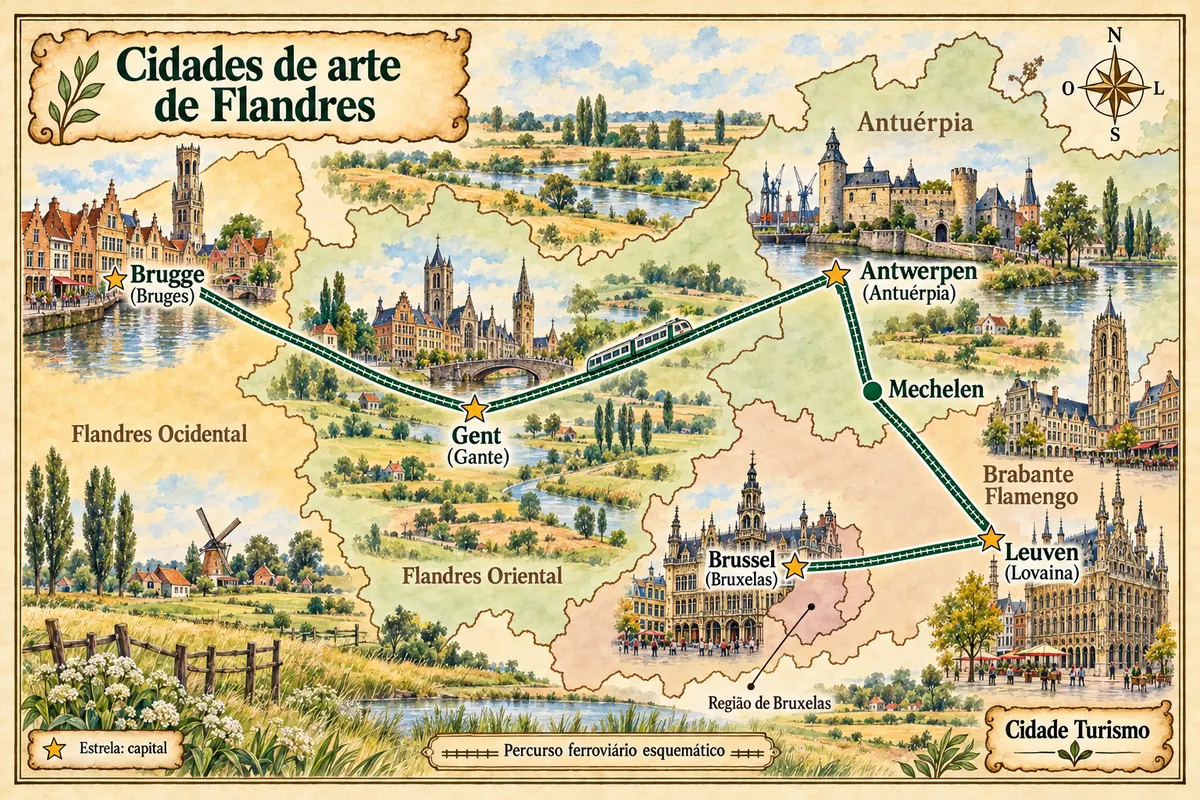
Ghent – na poti z imenom Flemish art cities

Six historic cities linked by train: Brussels, Leuven, Mechelen, Antwerp, Ghent and Bruges, with Flemish painting, cathedrals and medieval centres less than an hour apart.

Zemljevid je ilustrativen in ni v merilu. Dotaknite se mesta, da odprete njegovo stran.
Flemish art cities – ilustrirani zemljevid
Več o poti – Flemish art cities
Odkrijte druge destinacije Iskanje po zvezni državi in mestu

Več kot vodnik