Weimar and Erfurt

Thuringia · Nemčija

Weimar and Erfurt

Two neighboring towns in Turíngia: medieval Erfurt with the Krämerbrücke and the Domberg, and Weimar of Goethe, Schiller and the Bauhaus, 12 minutes by train.

East

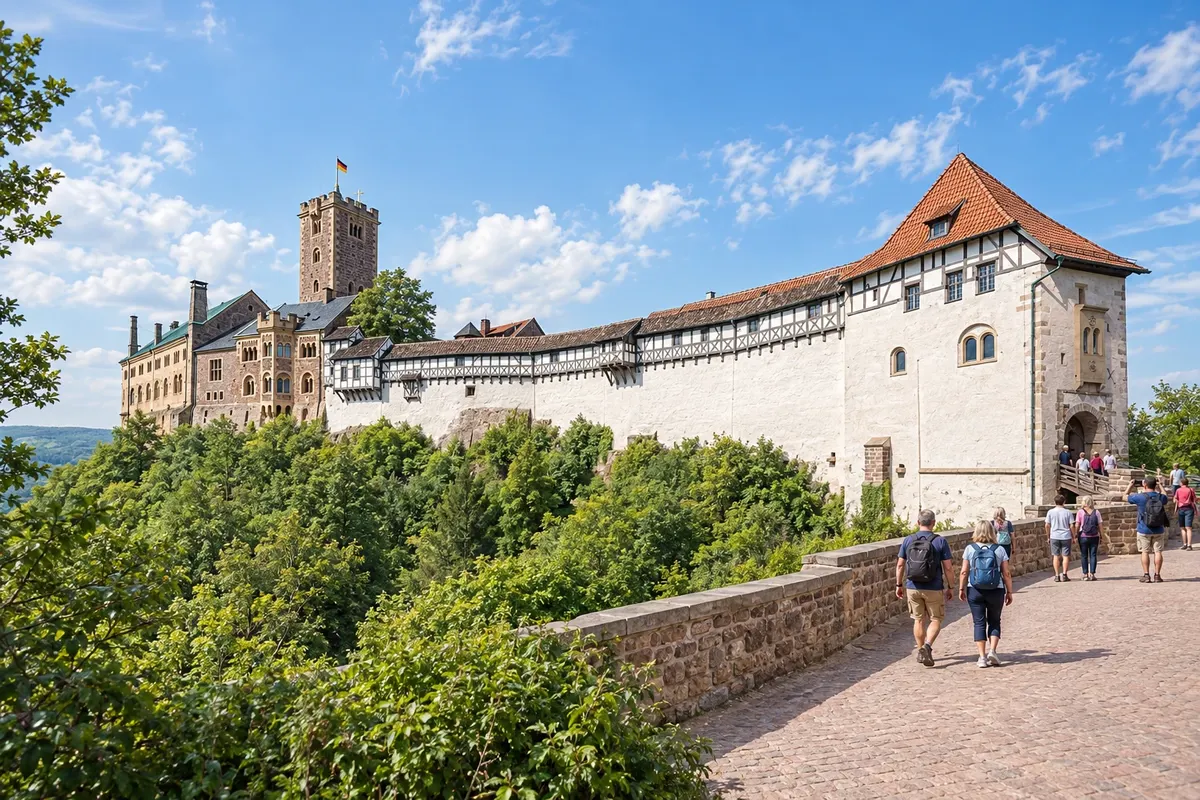
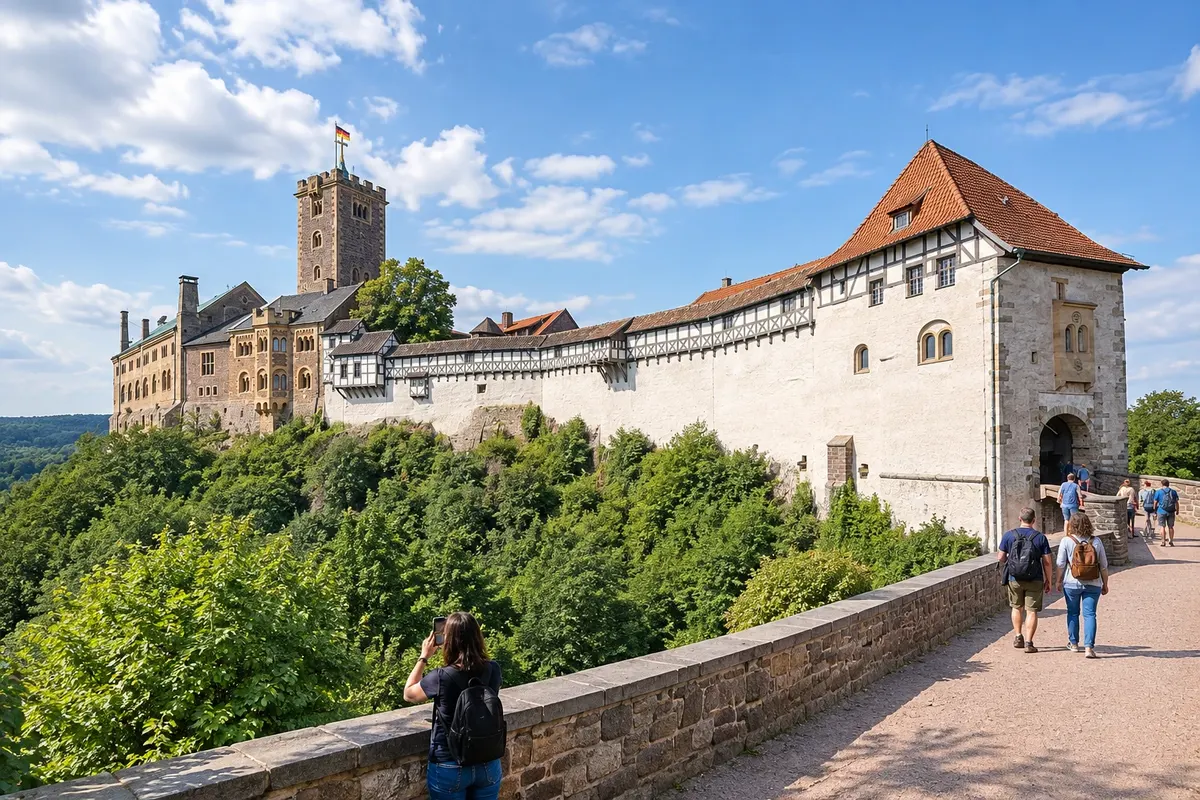
Na fotografiji: Wartburg, in Turíngia

Illustrative images. The pictures in this guide are illustrations based on the real place, not photographs, and may differ from it.

Na voljo v trgovini Google Play Pošljite svoje fotografije

Spoznajte kraj

Pokrajina, ki jo doživite
v svojem ritmu.

Erfurt and Weimar lie in the heart of Turíngia, in east-central Germany, separated by just over 20 km. Erfurt is the state capital and one of the country's main high-speed rail hubs: the ICE links the city to Berlin, Munich, Frankfurt and Leipzig. Weimar, smaller and quieter, is a short regional train ride away.

Erfurt preserves an old town (Altstadt) that largely escaped wartime destruction. The Krämerbrücke, a bridge lined with half-timbered houses over the river Gera, the cathedral and the Church of St Severus at the top of the Domplatz steps, and the baroque Petersberg fortress set the tone. It was in Erfurt that Martin Luther lived as a monk at the Augustinerkloster, and the city's medieval Jewish heritage is on the UNESCO list.

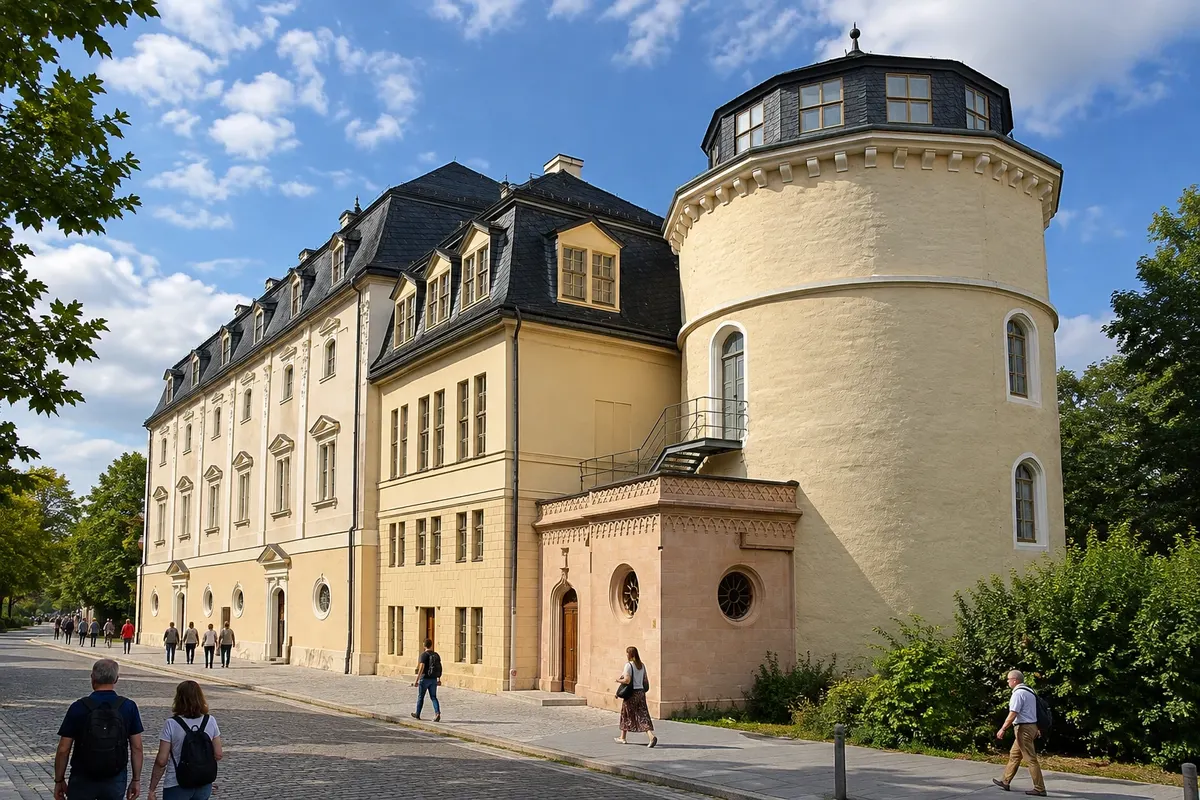
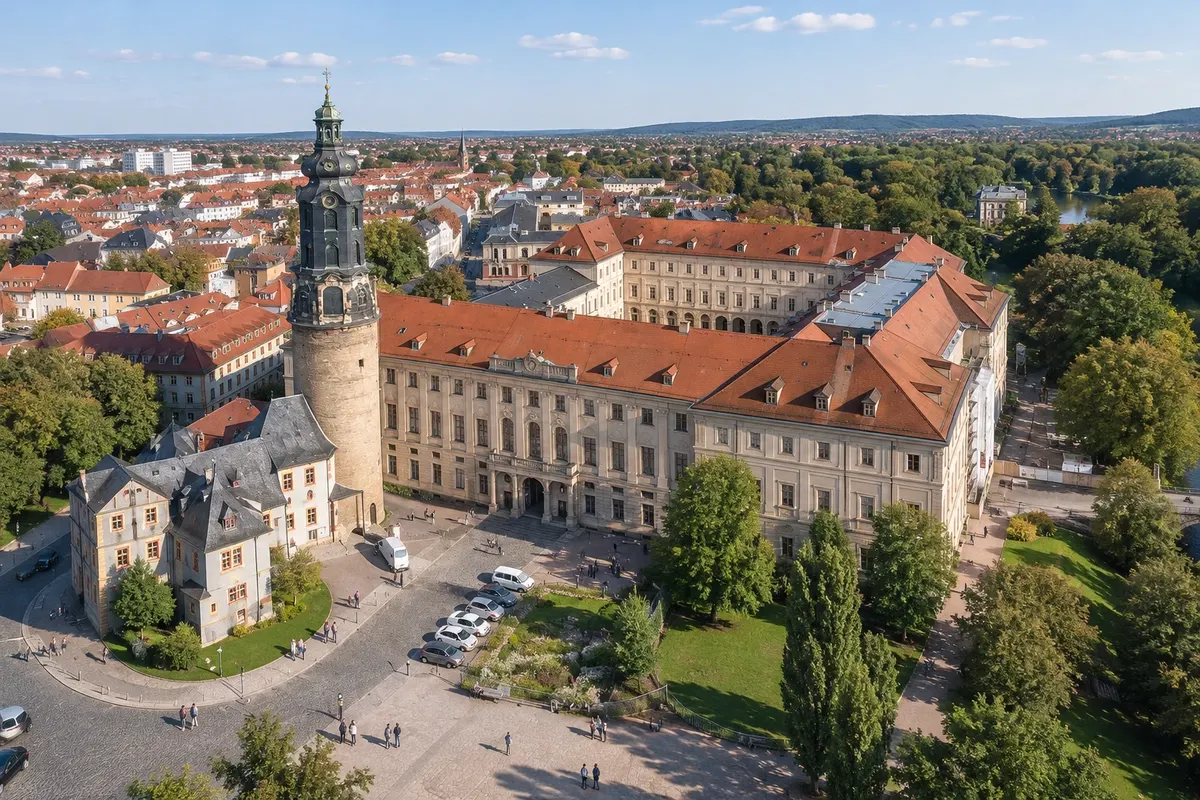
Weimar was the center of German literature in the late 18th and early 19th centuries. Goethe and Schiller lived and died there, and both of their houses can be visited. the Weimar Classicism ensemble and the Bauhaus sites, an art and design school founded in the city in 1919, are World Heritage. The Biblioteca Duquesa Anna Amalia, the Park an der Ilm and the city palace complete the itinerary.

A few kilometres from Weimar is the Gedenkstätte Buchenwald, a memorial on the site of the former Nazi concentration camp. It is a place of remembrance, visited in silence and with respect. West of Erfurt, in Eisenach, Wartburg Castle, where Luther translated the New Testament, is worth a full day.

This destination brings together 2 cities: Erfurt, Weimar.

Delite: WhatsApp
Delite svoja popotniška doživetja s fotografijami Pošljite fotografije vsakega kraja, ki ste ga obiskali. Največje število fotografij na kraj: 5.

Ena destinacija, več poti

Mesta na tej poti

Začnite v enem mestu ali v načrt poti vključite več mest.

Weimar and Erfurt – lega
WeimarErfurt

Obrisi: © BKG (2026), dl-de/by-2-0. Priredba: Cidade Turismo.

Kako do tja:Weimar and Erfurt

✈ Flughafen Frankfurt am Main (FRA), kraj: Frankfurt am Main· 270 km do cilja (Erfurt)

Check before booking. The most common route is to arrive in Frankfurt and continue by train: the ICE takes about 2 hours to Erfurt Hauptbahnhof. Erfurt also has direct ICE trains from Berlin and Munich. From Erfurt to Weimar the regional train takes 12 to 15 minutes.

Predlagana točka prihoda:Erfurt

Doživite kraj

Kaj početi – Weimar and Erfurt

Erfurt Cathedral (Dom St. Marien)
Erfurt · Thuringia · Stolnica

Erfurt Cathedral (Dom St. Marien)

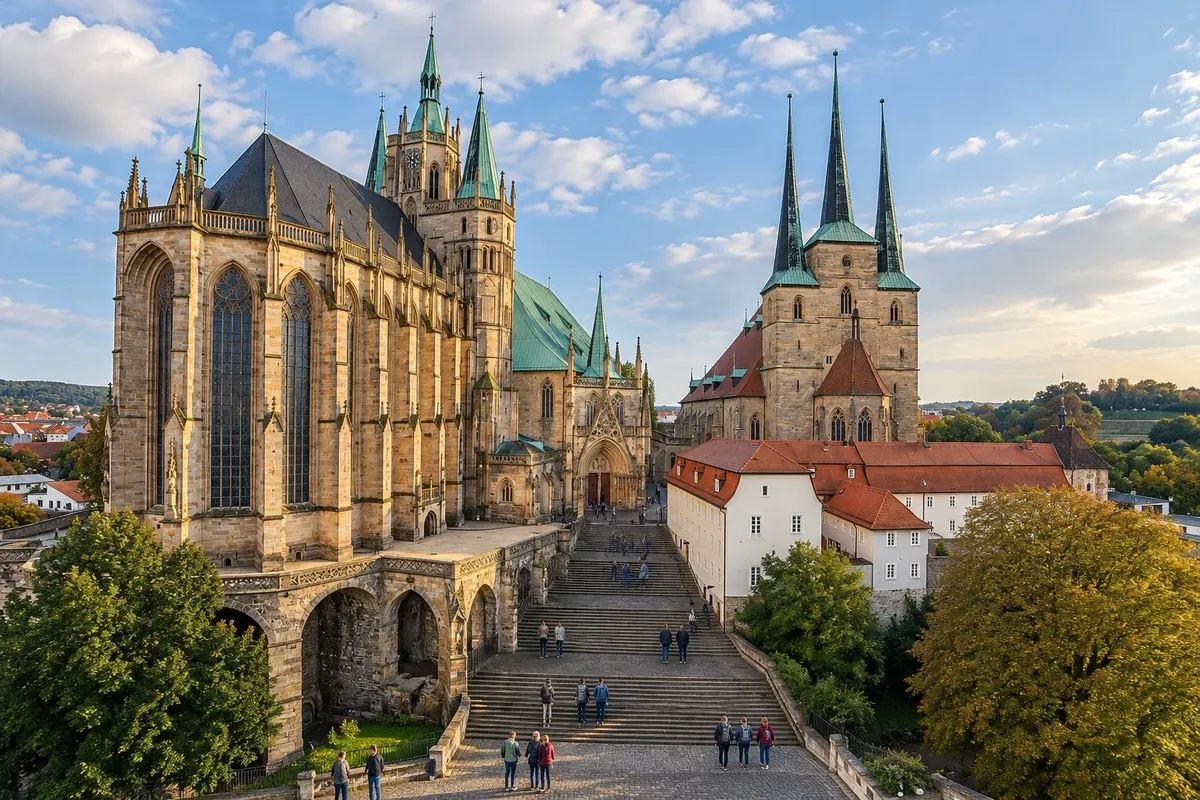
The Gothic cathedral of Santa Maria sits atop the steps of the Domplatz. It houses the Gloriosa, dating from 1497, the largest medieval bell still in use in the world, choir stained glass and the place where Luther was ordained as a priest.

Goethe National Museum
Weimar · Thuringia · House-museum

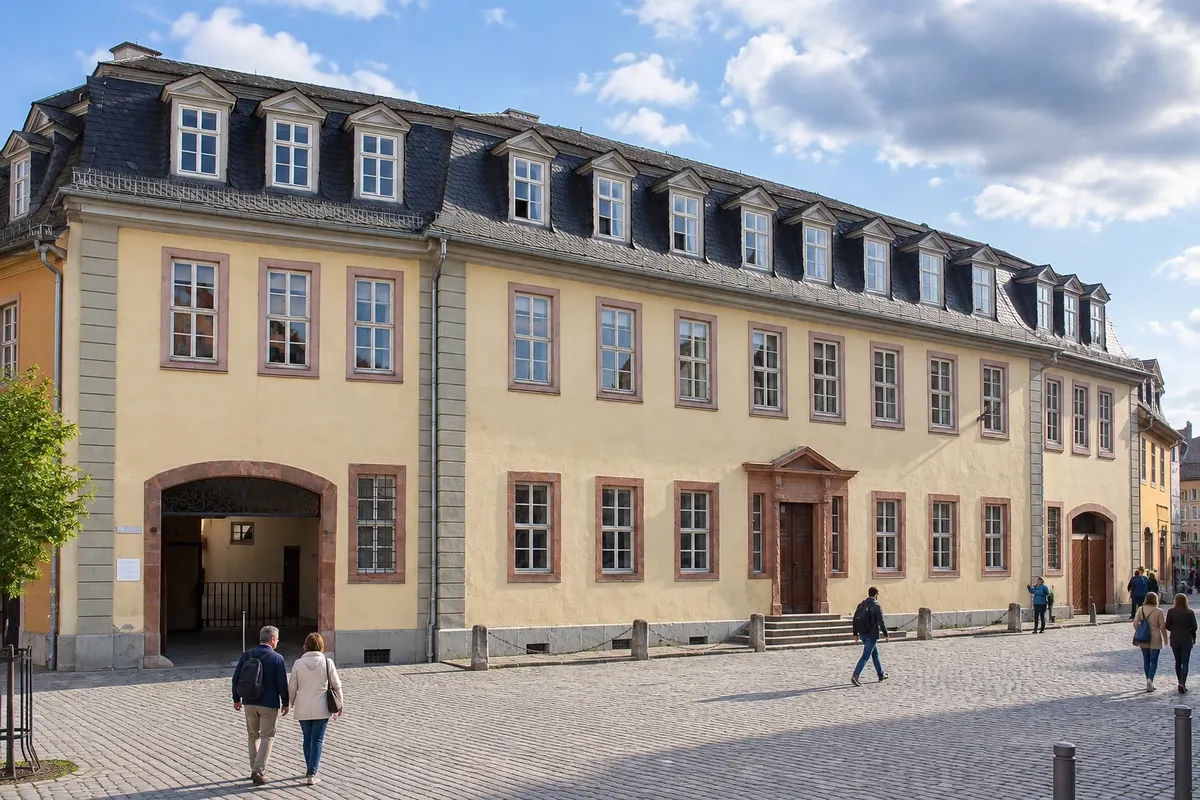
Goethe National Museum

The house on the Frauenplan where Goethe lived for about 50 years and died in 1832, with original furniture, collections, a private library and the permanent exhibition about the writer.

Schiller's House (Schillers Wohnhaus)
Weimar · Thuringia · House-museum

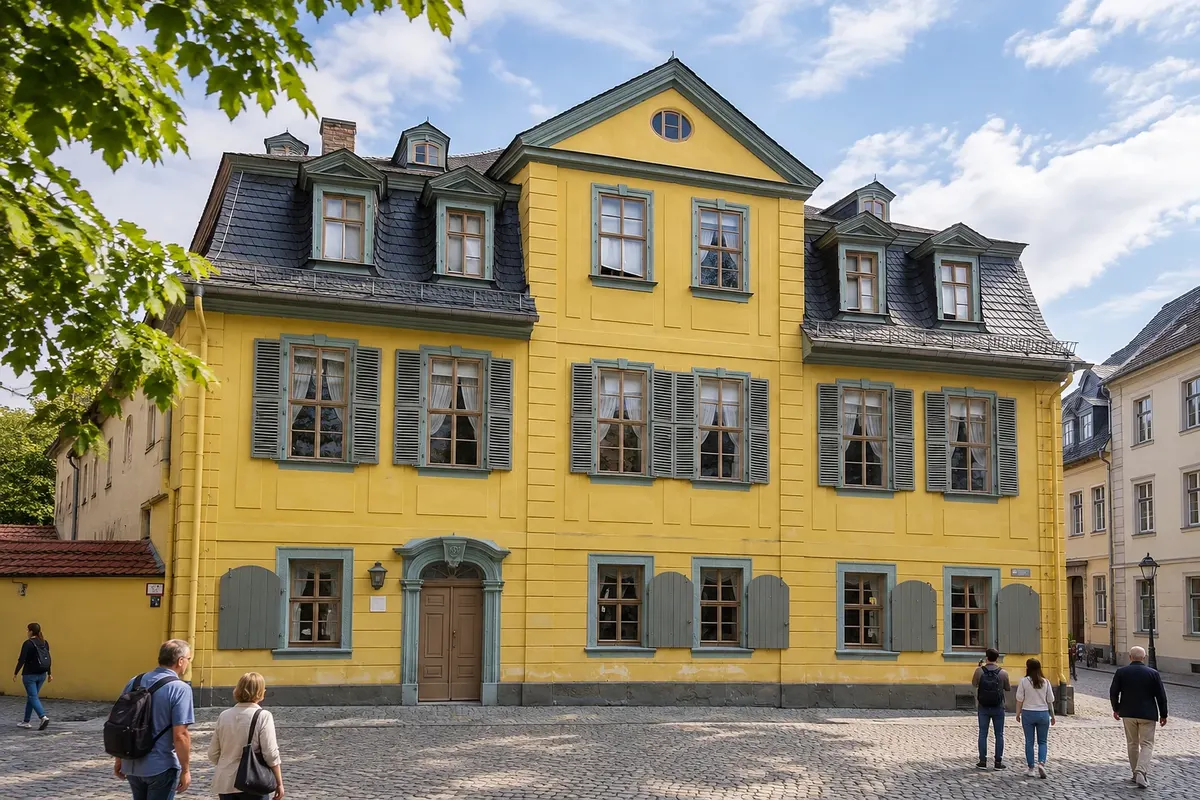
Schiller's House (Schillers Wohnhaus)

The house that Friedrich Schiller bought in 1802 and where he died in 1805. The study preserves the writer’s desk and bed; it was there that he wrote William Tell.

Severikirche (St. Severi)
Erfurt · Thuringia · Cerkev

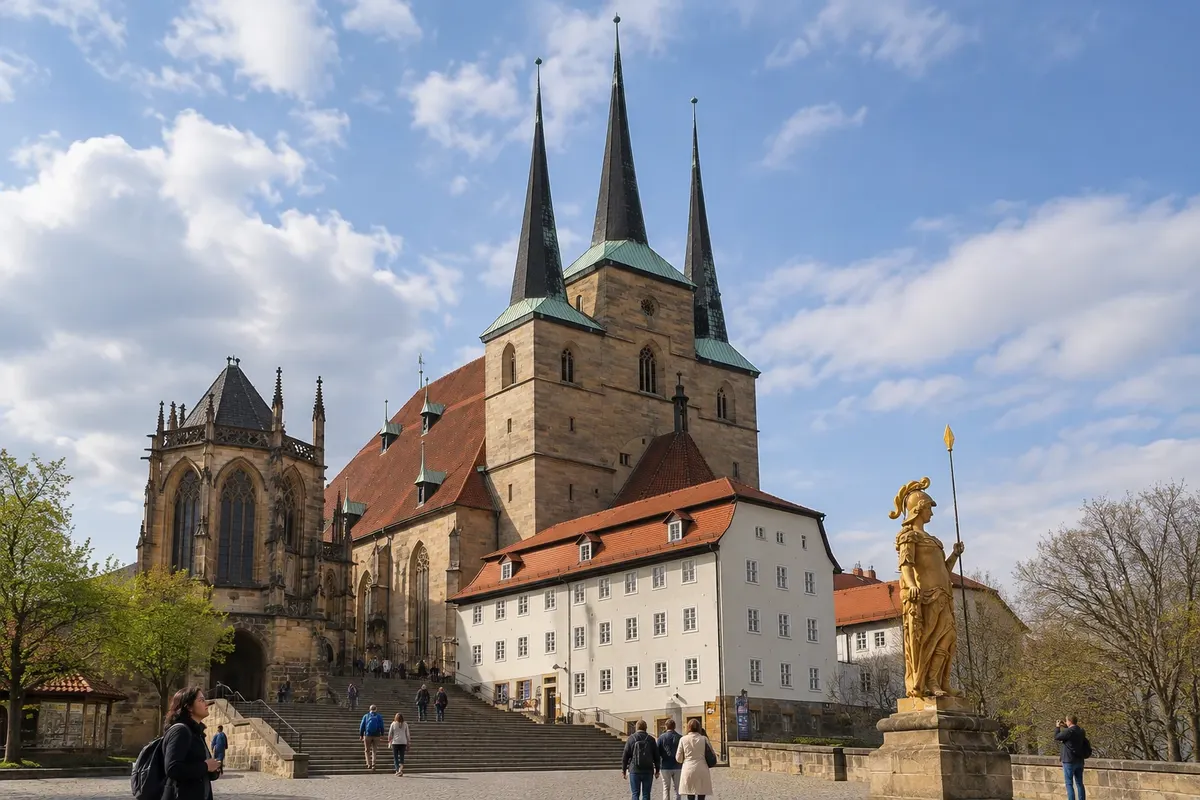
Severikirche (St. Severi)

Gothic church next to the cathedral, at the top of the Domberg. It is a five-aisled hall church with an almost square plan, three pointed towers and the sarcophagus of São Severo with 14th-century reliefs.

Weimar and Erfurt – prikaži dodatne kraje (14)
Domplatz
Erfurt · Thuringia · Trg

Domplatz

One of the largest squares in Germany, at the foot of the cathedral and São Severo. It features old houses, a market, summer performances and a Christmas market at the end of the year.

Duchess Anna Amalia Library
Weimar · Thuringia · Architecture

Duchess Anna Amalia Library

Historic library with the Rokokosaal, an oval hall from 1766, World Heritage. Goethe worked there for decades. Daily visitor numbers are limited.

Bauhaus Museum Weimar
Weimar · Thuringia · Muzej

Bauhaus Museum Weimar

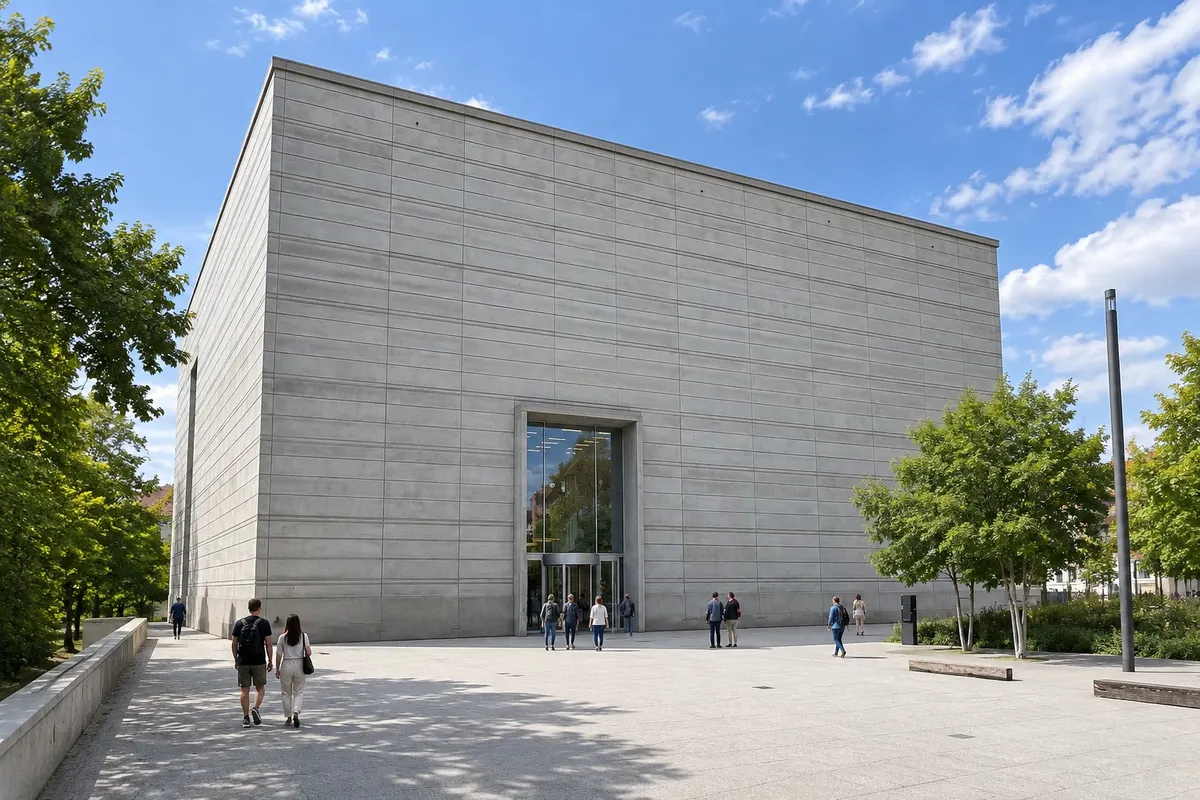
Museum of the Bauhaus school, founded in Weimar in 1919, housed in a new building. The permanent exhibition displays furniture, objects and ideas of the school based on the Weimar collection.

Krämerbrücke (Merchants' Bridge)
Erfurt · Thuringia · Most

Krämerbrücke (Merchants' Bridge)

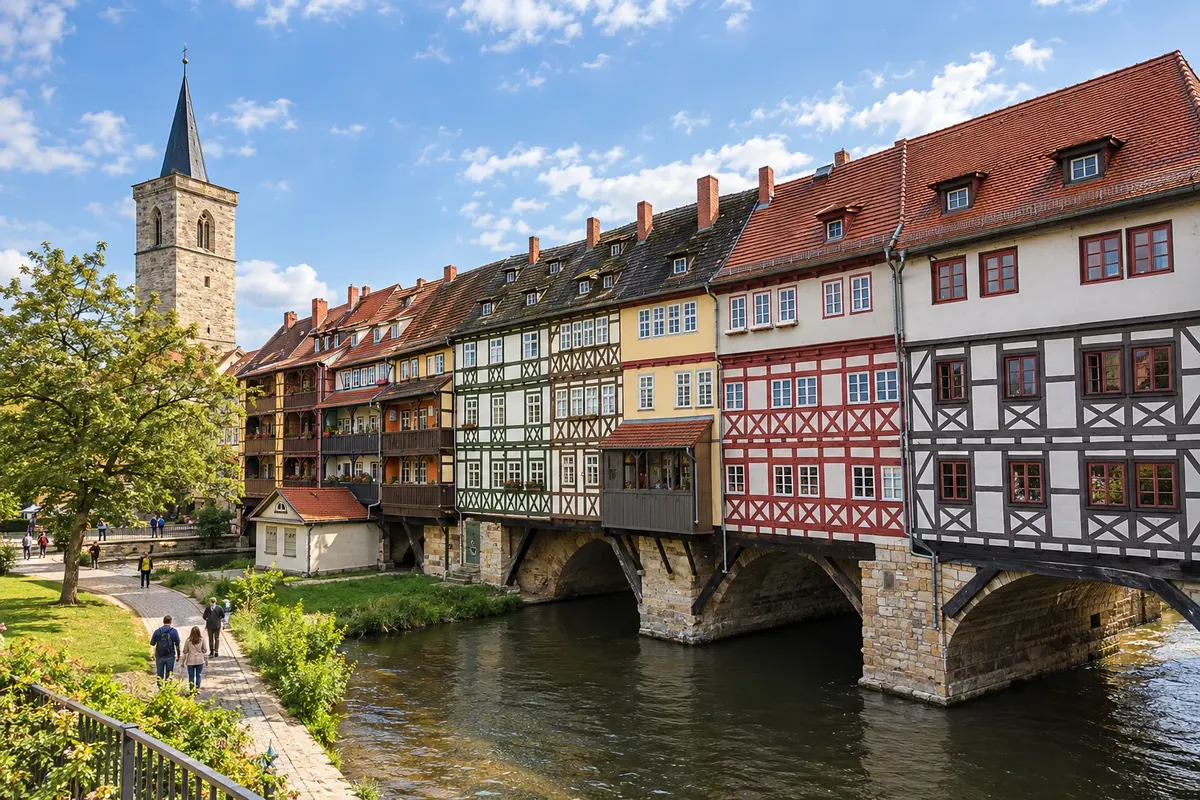
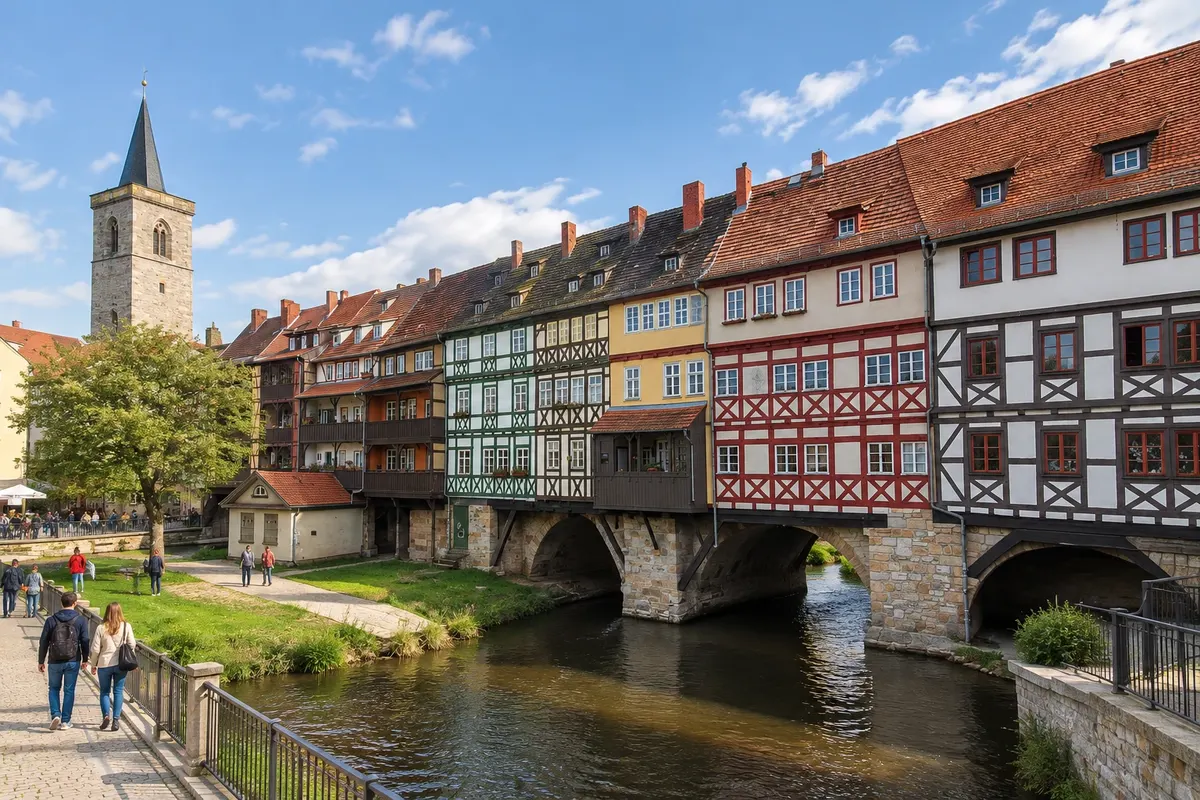
Stone bridge dating from 1325 over the river Gera, lined on both sides with half-timbered houses. With 32 houses, it is the longest bridge in Europe with houses along its entire length.

Medieval Mikveh of Erfurt
Erfurt · Thuringia · Historic site

Medieval Mikveh of Erfurt

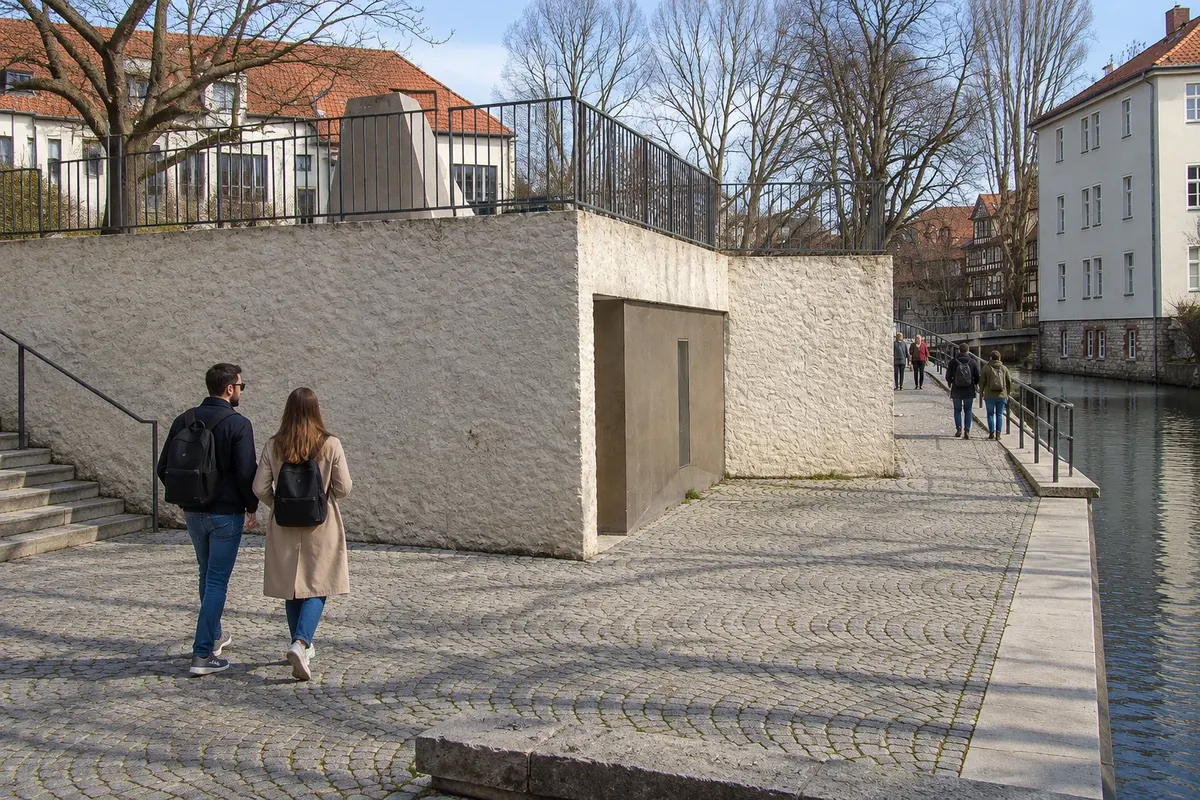
13th-century Jewish ritual bath, beside the Gera River, rediscovered in 2007. It is part of the World Heritage of Erfurt’s medieval Jewish heritage and is visited with a guide.

Weimar City Palace (Stadtschloss Weimar)
Weimar · Thuringia · Palace

Weimar City Palace (Stadtschloss Weimar)

Former palace of the dukes of Weimar, rebuilt after the 1774 fire with Goethe leading the work. The restored east wing houses the permanent exhibition Weimarer Klassik.

Park on the Ilm (Park an der Ilm)
Weimar · Thuringia · Park

Park on the Ilm (Park an der Ilm)

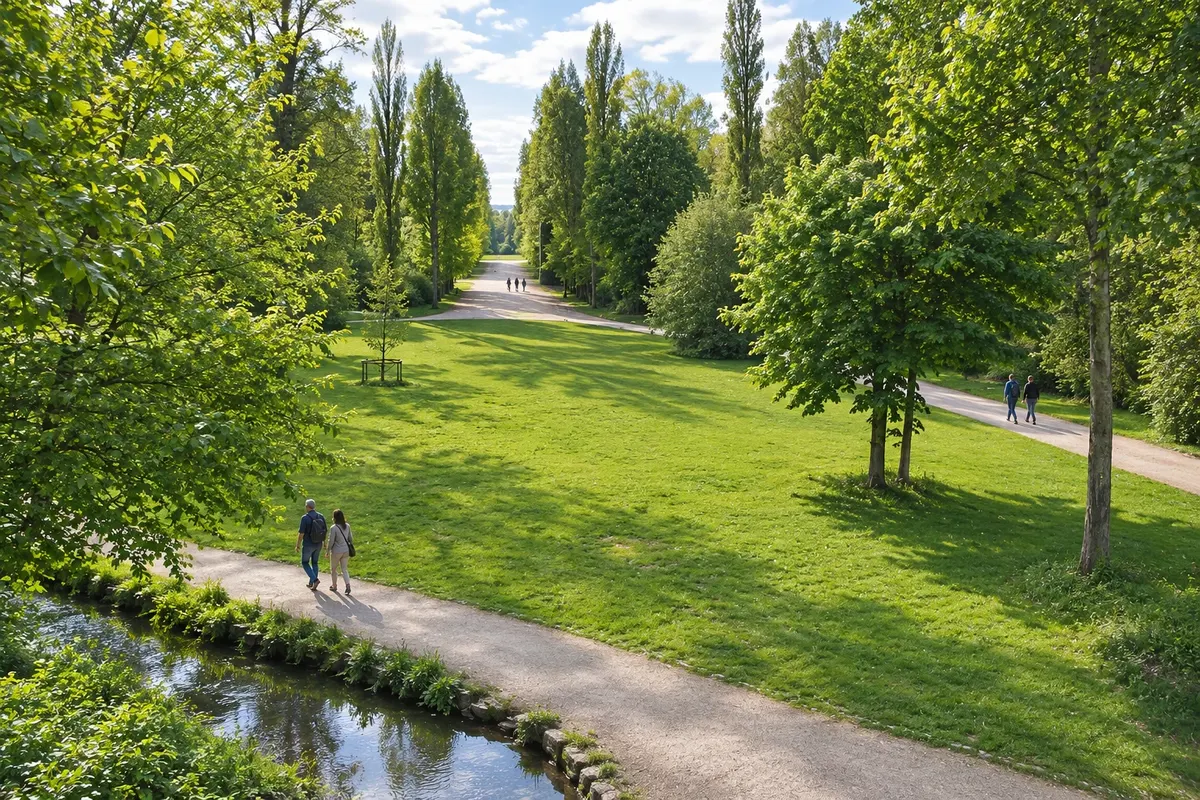
An English-style garden of 48 hectares along the Ilm river, created from 1776 with Goethe's involvement. It features the Römisches Haus, the Shakespeare monument and Goethe's garden house.

Petersberg Citadel (Zitadelle Petersberg)
Erfurt · Thuringia · Grad

Petersberg Citadel (Zitadelle Petersberg)

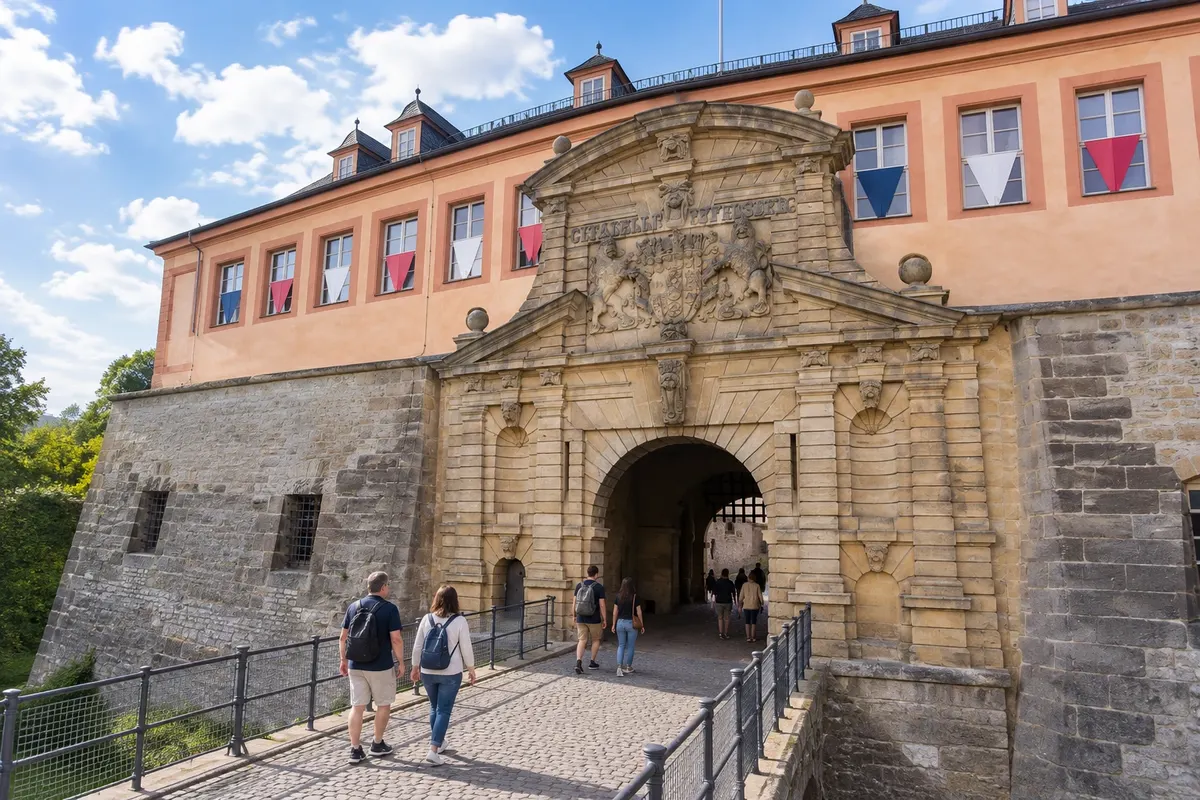
Baroque star-shaped fortress, built from 1665 on the hill behind the cathedral. It has bastions with views, an exhibition in the Kommandantenhaus and listening tunnels that are visited with a guide.

Augustinian Monastery of Erfurt (Augustinerkloster)
Erfurt · Thuringia · Cerkev

Augustinian Monastery of Erfurt (Augustinerkloster)

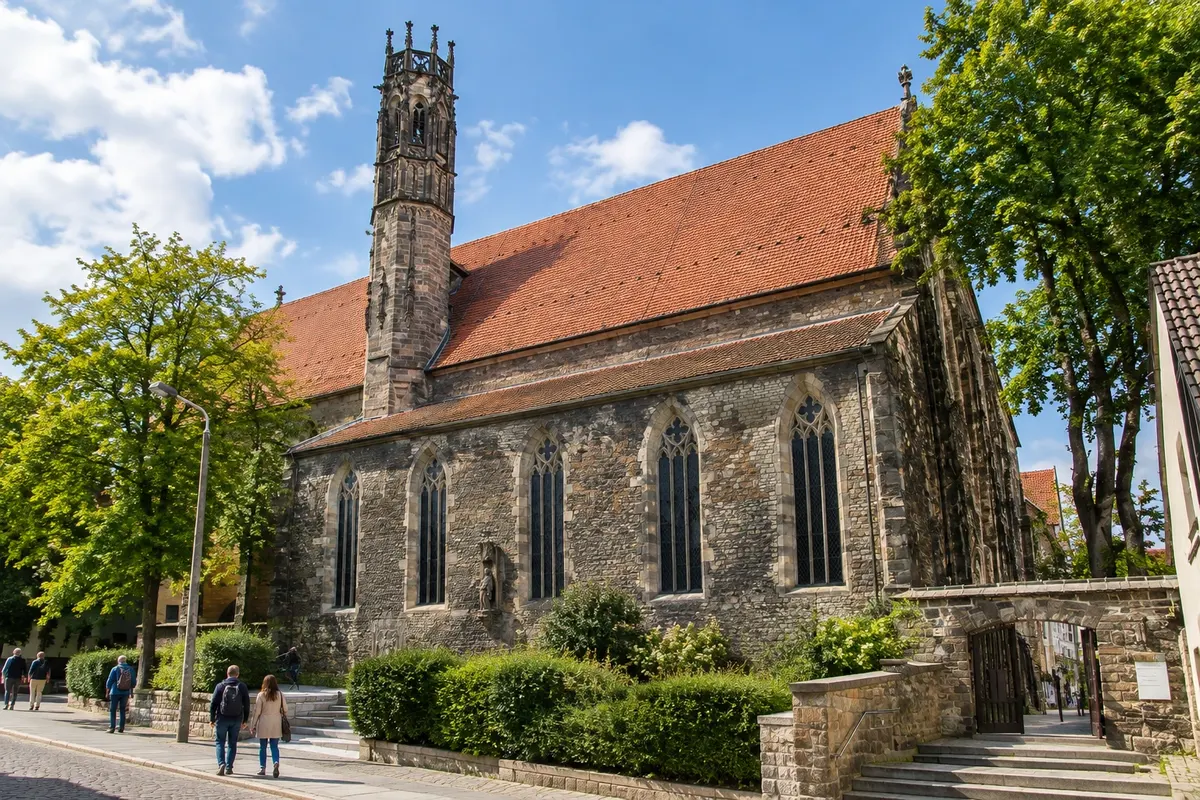
13th-century Augustinian convent where Martin Luther lived as a monk from 1505 to 1511. It has a church with 14th-century stained glass, a cloister, an exhibition about Luther and daily guided tours.

Goethe's Garden House (Goethes Gartenhaus)
Weimar · Thuringia · House-museum

Goethe's Garden House (Goethes Gartenhaus)

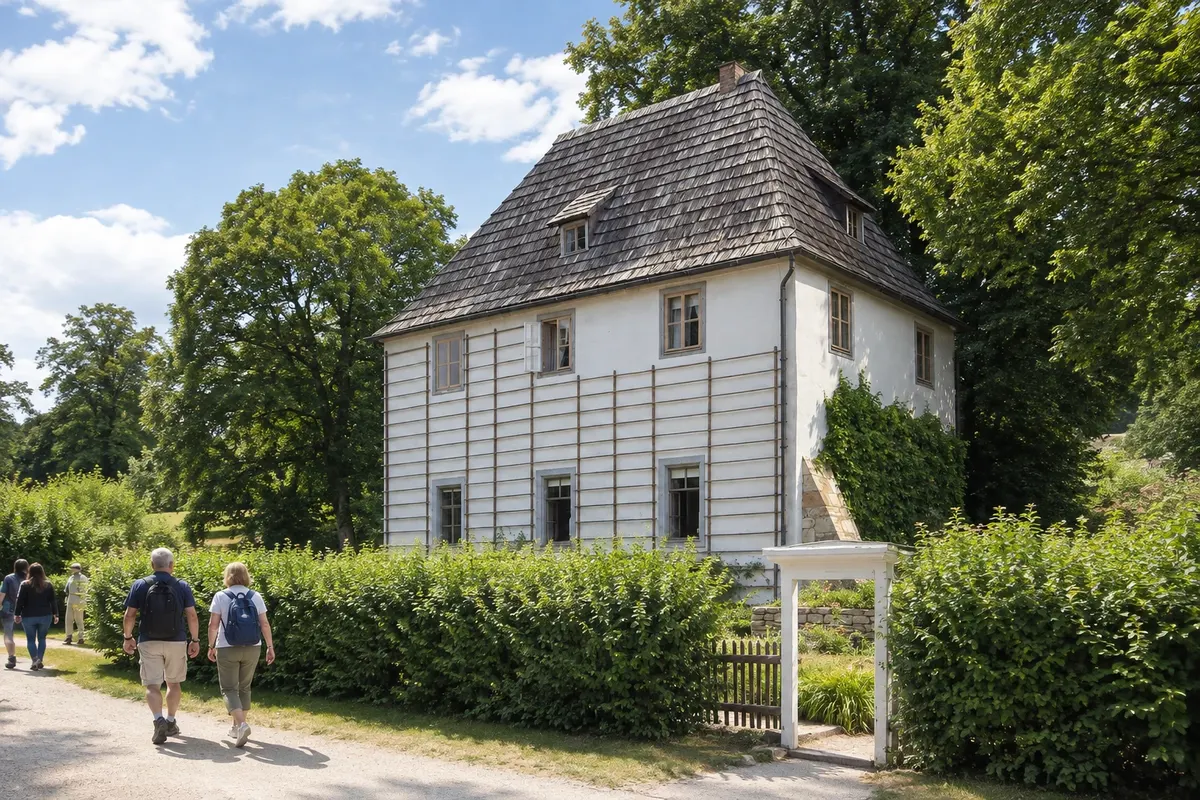
Small garden house on the slope of Park an der Ilm where Goethe lived from 1776 to 1782 after arriving in Weimar. Closed in winter.

Fischmarkt (Fish Market)
Erfurt · Thuringia · Trg

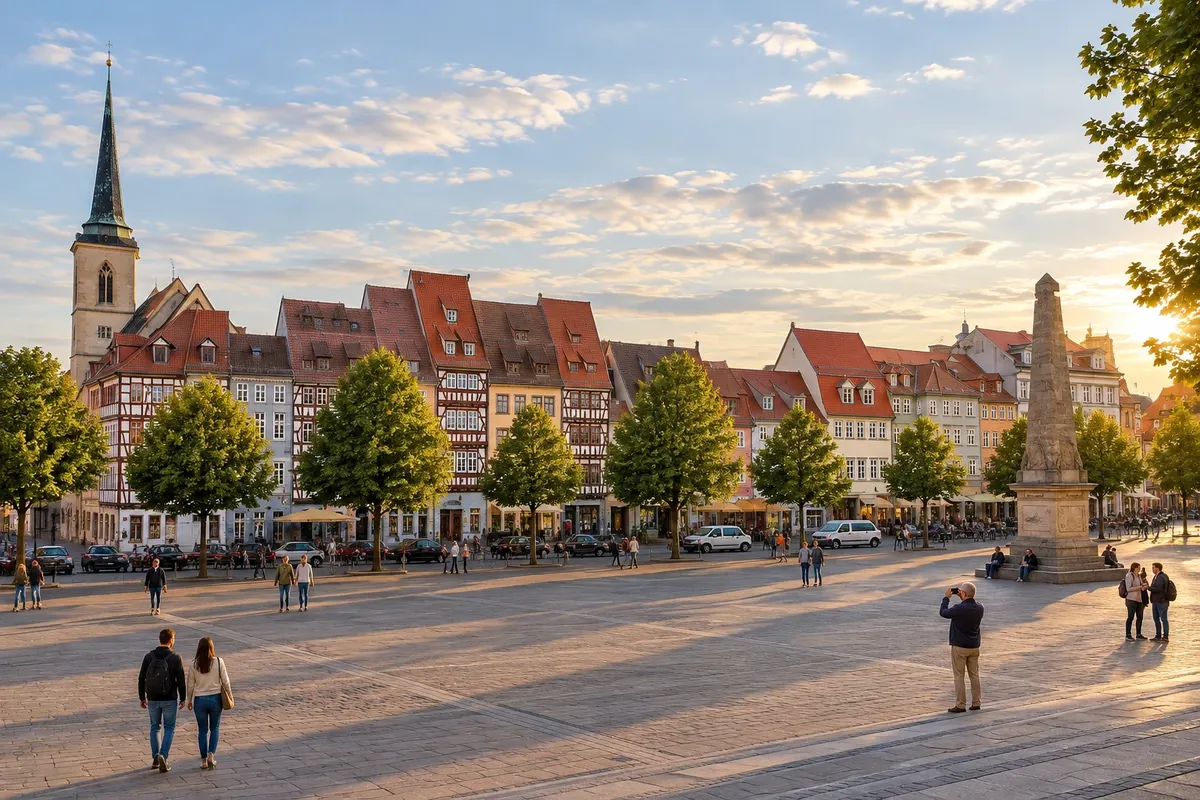
Fischmarkt (Fish Market)

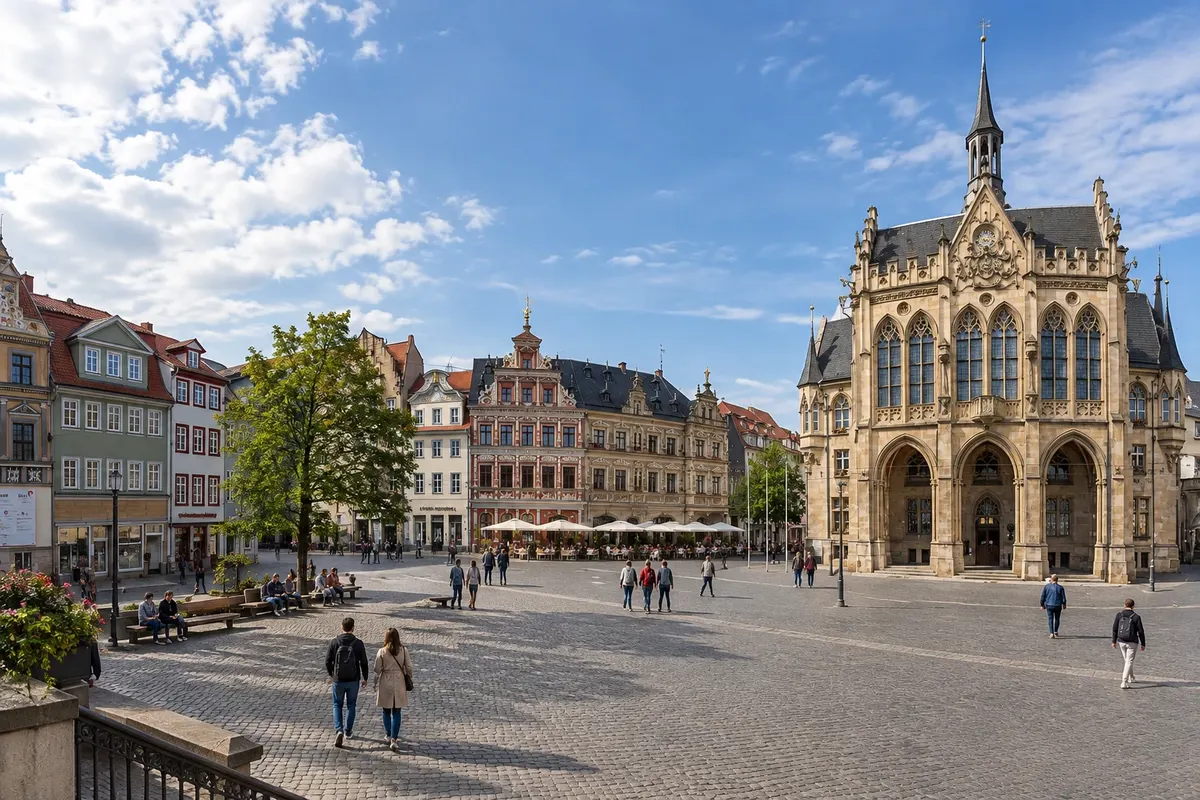
The historic heart of Erfurt’s old town, with the neo-Gothic town hall from 1875, Renaissance houses such as the Haus zum Breiten Herd, and the warrior column Römer from 1591.

Goethe–Schiller Monument
Weimar · Thuringia · Monument

Goethe–Schiller Monument

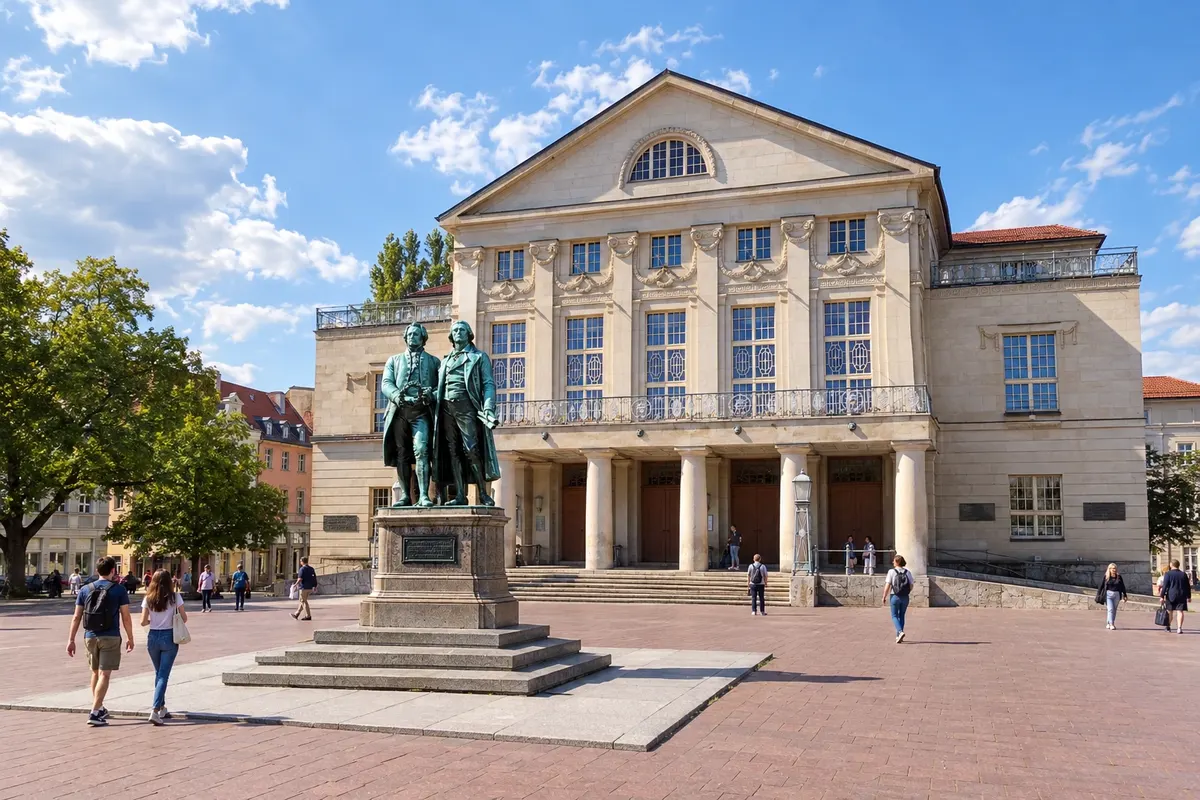
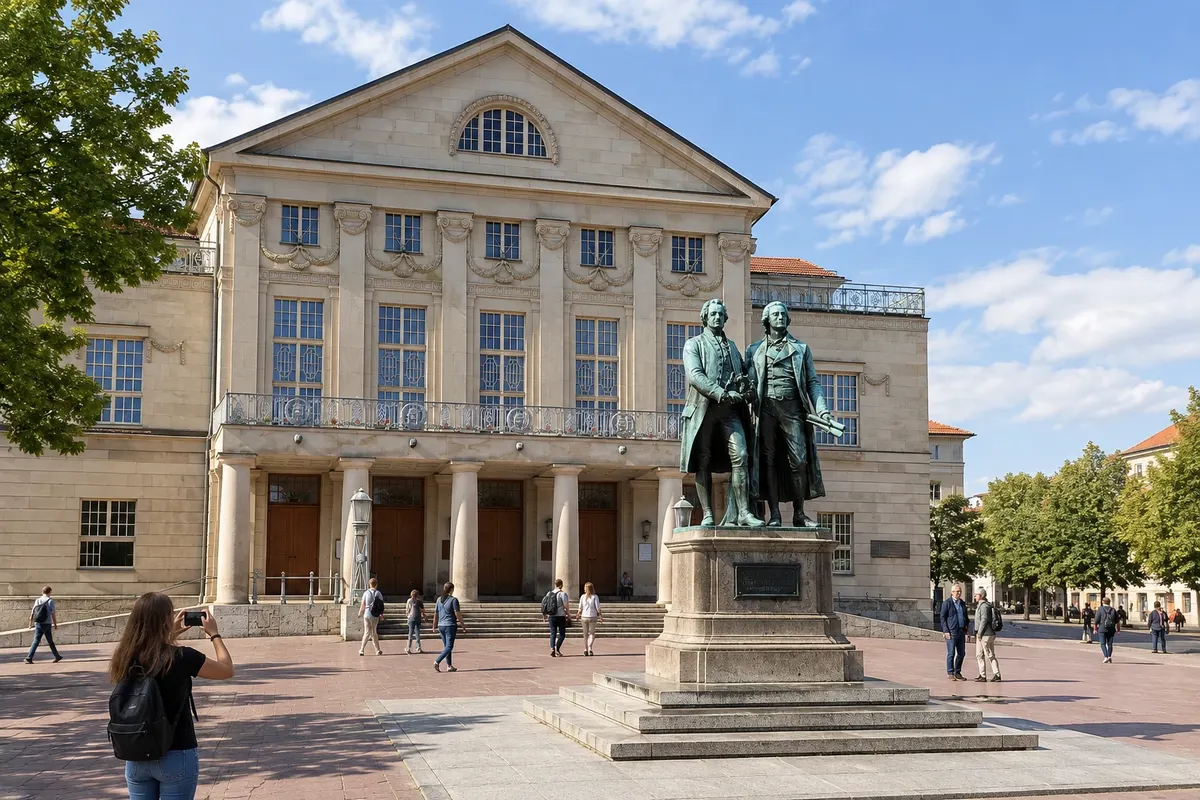
Bronze monument from 1857 showing Goethe and Schiller side by side, in front of the National Theatre on Theaterplatz. It was in that theatre that the Weimar Constitution was approved in 1919.

Buchenwald Memorial (Gedenkstätte Buchenwald)
Weimar · Thuringia · Spominsko obeležje

Buchenwald Memorial (Gedenkstätte Buchenwald)

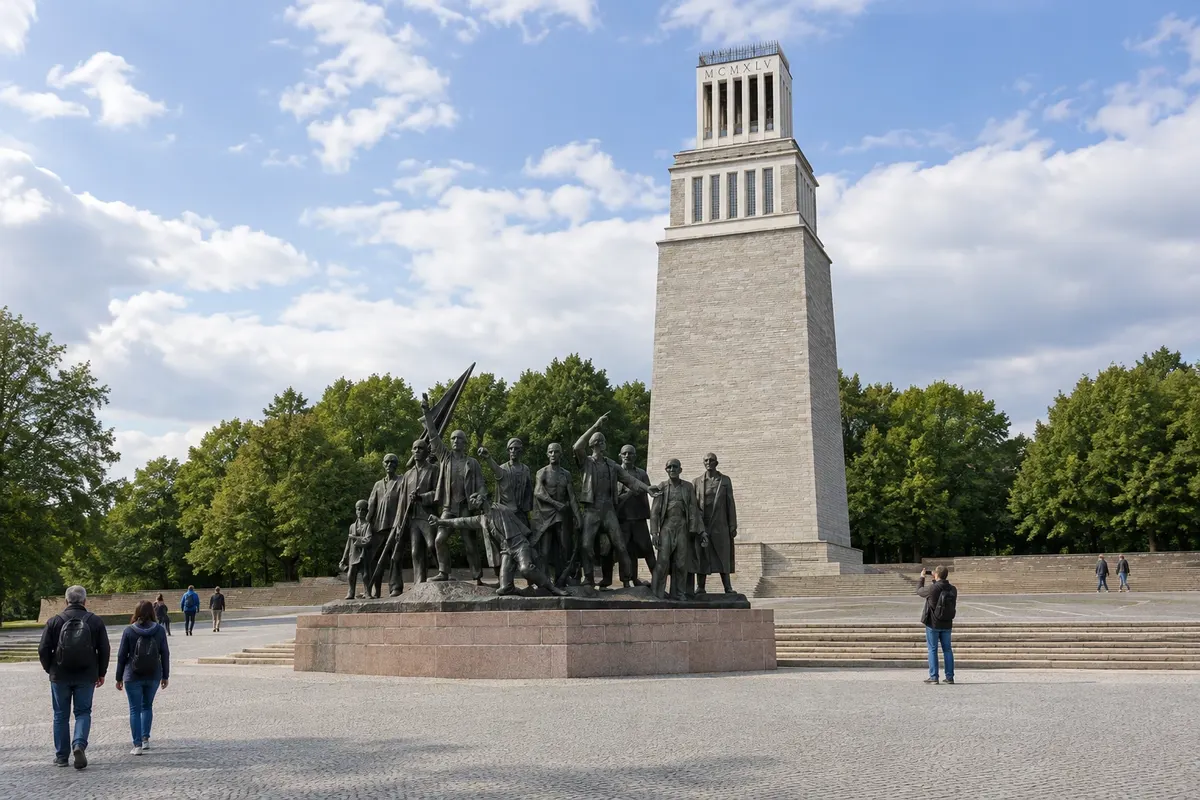
Memorial on the site of the Nazi concentration camp Buchenwald, on the Ettersberg hill near Weimar. Exhibitions about the prisoners and about the Soviet postwar camp. A place of remembrance.

Wartburg Castle
Erfurt · Thuringia · Grad

Wartburg Castle

Medieval castle above Eisenach, about 60 km from Erfurt, a World Heritage Site. Luther translated the New Testament there into German; the Romanesque Palas is seen on a guided tour.

Kaj izbrati pred odhodom

Izleti – Weimar and Erfurt

Izhodišče, trajanje, potek, vključene storitve in okvirna cena vsakega izleta.

Goethe-Nationalmuseum: Goethe’s house on the Frauenplan

Odhod: Weimar, Frauenplan (center) Walking visit, with audio guide about 2 to 3 hours Dopoldne easy (internal stairs)

The Baroque house on the Frauenplan was Johann Wolfgang von Goethe’s residence for almost fifty years: he lived there as a tenant from 1782 to 1789 and as owner from 1792 until his death in 1832. The poet planned the layout and decoration of the rooms, and much of the furniture from his final years is preserved. The audio-guide route has 16 stops, from the courtyard to the garden, and covers the reception rooms, the art and natural history collections he assembled, and the simple-looking study at the rear. The Goethe-Nationalmuseum was founded in 1885, shortly after the death of the poet’s last grandson, and acquired annex buildings in 1913 and 1935. These house the permanent exhibition about Goethe’s life around 1800, organized by themes, with about 46 highlight objects, including the poet’s travel coat and the head of the Juno Ludovisi. Visitor numbers in the house are limited for conservation reasons, so there can be queues on busy days. The ensemble is part of the Classical Weimar site, inscribed by UNESCO in 1998. Closed on Mondays.

Kraji na poti: Goethe-Nationalmuseum.

Vključuje: Separate paid ticket, covering the house and the permanent exhibition; the audio guide in English and German is included with the ticket. There are combination tickets with other houses of the Klassik Stiftung Weimar and a city tourist card that covers several museums; check the current table. There is no visit in Portuguese.

Nasvet: Arrive near opening time: the house admits a limited number of people at a time and waits grow by late morning. Book your time slot online in high season. After the visit, cross the Frauenplan to the Park an der Ilm, a few minutes on foot, to see the Gartenhaus, the poet’s first house in Weimar.

Najboljši čas za obisk: All year round, Tuesday to Sunday. From April to October the opening hours are longer; from November to March the house closes earlier and there is less traffic.

Schillers Wohnhaus and Theaterplatz: the Goethe and Schiller monument

Odhod: Weimar, Schillerstraße (center) Ogled peš Približno uro in pol Dopoldne ali popoldne easy (stairs up to the attic)

Friedrich Schiller bought the house on Schillerstraße in 1802 and lived there with his family until his death in 1805. During those three years he wrote the plays Die Braut von Messina (The Bride of Messina) and Wilhelm Tell. The study is in the attic (the mansard), with the original desk and bed; on the lower floors are the rooms of his wife, Charlotte, and the children, furnished with items from the family estate. The city of Weimar bought the house in 1847 and made it the first memorial to a poet in Germany. In 1988 an annex building was added that serves as the entrance and hosts temporary exhibitions. From the house it is only a short walk to Theaterplatz. In front of the Deutsches Nationaltheater stands the Goethe-Schiller-Denkmal, the 1857 bronze monument by Ernst Rietschel, showing the two poets side by side holding a laurel wreath; it is the city’s most used image. In that same theatre, in 1919, the national assembly approved the constitution of the Weimar Republic. The square also houses the Bauhaus-Museum Weimar on the opposite side.

Kraji na poti: Schillers Wohnhaus, Goethe-Schiller-Denkmal.

Vključuje: Separate paid admission for Schiller’s house, with an audio guide included; the square and the monument are open and free to enter. There is a combined ticket with Goethe’s house and other museums of the Klassik Stiftung; check the current price list.

Nasvet: Visit Schiller’s house on the same day as Goethe’s house: they are about a 5-minute walk from each other. The monument often has a photo queue at midday; early in the morning the square is empty. Check opening days before you go, because the house is closed one day a week.

Najboljši čas za obisk: All year round. From April to October the opening hours are longer; in December Theaterplatz often hosts part of the Christmas market.

Herzogin Anna Amalia Library: the Rokokosaal

Odhod: Weimar, Platz der Demokratie (center) Walking visit, with timed entry Približno 1 uro Dopoldne ali popoldne Lahko

The library occupies the Grünes Schloss (Green Castle), a Renaissance building from 1562–1565 that was adapted and opened as a library in 1766 by Duchess Anna Amalia. The centerpiece of the visit is the Rokokosaal, the oval hall of 1766, with two tiers of wooden galleries, shelves, busts and the portrait of Grand Duke Carl August. Goethe served as director of the library from 1797 to 1832. On September 2, 2004 a fire, caused by a short circuit, destroyed the roof and about 50,000 volumes, 12,500 of them irreplaceable, and damaged another 62,000; the hall was restored and reopened on October 24, 2007, the duchess’s anniversary. Today the holdings exceed 1 million items, with about 850,000 in the research library. Visitor numbers to the Rokokosaal are limited per day, at scheduled times, and many places sell out in advance. The visit also includes the Bücherturm (book tower) and an exhibition on the collection’s history; the Studienzentrum, the modern part across the square, is for readers’ use. The library has been part of the Weimar Classicism UNESCO site since 1998.

Kraji na poti: Herzogin Anna Amalia Bibliothek.

Vključuje: Separate paid ticket, by time slot, with audio guide. Daily capacity is limited: part of the tickets is sold online in advance and a small number at the box office from opening, on a first-come, first-served basis. Backpacks and large bags are stored in the cloakroom.

Nasvet: Buy the ticket online several days in advance, especially from April to October and on weekends. If you arrive without a reservation you should be at the door before opening. Photographing without flash is usually allowed; confirm at the entrance. The visit lasts under an hour and pairs well with Goethe’s house, a 5-minute walk away.

Najboljši čas za obisk: All year round, Tuesday to Sunday. From November to March more tickets are available on the day; from May to September book in advance.

Park an der Ilm and Goethe’s Gartenhaus: the park by the river

Odhod: Weimar, Platz der Demokratie (center) Walk through the park about 2 to 3 hours Popoldne easy (dirt trails)

The Park an der Ilm covers 48 hectares and follows the Ilm River for about 1 km beside the center of Weimar. It originated as an English landscape park from 1776, when Duke Carl August gave Goethe a small house with a garden on the east bank; the ensemble was completed in 1797 with the construction of the Römisches Haus (Roman House), a classical-style pavilion on the higher west bank. The Gartenhaus was Goethe’s first residence in Weimar, from 1776 until he moved to the Frauenplan in 1782, and it remained his retreat until the end of his life. There he wrote the ballad Erlkönig (The Erlking) and the poem An den Mond (To the Moon). On the ground floor are the small dining room and the kitchen; upstairs are four rooms with the tall writing desk, the folding bed, and the poet’s drawings. The garden, divided into a shaded slope, orchard and kitchen garden, contains the Stein des guten Glücks (Stone of Good Luck), from 1777, a sphere on a cube. Walkways through the park lead to the Liszt-Haus, the Roman House, the Shakespeare monument and bridges over the Ilm. It is part of the Classical Weimar UNESCO site.

Kraji na poti: Park an der Ilm, Goethes Gartenhaus.

Vključuje: The park is open year-round and entry is free. The Gartenhaus and the Römisches Haus have separate paid admission, with the possibility of a combined ticket with other Klassik Stiftung museums; check the current price list. There is no lighting on the trails at night.

Nasvet: The Gartenhaus is closed in winter and one day a week: check before you go. Enter from the Stadtschloss side, follow the east bank to the Gartenhaus and return along the west bank, ascending to the Römisches Haus for the valley view. Wear closed shoes after rain, as the trails are dirt.

Najboljši čas za obisk: From April to October, with the Gartenhaus open and the park green; May and June have the trees in bloom, and October shows autumn colors. In winter only the park is available.

Bauhaus-Museum Weimar and the modernity quarter: Museum Neues Weimar and Haus am Horn

Odhod: Weimar, Stéphane-Hessel-Platz (next to Theaterplatz) Walking visit, with a walking section to the Haus am Horn about 3 to 4 hours Dopoldne ali popoldne Lahko

The Bauhaus school was founded in Weimar in 1919 by Walter Gropius and remained in the city until 1925, before moving to Dessau. The Bauhaus-Museum Weimar, a gray cube-shaped building opened in April 2019 on the school’s centenary, houses the oldest collection of Bauhaus workshop pieces, started by Gropius himself in the 1920s and now numbering around 13,000 objects. The permanent exhibition Das Bauhaus kommt aus Weimar (The Bauhaus comes from Weimar) displays furniture, lamps, ceramics, textiles and toys, including Peter Keler’s cradle and Marianne Brandt’s kettle, and explains the school’s conflicts with the city. Next door is the Museum Neues Weimar, the former Grand Ducal Museum of 1869, devoted to art around 1900, with Henry van de Velde and the movement’s beginnings. About a 20-minute walk, on the other side of the Park an der Ilm, is the Haus am Horn, a model house designed by Georg Muche in 1923 for the Bauhaus’s first exhibition, the only school building in Weimar. The former school buildings, today the Bauhaus-Universität, designed by Van de Velde, are close to Theaterplatz. The Bauhaus site in Weimar is UNESCO World Heritage since 1996.

Kraji na poti: Bauhaus-Museum Weimar.

Vključuje: Separate paid admission for the Bauhaus-Museum, with a combined ticket available for the Museum Neues Weimar and the Haus am Horn; check the current price list. The university buildings are viewed from the outside; internal access is by guided tour on certain days.

Nasvet: The Bauhaus-Museum is closed on Tuesdays, unlike Goethe’s and Schiller’s houses, which close on Mondays: plan your days accordingly. Start at the museum, continue to the Museum Neues Weimar and finish at the Haus am Horn, crossing the Park an der Ilm along the way.

Najboljši čas za obisk: All year. From April to October the Haus am Horn and the Gartenhaus in the park are open, which can make a full day; in the colder months the museum closes earlier.

Gedenkstätte Buchenwald: the concentration camp memorial on the Ettersberg

Odhod: Weimar Hauptbahnhof or Goetheplatz, bus 6 City bus 6 (about 20 min) and walking on the memorial site at least 3 hours on site, half a day including travel Dopoldne ali ves dan easy on the terrain; heavy content

The Buchenwald concentration camp was established by the SS in July 1937 on the Ettersberg hill, about 10 km from Weimar’s center. Until April 1945 about 280,000 prisoners from more than 50 nationalities passed through it: political opponents, Jews, Sinti and Roma, Jehovah’s Witnesses, homosexuals, prisoners of war and, in the final months, deportees from camps in the east. About 56,000 people died there or on the evacuation marches. On April 11, 1945 the US army reached the camp, by then controlled by prisoners of the internal resistance. From 1945 to 1950 the Soviet administration used the site as Special Camp No. 2, where about 7,000 detainees died. The memorial preserves the gate with the inscription Jedem das Seine (to each his own), the foundations of the barracks, the crematorium, the cells and the former storage building, which houses the historical exhibition. In the visitor center next to the car park there is a 30-minute introductory film and the meeting point for guided tours. Other exhibitions deal with the Soviet camp and the history of the memorial itself, erected by the GDR in 1958 on the southern slope, with the bell tower and the mass graves. It is closed on Mondays; the outdoor area can be visited every day until dusk.

Kraji na poti: Gedenkstätte Buchenwald.

Vključuje: Visiting the site and the exhibitions is free of charge. Public guided tours and the multimedia guide are paid separately; the app with the same content is free. The main exhibition requires an online time-slot reservation; without a reservation, entry depends on availability. The city bus 6 fare is paid separately.

Nasvet: The memorial recommends not taking children under 12 years old to the museum, the cells and the crematorium. Reserve the exhibition time slot in advance and watch the introductory film before walking. The site is large and exposed to the wind: bring a coat even in summer. Check the return bus timetable, which runs only a few times a day; the correct bus is headed to Buchenwald, not Ettersburg.

Najboljši čas za obisk: All year, Tuesday to Sunday. From April to October the exhibitions stay open longer; from November to March they close mid-afternoon and the hill is cold.

Prikaži dodatne izlete (8)

Weimar on foot: Markt, Herderkirche with Cranach altar and the Stadtschloss courtyard

Odhod: Weimar, Theaterplatz Peš po starem mestnem jedru Približno 2 uri Dopoldne ali pozno popoldne Lahko

Weimar’s center is small and flat and can be seen in a morning. Start at the Goethe-Schiller-Denkmal on Theaterplatz and follow Schillerstraße, a pedestrian street with shops and cafés, to the Markt, the market square. There you’ll find the neo‑Gothic town hall of 1841 with a Meissen porcelain carillon, the Cranachhaus with its Renaissance façade where the painter Lucas Cranach the Elder spent his last year and died in 1553, and the Hotel Elephant, mentioned in Thomas Mann’s novel Lotte in Weimar. On weekdays there are bratwurst stands and Thuringian products in the square. Two blocks to the north is the Herderkirche, the city church of Saints Peter and Paul, a late Gothic hall church erected between 1498 and 1500. The altar triptych was begun by Cranach the Elder and finished by his son in 1555; the central panel shows Luther and Cranach himself at the foot of the cross. Johann Gottfried Herder was superintendent of this church from 1776 to 1803 and is buried there; his 1850 statue stands in the square opposite. Johann Sebastian Bach played the organ there in the years he worked at the Weimar court. Finish by descending the Platz der Demokratie, between the Anna Amalia library and the Stadtschloss, the ducal residential palace whose courtyard opens onto the Park an der Ilm.

Kraji na poti: Goethe-Schiller-Denkmal, Park an der Ilm.

Vključuje: Free walk: streets, squares and the palace courtyard are open and free to enter. The Herderkirche accepts donations. Paid guided walking tours are available, departing from the tourist office at the Markt.

Nasvet: The Herderkirche is closed during services and usually has reduced hours in winter; visit mid-morning. At the Markt, the tourist office sells the city’s sightseeing card, which covers the bus and several museums. Avoid visiting during the Zwiebelmarkt in October if you dislike crowds: the squares fill with stalls.

Najboljši čas za obisk: All year. From May to September there are tables in the squares; in early October the Zwiebelmarkt (onion market) takes place and in December the Christmas market is held at the Markt.

Domberg of Erfurt: the Cathedral of St. Mary and the Severikirche above the Domplatz

Odhod: Erfurt, Domplatz Walking visit, climbing the staircase Približno 2 uri Dopoldne easy (staircase of 70 steps)

Two Gothic churches side by side on top of a hill, linked to the square by a 70-step staircase: that is the image that identifies Erfurt. The Erfurter Dom (Cathedral of St. Mary) grew from a church founded in 742 by Boniface when he created the diocese of Erfurt. The high-Gothic choir was built from 1349 atop a huge retaining wall, with tall windows whose 14th-century stained glass is largely preserved. Inside, notice the 14th-century choir stalls, the Romanesque enthroned Madonna and the Wolfram, a 12th-century bronze candelabrum shaped like a man. In the central tower is the Gloriosa, a bell cast in 1497 by Geert van Wou, weighing about 11.4 tonnes, regarded as the largest medieval swinging bell still in use; it rings only on a few dates each year. Martin Luther was ordained a priest in the cathedral in 1507. The Severikirche beside it is a Gothic hall church of five naves begun in 1278, with the sarcophagus of Saint Severus from 1365, a stone Madonna from 1345 and a baptismal font from 1467 about 15 m high. The Domplatz below is one of Germany’s largest market squares and hosts fairs, the Christmas market and, in summer, the Domstufen-Festspiele, open-air opera performances on the steps.

Kraji na poti: Erfurter Dom, Severikirche, Domplatz.

Vključuje: Entrance to both churches is free, with a suggested donation. Guided tours and the climb to the tower with the Gloriosa, offered on certain days, are paid separately; check the current rates. The Domstufen-Festspiele performances have their own tickets.

Nasvet: On Sundays the churches open only in the afternoon after services; from Monday to Saturday visit in the morning when there are fewer people. Climb the staircase late in the day for the view over the square and façades. In July and August the Festspiele stage often covers part of the staircase; check before you go.

Najboljši čas za obisk: All year round. In July and August the Domstufen-Festspiele usually take place; from late November through December the Domplatz hosts the Christmas market, with a tree and a Ferris wheel.

Krämerbrücke: the bridge of houses over the Gera River and the Ägidienkirche tower

Odhod: Erfurt, Benediktsplatz or Wenigemarkt Short walk, with climb to the tower Približno uro in pol Dopoldne ali popoldne easy (narrow staircase in the tower)

The Krämerbrücke (merchants’ bridge) spans a branch of the Gera River in the middle of Erfurt’s old town. It was wooden until 1325, when it was rebuilt in stone, measuring about 120 m long with six arches. On both sides of the street that runs across it houses were built: there were 62 narrow ones initially, later merged into the 32 timber-framed houses that exist today. It is the longest run of inhabited buildings on a bridge in Europe, and people still live on the upper floors. On the ground level are workshops and small shops selling Thuringian blue-printed fabrics, painted pottery, Lauscha glass, jewelry, carvings and regional food. Walking along the street you do not notice you are over water; the view of the houses resting on the arches is from below, from the riverbank near Wenigemarkt or from the neighboring bridge. At the eastern end stands the Ägidienkirche, the only one of the two chancel churches that remains: its tower can be climbed and offers views over the bridge’s roof, the Domberg and the city centre. At house number 31 is the Stiftung Krämerbrücke, with a small exhibition about the bridge’s history. In June the bridge and surrounding squares host the three-day medieval Krämerbrückenfest.

Kraji na poti: Krämerbrücke.

Vključuje: The bridge is a public street and there is no entrance fee. The climb to the Ägidienkirche tower requires a separate paid ticket and the foundation’s exhibition requests a contribution. Shops generally open Monday through Saturday.

Nasvet: Go early in the morning to photograph the street without people and return in the late afternoon when the light hits the façades as seen from the riverbank. The tower is closed on Mondays and has a narrow staircase; if you have difficulties with heights you may prefer the view from the Rathausbrücke bridge next to it. In June, during the Krämerbrückenfest, shops change their opening hours; check before you go.

Najboljši čas za obisk: All year. In the first half of June the Krämerbrückenfest usually takes place; in December the bridge is decorated for Christmas.

Fischmarkt, Rathaus and Anger: Old Erfurt center on foot

Odhod: Erfurt Hauptbahnhof Peš po starem mestnem jedru about 2 hours and 30 minutes Dopoldne ali popoldne Lahko

Erfurt has one of the largest medieval centers in Germany, lightly damaged by the war, and everything is walkable from the main station. Start at the Anger, the elongated square that was the wool and woad market (the dye plant that enriched the city in the Middle Ages) and today is the shopping street, with the Kaufmannskirche, the merchants’ church consecrated in 1364, where Bach’s parents married. Continue along Schlösserstraße to the Fischmarkt, the central square, mentioned in 1293 and a market site since then. There stand the neogothic Rathaus from 1870–1874, with murals about the city’s history, Faust and Luther, and two Renaissance houses: the Haus zum Breiten Herd, from 1584, and the Haus zum Roten Ochsen, from 1562, now home to the Kunsthalle art gallery. In the middle of the square, the column with the armed warrior, from 1591, reminded the archbishop of Mainz (Mayence) that citizens would defend their freedoms. From the Fischmarkt it is two minutes to the Krämerbrücke and five to the Domplatz via Marktstraße. Along the way are narrow lanes with half-timbered houses, such as Michaelisstraße, the old university street, founded in 1379, where Luther studied.

Kraji na poti: Fischmarkt, Krämerbrücke, Domplatz.

Vključuje: Self-guided walk: the squares and streets are open and there is no entrance fee. The interior of the Rathaus can only be seen on a guided tour. There are paid guided walking tours separately, departing from the tourist office at Benediktsplatz, near the Krämerbrücke.

Nasvet: The tram connects the station to the Anger and the Domplatz in a few minutes, but on foot you see more: it’s about a 10-minute walk from the station to the Anger. On Sundays shops are closed and the squares are quiet; on Saturday mornings the Domplatz has a market. Book the guided tour of the Rathaus if you want to see the murals.

Najboljši čas za obisk: All year. From May to September the squares have outdoor seating; from late November to December there is a Christmas market in the Domplatz and decorations on the Anger.

Medieval Jewish Erfurt: Alte Synagoge, the Mikwe and the Steinernes Haus

Odhod: Erfurt, Waagegasse (by the Fischmarkt) Walking visit, with guided tour of the Mikwe Približno 2 uri Dopoldne ali popoldne easy (staircase down to the Mikwe basement)

In September 2023 UNESCO inscribed three buildings of medieval Erfurt’s Jewish community on the World Heritage list: the Alte Synagoge (old synagogue), the Mikwe (ritual bath) and the Steinernes Haus (stone house). The synagogue, in an alley behind the Fischmarkt, has parts dating to the late 11th century and is one of the oldest and best-preserved in Europe. After the 1349 pogrom, when the community was massacred, the building became a storage depot and later a dance hall, which hid and thus saved it; it was restored and opened as a museum in 2009. Inside is the Erfurter Schatz (Treasure of Erfurt), found in 1998 beneath a neighboring house: 3,140 silver coins, 14 ingots, about 700 pieces of goldsmith work from the 13th and 14th centuries and a Jewish gold wedding ring, one of three known in the world, as well as Hebrew manuscripts. The Mikwe, on the banks of the Gera beside the Krämerbrücke, is a 13th-century bath found in excavation and protected by a cover; the descent to the water is made during a short guided tour. The Steinernes Haus, a Jewish residential house from the 12th and 13th centuries, stands on Benediktsplatz and is viewed from the outside. The synagogue undergoes periods of restoration when it closes and the treasure is removed from display; check before you go.

Kraji na poti: Mittelalterliche Mikwe.

Vključuje: Separate paid admission for the Alte Synagoge, with audio guide; the guided tour of the Mikwe runs at fixed times and admission is free, with registration at the tourist office. The open-air exhibition Inter Judeos, in the streets of the former Jewish quarter, is open. Check the current rates.

Nasvet: Register for the Mikwe tour at the tourist office on Benediktsplatz as soon as you arrive in Erfurt: groups are small. Combine it with the Krämerbrücke, which is 2 minutes away. Check whether the synagogue is open before adding the visit to your itinerary.

Najboljši čas za obisk: All year round, Tuesday to Sunday. From April to October Mikwe tours are more frequent.

Augustinerkloster: the monastery where Luther was a monk

Odhod: Erfurt, Augustinerstraße (10 min on foot from the Krämerbrücke) Guided tour of the monastery Približno uro in pol Dopoldne Lahko

The Augustinerkloster (Augustinian monastery) was built around 1300 in the northern part of the old town, with a church, three inner courtyards, a cloister and convent buildings. Martin Luther, a student at the University of Erfurt from 1501, entered the monastery in July 1505, took vows in 1506 and was ordained a priest in the cathedral in 1507; he celebrated his first mass in the monastery church in May that year and lived there until 1511. The guided tour goes through the church, whose stained glass is about 700 years old and bears the rose that Luther later used on his seal, the cloister, the chapter house, the Renaissance courtyard and the Lutherzelle, the reconstructed cell recalling the monk’s years. The historic library, from the early 16th century, holds about 60,000 volumes and is visited only by appointment. An exhibition with an audio guide covers two other episodes in the building’s history: the Erfurt Union parliament, which met there in 1850, and the meetings of autumn 1989 during the change in the GDR. Today the monastery is Protestant and functions as a meeting center and guesthouse; the church is used for services. The guided tour departs every day in the late morning and, on Saturdays, there is a longer version about Luther in Erfurt.

Kraji na poti: Augustinerkloster.

Vključuje: Guided tour paid separately, in German, lasting about 1 hour; audio guide available at reception for those who prefer to visit independently. The church can be viewed outside service times free of charge. Check the current timetable.

Nasvet: Arrive before the start time of the morning guided tour, which is the only tour of the day for most of the year. Ask for the English audio guide at reception if you don't understand German. The walking route from the Krämerbrücke goes along Johannesstraße, with old houses; at night the courtyard is lit.

Najboljši čas za obisk: All year. From April to September there are night visits on Fridays; on October 31st, Reformation Day, a public holiday in Thuringia, the monastery usually has special programming.

Zitadelle Petersberg and egapark: the Baroque fortress and the garden park

Odhod: Erfurt, Domplatz (Petersberg) and tram 2 (egapark) Walk around the citadel, then tram to the park full day (half a day at each) Ves dan easy (ascent, with an elevator in the wall)

Above the Domplatz, on the side opposite the cathedral, is the Zitadelle Petersberg, a star‑shaped fortress built by the prince‑electors of Mainz from 1665 after they took the city and expanded until 1728. It covers 36 hectares enclosed by 2,180 m of walls, stone bastions and the Peterstor, the main gate dated 1666–1668 bearing the archbishop’s coat of arms. Inside are the Peterskirche, a Romanesque basilica from 1103–1147 of the Benedictine monastery that once stood on the hill, and the Kommandantenhaus, dating from 1669, which houses the visitor center with an exhibition on the site’s history; guided Horchgänge tours depart from there—listening galleries dug under the bastions to detect enemy tunnels—kept at 10 to 15 °C year‑round. French troops occupied the citadel from 1806 to 1814, and Napoleon received Tsar Alexander in Erfurt in 1808. From the top you can see the old town with the Domberg towers. A panoramic path and an elevator in the wall link the square to the plateau. In the afternoon take tram 2 to the egapark, a 36‑hectare park created for a horticultural exhibition in 1961 around the Cyriaksburg, a 15th‑century fortification that houses the Deutsches Gartenbaumuseum (gardening museum) and an observation tower. The park features a 6,000 m² ornamental bed, greenhouses, the Danakil desert and jungle house with tropical butterflies, a lake, a children’s farm and a playground.

Kraji na poti: Zitadelle Petersberg, Domplatz.

Vključuje: The citadel is open and free to enter; the Kommandantenhaus exhibition and guided Horchgänge tours are paid separately. The egapark has a separate paid entry, with different rates for the season and winter—check the current schedule. Tram 2 accepts the urban transport ticket.

Nasvet: The citadel is best visited in the morning, with the sun behind anyone looking toward the Domberg. Book the Horchgänge tour at the visitor center on arrival: spaces are limited. The egapark is closed on Mondays and requires at least 3 hours; on rainy days the Danakil and the greenhouses keep the visit worthwhile. Bring water: the park has little shade along the central beds.

Najboljši čas za obisk: From April to October, when the egapark is in season and in bloom; from mid‑March to May there is a spring flower exhibition. The citadel operates year‑round.

Day trip by train to Eisenach: the Wartburg, Luther’s castle and Saint Elizabeth’s castle

Odhod: Erfurt Hauptbahnhof (or Weimar, via Erfurt) Train to Eisenach (25 to 45 min), bus 3 and uphill walk about 7 hours by train Ves dan moderate (500 m uphill)

Eisenach is 49 km west of Erfurt, on the same rail line. From the station, bus 3 goes up to the Wartburg parking area, and from there it’s about 500 m uphill on foot (a paid minibus covers the final stretch). The castle, at 410 m above sea level over the Thuringian forest, was begun around 1067 by Ludwig der Springer and was the first German castle listed by UNESCO, in 1999. The Palas, the main hall, built between 1157 and 1170, is considered the best-preserved civil Romanesque building north of the Alps; the legend places the Sängerkrieg there, the singers’ contest of 1206 that Wagner adapted into the opera Tannhäuser. Saint Elizabeth of Hungary lived there from 1211 to 1228, and her rooms, the Elisabethkemenate, were lined with golden mosaics between 1902 and 1906. In the Vogtei is the Lutherstube, the wooden room where Martin Luther, hiding under the name Junker Jörg from May 1521 to March 1522, translated the New Testament into German in ten weeks. In 1817 students gathered at the Wartburgfest to call for German unity. The 19th-century restoration under Grand Duke Carl Alexander of Weimar gave the complex its current appearance, completed in 1890. The courtyard and ramparts are open daily; the interior is visited with a ticket and set times, and the museum houses an art collection including works by Cranach. Return to Erfurt in the late afternoon; from Weimar add about 15 minutes by train.

Kraji na poti: Wartburg.

Vključuje: Train fare paid separately (the Deutschlandticket and Thüringen-Ticket are valid on regional trains, not on ICE). Castle ticket paid separately, with timed tickets available online or at the box office; bus 3 and the uphill shuttle minibus charged separately. Check the current timetable.

Nasvet: Buy the castle ticket online for the time you expect to arrive to avoid the box office line in summer. From Erfurt, regional trains are covered by the Deutschlandticket. Wear footwear with a firm sole: the climb and courtyards are made of uneven stone. In Eisenach, the Bachhaus, the museum in the town where Bach was born in 1685, complements the afternoon.

Najboljši čas za obisk: From April to October, with the castle open longer and forest trails dry; October offers autumn colors. From November to March opening hours are short and the climb can be icy.


Po dnevih

Weimar and Erfurt – načrt poti. Število dni: 2, 3in5

Predlogi za načrtovanje poti. Vrstni red dni prilagodite vremenu in razpoložljivosti izletov.

2 dni · Weimar and Erfurt in 2 days: Goethe, the library and the Domberg

ZaFor travelers arriving by train from Berlin, Frankfurt or Munich who want to see the essentials of both cities, which are 15 minutes apart by train. · Izhodišče:Weimar (center) or Erfurt (near the Domplatz); both serve as a base for the other day
  1. Dan 1 · Weimar: Goethe’s house, Anna Amalia Library and the park

    Arriving in the morning at Weimar Hauptbahnhof, walk down to the center in about 15 minutes. Start at the Goethe National Museum on Frauenplan, with the audio guide. At the scheduled time, visit the Rokokosaal of the Herzogin Anna Amalia Library, 5 minutes away. Have lunch at the Markt and do the walking tour of Weimar on foot, including the Herderkirche and Cranach’s altar. In the afternoon, cross the Park an der Ilm to Goethes Gartenhaus and return via the Römisches Haus. At the end of the day, Schillers Wohnhaus and the Goethe-Schiller Monument at Theaterplatz, if time still allows.

  2. Dan 2 · Erfurt: Krämerbrücke, Fischmarkt, Cathedral and Severikirche

    Regional train from Weimar to Erfurt Hauptbahnhof in about 15 minutes. Walk along the Anger to the Fischmarkt and the Rathaus, and from there to the Krämerbrücke, with the climb to the tower of the Ägidienkirche. Register early at the tourist office for the guided visit to the Mittelalterliche Mikwe, next to the bridge. After lunch, cross the Domplatz and climb the 70 steps to the Erfurt Cathedral and the Severikirche. If you have energy left, finish at the Petersberg Citadel on the other side of the square for the view of the towers at sunset, before the return train.

3 dni · Weimar and Erfurt in 3 days: classical, Bauhaus, Buchenwald and medieval Erfurt
ZaFirst trip, interested in history and literature, arriving from Brazil via Frankfurt and continuing by direct train to Erfurt. · Izhodišče:Weimar, near the center (Theaterplatz or Markt)
  1. Dan 1 · Arrival from Brazil and afternoon in central Weimar

    The overnight flight from São Paulo or Rio arrives in Frankfurt in the morning. From the airport’s own station (Frankfurt Flughafen Fernbahnhof), the ICE takes about 2 hours 10 minutes to Erfurt Hauptbahnhof and, with a change to the regional train, another 15 minutes to Weimar. Drop your bags and do only a light activity to cope with jet lag: a walk through Weimar, the Markt, the Herderkirche and the Platz der Demokratie, and an afternoon in the Park an der Ilm. Sleep early.

  2. Dan 2 · Goethe, Schiller and the Anna Amalia Library

    Start at opening time at the Goethe National Museum on Frauenplan. Then, at the reserved time, the Rokokosaal of the Herzogin Anna Amalia Library. After lunch, Schillers Wohnhaus and the Goethe-Schiller Monument at Theaterplatz. In the late afternoon, cross the Park an der Ilm to Goethes Gartenhaus, open from April to October, and return via the Roman House. If it’s Tuesday, swap the Klassik Stiftung museums for the Bauhaus Museum Weimar, which is closed that day.

  3. Dan 3 · Buchenwald in the morning and Erfurt in the afternoon

    Take bus 6 at Weimar Hauptbahnhof or Goetheplatz to the Buchenwald Memorial, destination Buchenwald. Watch the introductory film, walk the grounds and visit the historical exhibition at the reserved time; allow at least 3 hours. Back in Weimar in the early afternoon, regional train to Erfurt in about 15 minutes. In Erfurt, walk from the Anger to the Fischmarkt and the Krämerbrücke, and finish on the Domberg with the Erfurt Cathedral and the Severikirche, which are open until early evening. Dine in Erfurt and return by train to Weimar; if your return flight is from Frankfurt, Erfurt station has ICE trains direct to the airport.

5 dni · Weimar and Erfurt in 5 days: both cities in full and the Wartburg
ZaFor those who want time for Weimar’s museums, medieval Erfurt, Buchenwald and a day trip to the Wartburg, without rushing, arriving from Brazil via Frankfurt, Munich or Berlin. · Izhodišče:Two days in Weimar and three in Erfurt, or all in one city: they are 15 minutes apart by train
  1. Dan 1 · Arrival and first contact with Weimar

    From Frankfurt airport, ICE direct to Erfurt in about 2 hours 10 minutes and regional to Weimar in 15 minutes; from Munich, S-Bahn to the central station and ICE to Erfurt in about 2 hours 20 minutes; from Berlin, ICE in about 1 hour 50 minutes. Drop your bags and take the walk through Weimar on foot: Goethe-Schiller Monument, Schillerstraße, Markt and Herderkirche. Finish the afternoon in the Park an der Ilm, along the riverbank, without entering the museums.

  2. Dan 2 · Classical Weimar: Goethe, Anna Amalia and Schiller

    Goethe National Museum at opening, with the full audio guide. Rokokosaal of the Herzogin Anna Amalia Library at the reserved time. Lunch at the Markt. In the afternoon, Schillers Wohnhaus and, via the Park an der Ilm, Goethes Gartenhaus and the Römisches Haus. Music lovers can add the Liszt-Haus at the park entrance, open from April to October.

  3. Dan 3 · Buchenwald in the morning, Bauhaus in the afternoon

    Bus 6 to the Gedenkstätte Buchenwald on the first departure of the morning; book the historical exhibition and allow at least 3 hours at the memorial. Back in Weimar, have a late lunch and in the afternoon visit the Bauhaus-Museum Weimar and the Museum Neues Weimar at Stéphane-Hessel-Platz. If the day is Tuesday, when the museum is closed, swap this with day 2. In the late afternoon, train to Erfurt to change base, if needed.

  4. Dan 4 · Medieval Erfurt: Domberg, Krämerbrücke, Jewish quarter and Augustinerkloster

    Start with the morning guided visit to the Augustinerkloster, Luther’s monastery. Walk to the Krämerbrücke, climb the Ägidienkirche tower and take the guided tour of the Mittelalterliche Mikwe, registering in advance at the tourist office; see the Alte Synagoge if it is open. Lunch at Wenigemarkt. In the afternoon visit Fischmarkt and Rathaus, then Domplatz, Erfurt Cathedral and Severikirche. Finish at the Zitadelle Petersberg, with the view over the center at dusk.

  5. Dan 5 · Round trip to the Wartburg in Eisenach, or a green day at the egapark

    Train from Erfurt Hauptbahnhof to Eisenach (ICE in about 25 minutes, regional in 35–45 minutes), bus 3 and hike up to the Wartburg; visit the Palas, the Elisabethkemenate and the Lutherstube with a timed ticket and, on the way down, the Bachhaus in Eisenach. If you prefer to stay in Erfurt, swap the castle for the Zitadelle Petersberg with its Horchgänge and for the egapark, tram 2, including the Danakil and the gardening museum. Return to Erfurt in the late afternoon; the next day the ICE takes you to Frankfurt Airport in about 2 hours 10 minutes.

Najboljši čas za obisk

Kdaj se odpraviti:Weimar and Erfurt po mesecih

From May to September the days are long and Weimar’s parks are green. Autumn, from September to October, is quieter and still pleasant. In winter, from December to February, it’s cold and the days are short, but the Christmas markets usually run from late November until near Christmas, with Erfurt’s market set up at the Domplatz.

The seasons shown are the most usual ones; nature doesn't always follow the calendar.

januar Malo padavin

winter · museums and few people

At the DWD Erfurt-Weimar station (airport, 316 m) January’s average is 0.3 °C, with nights below zero; in Weimar (264 m) about 30 mm fall during the month as light rain or snow that usually only stays on the ground for a few days. Days are short. Goethe’s Gartenhaus and Haus am Horn are closed; the Goethe and Schiller house museums, the Anna Amalia Library and the Bauhaus Museum operate reduced hours. Buchenwald’s hill is cold and exposed to wind. Low activity after New Year’s — it’s easy to get Rokokosaal tickets on the day.

februar Malo padavin

winter · driest month

Winter. February is the driest month of the year in Weimar (264 m), with about 26 mm, and the average in Erfurt-Weimar (316 m) is around 1 °C, with below-zero minima. There can be snow on Erfurt’s streets and in the Park an der Ilm, usually for a few days. Museums remain on winter hours; the egapark and Gartenhaus are closed. The ascent to the Wartburg may be icy. February often has winter school holidays in parts of Germany, so there may be more families in town. Bring a heavy coat, hat and gloves.

marec Malo padavin

late winter · first sunny days

End of winter, with spring arriving at the end of the month. Average 4.3 °C in Erfurt-Weimar (316 m) and about 38 mm of rain in Weimar (264 m). Trees are still bare, which opens views across the Park an der Ilm and Petersberg. The egapark usually opens its season in early April; Goethe’s Gartenhaus reopens as well. Easter, when it falls in March, brings holidays and busy museums — check the dates.

april Malo padavin

spring · museums on summer hours

Average 8.9 °C in Erfurt-Weimar (316 m), with days around 15 °C and cool mornings; about 35 mm in Weimar (264 m), one of the drier months. Goethe’s and Schiller’s house museums and Buchenwald switch to the longer summer hours, and Goethe’s Gartenhaus and Haus am Horn reopen. The egapark starts its season, featuring spring flower displays in the greenhouses and beds. Easter often falls in April, bringing a long weekend and more visitors to Erfurt. Bring a light coat and a rain layer.

maj Veliko padavin

pomlad · cvetoči parki

Spring. Average 13 °C in Erfurt-Weimar (316 m) and about 61 mm in Weimar (264 m): rain increases, in fast-moving afternoon showers. The Park an der Ilm and the egapark are in bloom, and days already last past 9 p.m. Outdoor tables start at the Markt in Weimar and on the Domplatz. The public holidays on May 1, Ascension and Pentecost (which can fall in May or June) fill the towns with German visitors; book the Rokokosaal in the library in advance. It’s a good month for the Wartburg, with the forest green.

junij Veliko padavin

summer · Krämerbrückenfest

Average 16.2 °C in Erfurt-Weimar (316 m), with afternoons around 25 °C, and about 57 mm in Weimar (264 m), in showers. Days are the longest of the year, with light until close to 10 p.m. In June the Krämerbrückenfest usually takes place, three days of medieval celebration around the Krämerbrücke and the central squares of Erfurt, with the town very busy. Weimar’s museums receive many school groups on weekday mornings. Bring sunscreen and a light rain jacket.

julij Veliko padavin

summer · rainiest month and Domstufen-Festspiele

Summer and the rainiest month of the year: about 79 mm in Weimar (264 m), almost always in short late-afternoon storms, with an average 18.4 °C in Erfurt-Weimar (316 m) and days that can exceed 30 °C. In July and August the Domstufen-Festspiele often take place, with outdoor opera on the cathedral steps in Erfurt; the stage occupies part of the steps. School holidays in Thuringia and much of Germany: queues at the Goethe National Museum and Rokokosaal tickets sold out days in advance. The Park an der Ilm and the Petersberg galleries are shady, cool refuges.

avgust Veliko padavin

summer · festivals and European holidays

Summer. Average 18.2 °C in Erfurt-Weimar (316 m), with warm afternoons, and about 63 mm in Weimar (264 m). The Domstufen-Festspiele continue in Erfurt, usually until mid-month, and Weimar typically hosts the Kunstfest, an arts festival, at the end of August. Holidays across Europe mean fuller hotels and trains and museums with queues at midday; go early to the Goethe and Schiller houses. The egapark’s central bed is at its peak. On hot days, Buchenwald, atop the Ettersberg, is cooler than the towns.

september Zmerne padavine

late summer · settled weather

Late summer, with autumn arriving at the end of the month. Average 13.9 °C in Erfurt-Weimar (316 m), pleasant days and cool nights; about 47 mm in Weimar (264 m), less rain than in summer. German school holidays end at the start of the month and visitor numbers fall at museums, with days still long. It’s one of the most balanced months for walking between the two towns and for visiting the Wartburg. In September the heritage days usually take place, with buildings normally closed to the public opened for a day; check the dates.

oktober Zmerne padavine

autumn · Weimar Zwiebelmarkt

Average 9.1 °C in Erfurt-Weimar (316 m), with misty mornings, and about 41 mm in Weimar (264 m). The trees in the Park an der Ilm and the forest around the Wartburg change color. On the weekend closest to October 2 the Zwiebelmarkt, Weimar’s onion market, usually takes place — a three-day fair held since 1653 that fills the central squares. The egapark and Goethe’s Gartenhaus close the season at the end of the month. October 31 is a public holiday in Thuringia.

november Zmerne padavine

autumn · Christmas markets at the end of the month

Autumn, moving toward winter. Average 4.3 °C in Erfurt-Weimar (316 m), with gray, short days, and about 46 mm in Weimar (264 m). Museums switch to winter hours; the Gartenhaus, Haus am Horn and egapark are closed. This is the quietest month of the year: no queue at Goethe’s house and Rokokosaal tickets are easy to get. At the end of November the Christmas markets usually open: Erfurt’s at Domplatz, with a large tree and a Ferris wheel, and Weimar’s at Markt and Theaterplatz — check dates. Bring a heavy coat and waterproof footwear.

december Malo padavin

winter · Christmas market on Domplatz

Winter. Average 1.3 °C in Erfurt-Weimar (316 m), with days that sometimes stay at or below zero, and about 38 mm in Weimar (264 m), some of it as snow. Daylight runs roughly from 8:00 to 16:00. Christmas markets usually run until shortly before the 24th: the Domplatz market in Erfurt is one of the largest in Germany and looks especially beautiful after dark, with the cathedral lit behind the stalls. The Gloriosa typically plays on dates in Advent and at Christmas. Between December 24–26 and on December 31 almost everything closes, including Buchenwald; Weimar’s museums reopen between the holidays with reduced hours. Check before you go.

Načrtujte pot

Kako do tja:Weimar and Erfurt

By train (Deutsche Bahn) from Frankfurt, Berlin, Munich and Leipzig

Erfurt Hauptbahnhof is Thuringia’s rail hub: the high-speed lines Frankfurt–Berlin and Berlin–Munich cross in the city, and Weimar is on the next regional line to the east. Approximate ICE times to Erfurt Hbf: from Frankfurt (Main) Hbf or the airport, about 2 hours 10 minutes, direct; from Berlin Hbf, about 1 hour 50 minutes, direct, with up to 30 trains per day; from München Hbf, about 2 hours 20 minutes, direct; from Leipzig Hbf, about 45 minutes; from Dresden, about 2 hours, with a change in Leipzig. Some ICE services on the Frankfurt line continue to Weimar without a change. Regional trains (RE and RB) run between Erfurt and Weimar several times an hour, with a 12–16 minute journey; Eisenach, home of the Wartburg, is about 25 minutes by ICE or 35–45 minutes by regional west of Erfurt. ICE tickets bought in advance for a fixed time are cheaper; regional fares are fixed. The Deutschlandticket, a monthly pass, is valid on all regional trains and on urban transport in both towns; the Thüringen-Ticket, the state day ticket, is valid on regional trains in Thuringia for up to five people. Neither is valid on ICE or IC.

By car: motorways and distances

The A4 crosses Thuringia west to east and runs south of Erfurt and Weimar; the A71 links Erfurt to the south toward Schweinfurt and Würzburg, and to the north to Sangerhausen; the A9 (Berlin–Munich) crosses the A4 at the Hermsdorfer Kreuz, east of Weimar. Approximate distances to Erfurt: Frankfurt, 260 km via the A5 and A4, about 2 hours 45 minutes; Berlin, 300 km via the A9 and A4, about 3 hours; Munich, 400 km via the A9, about 4 hours; Leipzig, 130 km; Dresden, 220 km. Between Erfurt and Weimar it’s 22 km via the A4 or the federal road B7, around 25 minutes. To the Wartburg in Eisenach, 50 km via the A4. Buchenwald is about 10 km from Weimar’s center, on a signposted road with parking at the visitor center. Erfurt has an Umweltzone (environmental zone) in the center that requires the green sticker on the windshield; rental cars in Germany usually have it. The old centers of both towns are largely pedestrian, with paid parking on the edge, such as the Domplatz in Erfurt. A car only makes a difference if you want to reach the villages and castles of Thuringia.

Getting around Weimar: on foot, bus 6 and tourist card

Weimar has about 65,000 inhabitants and a center you can walk across: from the Hauptbahnhof to Theaterplatz is about 1.2 km, or 15 minutes on foot, downhill along Carl-August-Allee; local buses cover the same route in a few minutes. All Klassik Stiftung museums, the Park an der Ilm and the Bauhaus-Museum are less than 15 minutes on foot from one another; the Haus am Horn, on the other side of the park, about 20. For Buchenwald, bus 6 departs from the Hauptbahnhof and passes Goetheplatz, heading to Buchenwald; it’s about 20 minutes with few departures per day, so note the return times. The city sells a 48-hour tourist card that includes local buses and entry to several museums; the Klassik Stiftung museums also offer combined tickets for one or more days. The Deutschlandticket is valid on the buses. Taxis are available at the station and at Goetheplatz.

Getting around Erfurt: trams, on foot and the egapark

Erfurt has about 215,000 inhabitants and a network of six tram (Straßenbahn) lines that meet at the Anger, the central square. From the main station to the Anger it’s a 10-minute walk along Bahnhofstraße, and from there to the Fischmarkt, the Krämerbrücke and the Domplatz another 5 to 10 minutes; the tram shortens trips, with a stop at the Domplatz about 250 m from the churches. Tram 2 goes from the center to the egapark, stopping 90 m from the entrance. The Petersberg is reachable on foot from the Domplatz via a scenic path, or by the elevator in the fortress wall. The Augustinerkloster is a 10-minute walk from the Krämerbrücke. Tram tickets are bought at machines at stops and in the transport company app; there is a daily ticket and the Deutschlandticket is valid across the network. The ErfurtCard, a 48-hour tourist card, includes transport, a guided walking tour and entry to municipal museums such as the Alte Synagoge; check what is included in the current version. The tourist office is on Benediktsplatz, beside the Krämerbrücke, and it is where visits to the Mikwe are booked.

Pred odhodom

Praktične informacije

Z nekaj načrtovanja boste imeli več časa za uživanje na poti.

Kdaj se odpraviti

From May to September the days are long and Weimar’s parks are green. Autumn, from September to October, is quieter and still pleasant. In winter, from December to February, it’s cold and the days are short, but the Christmas markets usually run from late November until near Christmas, with Erfurt’s market set up at the Domplatz.

The seasons shown are the most usual ones; nature doesn't always follow the calendar.

Koliko dni ostati

Two days allow one day in each city. With three or four days you can include a visit to the Gedenkstätte Buchenwald, which requires at least three hours, and the trip to Wartburg Castle in Eisenach, which takes up most of a day. If you’re short on time you can see the essentials of Weimar on a day trip from Erfurt.

V katerem mestu prenočiti

In Erfurt, the Altstadt is the most practical choice: between the Domplatz, the Fischmarkt and the Krämerbrücke everything is within walking distance, and the tram takes you to the station in a few minutes. The area near the Hauptbahnhof and the Anger is convenient for those who will use the train frequently. In Weimar, the historic centre between Theaterplatz, Markt and Frauenplan concentrates Goethe’s and Schiller’s houses and is close to the Park an der Ilm. The area around Weimar station is further from the centre but makes train departures easier.

Spoštujte kraj

Odnesite svoje odpadke, upoštevajte oznake in podprite lokalne ponudnike. V naravi upoštevajte navodila za obiskovalce.

Odgovori na vaša vprašanja

Pogosta vprašanja – Weimar and Erfurt

Do I need a car to visit Erfurt and Weimar?

No. Both towns have compact centres designed for walking, and the regional train between them runs several times an hour. The Gedenkstätte Buchenwald is served by a city bus from Weimar, and Eisenach, where Wartburg Castle is located, has a direct train from Erfurt. A car only helps if you want to explore villages in Turíngia that are off the rail lines.

Can you do a day trip to Weimar from Erfurt?

Yes. The regional train takes 12 to 15 minutes and there are frequent departures throughout the day. In one day you can see Goethe’s house, Schiller’s house, the Biblioteca Duquesa Anna Amalia and the Park an der Ilm. A visit to Buchenwald requires more time and works better on a separate day or by staying overnight in Weimar.

Is it worth visiting Buchenwald?

For those who want to understand Germany’s 20th-century history, yes. The Gedenkstätte Buchenwald is on the site of one of the largest Nazi concentration camps and has exhibitions about the prisoners’ lives and deaths. It is a place of remembrance: visit in silence, wear discreet clothing and do not take posed photos. Entry to the memorial is free, and the site advises against taking children under 12 into some areas.

How many days to allocate for the two cities?

Two days cover the essentials, one in each town. Three days allow you to include Buchenwald at a relaxed pace, and four days leave room for Wartburg Castle in Eisenach, about 30 to 60 minutes by train from Erfurt depending on the service.

Odkrijte druge destinacije Iskanje po zvezni državi in mestu

Več kot vodnik