Moselle Valley

Rhineland-Palatinate · Nemčija

Moselle Valley

Vineyards on steep slopes, castles above the river and Roman Trier: the German Mosela between Koblenz and the border with Luxembourg.

West

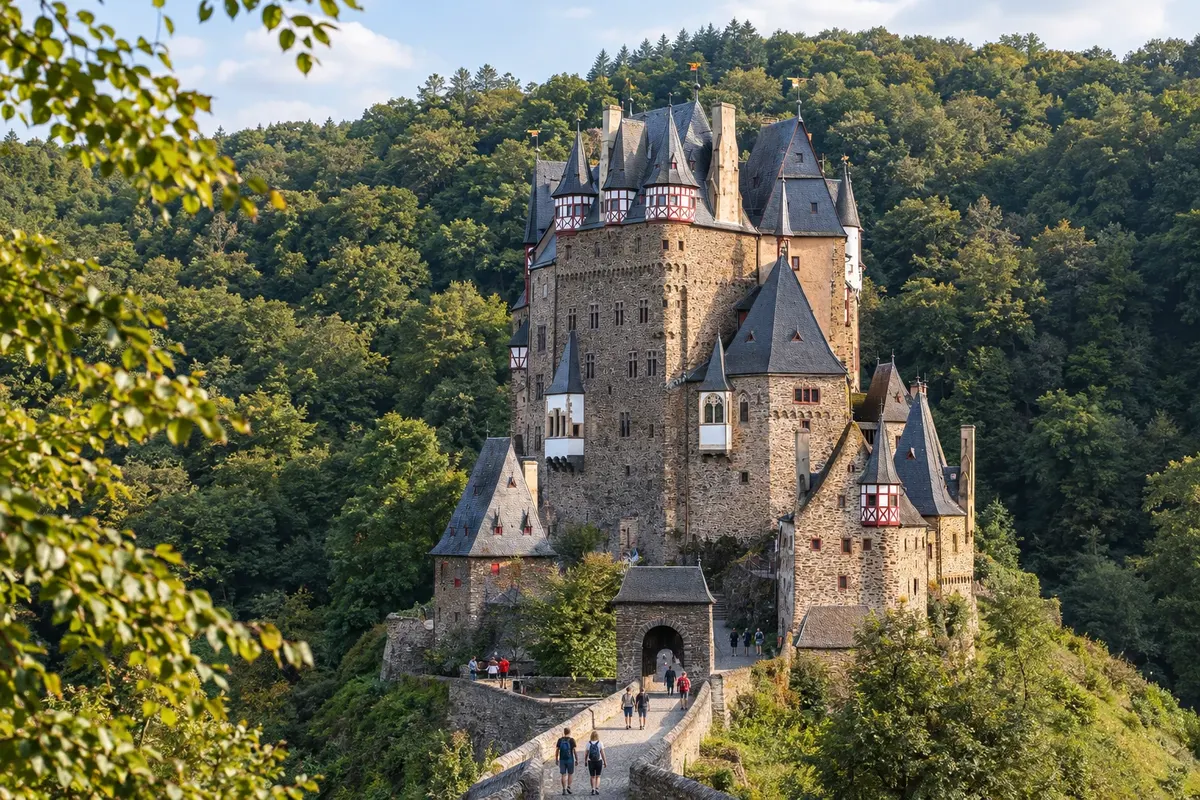
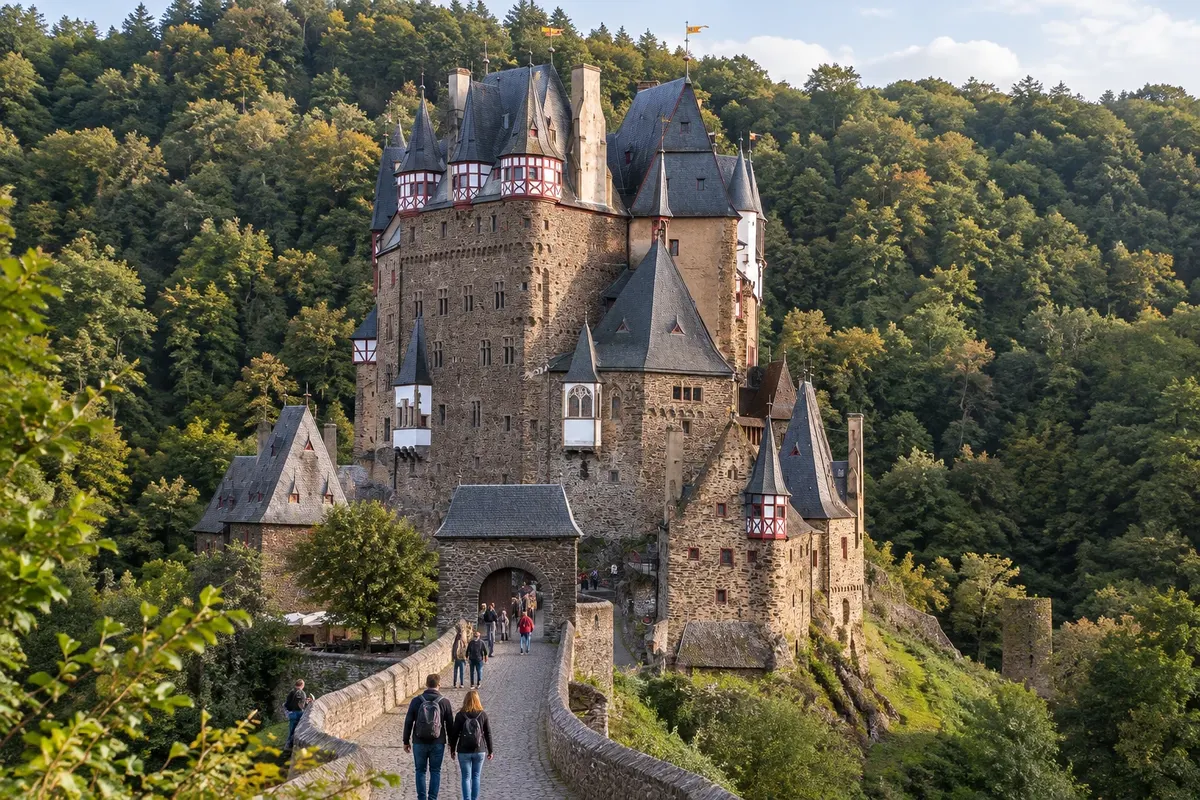
Na fotografiji: Burg Eltz, Vale do Mosela

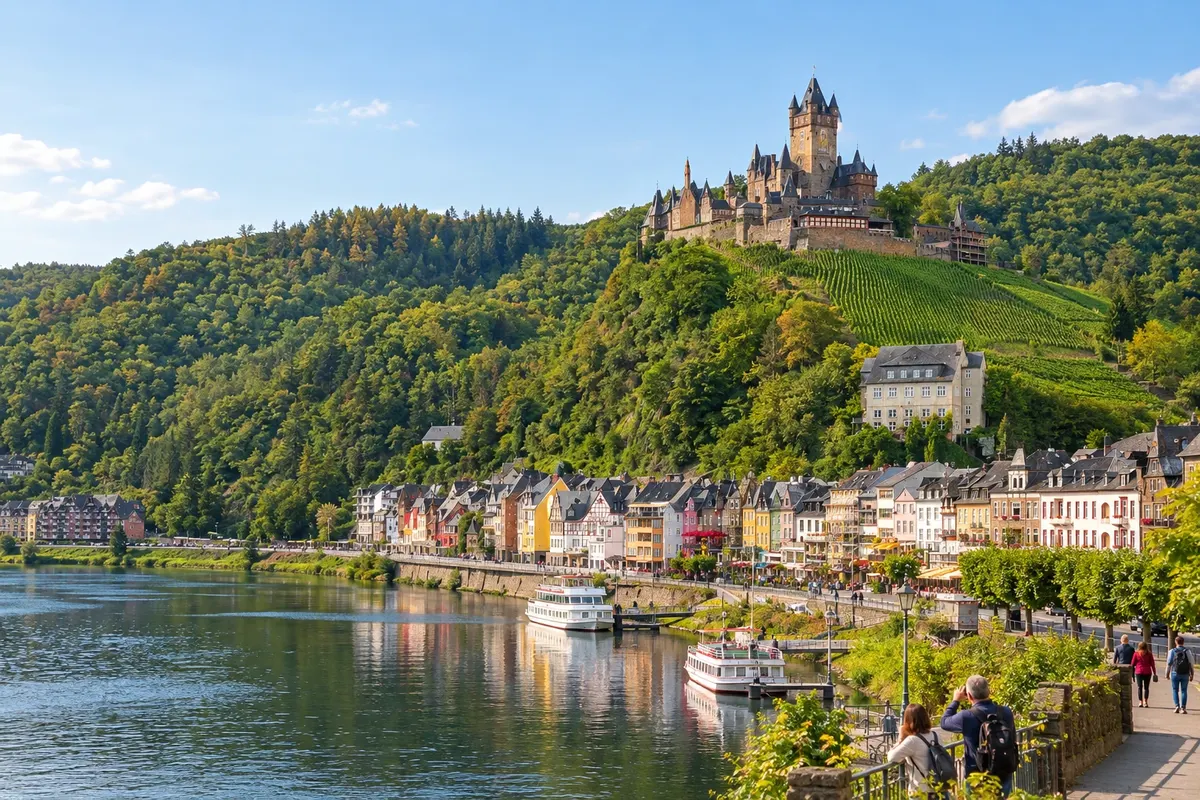
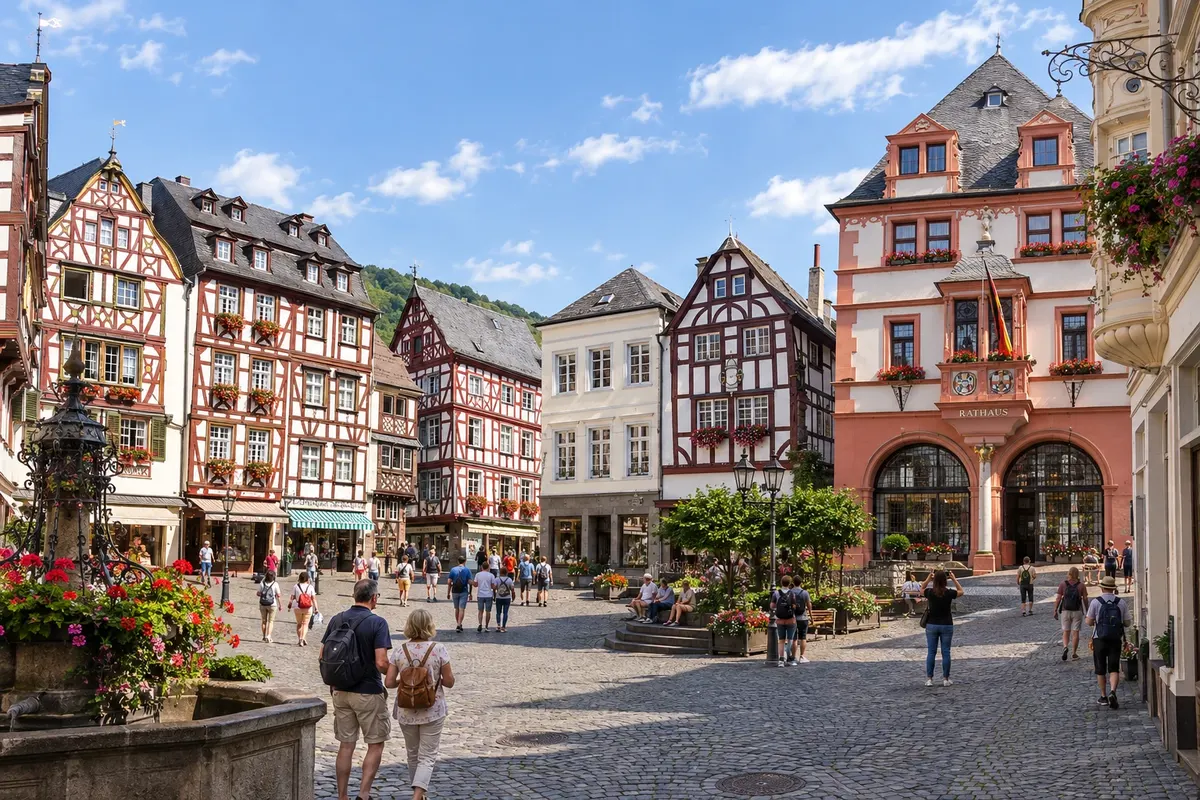
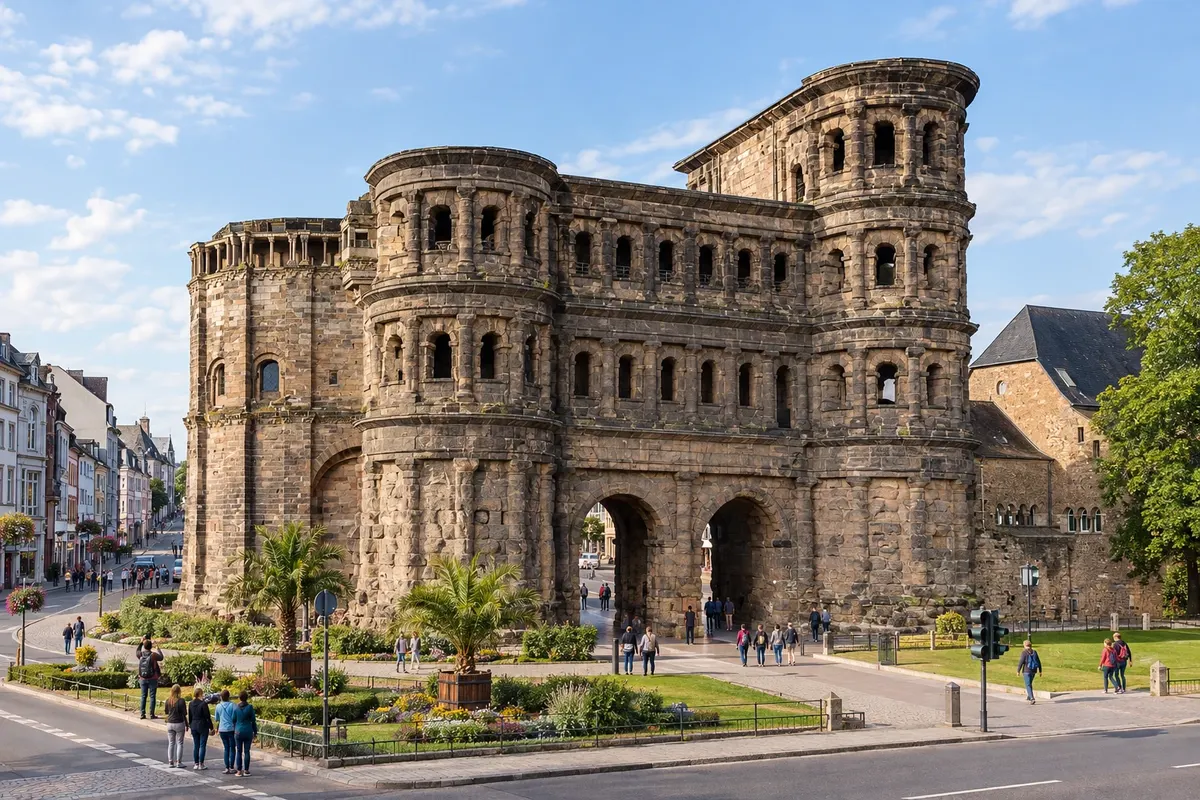
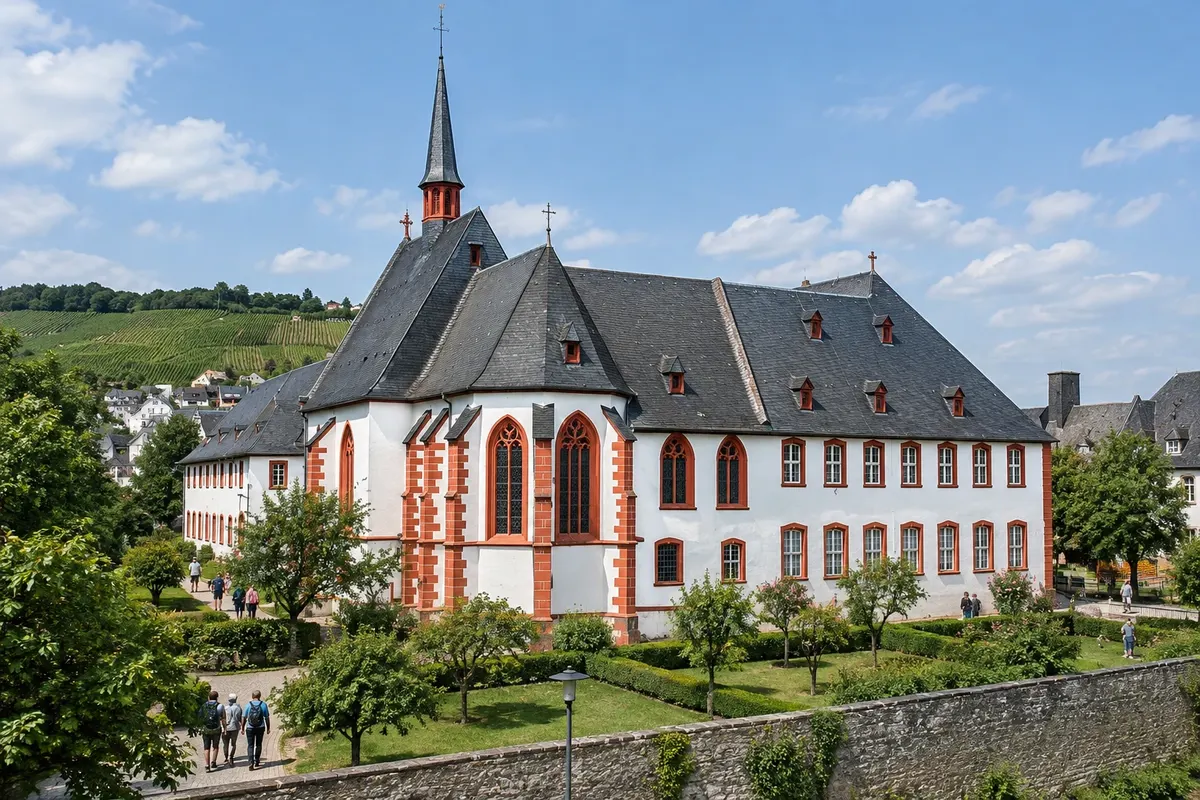
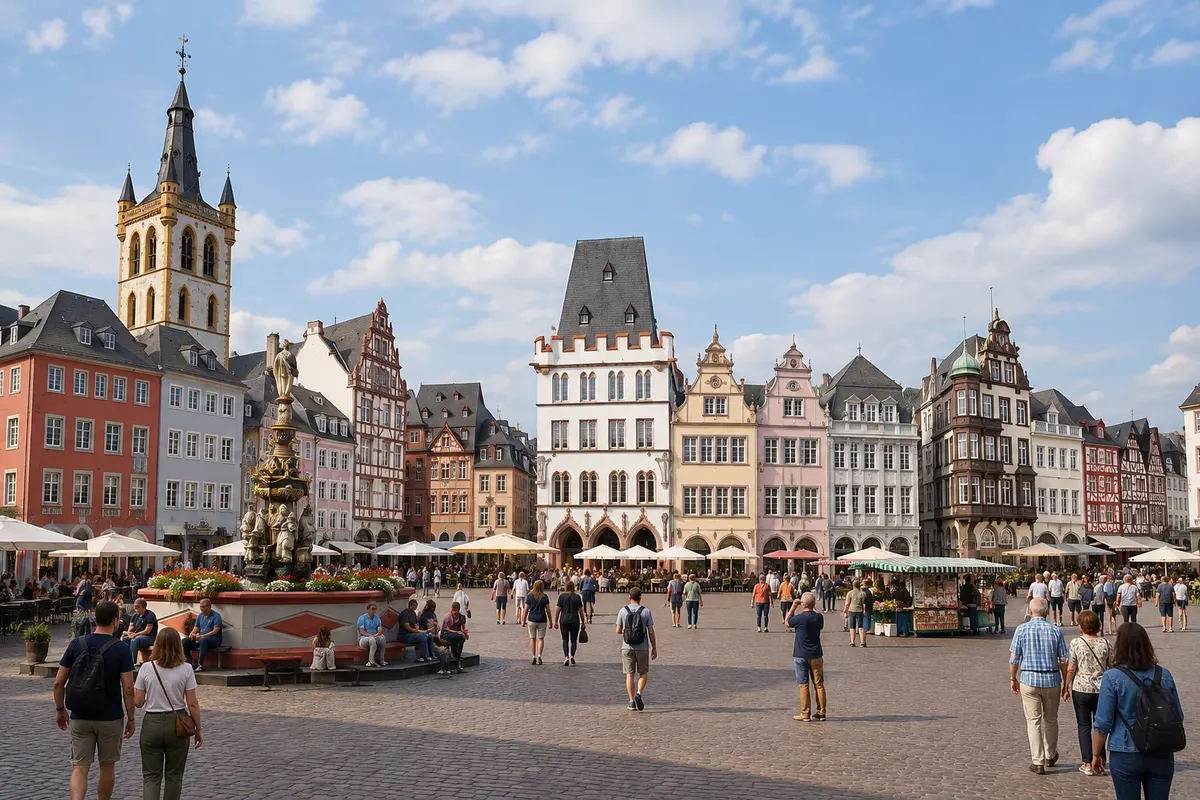
Illustrative images. The pictures in this guide are illustrations based on the real place, not photographs, and may differ from it.

Na voljo v trgovini Google Play Pošljite svoje fotografije

Spoznajte kraj

Pokrajina, ki jo doživite
v svojem ritmu.

The Mosela rises in France, passes through Luxembourg and enters Germany to run in tight bends until it meets the Rhine in Koblenz. In the German section, the valley is in the state of Renânia-Palatinado: slate-covered slopes planted with vineyards, half-timbered towns clinging to the water and castles atop the hills.

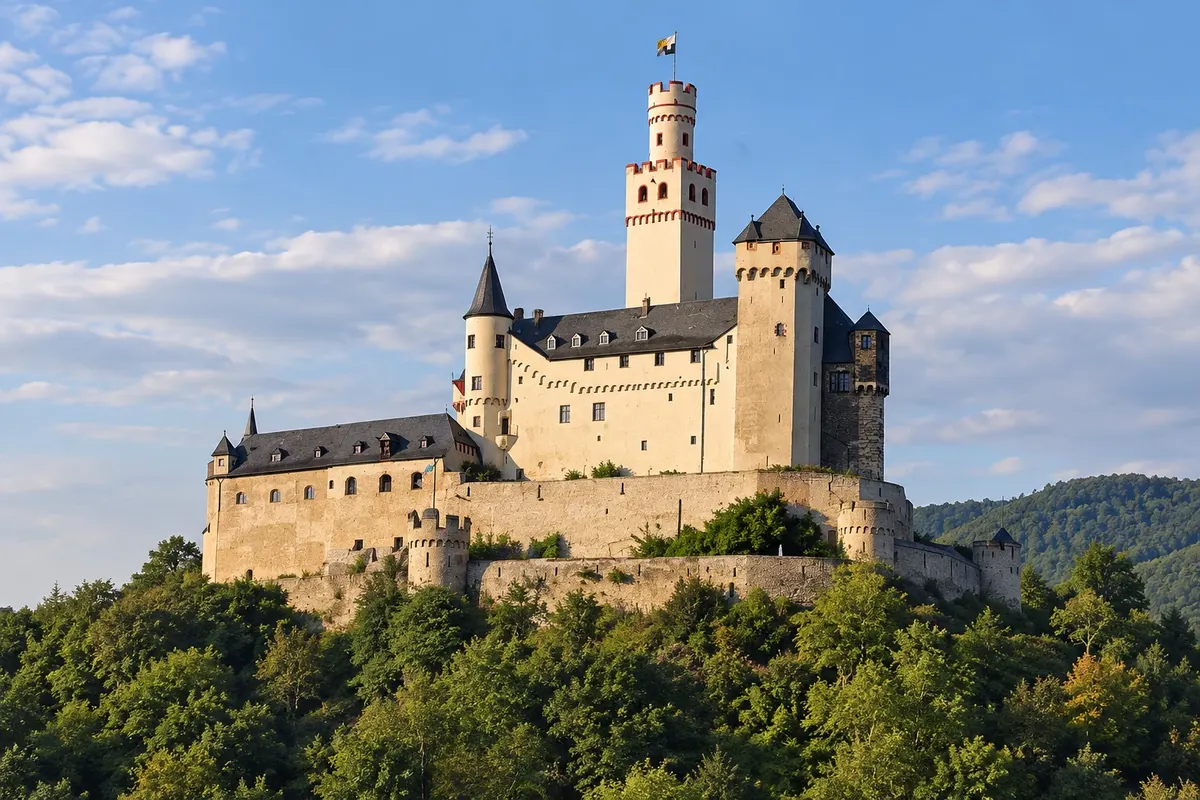
Cochem is the best-known stop of the lower Mosela, with the Reichsburg above the town and Burg Eltz, a medieval castle that was never destroyed, hidden in a side valley a few kilometres away. Upstream, Bernkastel-Kues combines a market square surrounded by half-timbered houses, the ruin of Burg Landshut and the St.-Nikolaus-Hospital, founded by the philosopher Nicolau de Cusa.

In the far west lies Trier, founded by the Romans as Augusta Treverorum and considered the oldest city in Germany. The Porta Nigra, the Konstantinbasilika, the imperial baths, the amphitheatre, the Roman bridge, the cathedral and the Liebfrauenkirche form an ensemble declared a World Heritage Site by UNESCO in 1986. Karl Marx was born in the city, and the house where he was born is now a museum.

Wine is part of the local culture: Riesling dominates the slopes, and wine festivals take place from late summer into autumn. The regional train connects Koblenz, Cochem and Trier along the river, and the excursion boats usually operate from March or April to October.

This destination brings together 4 cities: Cochem, Bernkastel-Kues, Trier, Koblenz.

Delite: WhatsApp
Delite svoja popotniška doživetja s fotografijami Pošljite fotografije vsakega kraja, ki ste ga obiskali. Največje število fotografij na kraj: 5.

Ena destinacija, več poti

Mesta na tej poti

Začnite v enem mestu ali v načrt poti vključite več mest.

Moselle Valley – lega
CochemKoblenzTrierBernkastel-Kues

Obrisi: © BKG (2026), dl-de/by-2-0. Priredba: Cidade Turismo.

Kako do tja:Moselle Valley

✈ Flughafen Frankfurt am Main (FRA), kraj: Frankfurt am Main· 133 km do cilja (Cochem)

The gateway is Frankfurt Airport. Check before booking. From Frankfurt or Cologne, the train goes to Koblenz, where you change to the regional Mosela line, which stops in Cochem and continues to Trier. Bernkastel-Kues has no station: you get off at Wittlich and continue by bus.

Predlagana točka prihoda:Cochem

Bernkastel-Kues
Renânia-Palatinado · Moselle Valley

Bernkastel-Kues

Bernkastel-Kues are two towns joined by a bridge over the Mosela. In Bernkastel, on the right bank, the market square brings together half-timbered houses, the Renaissance town hall of 1608 and the narrow Spitzhäuschen, dating from 1416; atop the hill lies the ruin of Burg Landshut. In Kues, on the left bank, is the St.-Nikolaus-Hospital, founded by Nicolau de Cusa. The Riesling from the slopes, like that of the Doctor vineyard, is part of the town's identity.

Koblenz
Renânia-Palatinado · Moselle Valley

Koblenz

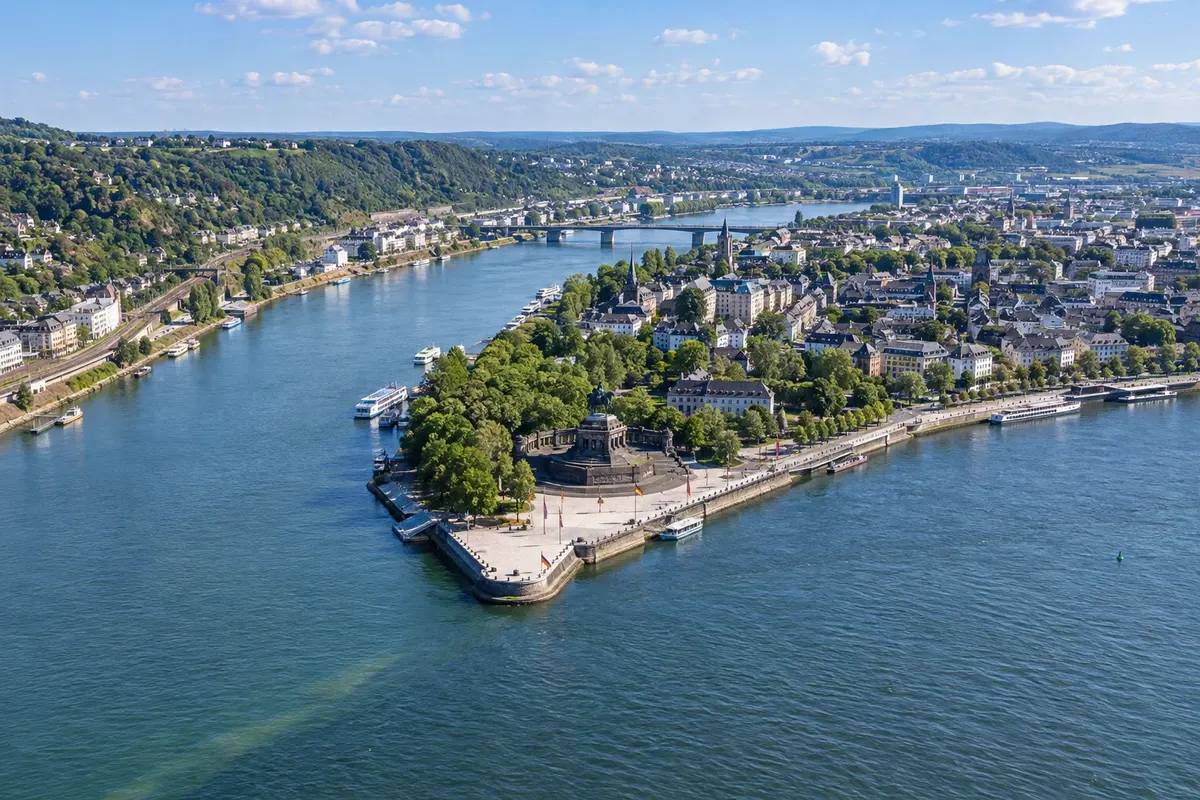
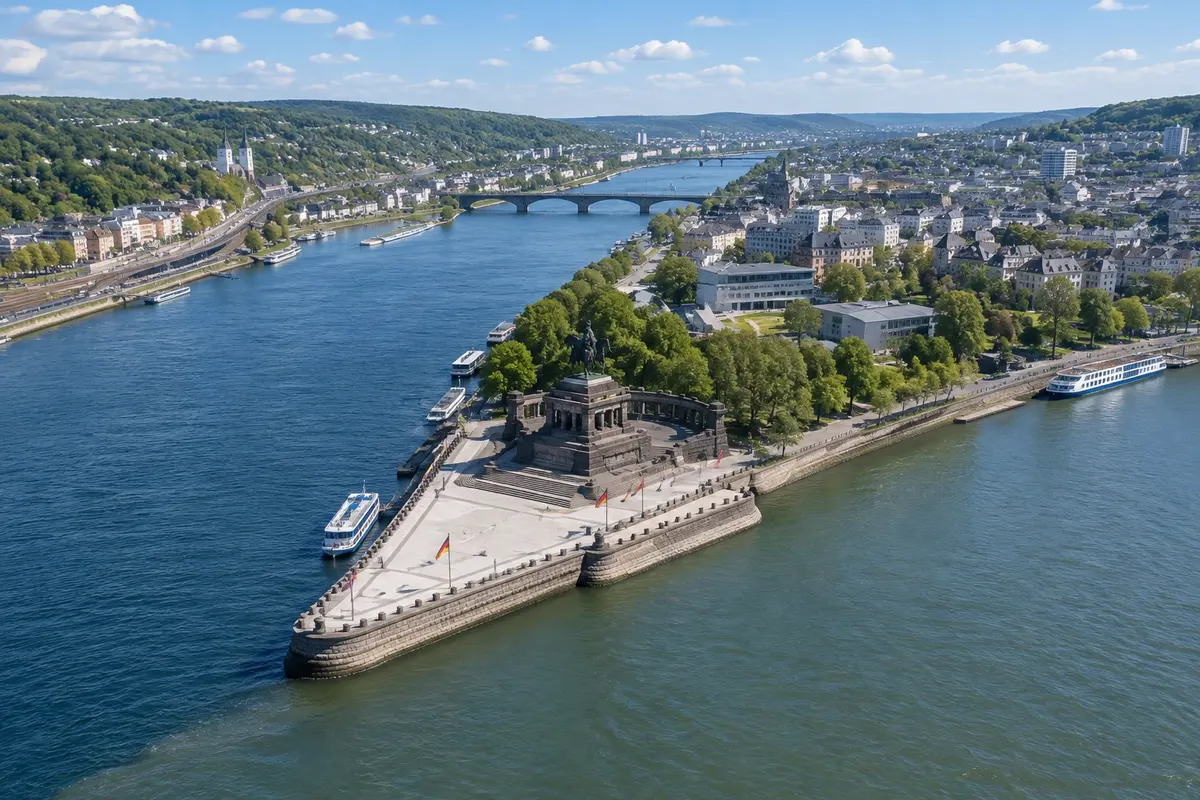
Koblenz began as a Roman camp at the confluence of the Mosela and the Reno, and its name comes from the Latin Confluentes. The point between the two rivers is the Deutsches Eck, with the equestrian monument to Emperor Guilherme I. On the other side of the Reno, the Prussian fortress of Ehrenbreitstein is reached by a cable car that crosses the river. The old town brings together the basílica de São Castor, the Liebfrauenkirche and squares such as the Jesuitenplatz. Upstream begins the romantic valley of the Reno, a World Heritage Site, with o castelo de Stolzenfels and the Marksburg a few kilometers away. German is spoken.

Doživite kraj

Kaj početi – Moselle Valley

Deutsches Eck
Koblenz · Rhineland-Palatinate · Monument

Deutsches Eck

The point of land where the Mosela empties into the Reno, with the equestrian monument to Emperor Guilherme I atop a pedestal with steps and a viewpoint over both rivers.

Bernkastel Market Square
Bernkastel-Kues · Rhineland-Palatinate · Trg

Bernkastel Market Square

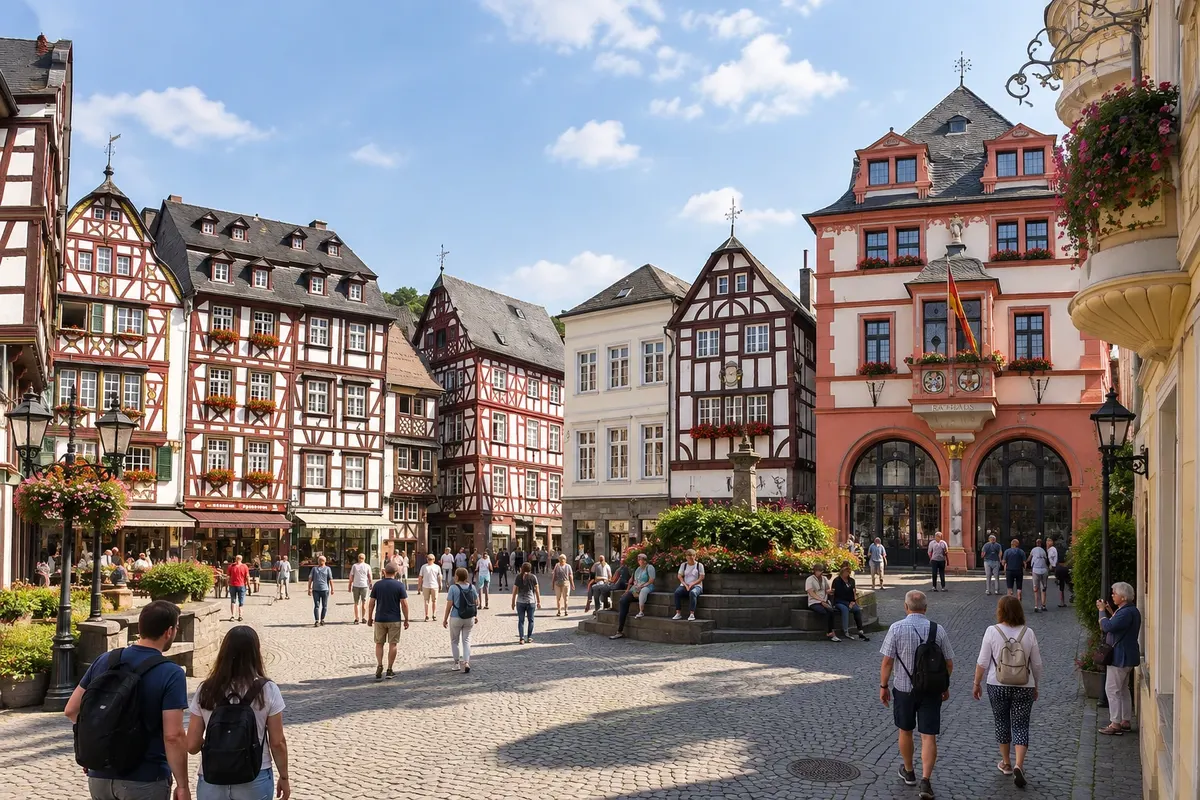
Medieval square of Bernkastel, surrounded by half-timbered houses from the 16th and 17th centuries, with the Renaissance town hall of 1608, Saint Michael's fountain of 1606 and, on the corner, the narrow Spitzhäuschen dating from 1416.

Porta Nigra
Trier · Rhineland-Palatinate · Monument

Porta Nigra

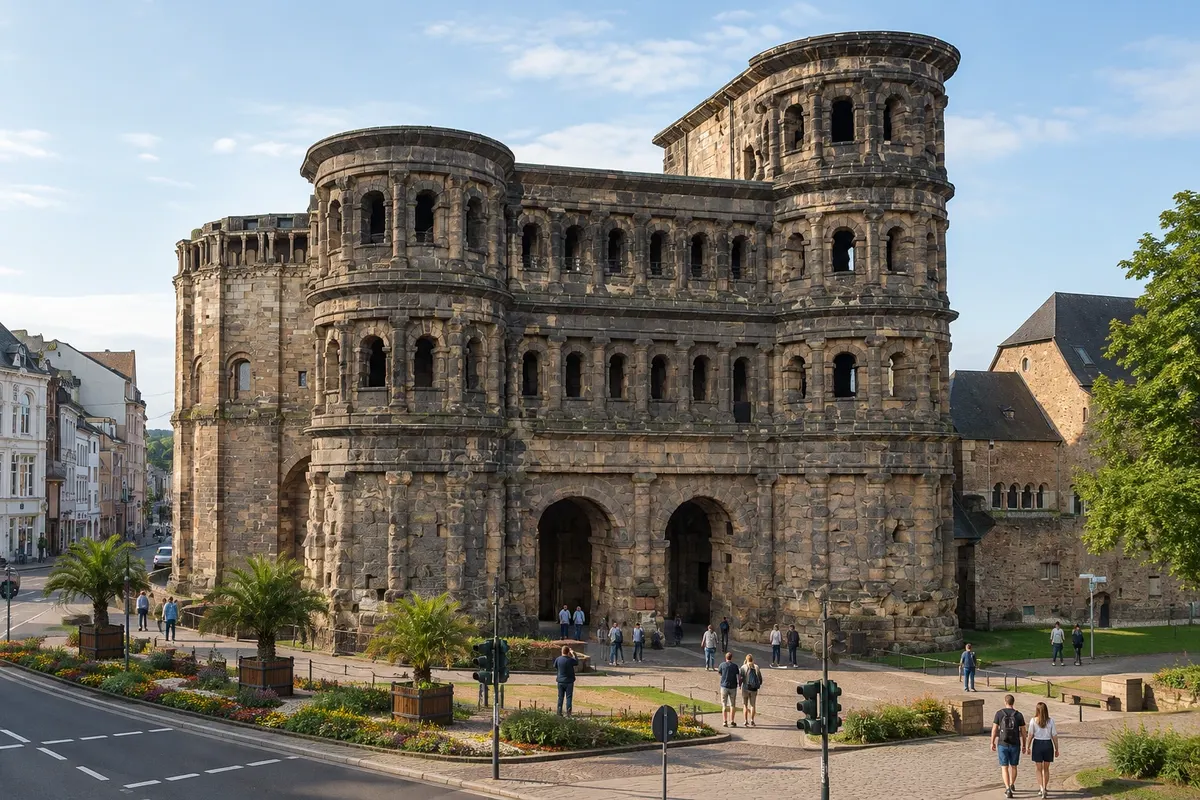
Roman sandstone gate built around AD 170, the only one of the four gates of the old Augusta Treverorum still standing. It became a church in the Middle Ages and was returned to its Roman form by order of Napoleon.

Cochem Castle (Reichsburg Cochem)
Cochem · Rhineland-Palatinate · Grad

Cochem Castle (Reichsburg Cochem)

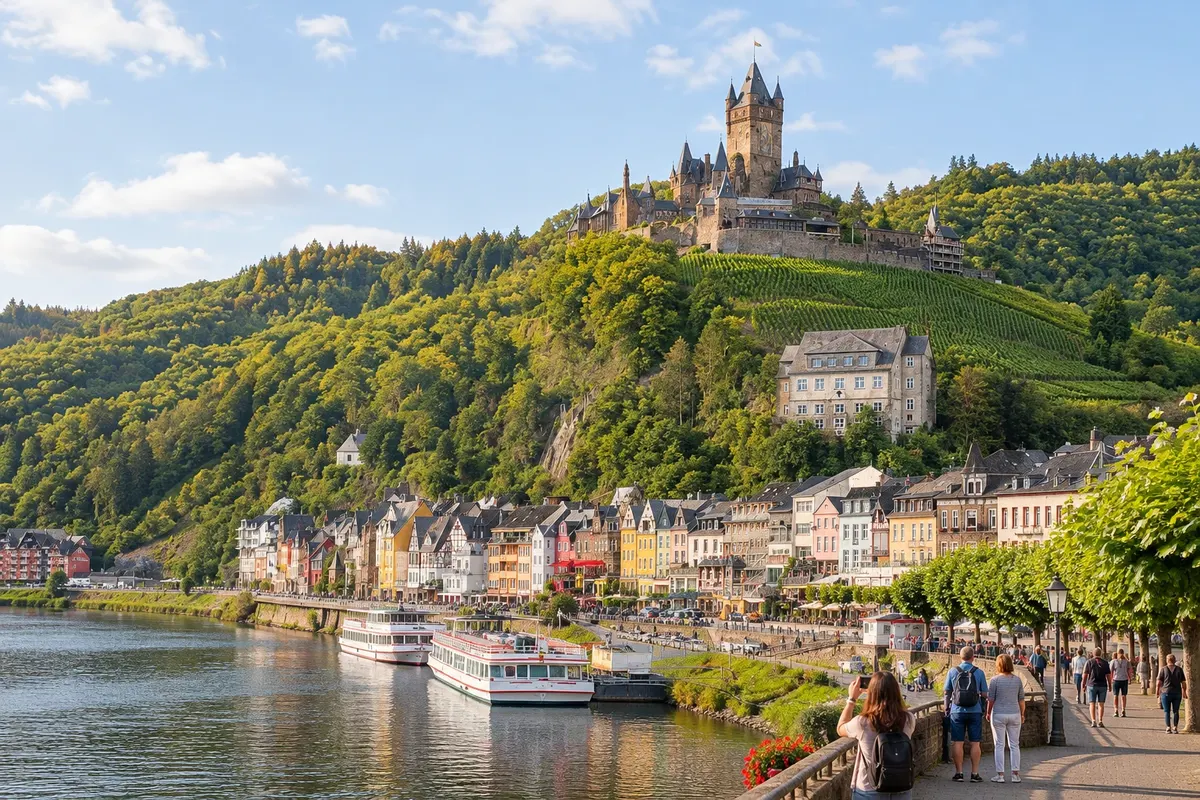
Castle on a hill about 100 meters above Cochem, of medieval origin, destroyed by the French in 1689 and rebuilt in a neo-Gothic style in the 19th century. Visits are by guided tour only.

Moselle Valley – prikaži dodatne kraje (20)
Landshut Castle (ruin)
Bernkastel-Kues · Rhineland-Palatinate · Ruins

Landshut Castle (ruin)

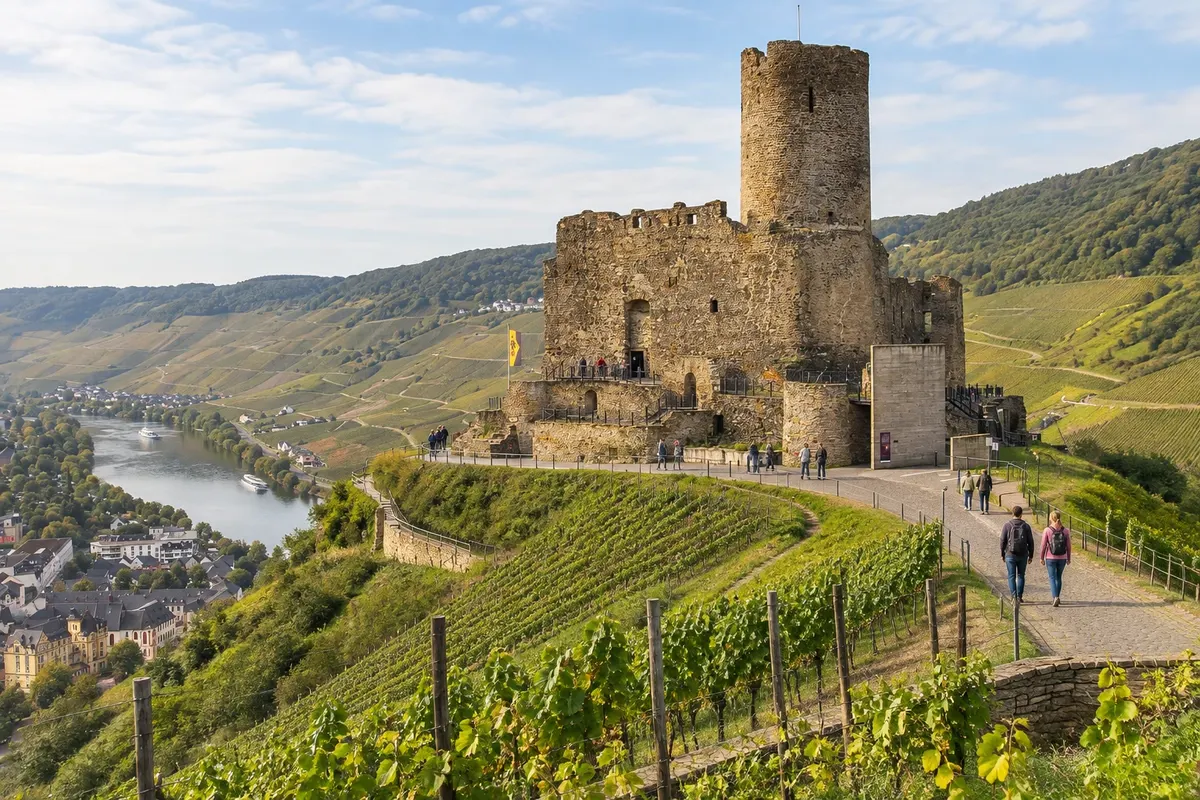
Castle ruin atop the hill above Bernkastel, former summer residence of the archbishops of Trier, destroyed by a fire in 1692. The tower and terrace are viewpoints over the Mosela bend.

Festung Ehrenbreitstein
Koblenz · Rhineland-Palatinate · Trdnjava

Festung Ehrenbreitstein

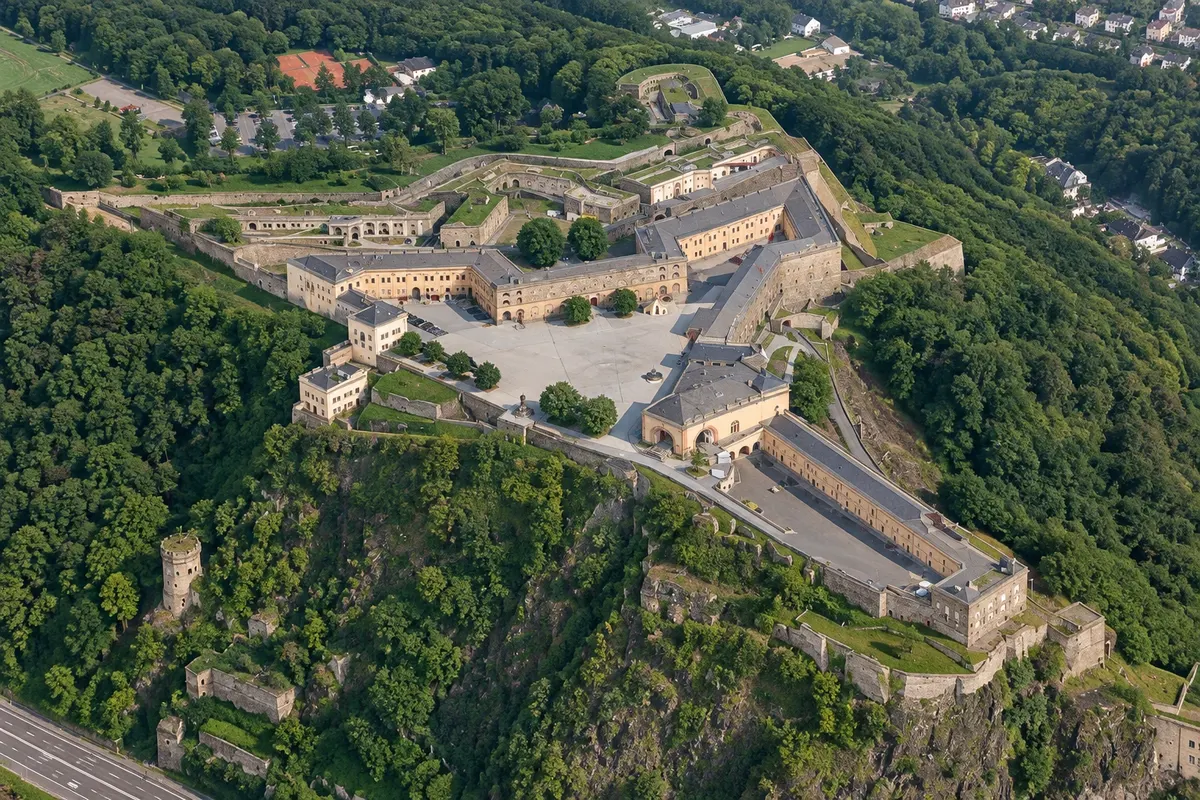
19th-century Prussian fortress high on the right bank of the Reno, opposite the Deutsches Eck, with walls, courtyards, the Landesmuseum Koblenz and viewpoints over the rivers’ confluence.

Cochem Market Square
Cochem · Rhineland-Palatinate · Trg

Cochem Market Square

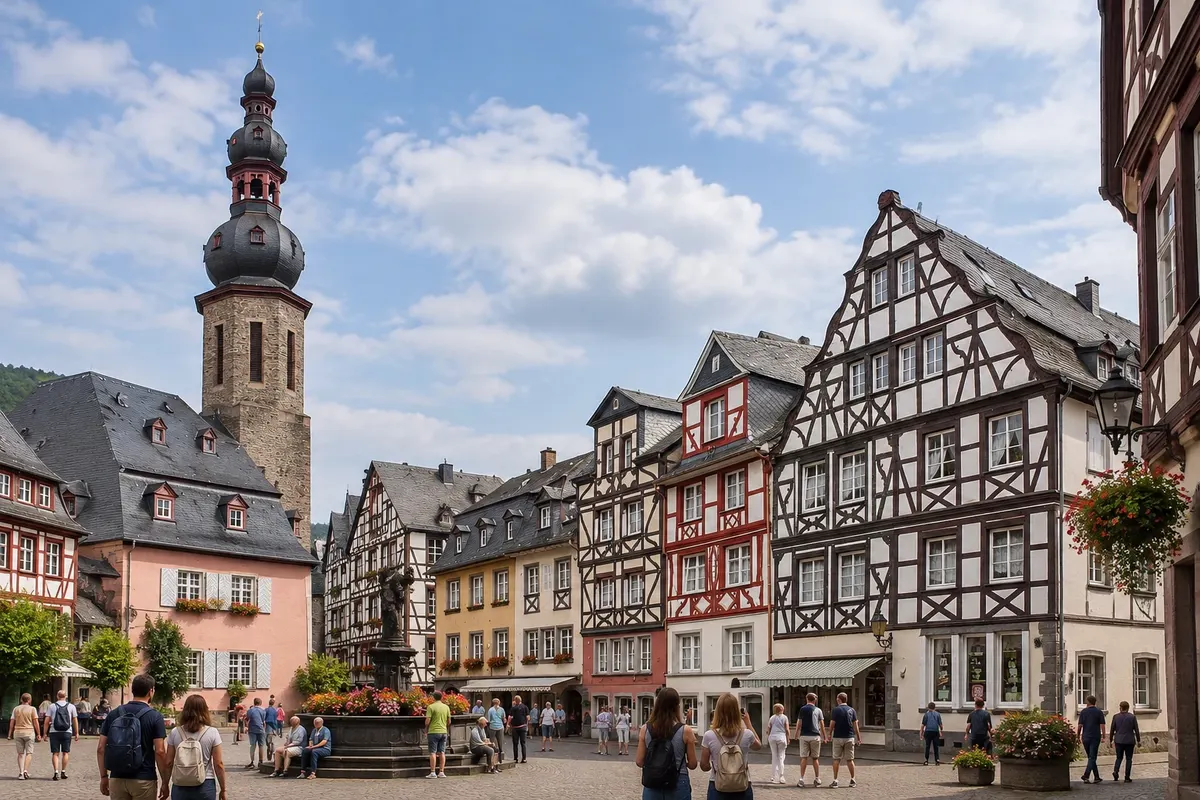
Cochem's market square, surrounded by half-timbered houses, with the baroque town hall from 1739 and the Martinsbrunnen. From here narrow lanes of the old town lead off and the path to the Mosela riverbank.

Trier Cathedral
Trier · Rhineland-Palatinate · Stolnica

Trier Cathedral

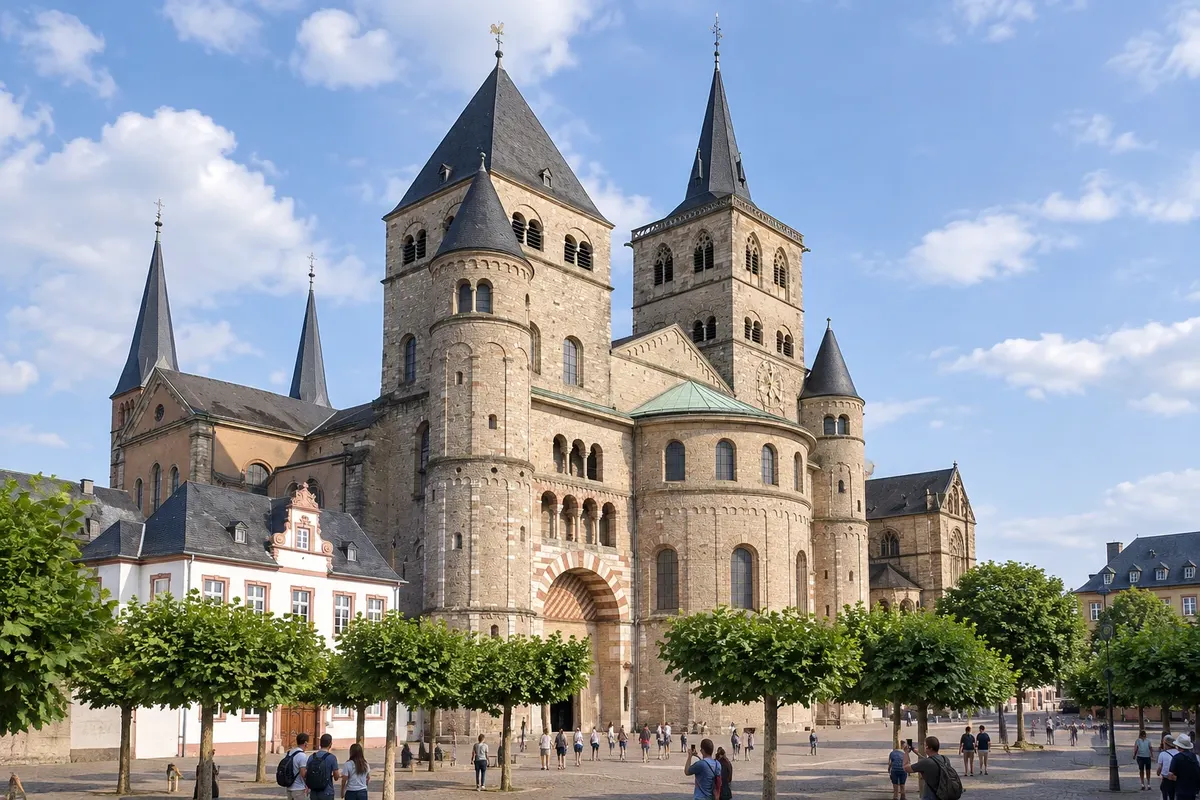
Catedral de São Pedro, with a Roman core from the 4th century, considered the oldest church in Germany still in use. It houses the Túnica Sagrada, a relic rarely displayed, and a treasury of sacred art.

Basilica of St. Kastor
Koblenz · Rhineland-Palatinate · Cerkev

Basilica of St. Kastor

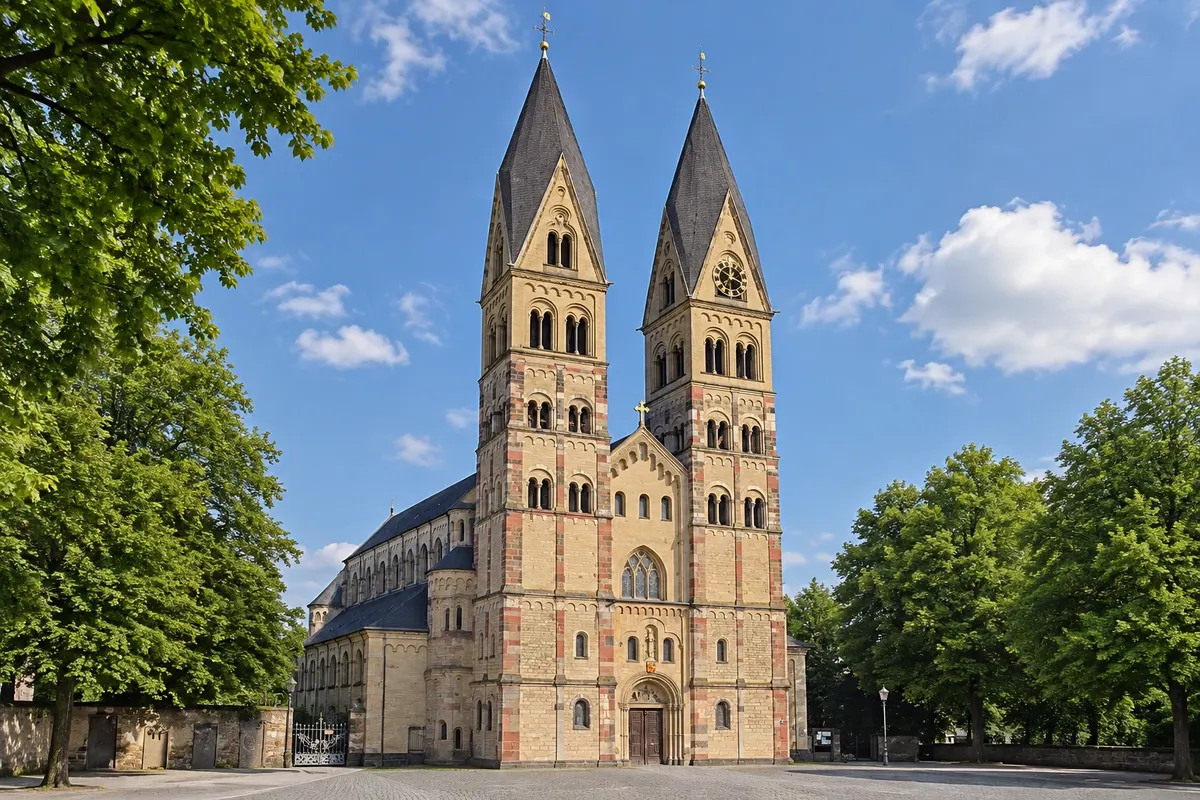
The oldest church in Koblenz, consecrated in 836, with a Romanesque façade of four towers, painted vaults and the fountain bearing Napoleon’s inscription in the square in front.

Cochemer Sesselbahn (Cochem Chairlift)
Cochem · Rhineland-Palatinate · Razgledišče

Cochemer Sesselbahn (Cochem Chairlift)

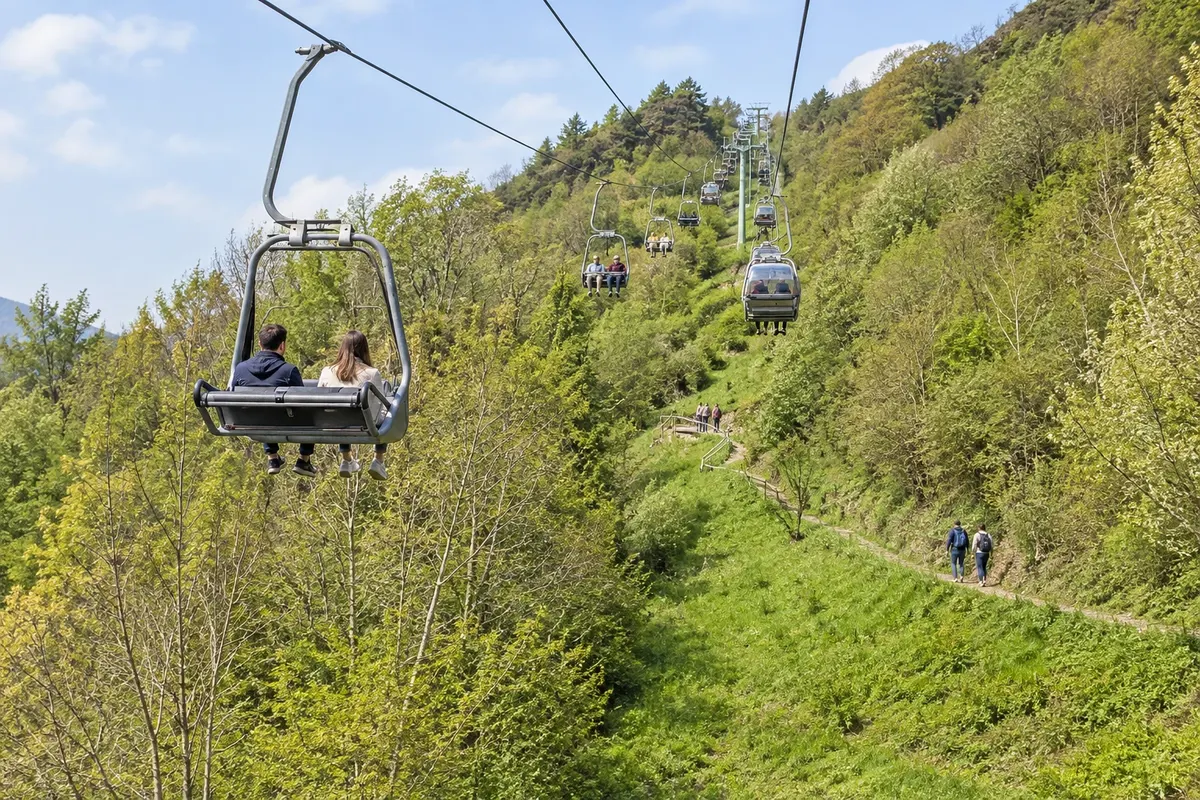
Chairlift-style cable car operating since 1955 that climbs to the Pinnerkreuz, a viewpoint with views over the Reichsburg and the valley. Along the way, on Endertstraße, is the Historische Senfmühle, a mustard mill.

Liebfrauenkirche
Trier · Rhineland-Palatinate · Cerkev

Liebfrauenkirche

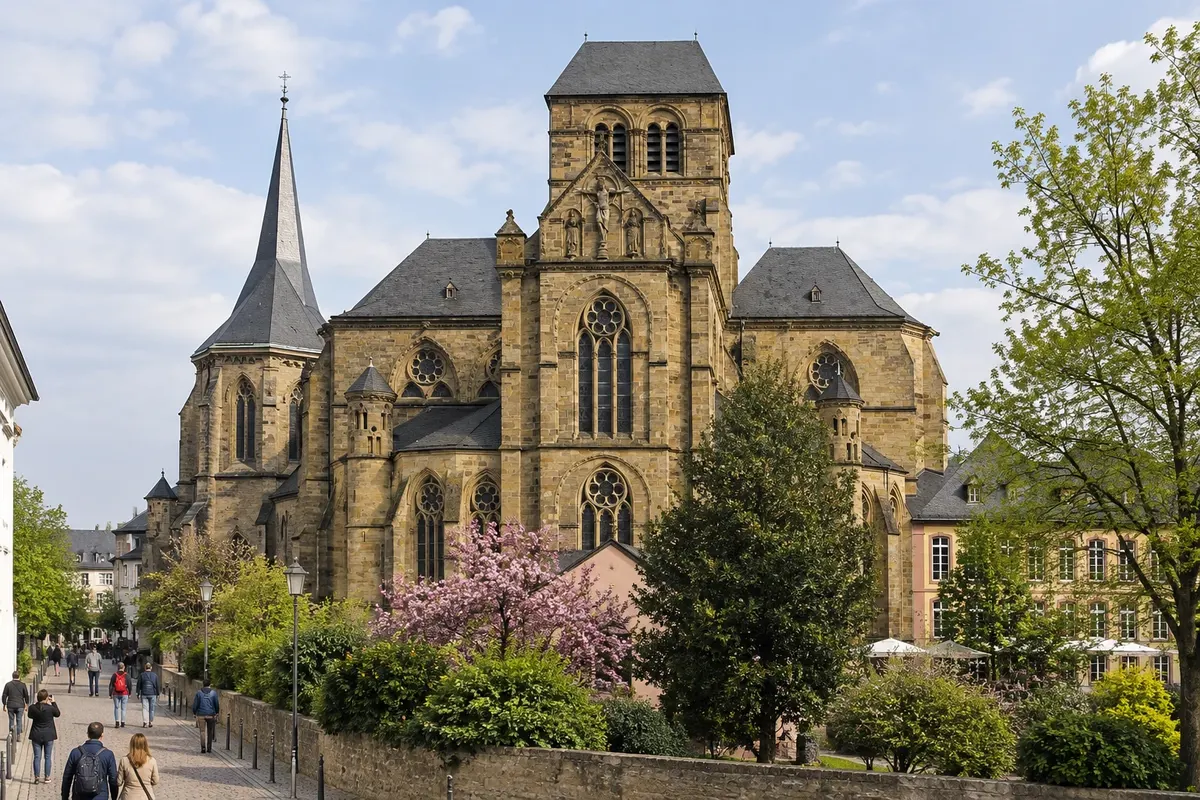
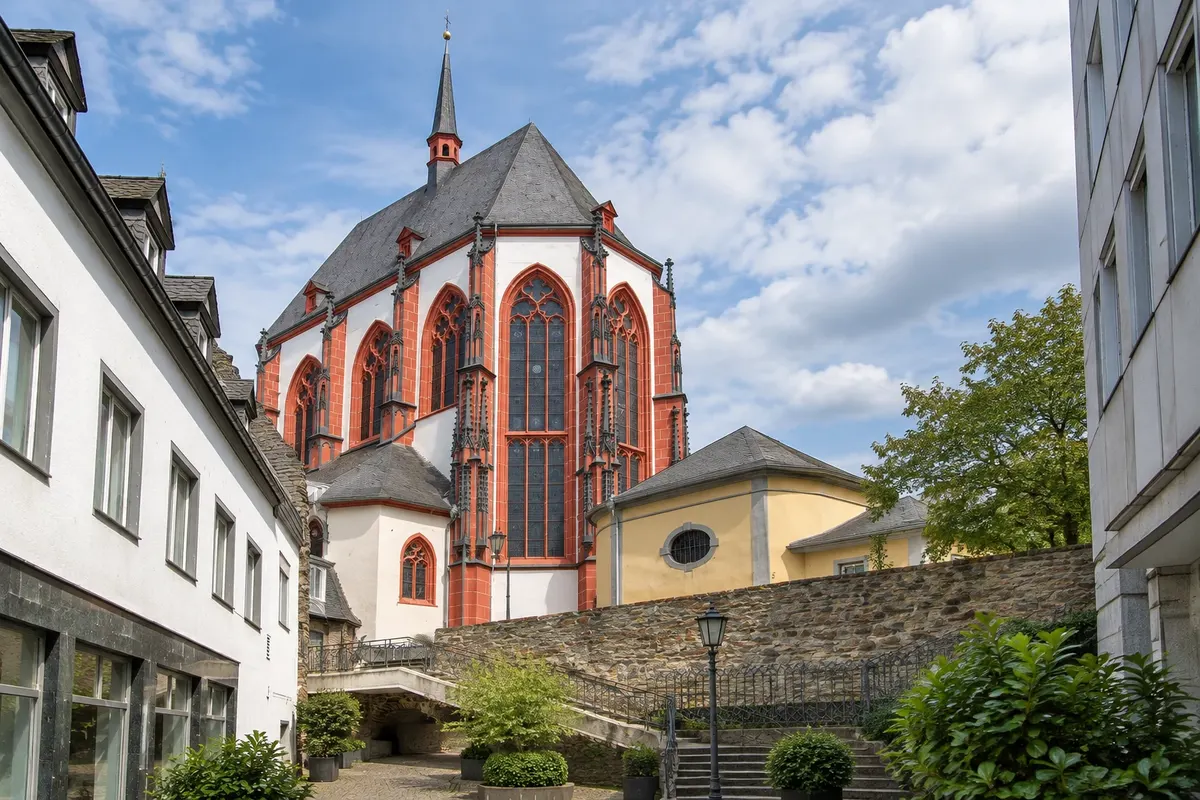
Igreja de Nossa Senhora, next to the cathedral, built from around 1230. Together with the Elisabethkirche of Marburg, it is considered the oldest Gothic church in Germany.

St. Nikolaus Hospital (Cusanusstift)
Bernkastel-Kues · Rhineland-Palatinate · Historic site

St. Nikolaus Hospital (Cusanusstift)

Gothic hospice founded in 1458 by the cardinal and philosopher Nicolau de Cusa, born in Kues. It has a cloister, a chapel containing the founder's heart and a library of medieval manuscripts, and it still functions as a home for the elderly.

Eltz Castle
Cochem · Rhineland-Palatinate · Grad

Eltz Castle

Medieval castle hidden in a wooded valley above the Mosela, with construction dating to before 1157 and never destroyed. It still belongs to a branch of the Eltz family and contains a treasure with items of gold, silver and suits of armor.

Konstantine Basilica
Trier · Rhineland-Palatinate · Historic site

Konstantine Basilica

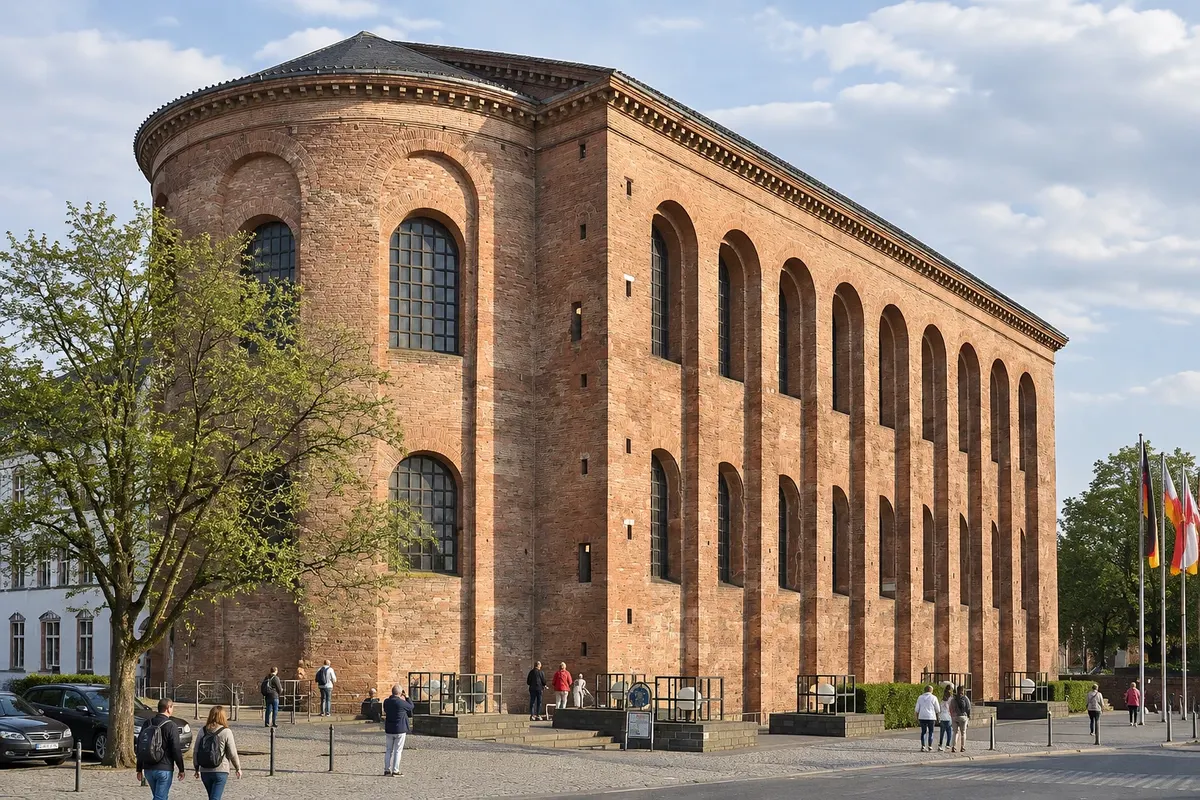
Former audience hall of Emperor Constantine's palace, from the early 4th century, measuring 67 meters long and 33 meters high. Since 1856 it has been used as a Protestant church.

Liebfrauenkirche
Koblenz · Rhineland-Palatinate · Cerkev

Liebfrauenkirche

Church at the highest point of Koblenz's old town, with a Romanesque nave, a Gothic choir and the two onion‑domed towers that define the city's skyline.

Kaiserthermen
Trier · Rhineland-Palatinate · Arheološko najdišče

Kaiserthermen

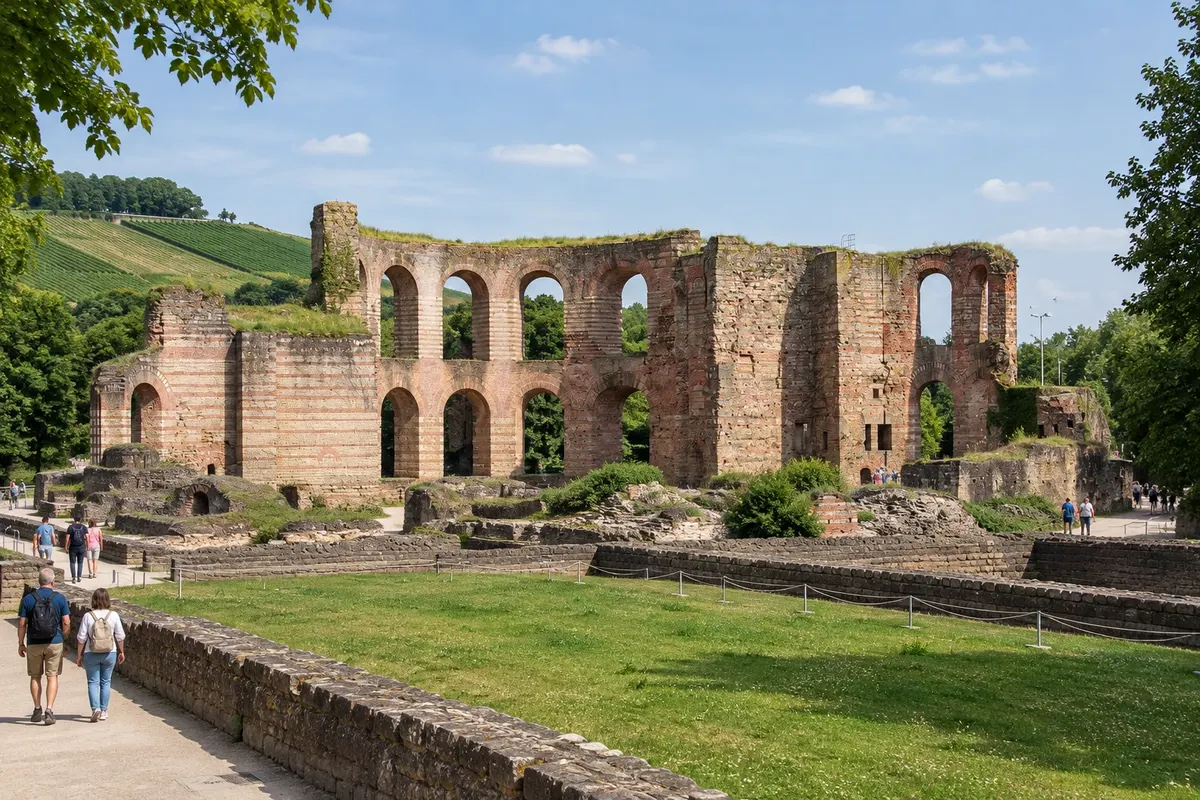
Imperial baths begun around the year 300 and never completed as bathing facilities. They became a Roman barracks and, in the Middle Ages, part of the city wall. The underground service galleries can be explored on foot.

Kurfürstliches Schloss
Koblenz · Rhineland-Palatinate · Palace

Kurfürstliches Schloss

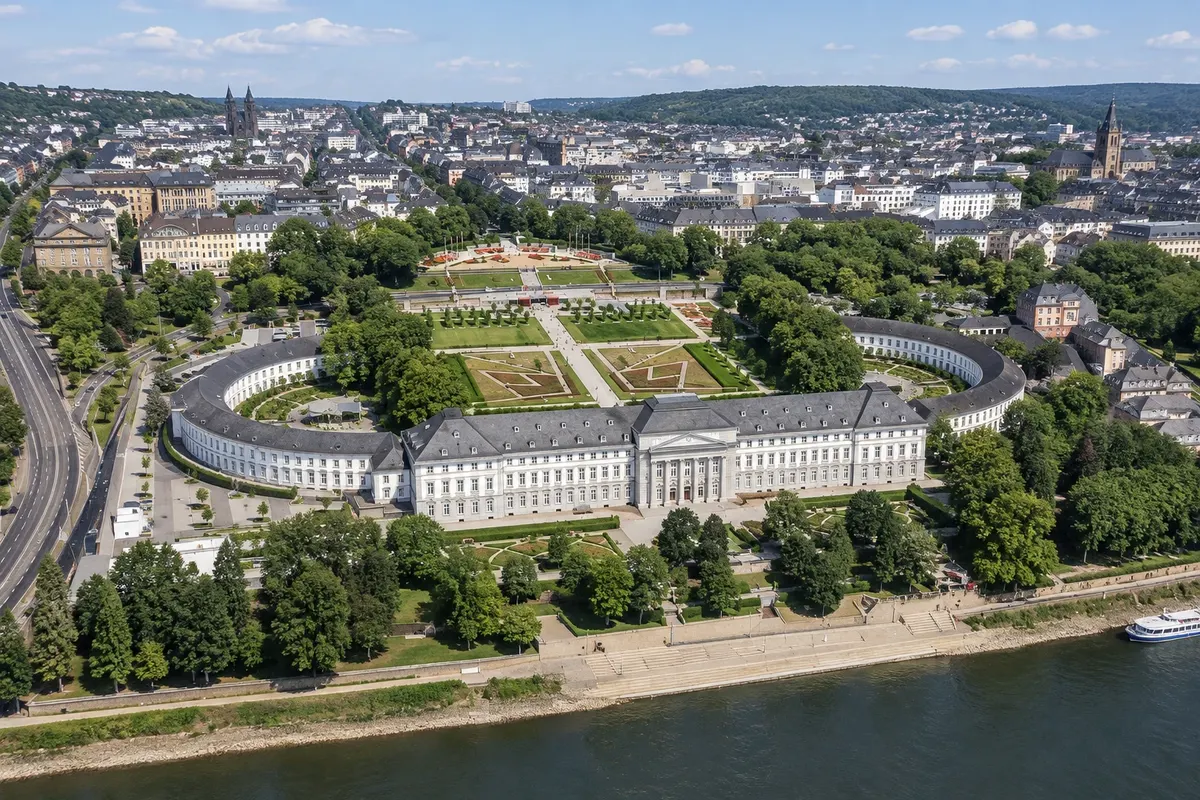
Neoclassical palace of the last prince‑elector of Trier, from 1786, on the banks of the Reno, with open gardens and the riverside promenade.

Amphitheater Trier
Trier · Rhineland-Palatinate · Arheološko najdišče

Amphitheater Trier

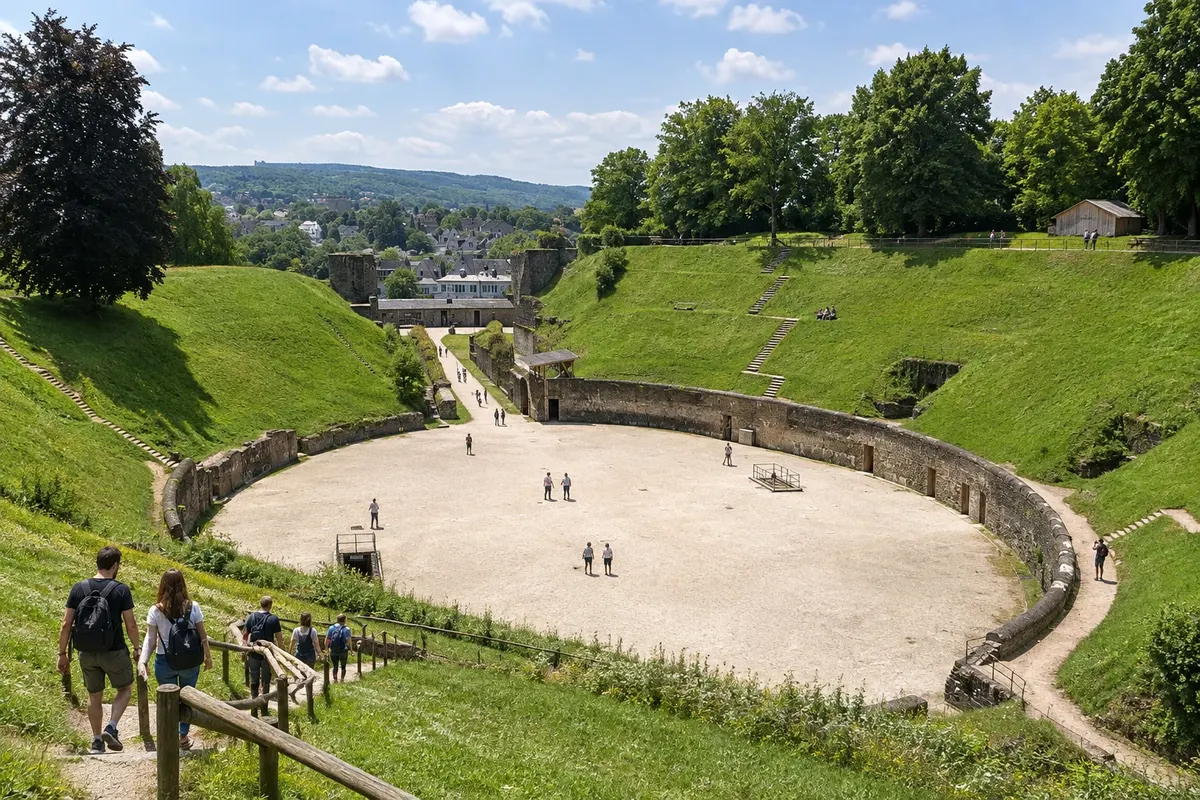
2nd-century Roman amphitheatre, with capacity for about 20,000 people, used for gladiator fights and animal spectacles. The cellar beneath the arena can be visited.

Schloss Stolzenfels
Koblenz · Rhineland-Palatinate · Grad

Schloss Stolzenfels

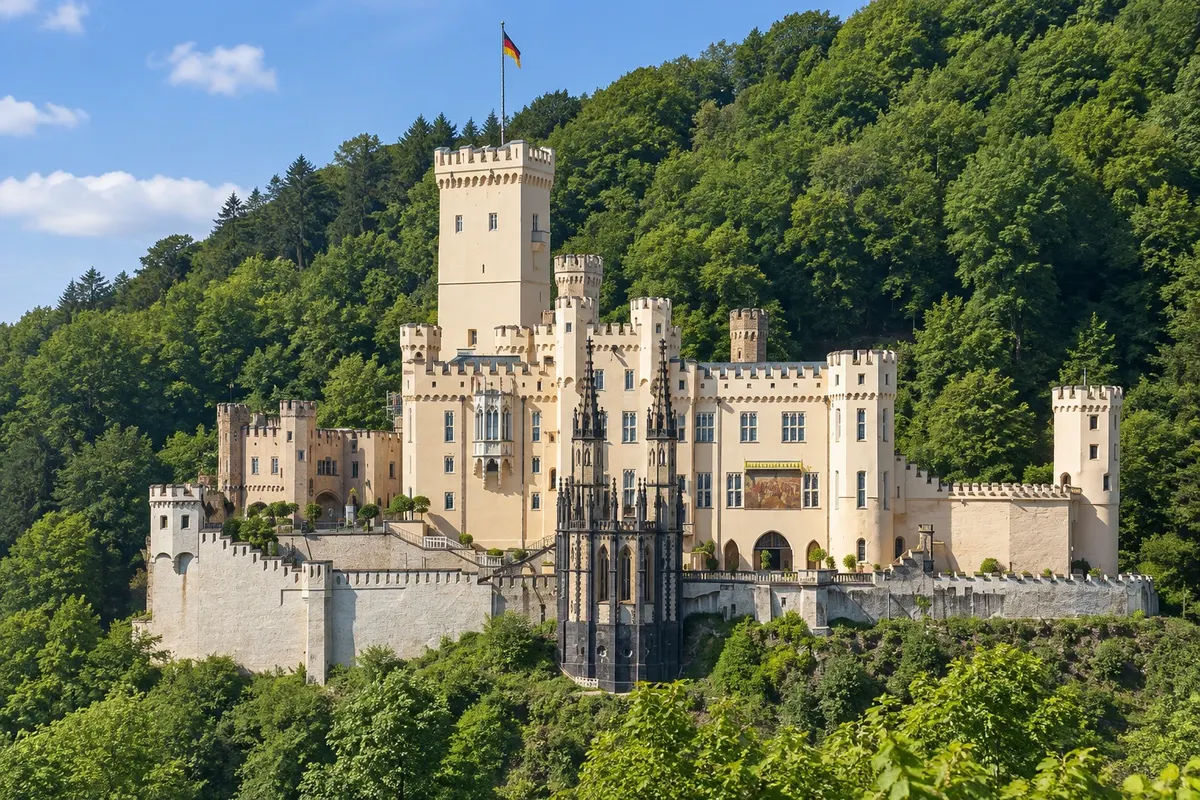
Neo‑Gothic castle on the left bank of the Reno, south of Koblenz, rebuilt from 1836 for the Prussian crown prince, with decorated rooms, a chapel and a garden.

Marksburg
Koblenz · Rhineland-Palatinate · Grad

Marksburg

Medieval hilltop castle above Braubach, overlooking the Reno, the only hill castle in the Middle Rhine Valley that was never destroyed, with guided visits to the rooms, the kitchen and the herb garden.

Römerbrücke
Trier · Rhineland-Palatinate · Most

Römerbrücke

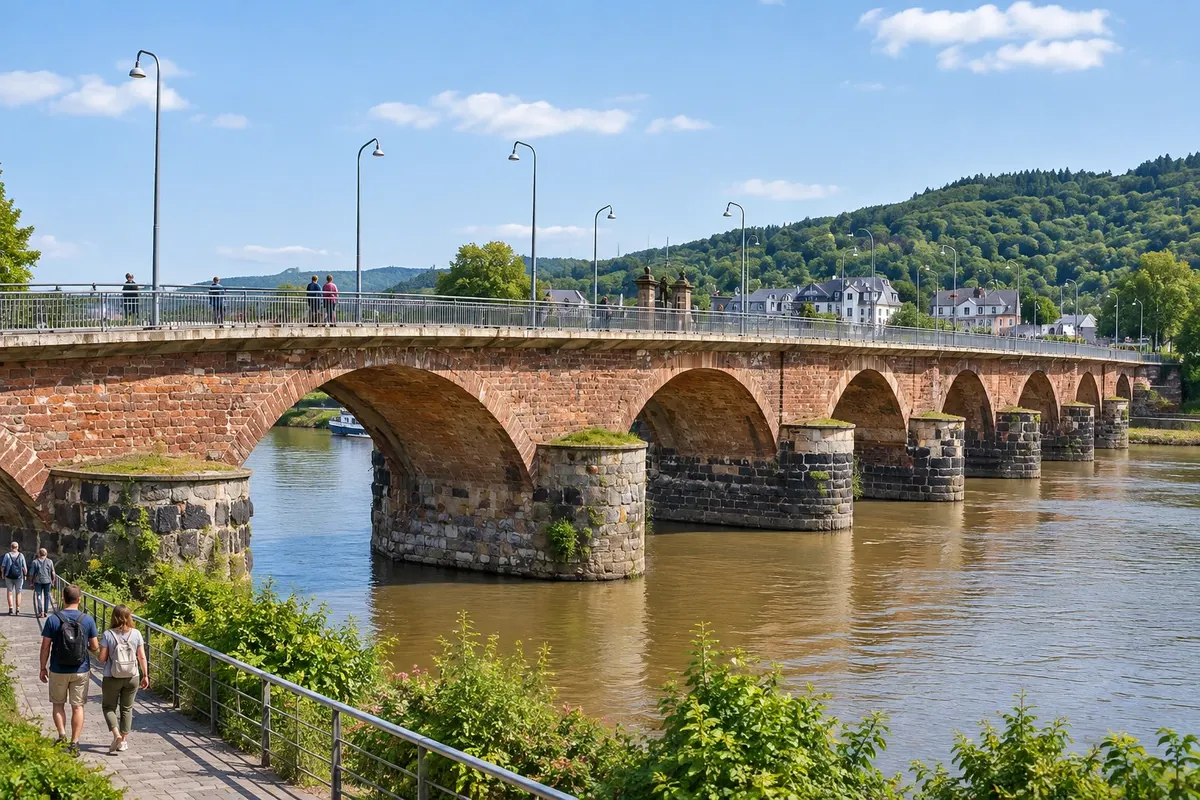
Bridge over the Mosela with stone piers built between 142 and 150 AD, considered the oldest bridge in Germany. It remains open to traffic.

Rheinisches Landesmuseum Trier
Trier · Rhineland-Palatinate · Muzej

Rheinisches Landesmuseum Trier

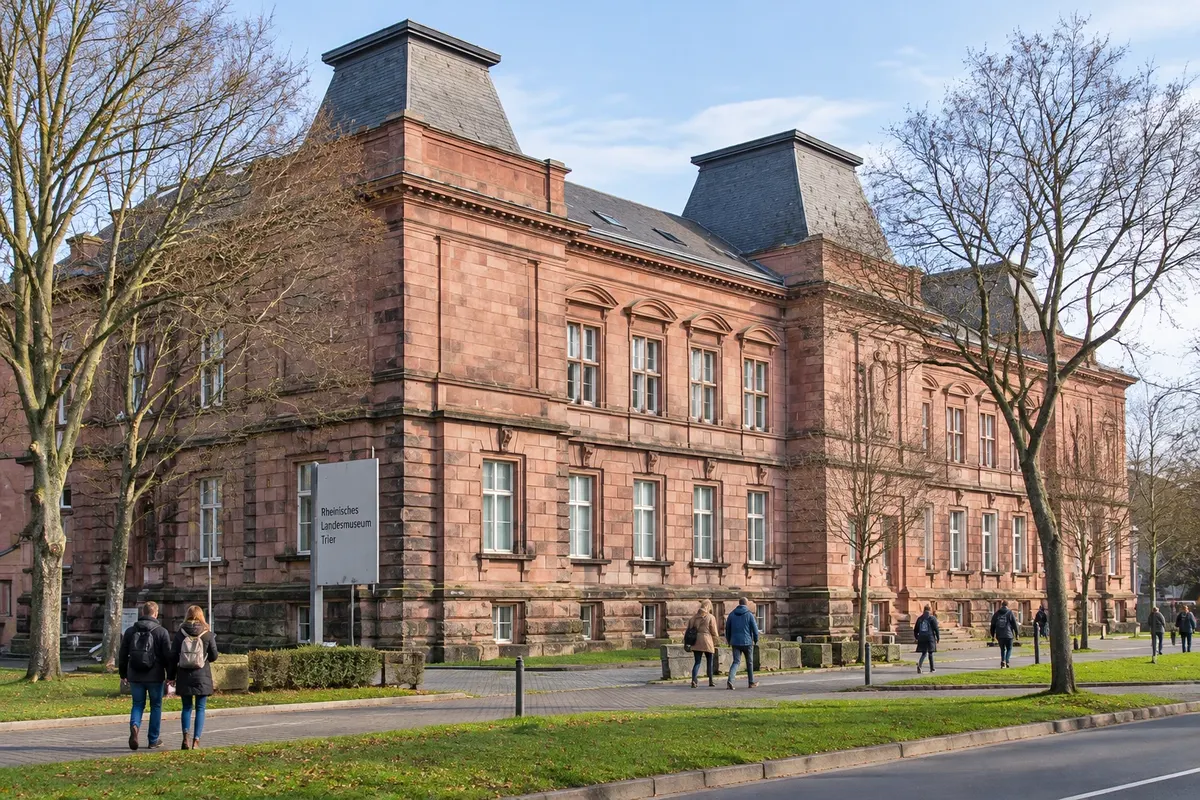
Archaeological museum with the largest collection of Roman mosaics north of the Alps, the wine boat of Neumagen and the Trier treasure of gold coins, with over 2,600 pieces.

Museum Karl‑Marx‑Haus
Trier · Rhineland-Palatinate · House-museum

Museum Karl‑Marx‑Haus

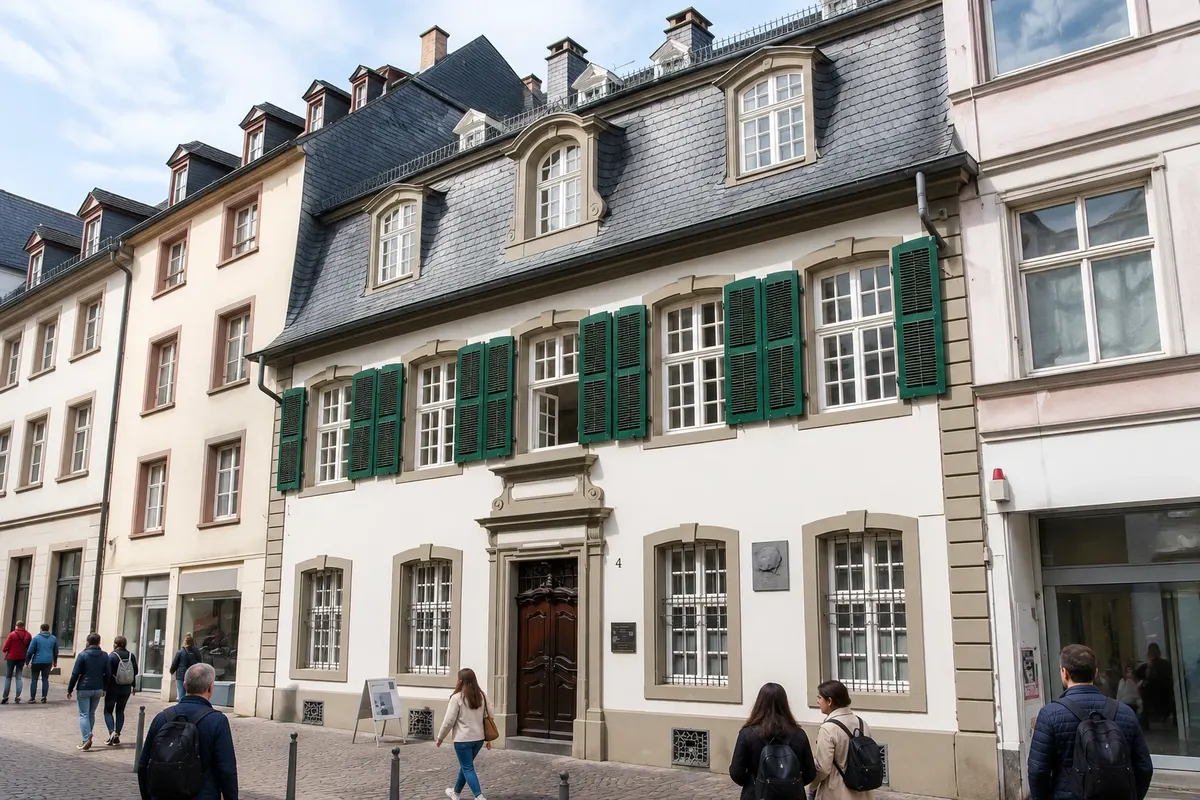
Baroque house from 1727 where Karl Marx was born on 5 May 1818; today it is a museum about his life, his ideas and their influence, maintained by the Friedrich Ebert Foundation.

Hauptmarkt
Trier · Rhineland-Palatinate · Trg

Hauptmarkt

Main square of Trier, with the market cross of 958, the St. Peter fountain of 1595, the Steipe and façades from various periods. From here you can walk to the Porta Nigra, the cathedral and the Church of St. Gangolf.

Kaj izbrati pred odhodom

Izleti – Moselle Valley

Izhodišče, trajanje, potek, vključene storitve in okvirna cena vsakega izleta.

Trier on foot: Porta Nigra, Simeonstraße and Hauptmarkt

Odhod: Trier Hauptbahnhof (main station) Peš po starem mestnem jedru Približno 3 ure Dopoldne easy (flat, stone paving)

Trier, on the banks of the Mosel, was founded by the Romans as Augusta Treverorum and is considered the oldest city in Germany. The walk begins about 10 minutes from the main station, at the Porta Nigra, the Roman city gate built around year 170 with roughly 7,200 sandstone blocks laid without mortar. The wall once measured about 6.4 km and had five gates; only this one survived because in the 11th century the monk Simeon lived in one of the towers and the gate was converted into a church. In the early 19th century, by order of Napoleon, the church was dismantled and the gate returned to its Roman form. Today you can climb to the upper levels, from which you can see Simeonstraße, the shopping street that leads to the Hauptmarkt. The market square features the market cross of 958, the St. Peter fountain (Petrusbrunnen) with figures of the four virtues, the Steipe with pointed arcades and statues of knights, and St. Gangolf church at the rear. There are flower stalls six days a week. The Roman monuments and Trier Cathedral (Dom) have been a UNESCO World Heritage Site since 1986. Parts of the Porta Nigra may be covered by scaffolding for restoration, but visits continue.

Kraji na poti: Porta Nigra, Hauptmarkt.

Vključuje: The Porta Nigra has a separate paid admission, with entry up to 30 minutes before closing; the Trier AntikenCard combines Roman monuments and the Rheinisches Landesmuseum. The square and streets are open. There is a staged tour with a centurion, paid separately.

Nasvet: Do this walk on your first day in Trier in the morning, and buy the AntikenCard at the Porta Nigra if you plan to see two or more Roman sites. For the classic photo, stand outside the wall on Porta-Nigra-Platz. Simeonstraße is the right street to have lunch before heading to the Cathedral.

Najboljši čas za obisk: Year-round. From April to September the gate is open for longer hours; from November to February it closes in the mid-afternoon, and in late November and December the Hauptmarkt usually hosts the Christmas market.

Trierer Dom and Liebfrauenkirche: the cathedral and the neighbouring Gothic church

Odhod: Hauptmarkt, Trier On foot, 3 minutes from the market square Približno uro in pol Dopoldne ali popoldne Lahko

The Cathedral of St. Peter in Trier is the oldest episcopal church in Germany. The core, called the Quadratbau, is Roman, from the year 340, and still stands within the building. The west façade, with its heavy towers, took its present form in the 11th century under Archbishop Poppo; in the 17th and 18th centuries Baroque chapels were added, including the chapel of the Heiliger Rock, the Holy Tunic, which tradition says was brought by Helena, mother of Constantine. The tunic is kept under guard and is only displayed on pilgrimages: the first was in 1512 and the most recent in 2012. Guided tours go to the excavations beneath the cathedral information centre, which reveal a Christian meeting room about 1,750 years old. Attached to the Dom is the Liebfrauenkirche, built between 1230 and 1260 by French master builders, and therefore one of the earliest Gothic churches in Germany. The plan is shaped like a twelve-petalled rose, with twelve columns representing the apostles and the altar in the centre rather than at the east end. The two churches, together with the Roman monuments, form the Trier World Heritage site. There are no visits during Masses.

Kraji na poti: Trierer Dom, Liebfrauenkirche.

Vključuje: Entry to both churches is free, except for concerts. The treasury chamber (Domschatzkammer), the Dom museum and guided tours to the roof, to the vaults and to the excavations are paid separately, with tickets available at the Dom Information.

Nasvet: See the Liebfrauenkirche first, which is open only from early afternoon for much of the year, and then the Dom, which is open from early in the day. In the cloister between the two churches there is silence and good light in the late morning. On the Dom’s façade, note the Domstein, the piece of Roman granite column lying in the square.

Najboljši čas za obisk: All year. Churches are a good option on rainy days, frequent from November to January; in December the Domfreihof usually hosts part of the Christmas market.

Konstantinbasilika and Kaiserthermen: the emperor’s hall and the baths

Odhod: Hauptmarkt, Trier On foot via Konstantinplatz and the Palastgarten about 2 hours and 30 minutes Popoldne easy (stairs in the galleries)

The Konstantinbasilika, or Aula Palatina, was built around 310 as the audience hall for Emperor Constantine, when Trier was an imperial residence. It is a column-free hall about 71 m long, 32 m wide and 36 m high, with a floor area of roughly 1,600 m² and underfloor and wall heating. Later it served as a castle for bishops and, in the 17th century, the prince-elector Lothar von Metternich attached the pink baroque palace, the Kurfürstliches Palais, now an administrative building, with a garden open to the public. Since the mid-19th century the basilica has been an evangelical church, so the interior is plain; the organ has over 6,000 pipes. Cross the Palastgarten to reach the Kaiserthermen, the imperial baths from the early 4th century. They were one of the empire’s largest bathing complexes, with a projected capacity of 25 million liters of water per day supplied by a 13 km aqueduct, but they were never completed as baths: when Trier ceased to be an imperial residence, construction stopped, and decades later the site became a barracks. Surviving are the tall walls of the caldarium and a maze of underground service galleries that can be walked through. An animated film at the entrance shows how the completed building would have looked.

Kraji na poti: Konstantinbasilika, Kaiserthermen.

Vključuje: The basilica has free entry outside of services and concerts; the Kaiserthermen require a separate paid ticket and are included in the AntikenCard. The palace garden is open.

Nasvet: In winter months the basilica is open only for a few hours a day and closes at lunchtime: check in advance. In the baths, bring a light jacket even in summer because the underground galleries are cold, and walk the full elevated walkway to understand the scale of the complex.

Najboljši čas za obisk: From April to October, when the basilica is open all day and the baths remain open until late afternoon. In summer the Palastgarten offers flowers and shade.

Amphitheater Trier: the Roman arena at the foot of Petrisberg

Odhod: Kaiserthermen, Trier On foot, about 15 minutes via Olewiger Straße Približno 1 uro Popoldne easy (ramps and stairs)

The Trier amphitheater was built around year 100, set into the slope of Petrisberg and integrated into the city wall, so it also served as a gate. The arena measures about 120 by 145 m and the stands held between 18,000 and 20,000 spectators for gladiatorial combat and animal hunts. Unlike Rome’s Colosseum, it has only two large entrances, one on each side. Around the arena you can still see the chambers where animals and gladiators waited before entering, and beneath the floor is a cellar with corridors, open to visitors, that housed the show machinery. The stone seating disappeared, quarried in the Middle Ages, and today the amphitheater is a large earthen ring covered in grass, with the hillside vineyard just behind. It is the Roman site farthest from the center, about 1.5 km from the Hauptmarkt, and pairs well with the Kaiserthermen, which lie on the way. In summer the amphitheater often hosts performances and reenactments; check the schedule.

Kraji na poti: Amphitheater Trier.

Vključuje: Admission paid separately, included with the AntikenCard. There is a multimedia guide for phones. Last entry is 30 minutes before closing.

Nasvet: Climb to the upper edge of the ring to see the whole arena and the Petrisberg vineyard; then go down to the cellar, which is the best-preserved part. If you have the energy you can continue up Petrisberg Road to the viewpoint over Trier, where the weather station mentioned in the monthly entries is also located.

Najboljši čas za obisk: From April to September, with long days and tall grass; in winter the site only opens until mid-afternoon and the cellar is damp.

Rheinisches Landesmuseum Trier: Roman gold, mosaics and the wine ship

Odhod: Konstantinbasilika, Trier On foot, 5 minutes via the Palastgarten Približno 2 uri Dopoldne ali popoldne Lahko

The Rheinisches Landesmuseum, on Weimarer Allee beside the Palastgarten, is the archaeological museum that explains Roman Trier. The centerpiece is the gold treasure found in 1993 during construction in the city: more than 2,500 gold coins, 18.5 kg in total, the largest find of gold coins from the Roman imperial period. The museum also houses the largest collection of mosaics north of the Alps, removed from houses and palaces in the city, and the Gräberstraße, a street of stone funerary monuments reused in antiquity as infill for the Neumagen wall; among them is the Neumagener Weinschiff, the wine ship with carved rowers that became a symbol of the Mosel. The collection also includes the inscribed cups (Spruchbecher), a 1:6000 scale model of Trier in the 4th century and the wooden tablet that underpins the claim to being Germany’s oldest city. Twice a day the funerary monuments hall hosts the light-and-sound show Im Reich der Schatten (In the Realm of Shadows), which projects the original colors onto the stones and tells the story of a Roman merchant searching for his wife in the world of the dead. The museum is closed on Mondays.

Kraji na poti: Rheinisches Landesmuseum Trier.

Vključuje: Separate paid admission; included with the AntikenCard. The Im Reich der Schatten show requires its own ticket, with a discount for cardholders. Guided groups only by reservation.

Nasvet: Reserve the whole morning if you want to see the shadow show Im Reich der Schatten, which has fixed times, and visit the gold treasure on the coin floor beforehand while it is empty. The museum is a good choice for a rainy day in Trier and pairs well with the basilica, 5 minutes away.

Najboljši čas za obisk: All year, Tuesday to Sunday. During Rhineland-Palatinate summer school holidays (July and August) there is usually programming for children.

Karl-Marx-Haus and Römerbrücke: the Mosel riverside in Trier

Odhod: Hauptmarkt, Trier On foot via Brückenstraße to the river Približno 2 uri Dopoldne ali popoldne Lahko

From the market square, Brückenstraße descends to the river. At number 10 is the baroque house from around 1727 where Karl Marx was born on May 5, 1818. It is now a museum run by the Friedrich Ebert Foundation, with a permanent exhibition in German and English about Marx as a critic of 19th-century society and capitalism and about the effects of his ideas in the world up to today. There is also an exhibition on the revolutions of 1848 and a garden at the back. The museum is open every day, with a short midday break, and closes only on Christmas, New Year’s Day and Carnival Monday. A few steps away, on Simeonstiftplatz near the Porta Nigra, stands the bronze statue of Marx from 2018. Continuing along Brückenstraße you reach the Römerbrücke, the Roman bridge over the Mosel: the nine stone piers, six of basalt and three of limestone, date to the year 144, and the bridge has been in use for about 1,900 years, with a more recent deck. It is the oldest bridge in Germany still in use and is part of the World Heritage. From the opposite bank, in Pallien, you can see the town ensemble. Nearby, on the right bank, the Zurlauben quay is the departure point for Mosel sightseeing boats from Trier.

Kraji na poti: Museum Karl-Marx-Haus, Römerbrücke.

Vključuje: The Karl-Marx-Haus has a separate paid admission, with online sales. The bridge, riverbanks and the statue are open. Boats departing from Zurlauben require their own ticket.

Nasvet: Go to the museum early in the morning, before the tour groups, and save the bridge for the low light of late afternoon, when the piers turn golden. In Zurlauben there are old fishermen’s houses and tables on the sidewalk; on summer weekends the quay fills up.

Najboljši čas za obisk: Year-round. Sightseeing boats from Trier typically run from April to October; check the season.

Prikaži dodatne izlete (9)

Reichsburg Cochem: the neo‑Gothic castle more than 100 m above the Mosel

Odhod: Marktplatz, Cochem On foot uphill (about 20 min) or Reichsburg shuttle bus about 2 hours, with the guided tour Dopoldne moderate (steep uphill walk)

Reichsburg dominates Cochem from a rock more than 100 m above the Mosel. The original castle dates to the 11th century, first documented in 1051, and belonged to the prince-electors of Trier. On May 19, 1689, during the Palatinate Succession War, French troops set fire to and blew up the fortress, which remained in ruins for almost 180 years. In 1868 the Berlin businessman Louis Ravené bought the rubble and rebuilt the castle in a neo-Gothic style with architects from Berlin; the new castle opened in 1877, with towers, steep roofs and carved wooden interiors in the 19th-century taste. For that reason what you see today is a romantic summer residence, not a medieval fortress. The interior and inner courtyards can only be seen on guided tours, with regular departures in German and generally one per hour in English; printed texts in several languages are provided. Rooms include the knights’ hall, banquet rooms, bedrooms and the kitchen, with views over the river’s bends. There is no parking at the castle: you walk up the marked path from the center in about 20 minutes uphill, or take the Reichsburg shuttle bus. The castle is open daily in the main season, from mid-March to early November, with reduced hours in winter.

Kraji na poti: Reichsburg Cochem.

Vključuje: Admission paid separately, only with guided tours, sold online and at the ticket office. The Reichsburg shuttle has its own fare. Themed tours, such as the 1877 servants tour and the lantern tour, are paid extras.

Nasvet: Arrive for the first visit of the morning, before excursion buses, and buy the ticket online on summer days and public holidays. Ask for the printed text in your language at the entrance. On the way down, stop at the viewpoint on the path for a photo of the castle with the river behind. In December the castle usually holds Christmas market days in the courtyards.

Najboljši čas za obisk: From mid‑March to early November, with tours all day. In winter there are tours only until mid‑afternoon and, in January and February, on some weekdays: check before you go.

Cochem on foot: Marktplatz, Enderttor and the Mosel promenade

Odhod: Cochem station (Bahnhof) Walk through the old town and the riverbank Približno 2 uri late afternoon Lahko

Cochem is the gateway town of the lower Mosel. From the station, about a 10-minute walk, you reach the Marktplatz, a rectangular square with the St. Martin fountain (Martinsbrunnen) in the middle and the baroque Rathaus (town hall) with a mansard roof: the 1620 building was destroyed in the 1689 fire and rebuilt in 1739 according to the old plans, and the ground floor used to be a covered market. Around the square and in the nearby lanes are half-timbered houses, cafés and shops selling regional products. The town once had eleven gates; the Enderttor, Martinstor and Balduinstor survive, along with stretches of wall and small towers such as the Zuckertürmchen. The Enderttor, at the north exit, still has the guard’s house. From the Marktplatz, walk down to the Mosel promenade, the riverside walkway, from which you can see the Reichsburg above and the bridge over the Mosel. Cross the bridge to the Cond quarter: from the opposite bank, the view of the center with the castle on the hill is the town’s most photographed image. Sightseeing boats depart from the promenade quay. The church of St. Martin, with its tower between houses, completes the picture.

Kraji na poti: Marktplatz Cochem.

Vključuje: Free walk, no ticket. There are paid guided city tours organized by the tourist information office, and a seasonal tourist train.

Nasvet: Save the walk for late afternoon, when tour groups have left and the light comes from behind the castle. On summer weekends and public holidays the center fills up: go early or late. The bridge to Cond is the place to see the castle illuminated at night.

Najboljši čas za obisk: All year. From April to October there are tables on the sidewalks and boats at the quay; in late August the town usually holds its wine festival with fireworks; in December there is a Christmas market.

Cochemer Sesselbahn: the chairlift to the Pinnerkreuz

Odhod: Valley station, Endertstraße, Cochem Double-chair cable car Približno uro in pol Dopoldne ali popoldne easy (return on foot is moderate)

The Cochemer Sesselbahn is the only chairlift on the Mosel. Operating since 1955, it departs from Endertstraße, about a 10-minute walk from the Marktplatz, near the Enderttor. The open double chairs cover 360 m of route and 158 m of elevation in about 7 minutes, from an elevation of roughly 100 m up to the upper station at about 258 m, next to the Pinnerkreuz, the stone cross on the hillside. From the viewpoint you can see all of Cochem below, the Reichsburg level with your eyes, the bridge and the river bend among vineyards. There is a restaurant with a terrace at the top. If you wish, you can return on foot via waymarked trails, descending through forest and vineyards to the castle or down to the center, or walk about 20 minutes across the plateau to the Wild- und Freizeitpark Klotten, a park with animals and rides. The chairlift season typically runs from March or April until mid-November, with longer hours in July and August and shorter hours in October and November; in heavy rain the operating times are reduced.

Kraji na poti: Cochemer Sesselbahn.

Vključuje: Ticket sold separately, round-trip or one-way for those who walk down. The viewpoint and trails are open. The Klotten park has its own admission.

Nasvet: Ride early in the morning, when the line is short and the light hits Cochem, or in the late afternoon for the castle against the sun. Bring a jacket even in summer: the chair is open and the wind at the top is chilly. If you are afraid of heights, sit on the inside of the chair, facing away from the valley.

Najboljši čas za obisk: From April to October. In July and August it opens earlier and closes later; from November to March check whether it is operating.

Cochem to Beilstein boat: the Fankel lock and the village of narrow lanes

Odhod: Moselpromenade pier, Cochem Scheduled boat with passage through the lock half day (about 2 h 30 by boat, plus the stop) Dopoldne ali popoldne easy (hills in Beilstein)

The most popular boat trip from Cochem goes up the Mosel to Beilstein, about 11 km away, passing through the Fankel lock where the boat is lifted by about 7 m. The outbound trip takes longer than the return because it goes against the current; the whole route, round trip, is about 2 hours 30 minutes of sailing, with stops to disembark in the village. The river here makes tight bends between vineyard-covered slopes, with villages of slate-roofed houses on the banks. Beilstein is called Dornröschen der Mosel, the Sleeping Beauty of the Mosel, because it has hardly changed: steep cobbled lanes, half-timbered houses, the market square with a fair on Tuesdays since 1322 and, above, the ruin of Burg Metternich, destroyed by the French in 1689, whose tower serves as a viewpoint over the village and the river. Above the square is the Carmelite convent, with the baroque church of St. Josef, begun in 1691, with an organ and 18th-century paintings. The boat runs in season, from April to November, with several departures per day; check return times before getting off. If you prefer, you can go by boat and return by bus, or cycle the section along the riverside bike path.

Kraji na poti: Marktplatz Cochem.

Vključuje: Boat fare paid separately, either return or one-way. The village, the ruin and the church are open; the climb to Burg Metternich’s tower may have its own fee—check locally. There are combined boat-and-walk visits.

Nasvet: Take the first morning departure and get off at Beilstein before the tour-bus groups; climb to Burg Metternich on arrival while the alleys are empty, and return on a mid-afternoon boat. Bring a hat: the upper deck has no shade.

Najboljši čas za obisk: From April to October, during the boat season; in September, at harvest time, the vineyards are golden. On days of high water or severe drought the boat may not run: confirm before you go.

Burg Eltz: day trip by train and walk through the Elzbach valley

Odhod: Cochem station (Bahnhof) Regional train to Moselkern (about 15 min) and a walk of about 5 km full day morning and afternoon moderate (trail with climbs and rocks)

Burg Eltz is hidden in a side valley of the Mosel, on a rock about 60 m high surrounded on three sides by the Elzbach stream, and therefore only appears in the last meters of the path. It is one of the few castles in the region that was never destroyed: the Eltz family has lived there for about 900 years, and the building grew between 1150 and 1650, with eight towers up to 35 m, lookout points and half-timbering, because there was no room to expand sideways. Three branches of the family—Rübenach, Rodendorf and Kempenich—divided the inner courtyard, reaching up to 180 inhabitants. The guided tour, about 35 to 40 minutes, in German and English, goes through the armory, the Rübenach halls from 1311, the knights’ hall, the children’s room and Rodendorf’s kitchen; photography inside is not allowed. The treasure chamber, with more than 500 items from nine centuries, is viewed independently. The simplest way to get there without a car is by train to Moselkern and, from the station, on foot along the Elzbach valley, passing the Ringelsteiner Mühle: about 5 km and 1 hour 15 minutes of gentle uphill, on dirt and stone trail. In season there is also a regular bus from Hatzenport station to the castle parking lot. If you go by car you leave the vehicle in the parking lot and continue on foot or by minibus. The castle is open daily from late March to early November; it is closed in winter.

Kraji na poti: Burg Eltz.

Vključuje: Separate paid admission, which includes the guided visit, the courtyard and the treasury chamber; without it you cannot enter the courtyard or the restaurants. Parking and the shuttle minibus from the car park are paid separately, in cash. There are leaflets with the tour text in Portuguese.

Nasvet: Allow 2 hours 30 to 3 hours at the castle, plus the walk. Leave Cochem early in the morning to arrive before the buses and avoid a queue for the visit. On the return, the path via Rotherhof to Treis-Karden has a viewpoint over the Mosel, but it is longer and steeper; if in doubt, return via Moselkern. Hiking shoes are necessary after rain.

Najboljši čas za obisk: From April to October, when the castle is open; May and June offer a green valley and fewer people than July and August. From November to March the castle is closed.

Bernkastel on foot: Marktplatz, Spitzhäuschen and Graacher Tor

Odhod: Mosel bridge between Kues and Bernkastel Walk through Bernkastel old town Približno 2 uri Dopoldne ali pozno popoldne Lahko

Bernkastel-Kues are two towns joined in 1905, one on each bank of the Mosel: Kues, flatter, where buses arrive, and Bernkastel, with its medieval centre clinging to the Burgberg slope. Bernkastel received town rights in 1291. The Marktplatz is a small, steep square, surrounded by 16th- and 17th-century half-timbered houses with gables facing the square, the St. Michael fountain (Michaelsbrunnen) from 1606 and the Renaissance Rathaus (town hall) of 1608, built of stone with three floors, which had an open market arcade on the ground floor. On Karlstraße, at the exit of the square, is the Spitzhäuschen, the little house of 1416 whose upper floor juts out over the street and whose roof ends in a narrow point, the image that appears on every postcard of the town. The church of St. Michael, from the second half of the 14th century, has a 56 m tower that was part of the town's defences. Of the eight gates in the wall only the Graacher Tor remains, from around 1300, which now houses a small local history museum. Above the last houses begins the Bernkasteler Doctor vineyard, one of the best-known vineyards of the Mosel, on a steep slope just behind the church. From the bridge over the river the view brings together the centre, the vineyard and the ruin of Burg Landshut on the heights.

Kraji na poti: Marktplatz Bernkastel.

Vključuje: Free walk, no ticket required. The Graacher Tor museum and guided city tours offered by the tourist office are paid separately.

Nasvet: Go early or late in the day: in summer afternoons the square fills with tour and boat groups. Morning light comes down Karlstraße and lights the Spitzhäuschen. Combine this with the climb to Burg Landshut, which starts on the streets above the square.

Najboljši čas za obisk: From April to October, with flowers in the windows and tables in the square. In early September the town usually has the Middle Mosel wine festival, with fireworks; in December there is a Christmas market in the square.

Burg Landshut and the Moselsteig: the ruin and the vineyards above Bernkastel

Odhod: Marktplatz Bernkastel Uphill walk (about 1 h) or Burg-Landshut-Express bus Približno 3 ure Dopoldne ali popoldne moderate (steep ascent)

Burg Landshut is the ruin on top of the Burgberg above Bernkastel. The castle was begun in 1276 by the Archbishop of Trier Heinrich von Finstingen and completed around 1320 under Balduin as the archbishops’ residence; the name Landshut appears in 1505. On January 8, 1692, an accidental fire destroyed the castle, which was abandoned and never rebuilt. In 2012 works on the outer wall revealed that below there was a late Roman fort from the 4th–5th centuries, about 60 by 30 m, one of the 19 height forts that protected the Mosel valley; a Roman sarcophagus found nearby is displayed on site. Today there is a step-free path around the walls with information panels about the history, a keep (Bergfried) open to climb and a restaurant with a panoramic window. From the top you can see Bernkastel town center, Kues on the opposite bank, the bridge and the river’s bends. Two marked trails leave the town: the Burgberg-Rundweg, about 1 hour, steeper, and the Familien-Rundweg, about 1 h 30, gentler; in summer the yellow Burg-Landshut-Express bus ascends from the landing (Gestade) in about 20 minutes. Stage 10 of the Moselsteig, the 365 km, 24-stage trail from Perl to Koblenz, passes the ruin before descending to the Marktplatz, and stage 11 continues from Bernkastel-Kues to Ürzig along the Doctor vineyard to the Maria Zill viewpoint. For a short loop with views there is the Bernkasteler Bärensteig, one of the circuits linked to the Moselsteig.

Kraji na poti: Burg Landshut.

Vključuje: Access to the ruin and the surrounding path is free; the Burg-Landshut-Express has its own fare and the restaurant is paid separately. Guided tours of the ruin are sold by the tourist information office.

Nasvet: Walk up in the morning via the Burgberg-Rundweg and descend via the family path that passes the vineyards; or take the bus uphill and return on foot. Bring water: there is no shade in the vineyards. The Bergfried is the highest viewpoint for photos of the valley.

Najboljši čas za obisk: From April to October; in September and early October, during the harvest, the slopes turn yellow. The bus usually operates only in the summer season; outside it, the ascent is on foot.

St. Nikolaus-Hospital (Cusanusstift): the 1458 foundation in Kues

Odhod: Mosel Bridge, Kues side On foot, 5 minutes via the Kues riverside Približno uro in pol Dopoldne Lahko

On the Kues bank, facing the river, stands the St. Nikolaus-Hospital, founded by charter on December 3, 1458 by Nikolaus von Kues (Nicholas of Cusa), a philosopher, theologian, mathematician and cardinal born there in 1401. He created the hospital as an asylum for 33 poor and elderly men from the region, one for each year of Christ’s life, and when he died in Todi, Italy, in 1464 he left all his possessions to the foundation. The old people’s home has operated in the same place without interruption for more than 500 years. Visitors enter the late Gothic cloister and the chapel, with a square nave supported by a single octagonal column, a model for many churches in the region. In the choir, in front of the altar, a brass plaque from 1488 marks the place where the cardinal’s heart is buried; his body remained in Rome. The altarpiece triptych, painted in Cologne around 1460, shows Nikolaus kneeling as donor, with the crab coat of arms, one of the oldest portraits of him. The library, with the cardinal’s own manuscripts, can only be seen on a guided tour: from April to October there are open visits on Tuesday mornings and Friday afternoons, and groups book year-round. The exhibition about Nikolaus von Kues’s legacy runs in season. The complex also includes a winery and the Mosel Wine Museum, with separate admission.

Kraji na poti: St. Nikolaus-Hospital (Cusanusstift).

Vključuje: The chapel and cloister have free entry. The guided tour of the library and exhibition requires a separate paid ticket, with fixed times in season and reservations for groups. The wine museum has its own admission.

Nasvet: If you want to see the library, plan to visit Bernkastel-Kues on a Tuesday or Friday between April and October and arrive a little before the tour time. The chapel closes earlier on Saturdays. The church is small: 20 minutes are enough, plus the cloister.

Najboljši čas za obisk: From April to October, when open guided tours run and the exhibition is installed; the chapel is open year-round.

Mosel‑Radweg: the bike valley, from Bernkastel‑Kues to Traben‑Trarbach

Odhod: Bernkastel‑Kues (bike rental in the center) Bicycle along the river bike path, about 24 km half day to full day morning and afternoon easy (flat, paved)

The Mosel‑Radweg is the bike path that follows the river for 248 km in the German section, from Perl on the border with Luxembourg and France to the mouth in Koblenz, in 10 stages. It is almost entirely flat, paved and separated from traffic, marked in green and white, with bank changes by bridges and ferries, which makes it possible for people who don’t cycle often. The stretch from Bernkastel‑Kues to Traben‑Trarbach, about 24 km downstream, is one of the easiest to arrange without a car: the path passes the wine villages of Wehlen, Zeltingen‑Rachtig and Ürzig, with the Ürziger Würzgarten vineyard on a red‑rock slope, and the meander at Kröv, always with vineyards on one side and the river on the other. Traben‑Trarbach at the end is a town of Jugendstil (art nouveau) villas and warehouses built in the early 20th century, when it was one of Europe’s wine trading centres, with the bridge and Brückentor gate over the river. To return there are regular buses to Bernkastel‑Kues and, in season, a scheduled boat taking half a day between the two towns that also carries bicycles. Another short, pretty section is between Cochem and Beilstein, about 11 km, with a boat return. There are shops renting conventional and electric bikes in Bernkastel‑Kues, Cochem and Trier. Bicycles are allowed on regional trains in the area with a separate ticket.

Kraji na poti: Marktplatz Bernkastel.

Vključuje: Bike rental paid separately, with helmet and lock; the bike path is open to the public. Return boat or bus fare paid separately, with a bike fee on the boat and on trains.

Nasvet: Cycle downstream from Bernkastel‑Kues to Traben‑Trarbach; the wind often helps, and book your bike the day before in July and August. Stop in Ürzig to see the red rock slope. Check the timetable for the last boat or bus back before you leave. On hot days, start early: the bike path has few shaded sections.

Najboljši čas za obisk: From May to September, with long days and ferries and boats in operation; in April and October the bike path is open but check ferry services. In winter many rental shops close.


Po dnevih

Moselle Valley – načrt poti. Število dni: 2, 3in5

Predlogi za načrtovanje poti. Vrstni red dni prilagodite vremenu in razpoložljivosti izletov.

2 dni · Mosel in 2 days: Cochem, the castle and the boat to Beilstein

ZaIf you are in Frankfurt or the Rhine valley and want to see the Mosel in a weekend, with one night in Cochem and everything on foot, by boat and by cable car. · Izhodišče:Cochem, near the Marktplatz or the station
  1. Dan 1 · Arrival, Reichsburg and cable car

    The overnight flight from Brazil arrives in Frankfurt in the morning. From the long-distance station at the airport, the train takes about 1 h 20 to Koblenz and from there the regional service follows the Mosel up to Cochem in about 40 minutes: by early afternoon you can already drop your bag. Walk up to Reichsburg Cochem for the mid‑afternoon guided tour and descend via the viewpoint path. At the end of the day, take the Cochemer Sesselbahn up to Pinnerkreuz to see the town and the castle in the low light, and finish on the Moselpromenade and the Marktplatz with an early dinner.

  2. Dan 2 · Boat to Beilstein and return

    Take the first boat departure from Cochem to Beilstein, passing through the Fankel lock. In Beilstein, climb to the ruins of Burg Metternich before the tour groups, see the convent church and have lunch in the narrow streets. Return on an early-afternoon boat or, if you prefer to cycle, rent a bike in Cochem in the morning, follow the bike path and return by boat. In the late afternoon, take the train from Cochem to Koblenz and Frankfurt, or continue upriver to Trier, about 1 hour, to carry on your trip.

3 dni · Mosel in 3 days: Cochem, Burg Eltz and Roman Trier
ZaFirst trip to the Mosel, arriving from Brazil on the direct flight to Frankfurt, interested in castles and Roman ruins and without a car. · Izhodišče:Two nights in Cochem and one in Trier, near the centre
  1. Dan 1 · Arrival in Cochem, castle and town centre

    From Frankfurt Airport, take the train to Koblenz (about 1 h 20) and the regional train to Cochem (about 40 minutes), arriving in the early afternoon. Keep the day light to recover from jet lag: a guided tour of Reichsburg Cochem in the mid‑afternoon, walk down via the viewpoint and stroll through the Marktplatz, the Enderttor and the Moselpromenade. If there is still light and the cable car is operating, go up to Pinnerkreuz for the end‑of‑day view. Sleep early.

  2. Dan 2 · Return trip to Burg Eltz and Beilstein

    Leave early in the morning by train to Moselkern and walk about 1 hour 15 minutes through the Elzbach valley to Burg Eltz. Do the guided visit and the treasure chamber, and return the same way to the train, arriving in Cochem in the mid-afternoon. If you have the energy, take an afternoon boat to Beilstein one-way and return by bus, or swap Beilstein for a calm late afternoon at the Cochem quay. Have dinner in the old town.

  3. Dan 3 · Trier: Porta Nigra, Cathedral, basilica and baths

    Regional train from Cochem to Trier, about 1 hour, along the riverbank. Leave your luggage and start with the Porta Nigra and the Hauptmarkt; continue to the Trier Cathedral (Trierer Dom) and the Church of Our Lady (Liebfrauenkirche). In the afternoon, visit the Constantine Basilica (Konstantinbasilika), the Palastgarten and the Imperial Baths (Kaiserthermen), with the amphitheater if time allows. With the AntikenCard, the Roman sites are covered on the same ticket. At day’s end, go down to the Römerbrücke to see the Roman pillars in the low sun. Trier has a direct train to Koblenz and a connection to Frankfurt the next day, or to Luxembourg in about 1 hour.

5 dni · Mosel in 5 days: Cochem, Bernkastel-Kues and Trier with time
ZaIf you want to travel the whole valley at a relaxed pace, with a castle, a boat, cycling, vineyards and two days for Roman Trier, all by train, bus and boat. · Izhodišče:Two nights in Cochem, one in Bernkastel-Kues and two in Trier
  1. Dan 1 · Arrival in Cochem and the castle

    From Frankfurt Airport, take the train to Koblenz and the regional service to Cochem, arriving in the early afternoon. Guided tour of Reichsburg Cochem in the mid‑afternoon and a walk through the Marktplatz, the Enderttor and the bridge to Cond, from where you can see the castle above the town. Early dinner and rest to recover from jet lag.

  2. Dan 2 · Burg Eltz in the morning, cable car in the afternoon

    Early train to Moselkern and walk through the Elzbach valley to Burg Eltz, with a guided tour and the treasure chamber; return to Cochem in the early afternoon. Take the Cochemer Sesselbahn up to Pinnerkreuz and walk down the trails to the town center. If you prefer an easier day, swap Burg Eltz for the boat to Beilstein, including the Fankel lock and the climb to Burg Metternich.

  3. Dan 3 · Bernkastel-Kues: Marktplatz, Burg Landshut and Cusanusstift

    Regional train from Cochem to Wittlich in under 1 hour, and bus from Wittlich to Bernkastel-Kues, about 40 minutes. Drop your luggage and see the St. Nikolaus Hospital (Cusanusstift) in Kues, with its chapel and the cardinal’s heart. Cross the bridge to Bernkastel: the Marktplatz, the Spitzhäuschen and the Graacher Tor. In the afternoon, climb to Burg Landshut via the Burgberg circular path or by bus and descend along the vineyard trail. Late afternoon in the square, when the tour groups have already left.

  4. Dan 4 · Bike to Traben-Trarbach and train to Trier

    Rent a bicycle in the morning and pedal the roughly 24 km of the Mosel-Radweg to Traben-Trarbach, passing Wehlen, Zeltingen-Rachtig and Ürzig; see the Jugendstil villages and return by bus or, in season, by boat with your bicycle. Late afternoon, take a bus to Wittlich and a train to Trier, about 20 minutes, or a direct bus from Bernkastel-Kues to Trier through the valley. Those who don’t cycle can swap this day for a short Moselsteig section starting from Bernkastel-Kues.

  5. Dan 5 · Roman Trier all day

    In the morning, Porta Nigra, Hauptmarkt, Trier Cathedral (Trierer Dom) and Liebfrauenkirche. After lunch, the Constantine Basilica, Kaiserthermen and Trier’s amphitheater, or the Rheinisches Landesmuseum with the shadow show if it rains. Late afternoon at the Karl-Marx-Haus and the Römerbrücke. The next day, take a direct train to Koblenz and a connection to Frankfurt Airport, about 3 hours in total, or to Luxembourg Airport, about 1 hour by train.

Najboljši čas za obisk

Kdaj se odpraviti:Moselle Valley po mesecih

From May to October: long days, boats and the cable car operating, and castles open daily. September and October bring the grape harvest and wine festivals. In winter (December to February) it's cold, days are short and many attractions reduce their hours; Christmas markets usually run from late November until close to Christmas.

The seasons shown are the most usual ones; nature doesn't always follow the calendar.

januar Zmerne padavine

winter · castles with reduced hours

At the DWD station Trier-Petrisberg (261 m): average 2 °C and about 64 mm of rain; in Bernkastel-Kues (120 m), at the valley bottom, 2.8 °C and 56 mm. Short days, morning river fog and frost on the slopes; snow on the ground occurs only a few days. Burg Eltz is closed, Reichsburg Cochem usually opens only on some weekdays and Cochem’s cable car does not operate. Boats stop running. Trier is the reliable option: museums, the cathedral and Roman sites open until mid-afternoon. Low activity and very quiet valley villages.

februar Malo padavin

winter · carnival

Winter, still cold: Trier-Petrisberg (261 m) averages 2.8 °C and about 53 mm of rain; Bernkastel-Kues (120 m), 3.4 °C and 47 mm. Vines are being pruned on the slopes. At the Rhineland carnival, which usually falls in February or early March, Trier and Cochem host parades, and some museums close on Carnival Monday (Rosenmontag). Castles and boats remain in winter mode; Reichsburg Cochem typically resumes daily opening in mid-February. Pack a heavy coat and waterproof shoes.

marec Malo padavin

early spring · castles reopen

Trier-Petrisberg (261 m): 6.2 °C and 51 mm; Bernkastel-Kues (120 m): 6.8 °C and 47 mm. Almond trees and the first blossoms appear in the villages. The season begins to reopen: Reichsburg Cochem returns to full hours mid-month, Burg Eltz reopens at the end of March and Cochem’s boats start their first runs. Still few tourists; good for Trier and for hiking without heat.

april Malo padavin

spring · Easter

Spring and the driest month of the year at both stations: Trier-Petrisberg (261 m) has 10 °C and 44 mm; Bernkastel-Kues (120 m), 10.7 °C and 41 mm. Sunny days and chilly mornings, slopes turning green. Almost everything opens in April: boats from Cochem, Bernkastel and Trier, the cable car, Burg Eltz, guided tours of the Cusanusstift. At Easter, which usually falls in April, there are public holidays and increased visitors from Germany and the Netherlands in the valley; outside that period it remains quiet. A good time for a round-trip to Burg Eltz and for cycling.

maj Zmerne padavine

full spring · May holidays

Full spring. Trier-Petrisberg (261 m): 13.9 °C and 67 mm, with brief showers; Bernkastel-Kues (120 m): 14.7 °C and 62 mm. Vineyards green, long days and pleasant temperatures for climbing to Burg Landshut and walking the Moselsteig. May 1, Ascension and Pentecost—German public holidays that often fall in May—fill Cochem and Bernkastel on long weekends. The bus to Burg Landshut and Treis boats are already operating. Book Reichsburg visits on holidays.

junij Zmerne padavine

early summer · longer days

Trier-Petrisberg (261 m): 17.2 °C and 66 mm; Bernkastel-Kues (120 m): 17.9 °C and 66 mm. Days are the longest of the year, with light until after 9:00 p.m., allowing a castle visit in the morning, a boat in the afternoon and a stroll in town at night. Late-afternoon thunderstorms are common. School holidays start in some German states and traffic rises in the river villages; still, June is quieter than July and August.

julij Veliko padavin

summer · European holidays

Summer and the rainiest month at Trier-Petrisberg (261 m): 19.1 °C and 72 mm, generally in short thunderstorms; Bernkastel-Kues (120 m) has 19.8 °C and 70 mm. Hot afternoons in the valley bottom, sometimes above 30 °C. High season: full boats, queues at Burg Eltz and the Reichsburg, cable car with extended hours. School holidays in Rhineland-Palatinate usually start late June or in July. Visit castles early and leave Roman Trier, with its museums, for the afternoon. Bring a hat and water when cycling and in the vineyards.

avgust Zmerne padavine

summer · wine festivals

Summer. Trier-Petrisberg (261 m): 18.6 °C and 62 mm; Bernkastel-Kues (120 m): 19.3 °C and 64 mm. Warm days, with the river low in dry years, which can affect boat schedules. Grapes begin to change color on the slopes. At the end of August Cochem usually holds its wine festival, with fireworks over the river and a parade, and the castle hosts a medieval festival at the start of the month. High activity all month, with many Dutch and Belgian visitors. Book accommodation and guided visits in advance.

september Zmerne padavine

early autumn · harvest

Trier-Petrisberg (261 m): 14.6 °C and 60 mm; Bernkastel-Kues (120 m): 15.1 °C and 58 mm. Misty river mornings that clear to bright afternoons. It is harvest time (Weinlese) in the steep vineyards, with tractors and workers on the slopes, and village festivals: Bernkastel-Kues usually holds the Middle Mosel wine festival on the first weekend of September, with fireworks and a procession. Good temperatures for the Moselsteig and for cycling. Still high traffic on weekends.

oktober Zmerne padavine

autumn · golden vineyards

Autumn. Trier-Petrisberg (261 m): 10.3 °C and 65 mm; Bernkastel-Kues (120 m): 10.9 °C and 58 mm. The slopes turn yellow and red, and it’s the photographers’ favorite month in the valley. Trier’s Roman monuments close one hour earlier, the Cochem cable car shortens its hours and the boats from Cochem and Bernkastel run their last trips of the year. Burg Eltz closes in early November: October is the last chance. Bring a windbreaker and layers.

november Zmerne padavine

end of autumn · season closes

Trier-Petrisberg (261 m): 5.8 °C and 62 mm; Bernkastel-Kues (120 m): 6.6 °C and 54 mm. Short, grey and wet days. Burg Eltz closes on the first day of the month, the Cochem cable car stops in mid-November and the Reichsburg switches to winter hours. Valley villages become empty, with many restaurants closed for holiday. On the plus side, Trier is open year-round, and at the end of the month the Christmas market usually opens at the Hauptmarkt and Domfreihof, with Cochem and Bernkastel boats running winter services on weekends.

december Veliko padavin

winter · Christmas markets

Winter and the rainiest month in Bernkastel-Kues (120 m), with 68 mm and an average of 3.6 °C; Trier-Petrisberg (261 m) has 2.9 °C and 78 mm, also the annual peak. Cold rain, sometimes wet snow. The highlight is Trier’s Christmas market, which usually runs from late November until just before Christmas, and the smaller markets in Cochem and Bernkastel-Kues, plus Christmas-day activities in the courtyards of the Reichsburg. Museums and Roman sites are open until mid-afternoon; Burg Eltz and the cable car are closed. Between Christmas and New Year almost everything closes for a few days: check before you go.

Načrtujte pot

Kako do tja:Moselle Valley

By train (Deutsche Bahn) from Frankfurt: Koblenz, Cochem and Trier

The train is the simplest way to get to and move around the valley. From the long-distance station at Frankfurt Airport, ICE and IC trains reach Koblenz Hauptbahnhof (central station) in about 1 hour 20. In Koblenz the Moselstrecke begins, the Mosel line: the regional RE climbs the valley to Cochem in about 40 minutes and continues to Trier Hauptbahnhof in roughly another hour, passing through Treis-Karden, Moselkern (for Burg Eltz), Bullay and Wittlich. Overall, Frankfurt Flughafen to Cochem takes about 2 hours and to Trier about 3 hours, with a change in Koblenz. Bernkastel-Kues has no station: the connection is by regional bus from Wittlich Hauptbahnhof, 14 km away, about 40 minutes, hourly; there are also buses from Trier through the valley and from Traben-Trarbach. Regional trains in the area accept the Deutschlandticket, the monthly pass for regional and urban transport, and the state day ticket (Rheinland-Pfalz-Ticket), valid for up to five people on regionals and buses; compare with a single fare. Check schedules in the Deutsche Bahn planner.

Getting around the valley: regional train, bus, boat and bicycle

Between Koblenz, Cochem and Trier, the regional RE on the Moselstrecke runs hourly and stops at the river villages (Treis-Karden, Moselkern, Bullay, Wittlich); it is the valley’s backbone. Where the train does not reach, such as Bernkastel-Kues, Beilstein and Traben-Trarbach, there are regional buses from the VRM network (Koblenz and Cochem side) and VRT (Trier and Bernkastel side), with services from Wittlich and from Trier to Bernkastel-Kues and from Bernkastel-Kues to Traben-Trarbach; guests staying in Bernkastel-Kues often receive a guest ticket valid on regional buses and trains. The Deutschlandticket covers regional trains and buses across the whole valley. Scheduled boats, from April to October, run trips from Cochem (Beilstein, Treis, Koblenz), from Bernkastel (Traben-Trarbach) and from Trier (Saarburg), and also serve as transport between towns; in winter there are short runs on December weekends. The Mosel-Radweg cycle path, flat and paved, links all towns, with bike rental in Cochem, Bernkastel-Kues and Trier and bikes allowed on trains and boats for a fee. Within Trier, the center is walkable; the amphitheater is about 1.5 km from the Hauptmarkt, and there are city buses.

Tickets and passes: AntikenCard, castles, cable car and boats

Squares, churches, the Römerbrücke, the ruins of Burg Landshut, the Pinnerkreuz path and the cycle path are open. Pay separately for: the Roman monuments of Trier (Porta Nigra, Kaiserthermen, Amphitheater, Barbarathermen) and the Rheinisches Landesmuseum, which offer the AntikenCard in a basic version (two monuments and the museum) and a premium version (four monuments and the museum), valid year-round and free for children; the treasury chamber and guided tours of the Cathedral; the Karl-Marx-Haus; Reichsburg Cochem and Burg Eltz, both only by guided tour and with online sales; the guided tour of the Cusanusstift library; the Cochem cable car; boats; and bike rental. For all of them, check the current price list on the venue's website before you go, because fees and opening days change year to year. Take some cash for the Burg Eltz shuttle and parking, for river ferries and for small ticket offices in the villages.

Pred odhodom

Praktične informacije

Z nekaj načrtovanja boste imeli več časa za uživanje na poti.

Kdaj se odpraviti

From May to October: long days, boats and the cable car operating, and castles open daily. September and October bring the grape harvest and wine festivals. In winter (December to February) it's cold, days are short and many attractions reduce their hours; Christmas markets usually run from late November until close to Christmas.

The seasons shown are the most usual ones; nature doesn't always follow the calendar.

Koliko dni ostati

Three days allow you to see the essentials: one in Cochem (with Burg Eltz), one in Bernkastel-Kues and one in Trier. With four or five days you can include a boat trip, a walk among the vineyards and two full days in Trier, which has Roman monuments and museums enough for more than one day.

V katerem mestu prenočiti

To explore the valley by train, Cochem and Trier are the most practical bases, with stations and a direct train between them. In Cochem, the old town by the river and the market square make everything walkable. In Trier, the old centre between the Porta Nigra and the Konstantinbasilika is close to the main station. Bernkastel-Kues has accommodation on both sides of the river: Bernkastel, on the right bank, has the historic square; Kues, on the left, lies next to the St.-Nikolaus-Hospital and the bus stop.

Spoštujte kraj

Odnesite svoje odpadke, upoštevajte oznake in podprite lokalne ponudnike. V naravi upoštevajte navodila za obiskovalce.

Odgovori na vaša vprašanja

Pogosta vprašanja – Moselle Valley

How many days to reserve for the Mosela?

Three days is the comfortable minimum: Cochem and Burg Eltz, Bernkastel-Kues and Trier. Those who want a boat trip, walks through the vineyards or to see Trier at a relaxed pace should allow four or five days.

Do you need a car in the Vale do Mosela?

It's not necessary. The regional train links Koblenz, Cochem and Trier, and Bernkastel-Kues is reached by bus from Wittlich or Trier. A car helps to stop in the smaller villages between Cochem and Bernkastel, where there is no train, and to get to Burg Eltz early.

Can you do a day trip from Frankfurt or from Cologne?

Cochem is possible, with about two hours of train each way and a change in Koblenz, but the day will be rushed. Trier is about three hours by train from Frankfurt. Ideally you should spend at least one night in the valley.

Rotas entre países

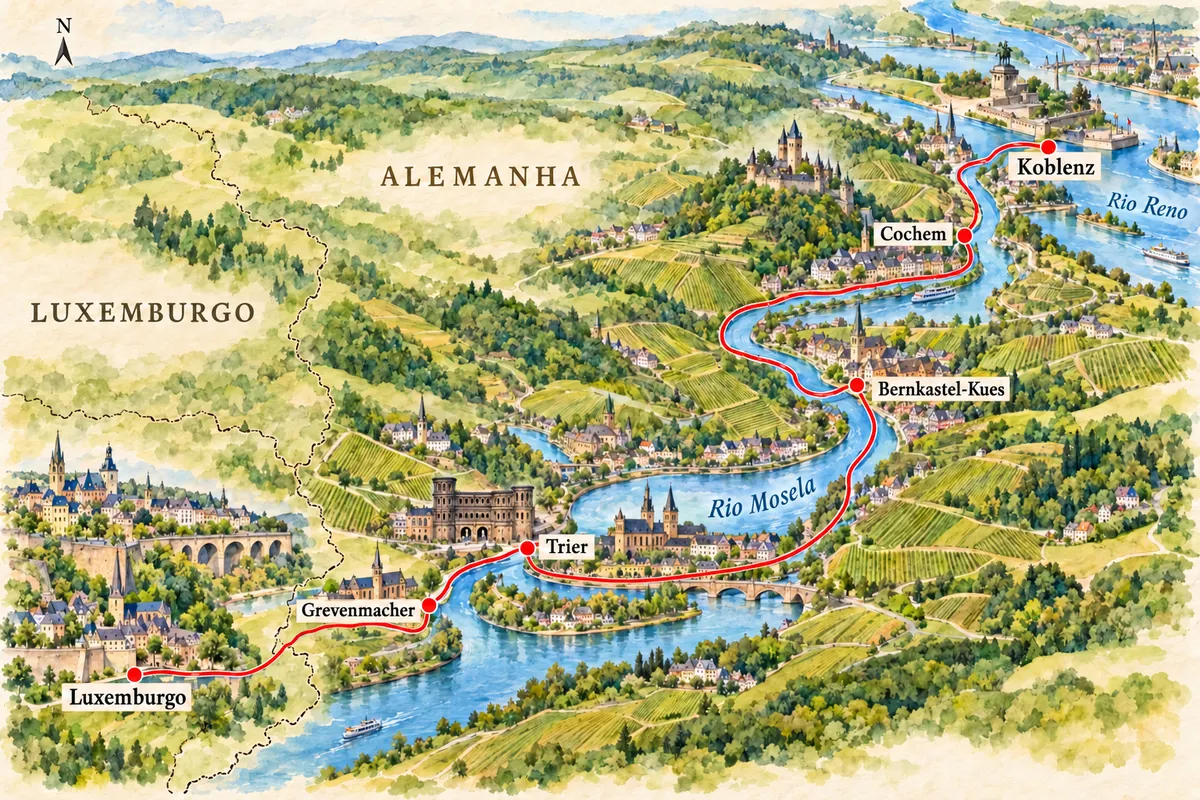
Moselle Valley – na poti z imenom Moselle Valley: Luxembourg–Trier–Cochem–Koblenz

Along the Moselle River, from Luxembourg to Germany: vineyards on slopes, half-timbered villages, Roman Trier, Cochem Castle, and the confluence with the Rhine in Koblenz.

Zemljevid je ilustrativen in ni v merilu. Dotaknite se mesta, da odprete njegovo stran.
Moselle Valley: Luxembourg–Trier–Cochem–Koblenz – ilustrirani zemljevid
Več o poti – Moselle Valley: Luxembourg–Trier–Cochem–Koblenz
Odkrijte druge destinacije Iskanje po zvezni državi in mestu

Več kot vodnik