Munich · Bavaria · Trg
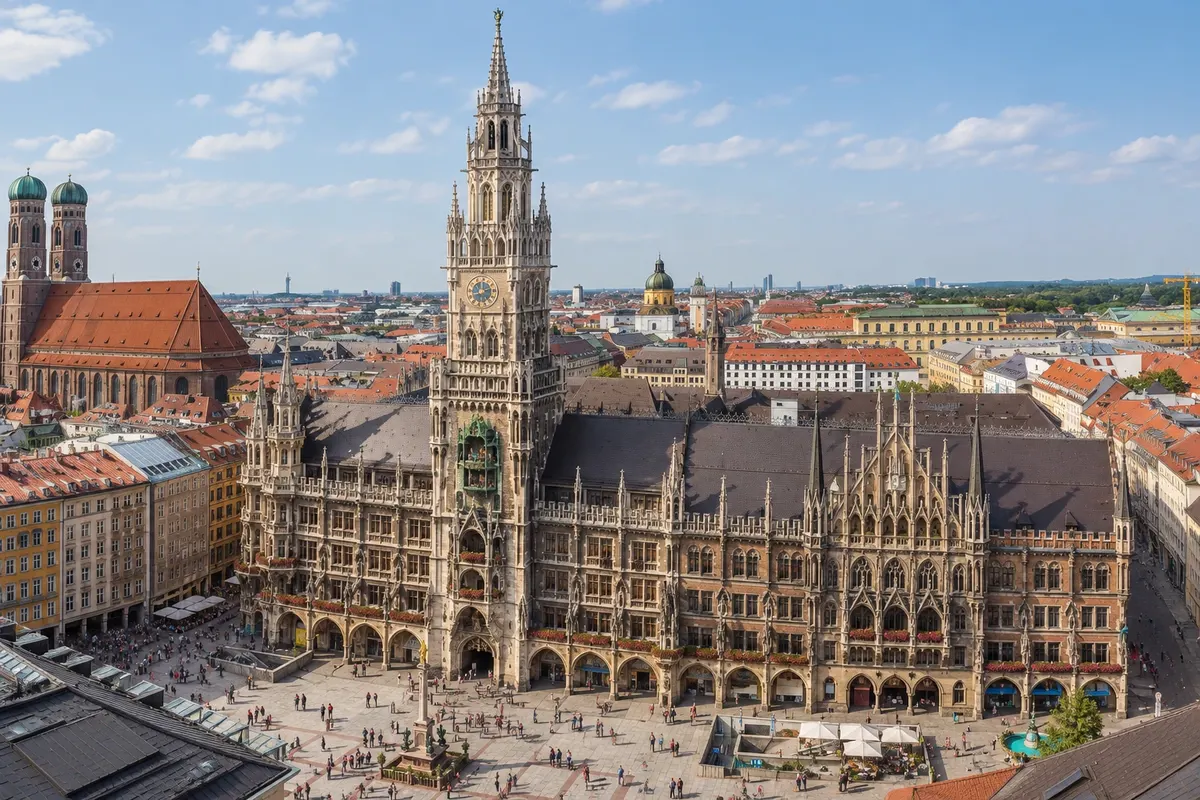
Marienplatz
Munich's central square, with the Mariensäule and the neo-Gothic façade of the Neues Rathaus, whose tower houses the city's most famous carillon.

 Išči
 Brazilija
 Antarktika
 Argentina
 Bolivija
 Čile
 Kolumbija
 Ekvator
 Gvajana
 Francoska Gvajana
 Falklandski otoki (Malvini)
 Paragvaj
 Peru
 Surinam
 Urugvaj
 VenezuelaNemčija
 Avstrija
 Belgija
 Hrvaška
 Danska
 Slovaška
 Slovenija
 Španija
 Finska
 Francija
 Grčija
 Nizozemska
 Madžarska
 Irska
 Islandija
 Italija
 Luksemburg
 Norveška
 Poljska
 Portugalska
 Združeno kraljestvo
 Češka
 Švedska
 Švica
 Turčija
 Bermudi
 Kanada
 Združene države Amerike
 Grenlandija
 Mehika
 Sveta Peter in Mihael
 Dominikanska republika
 JaponskaTurčija
 Južnoafriška republika
 Egipt
 Avstralija
 Fidži
 Nova Zelandija
 Papua Nova Gvineja
Bavaria · Nemčija
The capital of Bavaria combines a rebuilt old town, major museums, parks along the Isar, historic breweries and easy access to the Alps and the castles.
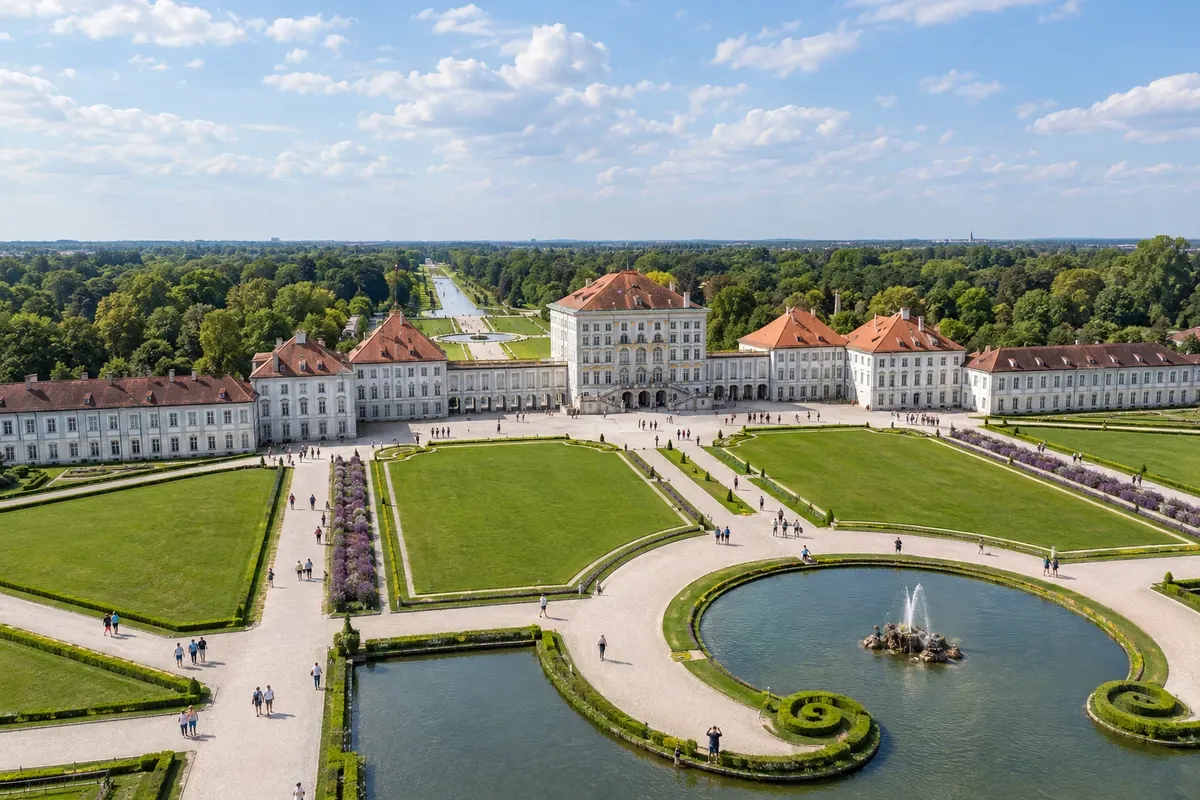
Na fotografiji: Schloss Nymphenburg, Munique
Illustrative images. The pictures in this guide are illustrations based on the real place, not photographs, and may differ from it.
Spoznajte kraj
Munique (München in German) is the capital of Bavaria and the largest city in southern Germany. The old town center revolves around the Marienplatz, with the neo-Gothic town hall and the Glockenspiel that usually draws crowds in the late morning, and the rounded-domed towers of the Frauenkirche, the city's emblem.
The city was the seat of the Wittelsbach family for centuries, and that shows everywhere: the Residenz in the center, the Schloss Nymphenburg to the west, and the painting collections gathered in the Kunstareal, the museum quarter, where the Alte Pinakothek is located. The Deutsches Museum, on an island in the Isar, is one of the largest science and technology museums in the world.
The outdoor side matters a lot: the Englischer Garten is one of the largest urban parks in Europe, with biergärten (the Bavarian beer gardens) and the Eisbach stream. Beer culture is visible at the Hofbräuhaus, the Viktualienmarkt and the Theresienwiese, where the Oktoberfest usually takes place from late September into early October.
20th-century history is also present. Munique played a central role in the rise of Nazism, and about 20 km from the center lies the Memorial of the Dachau Concentration Camp, a site of remembrance that many visitors include. In the north of the city, the Olympiapark from the 1972 Games, BMW Welt and the Allianz Arena show modern Munique.
V vodniku še ni nastanitev – Munich.
kako do tja · koliko dni · načrt poti · vprašanja
✈ Flughafen München Franz Josef Strauß (MUC)· 38 km do cilja (Munich)
Confirm before purchasing. From the airport (MUC), the S1 and S8 S-Bahn lines take you to the center and to the central station (Hauptbahnhof), which receives ICE trains from Berlin, Frankfurt and Nuremberg.
Doživite kraj
Munich's central square, with the Mariensäule and the neo-Gothic façade of the Neues Rathaus, whose tower houses the city's most famous carillon.
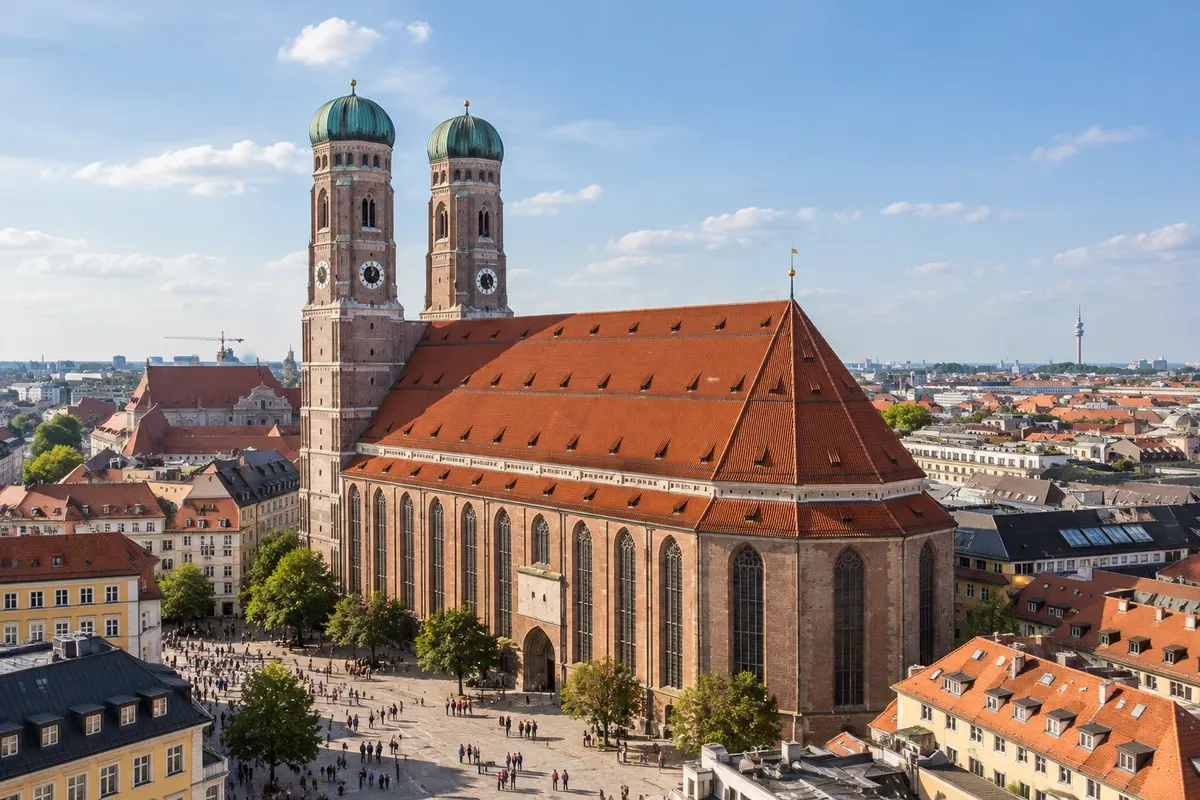
15th-century brick Gothic cathedral, with the two towers topped by rounded domes that are the symbol of Munich. The south tower can be visited.
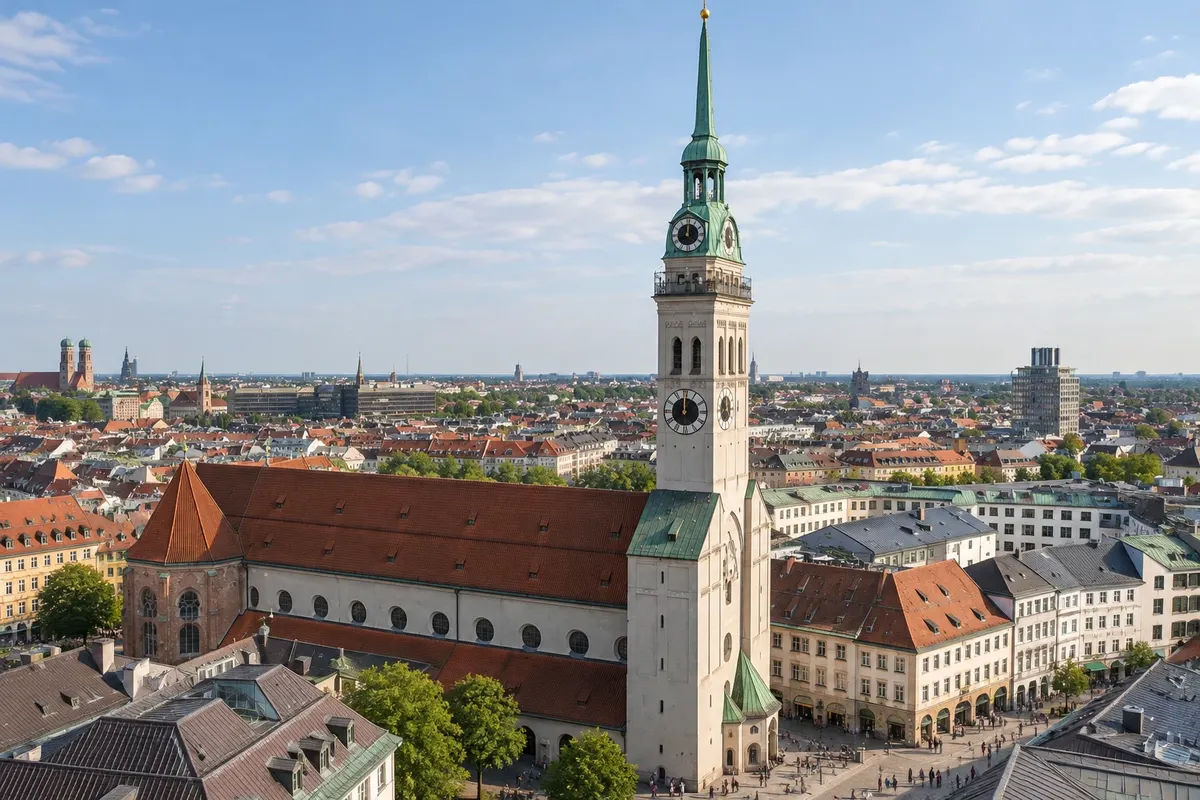
Munich's oldest church, next to Marienplatz. The tower, nicknamed Alter Peter by locals, has an open gallery with views over the center.
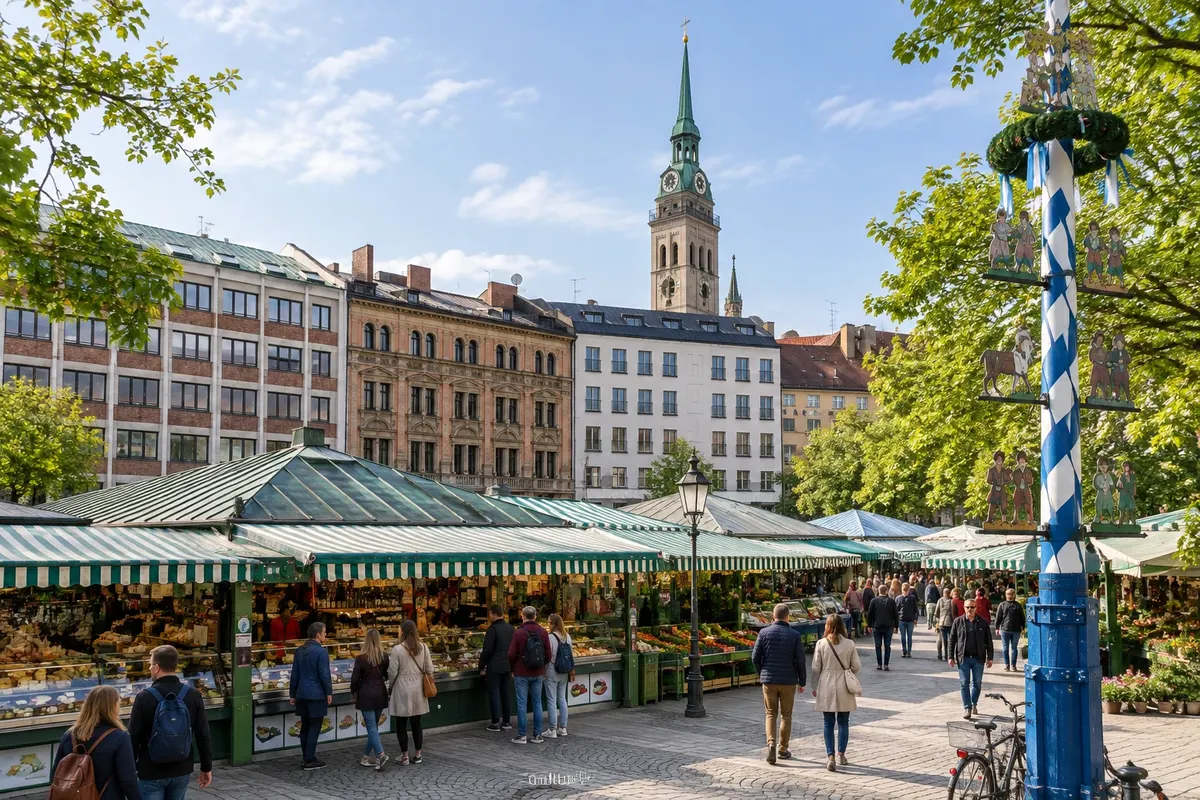
Open-air market next to Marienplatz, with stalls selling fruit, cheese, meats, flowers and ready-to-eat food around a biergarten and the town's Maibaum.
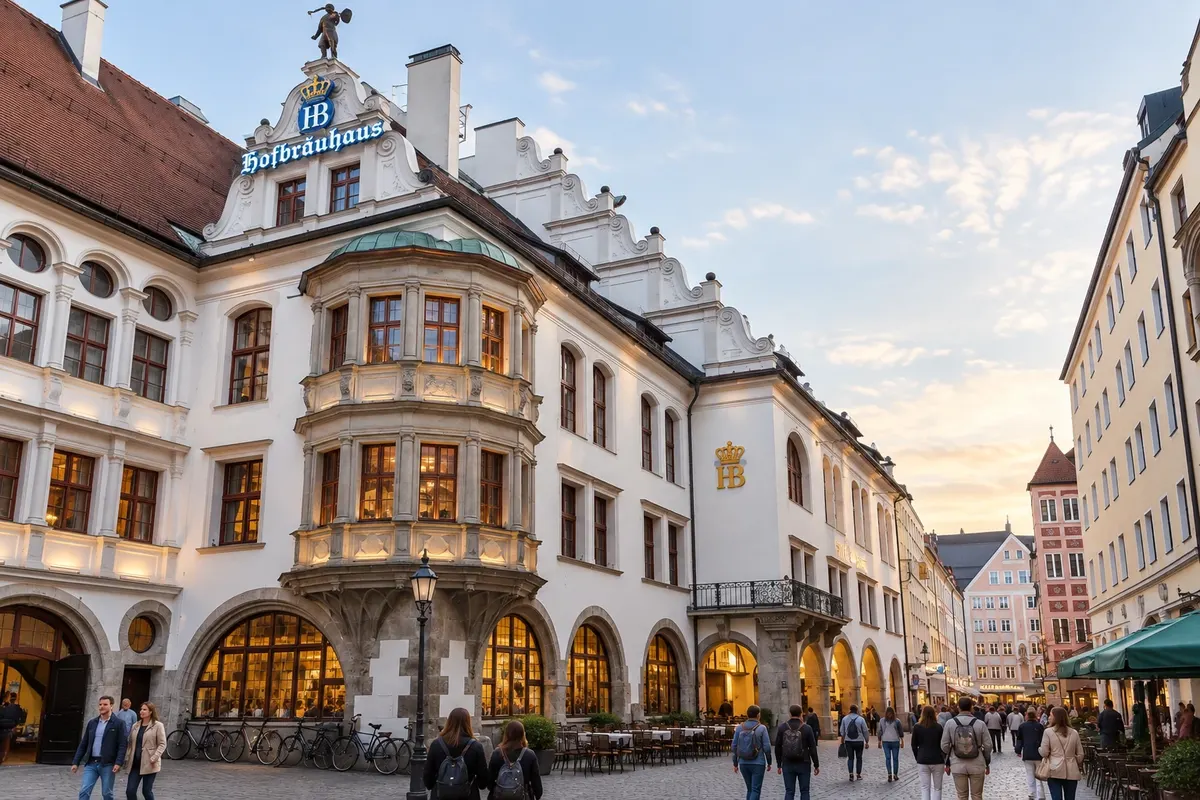
Munich's best-known brewery, founded by the Bavarian court in 1589, with long-table halls, music and Bavarian cuisine in the old town.
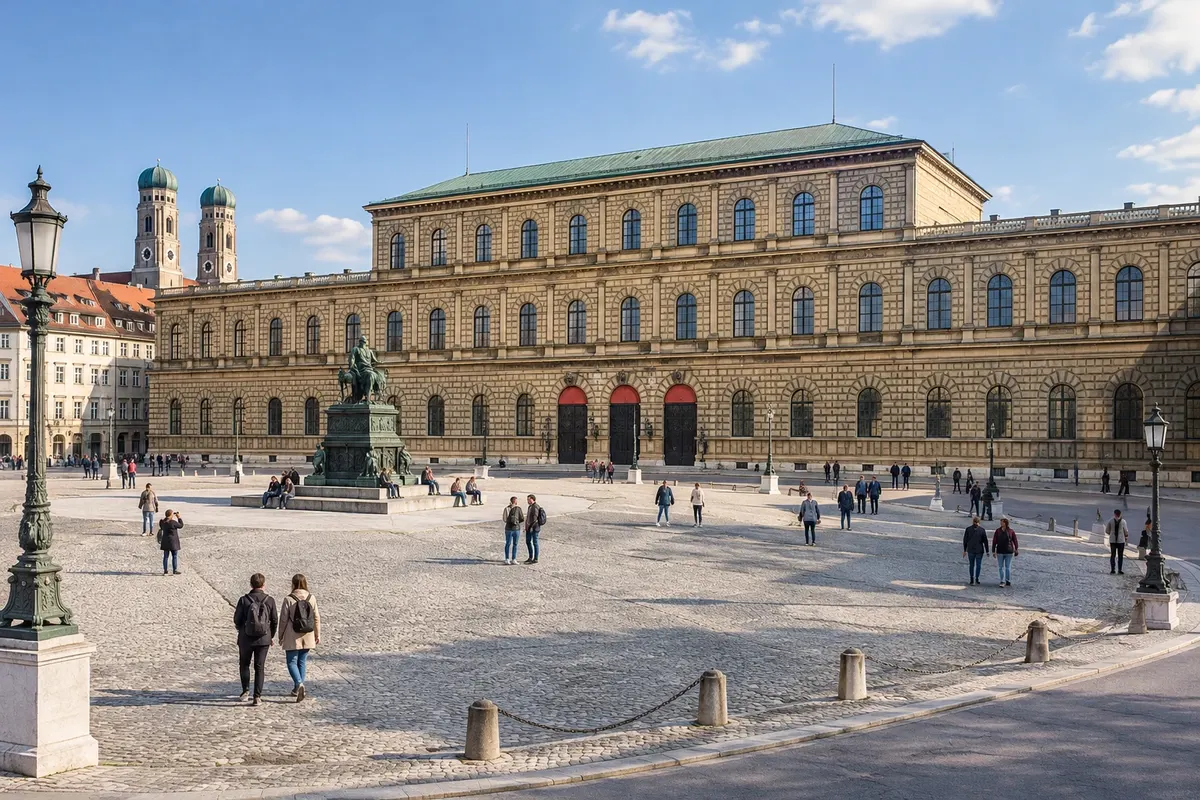
The former city palace of the dukes, electors and kings of Bavaria, with dozens of rooms, the Renaissance Antiquarium, the Treasury and the rococo Cuvilliés Theatre.
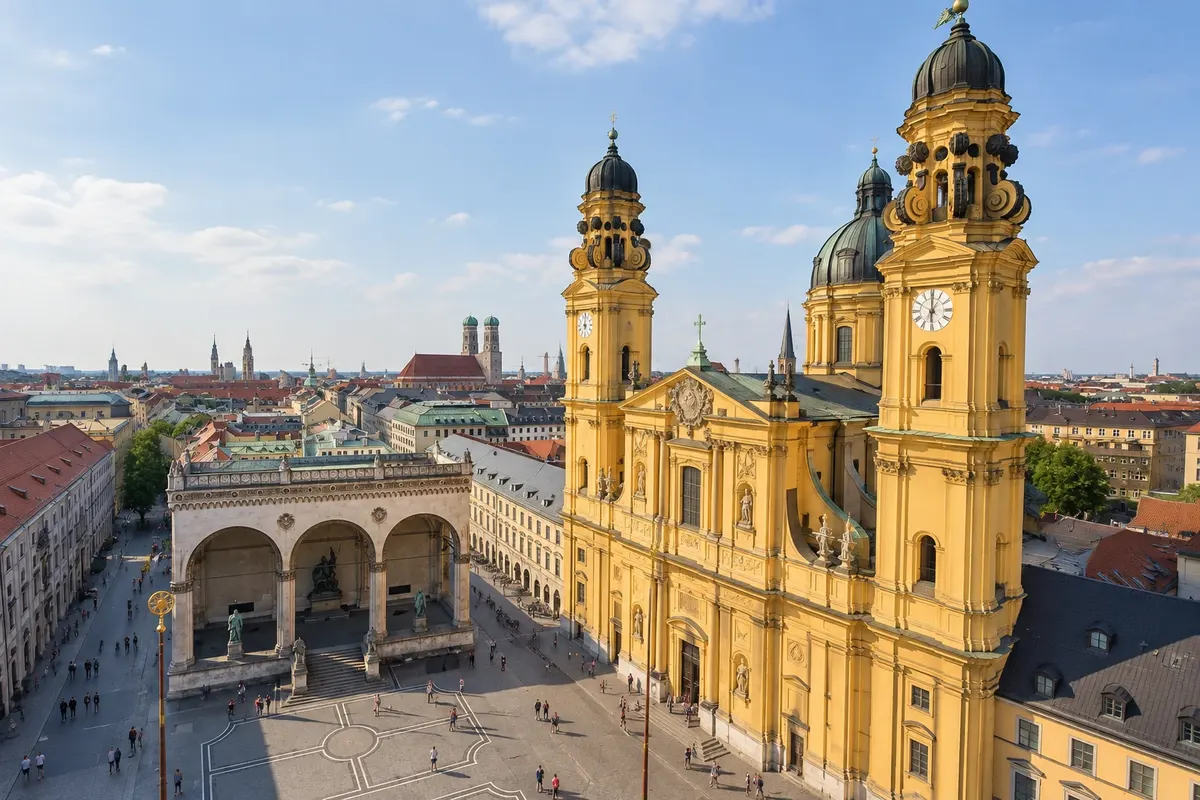
Monumental square at the start of Ludwigstraße, featuring the Feldherrnhalle, the yellow Theatinerkirche and the entrance to the Hofgarten, the former court garden.
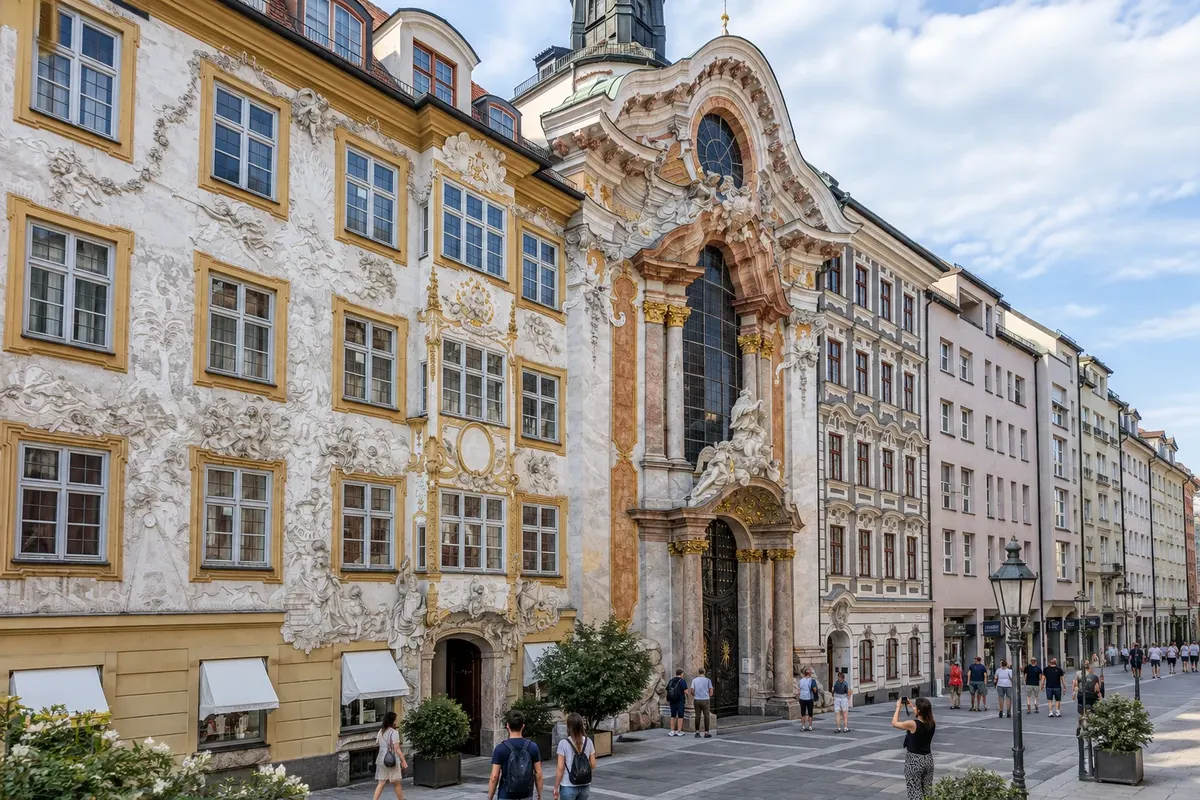
Small Baroque church on Sendlinger Straße, built by the Asam brothers next to one of their houses, with an interior richly decorated in gold, marble and frescoes.
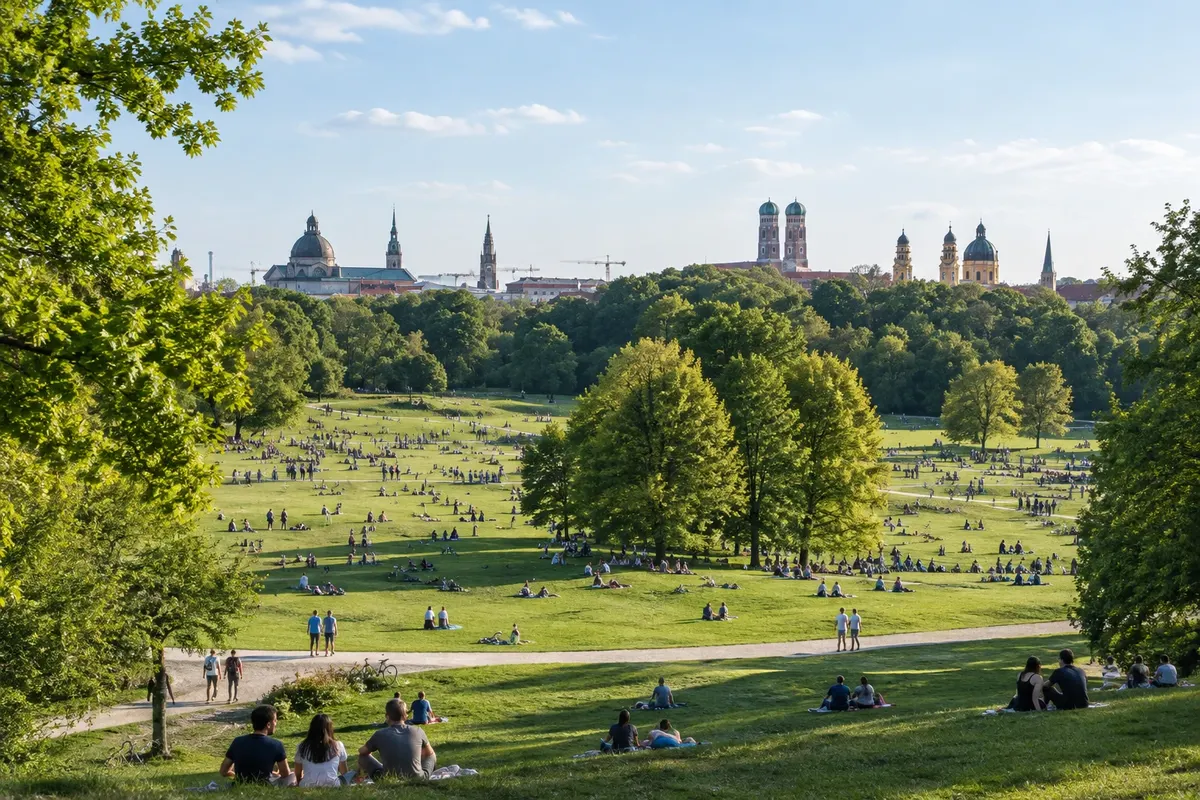
One of the largest urban parks in Europe, with fields, streams, the Monopteros, the Torre Chinesa and the Eisbach, where surfers often take on a standing wave.
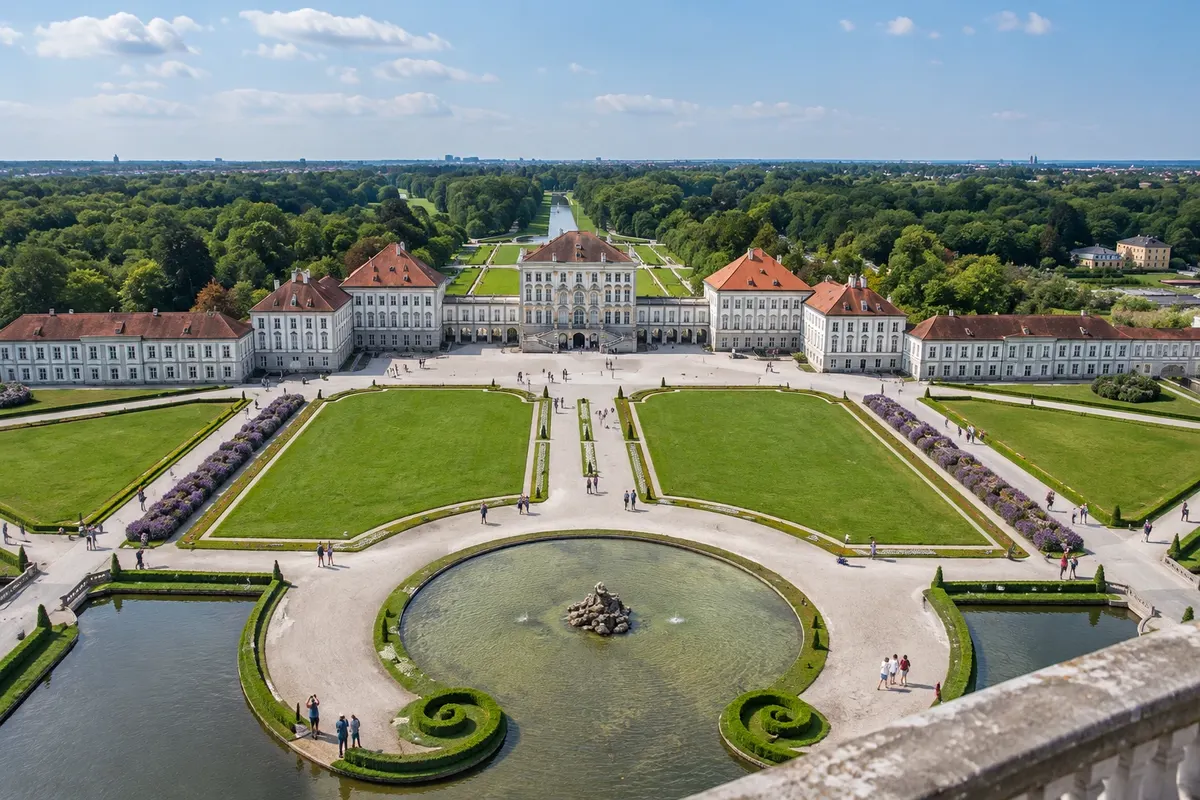
The Wittelsbachs' summer palace, begun in 1664, with Baroque rooms, the Galeria das Beldades, the carriage museum and a park of canals and pavilions.
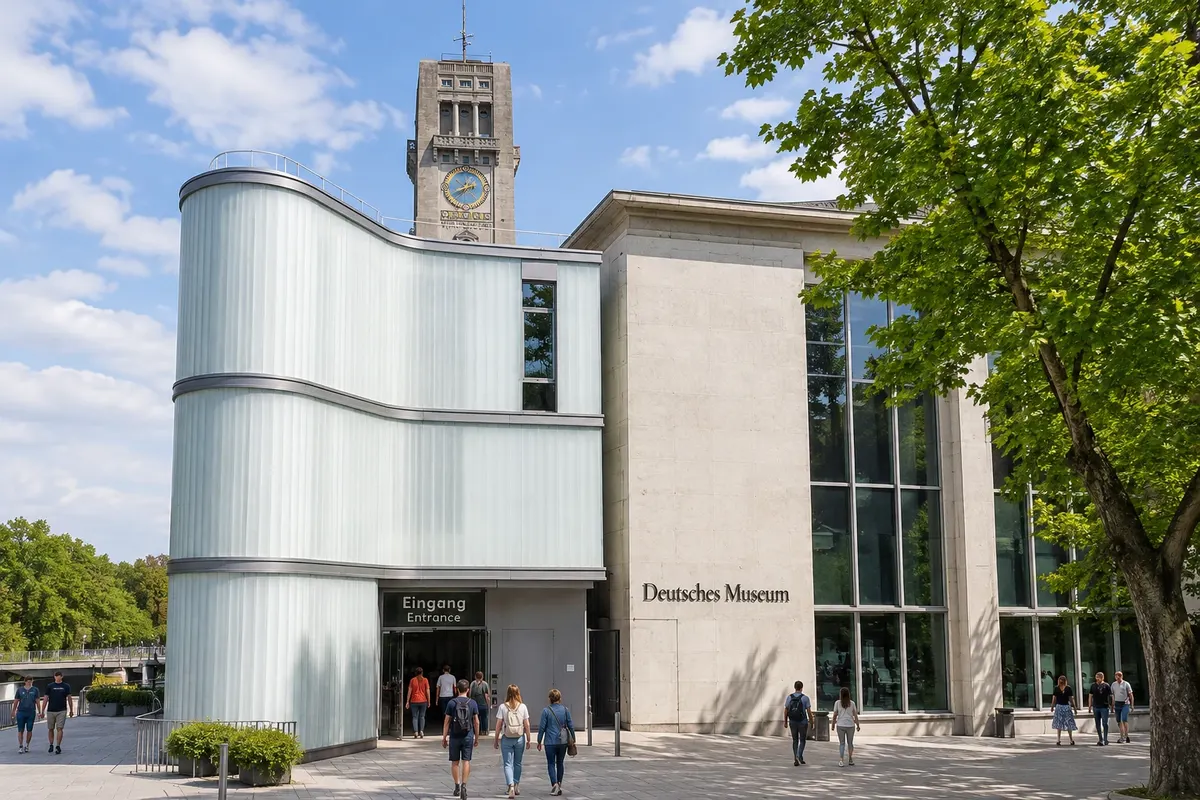
One of the world's largest science and technology museums, on an island in the Isar River, with airplanes, ships, machines, scientific instruments and hands‑on experiments.
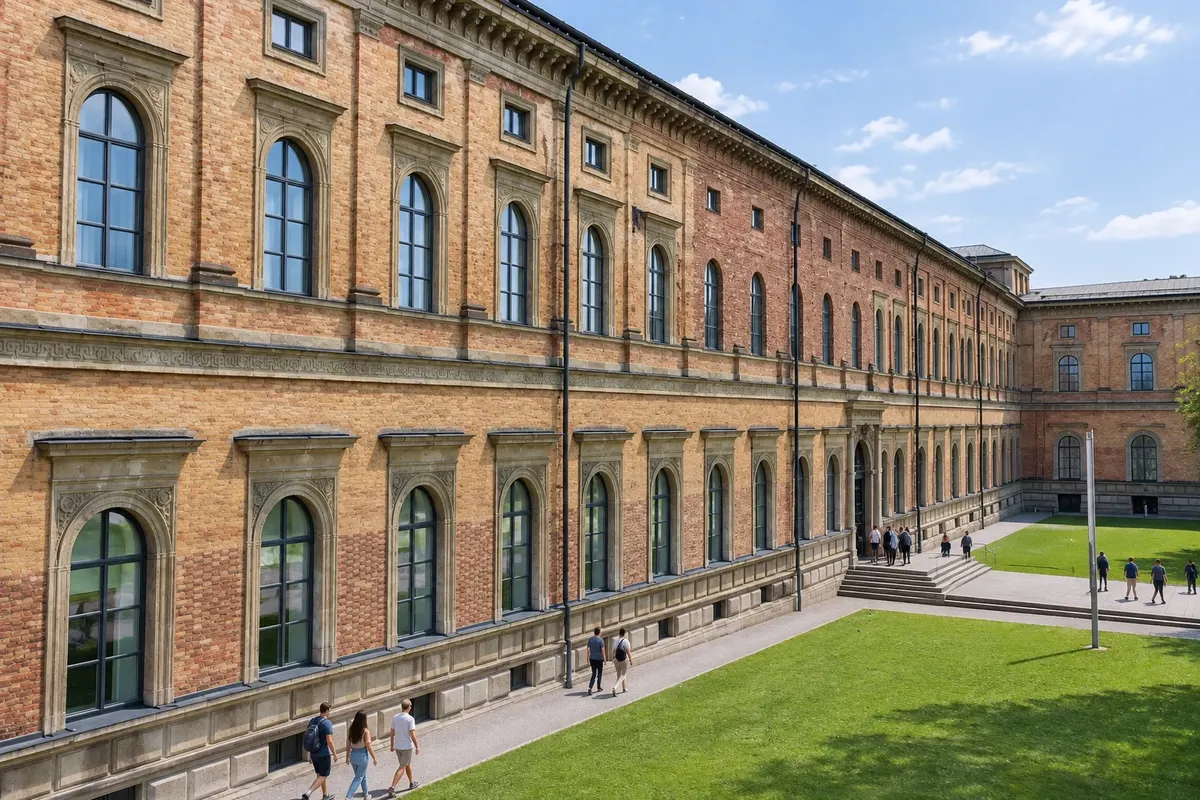
Museum of European painting from the 14th to the 18th century in the Kunstareal, the museums quarter, with works by Dürer, Rubens, Rembrandt, Raphael and Titian.
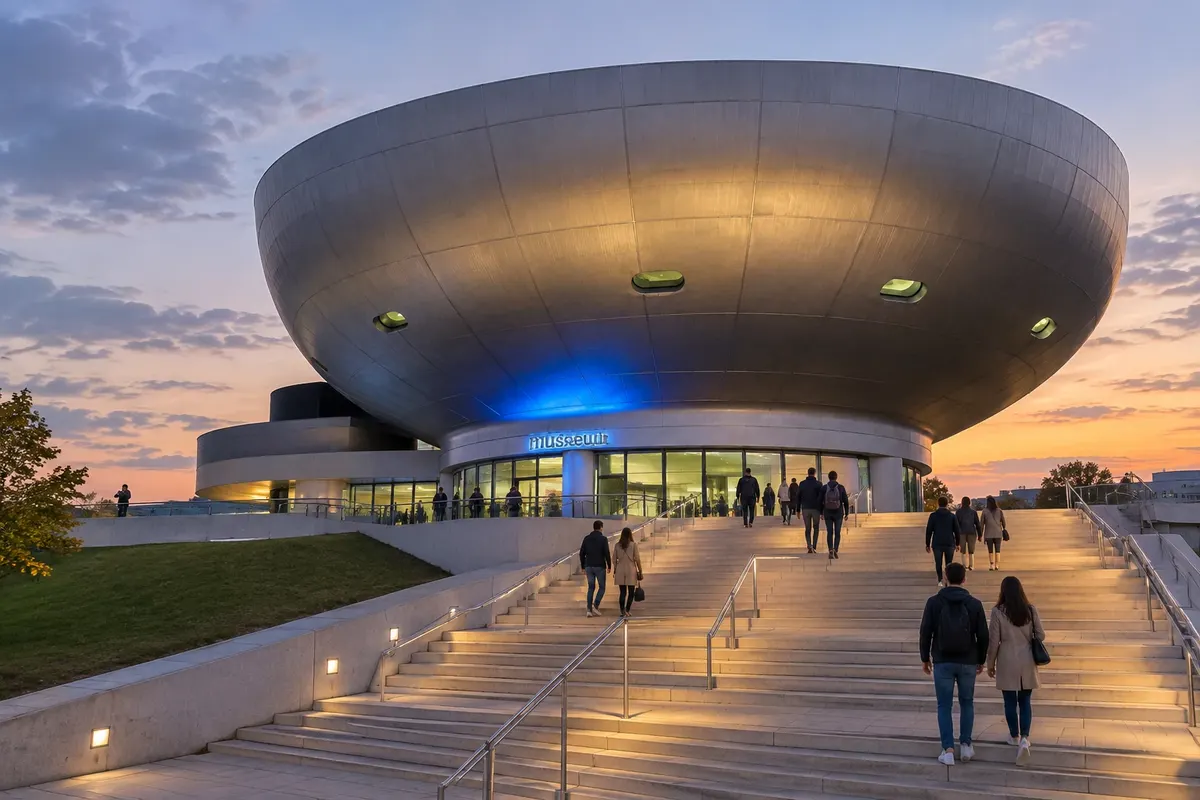
The BMW exhibition and delivery centre, in a building with curved forms, and the brand's museum, bowl‑shaped, next to the company headquarters.
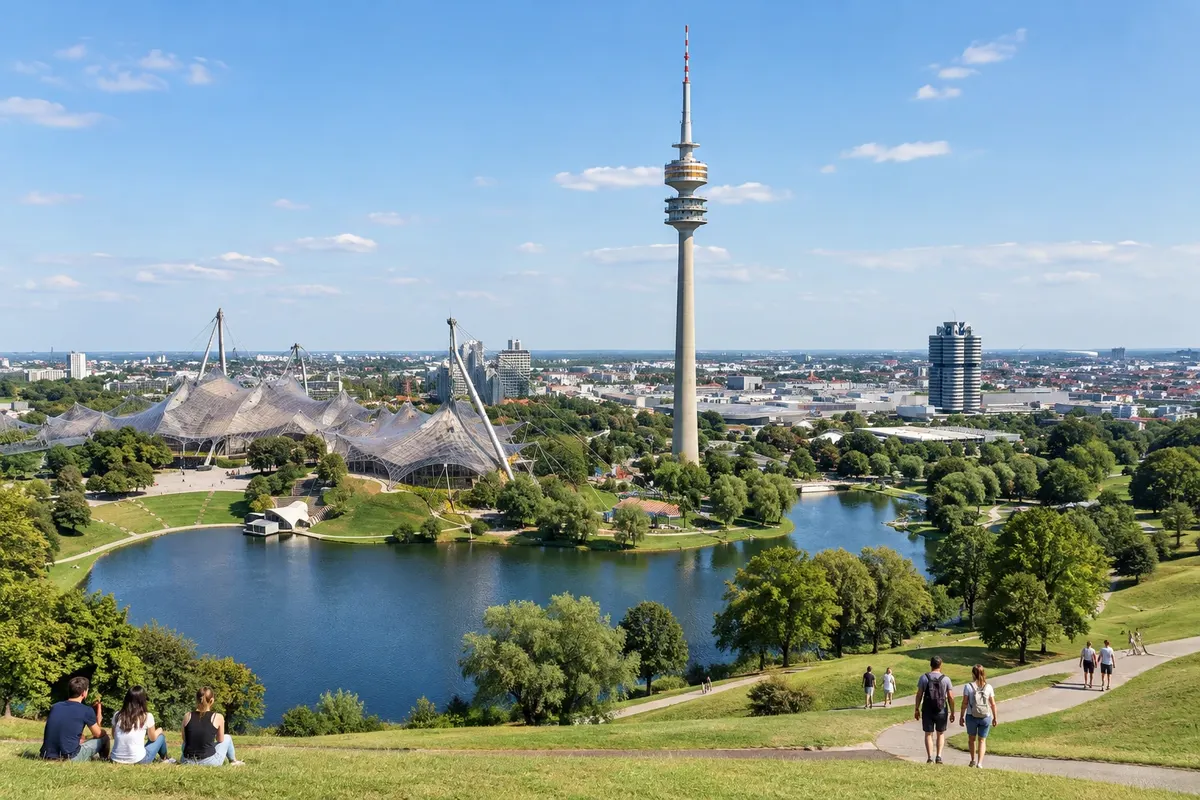
The park built for the 1972 Olympic Games, with the tent-roofed stadium covered in acrylic, the lake, the Olympiaberg hill and arenas that host concerts and sporting events.
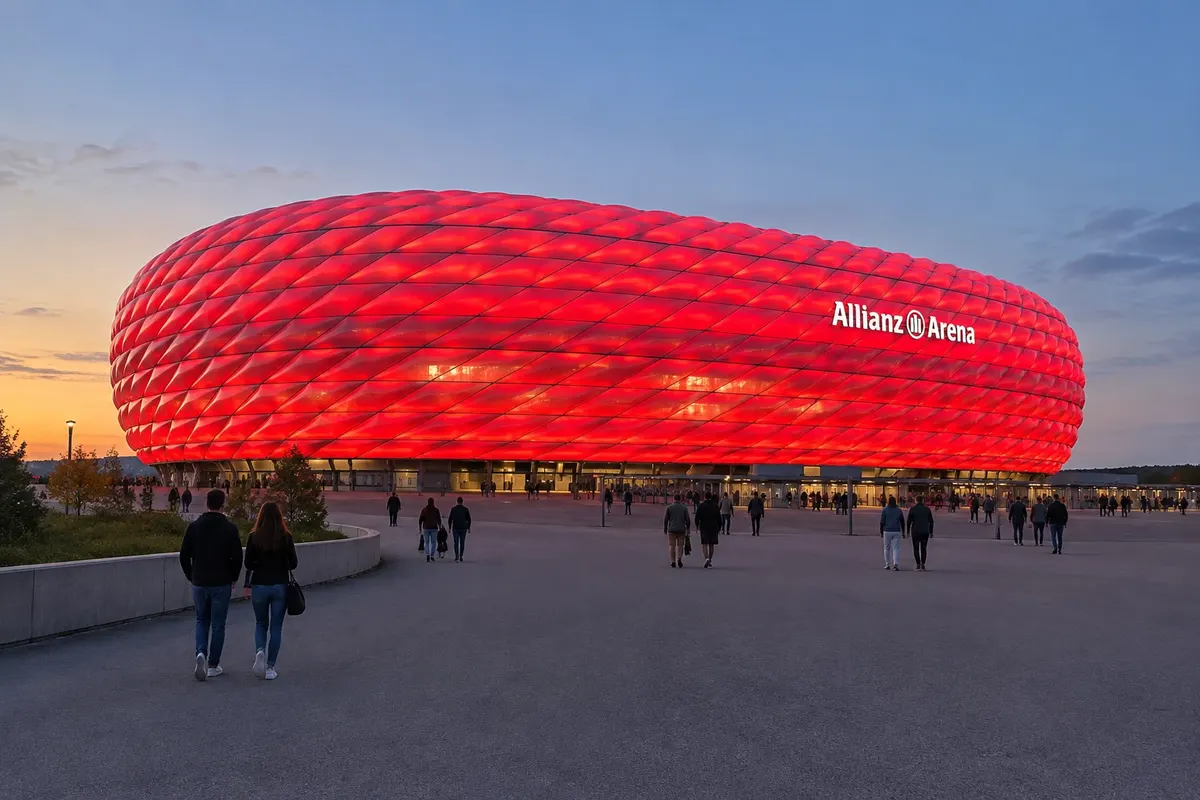
The FC Bayern Munich stadium, with a façade of inflatable panels that can be lit up, visited on guided tours and in the club museum.
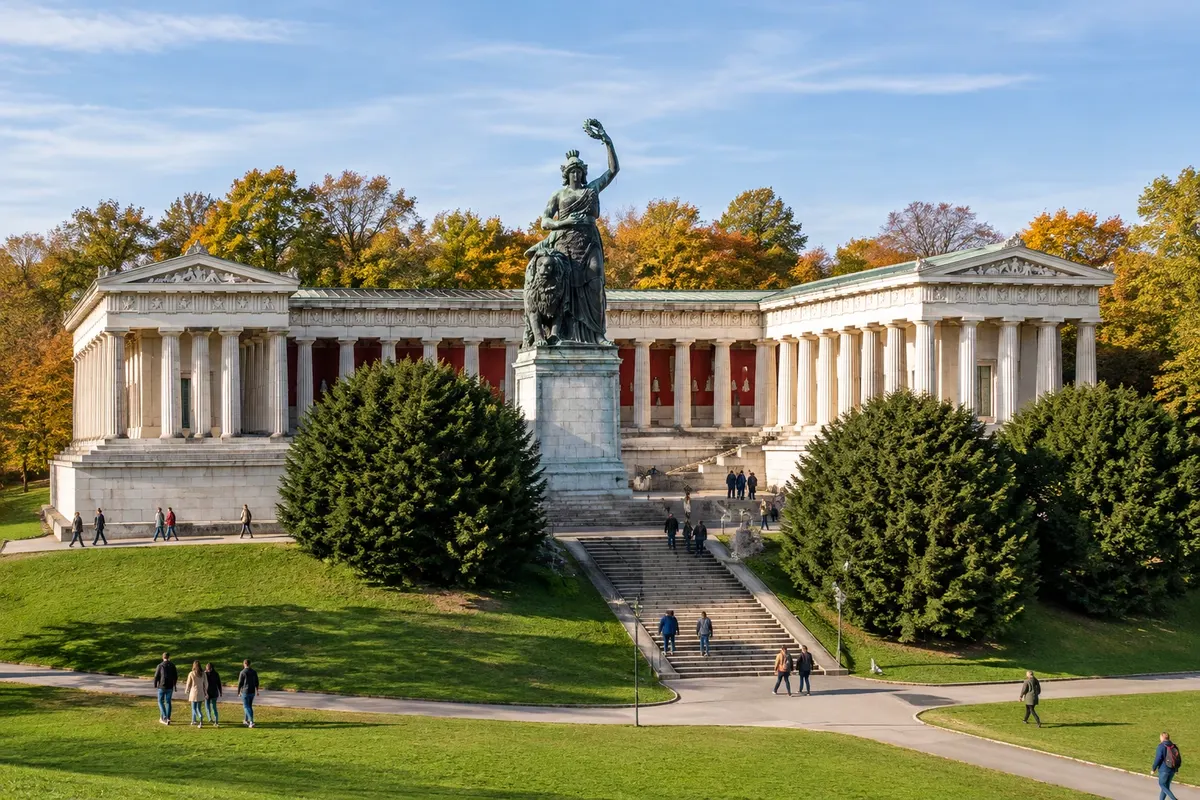
The large site west of the center where Oktoberfest usually takes place from late September to early October, with the Bavaria statue overlooking the field.
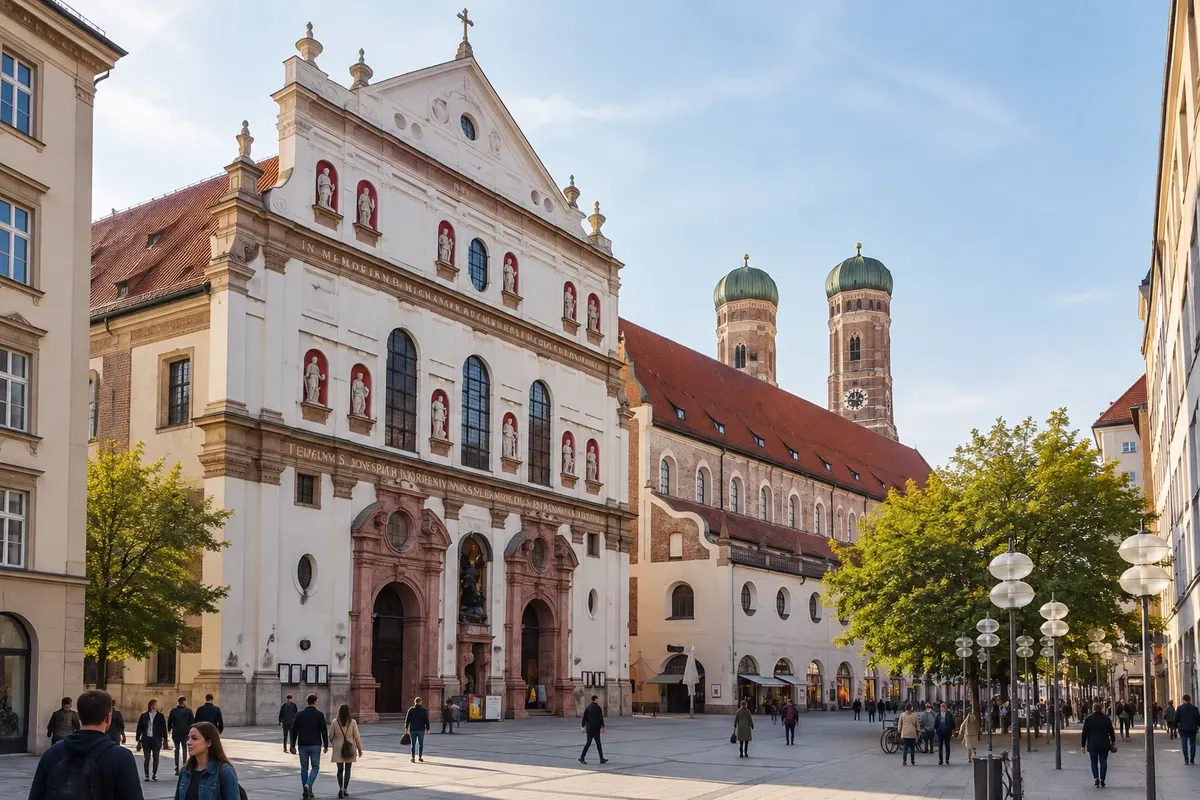
Renaissance Jesuit church on the pedestrian street, with a large barrel vault and the crypt where the tomb of King Ludwig II is located.
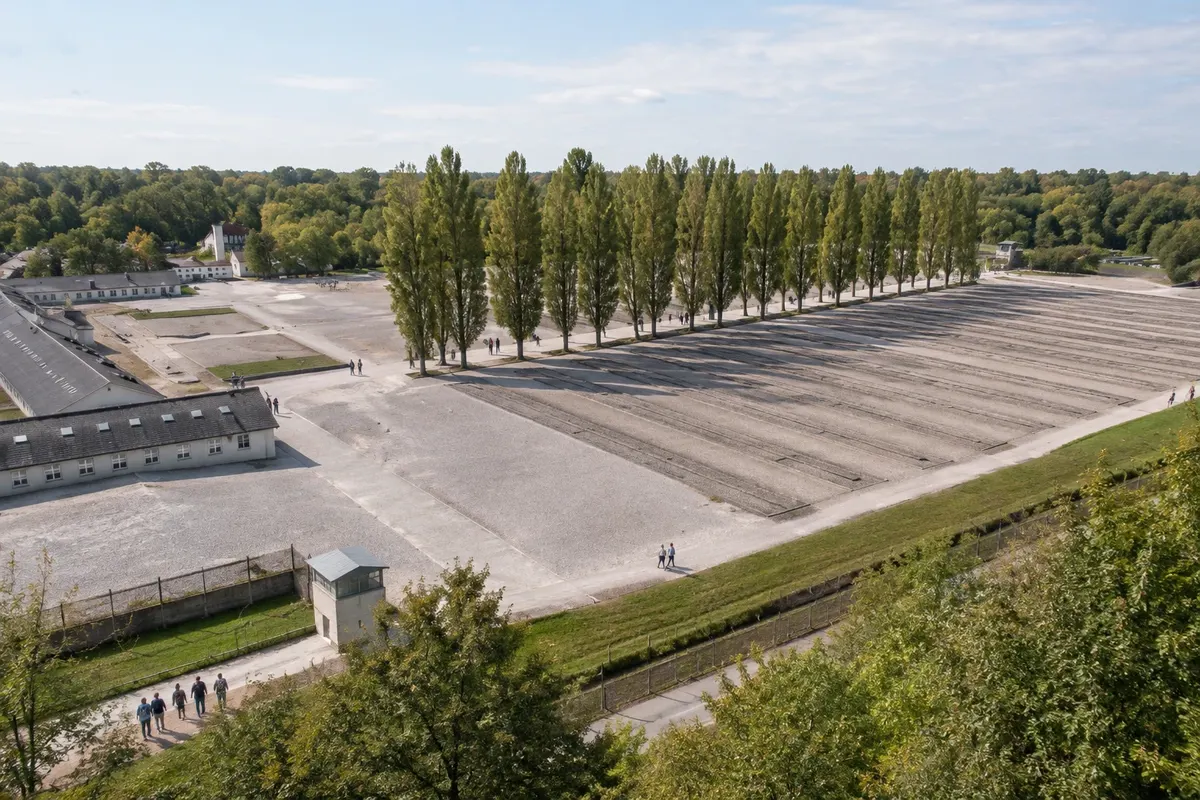
Memorial on the site of the first Nazi concentration camp, opened in 1933 in Dachau, about 20 km from Munique. It is a place of remembrance, with a permanent exhibition.
Kaj izbrati pred odhodom
Izhodišče, trajanje, potek, vključene storitve in okvirna cena vsakega izleta.
Marienplatz has been Munich's central square since the city's founding and was the main market until 1854. In the middle is the Mariensäule, a 1638 column erected in thanks that the city was spared during the Thirty Years' War. The north side is dominated by the Neues Rathaus (new town hall), in a neo-Gothic style, built from 1867 to 1905 by Georg von Hauberrisser, with a façade of about 98 m and an 85 m tower crowned by the Münchner Kindl, the monk-child from the city's coat of arms. The tower houses the Glockenspiel, a carillon of 43 bells with life-size figures that stage a knights' tournament and the coopers' dance; it plays daily at 11:00 and at noon and, from March to October, also at 17:00. On the east side is the Altes Rathaus (old town hall), from 1470–1475. Two blocks away is the Frauenkirche, the brick cathedral (Dom) begun in 1468 by Jörg von Halsbach and completed in about 20 years: its two towers, 98.45 m and 98.57 m, received onion-shaped domes around 1525 and are the city's symbol. On the entry floor is the Teufelstritt, the devil's footprint, a spot from which no window of the nave can be seen. Between Marienplatz and the Viktualienmarkt lies St. Peter, Munich's oldest parish, originating in the 12th century, with a Baroque high altar from 1730–1734. Its tower, the Alter Peter, is 91 m tall with a platform at 56 m, reached by 306 steps.
Kraji na poti: Marienplatz, Frauenkirche, St. Peter.
Vključuje: Self-guided walk: the square, the Glockenspiel and the interiors of the two churches have no entrance fee. The climbs to the Neues Rathaus tower (by elevator, at scheduled times), the Alter Peter platform (stairs only) and the south tower of the Frauenkirche are charged separately. The churches close to visitors during services.
Nasvet: Arrive at Marienplatz about 15 minutes before 11:00 to see the Glockenspiel from in front of the tower. The Alter Peter does not accept reservations: go up early, before the tour groups. With a Föhn wind (warm and dry), the Alps appear on the horizon. Combine this walk with the Viktualienmarkt, which starts behind St. Peter.
Najboljši čas za obisk: All year. From April to October there are more Glockenspiel performances and longer days; from late November to December 24 the square usually hosts the Christmas market.
The Viktualienmarkt has been Munich’s open-air food market since 1807, when King Max I Joseph moved part of the Marienplatz market here. It covers about 18,500 m² between St. Peter and the Schrannenhalle, with more than 100 permanent traders: fruit, vegetables, flowers, cheeses, breads, meats, fish, spices, honey and shops selling Bavarian products. In the middle of the stalls is a Biergarten (beer garden) under chestnut trees, where the beer served rotates every five or six weeks among the city’s six traditional breweries; you are allowed to bring your own food and sit at the tables without a tablecloth. The Maibaum, the pole painted blue and white with figures of trades, has been there since 1962 and is changed every few years. At the edges are fountains with statues of popular Munich performers, such as Karl Valentin and Liesl Karlstadt. The Schrannenhalle, at the southern end, was built in 1852 as a grain market, burned in 1932 and was rebuilt on the original site in 2005; it now houses shops and restaurants. The market operates Monday through Saturday; on Sundays and public holidays the stalls are closed, and many close in the early afternoon.
Kraji na poti: Viktualienmarkt.
Vključuje: Self-guided visit: entry to the market is free; food and drink are paid at each stall. At the Biergarten, only drinks must be purchased on site. There are paid guided food tours sold separately by agencies and by the official tourism office.
Nasvet: Go between 10:00 and 13:00, when all the stalls are open; it’s a good place for a quick lunch with Weißwurst, Brezn (pretzel) or a Leberkäse in bread. On Saturdays the crowds double. In February, at carnival, there is often the market sellers’ dance on Fat Tuesday; check before you go.
Najboljši čas za obisk: From April to October, with the Biergarten operating and the stalls full of seasonal fruit; in December there are decorations and mulled wine. Closed on Sundays.
The Residenz (royal residence) was the seat of the dukes, prince-electors and kings of Bavaria from 1508 to 1918, and is the largest city palace in Germany. It began as the Neuveste, a moated castle from 1385, and expanded over four centuries around ten courtyards. Much was destroyed in World War II; reconstruction began in 1945. The visit is divided into three museums. The Residenzmuseum covers more than one hundred rooms, from the Renaissance to Neoclassicism: the Antiquarium, a 66 m hall built from 1568 to 1571 by Duke Albrecht V for his collection of ancient sculptures and later used for banquets; the Ahnengalerie (ancestral gallery), with portraits of the Wittelsbachs; the Reiche Zimmer (rich rooms), in Rococo; the court chapel and the Nibelungen rooms. The Schatzkammer (treasury) holds the crown of the Bavarian kings, jewels, reliquaries and metalwork pieces dating back to the Middle Ages. The Cuvilliés-Theater, a red-and-gold Rococo theatre completed in 1753 by François Cuvilliés, has four tiers of boxes and still hosts concerts and chamber operas. Next to it is the Hofgarten, a 1613 garden with the Temple of Diana at its center, open to the public and with views toward the Theatinerkirche and Odeonsplatz.
Kraji na poti: Residenz München, Odeonsplatz.
Vključuje: Separate paid admission applies to each of the three museums, with a combined ticket available; the Residenzmuseum audio guide is included with admission. The Hofgarten and the external courtyards are free. It is closed on January 1, Shrove Tuesday and on December 24, 25 and 31; from mid-October to March opening hours are shorter. The Cuvilliés-Theater closes for rehearsals and performances: check before you go.
Nasvet: Reserve the whole morning: the Residenzmuseum alone takes two to three hours. Start with the Schatzkammer, smaller and quieter, and leave the Antiquarium for last. The main entrance is at Max-Joseph-Platz, opposite the State Opera. From the Hofgarten you can walk to the Englischer Garten.
Najboljši čas za obisk: Year round the visit is indoors. From April to mid-October opening hours are longer; on rainy days from May to August the museums get busier.
The Englischer Garten (English Garden) is Munich’s large park: 376 hectares, or 411 including adjacent areas, from the center to the north of the city along the Isar river. It began to be planted in 1789 at the initiative of Benjamin Thompson, the Count Rumford, and took on the form of an English landscape garden under Friedrich Ludwig von Sckell; from the start it was conceived as a park for everyone. The south entrance is on Prinzregentenstraße, next to the Haus der Kunst: right there, under the bridge, is the Eisbachwelle, a stationary wave on the Eisbach stream where surfers take turns year-round, even in winter; surfing has city rules and is only for experienced riders, but watching from the bridge is part of the visit. Heading north, the Monopteros, a round temple from 1836–1837 atop a hill, offers views of the city center towers. Further on is the Chinesischer Turm, a 25 m high wooden pagoda with a Biergarten of about 7,000 seats around it, and nearby the Japanisches Teehaus, a tearoom built for the 1972 Olympic Games on an island in the Schwabinger Bach. The Kleinhesseloher See is the park’s largest lake, with rowboat and pedal boat rentals in summer and the Seehaus restaurant on the shore. The northern part, the Hirschau, is quieter, with meadows and another Biergarten.
Kraji na poti: Englischer Garten.
Vključuje: Park open, no admission charge. Boats on the lake, food and drink in the Biergärten and bicycle rentals are paid separately. The Biergärten generally operate from April to October and depend on the weather: confirm before you go.
Nasvet: To see everything, rent a bicycle: on foot, stay in the south half (Eisbach, Monopteros, Chinesischer Turm), which takes an afternoon. On sunny days many people sunbathe nude on the lawns near the Eisbach, an old park custom. From the U3/U6 Universität or Giselastraße stations you can reach the Monopteros in 10 minutes.
Najboljši čas za obisk: From May to September, with the Biergärten open and boats on the lake; in October the trees turn yellow. In winter the park is quiet and surfers continue on the Eisbach.
Schloss Nymphenburg (Nymphenburg Palace) was the summer residence of the Wittelsbach family in the west of the city. It began in 1664, designed by the Italian Agostino Barelli, as a gift from Elector Ferdinand Maria to his wife, Henriette Adelaide of Savoy, on the birth of their heir Max Emanuel. Over the next hundred years the side pavilions, galleries and the more than 600 m façade facing the canal were added. The tour of the palace starts in the Steinerner Saal, a three‑storey festival hall with frescoes by Johann Baptist Zimmermann, preserved as a rococo room since 1758, and passes through the Schönheitengalerie (gallery of beauties), the portraits of Munich women that Joseph Stieler painted for King Ludwig I, and the room where Ludwig II was born on August 25, 1845. In the former stables, the Marstallmuseum displays more than forty court carriages and sledges, including Ludwig II’s gilded vehicles, and on the upper floor is the Nymphenburg porcelain museum. The park covers 229 hectares, has been open to the public since 1792 and was converted into an English landscape garden by Friedrich Ludwig von Sckell, featuring the central canal, two lakes and four small palaces: the Amalienburg, a rococo hunting pavilion by François Cuvilliés with a hall of mirrors; the Badenburg, with an indoor pool; the Pagodenburg, in Chinese style; and the Magdalenenklause, an intentionally ruined hermitage.
Kraji na poti: Schloss Nymphenburg.
Vključuje: Separate ticket required, with a combined ticket available for the palace, the Marstallmuseum and the park pavilions; the park itself does not charge admission. The park pavilions are closed from mid-October through March; the palace and the Marstallmuseum are open year-round except January 1, Carnival Tuesday and December 24, 25 and 31. Audioguide available for an extra charge.
Nasvet: Go to the palace in the morning and leave the afternoon for the park and the Amalienburg, the most ornate of the pavilions. In cold winters the canal freezes and becomes a skating rink and Eisstockschießen, a Bavarian game similar to curling. Beside the park is the Botanischer Garten (botanical garden), with greenhouses — a good option on a rainy day.
Najboljši čas za obisk: From April to mid-October, when the park pavilions are open and the fountains operate. The palace is worth visiting year-round; in December and January the park is quiet and sometimes snowy.
The Deutsches Museum is one of the largest science and technology museums in the world. It was founded in 1903 by Oskar von Miller, an engineer who set up Germany’s first high-voltage line in 1882, and the building on Museumsinsel, the Isar river island, opened in 1925. The collection holds about 125,000 objects, of which roughly 25,000 are on display, across 20 permanent exhibitions: astronautics, atomic physics, chemistry, electronics, health, robotics, musical instruments, bridges and hydraulic engineering, agriculture and food, railway models and a children’s kingdom for the youngest. Among the items are the first diesel engine, a section of an Airbus fuselage, a flight simulator and the table where Otto Hahn carried out nuclear fission in 1938. In every room there are push-button experiments and live demonstrations, such as the microscope theater. The Forum der Zukunft, in the former planetarium, has a projection dome and a virtual reality lab. The museum is undergoing phased renovation: half the building has reopened renovated and the other half is being redone, with a temporary entrance in a glass building next to the Corneliusbrücke. Some older sections, like the mine and the high-voltage room, are closed to visitors for several years. The museum has two branches: the Verkehrszentrum (transport) at Theresienhöhe, and the Flugwerft Schleißheim (aviation) north of the city.
Kraji na poti: Deutsches Museum.
Vključuje: Separate paid admission, sold online and by time slot; there is an annual pass and a combined ticket with the branches. Short demonstrations and guided visits are included with admission. It closes on some holidays, such as January 1, Carnival Tuesday, Good Friday, May 1, November 1 and December 24, 25 and 31: confirm before you go.
Nasvet: Choose four or five exhibits in advance: seeing everything is impossible in one day. Arrive at opening, 9:00 a.m., and check the lobby board for the day’s demonstrations. With children, start at the Kinderreich. The restaurant terrace looks over the Isar and, on clear days, the Alps.
Najboljši čas za obisk: Year-round, the visit is indoors: good for rainy days, common from May to August, and for winter. During Bavarian school holidays and rainy weekends the museum fills up.
Dachau was the first concentration camp of the Nazi regime. It opened on March 22, 1933, a few weeks after Hitler came to power, on the site of a former munitions factory, and served as a model for all later camps. Over twelve years, more than 200,000 people from over 40 countries passed through it and its subcamps; at least 41,500 died. American troops liberated the prisoners on April 29, 1945. The memorial was established in 1965 at the initiative of survivors and is about 20 km from central Munich. The visit begins at the Jourhaus, the guard building, with the gate bearing the phrase Arbeit macht frei. The former maintenance building houses the main exhibition, from 2003, which follows the prisoner’s path from arrival to death or liberation, with documents, photos, biographies and drawings made in the camp; the same building contains a cinema that shows a roughly 20-minute documentary several times a day, also in English. Opposite is the roll-call square; of the 34 barracks only the foundations remain, and two have been reconstructed to show how prisoners lived. At the rear of the site are the Catholic, Protestant, Jewish and Russian Orthodox chapels and memorials and, beyond a small wood, the crematorium area, with the two original crematoria and the gas chamber. It is a place of remembrance: it requests silence, simple clothing and time.
Kraji na poti: KZ-Gedenkstätte Dachau.
Vključuje: Entrance to the memorial and exhibition is free. Audio guides (in several languages) and guided tours are charged separately; there is an English guided tour every day, in the morning and early afternoon. Closed on December 24. Transport is on your own: the MVV day ticket for zones M and 1 covers S-Bahn and bus.
Nasvet: Take the S2 from Hauptbahnhof or Marienplatz (about 25 minutes to Dachau) and, on leaving the station, take bus 726, which stops at the memorial entrance. Go in the first half of the day and don’t schedule anything strenuous afterward. The memorial recommends visits from age 13. Bring water and a snack: there is only a small cafeteria on the site.
Najboljši čas za obisk: All year. The site is open and large: in winter, December to February, dress warmly; from May to September there are more groups, and mornings are quieter.
The Kunstareal (museum quarter), north of the Hauptbahnhof, brings together the main art museums of Munich within a few blocks. The Alte Pinakothek was built from 1826 to 1836 by Leo von Klenze for King Ludwig I and displays more than 700 European paintings from the 14th to the 18th century, mostly from the Wittelsbach collections: the Self‑Portrait with Fur‑Trimmed Coat by Albrecht Dürer; The Battle of Alexander by Albrecht Altdorfer; one of the world’s largest collections of Rubens; Leonardo da Vinci, Raphael, Botticelli, Titian, Rembrandt and El Greco. Because the 19th‑century Neue Pinakothek has been closed for many years for renovation, a selection of its works, including Van Gogh, Monet and Goya, is shown on the ground floor of the Alte Pinakothek. Across the street, the Pinakothek der Moderne, opened in 2002 to a design by Stephan Braunfels with a 25 m high glass rotunda, houses four museums: modern and contemporary art (Picasso, Beckmann, Kirchner, Warhol, Baselitz), design (from chair to computer, in the Neue Sammlung), architecture and printmaking. On the next corner, the Museum Brandhorst, opened in 2009 with a façade of 36,000 colored ceramic rods, is dedicated to art after 1945, with major holdings by Andy Warhol and Cy Twombly. Lawns between the buildings are where students from the adjacent university eat lunch in the sun.
Kraji na poti: Alte Pinakothek.
Vključuje: Separate paid admission at each museum, with a one-day ticket available for all three; on Sundays admission is nominally priced, check the current schedule. All are closed on Mondays. The Alte Pinakothek stays open later on Tuesdays and Wednesdays; the Pinakothek der Moderne and the Brandhorst on Thursdays. Audio guides are available for an additional fee.
Nasvet: Don’t try all three in one day: Alte Pinakothek in the morning and Pinakothek der Moderne in the afternoon is already a full program. Sundays are the busiest days because of the reduced-price admission. If you want only one museum, the Alte Pinakothek is the choice for lovers of old master painting; those who prefer design and 20th-century art should go to the Pinakothek der Moderne.
Najboljši čas za obisk: Year-round, indoor visits. On rainy days from May to August and during school holidays the museums are busier; Tuesday and Wednesday evenings are calm at the Alte Pinakothek.
BMW was founded in Munich in 1916, and its headquarters, the original factory and the two visitor venues are together next to the Olympiapark. The BMW Museum opened in 1973, shortly after the Olympic Games, in the round concrete building designed by Karl Schwanzer, the bowl locals call Weißwurstkessel (white sausage kettle), at the foot of the four-cylinder office tower by the same architect. The permanent exhibition, in a low wing added in 2008, occupies about 5,000 m² with some 125 cars, motorcycles and engines that tell the brand’s story, from 1920s aircraft engines to electric cars: the little Isetta of the 1950s, racing cars, the Art Cars collection painted by artists such as Andy Warhol and Roy Lichtenstein, and the BMW 750iL from the film 007 Tomorrow Never Dies. Across Lerchenauer Straße, linked by a footbridge, is the BMW Welt, from 2007, by Viennese firm Coop Himmelb(l)au, with the double glass-and-steel cone at the entrance: it’s the exhibition and delivery hall for new cars, showing current models from BMW, Mini and Rolls-Royce, sit-on motorcycles, shops and restaurants. The Munich factory next door offers guided tours of the assembly lines on weekdays with advance booking.
Kraji na poti: BMW Welt und BMW Museum.
Vključuje: Entrance to BMW Welt is free. The BMW Museum requires a separate paid ticket, with a timed entry when purchased online; it is closed on Mondays. The factory tour is paid separately, with reservation on the factory’s website and limited spaces. Guided tours of the museum and BMW Welt are paid.
Nasvet: Combine this with the Olympiapark, which is opposite: you can see both in the same afternoon. If you want the factory tour, book weeks in advance; it does not run on weekends or on production shutdown days. In the corridors of BMW Welt cars are handed over to buyers on a spiraling ramp.
Najboljši čas za obisk: Open year-round, indoor visit. Closed on some days in December and January and on brand event dates: confirm before you go.
Olympiapark was built for the 1972 Summer Olympic Games on the former Oberwiesenfeld airfield in the north of the city, designed by the firm Behnisch & Partner. The defining feature is the transparent acrylic canopy suspended by cables and masts, designed by Frei Otto, covering the stadium, the Olympiahalle and the Olympic pool like a continuous tent; it was the first large structure of this type in the world and remains in use. The park is open and serves as a recreational area for locals: the Olympiasee, an artificial lake with rowboats in summer; the Olympiaberg, a hill made from World War II rubble, offering views of the canopy complex, the TV tower and, on clear days, the Alps; the Theatron, a lakeside amphitheater with free summer concerts; and the Sea Life aquarium. The TV tower, the Olympiaturm, at 291 m, and the stadium interior are undergoing lengthy renovations and are not open to visitors for an indefinite period: don’t count on ascending the tower or on guided tours of the stadium and roof, and check the park’s website for what is open. Even so, a walk through the park, with the canopies seen from the top of the Olympiaberg, is worth it, and the BMW Welt is five minutes on foot.
Kraji na poti: Olympiapark.
Vključuje: Park is open with no entrance fee. Sea Life, boat rentals on the lake, guided tours and events are paid separately. The Olympiahalle hosts shows and sports with their own tickets. The tower and the stadium have been closed to visitors for an extended period: check what is open before you go.
Nasvet: Climb Olympiaberg in the late afternoon, when the sun lights the roofs; on föhn days the Alps appear. In July and August the Theatron often hosts concerts by the lake; in winter the hill becomes a sledding run. Combine this with BMW Welt and the BMW Museum across the U‑bahn station.
Najboljši čas za obisk: From May to September there are boats on the lake and outdoor concerts; in October the trees turn color. With snow, from December to February the Olympiaberg becomes a sledding slope.
The Allianz Arena is the stadium of FC Bayern München, in the Fröttmaning district in the north of the city. It opened in 2005, designed by the Swiss firm Herzog & de Meuron, and has 75,024 seats for Bundesliga matches (70,000 for international matches, seating only). The building is 258 m long, 227 m wide and 50 m high, and the façade is made of 2,874 ETFE cushions, a 0.2 mm plastic film that is cleaned by rain; at night they light up red for Bayern matches, white for the German national team and other colors on special occasions. It hosted the opening of the 2006 World Cup, the 2012 Champions League final and matches of Euro 2024. On non-match days, the Arena Tour takes you to the team dressing room, the tunnel to the pitch, the press room and the edge of the field; the FC Bayern Museum, inside the stadium, is the largest club museum in Germany and tells the club’s story since 1900, with trophies, shirts and an audio guide in several languages. The route from the subway station to the stadium runs along the esplanade, a wide outdoor ramp: about 15 minutes on foot.
Kraji na poti: Allianz Arena.
Vključuje: Separate paid admission for the museum, with combined tickets for the museum and the Arena Tour or the museum and a view of the stands. On match days there is no tour, and the museum has reduced hours: check the schedule before you go. Match tickets are sold by the club and usually sell out in advance.
Nasvet: Buy the timed combined ticket online, especially during school holidays. If you want to see a match, try midweek games or the German Cup, and buy only from the club's official website. The façade lights up after sunset: stay until dusk or pass by on the subway at night.
Najboljši čas za obisk: All year; the German league generally runs from August to May, with a break in December and January. On match days the tour does not run: confirm dates before you go.
Theresienwiese is a 42-hectare open field southwest of the Hauptbahnhof, named in 1810 for Therese of Saxe-Hildburghausen, the bride of Crown Prince Ludwig: the wedding celebration, which included a horse race, was the first Oktoberfest. Since then the festival has been held here every year, with interruptions for wars and epidemics. It usually begins on a Saturday in the second half of September and ends on the first Sunday of October, lasting about 16 days: from July they erect 17 large tents and 21 small ones, each operated by a Munich brewery, with bands, Bavarian food and millions of visitors from around the world; entrance to the grounds and tents is free, but table places in the evenings and on weekends are reserved months in advance. To the south is the Oide Wiesn, a historical version with vintage attractions and traditional music that has its own admission. The rest of the year the field hosts the Frühlingsfest (spring festival), about two weeks in April, and the winter Tollwood festival of culture and crafts from late November to late December; otherwise it is an open space for skaters and kites. On the west side stands the Bavaria, an 18.52 m bronze statue personifying Bavaria, cast in 1850 from a model by Ludwig Schwanthaler, facing the Ruhmeshalle (hall of fame), a colonnade by Leo von Klenze from 1853 with busts of notable Bavarians. Inside the statue, a spiral staircase leads up to the head, with two benches and openings offering views over the field.
Kraji na poti: Theresienwiese.
Vključuje: The field and, during Oktoberfest, the festival grounds and tents do not charge admission; food, drink, rides and the Oide Wiesn have separate charges. The climb to the Bavaria statue and the Ruhmeshalle require a separate ticket and are open only from late March to mid-October; during Oktoberfest the statue stays open later and the Ruhmeshalle closes.
Nasvet: For the Oktoberfest, go on a weekday morning, when the tents still have space without reservations, and book accommodation many months in advance: the city fills up. Many people wear Dirndl or Lederhose, but it is not mandatory. Outside the festival, the climb to the Bavaria statue at late afternoon is a short, inexpensive activity to include on a day in the city center.
Najboljši čas za obisk: Oktoberfest: usually runs from the second half of September into early October; check the dates for the year. Bavaria: late March to mid-October. Frühlingsfest in April; Tollwood in December.
East of Marienplatz, the narrow streets lead to the Platzl, the small square where the Hofbräuhaus stands, the court brewery founded in 1589 by Duke Wilhelm V so he would not have to buy beer from elsewhere; production moved to this address in 1607, and King Ludwig I opened the house to the public in 1828. The current building dates from 1897, by Max Littmann; it was destroyed in 1945 and rebuilt until 1958. On the ground floor is the Schwemme, the hall with painted vaults, long tables and about a thousand seats, where a brass band plays every day; upstairs is the Festsaal, for 1,500 people, and in the inner courtyard the Wirtsgarten, a summer garden with the lion fountain. The house has more than 125 regulars' tables (Stammtisch) and a safe with 616 compartments where regulars store their own mug. It’s a place to watch, eat a Bavarian dish and hear the music, even without drinking. From the corner of the Platzl, Pfisterstraße leads to the Alter Hof, the first Wittelsbach castle in Munich, from the 13th century, with a quiet courtyard and the wooden counter known as the Affenturm; from there you come out onto Maximilianstraße, an avenue opened by King Maximilian II from 1853, with luxury shops, the Kammerspiele theatre and, at the end over the Isar, the Maximilianeum, seat of the Bavarian parliament.
Kraji na poti: Hofbräuhaus am Platzl, Marienplatz.
Vključuje: Free walk: streets, the Platzl and the courtyard of the Alter Hof do not charge an entrance fee; at the Hofbräuhaus you pay for what you consume, and the tables without tablecloths are free to use. Paid guided tours of the Hofbräuhaus are available separately.
Nasvet: Enter the Hofbräuhaus in the late afternoon to early evening, when the band plays; on weekends it gets very crowded and the tables with tablecloths are reserved. For a more local experience, the Augustiner brewery on Neuhauser Straße and the Viktualienmarkt beer garden are less touristy. Maximilianstraße is pretty at dusk, with the Maximilianeum lit up at the end.
Najboljši čas za obisk: Year‑round. From May to September the Hofbräuhaus Wirtsgarten is open; in September and October, during Oktoberfest, the place is full all day.
Odeonsplatz closes the northern side of the old town and opens onto Ludwigstraße, the avenue King Ludwig I had built in the 19th century to give Munich a capital‑city feel. On the square, Theatinerkirche, a yellow‑faced church started in 1663 by the Italian Agostino Barelli in thanksgiving for the birth of the heir Max Emanuel, with a dome of about 70 m, was the first major Italian Baroque building in Bavaria; the interior is all white stucco. In front of it stands the Feldherrnhalle, a loggia from 1841–1844 copied from Florence’s Loggia dei Lanzi, which may be covered by restoration scaffolding for an extended period. It was here that Hitler’s coup attempt ended in November 1923; during the Nazi regime passersby avoided the mandatory salute to the monument by diverting through the Viscardigasse, the narrow lane behind, nicknamed Drückebergergassl (the shirker’s alley), now marked on the ground by a strip of golden stones. On the east side of the square, the Hofgarten, the Residenz garden from 1613, has Renaissance beds and the Diana temple at its center. Follow Ludwigstraße: the Bayerische Staatsbibliothek (state library), the Ludwigskirche, with a huge Last Judgment fresco, and Ludwig‑Maximilians‑Universität, with Geschwister‑Scholl‑Platz, dedicated to the Scholl siblings, White Rose resistance students executed in 1943; the avenue ends at the Siegestor, an 1852 triumphal arch, from which the Schwabing neighborhood begins.
Kraji na poti: Odeonsplatz, Residenz München.
Vključuje: Free walk: the square, the Hofgarten, the churches and the university courtyard have no entry fee. The Residenz next door has a separate paid ticket. In July the square often hosts ticketed open‑air concerts, Klassik am Odeonsplatz: check the dates.
Nasvet: Do the route in the morning, with the sun on the Theatinerkirche façade, and stop at Café Tambosi in the square, one of the city’s oldest cafés. In the university foyer there is a small permanent exhibition about the White Rose, free of charge. From the Siegestor, continue to the Englischer Garten, a ten‑minute walk away.
Najboljši čas za obisk: All year. From May to September the Hofgarten has flowers and music in the arcades; in July there are concerts in the square; from late November until December 22 there is usually a Christmas market at the Residenz.
Three pedestrian streets run from Sendlinger Tor, the city’s medieval gate, to Marienplatz, and along them are two churches that encapsulate Munich’s Baroque and Renaissance. On Sendlinger Straße, the Asamkirche, officially named St. Johann Nepomuk, was built from 1733 to 1746 by the brothers Cosmas Damian and Egid Quirin Asam, painter and sculptor, as a private church next to the house where they lived; pressure from neighbors forced them to open it to the public. The façade is only 8 m wide, and the interior, 22 m by 8 m, is covered from floor to ceiling with gilded stucco, painted marble, twisted columns and a fresco of the life of St. John Nepomuk, with indirect light coming from hidden windows. Turning onto Neuhauser Straße, St. Michael was the church of the Jesuit college, built from 1583 to 1597 at the request of Duke Wilhelm V, with a nave spanned by a barrel vault of about 20 m without columns—one of the largest of its kind; on the façade are 15 statues of Bavarian princes and, between the portals, the archangel Michael defeating the devil. The crypt holds about 30 members of the House of Wittelsbach, including King Ludwig II, buried here on June 19, 1886, whose tomb still receives flowers. Along the route are also the Bürgersaalkirche, with the tomb of Father Rupert Mayer, an opponent of Nazism, and the Karlstor, another city gate.
Kraji na poti: Asamkirche, St. Michael.
Vključuje: Entrance to both churches is free; donations are accepted. The Wittelsbach crypt in St. Michael requires a separate paid ticket and is open Monday through Saturday. The churches close to visitors during masses and concerts; the Asamkirche opens only in the afternoon on Fridays.
Nasvet: Enter the Asamkirche at a low-traffic time, early in the morning, and sit on a pew for a few minutes: the church is small and the light changes with the hour. In St. Michael, King Ludwig II’s tomb is at the back of the crypt. This walk fits between Marienplatz and the Viktualienmarkt.
Najboljši čas za obisk: All year round, suitable for visiting in bad weather. From November to March the Asamkirche closes earlier; during Advent in December there are concerts in both churches.
Königsplatz is the neoclassical square King Ludwig I commissioned in the early 19th century, designed by Leo von Klenze, to make Munich a kind of Athens on the banks of the Isar: on one side the Glyptothek, from 1830, a museum of Greek and Roman sculptures, with the Barberini Faun and sculptures from the temple of Aegina; on the other, the Staatliche Antikensammlungen (state collections of antiquities), with Greek vases; at the back, the Propyläen, a gate from 1862. In the 1930s the square was paved and used for Nazi party rallies, whose headquarters, the Braune Haus (Brown House), stood on the corner. On that site since 2015 is the NS‑Dokumentationszentrum, a documentation centre about Nazism: a four‑storey white cube that explains, with photos, documents and displays, why the movement was born in Munich, how the city became the movement’s capital and what happened to the persecuted; texts are in German and English. Next door, the Lenbachhaus, the villa the painter Franz von Lenbach built between 1887 and 1891, with a modern wing from 2013 clad in golden metal, houses the world’s largest collection of the Der Blaue Reiter group (The Blue Rider): Kandinsky, Franz Marc, Gabriele Münter, Paul Klee and August Macke, who painted in Munich and in Murnau before the First World War. The museum also contains 19th‑century art, New Objectivity works and pieces by Joseph Beuys. The Alte Pinakothek is a five‑minute walk away for those who want to continue.
Kraji na poti: Alte Pinakothek.
Vključuje: The NS‑Dokumentationszentrum does not charge admission and is closed on Mondays. The Lenbachhaus, the Glyptothek and the Antikensammlungen have paid admission and also close on Mondays; on Sundays the Glyptothek and the Antikensammlungen charge a nominal admission. Audioguides available for an additional fee.
Nasvet: Allow an hour and a half for the NS‑Dokumentationszentrum, which requires reading. At the Lenbachhaus, go straight to the second floor where the Blauer Reiter is located. The square is pleasant in the late afternoon, with people sitting on the museum steps.
Najboljši čas za obisk: Year‑round, covered visits. In June and July the square often hosts outdoor films and concerts; check before you go.
The Isar, an alpine river with green water and a gravel bed, runs through Munich from south to north, and its banks in the city center are a walk in themselves. Start at the Isartor, a 1337 gate of the medieval wall, and walk down to the Ludwigsbrücke: on the left, on the island, is the Deutsches Museum, shown here from the outside with its tower and river-facing façade; on the other side of the bridge is the Müllersches Volksbad, a covered public swimming pool from 1901 in an Art Nouveau style, donated to the city by engineer Karl Müller on the condition that it serve the people and not the rich: you can enter just to see the lobby or swim in one of the two pools by paying the entrance fee. Follow the east bank, opposite the Praterinsel, to the Maximiliansbrücke and the Maximilianeum, the 1874 palace that terminates Maximilianstraße and has housed the Bavarian parliament since 1949; from its steps you can see the whole avenue down to the center. Continue through the Maximiliansanlagen, a hillside park, to the Friedensengel (angel of peace), a 38 m column crowned by a 6 m golden angel, inaugurated in 1899 to commemorate 25 years of peace after the 1870–1871 war; the terrace in front looks over the Prinzregentenstraße, the Haus der Kunst and the Bavarian National Museum. On hot summer days, the gravel banks of the Isar south of the center, at the Flaucher, fill with people sunbathing and wading into the cold river.
Kraji na poti: Deutsches Museum.
Vključuje: Free route; riverbanks, bridges and parks have no entrance fee. Müllersches Volksbad pool and sauna are charged separately. The Maximilianeum is only open inside on an annual open day and during exhibitions; the exterior and the staircase are free to visit.
Nasvet: Do the route in the late afternoon, from south to north, and finish at the Friedensengel at sunset, when the angel gleams. Bring swimwear if you want to enter the Volksbad. On hot days, locals gather on the Flaucher bank: go by bike or U-Bahn to Brudermühlstraße.
Najboljši čas za obisk: From May to September, when the riverbanks are in use and the days are long; in October the slopes turn yellow and red.
Munich’s center is flat and the views come from church towers and the town hall tower, all within a short distance of each other. The classic is Alter Peter, St. Peter’s 91 m tower: 306 steps up a narrow staircase to the platform at 56 m, open around the tower, with the Frauenkirche domes in the foreground, the roof of the Neues Rathaus and, on föhn days, the Alps to the south; reservations are not accepted and it is closed on Good Friday, Shrove Tuesday, Christmas and New Year’s Day. The Neues Rathaus tower, 85 m high, is the effortless option: two elevators take you to the platform in timed 20‑minute groups, with Marienplatz below and Alter Peter opposite; it is open every day into the evening. The Frauenkirche south tower combines both: about 90 spiral steps and then an elevator to a glazed platform, from which you can see the entire center, Olympiapark and the Alps on clear days; it is open every day, on Sundays only from late morning, with entry in groups of up to 20 people and tickets sold online, at the cathedral shop or at the tourist office. Outside the center, the platform inside the Bavaria statue on the Theresienwiese and the Olympiaberg complete the city views.
Kraji na poti: St. Peter, Marienplatz, Frauenkirche.
Vključuje: All three climbs require separate paid tickets, sold on site (Alter Peter) or online and on site (Neues Rathaus and Frauenkirche). None of the three is wheelchair accessible. The Frauenkirche may close its tower without notice on celebration days.
Nasvet: Do one tower at a time, on different days, and choose late afternoon when the light hits the west-facing façades. With a Föhn wind, common in spring and autumn, the Alps seem close. If you have claustrophobia, avoid the Frauenkirche's spiral staircase.
Najboljši čas za obisk: All year. From April to October the Alter Peter stays open until early evening; on clear winter days, from December to February, views of the snow-covered Alps are often sharp.
The Münchner Christkindlmarkt is the city’s Christmas market, dating back to the 14th century and located at Marienplatz since 1972. It typically opens on the Friday before the last Sunday in November and runs until December 24, with about 140 wooden stalls around the tall Christmas tree, brought from a Bavarian forest and erected in front of the Neues Rathaus: glass and straw ornaments, candles, Alpine wood crafts, gloves, gingerbread, candied almonds, Bratwurst and Glühwein (mulled wine). Each day in the late afternoon brass bands and choirs sing from the town hall balcony. Next to Alter Peter is the Kripperlmarkt, a nativity market with complete figures and scenes, considered the largest of its kind in Germany. A few minutes’ walk away are other markets with different styles: the Residenz market in the palace courtyard, quieter, usually from late November to December 22; the medieval market at Wittelsbacherplatz, with period stalls and costumes; the Winter Tollwood at Theresienwiese, featuring crafts from around the world and music tents, from late November to late December; and the Chinesischer Turm market in the Englischer Garten. Shops along Kaufingerstraße stay open late, and days are short: it gets dark at around 4:30 p.m.
Kraji na poti: Marienplatz, Residenz München.
Vključuje: Entrance to the markets is free; food, drink and purchases are paid at each stall. The Glühwein cup carries a refundable deposit when you return it. Dates for each market change each year: confirm before you go.
Nasvet: Go to Marienplatz after dark, when the lights are on and music plays from the balcony, but avoid Saturdays, the busiest days. Bring gloves and warm shoes: average December temperatures are around 2 °C. For calmer gift shopping, the Residenz market and the Kripperlmarkt are quieter than the square.
Najboljši čas za obisk: Only from late November to December 24, with the dates confirmed each year; weekdays in early December are the quietest.
Po dnevih
Predlogi za načrtovanje poti. Vrstni red dni prilagodite vremenu in razpoložljivosti izletov.
The overnight flight from São Paulo arrives in Munich in the morning. Take the S-Bahn S1 or S8 to Marienplatz or Hauptbahnhof, about 40 minutes, drop off your bags and do a light day on foot: Marienplatz with the Glockenspiel at noon, the Frauenkirche and St. Peter, lunch at the Viktualienmarkt, then the Asamkirche and St. Michael along Sendlinger Straße. In the late afternoon, visit the Hofbräuhaus and the Platzl to hear the band. Go to bed early: the time difference is 4 or 5 hours.
In the morning, visit the Residenz, with the Antiquarium and the Schatzkammer, and the Hofgarten. After lunch, see Odeonsplatz and Theatinerkirche, then walk the Englischer Garten from the Eisbach, with the surfers, to the Monopteros and the Chinesischer Turm. In the late afternoon, climb Alter Peter or the tower of the Neues Rathaus to see the city and, if you're lucky, the Alps.
Leave early on the S2 to Dachau and take bus 726 to the KZ-Gedenkstätte Dachau; allow three hours for the memorial, with the audio guide. Return to Munich in the early afternoon and take tram 17 to Schloss Nymphenburg: palace, Marstallmuseum and a portion of the park, with the Amalienburg if you go from April to mid-October. If you prefer a lighter day, swap Nymphenburg for the Deutsches Museum, near the center.
The overnight flight arrives in Munich in the morning (S1 or S8 to the center, about 40 minutes) or in Frankfurt, from where the ICE departs the airport station and reaches München Hauptbahnhof in about 3 h 20. Leave your luggage and explore the old town: Marienplatz, Frauenkirche, St. Peter and the Viktualienmarkt for lunch. In the late afternoon, visit the Hofbräuhaus and the Alter Hof. Eat an early dinner and sleep.
Morning at the Residenz: Residenzmuseum, Schatzkammer and, if open, the Cuvilliés-Theater. Lunch near Odeonsplatz and a walk past Theatinerkirche, the Hofgarten and Ludwigstraße to the Siegestor. In the afternoon, the Englischer Garten by bike or on foot: Eisbach, Monopteros, Chinesischer Turm and Kleinhesseloher See. Late afternoon in a central tower, such as Alter Peter.
In the morning, take the S2 to Dachau and bus 726 to the memorial; three hours, with an audio guide or an English guided tour. Return, have lunch and take tram 17 to Schloss Nymphenburg: palace, Marstallmuseum, park and Amalienburg. Return via the center and finish with a walk along Maximilianstraße to the Maximilianeum.
In the morning, take the U3 to Olympiazentrum: BMW Museum and BMW Welt, then walk through Olympiapark and climb Olympiaberg to view the 1972 canopies. Have lunch in the park and continue by U-Bahn (U3 to Münchner Freiheit and U6) to Fröttmaning for the Allianz Arena, with the FC Bayern Museum and the Arena Tour on a non-match day. Return at dusk to see the illuminated façade.
Morning at the Deutsches Museum, choosing four or five exhibits. Then walk along the banks of the Isar: Müllersches Volksbad, Maximilianeum and Friedensengel. In the afternoon, the Kunstareal: the Alte Pinakothek or, for those preferring modern art, the Pinakothek der Moderne and the Lenbachhaus; the NS-Dokumentationszentrum is next door. If you are there in September or October during Oktoberfest, swap the afternoon for the Theresienwiese.
The overnight flight arrives in the morning in Munich or Frankfurt; from Frankfurt, the ICE from the airport station takes about 3 h 20 to reach München Hauptbahnhof. Do only the center: Marienplatz, Glockenspiel, Frauenkirche, St. Peter and the Viktualienmarkt. In the late afternoon, visit the Platzl and the Hofbräuhaus, and go to bed early.
Residenz in the morning (Residenzmuseum and Schatzkammer), Odeonsplatz, Theatinerkirche and Hofgarten after lunch, and the afternoon in the Englischer Garten, cycling to Kleinhesseloher See. Late afternoon at Alter Peter or the tower of the Neues Rathaus.
Morning at the KZ-Gedenkstätte Dachau, via S2 and bus 726, three hours at the memorial. Afternoon at Schloss Nymphenburg, with the Marstallmuseum, the park and the Amalienburg; if time allows, the Botanischer Garten next door.
Day trip by train from Hauptbahnhof, using the Bayern-Ticket or the Deutschlandticket for regional trains. Options are listed under other destinations in this guide: Garmisch-Partenkirchen and the Zugspitze (regional about 1 h 20), the castles of Neuschwanstein and Hohenschwangau in Schwangau via Füssen (about 2 hours, with a change at Buchloe or Kaufbeuren), or Berchtesgaden and the Königssee (about 2 h 30, with a change at Freilassing). Book Neuschwanstein tickets in advance and return to sleep in Munich.
BMW Museum and BMW Welt in the morning, Olympiapark and Olympiaberg before lunch, and the Allianz Arena in the afternoon, with the FC Bayern Museum and the Arena Tour (on a non-match day). If Bayern have a match during the week and tickets are available on the club website, it can be worth swapping the tour for the match.
Deutsches Museum in the morning; walk along the Isar to the Friedensengel in early afternoon; then the Alte Pinakothek or the Pinakothek der Moderne, and the NS-Dokumentationszentrum next door at Königsplatz. In September or October during Oktoberfest, swap the museums for the Theresienwiese; in December, finish at the Christkindlmarkt.
If your return flight is in the evening, do a short day trip: Nürnberg (Nuremberg) is about 1 h 10 by ICE, with the castle, the Altstadt and the Nazi party documentation center; Salzburg, in Austria, is about 1 h 50 by direct train, with Mozart’s city and the fortress. Return to Hauptbahnhof in mid-afternoon, collect your luggage and take the S-Bahn to the airport (about 40 minutes), allowing three hours before the flight.
Najboljši čas za obisk
From May to September the days are long and the biergärten are in full swing. The Oktoberfest usually runs from late September to early October and fills the city. The Christmas markets usually run from late November until close to Christmas. Winter, from December to February, is cold with short days.
The seasons shown are the most usual ones; nature doesn't always follow the calendar.
winter · possible snow
At the DWD München-Stadt station (515 m), average 1 °C and about 52 mm of precipitation, some of it snow; dry, cold air from the east brings clear days, and with Föhn the Alps become visible from the towers. Days are short, with just over 8 hours of daylight. Plan for museums, the Residenz, Nymphenburg and churches; the pavilions in Nymphenburg park and the Bavaria remain closed. Low activity after the 6th; hotels are cheaper. Bring a heavy coat, a hat and non-slip footwear.
carnival (Fasching) · driest month
Winter. February is the driest month of the year in München-Stadt (515 m): about 46 mm, with an average of 2 °C. Snowy days alternate with cold sunny days; Olympiaberg often has sledging. It’s Fasching, Munich’s carnival, with balls and, on Shrove Tuesday, the Viktualienmarkt vendors’ dance and a street party in the centre; confirm dates. Museums and beer halls are the recommendation; the city is quiet of tourists, except during winter school holidays in parts of Germany.
end of winter · Starkbierzeit
Average 6 °C in München-Stadt (515 m) and about 61 mm, with a chance of snow early in the month. Days lengthen quickly and the Glockenspiel starts playing again at 5:00 pm. Between March and April, during Lent, the breweries celebrate Starkbierzeit, the strong beer season, with gatherings in halls like the Nockherberg. At the end of the month Bavaria reopens and in April the Nymphenburg pavilions reopen. Still low crowds, except at Easter, when it falls in March.
spring · Frühlingsfest
Spring. Average 10 °C in München-Stadt (515 m) and about 56 mm, with days ranging from 5 °C to 20 °C in the same week; snow leaves the center but the Alps remain white. Biergärten begin to open on sunny days, the Nymphenburg park pavilions reopen and boats return to Kleinhesseloher See. At the Theresienwiese, the Frühlingsfest, the small spring Oktoberfest, usually runs for two weeks. Easter, when it falls in April, fills hotels and trains. Pack layered clothing and a rain jacket.
late spring · Biergärten open
Advanced spring. Average 14 °C in München-Stadt (515 m), but rainfall rises to about 107 mm, with afternoon showers that pass quickly. The chestnut trees in the Biergärten bloom, parks turn green and the city comes alive: Englischer Garten, the Isar and Viktualienmarkt at their best. There are movable holidays (Ascension, Pentecost, Corpus Christi) when Bavarians travel and museums fill up. Good month for Nymphenburg and day trips to the Alps, with the high mountains still snowy at the peaks.
start of summer · longer days
Average 18 °C in München-Stadt (515 m) and the rainiest month of the year, about 121 mm, usually with late-afternoon storms; mornings are often clear. Days are the longest of the year: it gets dark after 9:00 pm. Isar banks, Biergärten, Englischer Garten and boats on Olympiasee; the Eisbach surfing draw crowds all day. High traffic at main attractions: buy timed-entry for the Residenz, the Deutsches Museum and the BMW Museum. Bring a light rain jacket.
summer · European holidays
Summer. Average 20 °C in München-Stadt (515 m), with afternoons exceeding 30 °C on some days, and about 119 mm of rain in short storms. This is the busiest month for tourists, due to school holidays across much of Europe, and hotel prices rise. Locals head to the Isar and nearby lakes; Odeonsplatz often hosts Klassik am Odeonsplatz concerts and Olympiapark holds the summer Tollwood—check dates. Museums are a refuge in hot or rainy afternoons.
summer · Bavarian school holidays
Summer. Average 19 °C in München-Stadt (515 m) and about 117 mm, with afternoon storms. Bavarian school holidays fall in August and early September: many residents leave the city, but tourists remain, and Biergärten fill up on warm nights. Englischer Garten, the Isar and the Flaucher are crowded with swimmers. In the second half of the month assembly of the Oktoberfest tents begins at the Theresienwiese, and the field is closed for walking. Buy timed tickets for museums.
Oktoberfest · end of summer
Average 15 °C in München-Stadt (515 m) and about 78 mm, with cool mornings and still-warm afternoons, and many clear-sky days. This is Oktoberfest month, which usually begins on a Saturday in the second half of September and runs into early October: hotels sell out and double in price, trains and the S-Bahn are crowded, and the whole city wears Dirndl and Lederhose. If you want to avoid the party, avoid those two weeks. Outside them, September is one of the best months for walking and day trips to the Alps.
autumn · colored leaves
Autumn. Average 10 °C in München-Stadt (515 m) and about 67 mm; the first days still have Oktoberfest, which usually ends on the first Sunday of the month. After that the city empties and the leaves in the Englischer Garten and Nymphenburg park turn yellow; Föhn days bring the Alps into sharp view from the towers. In mid-month the pavilions at Nymphenburg and the Bavaria close, and the Residenz switches to winter hours.
late autumn · start of Christmas markets
Late autumn. Average 5 °C in München-Stadt (515 m) and about 58 mm, with gray days, fog and the first possible snow at the end of the month. Days are short, it gets dark before 5 p.m. It’s the quietest month of the year for museums, the Residenz and the Deutsches Museum. In the last week the Marienplatz Christkindlmarkt, the Residenz market and the Tollwood winter fair at the Theresienwiese usually open; confirm dates. November 1 is a public holiday in Bavaria (All Saints’ Day), with shops closed.
Christmas markets · winter
Average 2 °C in München-Stadt (515 m) and about 59 mm, with snow on some days and subzero temperatures at night. The city centre Christmas markets run until the 24th: Marienplatz, Residenz, Wittelsbacherplatz, Chinesischer Turm and the Tollwood. On the 24th, 25th and 31st the Residenz, Nymphenburg, the Deutsches Museum and shops close; the Dachau memorial closes on the 24th. Between Christmas and New Year the city fills up again. Pack proper cold-weather clothing and waterproof shoes.
Načrtujte pot
The two terminals of Munich Airport share a single S-Bahn station underground between them, served by lines S1 and S8. Both reach the Hauptbahnhof (central station) in about 40 minutes and run along the city’s trunk line, stopping at Marienplatz; the S8 goes via the east, passing Ostbahnhof, and the S1 via the northwest, through Moosach. Each line runs every 20 minutes, giving a train every 10 minutes; the S8 operates overnight with longer intervals in the early morning. The airport is in tariff zone 5: buy a ticket from zone M to 5 (or a day ticket covering those zones if you’ll travel the same day) at the station machines or via the MVV app, and validate any paper ticket before boarding. There is also an airport express bus to Hauptbahnhof every 20 minutes, taking about 45 minutes, and taxis; the driving route is via the A 92. Travelers arriving from Frankfurt by train arrive directly at Hauptbahnhof in the city center.
München Hauptbahnhof is one of Germany’s largest stations, in the city center, about a 15‑minute walk from Marienplatz, with U-Bahn, S-Bahn and trams at the door. Approximate ICE times, according to Deutsche Bahn: from Frankfurt (Main) Hauptbahnhof, about 3 hours, direct, with hourly trains; from Frankfurt Airport station, about 3 h 20, direct; from Berlin Hauptbahnhof, about 4 hours on the ICE Sprinter and 4 to 4 h 30 on other direct services; from Nürnberg (Nuremberg), about 1 h 10; from Stuttgart, about 2 h 15; from Hamburg, about 5 h 30 to 6 hours; from Salzburg (Austria), about 1 h 50, direct; from Vienna, about 4 hours; from Zürich, about 3 h 30. For regional day trips from Munich: Garmisch-Partenkirchen, about 1 h 20 by regional train; Füssen (Neuschwanstein castles), about 2 hours with a change; Berchtesgaden, about 2 h 30 with a change in Freilassing; Augsburg, about 30–45 minutes; Regensburg, about 1 h 30. Buy ICE tickets in advance on the DB website or app—the fixed‑price fares are cheapest for a set date and train; for regional trips the Bayern‑Ticket (one‑day Bavarian ticket for up to five people, valid from 9:00 am on weekdays) and the Deutschlandticket (monthly pass for all regional and urban transport across the country) are useful.
Munich has a subway (U-Bahn, eight lines), suburban trains (S-Bahn, which cross the center through a common tunnel between Hauptbahnhof and Ostbahnhof), trams and buses, all on the same ticket system, operated by the MVV. Fares are by zones: zone M covers the whole city and all sights in this guide within it; the airport is in zone 5 and Dachau in zone 1. There are single tickets, day tickets for individuals and groups (up to five people), the Streifenkarte (strip ticket) and the Deutschlandticket, which is valid across the MVV; paper tickets must be validated in the platform or bus machine before travel, and checks are done onboard, with fines for those without a valid ticket. The old town is pedestrian: from Marienplatz most things are within walking distance. To Nymphenburg, tram 17; to Olympiapark and BMW, U3 to Olympiazentrum; to the Allianz Arena, U6 to Fröttmaning; to Dachau, S2. The city is flat and has bike lanes: renting a bike is a good way to see Englischer Garten and the Isar. Taxis are relatively expensive; ride‑hailing apps work.
A car is not necessary in Munich: public transport reaches all the sights in this guide and parking in the center is difficult and expensive. A car only makes sense for trips to the Alps or the Romantic Road. Munich is crossed by the motorways A 8 (Stuttgart and Salzburg), A 9 (Nürnberg, Leipzig and Berlin), A 92 (airport and Deggendorf), A 95 (Garmisch-Partenkirchen) and A 96 (Lindau and Lake Constance), linked by the A 99 ring. Approximate distances: Frankfurt, about 400 km; Berlin, about 585 km; Nürnberg, about 170 km; Salzburg, about 145 km; Garmisch-Partenkirchen, about 90 km; Füssen, about 120 km. On the motorways there are sections without speed limits, but many with limits and roadworks; in towns the limit is 50 km/h, 30 km/h in residential areas. Munich has an Umweltzone (environmental zone) covering the center inside the Mittlerer Ring: only cars with the green sticker may enter, which rental cars in Germany usually have. To drive in Austria you need a toll vignette, bought at service stations before the border.
Several places in this guide sell timed tickets, and booking in advance avoids queues or being turned away. The BMW Museum, Deutsches Museum, FC Bayern Museum with the Arena Tour, the Neues Rathaus tower and the south tower of the Frauenkirche sell online with date and time; the Residenz and Nymphenburg sell online and on site; the BMW factory visit requires reservation weeks in advance; Alter Peter only sells tickets on the spot. The state museums (Pinakotheken, Brandhorst, Glyptothek) are closed on Mondays and offer low-cost entry on Sundays, when they get crowded. Memorials such as KZ-Gedenkstätte Dachau and the NS-Dokumentationszentrum do not charge admission. At Oktoberfest, tent tables are reserved months in advance on each tent’s website, but there are always unreserved seats during quieter hours. If in doubt, check the official website of each attraction for the current schedule and prices.
Pred odhodom
Z nekaj načrtovanja boste imeli več časa za uživanje na poti.
From May to September the days are long and the biergärten are in full swing. The Oktoberfest usually runs from late September to early October and fills the city. The Christmas markets usually run from late November until close to Christmas. Winter, from December to February, is cold with short days.
The seasons shown are the most usual ones; nature doesn't always follow the calendar.
Three days cover the center well, one palace, the main museums and the Englischer Garten. With four or five days you can include the Dachau Memorial and a day trip to the Alps, to Neuschwanstein or to Salzburg in Austria.
Altstadt (old town), between the Marienplatz and the Odeonsplatz, leaves almost everything within walking distance. The areas around the Hauptbahnhof are convenient for those taking train day trips and for arrivals from the airport. Maxvorstadt, near the Kunstareal, is a university neighborhood with cafés and museums. Schwabing lies next to the Englischer Garten. Haidhausen and Au, on the other side of the Isar, are residential and quiet. During the Oktoberfest season accommodation fills up early across the city.
Odnesite svoje odpadke, upoštevajte oznake in podprite lokalne ponudnike. V naravi upoštevajte navodila za obiskovalce.
Odgovori na vaša vprašanja
Three days allow you to see the old town, the Residenz or the Schloss Nymphenburg, one or two museums and the Englischer Garten without rushing. Those who want to visit the Dachau Memorial or take day trips to the Alps and the Bavarian castles should add one or two more days.
No. The center is walkable and the U-Bahn (metro), S-Bahn, tram and bus network reaches all the main points, including Dachau. The center lies within an environmental zone (Umweltzone), and parking is expensive and difficult. A car only helps for routes through the Alps and on country roads in Bavaria.
Yes. By train, Nuremberg is about an hour by ICE, and Salzburg, in Austria, about an hour and a half. Neuschwanstein is visited from Füssen, using regional train and bus, in a long day trip. The Dachau Memorial is about half an hour from the center by S-Bahn and bus.
Rotas entre países
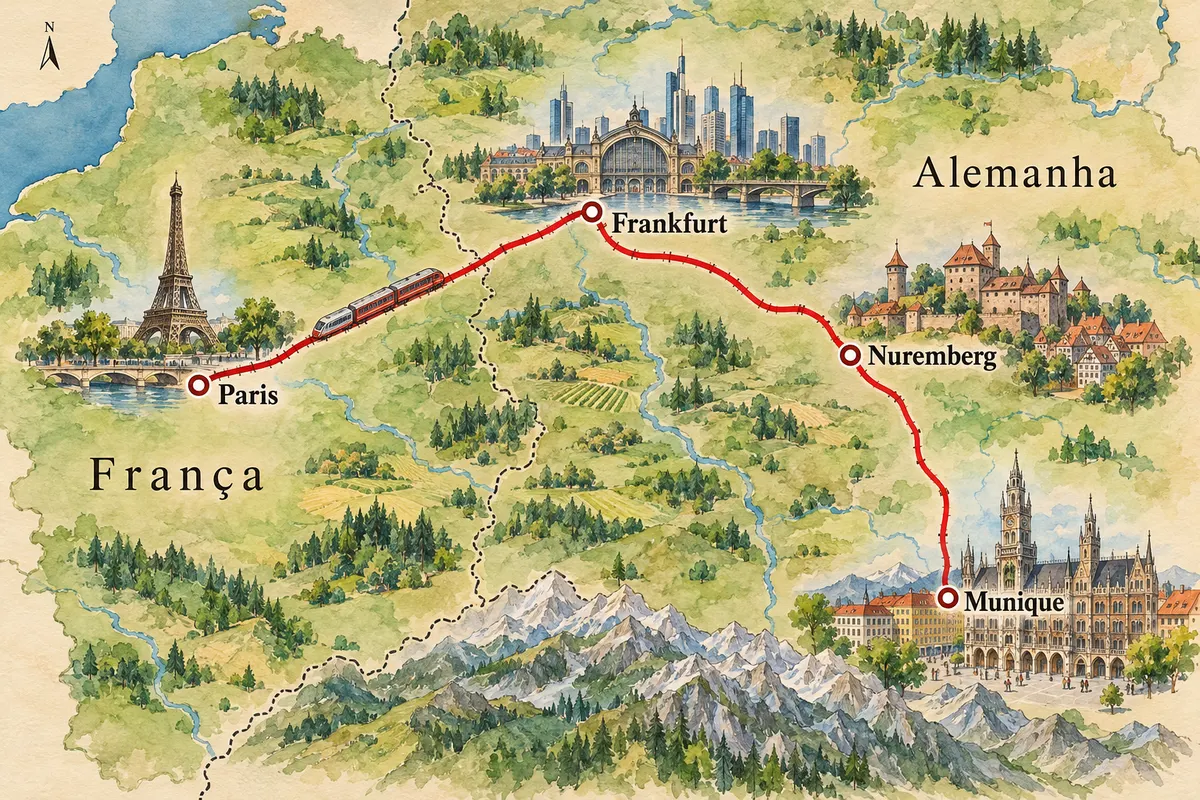
By train from Paris to Munich via Frankfurt and Nuremberg: TGV and ICE connect France with southern Germany from central station to central station.
Več kot vodnik