Dresden and Saxon Switzerland

Saxony · Nemčija

Dresden and Saxon Switzerland

The capital of Saxônia, rebuilt on the banks of the Elba, and the sandstone formations of the Parque Nacional Suíça Saxônica, less than an hour by train.

East

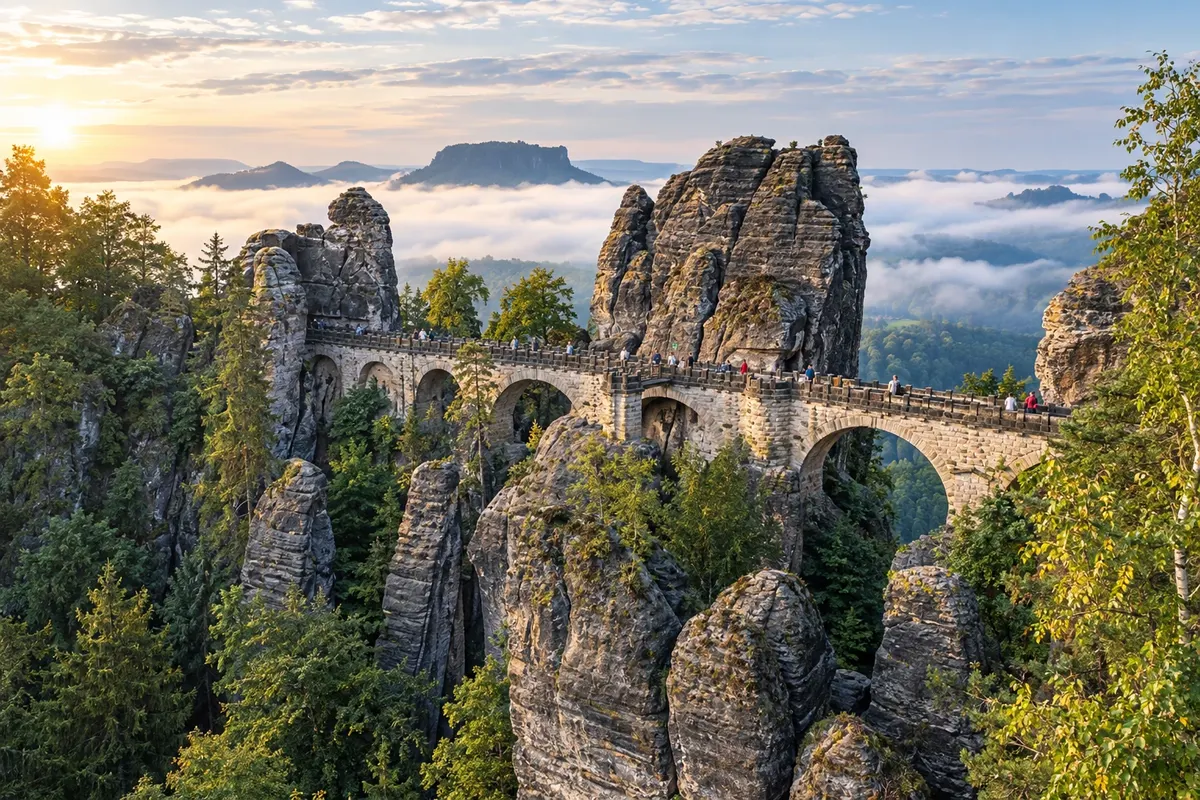
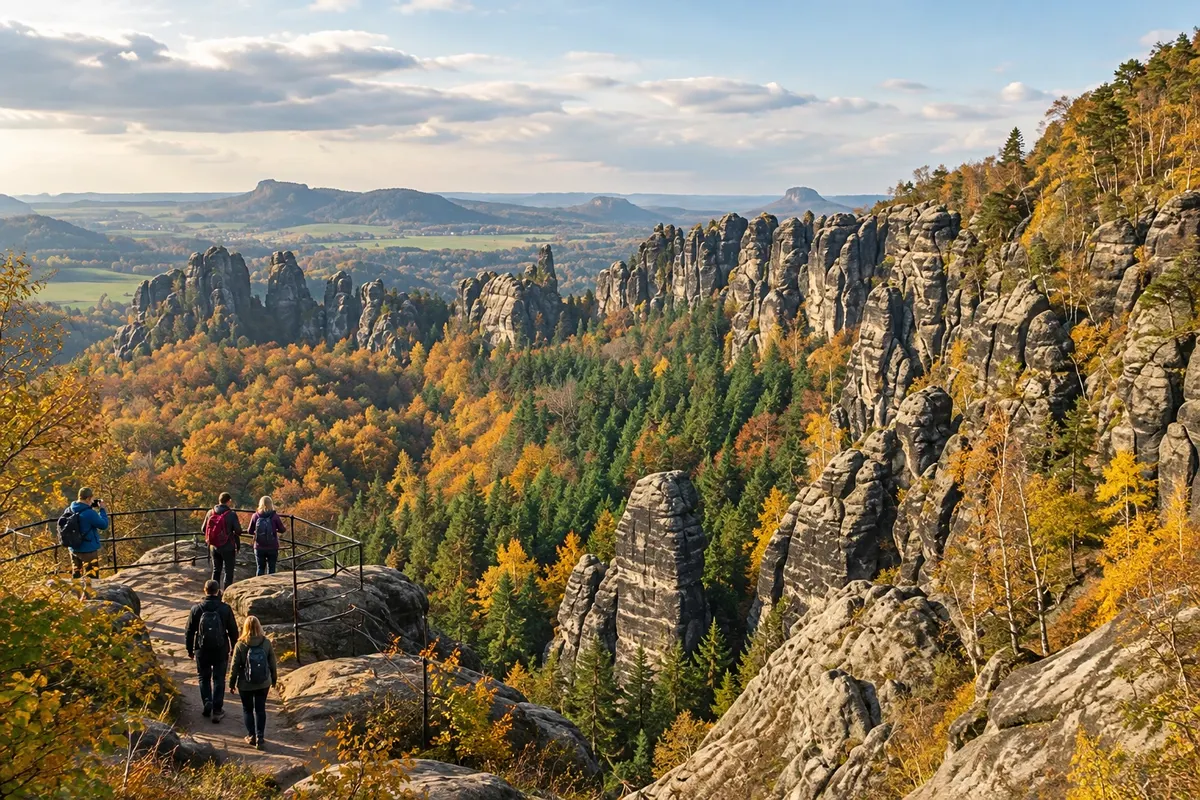
Na fotografiji: Basteibrücke, Suíça Saxônica

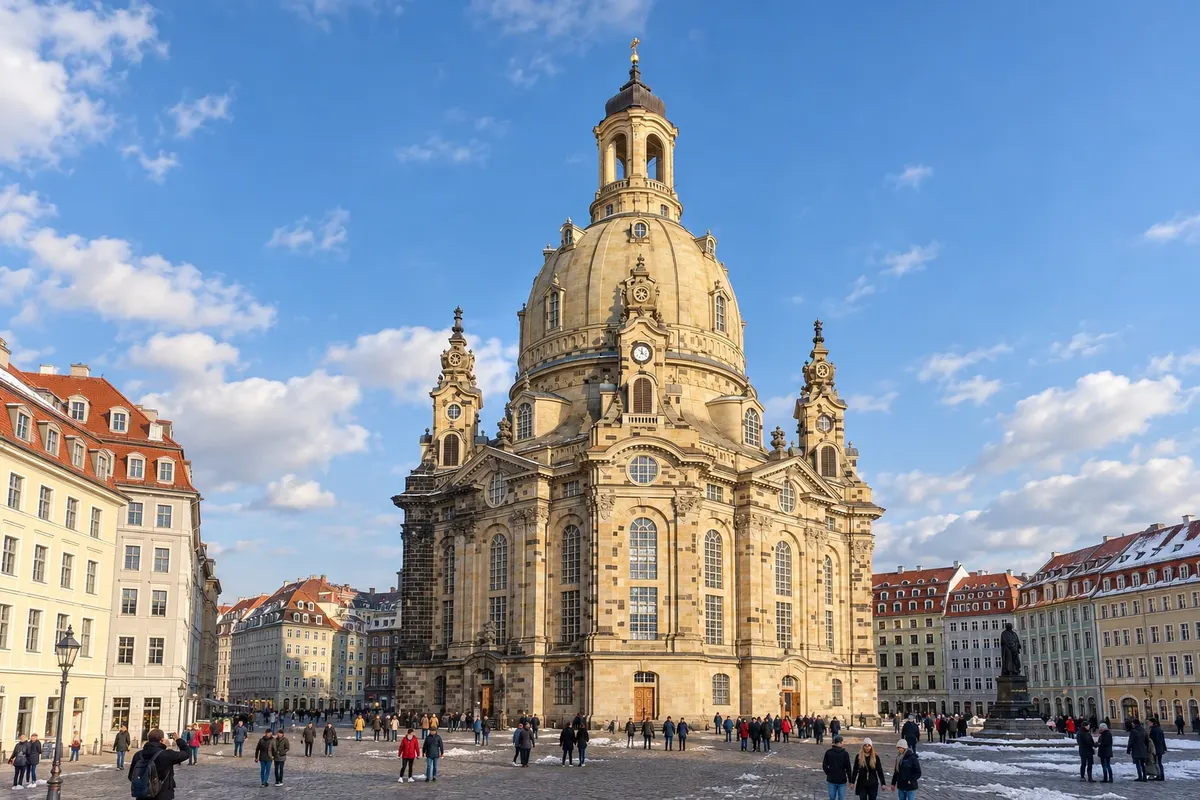
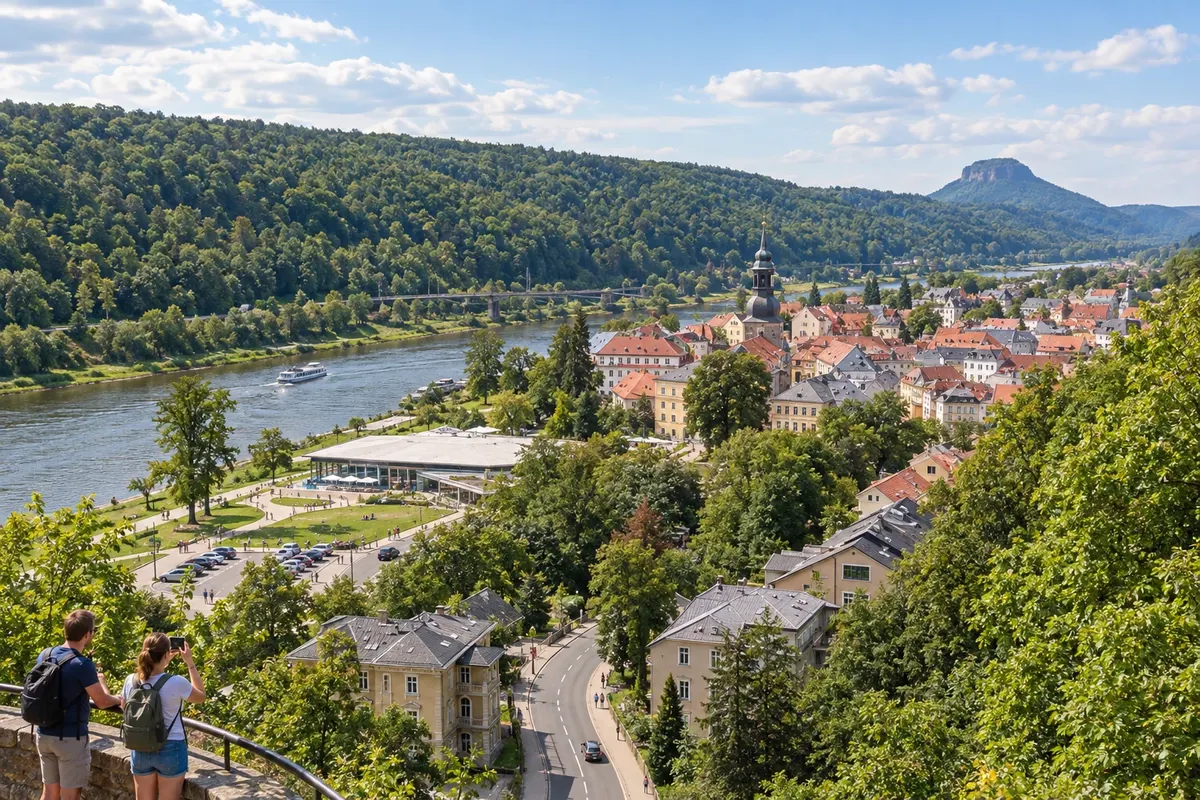
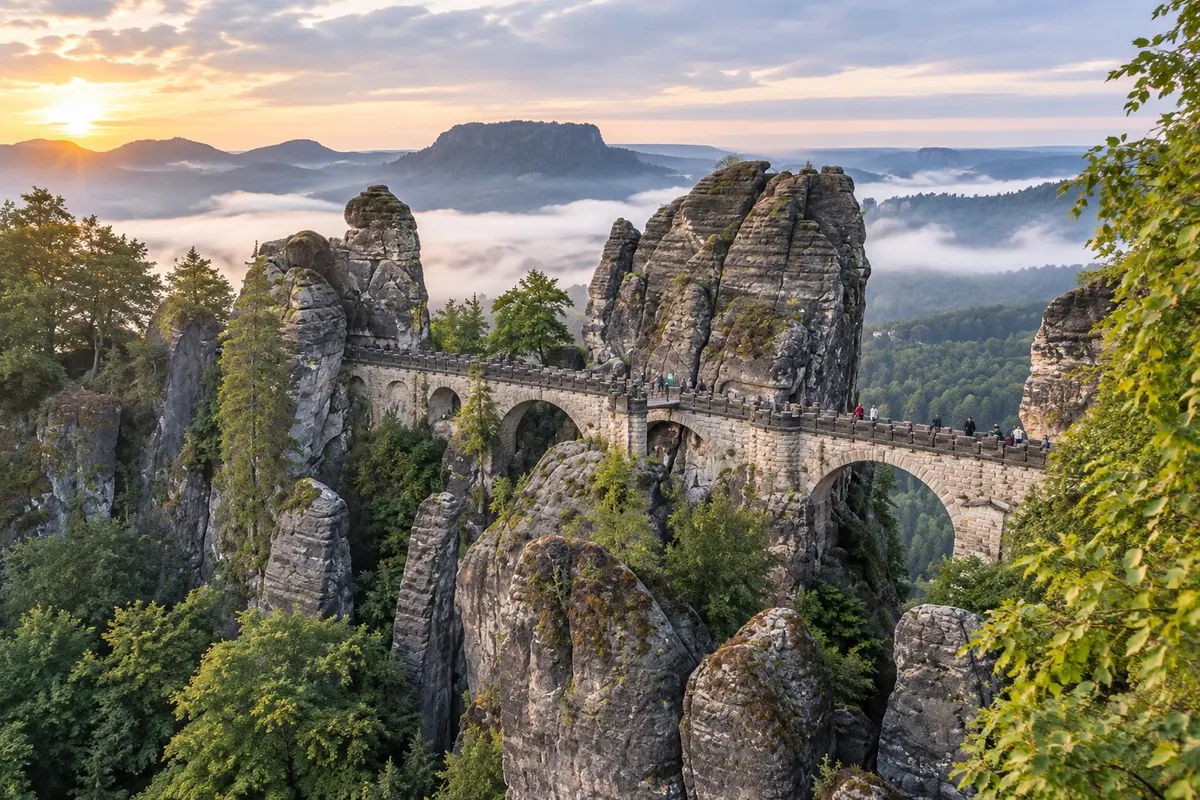
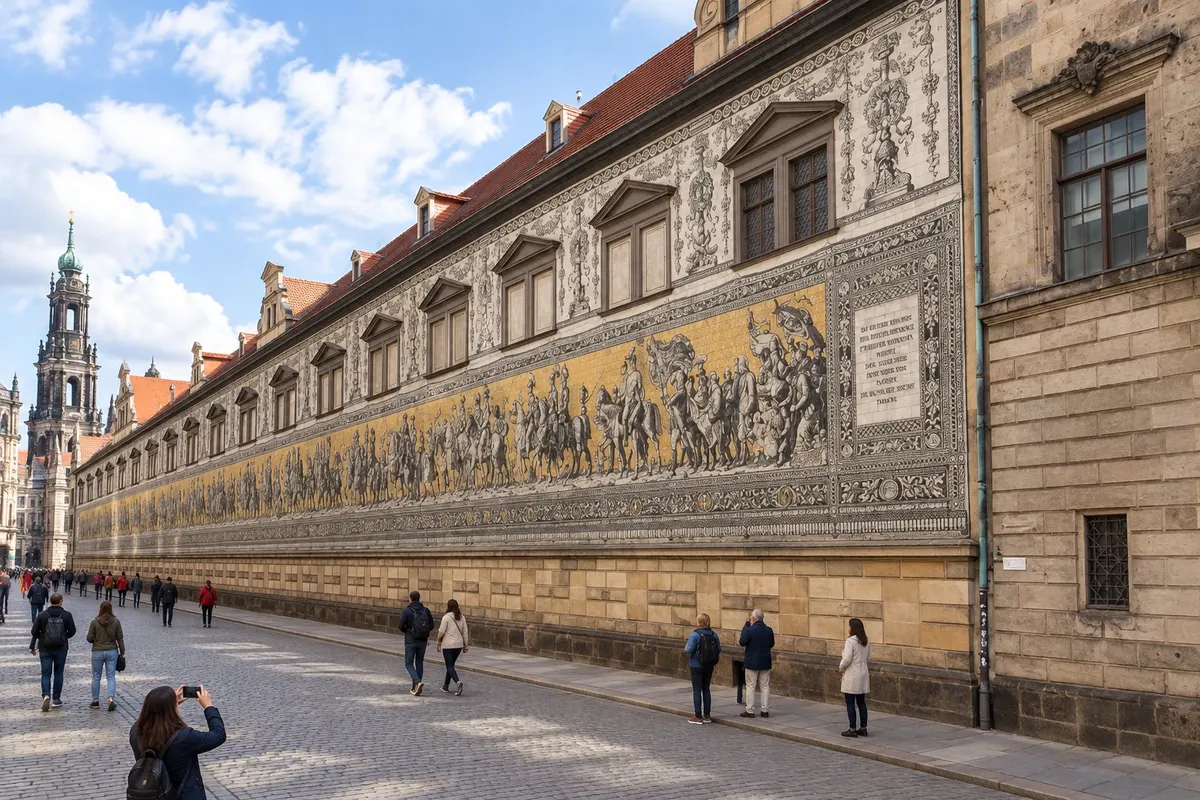
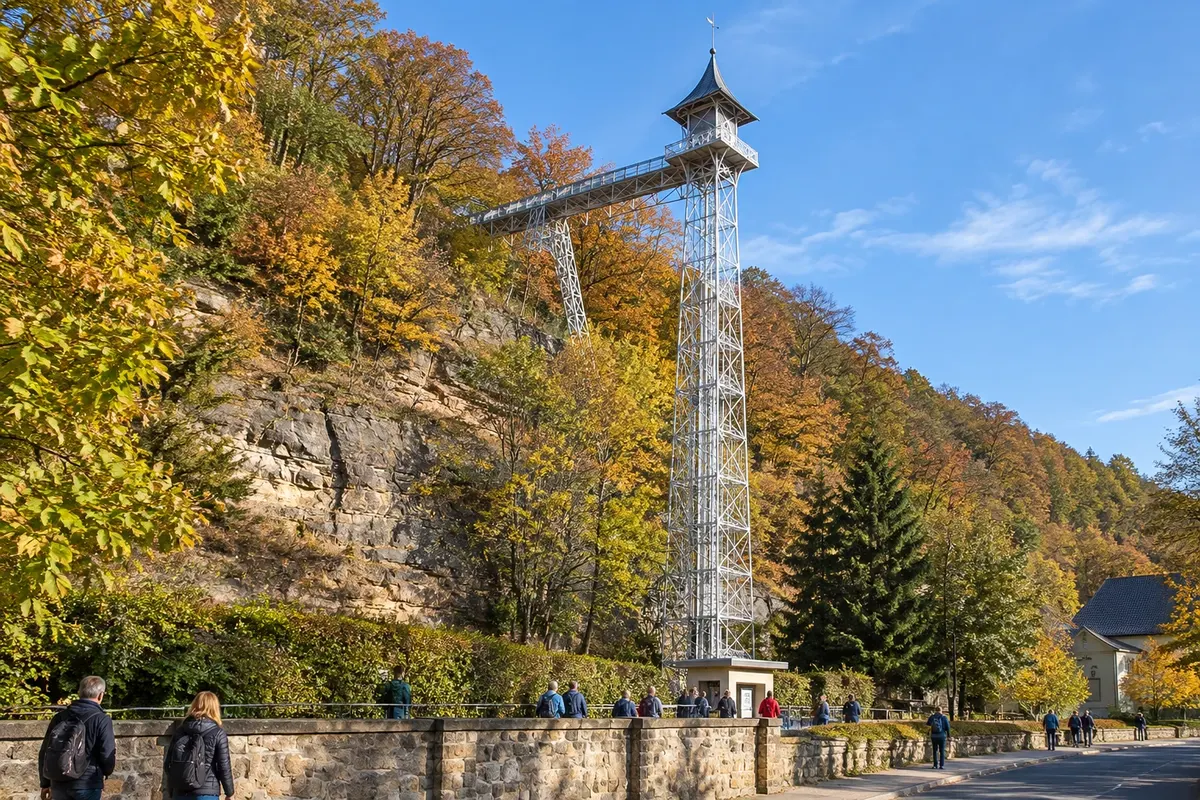
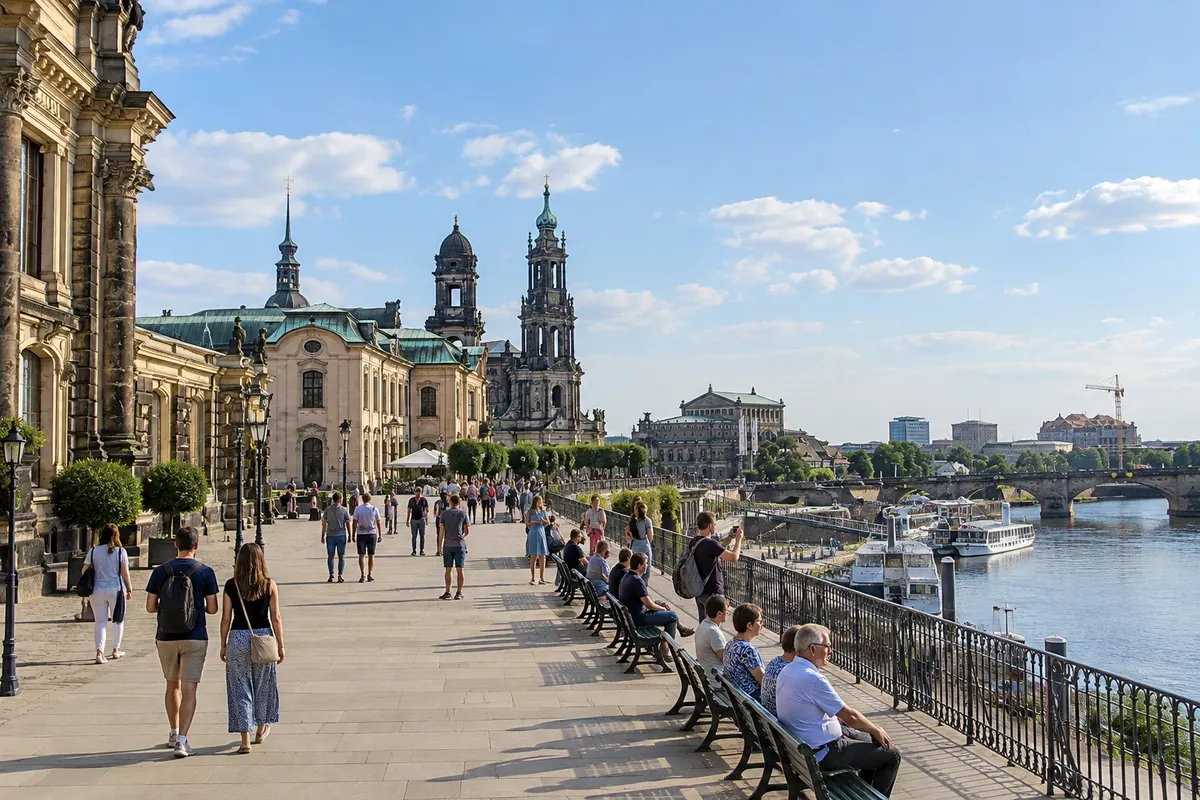
Illustrative images. The pictures in this guide are illustrations based on the real place, not photographs, and may differ from it.

Na voljo v trgovini Google Play Pošljite svoje fotografije

Spoznajte kraj

Pokrajina, ki jo doživite
v svojem ritmu.

Dresden is the capital of the state of Saxônia, in eastern Germany, near the border with the República Tcheca. The city sits on the banks of the Elba and brings together, in a compact old town, palaces and churches from the Baroque period, when the electors of Saxônia made it one of Europe’s wealthiest courts.

Much of that center was destroyed in the bombings of February 1945. What you see today is the result of decades of reconstruction: the Zwinger and the Semperoper were rebuilt even during the era of East Germany, and the Frauenkirche, which stood in ruins for almost fifty years as a memorial against war, was raised again after reunification, using some of the original stones. The state museums hold top collections of painting, porcelain and jewelry, such as the Gemäldegalerie Alte Meister and the Grünes Gewölbe.

Upstream, about 40 km away, the Suíça Saxônica (Sächsische Schweiz) begins — a region of sandstone towers and cliffs carved by the Elba. Part of it is a national park. Bad Schandau is the park’s base town, connected to Dresden by suburban train (S-Bahn). From there you can reach the Bastei and its stone bridge, the fortress of Königstein, the Schrammsteine trails and the historic tram of the Kirnitzsch valley.

This destination brings together 2 cities: Dresden, Bad Schandau.

Delite: WhatsApp
Delite svoja popotniška doživetja s fotografijami Pošljite fotografije vsakega kraja, ki ste ga obiskali. Največje število fotografij na kraj: 5.

Ena destinacija, več poti

Mesta na tej poti

Začnite v enem mestu ali v načrt poti vključite več mest.

Dresden and Saxon Switzerland – lega
DresdenBad Schandau

Obrisi: © BKG (2026), dl-de/by-2-0. Priredba: Cidade Turismo.

Kako do tja:Dresden and Saxon Switzerland

✈ Flughafen Dresden (DRS)· 12 km do cilja (Dresden)

Check before you buy. Dresden has its own airport (DRS), but many people arrive via Berlin (BER) and continue by train to Dresden Hauptbahnhof in about 2 hours. From Prague the train takes just over 2 hours. From Dresden to Bad Schandau take the S-Bahn (line S1).

Predlagana točka prihoda:Dresden

Doživite kraj

Kaj početi – Dresden and Saxon Switzerland

Bastei Bridge
Bad Schandau · Saxony · Razgledišče

Bastei Bridge

Sandstone formation about 190 metres above the Elba, with the Basteibrücke, a stone bridge from 1851, and viewpoints over the valley. It is the emblematic postcard image of Saxon Switzerland.

Frauenkirche
Dresden · Saxony · Cerkev

Frauenkirche

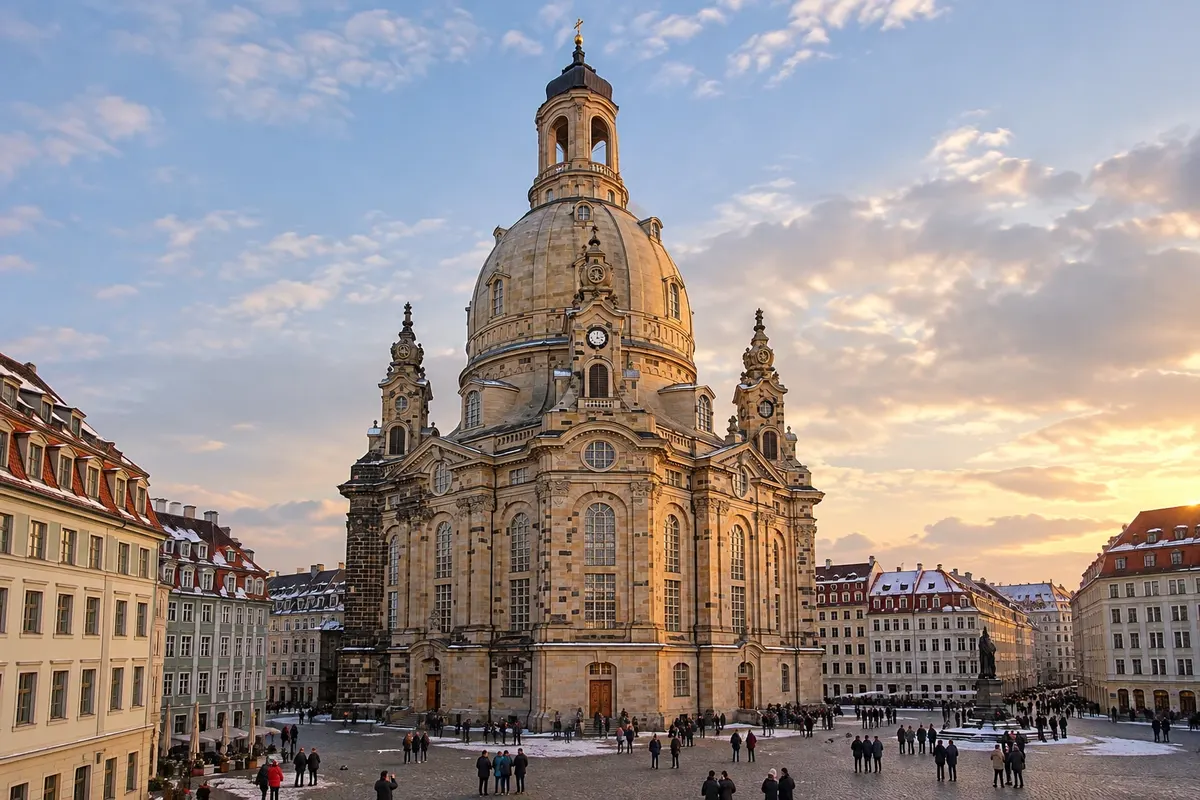
Baroque Lutheran church of the Neumarkt, destroyed in the 1945 bombings and rebuilt between 1994 and 2005 using some of the original stones. The dome has a viewing platform.

Königstein Fortress
Bad Schandau · Saxony · Grad

Königstein Fortress

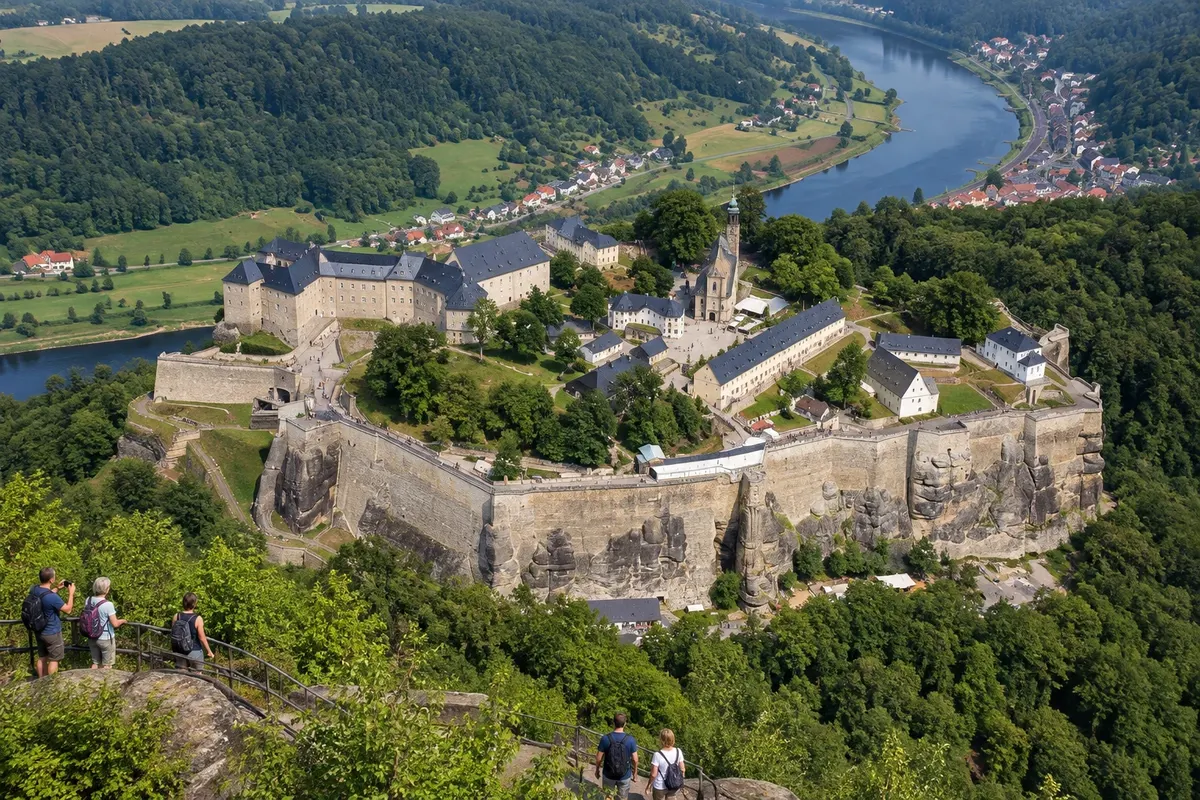
Fortress on a flat-topped hill about 240 meters above the Elba, with more than 50 buildings, walls up to 42 meters high and views of the valley. Open year-round.

Neumarkt
Dresden · Saxony · Trg

Neumarkt

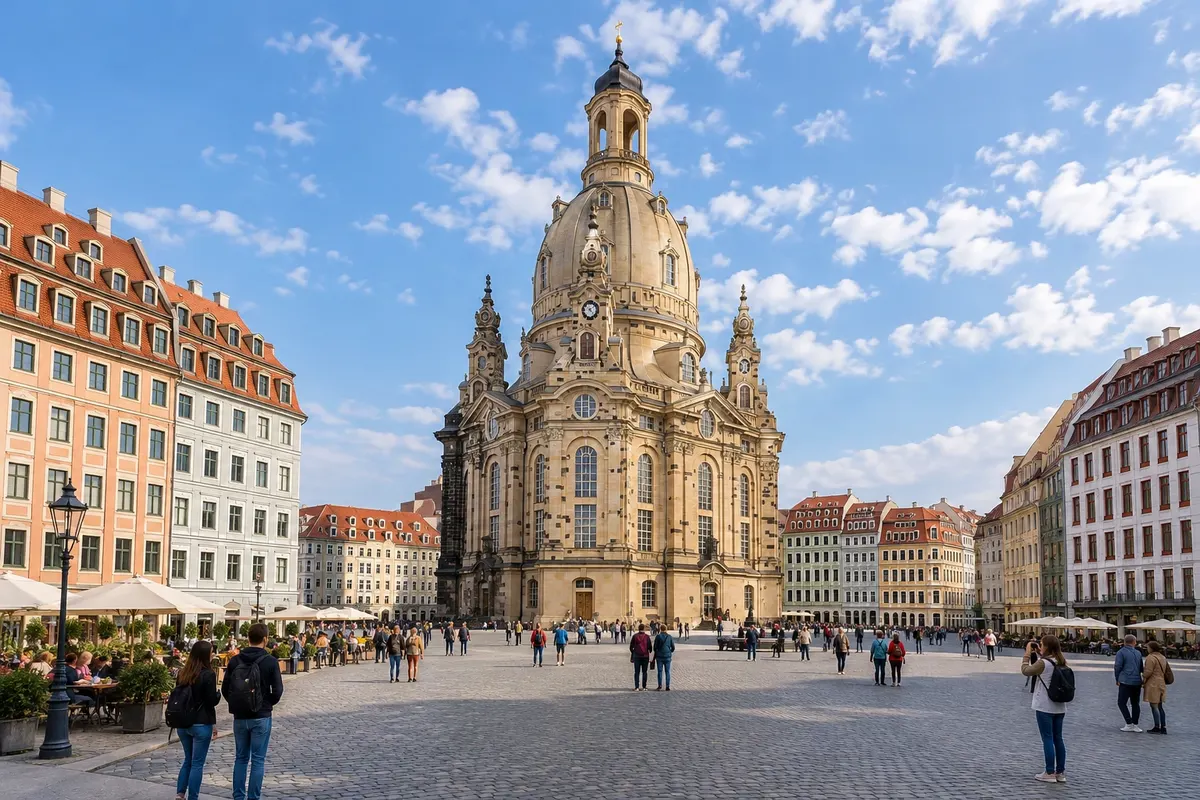
Historic square around the Frauenkirche, with reconstructed Baroque façades, cafés and the statue of Lutero. It’s the natural starting point for walking around the center.

Dresden and Saxon Switzerland – prikaži dodatne kraje (16)
Kirnitzschtalbahn
Bad Schandau · Saxony · Historic site

Kirnitzschtalbahn

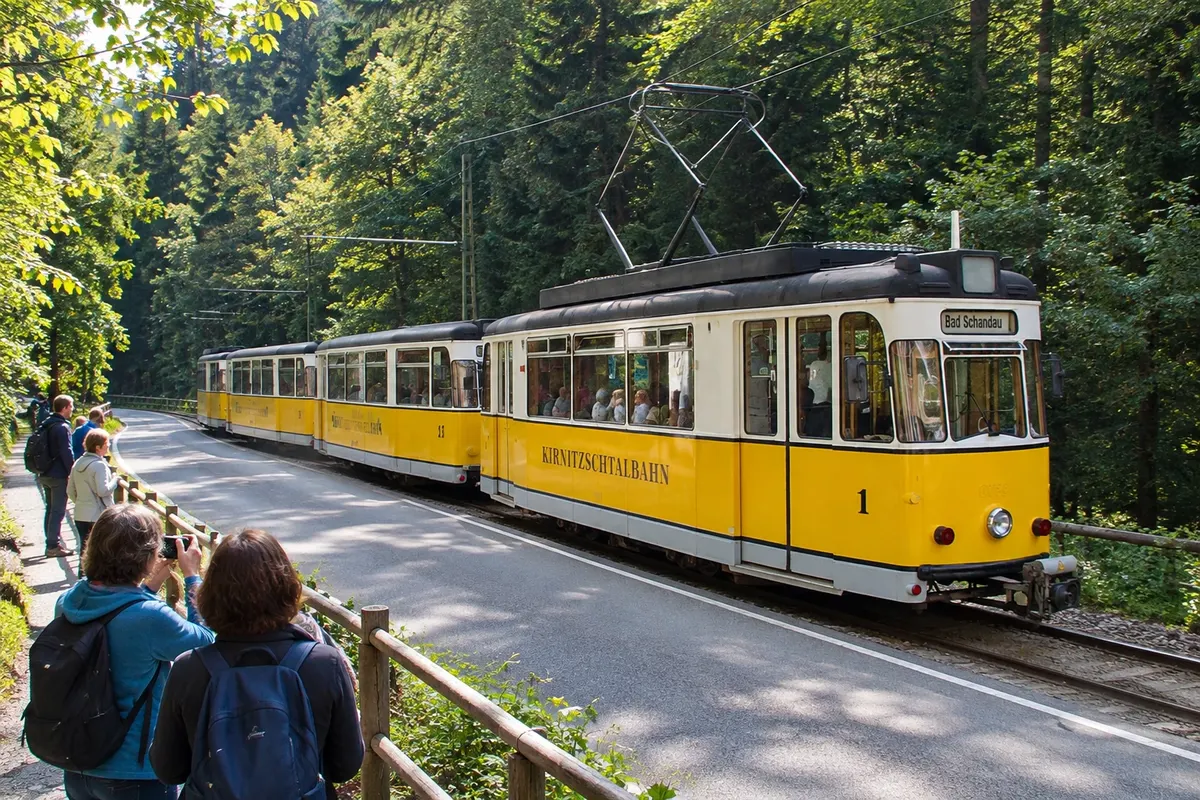
Historic tram from 1898 that climbs the valley of the river Kirnitzsch for about 8 km, from the Kurpark of Bad Schandau to the Lichtenhainer Wasserfall, with stops next to the trails.

Zwinger Palace
Dresden · Saxony · Palace

Zwinger Palace

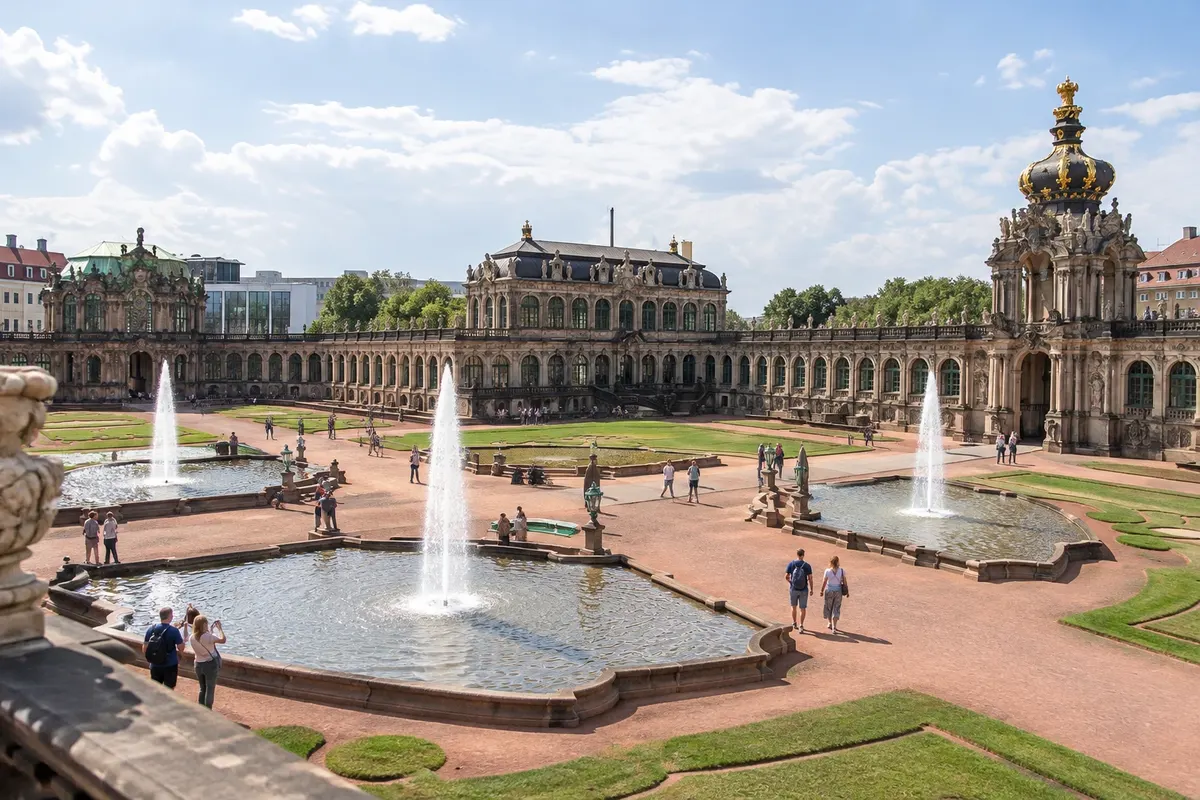
Baroque ensemble of pavilions and gardens from the 18th century, housing the Gemäldegalerie Alte Meister, where the Madona Sistina by Rafael is located, and the porcelain collection.

Lichtenhainer Waterfall
Bad Schandau · Saxony · Park

Lichtenhainer Waterfall

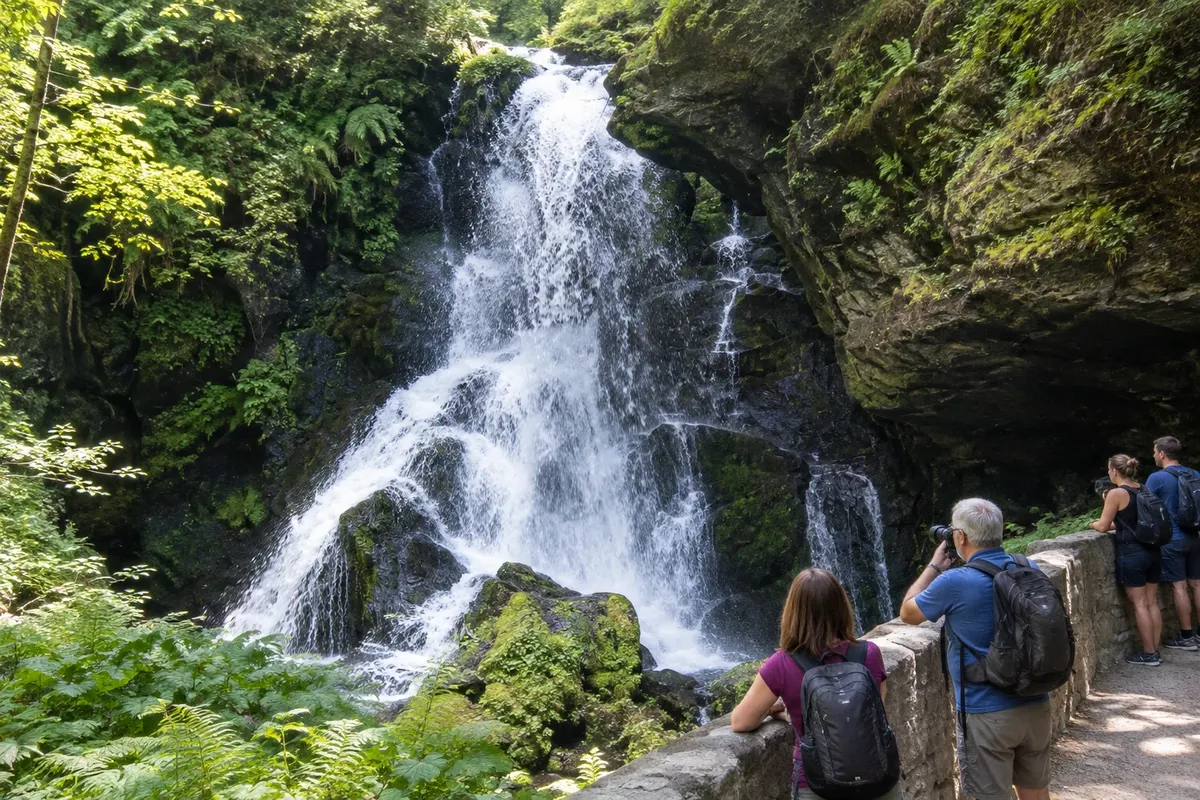
Small waterfall at the end of the tram line in the Kirnitzsch valley, dammed since 1830 so the water can be released in bursts. It is the starting point of the trail to the Kuhstall.

Semperoper
Dresden · Saxony · Architecture

Semperoper

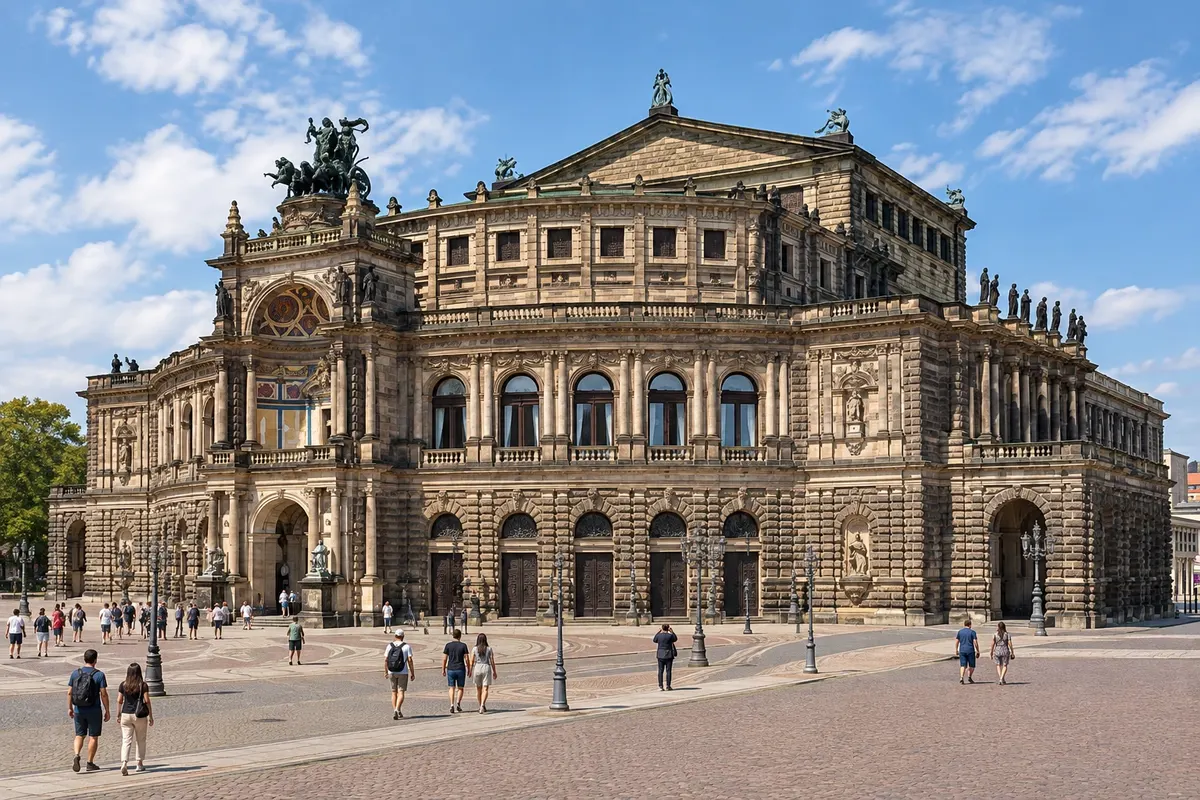
Opera house on the Theaterplatz, home of the Saxon State Opera and the Staatskapelle Dresden. It hosted premieres by Wagner and Richard Strauss and offers guided tours.

Residenzschloss (Dresden)
Dresden · Saxony · Palace

Residenzschloss (Dresden)

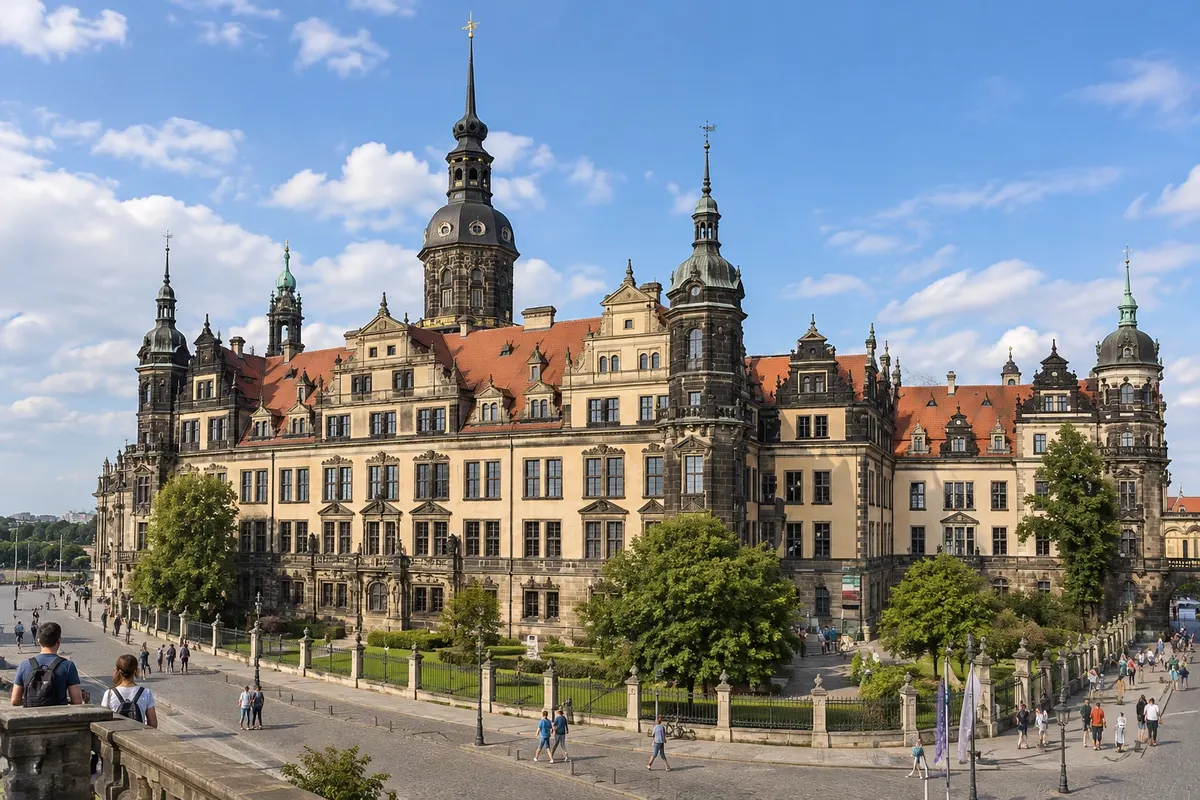
Former palace of the rulers of Saxony, now housing several museums: the Grünes Gewölbe (royal treasury), the Rüstkammer, the Münzkabinett and the Hausmannsturm tower.

Schrammsteine
Bad Schandau · Saxony · Park

Schrammsteine

Chain of towers and sandstone cliffs east of Bad Schandau, with trails of iron stairs up to the Schrammsteinaussicht viewpoint and the ridgeline path Gratweg.

Fürstenzug (Procession of Princes)
Dresden · Saxony · Monument

Fürstenzug (Procession of Princes)

A panel of roughly 102 metres made from about 23,000 Meissen porcelain tiles, depicting the procession of 35 rulers of the Wettin dynasty. It is on an open-air street.

Bad Schandau Lift (Historic Elevator)
Bad Schandau · Saxony · Razgledišče

Bad Schandau Lift (Historic Elevator)

Lift in a 52-meter steel tower, operating since 1904, that links Bad Schandau center to the Ostrau plateau, with views over the Elbe valley.

Brühl's Terrace
Dresden · Saxony · Razgledišče

Brühl's Terrace

An elevated promenade over the Elbe, nicknamed the Balcony of Europe, with views of the river and the Neustadt. It connects the Schlossplatz to the Albertinum.

Katholische Hofkirche (Dresden Cathedral)
Dresden · Saxony · Stolnica

Katholische Hofkirche (Dresden Cathedral)

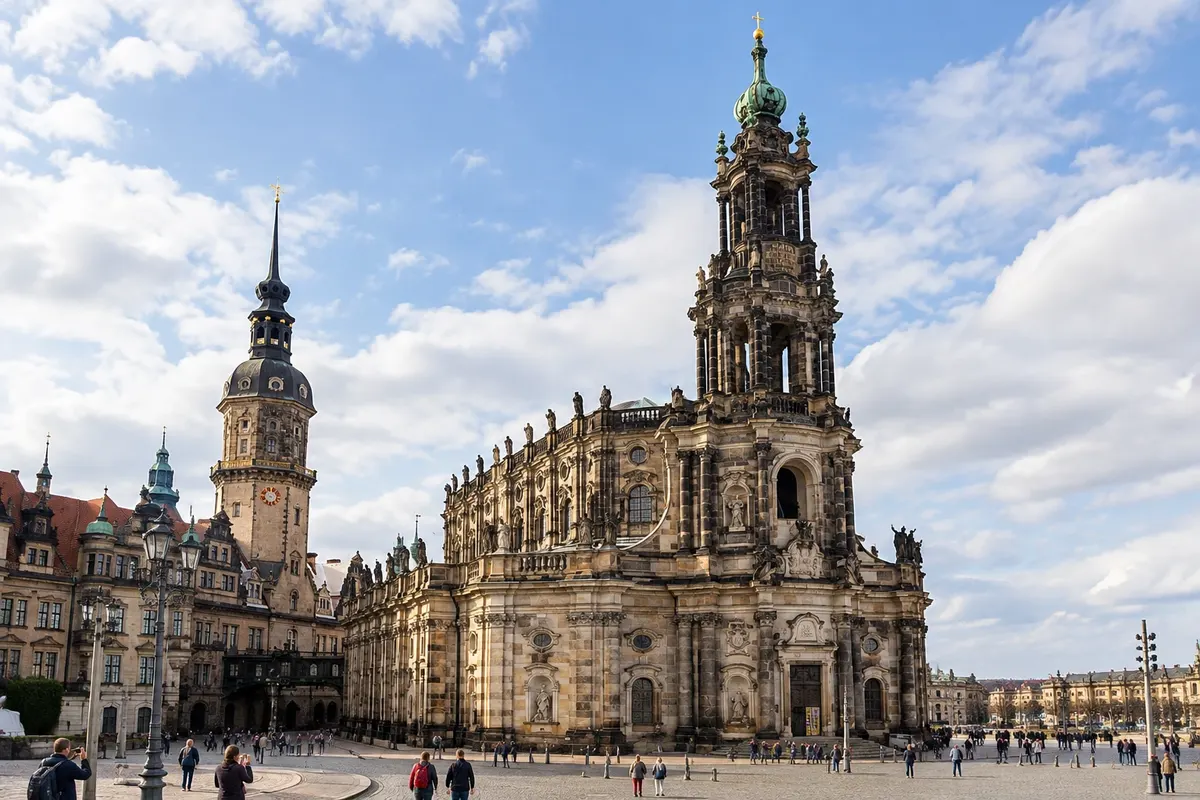
Former court church, now Dresden's Catholic cathedral, with the tower that shapes the city's skyline, 78 statues of saints and the last organ by Gottfried Silbermann.

Kreuzkirche
Dresden · Saxony · Cerkev

Kreuzkirche

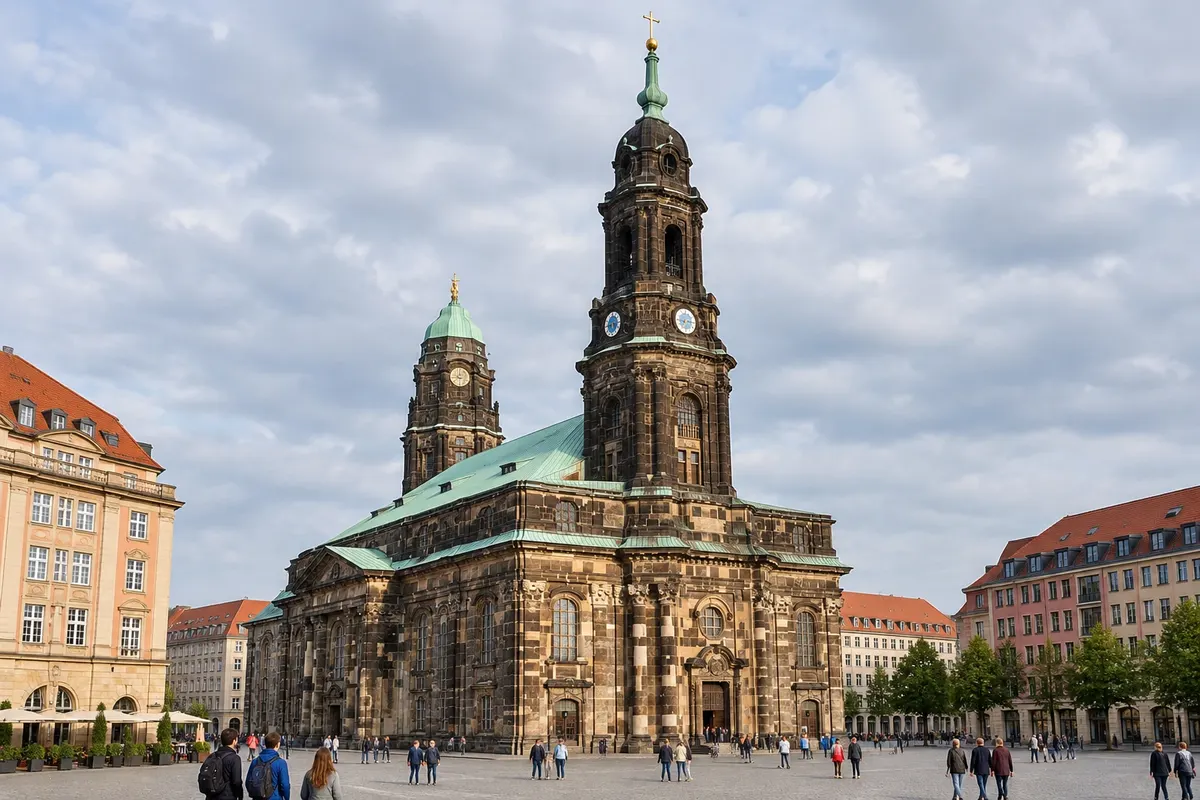
Main Lutheran church on the Altmarkt, home of the Dresdner Kreuzchor, a boys' choir with over seven centuries of history. The tower can be climbed and offers views over the center.

Albertinum
Dresden · Saxony · Muzej

Albertinum

Museum of modern art at the eastern end of the Brühlsche Terrasse, with painting from Romanticism to contemporary art, from Caspar David Friedrich to Gerhard Richter, and sculpture.

Äußere Neustadt
Dresden · Saxony · Zgodovinska mestna četrt

Äußere Neustadt

19th-century neighborhood on the other side of the Elbe, with bars, cafés, street art and the colorful courtyards of the Kunsthofpassage. It is the center of Dresden's nightlife.

Pfunds Molkerei
Dresden · Saxony · Architecture

Pfunds Molkerei

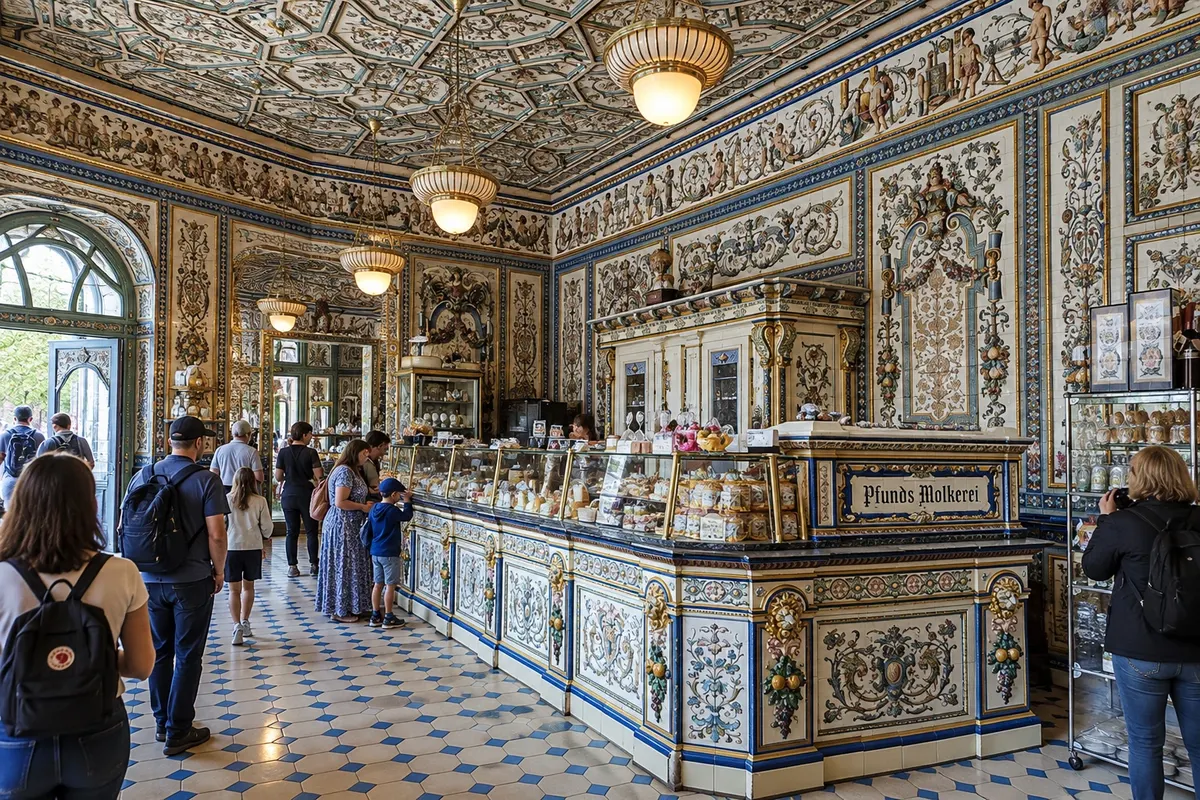
Dairy shop opened in the late 19th century in the Neustadt, with walls and floor covered in hand-painted tiles. It still operates as a shop selling dairy and regional products.

Pillnitz Castle
Dresden · Saxony · Palace

Pillnitz Castle

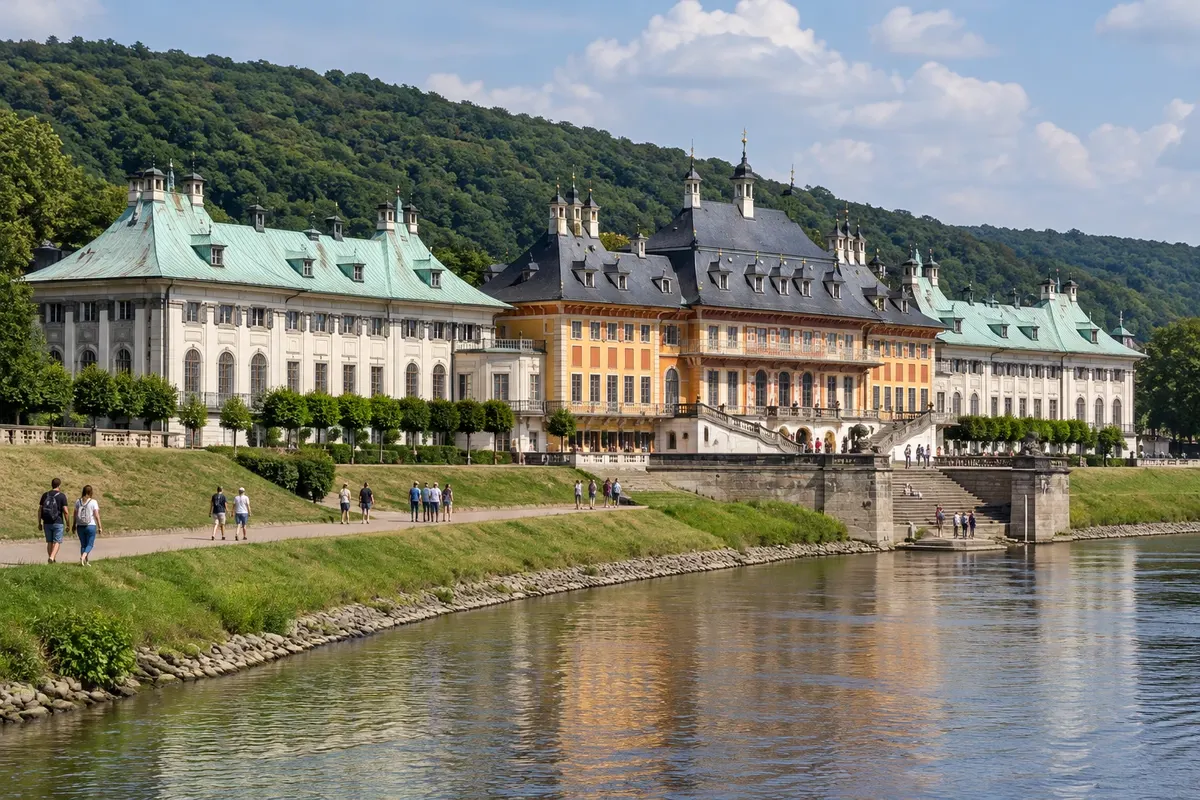
Summer residence of the Saxon monarchs on the banks of the Elbe, featuring palaces with Chinese-style decoration, gardens, a camellia over 200 years old and a museum of decorative arts.

Dresdner Striezelmarkt
Dresden · Saxony · Tržnica

Dresdner Striezelmarkt

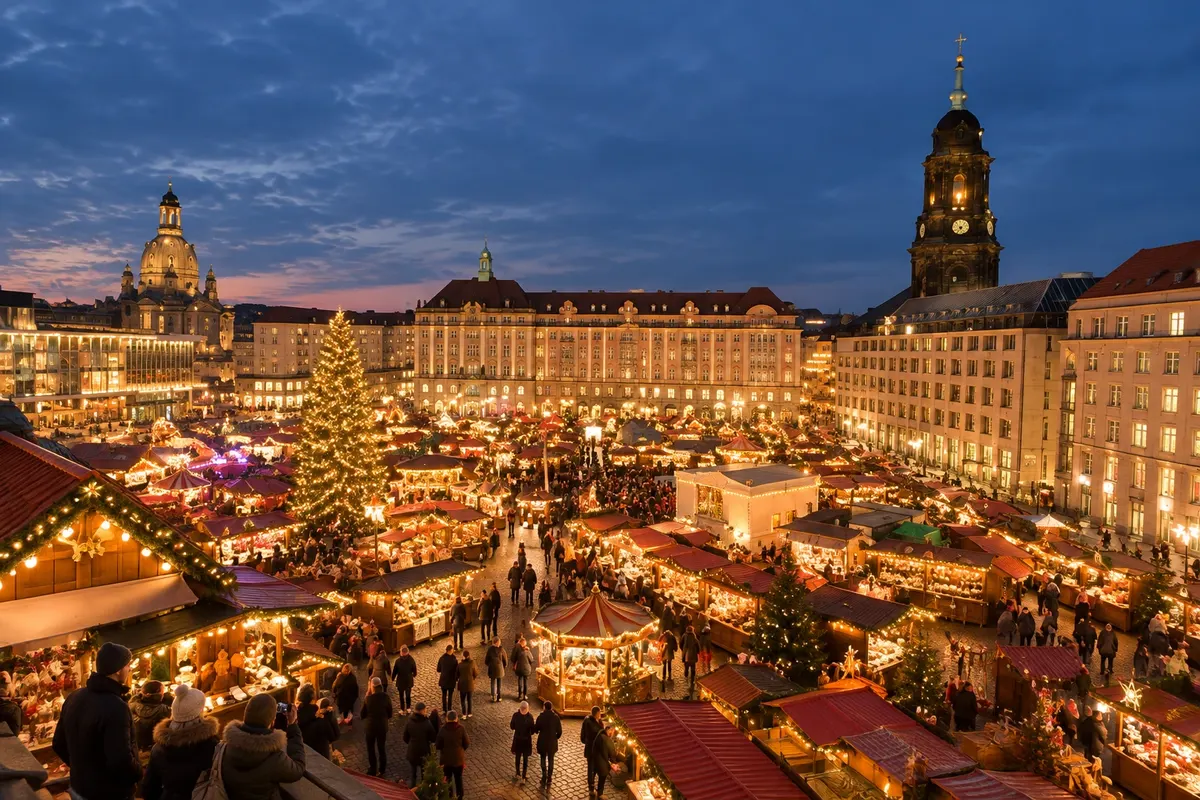
Altmarkt Christmas Market, recorded since 1434 and one of the oldest in Germany. It usually runs from late November until Christmas Eve, featuring Stollen.

Kaj izbrati pred odhodom

Izleti – Dresden and Saxon Switzerland

Izhodišče, trajanje, potek, vključene storitve in okvirna cena vsakega izleta.

Frauenkirche and Neumarkt: the rebuilt church and the dome climb

Odhod: Neumarkt, a 15-minute walk from Dresden Hbf Walk and climb to the dome Približno 2 uri Dopoldne ali popoldne moderate (ramp and stairs inside the dome)

The Frauenkirche (Church of Our Lady) is the Lutheran stone-domed church that dominates the Neumarkt, the central square of Dresden’s Altstadt (old town). It was built between 1726 and 1743 by architect George Bähr, with the sandstone dome reaching over 91 meters. It collapsed on February 15, 1945, two days after the city bombing, and the ruins remained in place throughout the GDR era as a memorial. Reconstruction began in 1994 and finished in 2005, using some original stones, which appear darker on the façade. Inside, the Baroque altar and the pale, pastel-toned interior follow the original design. Visiting the nave is free; there are services, organ concerts and guided tours. The climb to the dome requires a separate ticket: 174 steps in the stair tower, a spiral ramp of about two and a half turns inside the outer dome, and narrow stairs up to the platform at 67 meters, with views over the Elbe, the Zwinger and the roofs of the Neumarkt. Around the square, the Baroque facades were rebuilt after 2005 following the old designs; the Martin Luther statue stands in front of the church. In the side alleys, the Münzgasse concentrates restaurants with outdoor seating.

Kraji na poti: Frauenkirche, Neumarkt.

Vključuje: Entry to the church nave is free. The climb to the dome is charged separately, with tickets at the box office next to the church; check the current price list. Guided tours and concerts have separate tickets.

Nasvet: Climb the dome in the late morning, when the light strikes the river. The ramp is tiring; if you have difficulty with stairs you can remain in the nave. On Sundays the climb often starts only in the afternoon. Return to the square at night to see the church illuminated.

Najboljši čas za obisk: Open year-round. From November to February the dome closes earlier; in December the Neumarkt often hosts a Christmas market, so confirm before you go.

Zwinger: the Baroque courtyard, the Gemäldegalerie Alte Meister and the porcelain collection

Odhod: Theaterplatz or Postplatz (trams 1, 2, 4, 8, 9, 11) Walk and museums about 3 to 4 hours Dopoldne Lahko

The Zwinger is the Baroque complex of pavilions and galleries around a 15,500 m² courtyard, built from 1710 by order of Augustus the Strong, with designs by architect Matthäus Daniel Pöppelmann and sculptures by Balthasar Permoser. It served as an orangery and as a stage for court festivities; it was inaugurated in 1719 for the crown prince’s wedding. The Kronentor (Crown Gate), dating from 1714, and the Wallpavillon are the most photographed features; the Glockenspielpavillon houses a carillon of Meissen porcelain bells, and in the corner is the Nymphenbad, a courtyard of fountains with nymphs. The north side was closed off by Gottfried Semper with the Sempergalerie between 1847 and 1855. The complex was destroyed in February 1945 and rebuilt by 1963. The courtyard underwent a renovation of more than four years, with new paths and lawns, and is fully open; entry to the courtyard is free. Inside the Sempergalerie is the Gemäldegalerie Alte Meister, with Raphael’s Sistine Madonna (c. 1513, purchased in 1754 by Augustus III), Vermeer, Rembrandt and the Dresden views painted by Bernardo Bellotto, the Canaletto, in the 18th century. The same ticket grants access to the Porzellansammlung (porcelain collection), with Chinese, Japanese and Meissen pieces assembled by Augustus the Strong, and to the Mathematisch-Physikalischer Salon, with clocks and historic scientific instruments.

Kraji na poti: Zwinger.

Vključuje: Courtyard, outer galleries and the passage along the walls: entry is free. The Zwinger ticket is paid separately and covers the Gemäldegalerie Alte Meister, the sculpture collection up to 1800, the Porzellansammlung and the Mathematisch-Physikalischer Salon; temporary exhibitions may have their own admission. Check the current schedule.

Nasvet: The Zwinger museums are closed on Mondays: plan your day. Buy tickets online to enter without queuing. Climb to the gallery above the wall to see the courtyard from above and the Kronentor up close. Reserve the afternoon for the Residenzschloss, on the opposite side of the street.

Najboljši čas za obisk: Year-round, museums are closed on Mondays. From April to October the courtyard fountains usually operate; in winter the courtyard is quieter.

Residenzschloss: Grünes Gewölbe, Rüstkammer and the Hausmannsturm tower

Odhod: Schloßstraße or Taschenberg, next to the Zwinger Museums with timed entry about 3 to 4 hours Popoldne Lahko

The Residenzschloss (residential palace) was the seat of the electors and kings of Saxony from 1485. The building took on a Renaissance form in the 16th century and was expanded under Augustus the Strong; it burned in 1945 and lay in ruins for decades. Reconstructed externally and gradually internally, it has housed several museums of the Staatliche Kunstsammlungen Dresden (state art collections) since 2002. The most sought-after visit is the Historisches Grünes Gewölbe (Historic Green Vault), the treasury Augustus the Strong assembled between 1723 and 1730 on the ground floor: rooms rebuilt with mirrors and lacquers where amber, ivory, silver and gemstone pieces are displayed without showcases. Entry is by timed ticket, with a limited number of visitors per session, and no bags, coats or photos allowed. On the upper floor, the Neues Grünes Gewölbe presents in display cases the works of goldsmith Johann Melchior Dinglinger, including the Grand Mogul’s court in miniature, with more than one hundred figures. The same palace ticket includes the Rüstkammer (armory), with armors and tournament weapons in the Riesensaal (giant hall), the Türckische Cammer with Ottoman tents and objects, the coin cabinet and the western wing’s baroque ceremonial rooms. The Hausmannsturm, a 100-meter 17th-century tower, usually opens to visitors from April to October, offering views over the Altstadt and the Elbe; check before you go.

Kraji na poti: Residenzschloss.

Vključuje: Separate paid entry. The palace ticket covers the residence museums, except the Historisches Grünes Gewölbe, which has a timed ticket; there is a combined ticket for everything. Audio guide included; lockers for bags and coats. Check the current schedule.

Nasvet: Book a timed slot for the Historisches Grünes Gewölbe several days in advance, especially in summer and in December; the museum is closed on Tuesdays. Arrive 15 minutes early to check bags and coats. On Fridays the opening hours often extend into early evening, useful if you spent the day in Saxon Switzerland.

Najboljši čas za obisk: All year round, closed on Tuesdays. The Hausmannsturm usually opens from April to October; the Grünes Gewölbe is very busy in July, August and during Advent.

Theaterplatz: the Semperoper inside and the Katholische Hofkirche

Odhod: Theaterplatz (trams 4, 8, 9) Guided opera tour and walk Približno 2 uri Dopoldne ali popoldne Lahko

The Theaterplatz brings together, around the equestrian statue of King John, the Semperoper, the Hofkirche, the Zwinger and the Residenzschloss. The Semperoper is home to the Sächsische Staatsoper and the Staatskapelle Dresden, one of the oldest orchestras in the world. Gottfried Semper’s first theatre opened in 1841 and burned in 1869; the second, in neo-Renaissance style, was completed in 1878 by Semper’s son Manfred, following his father’s plans while the elder was in exile. Wagner operas premiered here, such as Rienzi and The Flying Dutchman, and Richard Strauss works like Salome, Elektra and Der Rosenkavalier. Destroyed in 1945, it reopened on 13 February 1985 with the same opera as the last night before the bombing, Weber’s Der Freischütz. The guided tour lasts about 45 minutes and goes through the foyers, the painted halls and the auditorium; there are German and English departures almost daily, meeting beside the main entrance. Next door is the Katholische Hofkirche (court Catholic church), today Dresden Cathedral, built from 1739 to 1755 by the Italian architect Gaetano Chiaveri for Augustus III, who needed a Catholic church in Lutheran Saxony. The slender tower and the dozens of statues on the balustrade define the city’s silhouette; inside are Gottfried Silbermann’s organ, the last he built, and the crypt with 49 members of the House of Wettin and the heart of Augustus the Strong.

Kraji na poti: Semperoper, Katholische Hofkirche.

Vključuje: The guided tour of the Semperoper is paid separately and has scheduled times; operas and concerts require their own tickets. Entrance to the Hofkirche is free except for concerts; the crypt is seen on a guided visit. Check the current timetable.

Nasvet: Book the opera tour online: spots fill up on weekends. If you want to attend an opera or a Staatskapelle concert you should buy tickets months in advance. Go to the Hofkirche in the late afternoon, when the square empties, and view the riverside façade from the Augustusbrücke.

Najboljši čas za obisk: Year round. The opera season runs from September to June or July; there is a summer break in July and August, but guided tours usually continue.

Brühlsche Terrasse, Fürstenzug and the fortress beneath the terrace

Odhod: Schloßplatz, next to the Augustusbrücke Walk and underground exhibition about 2 to 3 hours Dopoldne ali pozno popoldne easy (staircases)

The Brühlsche Terrasse (Brühl Terrace) is the elevated promenade along the left bank of the Elbe, between the Augustusbrücke and the Albertinum, nicknamed the balcony of Europe. It sits atop the city’s 16th-century defensive wall. From 1737 Count Heinrich von Brühl, minister to Augustus III, built his palace, library and gardens there; in 1814 the terrace was opened to the public, with the monumental staircase by Gottlob Friedrich Thormeyer descending to the Schloßplatz. Today the complex houses the Academy of Fine Arts, with a glass dome nicknamed the lemon squeezer, the Sekundogenitur and the Ständehaus. From the balustrade you can see the Neustadt across the river, the paddle steamers moored at the Terrassenufer and the Elbe meadows. Under the terrace, the Festung Xperience opens the casemates and galleries of the Renaissance fortress, with projections that tell the city’s history; the visit is independent and takes about an hour. Descending the staircase and skirting the Residenzschloss along the Augustusstraße you reach the Fürstenzug (procession of princes), a 101.9‑meter-long mural on the outer wall of the Stallhof (stables courtyard). Painted by Wilhelm Walther between 1871 and 1876 and transferred between 1904 and 1907 to about 23,000 Meissen porcelain tiles, it shows on horseback 35 margraves, dukes, electors and kings of the House of Wettin, plus 59 figures of scholars, craftsmen and peasants. The mural passed the 1945 bombing almost unscathed.

Kraji na poti: Brühlsche Terrasse, Fürstenzug.

Vključuje: Terrace, staircases and the Fürstenzug are open and there is no entrance fee. The Festung Xperience requires a separate paid ticket with an audio guide; check the current price list. The Stallhof usually opens free of charge when there is no event.

Nasvet: See the Fürstenzug early in the morning or at night, when the Augustusstraße is free of tour groups; look for Augustus the Strong with his horse stepping on a rose. On the terrace, the late afternoon light falls over the Neustadt. Combine it with the Albertinum, which is at the eastern tip.

Najboljši čas za obisk: All year. From May to September there are outdoor tables on the terrace and boats on the river; in December the Stallhof usually hosts a medieval Christmas market, check before you go.

Albertinum: from Caspar David Friedrich to Gerhard Richter

Odhod: Georg-Treu-Platz, at the eastern end of the Brühlsche Terrasse Museum Približno 2 uri Popoldne Lahko

The Albertinum closes off the eastern end of the Brühlsche Terrasse. The building began as an arsenal in the 16th century and was converted into a museum between 1884 and 1887, named for King Albert of Saxony. After the Elbe flood of 2002, which flooded the storage areas, the museum added a suspended storage unit above the inner courtyard and reopened in 2010. Today it houses the Galerie Neue Meister (gallery of the new masters), with painting from Romanticism to the present, and the Skulpturensammlung ab 1800 (sculpture collection from 1800 onward). Highlights are the canvases by Caspar David Friedrich, who lived in Dresden; works by Gerhard Richter, born in the city and with his own archive inside the museum; plus Otto Dix, French Impressionists and sculptures by Rodin. The covered, light and quiet courtyard provides a pause between rooms. The visit takes about two hours and pairs well with a walk along the terrace that starts at the museum door.

Kraji na poti: Albertinum.

Vključuje: Separate paid admission, giving access to the permanent collection, the sculpture collection and temporary exhibitions; check the current price list. Lockers and a café in the inner courtyard.

Nasvet: Closed on Mondays; opens from 11 a.m., later than other museums, which makes it easy to visit after the Zwinger or the Residenzschloss. Rainy days are good for this museum, which has fewer visitors compared with the Grünes Gewölbe.

Najboljši čas za obisk: Open year-round, closed on Mondays. A good program for the short, cold days from November to February.

Prikaži dodatne izlete (11)

Kreuzkirche and Altmarkt: the viewing tower and the Kreuzchor choir

Odhod: Altmarkt (trams 1, 2, 4) Church, tower climb and square Približno uro in pol Popoldne moderate (256 steps)

The Kreuzkirche (Church of the Holy Cross) stands on the corner of the Altmarkt (old market), the city’s main square since the Middle Ages. It is the largest church in Saxony, with more than 3,000 seats, and the home of the Dresdner Kreuzchor, a boys’ choir with a recorded history since the 13th century. It burned on February 13, 1945 and was reopened in 1955 with the interior left in rough plaster, unadorned, as a mark of the destruction; that choice became one of the church’s features. The tower is 94 meters tall; the viewing platform at 54 meters is reached by 256 steps that pass the former tower watch room. From the top you can see the Altmarkt, the Kulturpalast, the Frauenkirche and, on clear days, the Elbe hills. The Kreuzchor often sings vespers in the church on weekends, as well as giving concerts; the schedule changes through the year. On the Altmarkt are the Kulturpalast, a concert hall from the GDR era refurbished inside, housing the philharmonic orchestra and the municipal library, and, from late November to December 24, the Striezelmarkt.

Kraji na poti: Kreuzkirche.

Vključuje: Entrance to the church is free, with a requested contribution. The tower climb is paid separately; check the current price table. Vespers and Kreuzchor concerts may have their own tickets.

Nasvet: Climb the tower in the mid‑afternoon, when the light comes from the west and illuminates the Frauenkirche. Check the vespers schedule beforehand: hearing the Kreuzchor in the church is a short, inexpensive thing to fit in. On Saturdays the tower often closes earlier.

Najboljši čas za obisk: All year. From late November until December 24 the Altmarkt hosts the Striezelmarkt and the square fills up.

Äußere Neustadt and Pfunds Molkerei: the neighborhood of courtyards, bars and tiles

Odhod: Albertplatz (trams 3, 6, 7, 8, 11) Walk around the neighborhood Približno 3 ure late afternoon and early evening Lahko

The Äußere Neustadt (outer Neustadt) lies on the right bank of the Elbe, north of Albertplatz. The neighborhood was laid out in the 1830s and built mostly between 1885 and 1905, and forms one of the largest surviving complexes of residential buildings from the industrialization era in Germany; the writer Erich Kästner grew up there. At the end of the GDR, the unrestored buildings attracted students and artists, and in 1990 residents jokingly proclaimed the Bunte Republik Neustadt (colorful republic), a street festival usually held in June. Today Alaunstraße, Görlitzer Straße and Louisenstraße are full of bars, cafés, restaurants from many countries and small shops. At Görlitzer Straße 21–25 is the Kunsthofpassage, five inner courtyards decorated by artists: in the Hof der Elemente the downspouts on the blue façade become instruments when it rains. Alaunpark is the lawn where the neighborhood gathers on sunny days. On Bautzner Straße is Pfunds Molkerei, a dairy shop opened in 1892 by the Pfund brothers, with walls, counter and ceiling covered by almost 248 m² of hand-painted tiles by Villeroy & Boch; it entered the record books as the most beautiful milk shop in the world and sells cheeses, milk and souvenirs, with a small bistro. On the return, the Innere Neustadt has the tree-lined Hauptstraße, the gilded statue of Augustus, the Fortress, the Goldener Reiter and the baroque Königstraße.

Kraji na poti: Äußere Neustadt, Pfunds Molkerei.

Vključuje: Self-guided walk; the Kunsthofpassage is open and free to enter. Pfunds Molkerei is a shop: entry is free, but the visit is short and there is often a queue at the door on weekends; it is closed on Sundays outside Advent. There are paid guided tours available separately.

Nasvet: Go to Pfunds Molkerei in the early afternoon, before it gets busy, and don’t expect photos: the shop does not allow photography inside. Leave the neighborhood for the end of the day, when the bars open. The gutters of the Kunsthofpassage only play when it’s raining.

Najboljši čas za obisk: All year. From May to September the tables spill onto the sidewalks; in June the Bunte Republik Neustadt often closes streets for a weekend, so check before you go.

Schloss Pillnitz: the Chinese-style palaces and the park on the Elbe riverbank

Odhod: Dresden, bus 63 to Pillnitzer Platz or tram 2 and ferry Bus or tram and ferry, then on foot Pol dneva Dopoldne ali popoldne Lahko

Schloss Pillnitz (Pillnitz Palace) stands on the right bank of the Elbe at the eastern tip of Dresden, between the river and the vineyards. It was the summer residence of the electors and kings of Saxony until 1918. Augustus the Strong commissioned the Wasserpalais (water palace) from 1720 to 1721, facing the river, with the landing staircase of 1725, and the Bergpalais (mountain palace) from 1722 to 1723, both designed by Matthäus Daniel Pöppelmann in a Chinese style, with curved roofs and Asian scenes painted on the eaves. The Neues Palais (new palace), neoclassical, was built between 1819 and 1826 after a fire and connects the two. The park covers 28 hectares, with a baroque garden, an English garden, a Chinese pavilion and the Palmenhaus (palm house), built 1859–1861, with 660 m². The Japanese camellia planted in 1801 by the court gardener is about 8.9 meters tall and 12 meters in diameter and usually flowers from mid-February to April; in cold weather a movable glass greenhouse of 54 tons is rolled over it. Inside the palaces, the Kunstgewerbemuseum (applied arts museum) and the Schlossmuseum display furniture, porcelain and the royal family’s rooms; the museums usually open only in season, from May to October. It was at Pillnitz that, in 1791, Austria and Prussia signed the declaration against the French Revolution.

Kraji na poti: Schloss Pillnitz.

Vključuje: The park charges admission in the main season; the palace museums have separate tickets, and there is a combined ticket. Check the current price list. The bus or tram ride is covered by the Dresden local transport ticket.

Nasvet: Take the bus or tram and return by steam boat, or vice versa, to see the palace from the river as it was meant to be seen. From February to April ask about the camellia in bloom. Bring a snack: there are shaded benches by the river.

Najboljši čas za obisk: From May to October, when the museums are open and the gardens are in bloom. From mid-February to April the camellia usually flowers; check before you go.

Steamship on the Elbe: from the Terrassenufer to Pillnitz with the historic fleet

Odhod: Terrassenufer, quay below the Brühlsche Terrasse Paddle-wheel steamship about 3 hours, round trip Popoldne Lahko

The Sächsische Dampfschiffahrt, known as the Weiße Flotte Sachsen (White Fleet of Saxony), has been operating on the Elbe since 1836 and maintains nine historic paddle-wheel steamers—the oldest and largest fleet of its kind still in operation worldwide. The Stadt Wehlen is the oldest, the Meissen dates from 1885, the Kurort Rathen has sailed since 1896, and the Diesbar still burns coal. Boats depart from the Terrassenufer quays at the foot of the Brühlsche Terrasse. The most popular route is the palaces line, upriver to Pillnitz, with a stop in Blasewitz: the boat passes under the Blaues Wunder (Blue Wonder), the 1893 steel bridge, and in front of the three Elbe castles and the Loschwitz vineyards, arriving at the landing steps of the Wasserpalais in Pillnitz; the full round trip takes up to about 3 hours. You can disembark at Pillnitz, visit the park and return by bus. Other lines go upriver to Saxon Switzerland, passing Pirna, Stadt Wehlen, Kurort Rathen, Königstein and Bad Schandau, and downriver follow the wine route to Radebeul and Meißen. The engine room is open to view on the lower deck, and the upper deck has outdoor benches. In winter there are short trips with a heated steamer and Christmas programs.

Kraji na poti: Brühlsche Terrasse, Schloss Pillnitz.

Vključuje: Ticket paid separately, available at pier 2 of the Terrassenufer or online; check the current timetable. Food and drink on board are paid separately. Urban transport tickets are not valid on the boats.

Nasvet: Arrive half an hour early to get a place on the upper deck, on the river side facing the vineyards (right bank when heading upstream). Prefer one of the historic steamers to the motor boat: ask at the quay which vessel makes the departure. The line to Saxon Switzerland is long; to see the Bastei from the river it’s better to take the short section from Bad Schandau or go by S-Bahn.

Najboljši čas za obisk: The main season typically runs from April to October, with daily departures to Pillnitz; from November to March there are few departures, with a winter boat. Confirm before you go.

Bastei and Basteibrücke: the bridge among the rocks from Kurort Rathen

Odhod: Dresden Hbf, S-Bahn S1 to Kurort Rathen and ferry S-Bahn, ferry and walk about 2 hours 30 minutes of trail Dopoldne moderate (190 m ascent, stairs)

The Bastei is the sandstone tower formation rising above the Elbe near Kurort Rathen, and it is the image that defines the Sächsische Schweiz (Saxon Switzerland). The restaurant at the top sits 194 meters above the river. The Basteibrücke (Bastei Bridge) links the stone needles: the first, wooden bridge was built in 1824; the current sandstone bridge, 76.5 meters long with seven arches, dates from 1851 and has been the park’s most photographed stone bridge ever since. On the far side of the bridge are the ruins of Felsenburg Neurathen, a medieval rock-hewn castle with walkways over the abyss; due to conservation work it can only be seen from outside for now. A new panoramic platform, opened in 2023, projects over the void and gives the classic view of the bridge with the Elbe valley, the 415-meter Lilienstein, and the Festung Königstein in the background. The easiest way to reach it without a car is the S-Bahn S1 from Dresden Hbf to Kurort Rathen (about 35–40 minutes), the cable ferry across the Elbe (paid separately), and the climb of roughly 190 meters of elevation via the trail from the village. The most common circuit, 6.4 km, climbs to the Bastei, passes seven viewpoints and descends via the Schwedenlöcher (Swedes’ Holes), a narrow gorge with about 700 steps and two iron ladders, down to Amselsee and back to Rathen; it takes about 2 hours 30 minutes. Those who prefer to avoid stairs can return the same way they came.

Kraji na poti: Bastei.

Vključuje: The trail, bridge and viewing platform are open and there is no entrance fee. The Rathen ferry is paid separately, in cash, and is not included in the public transport ticket. Restaurant and toilets at the top. There are buses from Pirna (line 237) and paid parking on the plateau, with shuttle buses from April to October.

Nasvet: Take the first S-Bahn of the morning: after 10 a.m. the bridge becomes crowded, especially on weekends from May to October. Wear boots or sneakers with a firm sole; the descent through the Schwedenlöcher is slippery when wet. Bring water—there is little for sale along the route. Return to Dresden to sleep or continue on the S1 to Bad Schandau.

Najboljši čas za obisk: From April to October, when days are long. In autumn, from mid-September to October, the beeches turn yellow. In winter the trail often has ice on the steps; check conditions before you go.

Festung Königstein: the fortress atop the sandstone plateau

Odhod: Dresden Hbf, S-Bahn S1 to Königstein (Sächs Schw) S‑Bahn, then a connecting bus or a walk uphill about 3 hours at the fortress Ves dan easy to moderate (stairs or elevator)

Festung Königstein sits on the top of a sandstone plateau rising 240 meters above the Elbe, near the town of Königstein. The rock is mentioned in documents from 1241, and the fortress as seen today began construction in 1589 under Elector Christian I; it was never taken. The plateau covers 9.5 hectares and contains more than 50 buildings, surrounded by walls up to 42 meters high, with a curtain walk of roughly 1.8 km that circles the site and shows the Elbe valley, the Lilienstein and the sandstone mesas up to the Czech border. The well, dug into the rock between 1563 and 1569, is 152.5 meters deep, the deepest in Saxony, and is operated during demonstrations. The fortress served as a court refuge, a wartime treasury depot and a state prison: Johann Friedrich Böttger, the alchemist who helped discover European porcelain, was imprisoned here between 1706 and 1707, and the Russian anarchist Bakunin in 1849 and 1850. Since 1955 it has been a museum, with the permanent exhibition In Lapide Regis in 33 rooms covering eight centuries of history, plus the Magdalenenburg, the barracks, the garrison church and the cellar that housed a giant barrel. A panoramic elevator rises along the wall from the foot. The S1 runs from Dresden Hbf to Königstein station in about 40 minutes; from there the Festungsexpress bus or a 25-minute walk takes you up. Open every day of the year.

Kraji na poti: Festung Königstein.

Vključuje: Separate paid ticket required, giving access to the plateau, exhibitions, and the elevator; check the current price list. The Festungsexpress from the station is paid separately. Restaurants and snack bars are located inside the fortress.

Nasvet: Allow 2–3 hours; the circuit walk is worth the time. Go early and only combine with the Bastei the same day if you’re prepared to walk a lot—the two are three S‑Bahn stops apart. On Advent weekends the fortress usually hosts Christmas markets in the courtyards; check before you go.

Najboljši čas za obisk: Open year-round, daily. From April to October the hours are longer; in winter valley fog can obscure the view.

Schrammsteine: the rock ridge via the Wildschützensteig

Odhod: Bad Schandau, Kurpark Ostrau (bus 252) Trail with iron stairs about 3 hours 30 minutes Dopoldne difficult (stairs, requires sure footing)

The Schrammsteine are the cleft sandstone rock chain that stretches east of Bad Schandau, within the Nationalpark Sächsische Schweiz (Saxon Switzerland National Park), established in 1990 and covering 93.5 km². The Schrammsteinaussicht, the viewpoint at the top, sits at about 417 meters altitude and looks over the Elbe valley, the Falkenstein, the Lilienstein, the Affensteine and the Großer Winterberg, the park's highest point at 556 meters. The classic route is the Wildschützensteig (poachers' path), a sequence of iron stairs, wooden walkways and handrails that climbs through narrow fissures between the walls; it is ascent-only, and the descent is made via the Jägersteig or another marked path. The circuit starting from Kurpark Ostrau, the upper district of Bad Schandau, is 9.1 km and takes about 3 hours 30 minutes, with roughly 310 meters of ascent, returning via Mittelwinkel, Schießgrund and Zschiehädelweg; those who get off the bus at the Schrammsteinbaude stop shorten it to about 5 km. On the top, the Gratweg (ridge way) follows the tops of the rocks, with carved steps and exposed sections. The park asks visitors to stay on marked trails, not to light fires and not to climb on wet rock; it is the birthplace of free climbing on sandstone, governed by rules dating from the early 20th century.

Kraji na poti: Schrammsteine.

Vključuje: The national park trails are open and there is no admission charge. Bus 252 from Bad Schandau to Ostrau is included in the regional ticket. There are no toilets or food on the route, except at the Schrammsteinbaude at the trailhead.

Nasvet: Do not attempt it in rain, ice or strong wind: the stairs become slippery. It is not a route for those afraid of heights or for dogs. Carry 1.5 liters of water per person, snacks and a downloaded map; cell signal fails in the gaps. Start early to have shade on the climb.

Najboljši čas za obisk: From May to October, with dry rock. In July and August afternoon downpours are common; from November to March there is ice on the steps and the trail is only for experienced hikers.

Kirnitzschtalbahn, Lichtenhainer Wasserfall and the Kuhstall cavern

Odhod: Bad Schandau, Kurpark stop Historic tram and walk Približno 4 ure Dopoldne ali popoldne moderate (45 min ascent to the Kuhstall)

The Kirnitzschtalbahn is the tram that climbs the Kirnitzsch stream valley since 1898, from Bad Schandau to the Lichtenhainer Wasserfall, over 8 km of single track inside the national park. The yellow, historic cars depart from the Kurpark in central Bad Schandau and stop nine times along the valley; each stop has a trail; about 30 percent of the energy comes from solar panels at the depot. In summer departures are typically every 30 minutes, in winter every 70; on the holidays of May 1, Pentecost, October 3 and at the valley festival even older cars run, including one from 1928. The terminus is the Lichtenhainer Wasserfall, a small fall that for about 200 years has been dammed and released at intervals for the public, a tradition started when the innkeeper, whose inn opened in 1853, charged to open the sluice; today the waterfall and the inn next to it, with a beer garden, are 3 minutes from the stop. From there you climb in about 45 minutes to the Kuhstall (cow stable), the park’s largest rock arch, 11 meters high, 17 meters wide and 24 meters deep, opened in the Neuer Wildenstein plateau; the name comes from cattle that hid there during the Thirty Years’ War. Via the Himmelsleiter (stairway to heaven), a narrow iron ladder set in a fissure, you reach the top of the rock and a view of the Bärenfang walls. Return by the same way and the tram, or on foot through the valley.

Kraji na poti: Kirnitzschtalbahn, Lichtenhainer Wasserfall.

Vključuje: Tram fare is paid separately, in cash on board, with its own tariff; the Deutschlandticket and the regional guest card are accepted. Check the current fare table. The waterfall, trail and Kuhstall are open and there is no admission charge.

Nasvet: Sit on the creek side. The waterfall’s release follows a daily schedule; ask at the inn. At the Kuhstall, the Himmelsleiter is narrow and one-way in sections: avoid it with small children and on busy days. The trams get crowded on summer weekend afternoons; aim for the morning.

Najboljši čas za obisk: From April to October, departures every half hour and the waterfall operating. From November to March the tram runs a reduced schedule; confirm before you go.

Bad Schandau: the 1904 elevator, Ostrau and the national park center

Odhod: Bad Schandau, Elbufer (center) Historic elevator and short walk Približno 2 uri late afternoon Lahko

Bad Schandau is the base town for Saxon Switzerland, on the right bank of the Elbe, about 45 minutes by S-Bahn from Dresden Hbf and close to the Czech border. The station is on the opposite bank; buses and a ferry link to the center, where the market square, the Kurpark and the Kirnitzschtalbahn departure are located. On the riverbank, the Historischer Personenaufzug (historic passenger elevator) has operated since 1904: a 52-meter steel tower in Jugendstil (art nouveau) style, listed as a technical monument, with a glazed cabin that rises in less than a minute. At the top a 28-meter walkway crosses to the hillside and leads to the Ostrau district on the plateau, with holiday homes, views over the Elbe valley and the sandstone tablelands, and the starting point for the Schrammsteine trails. In Ostrau there is an easy forest path to the district Kurpark. Back in the center, the NationalparkZentrum, the park visitor center, explains sandstone formation, wildlife and park rules in its exhibits, and helps choose trails depending on the weather. The walk along the Elbufer, the avenue beside the river, shows the paddle steamers mooring at the quay and, in the late afternoon, the light on the walls of the Lilienstein.

Kraji na poti: Historischer Personenaufzug Bad Schandau.

Vključuje: Elevator ticket paid separately, per section or round trip; discount with the region’s guest card. National park center has its own admission. Check current timetables. Streets, the footbridge and the Elbufer are open.

Nasvet: Use the elevator to go up and return on foot via Ostrau, descending along the trail, so you do not pay for both sections. From May to September the elevator commonly runs until early evening, good for watching the sunset from above. If you sleep in Dresden you can fit this walk at the end of the day after visiting the Schrammsteine.

Najboljši čas za obisk: All year. From May to September the elevator runs longer hours; in winter it closes in the late afternoon. Confirm before you go.

Malerweg between Stadt Wehlen and Kurort Rathen: the painters’ section to the Bastei

Odhod: Dresden Hbf, S-Bahn S1 to Stadt Wehlen S-Bahn, ferry and trail Približno 2 uri hoje Dopoldne ali popoldne moderate (many stairs)

The Malerweg (painters’ way) is the 116 km long-distance trail that starts in Pirna, follows the Elbe up to Schmilka and returns on the other bank in eight stages, through the places Caspar David Friedrich and other Romantic painters depicted in the 19th century. The section between Stadt Wehlen and Kurort Rathen is the easiest part to fit into a short trip and covers the Bastei by a route different from the usual one. Get off the S1 at Stadt Wehlen, about 30 minutes from Dresden Hbf, and cross by ferry to the right bank, where the village square is. The trail climbs via the Schwarzbergweg, with stone steps, to the Steinerner Tisch (stone table), a 1710 sandstone table where the court of Augustus the Strong held hunting picnics, and continues among the rocks to the Basteibrücke, with viewpoints over the Elbe. Then it descends by steps to Kurort Rathen, a car-free village on the right bank, and ends at the cable ferry to the station. It is 5.8 km and about 2 hours, with roughly 250 meters of ascent, on a route suitable for children used to walking. In Rathen there is the Amselsee, a dammed lake with rowboats, and the open-air theatre Felsenbühne, set into the rocks, which usually runs from May to September. Malerweg markers are a white M on a green background; on the descent from the Bastei follow the blue markers, because the Malerweg splits toward the Amselgrund.

Kraji na poti: Bastei.

Vključuje: Trail is open and free. Ferries at Stadt Wehlen and Kurort Rathen are paid separately, in cash. Restaurant and restrooms at the Bastei; in Rathen, riverside cafés. The S1 is included on the regional ticket and the Deutschlandticket.

Nasvet: Do it from Wehlen toward Rathen: the approach to the bridge through the woods is prettier and the stair descent ends at the ferry. Avoid going by car; Rathen has no visitor access. In Stadt Wehlen buy bread and fruit at the village square before you go up.

Najboljši čas za obisk: From April to October. Autumn afternoons, until mid-October, have low light over the rocks; the Felsenbühne usually has performances from May to September, check before you go.

Dresdner Striezelmarkt: the Altmarkt Christmas market in December

Odhod: Altmarkt (trams 1, 2, 4) Walk through the market Približno 2 uri late afternoon and evening Lahko

The Striezelmarkt is Dresden’s Christmas market, the oldest recorded in Germany: it began in 1434, by license of Elector Frederick II, as a one‑day market on the Monday before Christmas at the Altmarkt. The name comes from Strüzel, the old name for Stollen, the rich Christmas fruit cake with butter that is Dresden’s specialty; the city holds its own Stollen festival on an Advent Saturday, with a giant cake carried in procession to the square. The market fills the Altmarkt, opposite the Kulturpalast and the Kreuzkirche, with more than 200 wooden stalls, a 14.6‑meter Erzgebirge (Ore Mountains) Christmas pyramid—the largest of its kind—a house‑sized Advent calendar and a wooden candle arch that serves as a gate. Wood toys and nutcrackers from the Ore Mountains, decorations, Stollen, gingerbread and the season’s hot drinks are sold. In 2026 the season runs from November 25 to December 24, with early closing on Christmas Eve; subsequent years usually follow the same schedule, from late November to the 24th. At the same time, the Neumarkt, the Stallhof, Prager Straße and Hauptstraße host other markets, each with its own style, and shops stay open later.

Kraji na poti: Dresdner Striezelmarkt, Kreuzkirche.

Vključuje: Market entry is free. Food, drink and purchases are paid separately; the cup for hot drinks is charged as a deposit and refunded when returned. Check the dates for each year.

Nasvet: Go on a weekday late in the afternoon, when the lights come on and the stalls are not yet crowded; Advent weekends have queues to enter the square. Bring gloves and closed shoes, the stone pavement gets very cold. Try the Stollen at a city bakery, where it is cheaper than at the market.

Najboljši čas za obisk: Only from late November to December 24, the Advent season; crowds are usually smaller Monday–Thursday and in the early days.


Po dnevih

Dresden and Saxon Switzerland – načrt poti. Število dni: 2, 3in5

Predlogi za načrtovanje poti. Vrstni red dni prilagodite vremenu in razpoložljivosti izletov.

2 dni · Dresden in 2 days: Altstadt and a day at the Bastei

ZaSomeone coming from Berlin or Prague for a weekend, or passing through Germany and wanting to see the Baroque city and the Elbe landscape at a relaxed pace. · Izhodišče:Dresden, between the Altstadt and the Hauptbahnhof (Dresden Hbf)
  1. Dan 1 · Arrival, Brühlsche Terrasse, Fürstenzug and Frauenkirche

    If you arrive from Brazil on the overnight flight you disembark in the morning at Frankfurt and take the direct ICE from the airport station to Dresden Hbf, about 4 hours 30 minutes, arriving mid-afternoon; if you are already in Europe you can arrive from Berlin in under 2 hours. Leave your bags and walk 15 minutes to the Schloßplatz. Walk along the Brühlsche Terrasse and the Fürstenzug, cross the Theaterplatz with the Semperoper and the Hofkirche visible from outside, and finish at the Neumarkt at the Frauenkirche in time to climb the dome before it closes. Have dinner on Münzgasse and go to bed early.

  2. Dan 2 · Bastei in the morning, Zwinger and Residenzschloss in the afternoon

    Take the first S-Bahn S1 from Dresden Hbf to Kurort Rathen, about 35–40 minutes, cross by ferry and climb to the Bastei and the Basteibrücke; return the same way to shorten and be back in Dresden by early afternoon. Spend the afternoon at the Zwinger, with the Gemäldegalerie Alte Meister, and the Residenzschloss, with a timed entry at the Historisches Grünes Gewölbe. If the day is Tuesday, swap: the Grünes Gewölbe is closed, go to the Albertinum. To finish, take a short steam boat on the Elbe or enjoy an evening in the Äußere Neustadt.

3 dni · Dresden and Saxon Switzerland in 3 days: museums, Bastei and Königstein
ZaFirst trip, arriving from Brazil via Frankfurt or Munich, interested in art and a full day of scenery and hiking. · Izhodišče:Dresden, near the Altstadt; Saxon Switzerland on S-Bahn day trips
  1. Dan 1 · Arrival and walk through the Altstadt

    The overnight flight arrives in the morning at Frankfurt; from the airport station the direct ICE takes about 4 hours 30 minutes to Dresden Hbf. From Munich, plan on the S-Bahn to the central station and about 4 hours 30 minutes by ICE with one change. If you arrive mid-afternoon, do only the easy walk along the Brühlsche Terrasse, the Fürstenzug and Theaterplatz, with the Semperoper and the Hofkirche seen from the outside, and finish at the Frauenkirche and Neumarkt. Dine nearby and sleep early to cope with the 4- or 5-hour time difference.

  2. Dan 2 · Zwinger, Residenzschloss and steam boat to Pillnitz

    In the morning, visit the Zwinger with the Gemäldegalerie Alte Meister and the porcelain collection. A quick lunch and in the afternoon the Residenzschloss, with a timed ticket for the Historisches Grünes Gewölbe purchased in advance. If time allows and it’s the season (April to October), take the steam boat from the Terrassenufer to Pillnitz and return on bus 63, or do just the short out-and-back stretch. In the evening, head to the Äußere Neustadt, with the Kunsthofpassage courtyards and the bars on Alaunstraße. If the day is Tuesday, swap this with day 3.

  3. Dan 3 · Bastei and Festung Königstein by S-Bahn

    Leave early on the S1 from Dresden Hbf to Kurort Rathen, ferry and climb to the Bastei and the Basteibrücke, returning via the Schwedenlöcher if your legs can handle stairs, or the same route if not. Have lunch in Rathen and take the S1 three stops to Königstein; ascend by Festungsexpress or on foot to Festung Königstein and walk the ramparts. Return to Dresden in the early evening, about 40 minutes by S-Bahn. If you’re traveling the next morning, have your luggage ready: trains to Berlin, Frankfurt, or Prague depart from Dresden Hbf.

5 dni · Dresden and Saxon Switzerland in 5 days: the city in depth and two nights in the park
ZaFor those who want to see the museums at a relaxed pace, do serious hikes in the Schrammsteine and stay in Bad Schandau with the national park on the doorstep. · Izhodišče:3 nights in Dresden (Altstadt or Neustadt) and 2 nights in Bad Schandau
  1. Dan 1 · Arrival from Brazil and first stroll around the Altstadt

    Arrive in the morning to Frankfurt and take the ICE directly from the airport station to Dresden Hbf, about 4 hours 30 minutes; via Munich, take the S-Bahn to the central station and an ICE with one change, similar time. In the mid-afternoon, stroll unhurriedly along the Brühlsche Terrasse, see the Fürstenzug and the Theaterplatz, and enter the Frauenkirche—leave the dome for another day. Dine on Münzgasse or at Neumarkt and get an early night.

  2. Dan 2 · Zwinger, Residenzschloss and the Semperoper inside

    Morning at the Zwinger, including the Gemäldegalerie Alte Meister, the porcelain collection, and the Mathematisch-Physikalischer Salon. Lunch in the Altstadt and in the afternoon the Residenzschloss with a timed slot for the Historisches Grünes Gewölbe and the Rüstkammer. Late afternoon, take the 45-minute guided tour of the Semperoper, or an opera in the evening if you have a ticket. Avoid Tuesday for this day: the Grünes Gewölbe is closed.

  3. Dan 3 · Steam boat to Pillnitz, Albertinum and Neustadt

    In the morning, take the steam boat from the Terrassenufer to Pillnitz, about 3 hours round trip, or just one way, visiting the park, the Chinese palaces and the camellia, and return on bus 63. In the afternoon, visit the Albertinum, with Caspar David Friedrich and Gerhard Richter, and climb the dome of the Frauenkirche or the tower of the Kreuzkirche. End the day in the Äußere Neustadt: Pfunds Molkerei before it closes, the Kunsthofpassage and dinner on Louisenstraße. Outside the boat season, replace the river trip with Pillnitz by bus.

  4. Dan 4 · Move to Bad Schandau: Bastei via the Malerweg

    Leave Dresden with your luggage on the S1 and drop it at your hotel in Bad Schandau, about 45 minutes, or do the hike before arriving. Get off at Stadt Wehlen, cross by ferry and walk the Malerweg to the Bastei and the Basteibrücke, descending to Kurort Rathen—about 2 hours—and take the S1 three more stops to Bad Schandau. In the late afternoon, ride the historic 1904 elevator up to Ostrau to see the Elbe valley and visit the NationalparkZentrum to choose the trail for the next day.

  5. Dan 5 · Schrammsteine or Kirnitzschtalbahn and Kuhstall, and Königstein on the return

    In dry weather, do the Schrammsteine via the Wildschützensteig from Ostrau, about 3 hours 30 minutes; in rain or ice, substitute the Kirnitzschtalbahn to the Lichtenhainer Wasserfall and the climb to the Kuhstall, which is more sheltered. In the afternoon, the S1 takes you in minutes to Königstein: visit Festung Königstein and walk the ramparts until late afternoon. Return to Bad Schandau for the last night or continue directly to Dresden Hbf, about 40 minutes, for the next day’s train. If you have more time, cross the border: the train from Bad Schandau to Prague follows the Elbe valley.

Najboljši čas za obisk

Kdaj se odpraviti:Dresden and Saxon Switzerland po mesecih

From May to September the days are long and the trails in the Suíça Saxônica are more pleasant; boats on the Elba generally run from April to October, when the river level allows. September and October are quieter. In winter, from December to February, it’s cold and gets dark early, but Dresden’s Christmas market usually runs from late November until Christmas Eve.

The seasons shown are the most usual ones; nature doesn't always follow the calendar.

januar Malo padavin

winter · museums and Grünes Gewölbe without queues

At the DWD station Dresden-Klotzsche (228 m) the monthly average is 0.5 °C and about 42 mm of rain or snow; in Lichtenhain-Mittelndorf (321 m), in Saxon Switzerland, the average is -0.5 °C and 63 mm. Short days, around 8 hours of daylight, with mostly overcast skies. The Bastei and Schrammsteine trails often have ice on the steps; the Kirnitzschtalbahn runs a reduced timetable and boats rarely operate. It’s museum season: Zwinger, Residenzschloss and Albertinum without queues. Low activity after New Year; bring a heavy coat, hat and slip-resistant soles.

februar Malo padavin

winter · Pillnitz camellia in bloom

Winter and the driest month of the year in Dresden-Klotzsche (228 m): about 33 mm, average 1.4 °C. In Lichtenhain-Mittelndorf (321 m), 0.5 °C and 45 mm. Snow on the ground occurs on some days, especially in the national park. From mid-month the Pillnitz camellia usually flowers inside the mobile greenhouse, a rare winter program. The Semperoper is in full season and the Frauenkirche closes the dome earlier, at 4 p.m. In February the city commemorates the February 13, 1945 bombing with silent acts and a human chain; visitors are welcome, with respect. Low activity.

marec Malo padavin

early spring · end of winter time

Beginning of spring in the northern hemisphere, still cold: Dresden-Klotzsche (228 m) has an average of 4.7 °C and about 42 mm; Lichtenhain-Mittelndorf (321 m), 3.9 °C and 54 mm. At the end of March the Kirnitzschtalbahn returns to summer hours and Festung Königstein extends its opening times. Trails may still be muddy and icy in shaded areas; the Bastei is usually quiet on weekdays. A good month for museums in the morning and a short hike in the afternoon.

april Malo padavin

spring · start of the boat season

Spring, with weather that can change from day to day: Dresden-Klotzsche (228 m) averages 9.7 °C and about 36 mm, one of the driest months; Lichtenhain-Mittelndorf (321 m), 9 °C and 38 mm. Elbe steamers often return to full timetables, Pillnitz begins charging park entrance as the gardens bloom, and the Hausmannsturm at the Residenzschloss usually reopens. The beeches in the national park are still leafless, which opens views of the rocks. At Easter, which can fall in March or April, hotels and trails are busy for four days; check the dates. Bring layers and a rain jacket.

maj Zmerne padavine

spring · Dixieland and Musikfestspiele

Late spring, the best days for hiking before the heat: Dresden-Klotzsche (228 m) averages 13.9 °C and about 63 mm, with afternoon showers possible; Lichtenhain-Mittelndorf (321 m), 13.3 °C and 66 mm. Light-green forest in Saxon Switzerland, days with 15 hours of daylight. In May Dresden typically hosts the international Dixieland festival, with bands in the streets and on steamers, and from May to June the Dresdner Musikfestspiele. Holidays on May 1, Ascension and sometimes Pentecost bring historic vehicles to the Kirnitzschtalbahn and fill the Bastei on long weekends; check dates.

junij Zmerne padavine

early summer · Bunte Republik Neustadt

Days of up to 16.5 hours of daylight, with light until around 10 p.m. In June the Äußere Neustadt typically hosts the Bunte Republik Neustadt, three days of street party with music in courtyards; the Elbe meadows offer open-air cinema and concerts. Steamers run daily and the Felsenbühne in Rathen is in season. Start hikes early to avoid afternoon storms.

julij Veliko padavin

summer · rainiest and busiest month

Summer and the rainiest month of the year in Dresden-Klotzsche (228 m): about 85 mm, in strong short downpours, with an average of 19.4 °C and afternoons that can exceed 30 °C. In Lichtenhain-Mittelndorf (321 m), 18.4 °C and 95 mm. School holidays in Saxony and much of Germany: the Bastei is crowded from 10 a.m. to 4 p.m., the Grünes Gewölbe books up days in advance and steamers are full. The fissures of the Schrammsteine and the Kirnitzschtal are shady refuges. In dry years the Elbe falls and some boat lines may be shortened; check before you go. Bring sunscreen, a hat and a lightweight layer.

avgust Veliko padavin

summer · Stadtfest and hot days

Busy summer: Dresden-Klotzsche (228 m) averages 19.1 °C and about 80 mm; Lichtenhain-Mittelndorf (321 m), 18.1 °C and 93 mm, with storms at the end of the day. In August the city usually holds the Stadtfest, a three-day street festival around the Altstadt and the bridges, and the Semperoper is on summer break, with guided tours still running. The park’s sandstone heats up and climbs call for early starts; the Elbe banks, meadows and beer gardens make for pleasant late-afternoon plans. High season lasts until the end of school holidays, late in the month; hotels in Bad Schandau are full on weekends.

september Zmerne padavine

end of summer · trails with stable weather

End of summer and start of autumn, the month many hikers choose: Dresden-Klotzsche (228 m) averages 14.6 °C and about 52 mm; Lichtenhain-Mittelndorf (321 m), 13.8 °C and 61 mm. Weather usually becomes more stable, with cool mornings and mild afternoons, and the holidays end, emptying the Bastei on weekdays. Steamships still run every day and the Semperoper reopens its season. At the end of the month the first beeches turn yellow in the national park. In September the Schrammsteine, the Malerweg and the Kuhstall are at their best; bring an extra layer for late afternoon.

oktober Malo padavin

autumn · colors on the rocks, end of daylight saving time

The beeches and oaks among the rocks turn yellow and red in the first weeks, and morning fog in the Elbe valley usually clears by midday. The October 3 holiday brings historic vehicles on the Kirnitzschtalbahn and a busy weekend. Wear a coat and thin gloves.

november Malo padavin

end of autumn · quietest month, Striezelmarkt at the end

Late autumn, gray and wet: Dresden-Klotzsche (228 m) has an average of 4.9 °C and about 48 mm; Lichtenhain-Mittelndorf (321 m), 4.2 °C and 59 mm. Short days, it gets dark before 5 p.m., and fog is frequent in the valley. This is the quietest month: museums are empty, hotels cheaper, the Kirnitzschtalbahn runs a winter timetable and there are few boats. The Bastei trails remain open, but stairs are slippery with wet leaves. At the end of the month, usually in the last week, the Striezelmarkt opens on the Altmarkt, and the Zwinger museums extend weekend hours during Advent. Check dates before you go.

december Malo padavin

winter · Striezelmarkt and Stollen

Winter: averaging 1.7 °C and about 44 mm in Dresden-Klotzsche (228 m) and 0.5 °C and 61 mm in Lichtenhain-Mittelndorf (321 m); snow on some days, more likely in Saxon Switzerland. The Striezelmarkt occupies the Altmarkt until December 24, featuring a 14.6-meter pyramid and the Stollen celebration on an Advent Saturday; there are other markets at the Neumarkt, the Stallhof and Neustadt, and Festung Königstein usually hosts one on weekends. Hotels are full on Advent weekends and between Christmas and New Year; on the 24th, 25th and 31st most places close early. Pack a heavy coat, scarf and insulated footwear.

Načrtujte pot

Kako do tja:Dresden and Saxon Switzerland

By train (Deutsche Bahn) from Frankfurt, Munich, Berlin and Leipzig

Dresden Hbf (Hauptbahnhof, the main station) is south of the Altstadt, a 15-minute walk from the Zwinger; the second station, Dresden-Neustadt, serves the right bank. Approximate times: from Frankfurt (Main) Hbf or the airport long-distance station, direct ICE in about 4 hours 30 minutes, with up to 7 direct services per day; from Berlin Hbf, direct long-distance trains in about 1 hour 40 to 2 hours, with around 10 direct services per day; from Leipzig Hbf, ICE in about 1 hour 5 minutes or regional RE in about 1 hour 35 minutes; from München Hbf (Munich), ICE with one change in about 4 hours 30 minutes. From Prague there are direct trains via the Elbe valley that stop at Bad Schandau. Advance long-distance tickets are usually cheaper and are tied to the chosen train. The Deutschlandticket, a monthly pass, is valid on regional RE and RB services and on local transport nationwide, but not on ICE, IC and EC; for a group traveling only within Saxony for a day there is the Sachsen-Ticket, a regional state ticket. Buy via the DB Navigator app or at the machines, no validation needed.

By car: motorways and distances

Dresden sits at the junction of the A 4, which comes from Frankfurt and Erfurt in the west and continues toward Görlitz and Poland; the A 13, which comes from Berlin in the north; the A 14, linking Leipzig; and the A 17, which leaves the city to the south, passes Pirna—the gateway to Saxon Switzerland—and crosses the Czech border toward Prague. Approximate distances: Berlin 190 km; Leipzig 120 km; Prague 150 km; Frankfurt 460 km; Munich 460 km. On sections without a speed limit there are speed restrictions posted and in roadwork zones; speeding fines are charged to the rental company. Dresden has no permanent environmental zone, but Berlin, Leipzig and other cities along the way require the green sticker (Umweltplakette): confirm with the rental company. In Saxon Switzerland, Bastei parking lots are on the plateau about 3.5 km from the bridge, with shuttle buses from April to October, and Kurort Rathen has no car access for visitors; Bad Schandau and Königstein have paid parking. On summer weekends, the train is more practical than the car for the park.

How to get around Dresden: trams, buses and ferries

The Altstadt is best explored on foot: from the Zwinger to the Frauenkirche is 10 minutes, and the Hauptbahnhof is 15 minutes from the Altmarkt. For everything else, DVB, the municipal operator, runs trams and buses covering the city, including the Neustadt, Pillnitz (bus 63) and Blasewitz, plus pedestrian ferries across the Elbe. Tickets are from the VVO (Verkehrsverbund Oberelbe), the region’s integrated fare: single ticket, day ticket for one person or for a family, and the Deutschlandticket, valid everywhere. Buy at the stop or tram machine, or in the app; paper tickets are validated in the onboard machine. The Dresden Card, sold in one- to multi-day versions, bundles transport and museum discounts; compare it with the day ticket. Trams run until around midnight and there are night lines on weekends. Bicycle: the Elberadweg (Elbe cycle route) runs flat along both banks to Pillnitz and Saxon Switzerland.

From Dresden to Saxon Switzerland: S-Bahn S1, ferries and park buses

The S-Bahn S1 is the main option: it departs Dresden Hbf and Dresden-Neustadt every 30 minutes, runs along the Elbe valley and stops at Pirna, Stadt Wehlen, Kurort Rathen, Königstein and Bad Schandau in about 45 minutes, continuing hourly to Schöna at the Czech border. The stations at Stadt Wehlen, Kurort Rathen and Bad Schandau are on the left bank; the villages and the Bastei trails are on the right bank, and the crossing is by small ferries, paid separately in cash and outside the integrated fare. The ticket is the VVO fare, and the Deutschlandticket is valid. Inside the park, buses 237 (Pirna–Bastei–Hohnstein), 241 and 252 (Bad Schandau–Schmilka), the Kirnitzschtalbahn and the Königstein Festungsexpress complete the network; most accept the regional ticket, but the tram and the Festungsexpress have their own fares. The Weiße Flotte steamers run from Dresden to Bad Schandau in season on the long trip, and operate shorter sections from Bad Schandau. Guests staying in the region receive the Gästekarte (guest card), with transport included on some lines; ask at your accommodation.

Pred odhodom

Praktične informacije

Z nekaj načrtovanja boste imeli več časa za uživanje na poti.

Kdaj se odpraviti

From May to September the days are long and the trails in the Suíça Saxônica are more pleasant; boats on the Elba generally run from April to October, when the river level allows. September and October are quieter. In winter, from December to February, it’s cold and gets dark early, but Dresden’s Christmas market usually runs from late November until Christmas Eve.

The seasons shown are the most usual ones; nature doesn't always follow the calendar.

Koliko dni ostati

Two days cover the essentials of Dresden: the old town, the Zwinger, Residenzschloss and a stroll through the Neustadt. A third day lets you visit Schloss Pillnitz or a museum at a relaxed pace. For the Suíça Saxônica, allow at least one full day (Bastei and Königstein) and, if you enjoy walking, a second day based in Bad Schandau for the Schrammsteine and the Kirnitzsch valley.

V katerem mestu prenočiti

In Dresden, anyone wanting to do everything on foot should stay in the Altstadt (old town), between the Altmarkt, the Neumarkt and the Brühlsche Terrasse. The area around the Hauptbahnhof and Prager Straße is convenient for arrivals and departures by train. On the other side of the river, the Innere Neustadt is calmer, and the Äußere Neustadt has bars, cafés and nightlife. To sleep near the trails, Bad Schandau and Kurort Rathen, on the Elba, are the most used bases in the Suíça Saxônica.

Spoštujte kraj

Odnesite svoje odpadke, upoštevajte oznake in podprite lokalne ponudnike. V naravi upoštevajte navodila za obiskovalce.

Odgovori na vaša vprašanja

Pogosta vprašanja – Dresden and Saxon Switzerland

How many days should I allow for Dresden and the Suíça Saxônica?

The ideal is three to four days: two in Dresden for the old town, the museums and the Neustadt, and one or two for the Suíça Saxônica. With only one day for the park the most common plan is to combine the Bastei and the fortress of Königstein. With two days you can include the Schrammsteine and the Kirnitzsch valley from Bad Schandau.

Can you visit the Suíça Saxônica on a day trip from Dresden?

Yes. The S-Bahn line S1 departs from Dresden Hauptbahnhof and runs along the Elba valley, stopping at Kurort Rathen (access to the Bastei), Königstein and Bad Schandau in under an hour. Leave early, wear sturdy shoes and bring water, and check the schedule for the last train back. In season, it's also possible to do part of the route by boat on the Elba.

Do I need a car for that region?

No. Dresden has an integrated tram and bus network, and the main attractions of the Suíça Saxônica are linked by S-Bahn, buses, ferries on the Elba and the Kirnitzsch valley tram. A car only helps to explore more remote villages; parking near the Bastei often fills up on summer weekends, and Dresden has an environmental zone (Umweltzone) for cars.

What is the best time to visit?

For hiking in the Suíça Saxônica, May to September is best, with long days; September and October tend to be quieter. Boats on the Elba normally operate from April to October but stop if the river is low. Winter, from December to February, is cold with short days, but it's the season of the Striezelmarkt, Dresden’s Christmas market, which usually runs from late November until Christmas Eve.

Odkrijte druge destinacije Iskanje po zvezni državi in mestu

Več kot vodnik