Triberg via the Schwarzwaldbahn: the 163-meter waterfalls and the land of cuckoo clocks
Odhod: Freiburg Hauptbahnhof (central station) Train with change in Offenburg and Schwarzwaldbahn (1 h 30 to 2 h total) about 8 hours Ves dan moderate (steps beside the water)
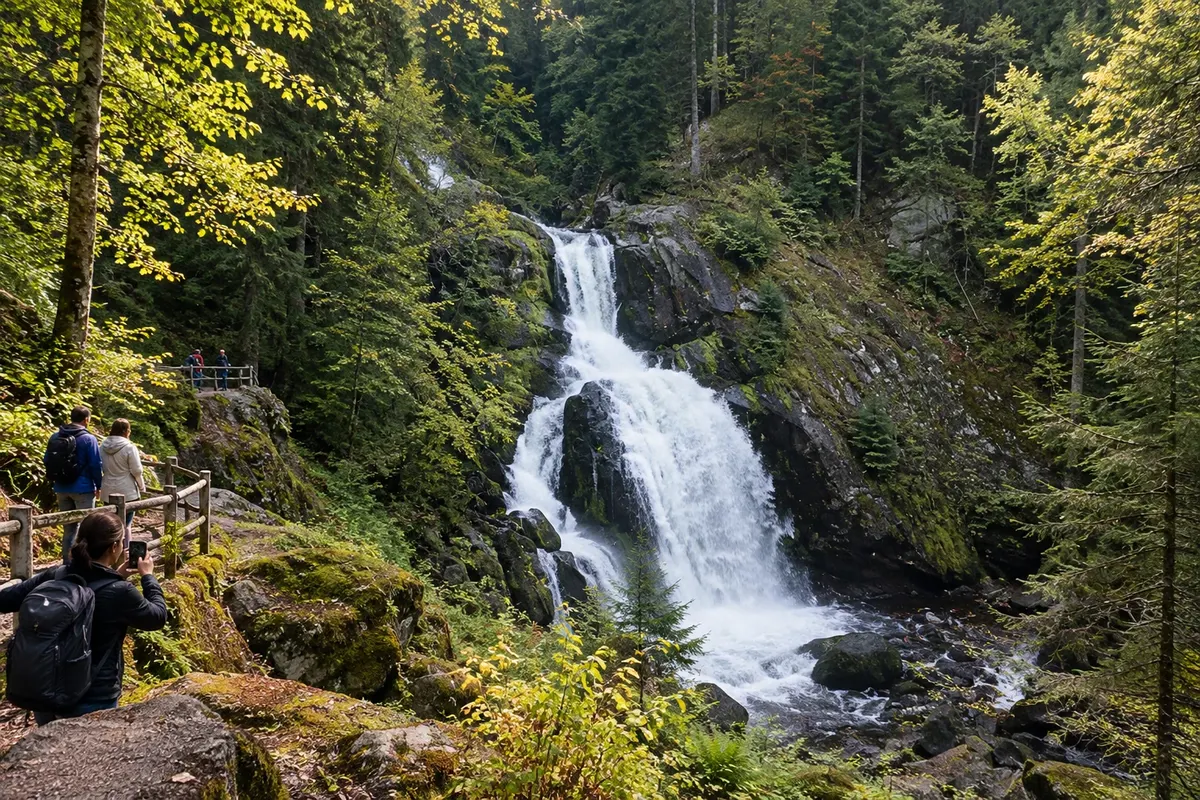
Triberg is at 616 meters elevation, in the middle of the Black Forest, and the journey there is part of the experience. The Schwarzwaldbahn (Black Forest Railway) links Offenburg to Singen and Konstanz over about 149 km, built between 1863 and 1873 by engineer Robert Gerwig, with 39 tunnels and looped curves between Hornberg and Triberg to gain altitude; the highest point is the Sommerau tunnel, at 832 meters. Regional trains run hourly. From Triberg station, a walk of about 25 minutes brings you to the main entrance of the Triberger Wasserfälle (Triberg Waterfalls): the Gutach River drops 163 meters in seven granite steps, one of the highest falls in Germany. Three waymarked paths traverse the slope: the Kaskadenweg, about 45 minutes, to the main steps viewpoint; the Kulturweg, about 1 hour; and the Naturweg, about 90 minutes, to the upper section. In winter only the section to the main falls is open, and at night the waterfall is often illuminated. On Triberg’s Hauptstraße are the cuckoo clock shops, a regional tradition since the 18th century, and the Schwarzwaldmuseum, with reconstructed workshops, costumes, carnival masks and racing sleds. Nearby there are house-sized cuckoo clocks with mechanisms you can visit. If you drive, you can stop in Schonach and Furtwangen, home to the German Clock Museum.
Kraji na poti: Triberger Wasserfälle.
Vključuje: Train requires its own ticket; regional trains accept the Deutschlandticket and the Baden-Württemberg-Ticket. Entrance to the waterfall park is paid separately, with tickets also sold online; the Schwarzwaldmuseum has its own admission. Trails and viewpoints are inside the park.
Nasvet: Take the morning train and sit on the right between Hausach and Triberg to see the railway loops. Wear shoes with firm soles: the paths beside the water are wet and have steps. Buy a cuckoo clock with a Black Forest manufacture certificate if you want to take one home. Return via Offenburg in the mid-afternoon to arrive in Freiburg before dinner.
Najboljši čas za obisk: From April to October, with strong water flow in spring after the thaw; from November to March only the lower section is open and the paths can be icy, check before you go.
Schauinsland by cable car: Freiburg’s mountain at 1,284 meters
Odhod: Freiburg Hauptbahnhof (central station) Tram line 2 to Günterstal and bus 21 to the cable car station Približno pol dneva Dopoldne ali popoldne easy (optional trails on the summit)
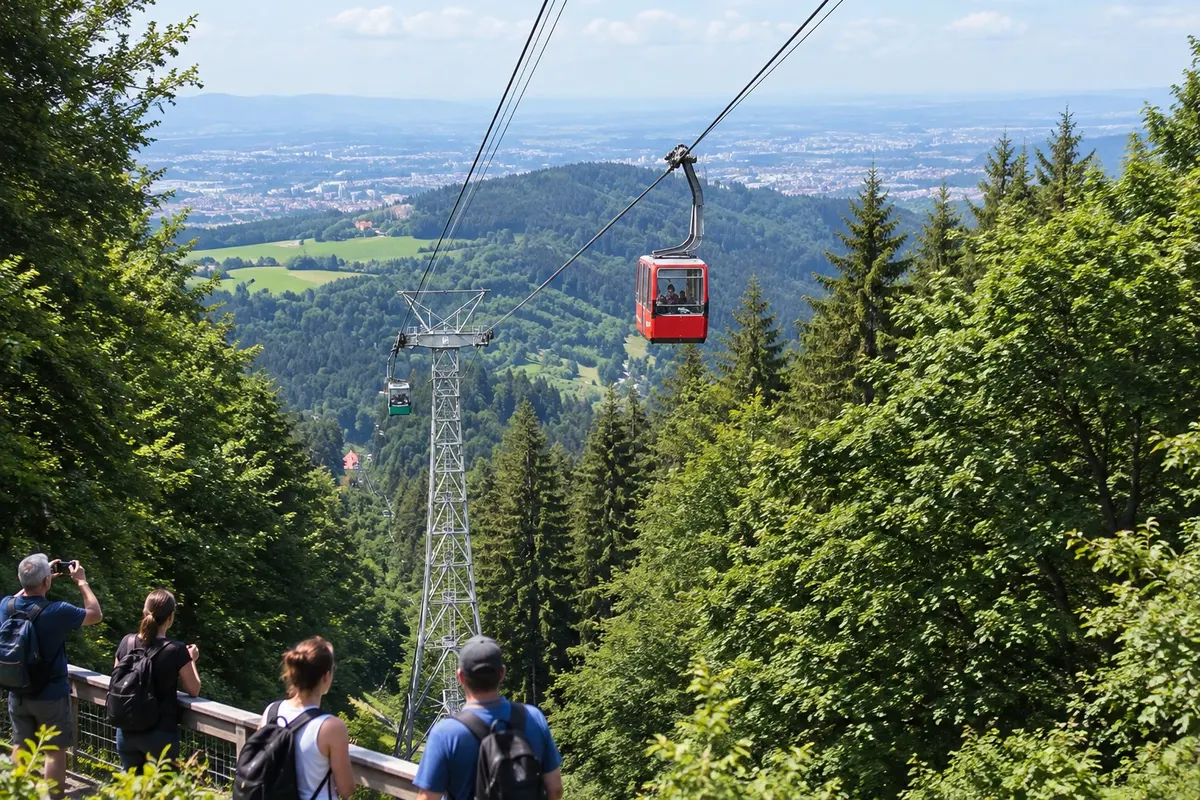
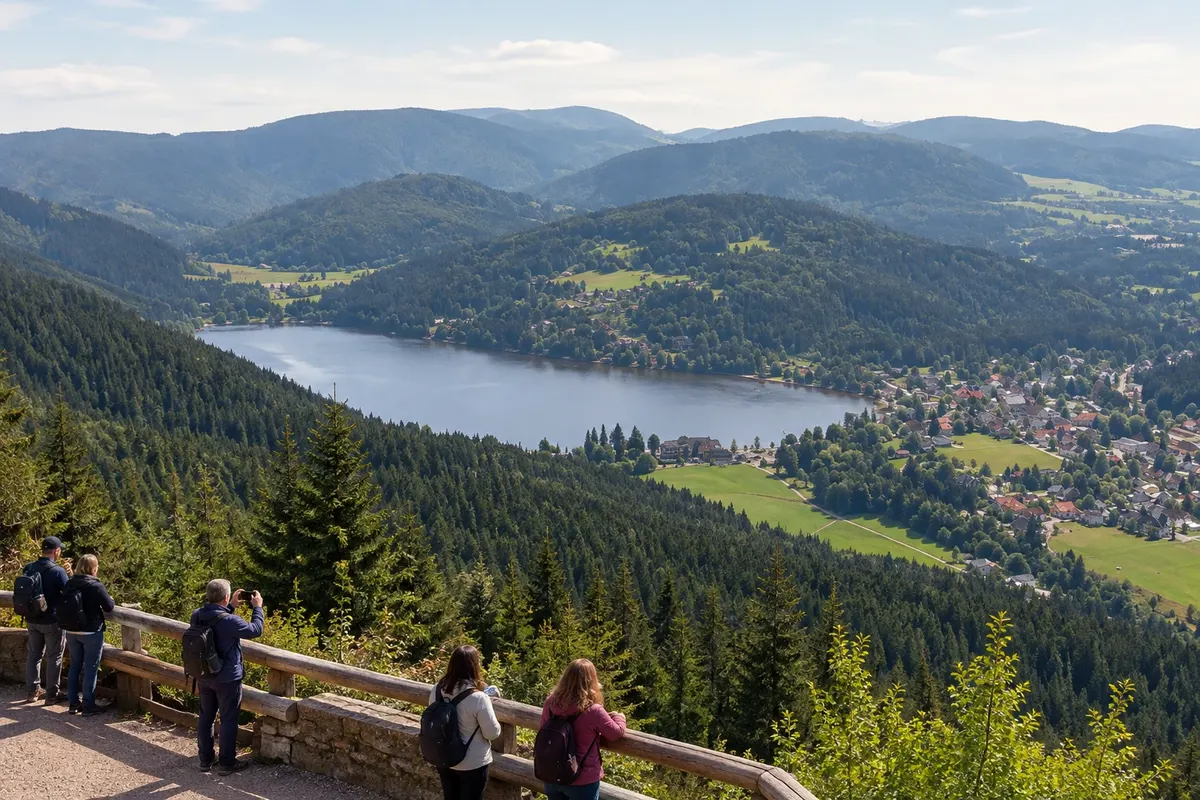
The Schauinsland, whose name means something like look toward the countryside, is Freiburg’s mountain, at 1,284 m, about 10 km from the center. The Schauinslandbahn, opened in July 1930, was the world’s first continuous-circulation cable car with large cabins; today it uses small cabins that depart without stopping from the Horben station, at 473 m, and climb 746 m of elevation over 3.6 km in about 20 minutes — the longest route of this type in Germany. The valley station is in Horben: from Freiburg city center take the tram to Günterstal and from there the bus. At the top there is a panoramic terrace, a café and a roughly 20-minute path to the Eugen-Keidel-Turm, an observation tower with views over the Rhine valley, the Vosges in France and, on clear days, the Swiss Alps. The mountain had silver, lead and zinc mines for more than 700 years, until 1954; the old mine is now an underground museum, the Museums-Bergwerk, with guided tours in season. There are trails of all lengths through pastures and fir forest, passing farms and mountain restaurants, and a solar observatory that runs science outreach.
Kraji na poti: Schauinslandbahn.
Vključuje: Cable car ticket paid separately, round‑trip or up only for those who walk down. Tram and bus to the valley station are covered by Freiburg public transport tickets. The tower and trails are open; the mine museum has its own entrance fee and opening hours.
Nasvet: Go in the morning on clear days; in autumn the valley is often fogged while the summit is sunny. Those who enjoy walking can descend on marked trails to Horben or Günterstal in about 2 hours. The cable car closes a few days a year for maintenance, so check before you go.
Najboljši čas za obisk: All year; trails and the mine are best from May to October, and there may be snow on the summit from December to February. The clearest views are often in autumn.
Alte Brücke and Philosophenweg: the old bridge and the philosophers’ path with castle views
Odhod: Marktplatz (Heidelberg) Hike with ascent via the Schlangenweg about 2 to 3 hours late afternoon moderate (steep 15-minute climb)
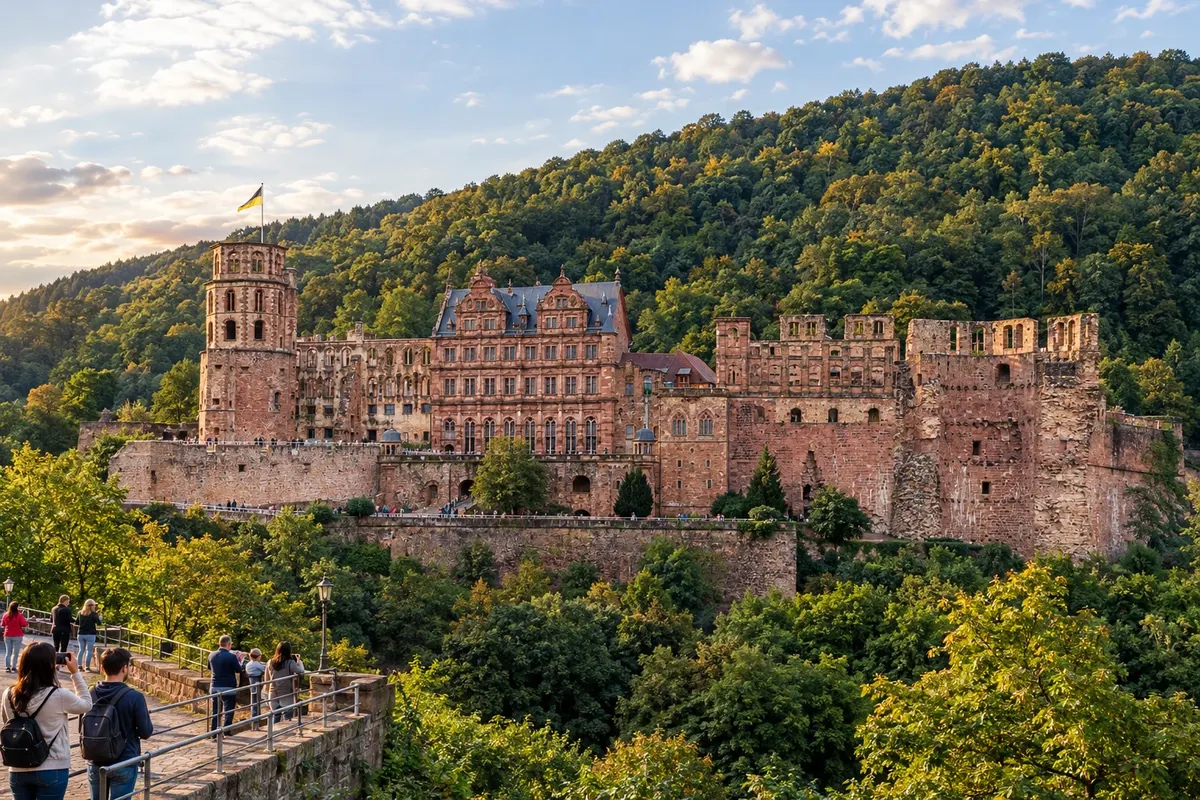
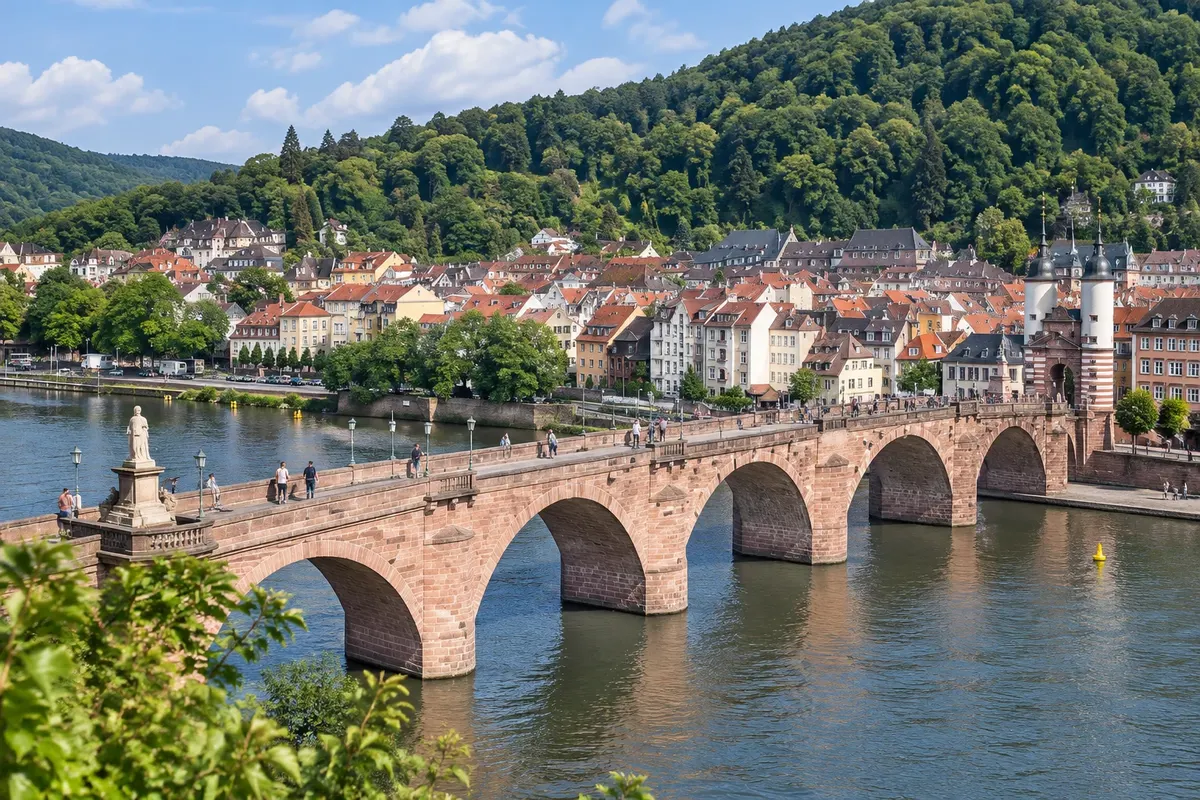
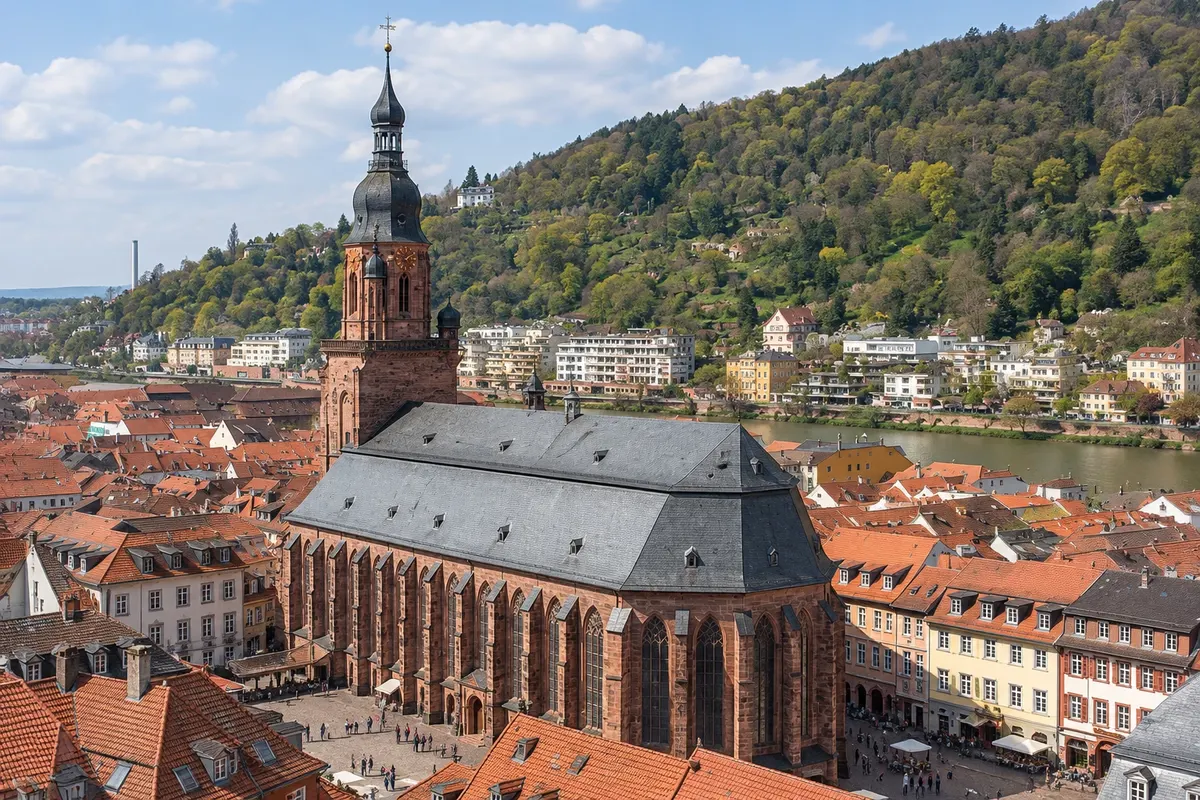
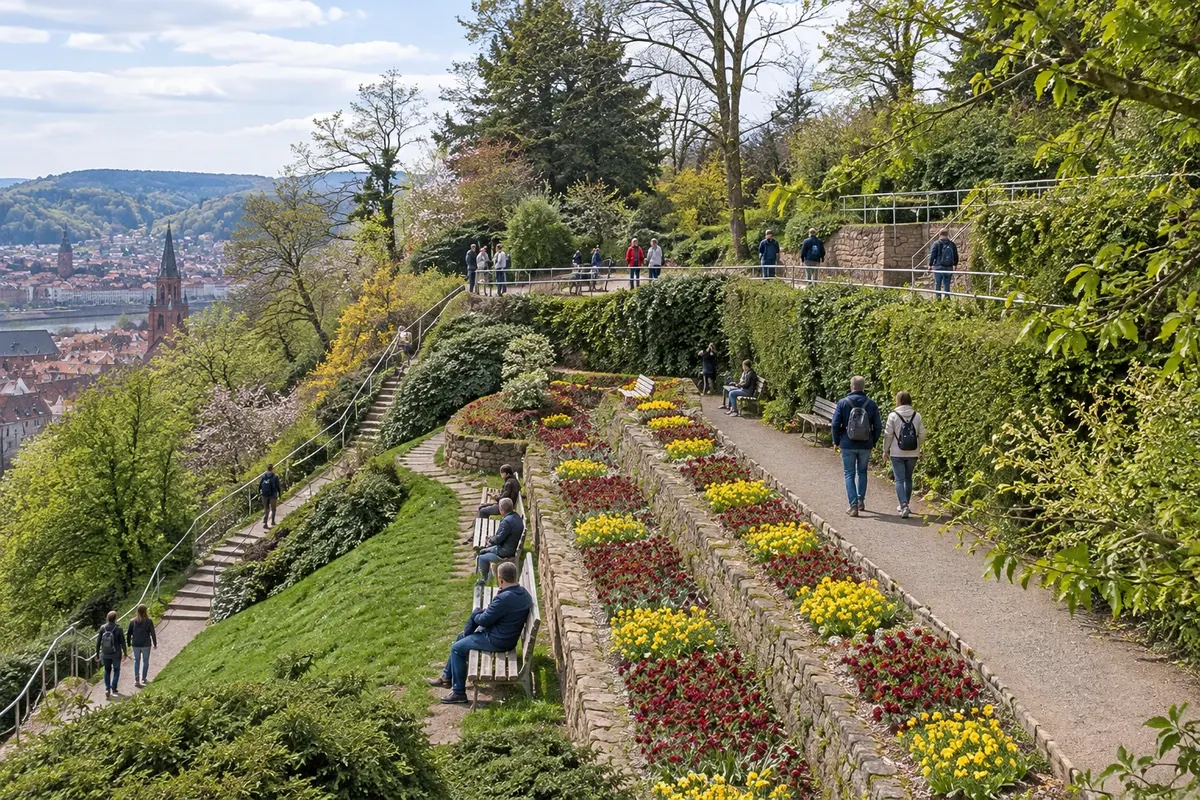
The Alte Brücke (old bridge), officially the Karl-Theodor-Brücke, crosses the Neckar between the Altstadt and the Neuenheim district. It is the ninth bridge in the same place: it was built from Neckar sandstone between 1786 and 1788 by order of Elector Karl Theodor, is about 200 meters long and is closed by the Brückentor, a medieval gate with two towers that received baroque helmets in 1788. On the piers are statues of the elector and the goddess Minerva. In March 1945, German troops blew up three arches to delay the Allied advance, and the bridge was rebuilt after the war. At the city-side entrance stands the Brückenaffe, a bronze monkey by Gernot Rumpf from 1979, recalling a 15th-century figure: visitors touch its mirror and fingers. On the other side of the river, to the left, the Schlangenweg begins, a zigzag path between walls of old vineyards that climbs in about 15 minutes to the Philosophenweg (philosophers’ path), on the south slope of the Heiligenberg, which is 445 meters high. Professors and poets from the university used to walk there, and the name comes from that. The main stretch is flat, with benches, and gives the full view of the castle, Altstadt, the bridge and the river; the slope is so sheltered that Mediterranean plants grow there, gathered in the Philosophengärtchen. Those who wish can continue up to the ruins of St. Michael’s monastery and the Thingstätte, an open-air amphitheater from the 1930s, on the top of the Heiligenberg.
Kraji na poti: Alte Brücke, Philosophenweg.
Vključuje: Self-guided walk: the bridge, path and garden are open and there is no entrance fee. There is no transport to the Philosophenweg from the Schlangenweg; the tram to Neuenheim shortens the climb from the other side.
Nasvet: Go in the late afternoon: the low sun lights the castle from the front and the city lights come on as you descend. Ascend via the Schlangenweg and descend along the Bergstraße to Neuenheim so you don’t repeat the route. On Schlossbeleuchtung nights, the Philosophenweg and the Neckar bank fill up hours before the fireworks.
Najboljši čas za obisk: All year; from April to October the almond trees, fig trees and vines on the slope are green. On rainy days the Schlangenweg becomes slippery.
Lichtentaler Allee and Museum Frieder Burda: Baden-Baden’s tree-lined walk
Odhod: Kurhaus / Goetheplatz (Baden-Baden) Walk along the Oos River and museum visit about 3 to 4 hours Dopoldne ali popoldne easy (flat terrain)
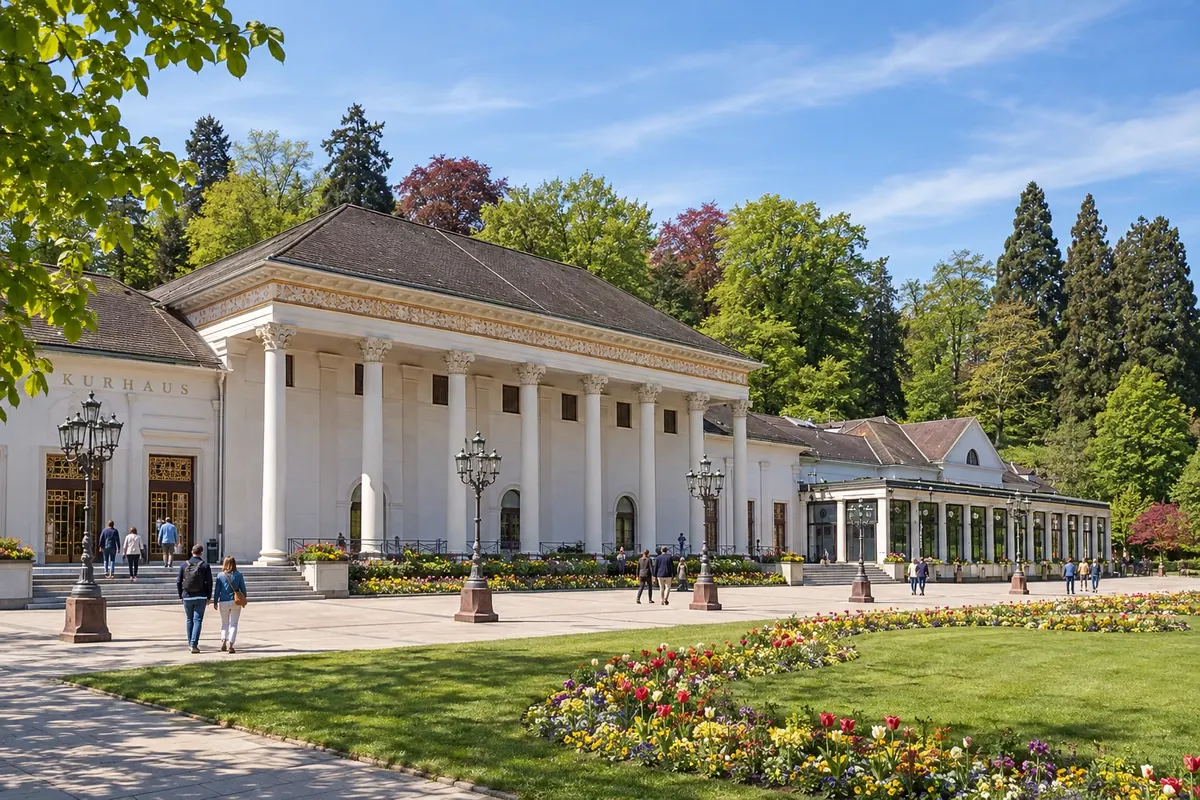
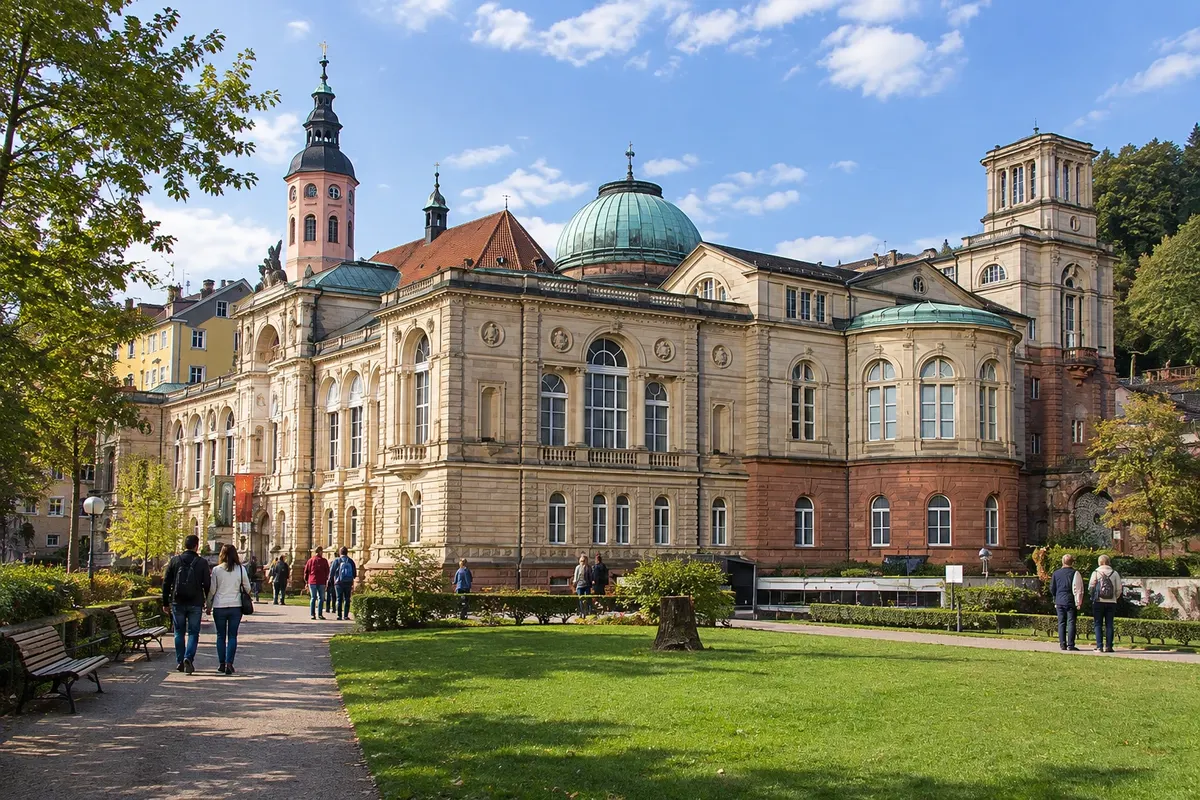
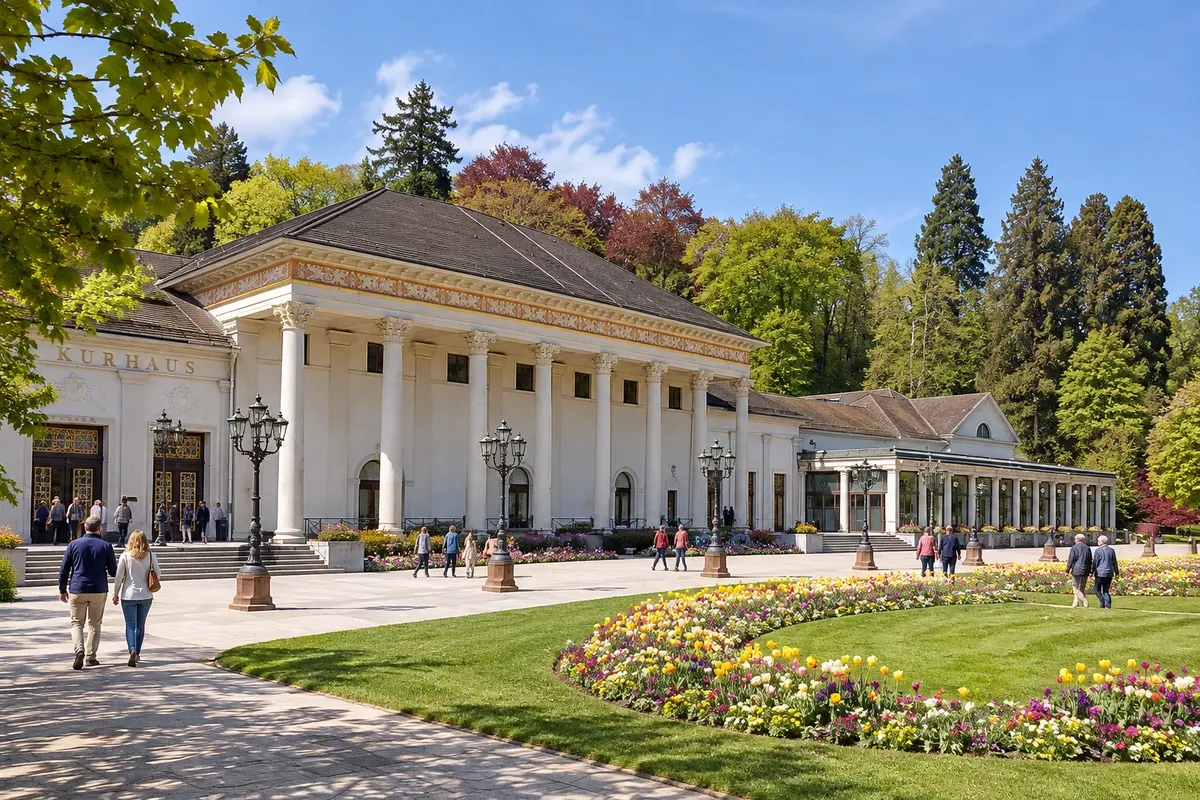
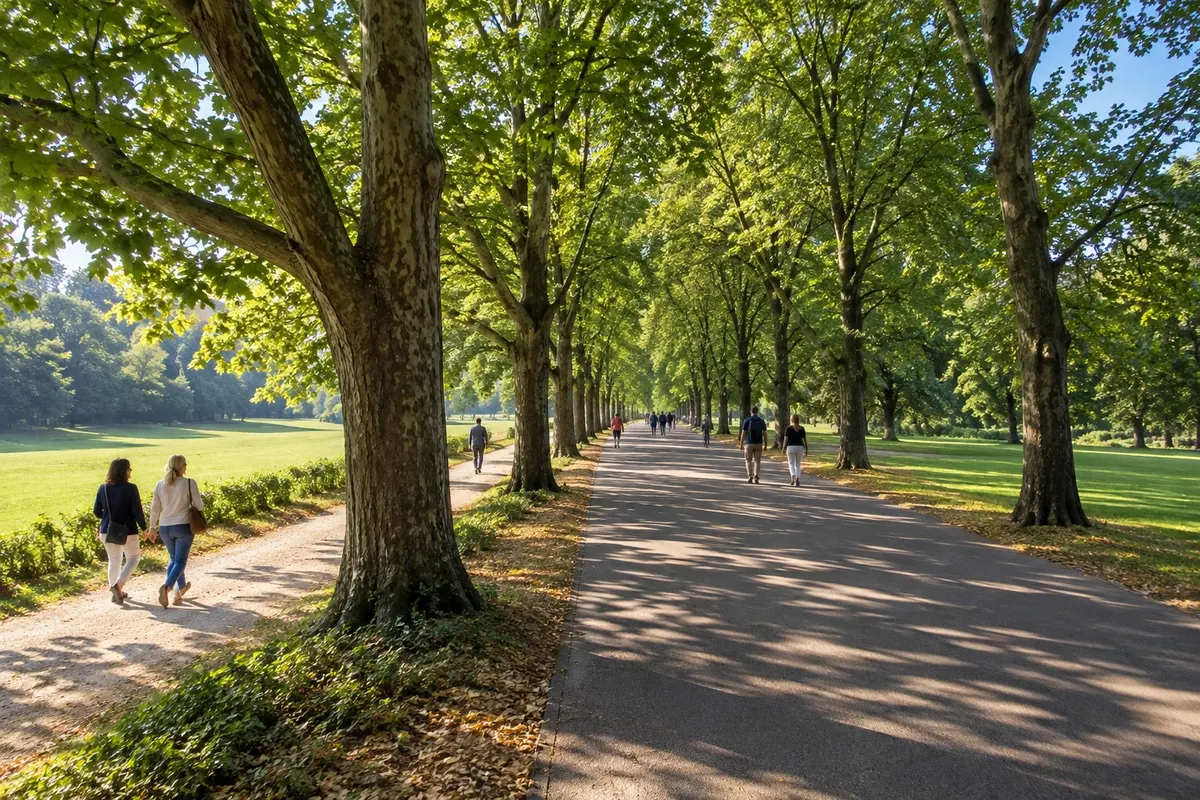
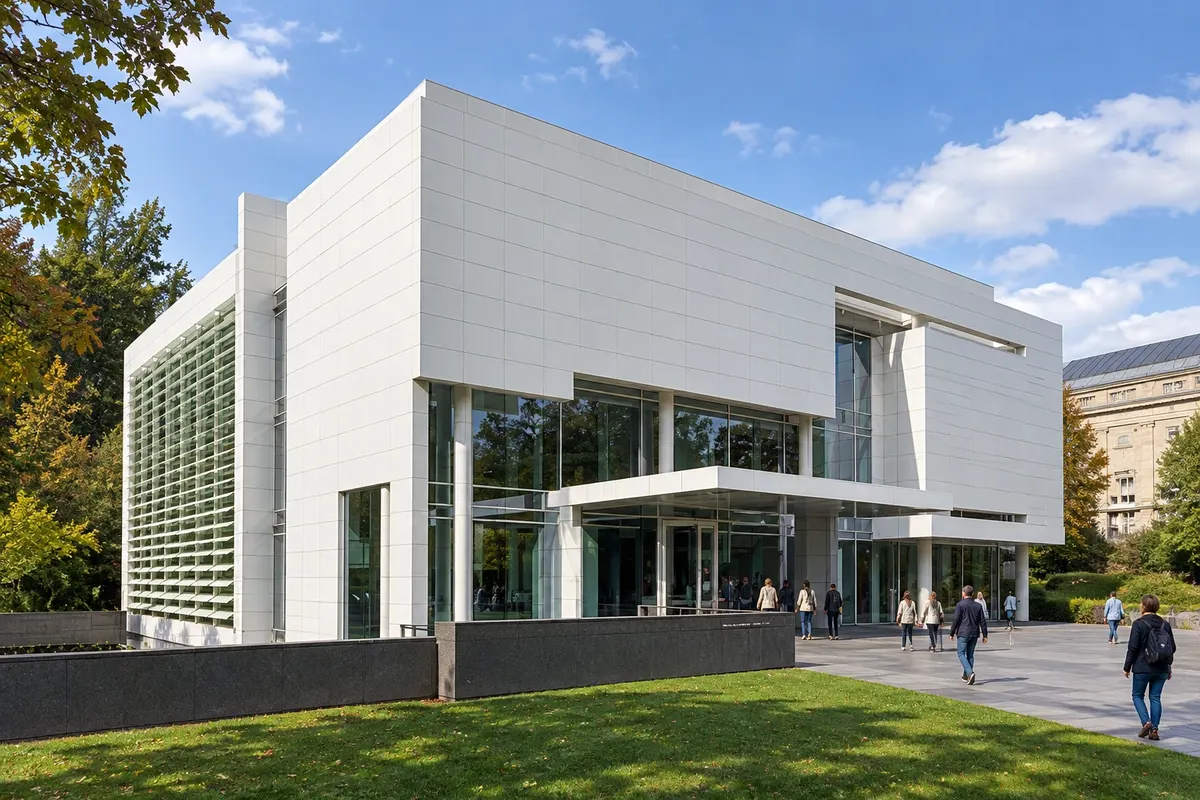
The Lichtentaler Allee is the 2.3 km avenue that follows the Oos River from the Kurgarten, opposite the Kurhaus, to the Lichtenthal monastery, a Cistercian abbey founded in the 13th century and still active. It began in 1655 as an oak-lined path between the market and the convent and was turned into a park between 1850 and 1870 at the request of the Bénazet casino, featuring about 300 species of trees and shrubs: magnolias, ginkgos, chestnuts, azaleas, plane trees. Along it are the theater, the Staatliche Kunsthalle, 19th-century villas and, further on, the Gönneranlage rose garden with hundreds of varieties, and the Dahliengarten, a dahlia garden with busts of Clara Schumann, Johannes Brahms and Robert Stolz, who lived in the town. Midway along the avenue is the Museum Frieder Burda, a white building by American architect Richard Meier, opened in 2004 and linked to the neighboring Kunsthalle by a walkway. Publisher Frieder Burda’s collection brings together modern and contemporary art, with works by Picasso, Gerhard Richter, Sigmar Polke and Georg Baselitz, shown in temporary exhibitions that change during the year, with loans from outside museums. The museum is closed on Mondays.
Kraji na poti: Lichtentaler Allee, Museum Frieder Burda.
Vključuje: The avenue, the gardens and the Lichtenthal monastery (church) are open and free to enter. The Museum Frieder Burda and the Kunsthalle require paid admission; there is a combined ticket for both—check the current pricing. Guided tours of the exhibitions are paid separately.
Nasvet: Walk the full avenue in the morning to the monastery, then return by bus or along the other side of the river; visit the museum on the way back when your legs need a rest. In October the leaves change color and the avenue looks especially pretty. Check the museum schedule beforehand—the current exhibition will shape the visit.
Najboljši čas za obisk: All year; May to June for the roses, August to October for the dahlias and autumn foliage. The museum is closed on Mondays.
Merkur: the steep funicular and the panoramic tower above Baden‑Baden
Odhod: Leopoldsplatz (Baden‑Baden), bus 204 or 205 to the valley station Bus and Merkurbergbahn funicular Približno pol dneva Popoldne easy (optional trails on the summit)
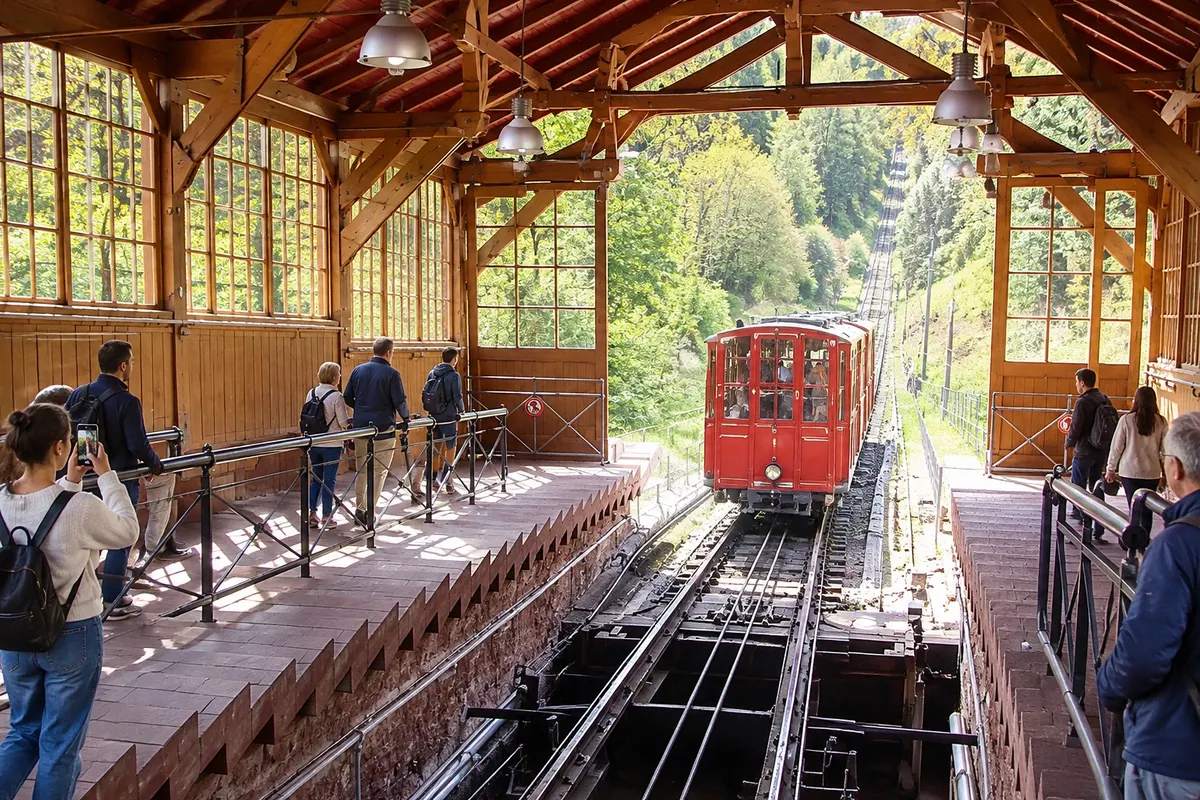
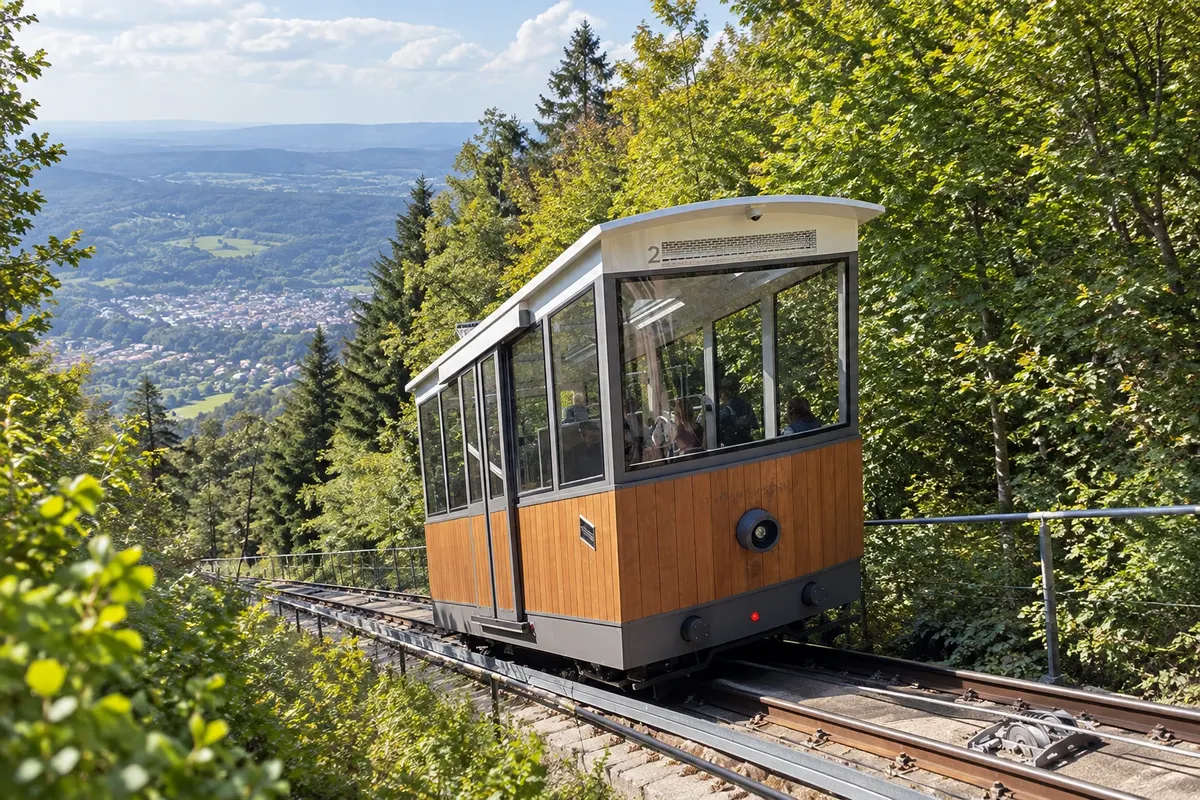
The Merkur is Baden‑Baden’s mountain, at 668 meters, east of the center; the name comes from a Roman altar to the god Mercury found at the top. The Merkurbergbahn, a funicular opened in 1913, stopped in 1967 and resumed service in 1979, fully automatic: passengers press the start button themselves. It runs 1,192 meters of track, one of the longest routes of this type in Germany, with gradients reaching over 50 percent, from the valley station at 287 meters to the upper station at 657 meters. The valley station is about 2 km from the center; buses 204 and 205 stop at the door and there is a combined bus+funicular ticket. At the top there is an elevator inside the Merkurturm to the platform at 23 meters, offering a circular view over Baden‑Baden, the Murg valley, the northern Black Forest, the Rhine plain and, on clear days, the Vosges. The summit is also a paragliding take‑off point, with a restaurant, lawn and barbecue areas. Waymarked paths descend through the forest to the town, passing viewpoints, an enclosure with regional animals and a Kneipp cold‑water installation; the second stage of the Panoramaweg, the walking circuit around the town, begins at the valley station.
Kraji na poti: Merkurbergbahn.
Vključuje: Funicular with round‑trip or one‑way (up only) ticket, paid separately; combined bus+funicular sold by the driver. The tower, trails and animal enclosure are open. Restaurant at the top requires separate payment.
Nasvet: Go up in the late afternoon and stay to watch the city lights come on: the funicular runs until night. If you have the time and energy, walk down from Merkur to Lichtental in about 1 h 30 and finish at Lichtentaler Allee. Bring a jacket: it’s windy on the summit.
Najboljši čas za obisk: All year; preferably on clear days. The funicular runs daily but closes for maintenance at certain periods, so check before you go.
Königstuhl: the historic section of the funicular and the viewpoint at 568 meters
Odhod: Kornmarkt (Heidelberg), with a change at Molkenkur station Funicular in two sections; descent optional on foot about 2 to 3 hours Dopoldne ali popoldne easy (optional trails on the descent)
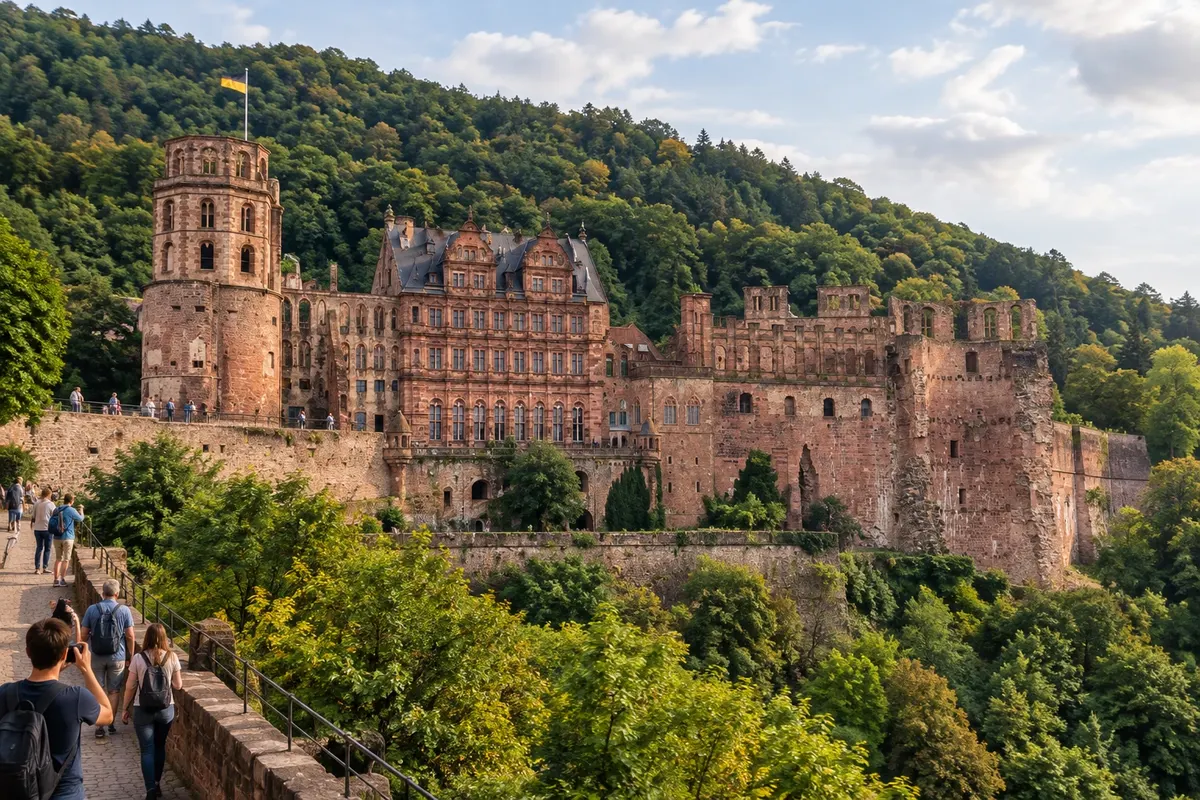
The Königstuhl (king's chair) is the 568-meter hill rising behind Heidelberg Castle in the Odenwald. The Heidelberger Bergbahn reaches it in two sections. The lower section, from Kornmarkt to the castle and Molkenkur, opened in 1890, was water-ballasted, and received modern glass cars between 2003 and 2005; it is 471 meters long and takes about 5 minutes. At Molkenkur you change to the upper section, opened in 1907 and still using the original wooden cars: it is 1,020 meters long, with 260 meters of elevation gain and about a 9-minute slow ascent through the forest, one of the oldest electric funiculars still operating in Germany. On top there is a viewpoint over the city, the Neckar and, on clear days, the Rhine plain to the Pfälzerwald (Palatinate Forest), 40 to 50 km away. Near the station are a fairytale playground, a falconry with seasonal shows and the Landessternwarte, an observatory founded in 1898 next to the Max Planck Institute for Astronomy; the TV tower is a bit further on. Waymarked trails descend through the forest to the castle or to the Handschuhsheim neighborhood.
Kraji na poti: Heidelberger Bergbahn.
Vključuje: The lower section of the funicular is included with the castle ticket; the upper section requires its own ticket or a separate round-trip combined ticket to the Königstuhl. Lookout and trails are open. The falconry and playground require separate admission.
Nasvet: Buy the combined ticket to the top at the Kornmarkt, visit the castle on your return and avoid ascending on foggy days. The walk down to the castle takes about 1 hour via a forest path. In summer, falconry demonstrations are usually in the afternoon—check times.
Najboljši čas za obisk: From April to October, on clear days; in winter the summit can have snow and fog. The upper section closes a few days a year for maintenance—check before you go.
Freiburg Altstadt on foot: Bächle, Martinstor, Schwabentor and the medieval alleyways
Odhod: Bertoldsbrunnen (Freiburg) Peš po starem mestnem jedru about 2 to 3 hours Dopoldne ali popoldne easy (flat terrain)
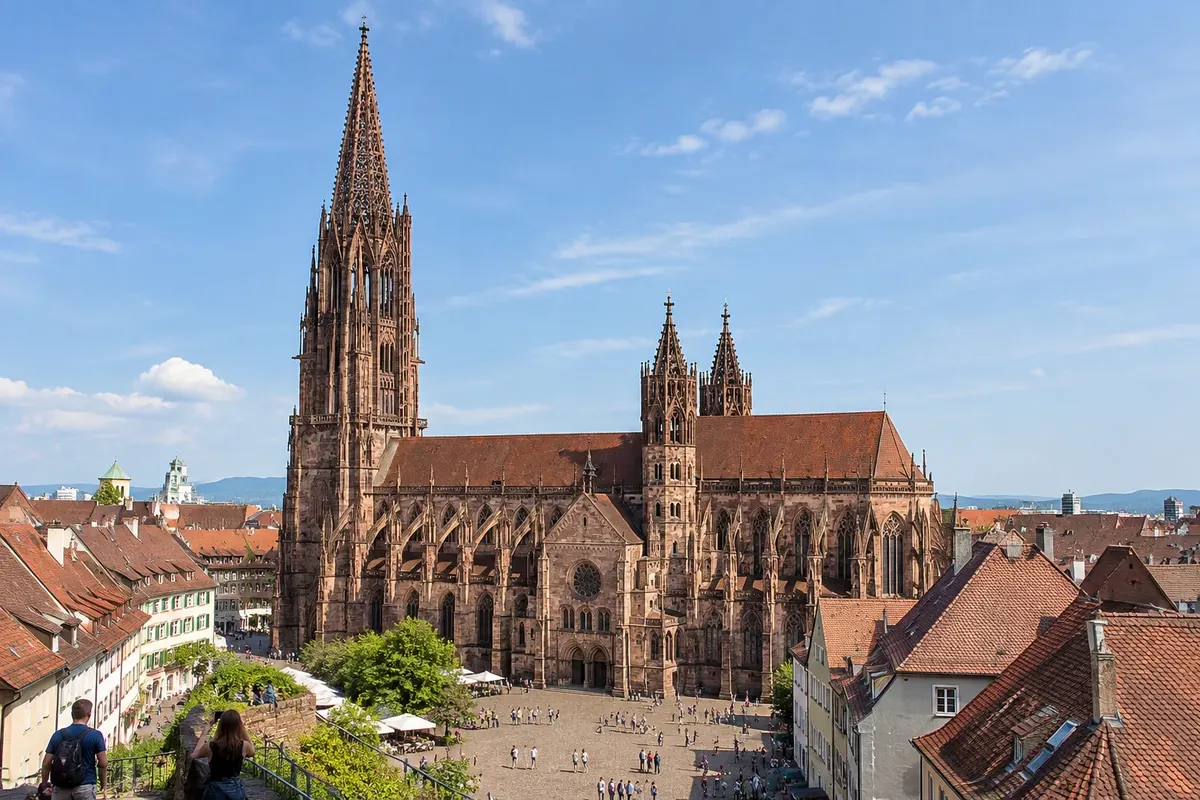
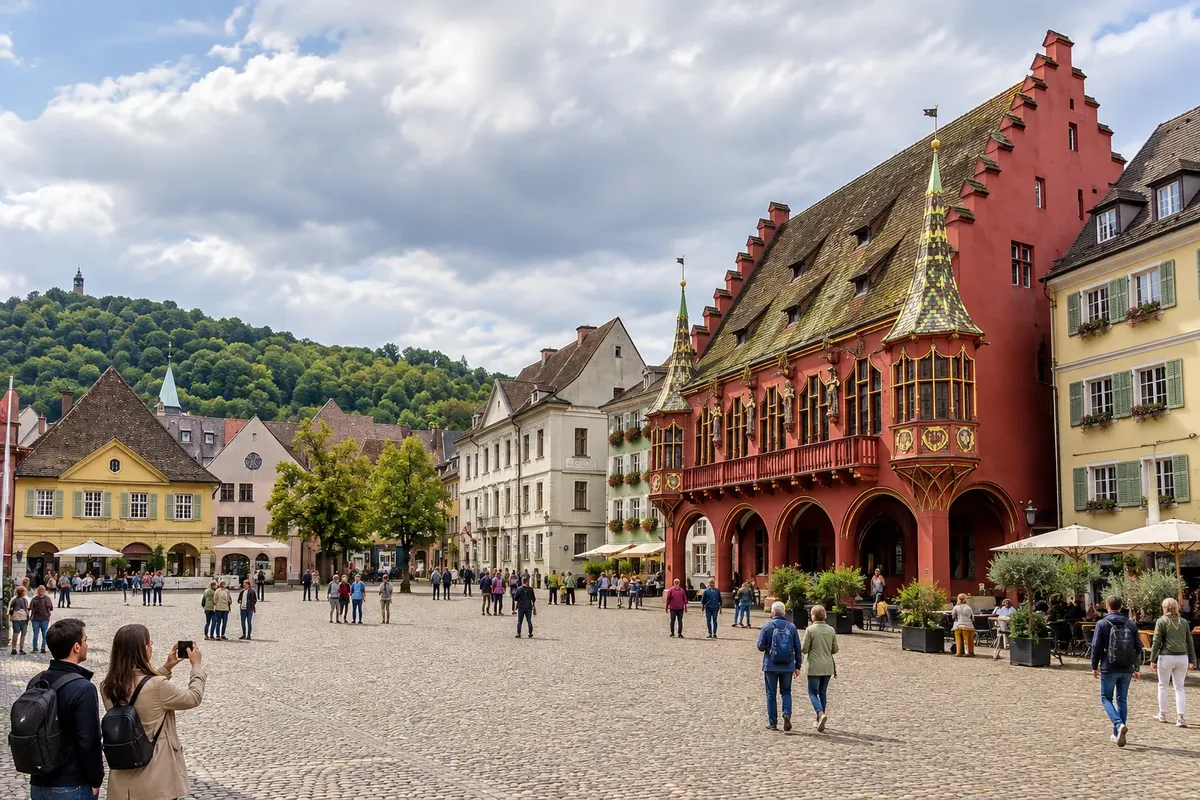
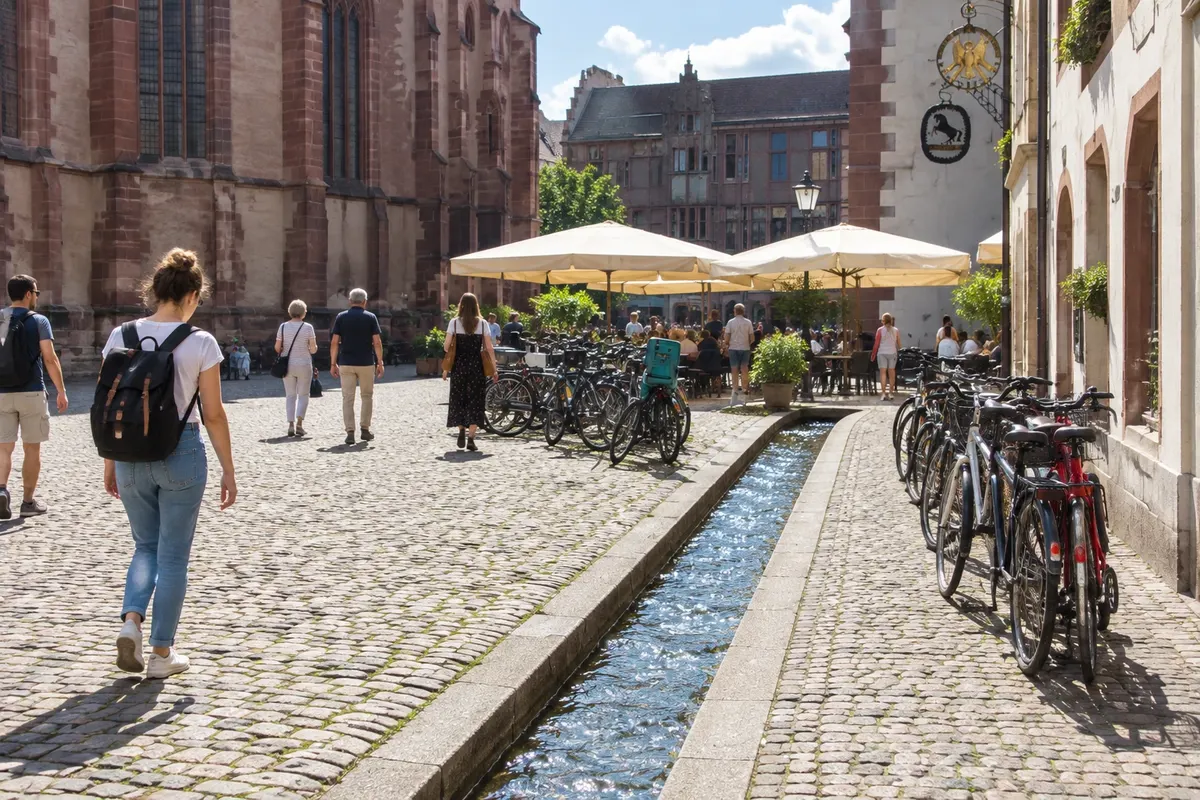
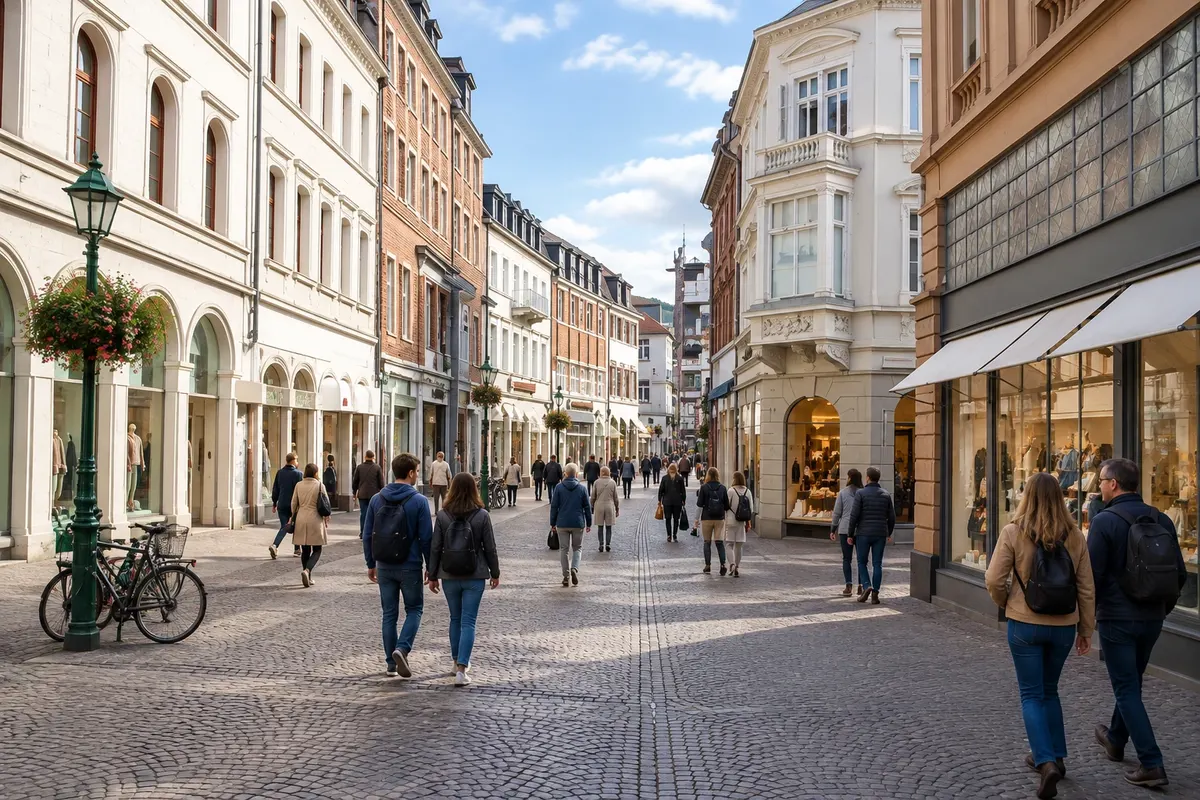
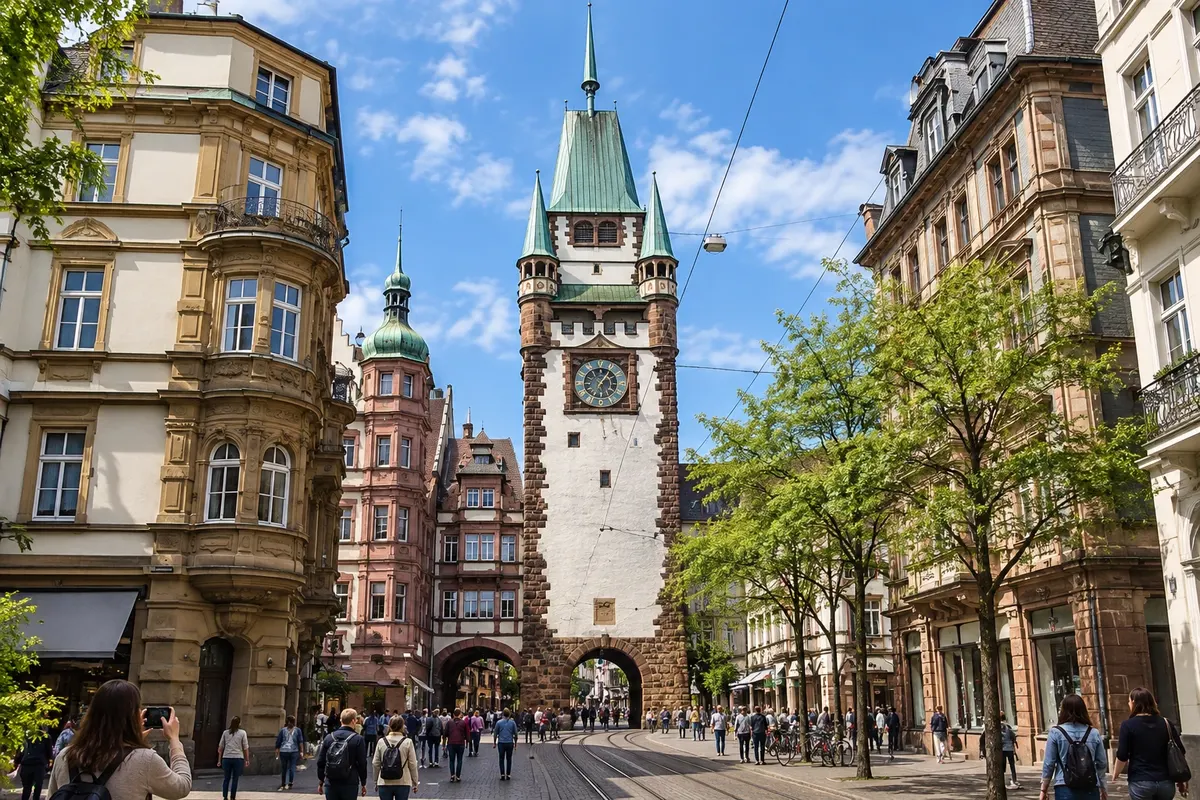
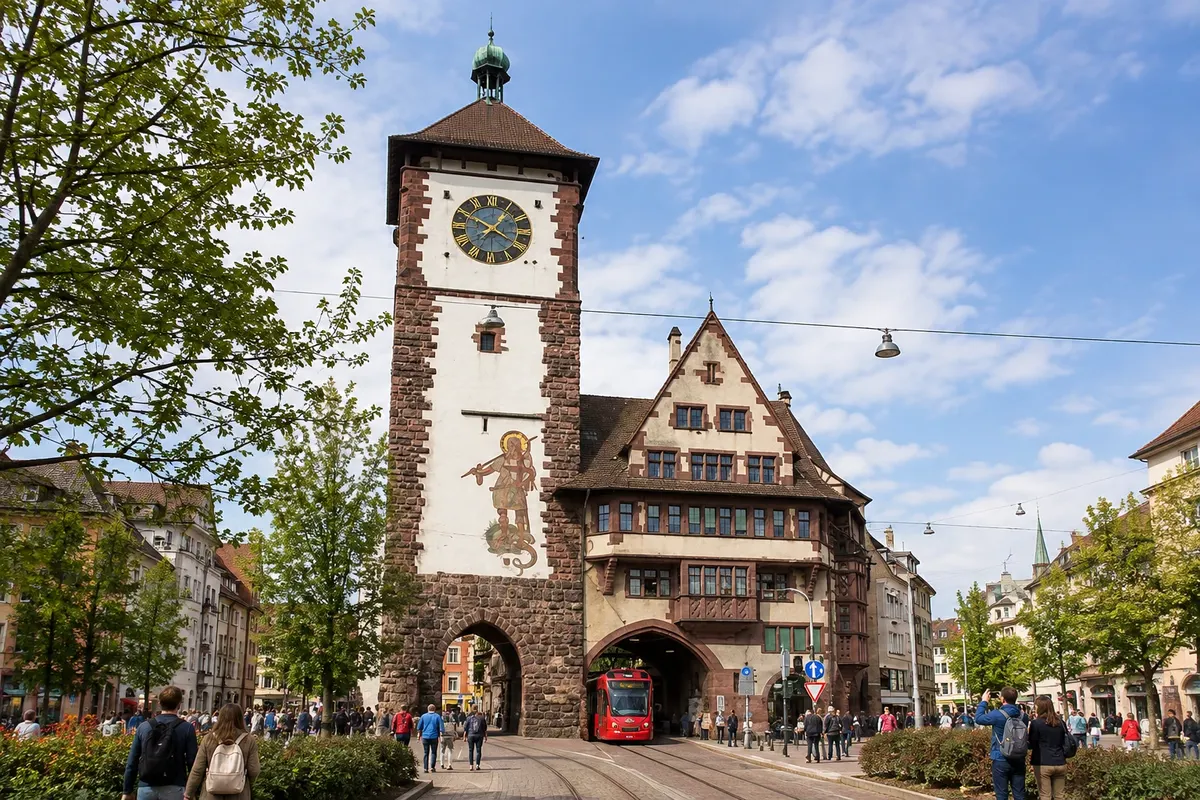
The hallmark of Freiburg’s old town are the Bächle, the narrow running-water channels that line the streets. First mentioned in 1220, they are fed by the Dreisam River, diverted near the Schwabentor, and total about 15.9 km, some of it underground. They were used for irrigation, watering animals and fighting fires; today they cool the streets in summer and children play with small wooden boats. Tradition says that anyone who accidentally steps into a Bächle will marry someone from Freiburg. Of the city’s five medieval gates, two remain, saved from demolition at the end of the 19th century by mayor Otto Winterer. The Martinstor, on Kaiser-Joseph-Straße, contains wood dated to 1202 and appears in documents from 1238; in 1901 it was raised from 22 to 60 meters to allow trams to pass, which still run beneath it. The Schwabentor, from around 1250, at the Oberlinden exit, was also raised in 1901; on the inside face is a painting of a merchant with a cart tied to the legend of the Swabian who tried to buy the city with barrels of gold that contained sand, and on the outside a Saint George from 1903. Since 1969 a small pewter-figure museum has operated inside it. Between the two gates are the Rathausplatz, with the old and new town halls, the Franciscan church and the Konviktstraße, an alley of wisteria and Rhine pebble paving, with mosaics indicating the trade of each house.
Kraji na poti: Freiburger Bächle, Martinstor, Schwabentor.
Vključuje: Self-guided walk: streets, channels and gates are open and there is no entrance fee. The tin-figure museum in the Schwabentor has its own ticket and limited opening hours. Guided city tours depart from the tourist office and cost extra.
Nasvet: Watch the ground: the pebble mosaics in front of shops show what each one sells. Do the walk after the Münsterplatz market and finish at the Schwabentor, where the stairs to the Schlossberg start. Be careful with the channels when looking up: falling into them is common.
Najboljši čas za obisk: All year; from May to September the channels are full and tables occupy the streets. In the cold months the Bächle water is sometimes diverted for cleaning.
Schlossberg: the hill of central Freiburg, by funicular or via the stairs
Odhod: Stadtgarten or Schwabentor (Freiburg) Funicular Schlossbergbahn or walk up Približno 2 uri late afternoon easy to moderate (ascent to the tower)
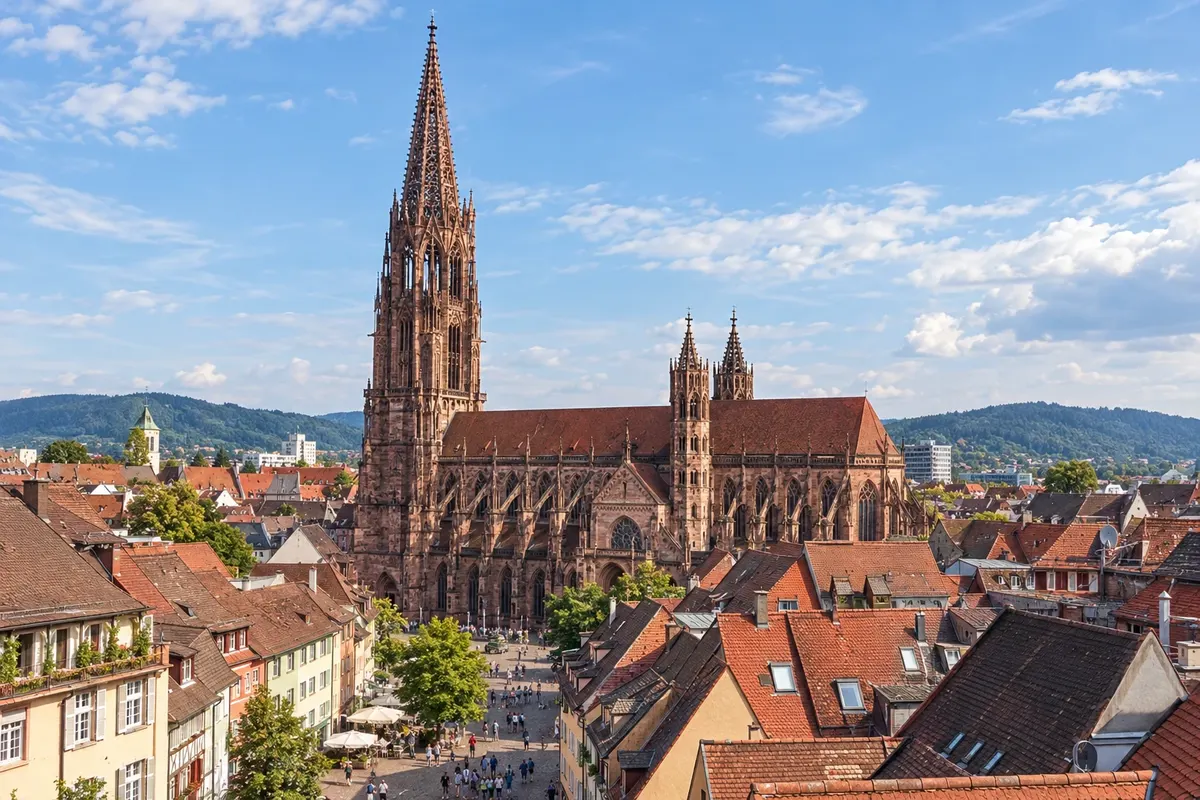
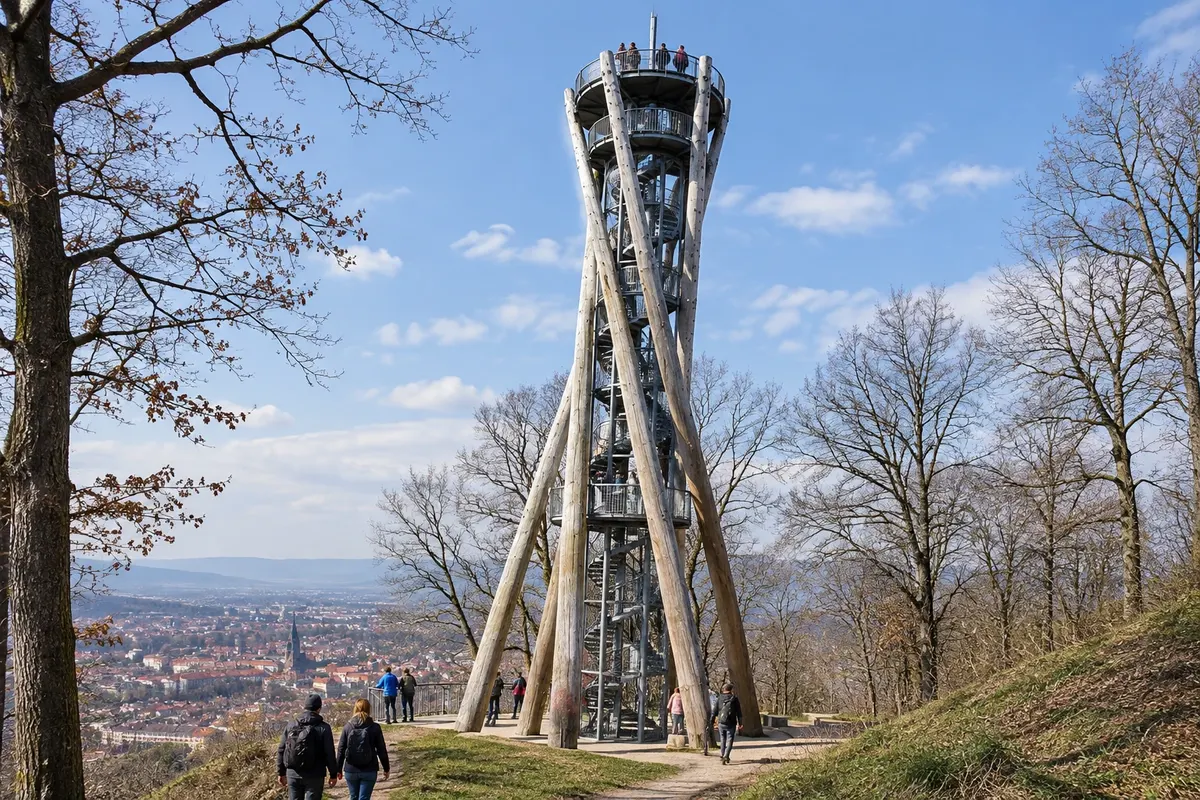
The Schlossberg is the 456-meter wooded hill adjoining Freiburg’s old town, the first step of the Black Forest. From the 11th century there were fortifications at the top; after 1679 Louis XIV commissioned engineer Vauban to build a fortress, which the French demolished in 1744 before leaving the city, and the ruins, walls and ditches remained in the wood. The easiest ascent is by the Schlossbergbahn, a funicular that departs from the Stadtgarten beside the Karlssteg and reaches, in about 3 minutes, a restaurant with a terrace and an outdoor brewery under chestnut trees. From there a roughly 15-minute path leads to the summit and the Schlossbergturm, a 2002 observation tower with views over the cathedral, the roofs, the Rhine plain, the Kaiserstuhl and the Vosges. Those who prefer to walk climb the stairs behind the Schwabentor up to the Kanonenplatz, a viewpoint a few minutes from the city and the classic spot to photograph the cathedral tower. The paths are signed and there are benches and panels about the fortress’s history.
Kraji na poti: Schlossberg.
Vključuje: Lookouts, trails, ruins and the tower are open and free to enter. The funicular has its own ticket, paid separately. Restaurant and brewery at the top are paid separately.
Nasvet: Climb the Schwabentor stairs up to the Kanonenplatz in the late afternoon and descend by funicular once it’s dark, or do the reverse to vary the route. On foggy valley days, the summit is sometimes in sunshine. Combine the climb with the walk through the Altstadt, which ends at the Schwabentor.
Najboljši čas za obisk: All year; from April to October the outdoor brewery is open and the leaves are green. In winter paths can have wet leaves or ice.
University of Heidelberg: Studentenkarzer, Universitätsmuseum and Alte Aula
Odhod: Universitätsplatz (Heidelberg) Walk-through visit to the buildings of the Alte Universität Približno 1 uro in 30 minut Dopoldne ali popoldne easy (stairs in the building)
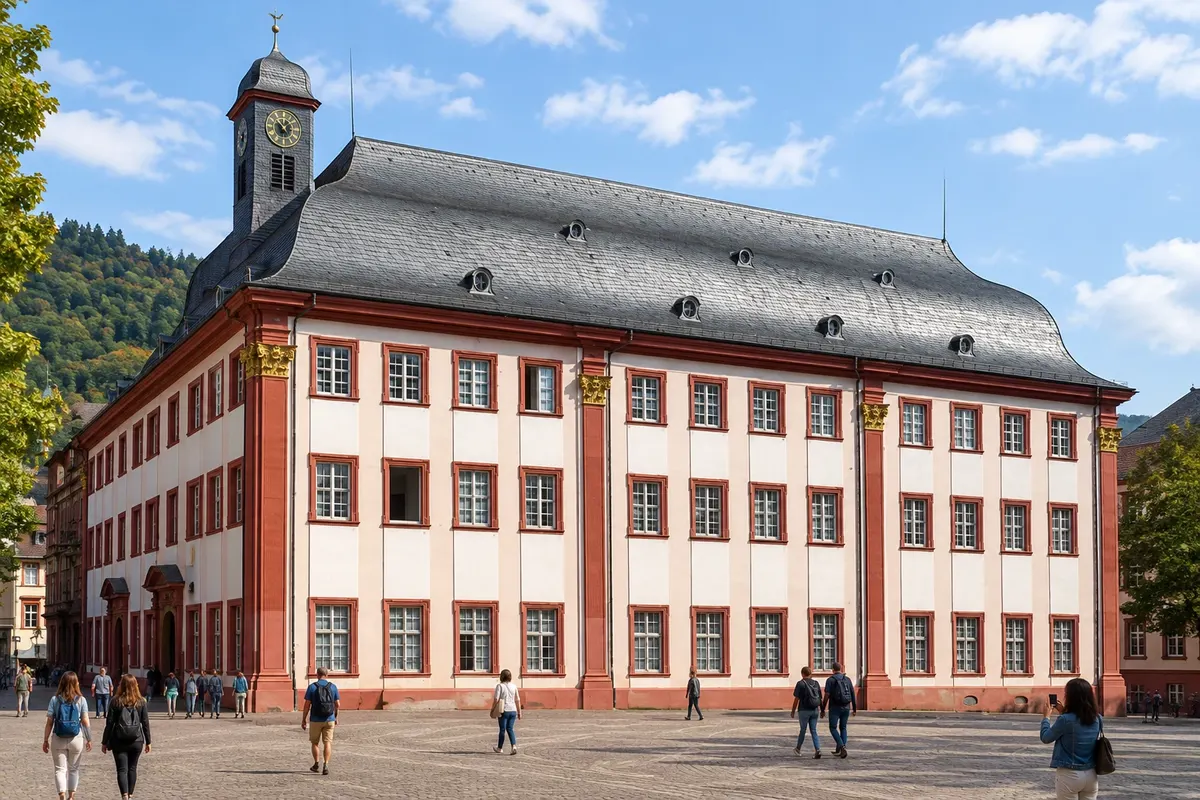
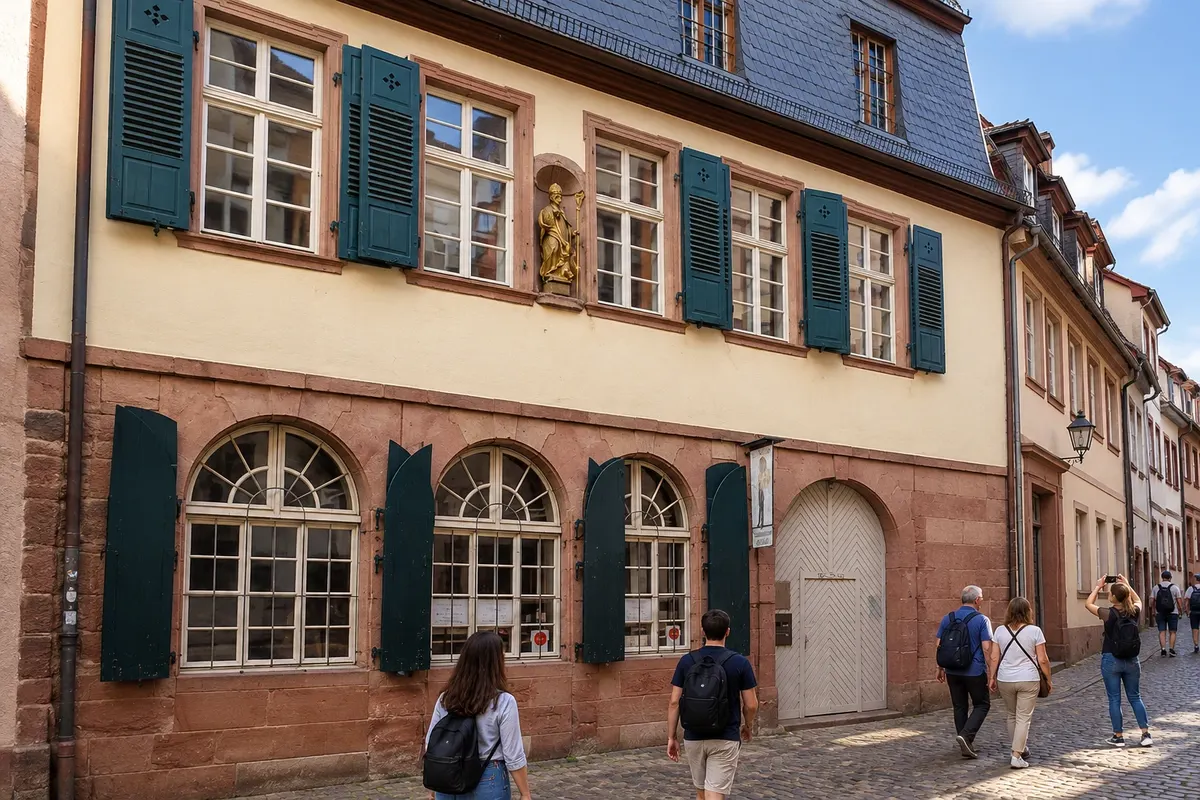
The University of Heidelberg, Ruperto Carola, was founded in 1386 and is the oldest university on German territory. The main buildings are on Universitätsplatz: the Alte Universität, from 1712, and the Neue Universität, from the 1930s, facing each other. On the ground floor of the Alte Universität the Universitätsmuseum has operated since 1996, in three rooms: the red one, with documents from the founding in 1386 until 1802; the green one, covering the 19th century, Heidelberg Romanticism and the revolution of 1848; and the blue one, with the Weimar Republic, the Nazi dictatorship and the postwar period. On the first floor is the Alte Aula, the ceremonial hall with dark wood and paintings, used for concerts and graduations, which can only be seen when there is no event. At the rear, at Augustinergasse 2, is the Studentenkarzer, the students’ prison. Until 1914 the university had its own jurisdiction over students and locked up there, for a few days or weeks, those who made noise at night, dueled, broke street lamps or bathed naked in the Marktplatz fountain; the inmates continued to attend classes. The cells you visit date from 1823, and the walls and ceilings are covered with drawings, silhouettes, verses and fraternity names made by the detainees themselves, with candle soot and ink; at the end of the 19th century passing through the Karzer became a point of pride among students.
Kraji na poti: Studentenkarzer, Universitätsmuseum.
Vključuje: Combined ticket paid separately for the museum, the temporary exhibition and the Studentenkarzer; on days when the museum is closed there is a ticket only for the Karzer. Bags and coats are kept in lockers. Guided tours for groups by reservation.
Nasvet: Go in the morning, before the tour groups arrive: the cells are small. Hours change between summer and winter and the Karzer closes at noon for half an hour; check before you go. From Universitätsplatz, walk to the Universitätsbibliothek on the Plöck, a 1905 building with a decorated façade, to see the manuscript exhibition room.
Najboljši čas za obisk: Open year‑round; from June to mid‑September it is open every day, the rest of the year it is closed on Sundays. In winter visitor numbers are low.
Augustinermuseum: medieval art of the Upper Rhine and the originals from Freiburg Cathedral
Odhod: Augustinerplatz (Freiburg) Walking visit, three minutes from Münsterplatz Približno 2 uri Popoldne easy (museum with elevator)
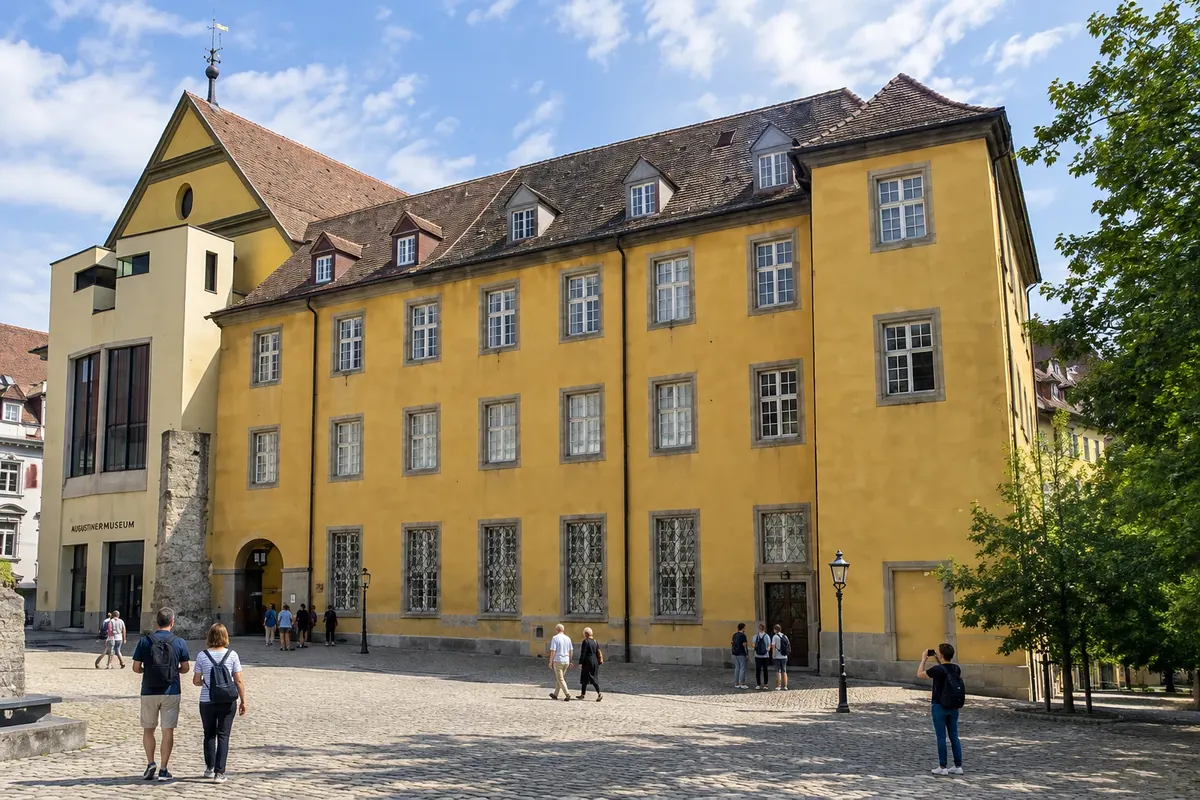
The Augustinermuseum occupies the former Augustinian convent on Augustinerplatz; the building served as a theater and a barracks before becoming a museum, opened in 1923. The collection began in the 1880s and the renovation by architect Christoph Mäckler, with the first phase completed in 2010, turned the old convent church into a high‑ceilinged sculpture hall. There are the originals from Freiburg Cathedral: four‑meter stone prophets, gargoyles and the medieval stained glass windows removed from the Münster for protection, displayed at eye level with light behind them—something you do not see in the cathedral. The holdings are among the foremost medieval art collections of the Upper Rhine, with paintings by Matthias Grünewald, Lucas Cranach the Elder and Hans Baldung Grien; a 15th‑century Dominican altar; Baroque sculptures and altars in the former chancel; and 19th‑century paintings by Anselm Feuerbach, Hans Thoma and Franz Xaver Winterhalter, a court painter born in the Black Forest. The Gothic cloister is part of the visit. The museum also has an organ case from Gengenbach Abbey (1732) and a Welte organ from 1935, played in regular concerts, and a print cabinet with more than 70,000 pieces. Closed on Mondays.
Kraji na poti: Augustinermuseum.
Vključuje: Separate paid admission; there is a ticket valid for Freiburg’s municipal museums—check the current table. Audio guides and guided tours are paid separately. Temporary exhibitions sometimes have their own admission fees.
Nasvet: Visit it after the cathedral on the same day to compare the copies on the cathedral façade with the originals here. Ask at the entrance for organ concert times, which are typically on Fridays and Saturdays. On rainy days in the Black Forest, this is the Freiburg program to follow.
Najboljši čas za obisk: Year-round; closed on Mondays. A good option for rainy days, which in Freiburg are more common from May to August.


 Brazilija
 Antarktika
 Argentina
 Bolivija
 Čile
 Kolumbija
 Ekvator
 Gvajana
 Francoska Gvajana
 Falklandski otoki (Malvini)
 Paragvaj
 Peru
 Surinam
 Urugvaj
 Venezuela
 Avstrija
 Belgija
 Hrvaška
 Danska
 Slovaška
 Slovenija
 Španija
 Finska
 Francija
 Grčija
 Nizozemska
 Madžarska
 Irska
 Islandija
 Italija
 Luksemburg
 Norveška
 Poljska
 Portugalska
 Združeno kraljestvo
 Češka
 Švedska
 Švica
 Turčija
 Bermudi
 Kanada
 Združene države Amerike
 Grenlandija
 Mehika
 Sveta Peter in Mihael
 Dominikanska republika
 Japonska
 Južnoafriška republika
 Egipt
 Avstralija
 Fidži
 Nova Zelandija
 Papua Nova Gvineja