Zurich

Zurich · Zug · Švica

Zurich

The city at the northern tip of Lake Zurique, with a medieval center on both banks of the Limmat River, museums, churches with stained glass by Chagall and Giacometti, and trains to the whole country.

German-speaking Switzerland

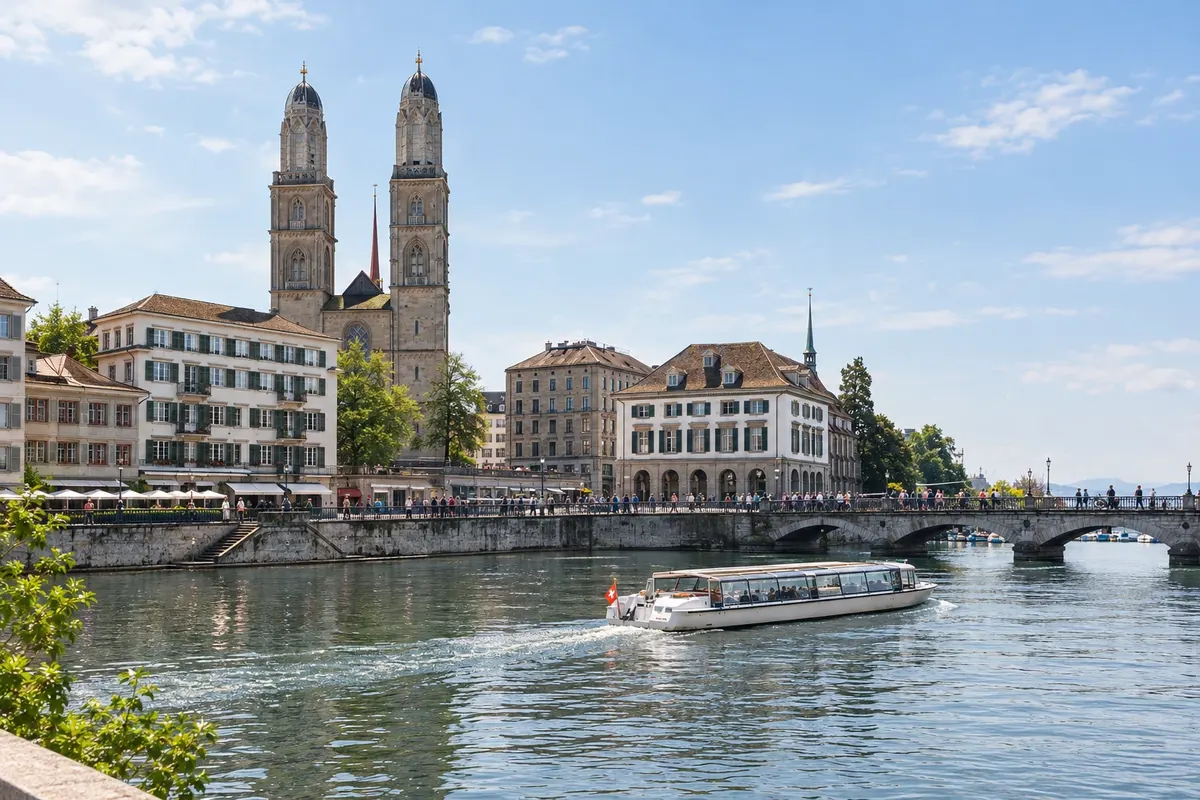
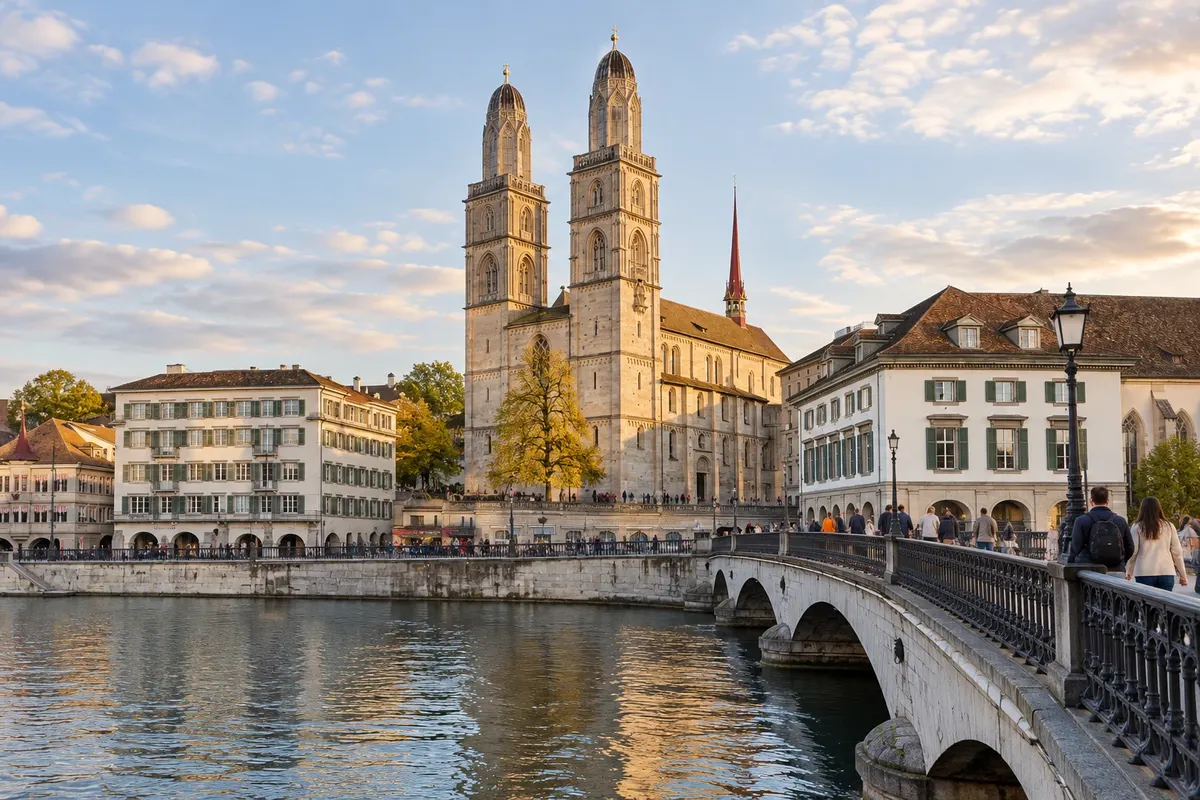
Na fotografiji: Rio Limmat and Grossmünster, Zurique

Illustrative images. The pictures in this guide are illustrations based on the real place, not photographs, and may differ from it.

Na voljo v trgovini Google Play Pošljite svoje fotografije

Spoznajte kraj

Pokrajina, ki jo doživite
v svojem ritmu.

Zurique is in the north of Suíça, where the Limmat River flows out of Lake Zurique, the Zürichsee.

The historic center spans both banks of the Limmat. On the right bank is the Niederdorf, with car-free streets, and the Grossmünster, from where Zwingli led the Reformation in the 16th century. On the left are the Fraumünster, with five stained-glass windows by Marc Chagall, the Lindenhof hill and the Bahnhofstrasse, the shopping street that runs from the station to the lake.

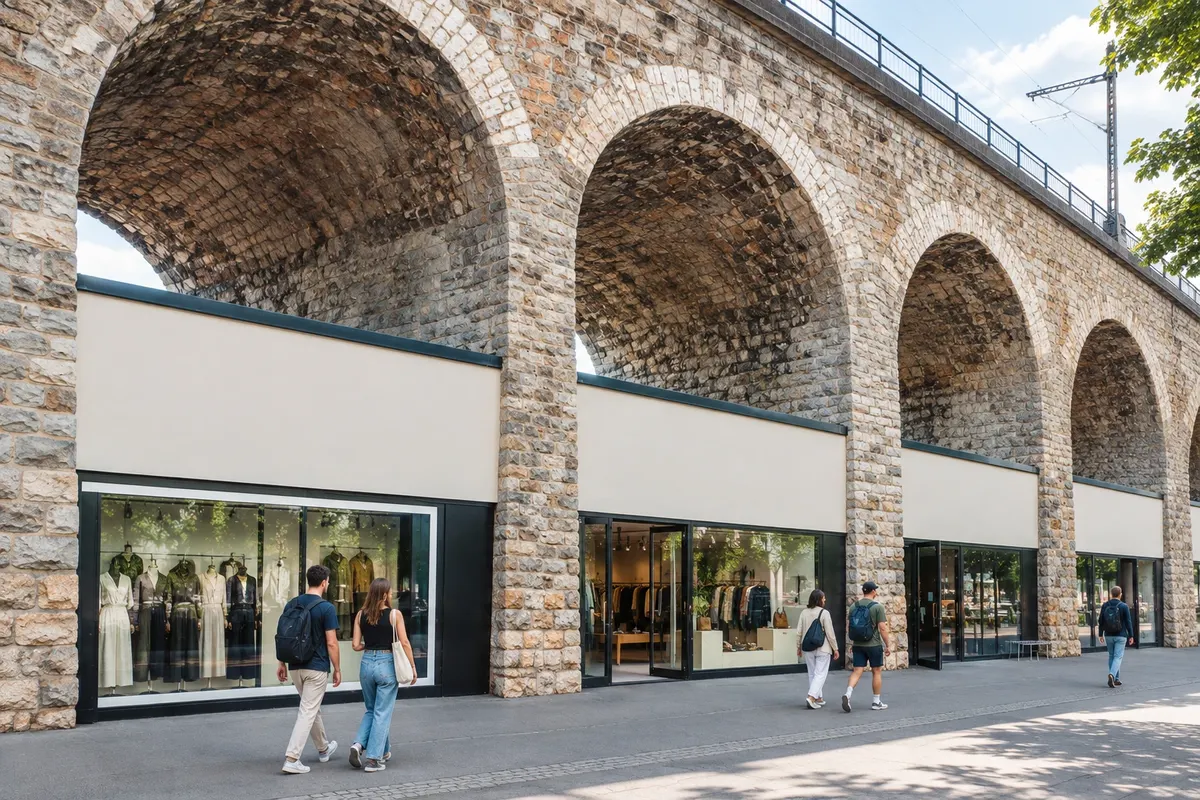
The city has museums for several days: the Landesmuseum Zürich, with the history of Suíça, the Kunsthaus, for art, the Museum Rietberg, with art from Asia, Africa, the Americas and Oceania, and the FIFA Museum, about football. In the former industrial district, Zürich-West, the arches of a railway viaduct became shops and a market.

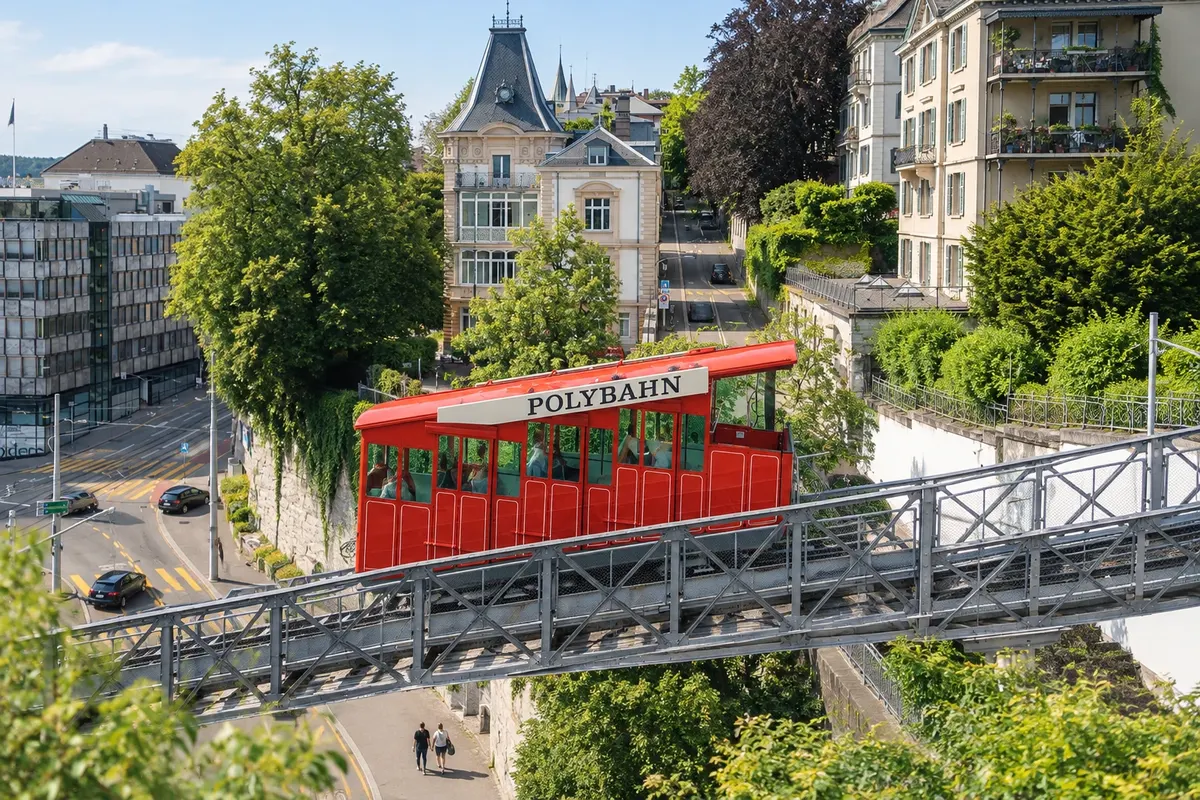
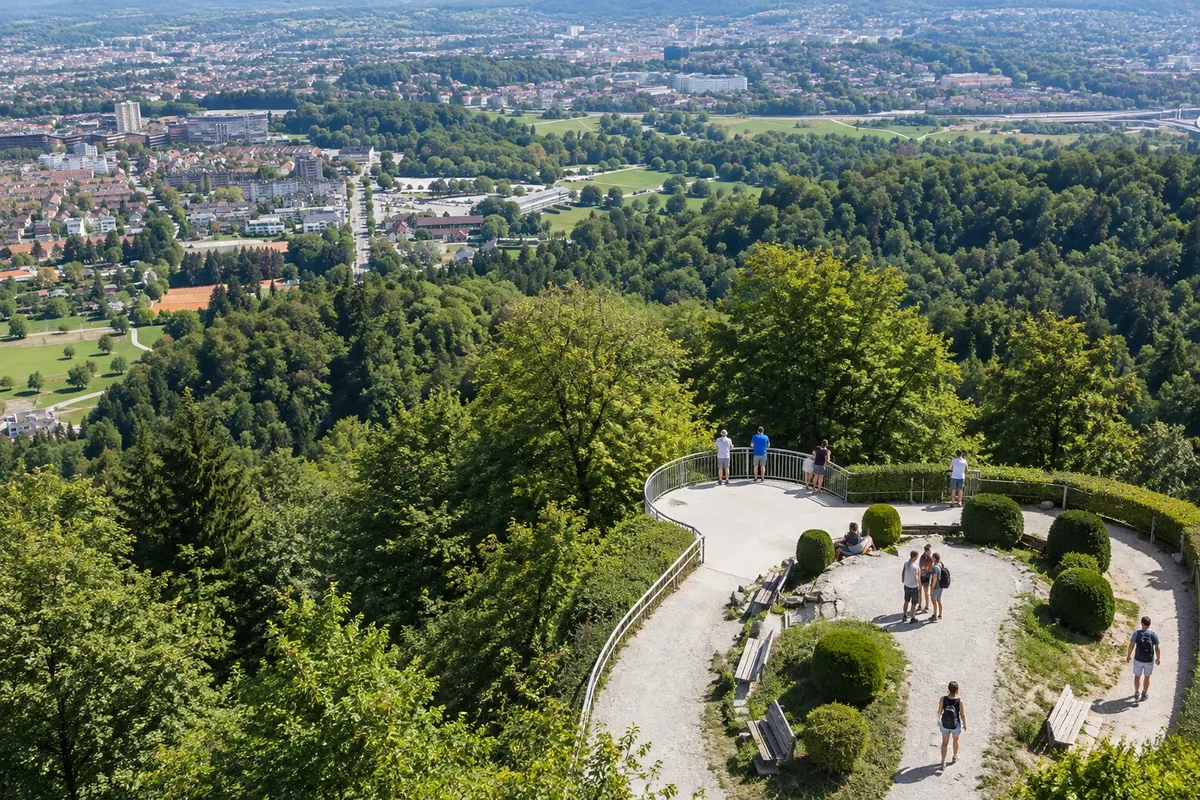
The lake has a waterfront for walking and boats that depart from the Bürkliplatz. Above the city, the Uetliberg, at 870 meters altitude, has a viewpoint with views of the lake and the Alps, and the Zoo Zürich occupies a slope of the Zürichberg. The Polybahn, a funicular from 1889, climbs up to the terrace of the ETH, the university where Einstein studied.

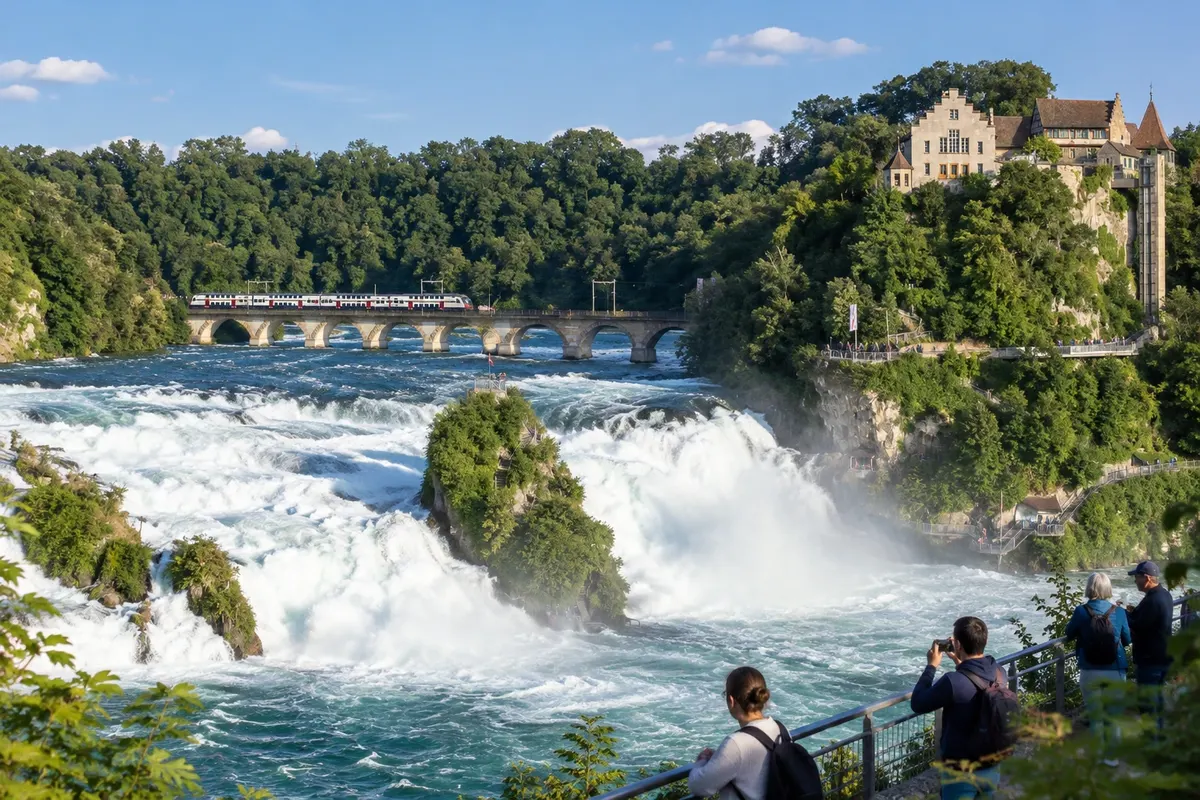
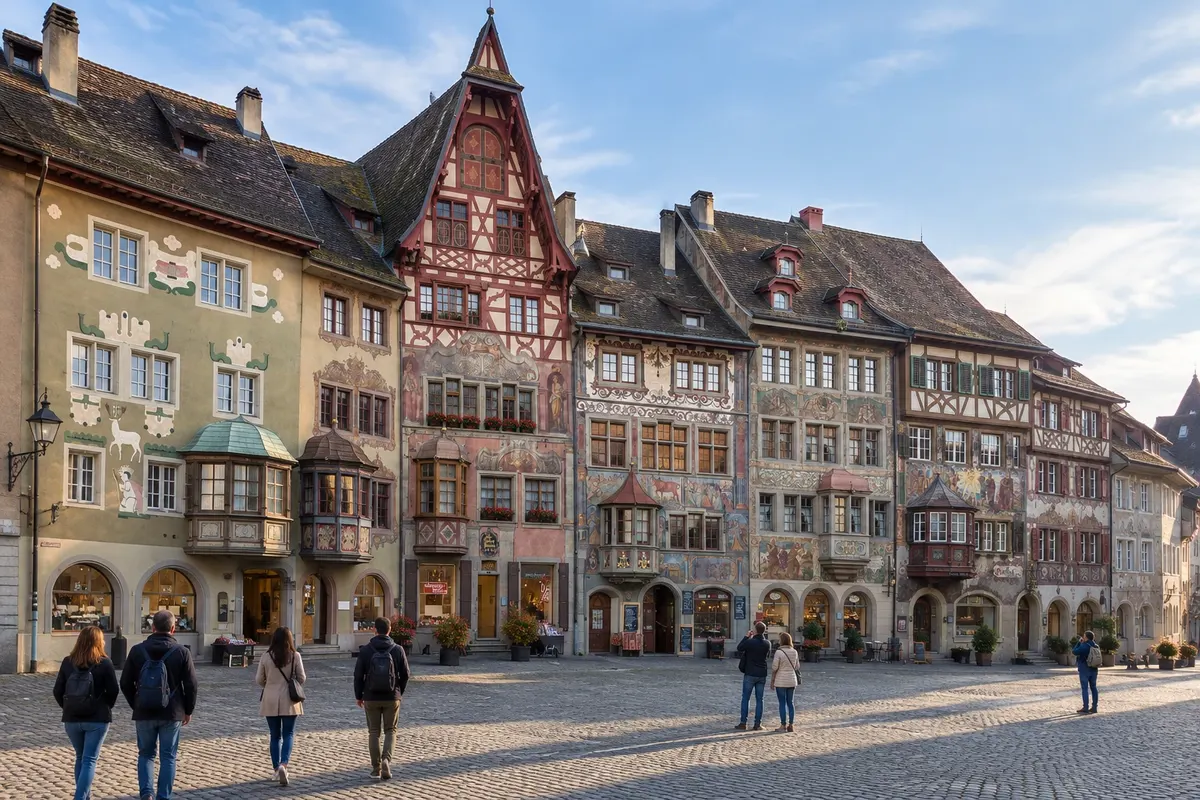
On a day trip, the Lindt Home of Chocolate factory is in Kilchberg, on the lakeshore. To the north, about an hour by train, are the Rheinfall, the Rhine waterfalls, and Stein am Rhein, a medieval village with painted façades.

This destination brings together 2 cities: Zurich, Zug.

Delite: WhatsApp
Delite svoja popotniška doživetja s fotografijami Pošljite fotografije vsakega kraja, ki ste ga obiskali. Največje število fotografij na kraj: 5.

Doživite kraj

Kaj početi – Zurich

Niederdorf
Zurich · Zurich · Staro mestno jedro

Niederdorf

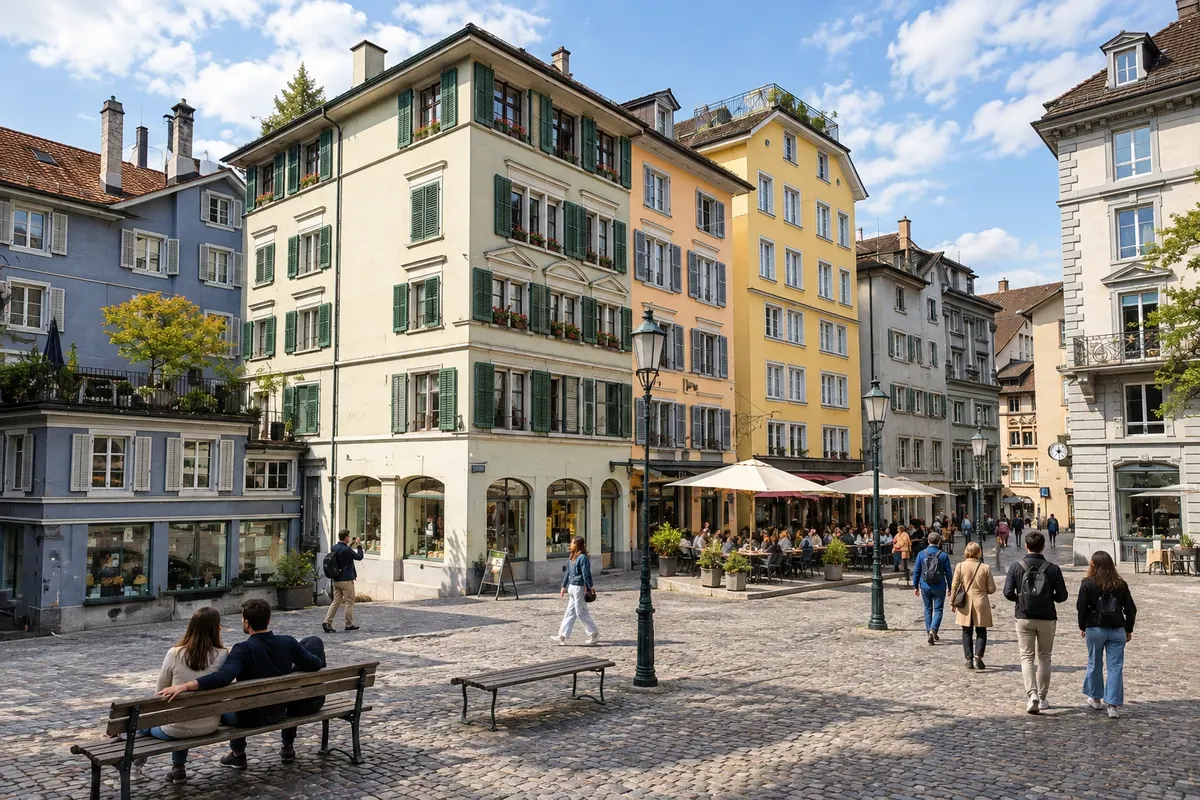
The part of the old town on the right bank of the Limmat, with the car-free Niederdorfstrasse, guild houses on the Limmatquai, the Rathaus and the Cabaret Voltaire, where the Dada movement was born.

Zytturm (Zug Clock Tower)
Zug · Zug · Tower

Zytturm (Zug Clock Tower)

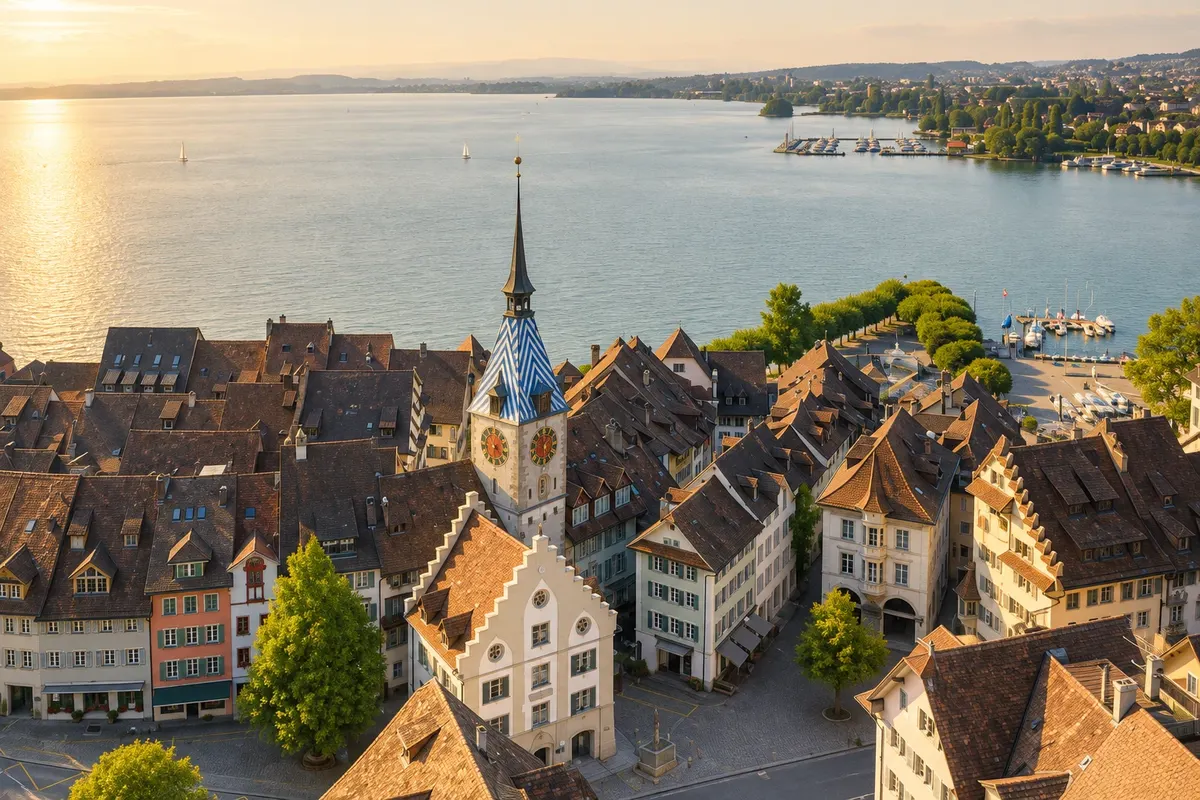
The historic center’s clock tower in Zug, 41.5 m tall with a blue-and-white roof, the city’s colors. It was part of the medieval wall and has an astronomical clock that shows the week, moon phases, the month and the leap year.

Lindenhof
Zurich · Zurich · Razgledišče

Lindenhof

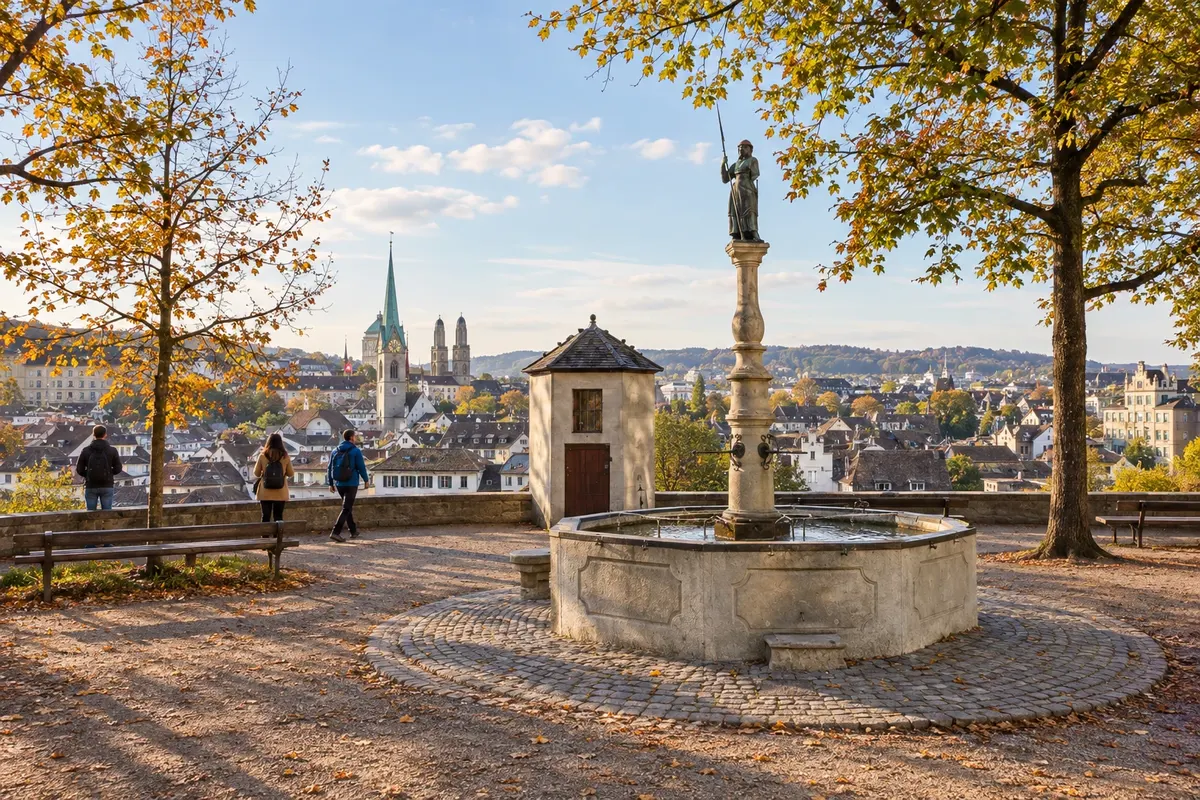
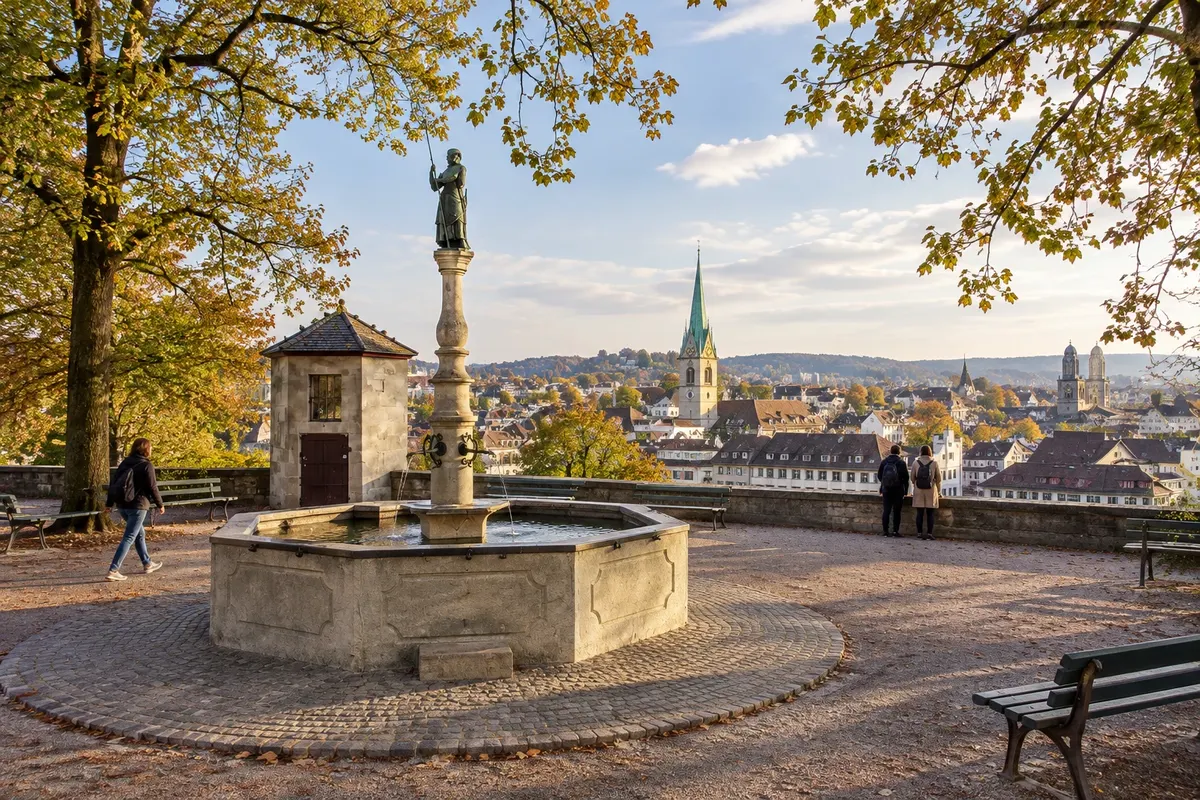
Tree-lined square atop a hill in the old town, where a Roman fort and a Carolingian palace once stood, with views over the Limmat, the Niederdorf and the ETH. Next to it are the church St. Peter and Augustinergasse.

Museum Burg Zug
Zug · Zug · Muzej

Museum Burg Zug

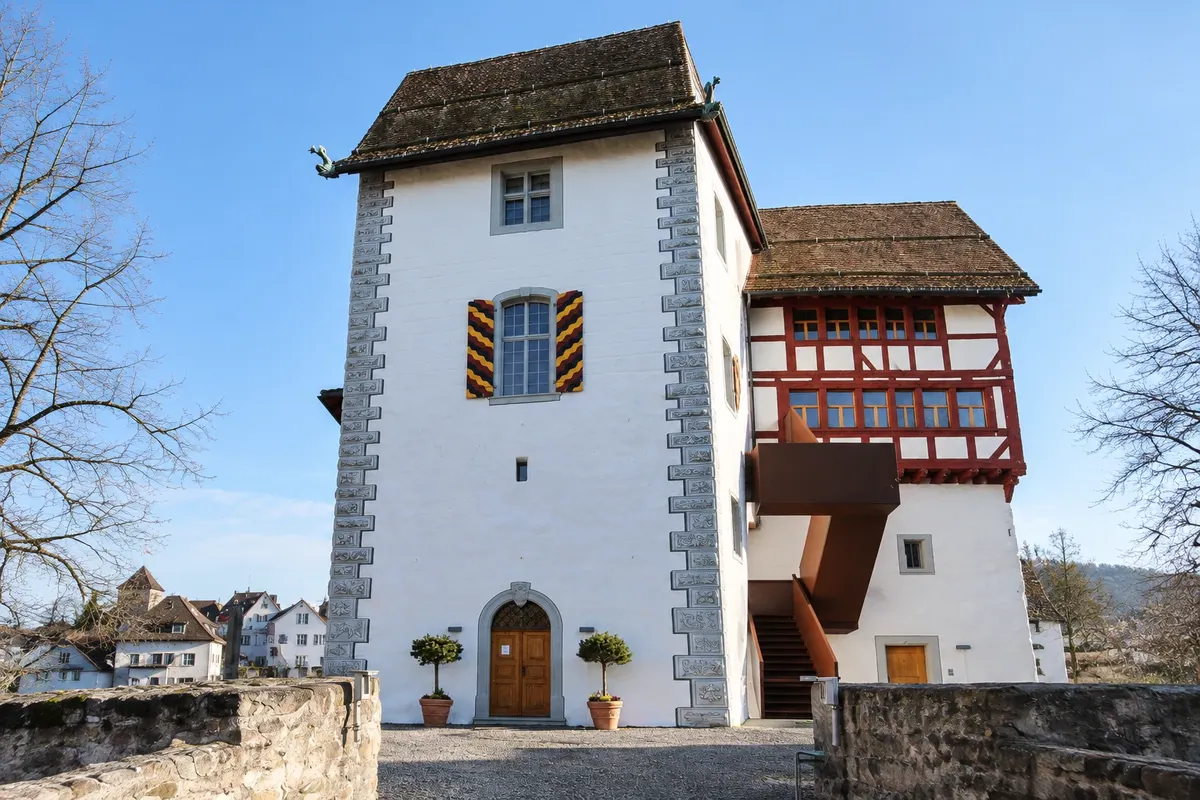
Medieval castle on the edge of Zug’s old town, with a stone tower and half-timbered wings, housing the city and cantonal cultural history museum.

Zurich – prikaži dodatne kraje (16)
Grossmünster
Zurich · Zurich · Cerkev

Grossmünster

The Romanesque twin-tower church that is a symbol of Zurique, from where Huldrych Zwingli led the Reformation. It has stained glass by Augusto Giacometti and Sigmar Polke, a crypt and the Karlsturm tower, which is climbed by 187 steps.

Mount Zug
Zug · Zug · Gora

Mount Zug

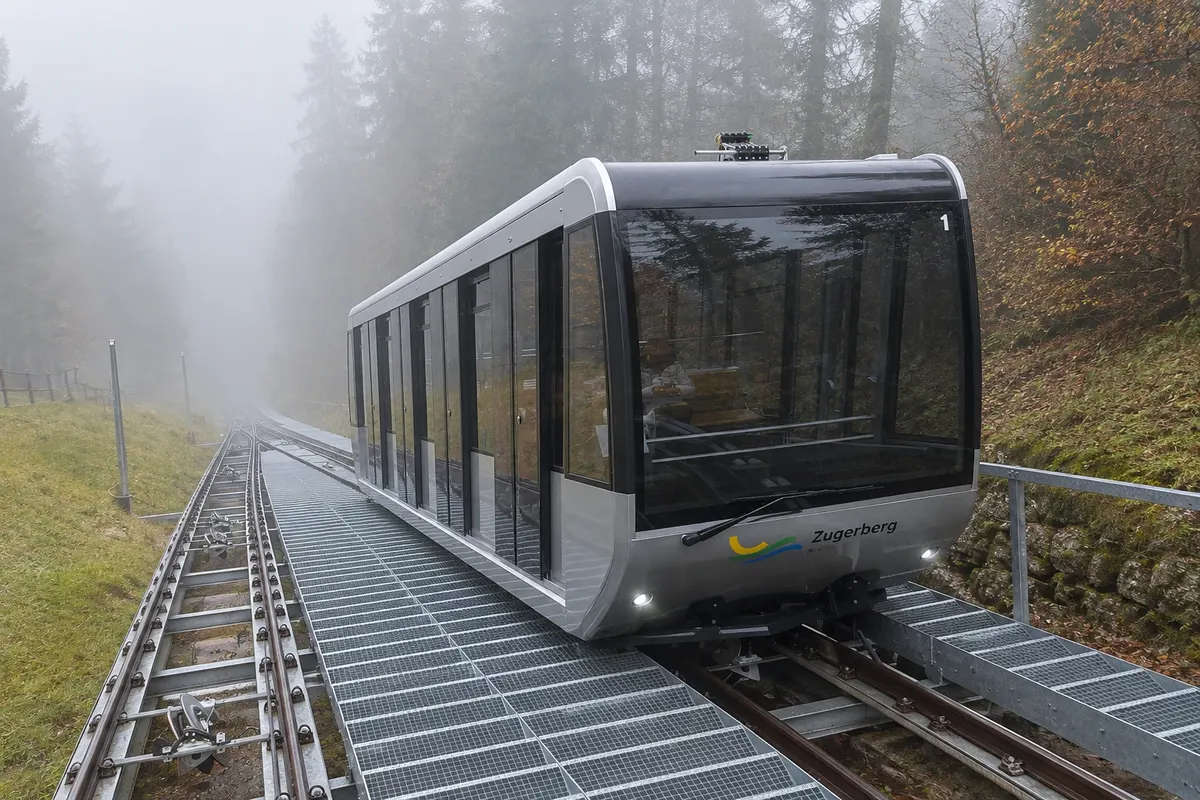
Mountain rising just above Zug, reached by funicular, with meadows, trails and views over Lake Zug, the town and the Alps.

Fraumünster
Zurich · Zurich · Cerkev

Fraumünster

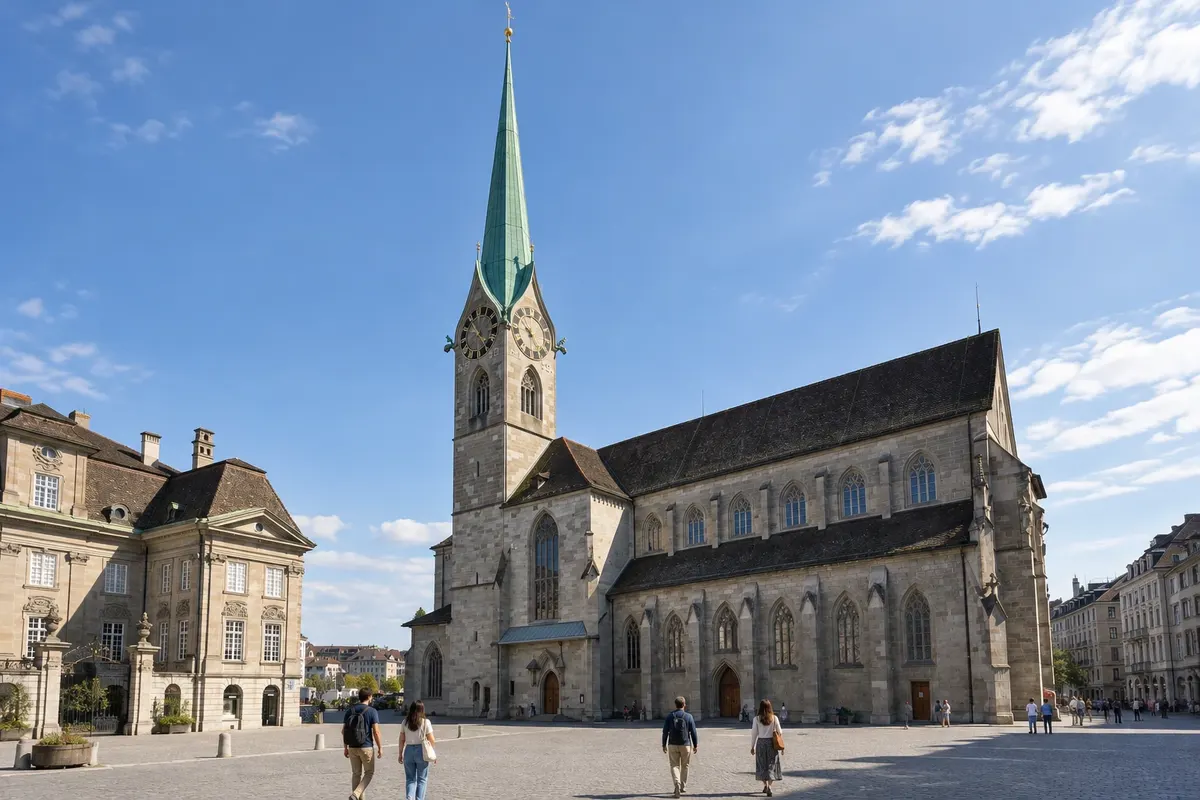
Church founded in 853 as an abbey for noble women, known for the five choir windows designed by Marc Chagall in 1970 and for the window by Augusto Giacometti. The crypt tells more than 1,200 years of history.

Bahnhofstrasse
Zurich · Zurich · Shopping street

Bahnhofstrasse

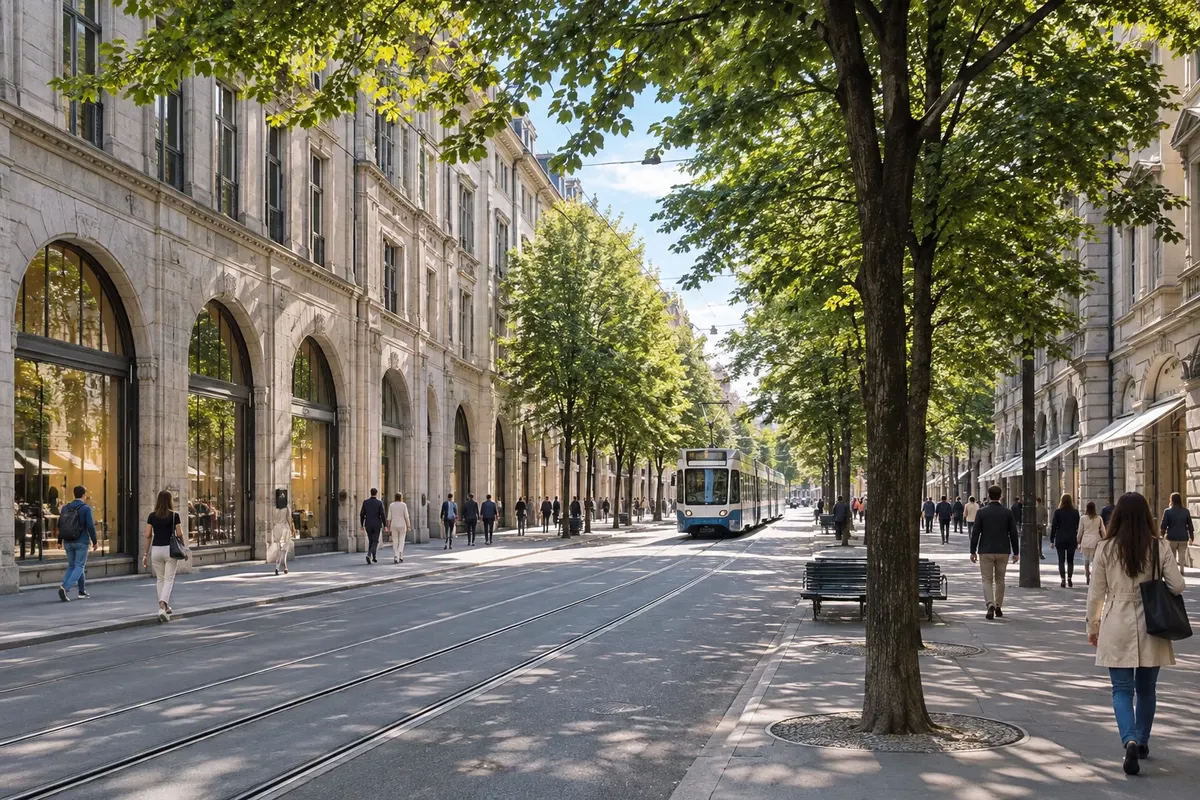
The pedestrian and tram street that connects the central station to the lake over 1.4 km, with department stores, jewellers, watchshops and Paradeplatz, the square of banks and the confectionery Sprüngli.

Lake Zurich
Zurich · Zurich · Jezero

Lake Zurich

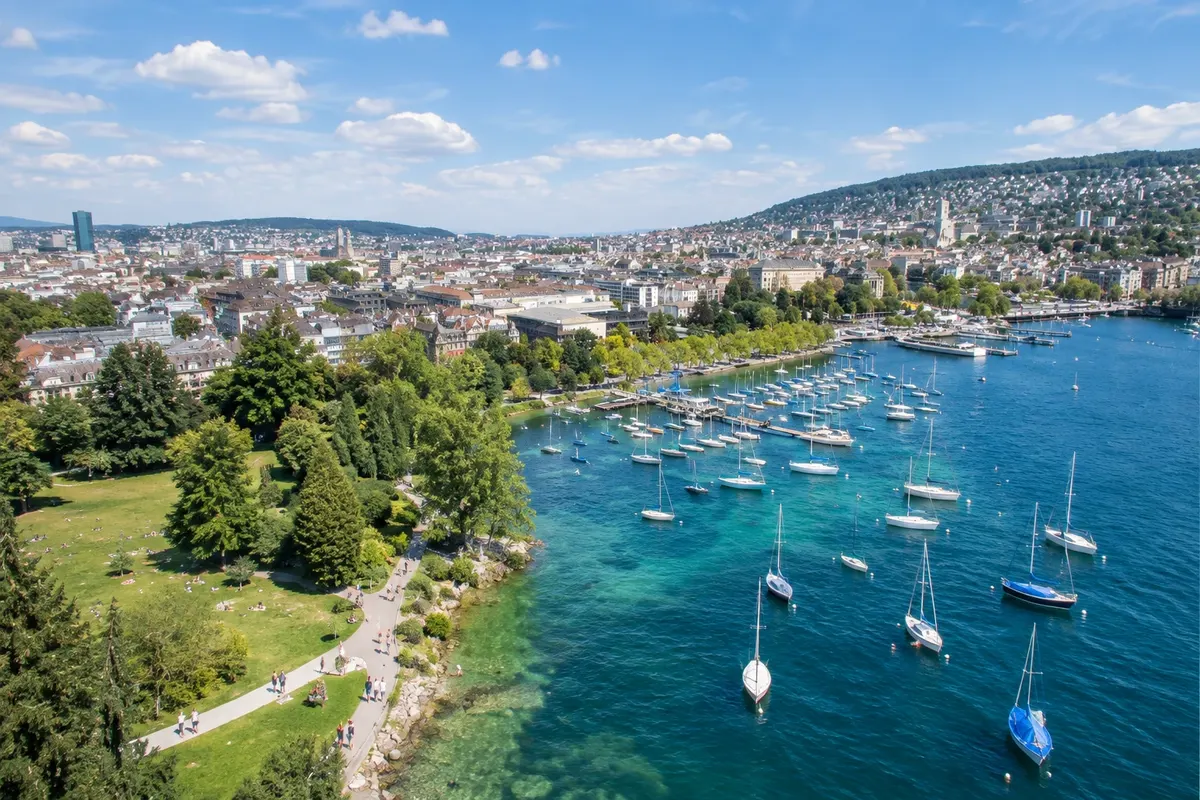
The lake at the southern tip of the city, with waterfront promenades, public pools in summer and ZSG boats that leave Bürkliplatz for one-hour cruises up to the crossing to Rapperswil.

Swiss National Museum
Zurich · Zurich · Muzej

Swiss National Museum

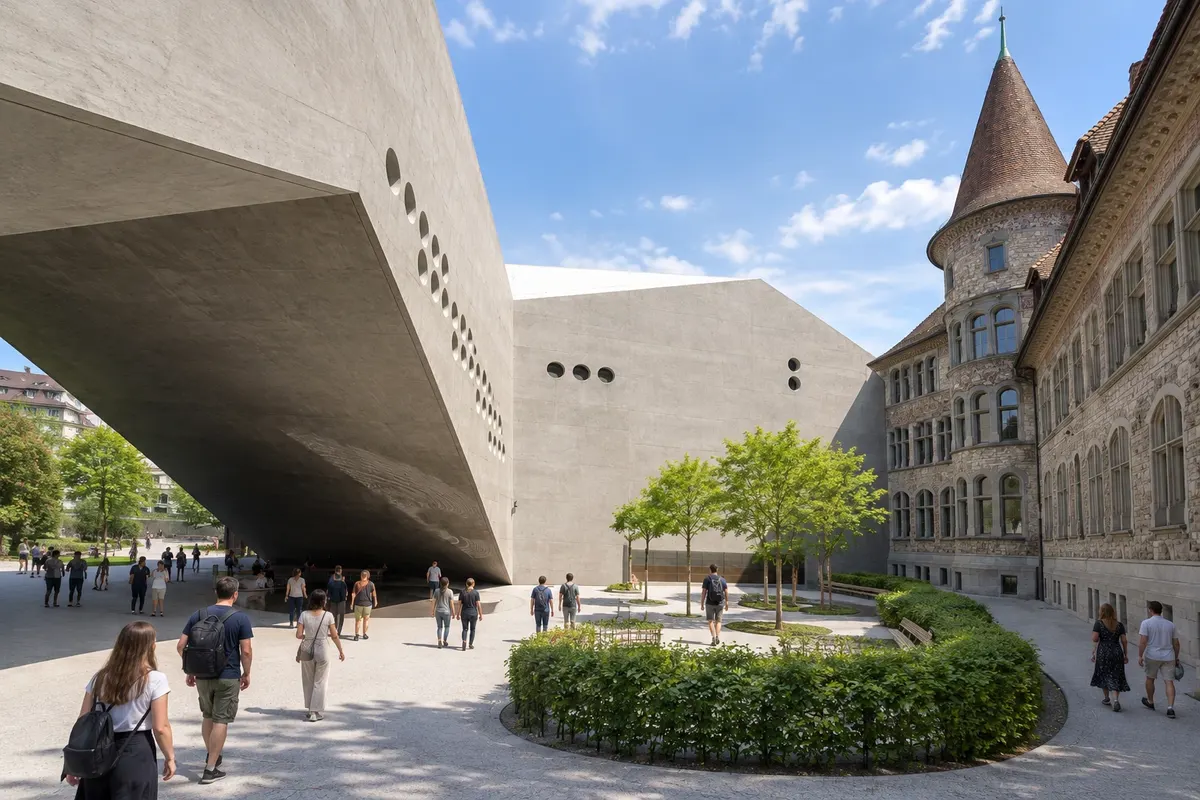
The Museu Nacional Suíço, housed in a 1898 castle-like building next to the central station, presenting the history of Suíça from prehistory to the present and a modern wing from 2016.

Kunsthaus Zürich
Zurich · Zurich · Muzej

Kunsthaus Zürich

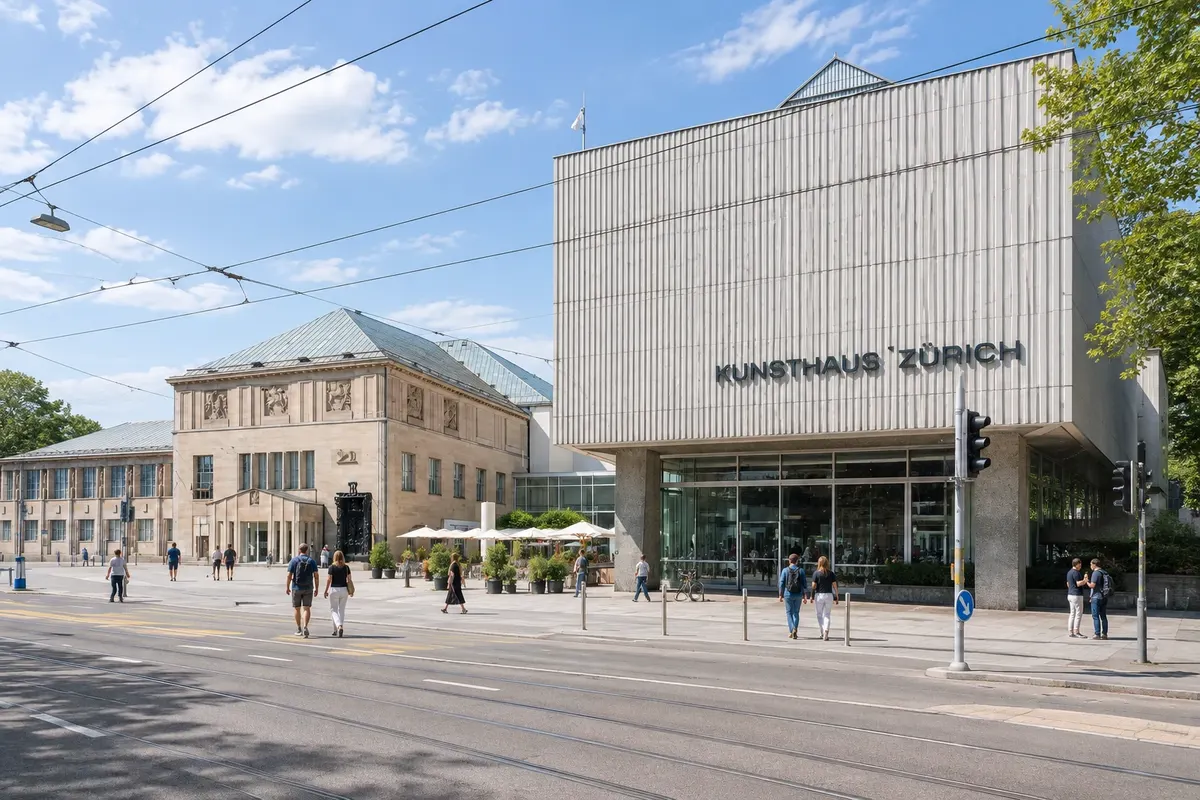
Art museum at Heimplatz, with works by Alberto Giacometti, Edvard Munch, Monet, Picasso, Van Gogh and the Swiss Ferdinand Hodler and Füssli, in two buildings linked by a tunnel: Karl Moser’s from 1910 and David Chipperfield’s from 2021.

FIFA Museum
Zurich · Zurich · Muzej

FIFA Museum

The FIFA football museum, opened in 2016 in Enge, with over a thousand objects from all men’s and women’s World Cups, the original World Cup trophy and interactive attractions across three floors.

Museum Rietberg
Zurich · Zurich · Muzej

Museum Rietberg

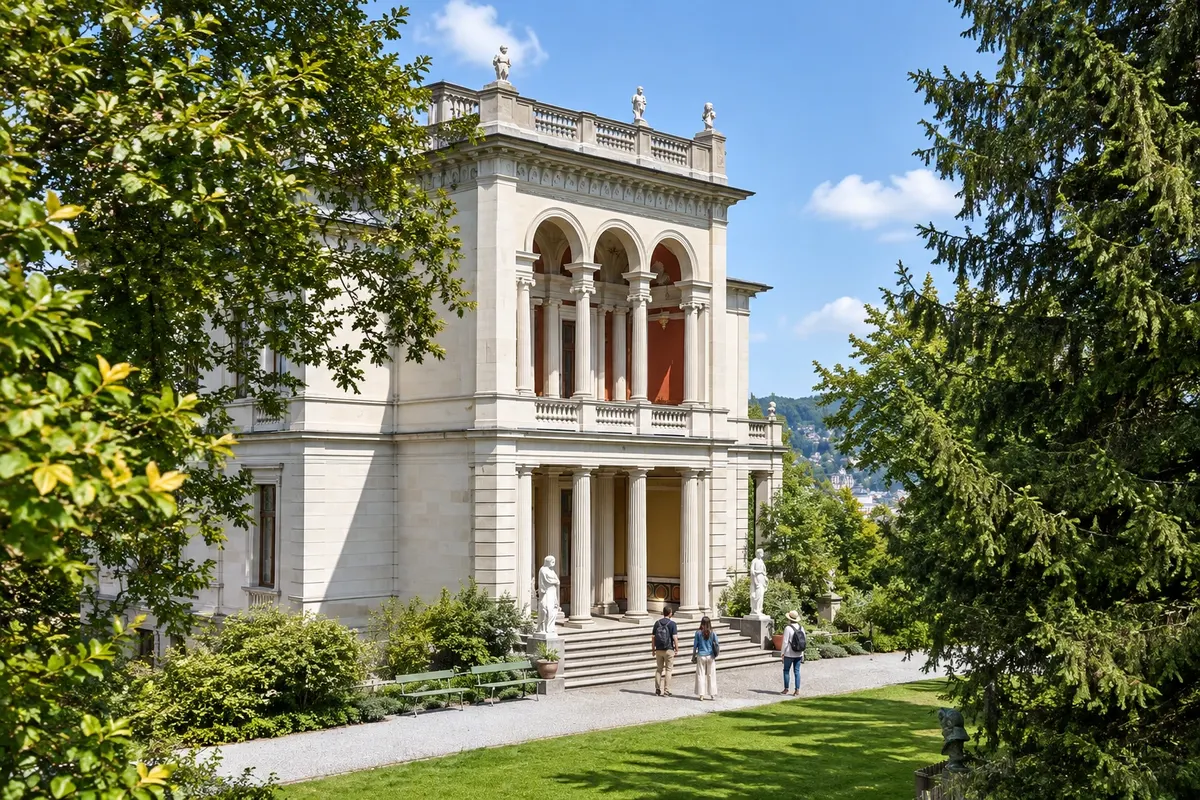
Museum of art from Asia, Africa, the Americas and Oceania, housed in the Villa Wesendonck and an underground pavilion within the Rieterpark, a park of old trees with views of the Glarus Alps on clear days.

Polybahn
Zurich · Zurich · Funicular and viewpoint

Polybahn

A red funicular from 1889 that climbs in about 100 seconds from Central up to the Polyterrasse, the terrace in front of ETH’s main building, with views over the old town roofs, the Limmat and the lake.

Uetliberg
Zurich · Zurich · Mountain and viewpoint

Uetliberg

The city’s mountain, at 870 meters altitude, about 20 minutes by train from Zürich HB, with a lookout tower over the city, the lake and the Alps, and the Planetenweg trail to the Felsenegg.

Zurich Zoo
Zurich · Zurich · Zoo

Zurich Zoo

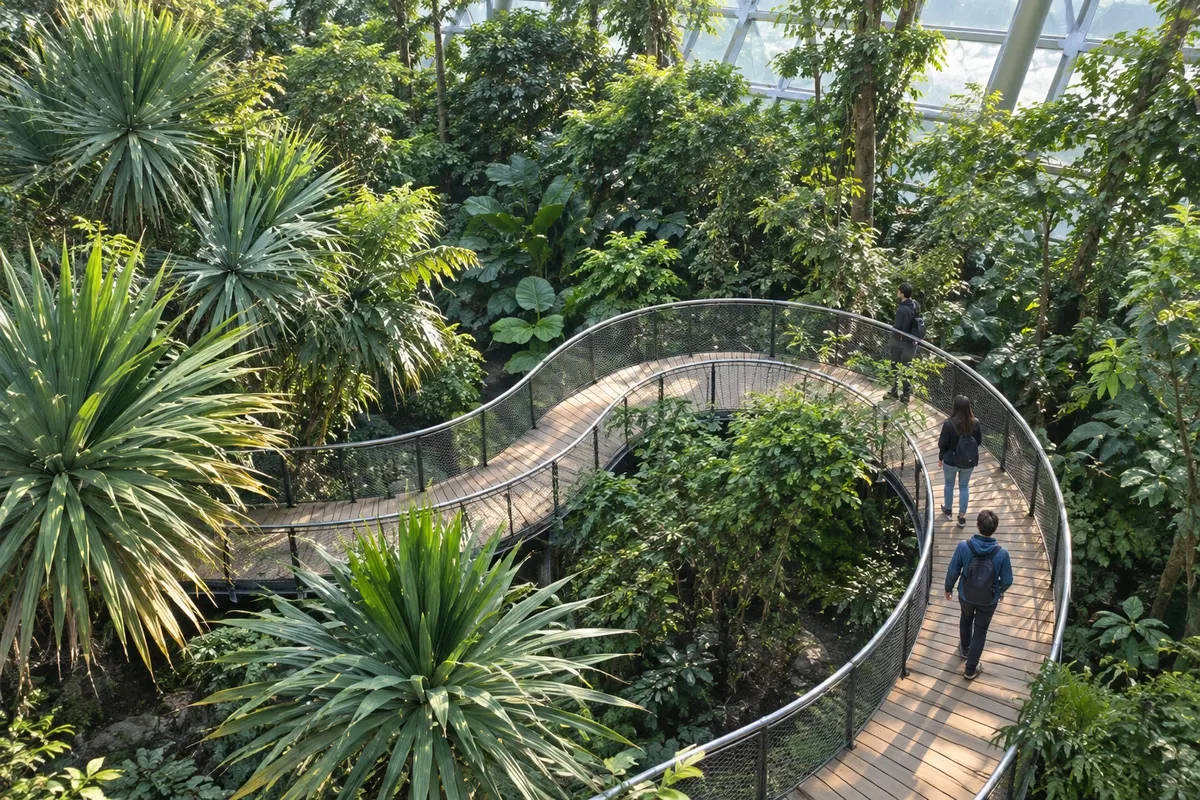
A 27-hectare zoo on the Zürichberg, opened in 1929, featuring the Madagascar rainforest in a greenhouse (Masoala), the Lewa savanna with rhinos and giraffes, and an Asian elephant park.

Lindt Home of Chocolate
Zurich · Zurich · Muzej

Lindt Home of Chocolate

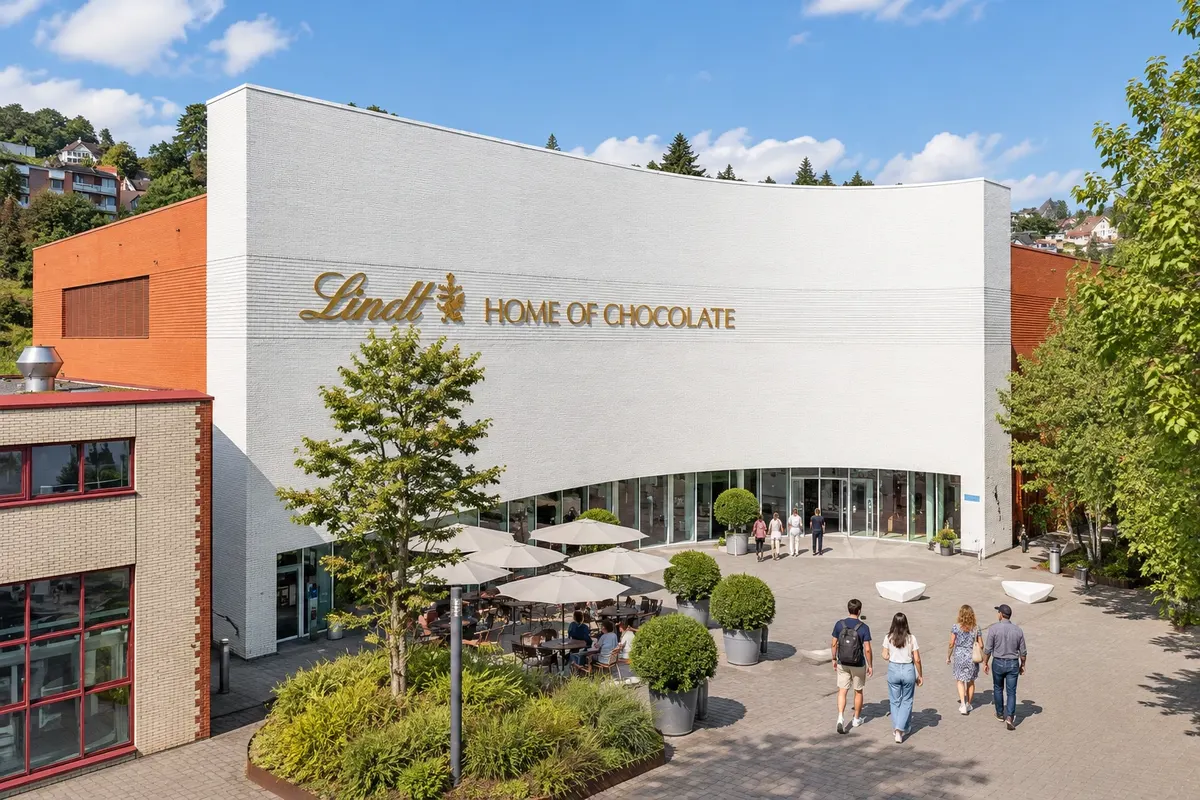
Lindt & Sprüngli chocolate museum in Kilchberg, on the lakeside, about 20 minutes from Zurique, with a chocolate fountain over 9 metres high, tastings, a pilot factory, courses, a café and a shop.

Zürich-West
Zurich · Zurich · Neighborhood

Zürich-West

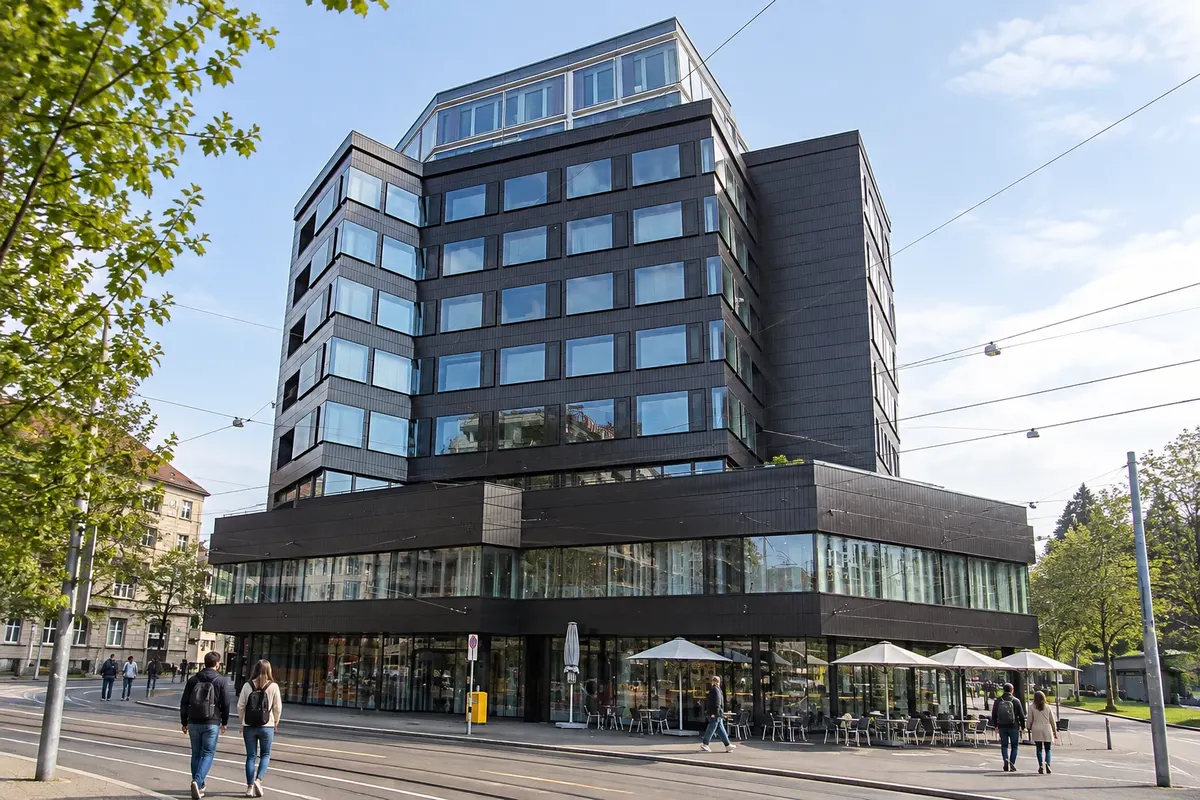
Former industrial neighbourhood turned into an area of art, design and nightlife, with shops and a market under the arches of the Im Viadukt viaduct, Freitag's container tower, the Prime Tower and the Löwenbräukunst art centre.

Rhine Falls
Zurich · Zurich · Slap

Rhine Falls

The Rhine Falls, in Neuhausen am Rheinfall, about an hour by train from Zurique: 150 metres wide and 23 metres high, with viewpoints at Schloss Laufen and boats to the rock in the middle of the falls.

Stein am Rhein
Zurich · Zurich · Historic town

Stein am Rhein

Medieval town on the banks of the Rhine, where it flows out of Lake Constance, with the Rathausplatz surrounded by half-timbered houses and painted façades, the museum of the former monastery of São Jorge and Hohenklingen castle above.

Kaj izbrati pred odhodom

Izleti – Zurich

Izhodišče, trajanje, potek, vključene storitve in okvirna cena vsakega izleta.

Zürich old town: Lindenhof, St. Peter and the Niederdorf on foot

Odhod: Zürich HB (main station) Peš po starem mestnem jedru Približno 3 ure Dopoldne ali popoldne Lahka, z nekaj kratkimi vzponi

Zürich’s old town (Altstadt) lies on both sides of the river Limmat, a few minutes’ walk from the main station (Hauptbahnhof, or HB). On the left bank, climb up to the Lindenhof, a tree-lined square on top of a hill where a Roman fort stood in the 4th century and, in the 9th century, a palace built by a grandson of Charlemagne. From the wall you can see the river, the Grossmünster, the town hall (Rathaus), the university and the ETH (federal polytechnic). People often play chess on large boards in the square. Coming down, you reach St. Peter’s church, known for the clock face on its tower, about 9 meters in diameter. Cross the Limmat to the right bank and enter the Niederdorf, the neighborhood of narrow streets along Niederdorfstrasse, full of shops, cafés and bars; at night it is one of the city’s nightlife areas. On Spiegelgasse is the Cabaret Voltaire, where the Dada movement began in 1916; Lenin lived on the same street. To finish, take the Polybahn, the rack railway from 1889 that climbs from Central to the Polyterrasse in under two minutes: from the terrace in front of the ETH you get views of the old town and the lake.

Kraji na poti: Lindenhof, Niederdorf, Polybahn, Bahnhofstrasse.

Vključuje: Self-guided walk: the streets and the Lindenhof are open and there is no entrance fee. The Polybahn has its own ticket; the regular city transport ticket and the Zürich Card are also valid. There are paid guided tours available separately, departing from the center.

Nasvet: Begin at Lindenhof in the morning, with the light over the river, and save Niederdorf for late afternoon when the streets fill up. Wear comfortable shoes: there is stone paving and stairs. Combine this walk with the Fraumünster and Grossmünster churches, which are along the way.

Najboljši čas za obisk: All year. From May to September the days are long and there are sidewalk tables; in December there are decorations and Christmas markets.

Fraumünster and Grossmünster: Chagall’s stained glass and the Karlsturm tower

Odhod: Zürich old town On foot, on both sides of the Limmat Približno 2 uri Dopoldne ali popoldne easy (187 steps in the tower)

The two churches face each other on opposite sides of the Limmat, connected by the Münsterbrücke. The Fraumünster, on the left bank, was founded in 853 by King Louis the German as a women’s abbey. The main reason to visit is Marc Chagall’s stained glass: a set of five windows in the choir from the 1970s, plus a rose window in the south transept. The north transept contains stained glass by Augusto Giacometti. A visit to the church takes about 30–40 minutes. Across the river, the Grossmünster, with its two towers that define Zürich’s skyline, was traditionally built over the tombs of Félix and Régula, the city’s patron saints. It was Zwingli’s church during the Reformation; the cloister houses a Reformation museum. Inside there is a Romanesque crypt, Augusto Giacometti stained glass in the choir and Sigmar Polke windows. In the south tower, the Karlsturm, 187 steps lead to a room with six large windows overlooking the old town and the lake; at the top of the tower stands a statue of Charlemagne.

Kraji na poti: Fraumünster, Grossmünster.

Vključuje: There is admission to enter the Fraumünster and to climb the Grossmünster tower; children and students pay reduced or no fare, and the Zürich Card grants entry. The Grossmünster nave is open for visiting. Check the current pricing table.

Nasvet: Both churches hold services and concerts, and tourist visits are suspended at those times, especially Sunday morning. The Fraumünster’s stained glass looks more vivid in sunlight. Do not climb the tower while carrying small children in your arms: the staircase is narrow.

Najboljši čas za obisk: All year. On sunny days the stained glass is seen best; in winter the late-afternoon light arrives early.

Bahnhofstrasse and Paradeplatz to the lakefront

Odhod: Zürich HB (main station) On foot or by tram along Bahnhofstrasse about 1 to 2 hours Dopoldne ali popoldne Lahka, ravna pot

Bahnhofstrasse is the shopping street that links the main station to the Zürichsee (Lake Zurich), about 1.4 km and almost entirely flat. Only trams, pedestrians and bicycles use the street. Near the station you’ll find department stores and international brands; closer to the lake are watchmakers, jewelers and luxury boutiques. Midway is Paradeplatz, the square of the major Swiss banks, with traditional pastry shops around it. From Paradeplatz a side street leads in a few minutes to Fraumünster and Münsterhof. At the end the street opens onto Bürkliplatz on the lakefront: ZSG boats depart from there, and the lakeside promenade continues both ways, with lake views and, on a clear day, the Alps in the distance. To return, trams run along Bahnhofstrasse back to the station.

Kraji na poti: Bahnhofstrasse, Zürichsee.

Vključuje: The street is open; there is no admission. Shopping and cafés are paid separately.

Nasvet: Even if you don’t buy anything, the walk links the station, the Old Town and the lake. Most shops are closed on Sundays; plan shopping for other days.

Najboljši čas za obisk: Year round. In December the street is usually decorated with Christmas lights.

Boat on the Zürichsee and on the Limmat River

Odhod: Bürkliplatz or Landesmuseum, in Zürich ZSG scheduled boat from 1 to 4½ hours Dopoldne ali popoldne Lahko

The Zürichsee (Lake Zurich) is the fifth largest lake in Switzerland and stretches southeast of the city, between the cantons of Zurich, St. Gallen and Schwyz. ZSG (Zürichsee-Schifffahrtsgesellschaft) boats depart from Bürkliplatz, at the end of Bahnhofstrasse, and run cruises of varying lengths: the short round takes about 1 hour; the small round about 1 hour 30 minutes; and the large round about 4 hours 30 minutes, reaching Rapperswil and returning. From the boat you can see the villages along the shores, the slopes with vineyards and, on a clear day, the Alps to the south. One of the stops is Kilchberg, for the Lindt Home of Chocolate. There is also the river boat: the Limmat cruise leaves from the Landesmuseum, passes under the old town bridges and continues to the Zürichhorn on the lake, in low boats with glass roofs; the full round takes about 55 minutes.

Kraji na poti: Zürichsee, Lindt Home of Chocolate, Landesmuseum Zürich.

Vključuje: Boat fare, paid separately; scheduled boats accept public transport tickets and passes depending on the section. The Zürich Card is valid on Limmat boats and on short lake trips. Check the current fare table.

Nasvet: To see the lake at a relaxed pace, take the boat to Rapperswil and return by train. Limmat boats have no reservations and limited capacity: in summer, arrive early at the Landesmuseum.

Najboljši čas za obisk: From spring to autumn, when there are more departures. The Limmat boat typically runs from late March to October.

Landesmuseum Zürich (Swiss National Museum)

Odhod: Zürich HB (main station) On foot, behind the station about 2 to 3 hours Dopoldne ali popoldne Lahko

The Landesmuseum Zürich, part of the Swiss National Museum, is located right behind the main station, a one-minute walk away. The original building, designed by Gustav Gull in a historicist style, resembles a fairy-tale castle with towers and an inner courtyard; in the courtyard, a modern wing contrasts with the old part. The permanent exhibition History of Switzerland tells the story of the country’s formation, from the earliest inhabitants to the present day, and helps you understand what you will see in the other cantons. On the upper floor of the historic building, the Simply Zurich exhibition covers the city and the canton of Zurich. There are always temporary exhibitions, and audio guides are available in several languages. The inner courtyard often hosts concerts and events in summer.

Kraji na poti: Landesmuseum Zürich.

Vključuje: There is admission for exhibitions, with discounts and free entry for children depending on age; the Simply Zurich exhibition is free. The Zürich Card provides entry. Check the current schedule.

Nasvet: The museum is closed on Mondays. It’s a good option for a rainy day or for the day you arrive, since it’s next to the station. The Limmat boat departs in front of the museum.

Najboljši čas za obisk: Year-round; on rainy or cold days.

Kunsthaus Zürich (art museum)

Odhod: Zürich city centre (Heimplatz) On foot or by tram to Heimplatz about 2 to 3 hours Dopoldne ali popoldne Lahko

The Kunsthaus Zürich, on Heimplatz and a few minutes’ walk from the Grossmünster, is the largest art museum in Switzerland. The collection ranges from the Middle Ages to contemporary art and occupies two buildings on either side of the square: the historic building and the new wing designed by architect David Chipperfield. Highlights include the largest collection of Edvard Munch outside Norway, a large Alberto Giacometti collection, old masters, Swiss painters, Impressionists, works by Picasso, Van Gogh and Chagall, and postwar art featuring Warhol, Rothko and Beuys. The new wing houses private collections, including Emil Bührle’s, and an installation by Pipilotti Rist. Allow two to three hours to see the essentials.

Kraji na poti: Kunsthaus Zürich.

Vključuje: There is an admission fee, with different prices for the permanent collection and for temporary exhibitions; the Zürich Card grants entry or a discount. Check the current schedule.

Nasvet: The museum is closed on Mondays and stays open later on Thursdays. Combine it with the Grossmünster and the Polybahn, which are nearby. Large backpacks go in the cloakroom.

Najboljši čas za obisk: Year-round; on rainy or cold days.

Prikaži dodatne izlete (11)

Uetliberg and the panoramic trail to Felsenegg

Odhod: Zürich HB (main station) S10 train to Uetliberg; cable car and train on the return Približno 4 ure Dopoldne ali popoldne easy (6 km walk)

Uetliberg is Zürich’s mountain, at 871 m elevation, on the city’s western edge. You reach it on the S10 train of the Uetlibergbahn in about half an hour from the center; from the upper station a short climb leads to the top, Uto Kulm. There is a 72-meter observation tower: from there you can see the city, the whole lake, and on a clear day the Alps. If you have time, follow the panoramic ridge trail, the Planetenweg, with panels about the solar system along the route: it’s 6 km, roughly 1 hour 40 minutes of easy walking to Felsenegg, where there is a restaurant with a terrace. From Felsenegg a cable car descends to Adliswil, and from there the suburban train (S-Bahn) returns to Zürich. If you don’t want to walk you can go up, enjoy the view, and return on the same train.

Kraji na poti: Uetliberg.

Vključuje: Train and cable car tickets, paid separately; the Zürich transport ticket covers the section according to the zones. The trail and the viewpoint have no entrance fee. Check the current transport timetable.

Nasvet: Go up in the late afternoon to see the sunset over the city. In winter the city is often in fog while the summit is sunny; but this is not guaranteed. The Felsenegg cable car stops for maintenance for some weeks each year; confirm.

Najboljši čas za obisk: The hike to Felsenegg is recommended from March to November. The Uto Kulm viewpoint is worth visiting year-round.

Lindt Home of Chocolate, in Kilchberg

Odhod: Zürich (Bürkliplatz or Zürich HB) Train S8 or S24, bus 165 or boat Približno 3 ure Dopoldne ali popoldne Lahko

The Lindt Home of Chocolate is in Kilchberg, on the west shore of the Zürichsee, next to the Lindt & Sprüngli factory, about 20 minutes from central Zurich. At the entrance there is a chocolate fountain over 9 meters high, through which 1,500 kg of chocolate flow. The interactive museum tells the story of cacao, the Swiss chocolate pioneers, and demonstrates, via a pilot factory, how chocolate is made; tastings are offered throughout the visit. There is also the Chocolateria, where you can make your own chocolate with a chocolatier, and a large shop. How to get there: train S8 or S24 to Kilchberg ZH station and about a 10‑minute walk; bus 165 from Bürkliplatz to the Lindt & Sprüngli stop; or ZSG boat from Bürkliplatz to Kilchberg stop, then a 10‑minute walk.

Kraji na poti: Lindt Home of Chocolate.

Vključuje: There are timed-entry tickets; the course at the Chocolateria is charged separately. Check the current price list.

Nasvet: Buy your ticket in advance: time slots often sell out, even on weekdays. Going by boat and returning by train turns the visit into a lake cruise.

Najboljši čas za obisk: Year‑round. In the summer season there are more boats to Kilchberg.

Zürich-West: the industrial quarter that became a design district

Odhod: Zürich HB (main station) Tram or train to Hardbrücke or Escher-Wyss-Platz Približno 3 ure Popoldne Lahko

Zürich-West is the former industrial quarter about 2 km west of the main station. The factories left and the warehouses became shops, restaurants, theaters and art spaces. The walk starts at Im Viadukt, where the arches of a railway viaduct house design shops and an indoor food market. Nearby is the flagship Freitag store, a brand of bags made from truck tarpaulins, and Frau Gerolds Garten, an urban garden with a bar and outdoor restaurant. Across the Hardbrücke bridge rises the Prime Tower, 126 meters high, which was once Switzerland’s tallest building. The Schiffbau, a former shipyard, houses a theater, restaurants and a jazz club; the Lichthalle Maag hosts events. At night the neighborhood concentrates bars and live-music venues.

Kraji na poti: Zürich-West.

Vključuje: Free walk through the streets; there is no ticket. Food, shopping and shows are paid separately.

Nasvet: Go late in the afternoon and stay for dinner. Frau Gerolds Garten operates mainly in the summer season; in winter, Im Viadukt and the covered market are the main attractions.

Najboljši čas za obisk: From May to September, with outdoor seating; year-round for the market and the shops.

Zoo Zürich and the Masoala tropical rainforest

Odhod: Zürich city center Tram to Zürichberg Približno 4 ure a full day or morning easy (little walking)

Zoo Zürich is on the Zürichberg, the hill in the Fluntern neighborhood, about 3 km from the main station, occupying 27 hectares with around 6,000 animals of more than 365 species. The Masoala Regenwald is a huge greenhouse that recreates Madagascar’s tropical rainforest, with lizards, turtles, snakes and free birds among the plants. The Kaeng Krachan Elefantenpark houses Asian elephants, and there are presentations showing them swimming. The Lewa Savanne, the largest enclosure, has white rhinoceroses, giraffes and Grevy’s zebras.

Kraji na poti: Zoo Zürich.

Vključuje: There is an admission fee, with rates for adults and children. Food is paid separately. Check the current price list.

Nasvet: A good option with children and for a cloudy day: the Masoala greenhouse is warm and humid, so dress in layers. Arrive early to see the animals at their most active.

Najboljši čas za obisk: Year-round. From March to October Masoala stays open later.

Enge: Museum Rietberg and FIFA Museum

Odhod: Zürich Enge (neighborhood and station) Tram or train to Enge; on foot between the two Približno 4 ure Dopoldne ali popoldne Lahko

Two different museums are located in the Enge neighborhood, near the lake’s west shore. The Museum Rietberg is Switzerland’s largest museum dedicated to non-European cultures: over 23,000 objects from Asia, Africa, the Americas and Oceania, with highlights including Indian miniature painting, Himalayan Buddhist art and Chinese ceramics. The museum occupies historic villas plus an underground extension, the Smaragd, within the 67,000 m² Rieterpark, open year-round. In one villa, Villa Wesendonck, Richard Wagner wrote Tristan und Isolde; the former winter garden is now a café. The FIFA Museum, at Tessinerplatz next to Zürich Enge station, tells the story of football and the World Cups; the original World Cup trophy is on display, and there is a games area to test ball skills.

Kraji na poti: Museum Rietberg, FIFA Museum.

Vključuje: The two museums have separate admission; Rieterpark does not charge an entrance fee. Check the current pricing table.

Nasvet: The Rietberg is closed on Mondays and stays open later on Thursdays. Both are in the same neighborhood: you can combine them with a walk along the lakeshore.

Najboljši čas za obisk: All year; Rieterpark is more rewarding from spring through autumn.

Day trip to the Rheinfall (Rhine Falls) and Stein am Rhein

Odhod: Zürich HB (main station) SBB train (S12 direct or with a change at Schaffhausen) about 8 hours Ves dan Lahko

The Rheinfall (Rhine Falls) lies on the border of the cantons of Schaffhausen and Zurich, about 3 km south of the town of Schaffhausen. It is 150 meters wide and 23 meters high; in summer an average of about 600 m³ of water per second flows, more than twice the winter volume. From Zürich HB, the train takes around 50 minutes to Schloss Laufen am Rheinfall station on the south bank: the S12 runs direct, and there are options with a change at Schaffhausen. On the south side is Schloss Laufen, with the Historama and platforms that descend close to the water, such as the Fischetz. On the north bank, in Neuhausen am Rheinfall, are Schlössli Wörth and the riverside park; a small ferry crosses between the banks, and other boats go to the rock in the middle of the falls, which can be climbed by a staircase. In the afternoon, continue to Stein am Rhein, about 30 minutes away with a train change at Schaffhausen. The small town, where the Rhine leaves Lake Constance, has an old town of half-timbered houses from the 15th and 16th centuries, with painted façades around the town hall square (Rathausplatz). There is the museum of the former St. Georgen monastery, and a walk up leads to Hohenklingen Castle, with views over the town and river. On the return, the train takes about 1 hour to Zurich, with a transfer.

Kraji na poti: Rheinfall, Stein am Rhein.

Vključuje: Train tickets, paid separately. There is an entrance for the Schloss Laufen platforms and fares for the Rheinfall boats. Check the current schedule/prices.

Nasvet: In the boat season, you can take a boat from Stein am Rhein to Schaffhausen on the Rhine and return by train. boats to the rock in the middle of the falls depend on the water level. At night, the falls are often illuminated.

Najboljši čas za obisk: From May to September, when boats reach the rock and the waterfall has more water (highest flow in June and July).

Day trip to Luzern (Lucerne): Kapellbrücke, old town and the lake

Odhod: Zürich HB (main station) Direct SBB train (InterRegio) about 8 hours Ves dan Lahko

Luzern (Lucerne) is about 45 to 50 minutes from Zürich HB by direct train. The city is the capital of the canton of the same name and sits at the outlet of the Vierwaldstättersee (Lake of the Four Cantons), with mountains around. Leaving the station, next to the KKL cultural and congress center, you reach Kapellbrücke in a few minutes — the covered wooden bridge that is the city’s symbol, with painted panels on the ceiling and the water tower (Wasserturm) in the middle of the Reuss River. On the other side are the squares of the old town, with painted façades and fountains, such as Kornmarkt, next to the town hall, and Weinmarkt. Walk on to the Löwendenkmal, the lion carved into the rock in memory of the Swiss guards killed in Paris in 1792. The Museggmauer wall, with nine towers, has sections you can walk, offering views of the city and the lake. In the afternoon, a boat trip on the lake departs from the quay in front of the station; if you prefer museums, there is the Swiss Museum of Transport (Verkehrshaus) at the lakeshore.

Kraji na poti: Luzern, Kapellbrücke, Vierwaldstättersee.

Vključuje: Train and boat tickets, paid separately; tourist transport passes cover the train and scheduled boats. Museums have admission. Check the current table.

Nasvet: For a longer mountain day, Luzern is the gateway to Pilatus via the lake and Alpnachstad, and to Rigi via Vitznau; in that case, leave Zürich early. The city has its own comprehensive guide on its website.

Najboljši čas za obisk: All year for the city; April to October there are more boats on the lake.

Day trip to Bern, the capital

Odhod: Zürich HB (main station) Direct SBB train (InterCity) about 8 hours Ves dan easy (hill up to the Rosengarten)

Bern, the federal capital, is about 1 hour from Zürich HB on the direct InterCity. The old town, a UNESCO World Heritage site, occupies a bend of the Aare River and has about 6 km of arcades (Lauben), sandstone houses, vaulted cellars open to the street and historic fountains with colorful statues. From the station, walk down the main street to the Zytglogge, the clock tower, with the astronomical clock on its façade. Nearby are the Münster, the Gothic cathedral, and the Bundeshaus, the parliament building, with a terrace facing the Aare and the Alps in the background. At the end of the old town, cross the Nydeggbrücke to the Bärenpark, the bear park on the river slope. From the Rosengarten, a rose garden on the hill opposite, you see the whole old town. In summer, locals swim in the Aare and go down the river in boats.

Kraji na poti: Bern, Zytglogge, Bärenpark.

Vključuje: Train tickets, paid separately. The old town, the Bärenpark and the Rosengarten do not charge admission; the Münster tower and the museums have tickets. Check the current table.

Nasvet: Go on foot: the old town is compact, and the arcades protect you from the rain. Only enter the Aare to swim if you have experience: the current is strong. The city has its own comprehensive guide on its website.

Najboljši čas za obisk: All year; May to September for the Rosengarten in bloom and the river.

Rapperswil: the town of roses and the wooden causeway to Hurden

Odhod: Zürich (Bürkliplatz or Zürich HB) ZSG boat there and train S7 on the return Približno 6 ur Ves dan Lahko

Rapperswil, at the southeast corner of the Zürichsee, is known as the town of roses: there are rose beds in several spots, near the castle, along the lakeside promenade and on the Rosenberg. From Zürich HB, the S7 train takes about 40 minutes direct; by boat from Bürkliplatz the lake trip is longer and passes villages on both shores. The old town has narrow streets and historic houses. Up above, Rapperswil Castle houses a museum of the town and region’s history, and from the courtyard you can see the lake and the Alps. From the promenade the Holzsteg departs, an 841-meter wooden footbridge, the longest in Switzerland, which crosses the lake at its narrowest point to Hurden on 233 piles; it is part of the Camino de Santiago. Boats from Rapperswil go to the island of Ufenau, a nature-preserved island with a restaurant. With children, the Knies Kinderzoo, a children’s zoo, is close to the station.

Kraji na poti: Rapperswil, Zürichsee.

Vključuje: Boat and train tickets are paid separately. The streets, the castle courtyard and the wooden causeway are free to access; the museum and the children’s zoo charge admission. Check the current price list.

Nasvet: Go by boat and return by train: the boat takes up much of the morning. The roses usually bloom from June to September.

Najboljši čas za obisk: June to September for the roses; April to October there are more boats on the lake.

Einsiedeln: the Baroque monastery and the Black Madonna

Odhod: Zürich HB (main station) SBB train with a change at Wädenswil Približno 5 ur Dopoldne ali popoldne Lahko

Einsiedeln, in the canton of Schwyz, sits on a plateau at almost 900 m above sea level, about 50 minutes by train from Zürich HB with a change at Wädenswil. The town grew around the Benedictine abbey, the most visited pilgrimage site in Switzerland and one of the country’s major Baroque buildings. The abbey church has an interior covered in paintings and gilded stucco; inside is the Chapel of Grace, home to the Black Madonna, an image that wears one of more than 20 mantles, changed according to the calendar. Guided tours of the monastery also include the library. Einsiedeln is a stage of the Camino de Santiago, arriving from Rapperswil. Nearby is the Sihlsee, the largest artificial lake in Switzerland. In the square in front of the monastery there are shops selling religious items and bakeries that sell the Schafbock, a honey pastry for pilgrims.

Kraji na poti: Einsiedeln.

Vključuje: Train tickets, paid separately. Church entry is free; guided tours of the monastery have their own fee. Check the current schedule.

Nasvet: The church is a place of worship: respect mass times and avoid loud conversation. You can combine this with Rapperswil on the same day by train.

Najboljši čas za obisk: All year. In winter the plateau usually has snow.

Säntis: cable car to the summit, at 2,502 m

Odhod: Zürich HB (main station) Train to Urnäsch and PostAuto bus to Schwägalp about 8 to 9 hours Ves dan easy (altitude 2,502 m)

The Säntis, at 2,502 m, is the highest point of the Alpstein massif in northeastern Switzerland, in the Appenzell region. There is no train to the base: from Zürich HB take trains to Gossau and Urnäsch and continue by PostAuto bus to Schwägalp, at 1,351 m; the trip takes about 2 hours. From Schwägalp the cable car (Säntis-Schwebebahn) climbs 1,151 meters in about 10 minutes. At the top there are terraces, a restaurant and a view that on a clear day reaches six countries: Switzerland, Germany, Austria, Liechtenstein, France and Italy. Lake Constance appears to the north, and to the south you can see the Glarus Alps and the Central Swiss Alps. On the way back, if you have time you can stop at the village of Appenzell, known for its painted facade houses and its cheese.

Kraji na poti: Säntis, Schwägalp, Appenzell.

Vključuje: Train, bus and cable car tickets, paid separately. Check the current timetable.

Nasvet: Bring a jacket even in summer: at the top it is much colder than in Zürich and windy. Check the forecast and the summit cameras before you go: the view depends on the weather. The cable car often stops for maintenance for some weeks each year and can be closed for long works; confirm before going.

Najboljši čas za obisk: From June to October, with longer days; in winter there is snow at the summit and very cold weather.


Po dnevih

Zurich – načrt poti. Število dni: 3, 5in7

Predlogi za načrtovanje poti. Vrstni red dni prilagodite vremenu in razpoložljivosti izletov.

3 dni · Zurich in 3 days: old town, lake and Rheinfall

ZaFirst trip, arriving from Brazil on the direct flight to Zurich, with limited time and a wish to see the city and some scenery outside it. · Izhodišče:Zürich, near the main station (Zürich HB) or the old town
  1. Dan 1 · Arrival, old town and Bahnhofstrasse

    The overnight flight from São Paulo arrives in the morning at Zurich Airport. From the airport station (Zürich Flughafen), the train takes about 10 to 13 minutes to Zürich HB. Drop your bags and take a light day to cope with jet lag: walk through the old town, including the Lindenhof, St. Peter and the Niederdorf, and visit the Fraumünster with its Chagall stained-glass windows. In the late afternoon, walk down Bahnhofstrasse to the lakeshore and go to bed early.

  2. Dan 2 · Museum, lake boat and Uetliberg

    In the morning, visit the Landesmuseum Zürich, behind the station, or the Grossmünster with the climb up the Karlsturm tower. After lunch, take a boat cruise on the Zürichsee from Bürkliplatz, or continue by boat to Kilchberg for the Lindt Home of Chocolate (timed-entry ticket). In the late afternoon, take the train up Uetliberg to see the city and the lake from above.

  3. Dan 3 · Round-trip excursion to the Rheinfall and Stein am Rhein

    Leave early from Zürich HB for the Rheinfall, about 50 minutes by train. View the falls from the platforms at Schloss Laufen and, in season, take the boat to the rock in the middle. In the afternoon, continue by train to Stein am Rhein and stroll the square with its painted façades. Return to Zurich in the early evening, roughly 1 hour by train.

5 dni · Zurich in 5 days: the city, Luzern and the lake
ZaFor those who want to get to know Zurich well and take day trips by train without changing hotels. · Izhodišče:Zürich, near the main station (Zürich HB)
  1. Dan 1 · Prihod in sprehod po starem jedru

    Morning arrival at Zurich Airport and train to Zürich HB in about 10 to 13 minutes. After leaving your bags, walk through the old town (Lindenhof, St. Peter, Niederdorf) and finish with the Polybahn up to the Polyterrasse. Have an early dinner and rest.

  2. Dan 2 · Churches, museums and Zürich-West

    In the morning, visit Fraumünster and Grossmünster, including the climb up the Karlsturm tower. Afterwards, go to the Kunsthaus Zürich on Heimplatz, or the Landesmuseum Zürich depending on your interest (both are closed on Mondays). In the late afternoon, head to Zürich-West for Im Viadukt and have dinner there.

  3. Dan 3 · Day trip to Luzern

    Direct train from Zürich HB to Luzern in about 45 to 50 minutes. See the Kapellbrücke, the old town squares and the Löwendenkmal, and walk along the Museggmauer wall. In the afternoon, take a boat trip on the Vierwaldstättersee from the pier in front of the station. Return to Zurich at night.

  4. Dan 4 · Round-trip excursion to the Rheinfall and Stein am Rhein

    About 50-minute train to the Rheinfall. Platforms at Schloss Laufen, boat in season and walk along the north bank. In the afternoon, Stein am Rhein with its old town of painted houses and the climb to Hohenklingen Castle. Return to Zurich by train.

  5. Dan 5 · Lake Zurich, Lindt and Uetliberg

    Take the boat from Bürkliplatz to Kilchberg and visit the Lindt Home of Chocolate (buy tickets in advance). Return by train to the center and in the late afternoon take the Uetliberg; in good weather, do the scenic route to Felsenegg and descend by cable car to Adliswil.

7 dni · Zurich in 7 days: the city and train day trips
ZaFor those who want to use Zurich as a base to explore northern and central Switzerland by train, with one mountain day. · Izhodišče:Zürich, near the main station (Zürich HB)
  1. Dan 1 · Prihod in sprehod po starem jedru

    Arrive in the morning at Zurich Airport and take a train of about 10 to 13 minutes to Zürich HB. Easy day: walk through the old town, including Lindenhof and Niederdorf, and along Bahnhofstrasse to the lakefront in the late afternoon.

  2. Dan 2 · Churches, Landesmuseum and Limmat boat

    Fraumünster with Chagall's stained-glass windows, Grossmünster and the Karlsturm tower. In the afternoon, visit the Landesmuseum Zürich and, in season, take the boat on the Limmat, which departs in front of the museum and goes to the Zürichhorn.

  3. Dan 3 · Day trip to Luzern

    Direct train of about 45 to 50 minutes. Kapellbrücke, old town, Löwendenkmal and Museggmauer in the morning; boat on the Vierwaldstättersee or the Swiss Museum of Transport in the afternoon.

  4. Dan 4 · Day trip to Bern

    Direct InterCity of about 1 hour to the capital. Walk under the arcades of the old town to the Zytglogge, the Münster and the Bundeshaus terrace, cross the Aare to the Bärenpark and climb to the Rosengarten for a city view from above.

  5. Dan 5 · Round-trip excursion to the Rheinfall and Stein am Rhein

    Train of about 50 minutes to the Rheinfall, with the platforms at Schloss Laufen and, in season, the boat to the rock. In the afternoon, Stein am Rhein and Hohenklingen Castle; return by train.

  6. Dan 6 · Säntis or Rapperswil and Einsiedeln

    With clear weather and the cable car operating, go to Säntis: about 2 hours by train and bus to Schwägalp and 10 minutes by cable car to 2,502 m. In poor weather, replace it with the boat to Rapperswil, the wooden footbridge to Hurden and, in the afternoon, the Einsiedeln monastery, by train with a change in Wädenswil.

  7. Dan 7 · Kunsthaus, Lindt and Uetliberg

    In the morning, the Kunsthaus Zürich or the Lindt Home of Chocolate in Kilchberg (timed-entry ticket). Late afternoon, climb Uetliberg to view the city and lake, and finish the trip with dinner in Zürich-West.

Najboljši čas za obisk

Kdaj se odpraviti:Zurich po mesecih

From May to September the days are long and there are more boat departures on the lake; in the European summer, from June to August, temperatures can exceed 30 °C. In April there is the Sechseläuten and in August the Street Parade. From December to February it is cold, near freezing, and the days are short, but there are Christmas markets.

The seasons shown are the most usual ones; nature doesn't always follow the calendar.

januar Malo padavin

winter · snow in the mountains

Winter. At the MeteoSwiss Zürich/Fluntern station (556 m), average 1 °C, with highs near 4 °C and lows of -1 °C, and about 63 mm of precipitation in the month. Days are short and the city is often under fog; the top of Uetliberg sometimes sits above it. Snow on the ground occurs on a few days. Säntis usually has snow at the summit. Museums are the main activity; there are fewer boats on the lake. Low activity after New Year.

februar Malo padavin

Fasnacht · winter

Winter, the driest month of the year in Zürich/Fluntern: about 60 mm, average 2 °C, highs around 5 °C and lows of -1 °C. Snow on the ground on a few days. In February the Fasnacht, the street carnival, usually takes place, with the three-day Züri Carneval. Ski season in the mountains, with winter holidays in parts of Europe; in Zürich activity is moderate. Bring a heavy coat, hat and gloves.

marec Malo padavin

early spring · longer days

End of winter and start of spring: average 6 °C, highs around 10 °C and lows around 2 °C, with about 71 mm of rain. Days get longer and European summer time begins at the end of the month. The panoramic trail from Uetliberg to Felsenegg starts to be signposted. The Limmat boat usually begins its season at the end of March. Low activity, except at Easter when it falls in March.

april Zmerne padavine

Sechseläuten · spring

Spring: average 10 °C, highs of 15 °C and lows of 5 °C, with about 80 mm of rain. Trees blossom in the parks and along the lake shore. In April the Sechseläuten often takes place, a guilds’ festival that ends with the burning of the Böögg, a snowman stuffed with fireworks. Lake boats run more frequently. Easter holidays increase visitor numbers.

maj Veliko padavin

spring · lake boats

Late spring and start of the rainiest month: average 14 °C, highs of 19 °C and lows of 9 °C, with about 128 mm of rain, often in showers. Boats on the Zürichsee and the Rhine run on seasonal timetables, and boats to the rock at the Rheinfall usually begin in May. Days are already long. Holidays such as Ascension and Pentecost, depending on the year, fill trains and lakes.

junij Veliko padavin

Poletje · dolgi dnevi

Early summer: average 17 °C, highs of 22 °C and lows of 13 °C, with about 128 mm of rain, with afternoon thunderstorms. Days are the longest of the year and clear skies last late into the night. Outdoor pools and bathing areas of the lake and river (Badis) open. The roses of Rapperswil usually begin to bloom. A good month for Säntis and the Uetliberg trail, with still-moderate crowds.

julij Veliko padavin

summer · lake swimming

The warmest month: average 19 °C, highs of 24 °C and lows of 14 °C, with about 126 mm of rain, mainly in storms. Bathing season in the lake and in the Limmat. The Rheinfall often has high water at this time. In some years the Züri Fäscht, a large lakeside festival, takes place. European school holidays: trains, boats and attractions are busy; book the Lindt Home of Chocolate in advance.

avgust Veliko padavin

Street Parade · August 1

Summer: average 19 °C, highs of 24 °C and lows of 14 °C, with about 119 mm of rain. On August 1, the Swiss national holiday, there are celebrations and fireworks. At the start of the month the Street Parade, an electronic music festival in the streets around the lake, typically takes place, and there is also the Dörflifäscht, a street festival in the Niederdorf. European school holidays mean high visitor numbers.

september Zmerne padavine

late summer · quieter

Late summer and early autumn: average 14 °C, highs of 19 °C and lows of 11 °C, with about 87 mm of rain. Visitor numbers drop after the European holidays and the weather is often more stable. Lake boats and mountain excursions remain in season, and boats to the rock at the Rheinfall usually operate until September. Recommended month for day-trip train excursions.

oktober Zmerne padavine

autumn · colors in the trees

Autumn: average 10 °C, highs around 14 °C and lows around 7 °C, with about 85 mm of rain. Trees in parks and on the hills change color. Morning fog begins to appear. The Limmat boat usually ends its season in October, and lake boats switch to winter timetable. European summer time ends at the end of the month. Moderate activity.

november Malo padavin

fog · Christmas markets

Late autumn: average 5 °C, highs around 8 °C and lows around 3 °C, with about 76 mm of rain. Short, gray, foggy days. Mountain cable cars often have maintenance pauses in autumn; check before you go. At the end of the month Christmas markets and street lighting start. Low activity.

december Zmerne padavine

Christmas · winter

Winter: average 2 °C, highs around 4 °C and lows around -1 °C, with about 83 mm of precipitation; snow on the ground for a few days. Christmas markets usually run until Christmas Eve, including the Christkindlimarkt with about 120 stalls inside the main station. Days are the shortest of the year. Between Christmas and New Year activity increases with winter holidays; shops close on the 25th and 26th.

Načrtujte pot

Kako do tja:Zurich

By train (SBB) from Zürich and from Genève

The SBB (CFF/FFS) train is the main mode of transport in Switzerland, and Zürich HB (Hauptbahnhof, the main station) is the country’s largest hub. Approximate train times from Zürich HB: Luzern (Lucerne), 45–50 minutes, direct; Bern, about 1 hour, direct; Rheinfall (Schloss Laufen am Rheinfall station), about 50 minutes; Stein am Rhein, about 1 hour, with one change; Rapperswil, about 40 minutes; Einsiedeln, about 50 minutes, with a change at Wädenswil; Chur, about 1 hour 15 minutes. From Genève (Geneva) there are direct trains to Zürich HB in around 3 hours. There are tourist transport passes that cover trains, buses and scheduled boats, and discount cards; compare options before buying.

Panoramic trains from Zurich

Zurich is not on the route of the panoramic trains, but it is a starting point for them. Chur, about 1 hour 15 minutes by direct train, is the boarding station for the Bernina Express, which crosses the Alps on the Albula/Bernina line, a UNESCO World Heritage site, to Tirano in Italy, passing the Ospizio Bernina at 2,253 m; it is also a stop for the Glacier Express between St. Moritz and Zermatt. On both trains a seat reservation is mandatory and paid separately in addition to the ticket. These are long journeys that require staying overnight outside Zurich; a same-day round trip is not worth it. Lucerne, under 1 hour away, is the departure point for the Luzern–Interlaken Express.

Z avtom

Zürich is crossed by motorways: the A1 links the city to Bern and Genève to the west and to St. Gallen to the east; the A3 follows the shore of Lake Zurich toward Chur; the A4 goes to Schaffhausen in the north and toward Luzern in the south. To use Swiss motorways you must have the vignette, which can be electronic and tied to the vehicle license plate; check with the rental company whether the car already has it. In central Zürich a car is a hindrance: streets are narrow, there are many tram- and pedestrian-only areas, and parking spaces are scarce. A car is useful only for places off the rail network, such as the Schwägalp, base of the Säntis cable car.

How to get around Zürich

Zürich city centre is walkable, and the rest of the city is covered by tram (Tram), bus and suburban train (S-Bahn), all operated by the ZVV network, using the same ticket by zone. The Polybahn climbs from Central to the Polyterrace; the Uetlibergbahn (S10) climbs to Uetliberg; ZSG boats cross the lake and the Limmat river. The Zürich Card, for 24 or 72 hours, is valid on city transport, including between the airport and the main station, on Limmat boats and short lake cruises, and provides admission to several museums; for travel beyond the city there are zone extension tickets. The city has bike lanes and bike rental.

Reservations and timed tickets

The Lindt Home of Chocolate operates with timed-entry tickets, and slots often sell out: buy in advance. The Bernina Express and the Glacier Express require seat reservations. Limmat boats do not accept reservations and have limited capacity. Zurich museums (Landesmuseum, Kunsthaus, Rietberg) are closed on Mondays. Cable cars such as the Säntis and Felsenegg often stop for maintenance during some weeks of the year; check before you go.

Pred odhodom

Praktične informacije

Z nekaj načrtovanja boste imeli več časa za uživanje na poti.

Kdaj se odpraviti

From May to September the days are long and there are more boat departures on the lake; in the European summer, from June to August, temperatures can exceed 30 °C. In April there is the Sechseläuten and in August the Street Parade. From December to February it is cold, near freezing, and the days are short, but there are Christmas markets.

The seasons shown are the most usual ones; nature doesn't always follow the calendar.

Koliko dni ostati

Two days are enough for the historic center, the churches, the Bahnhofstrasse, a museum and a lake cruise. With three days you’ll have time for the Uetliberg, the zoo or the Lindt factory. To include the Rheinfall and Stein am Rhein, add one more day. Zurique also serves as a base for day trips to Lucerne and the Alps.

V katerem mestu prenočiti

Kreis 1, the historic center, leaves everything within walking distance: the Niederdorf, on the right bank, has lively streets at night; the left bank, near the Bahnhofstrasse, is quieter. The area around Zürich HB is convenient for those who will use trains a lot. Zürich-West, in Kreis 4 and 5, has bars and restaurants and is a few minutes by train or tram from the center. Seefeld, on the east shore of the lake, is residential and close to the waterfront.

Spoštujte kraj

Odnesite svoje odpadke, upoštevajte oznake in podprite lokalne ponudnike. V naravi upoštevajte navodila za obiskovalce.

Odgovori na vaša vprašanja

Pogosta vprašanja – Zurich

How many days to stay in Zurique?

Two days for the city and one or two more for nearby day trips, such as the Rheinfall, Stein am Rhein or the Uetliberg. Those continuing through Suíça can reserve a day here on arrival or departure.

Do I need a car in Zurique?

No. Trams, buses, suburban trains and boats operate in an integrated way, and the center is walkable. For day trips, SBB trains reach the Rheinfall, Stein am Rhein, Lucerne and Bern.

What language is spoken in Zurique?

German, written in the standard form and spoken in the Swiss-German dialect, Züritüütsch. English is widely used in hotels, restaurants and transport. The currency is the franco suíço: Suíça does not use the euro.

Rotas entre países

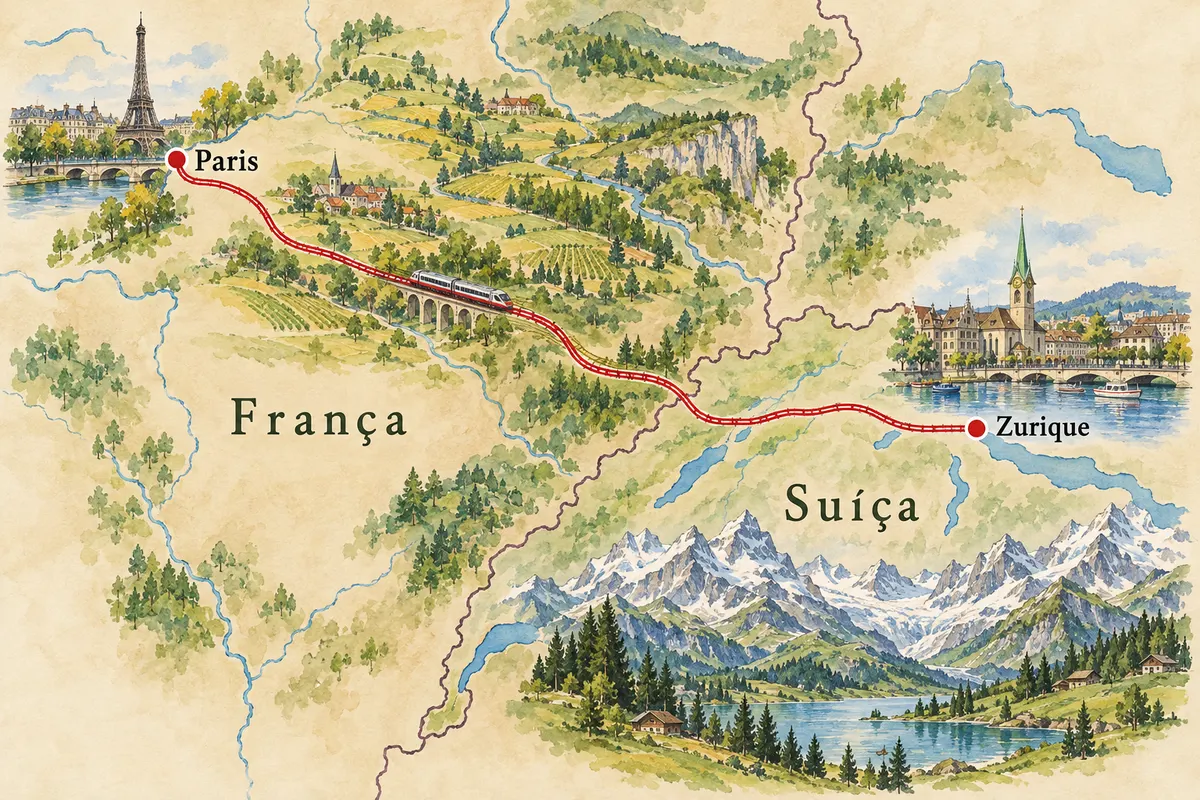
Zurich – na poti z imenom TGV Lyria Paris–Zurich

By train from Paris to Zurich in about four hours, without changing: from Gare de Lyon to the center of Switzerland’s largest city, passing through Alsace and Basel.

Zemljevid je ilustrativen in ni v merilu. Dotaknite se mesta, da odprete njegovo stran.
TGV Lyria Paris–Zurich – ilustrirani zemljevid
Več o poti – TGV Lyria Paris–Zurich

Rotas entre países

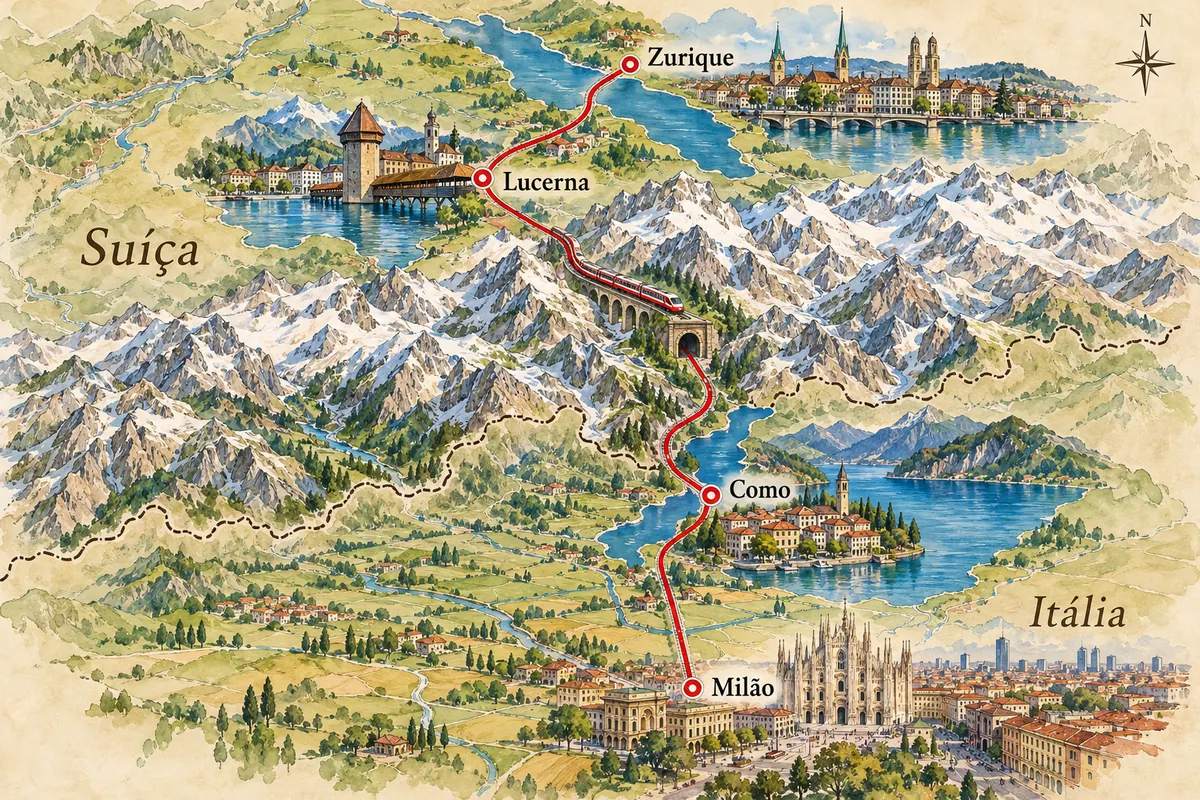
Zurich – na poti z imenom Zurich–Milan via the Gotthard

By train from Switzerland to Italy through the Alps: from Zurich to Milan via the Gotthard base tunnel, with Lucerne, Lake Como and, if you have time, the old panoramic mountain line.

Zemljevid je ilustrativen in ni v merilu. Dotaknite se mesta, da odprete njegovo stran.
Zurich–Milan via the Gotthard – ilustrirani zemljevid
Več o poti – Zurich–Milan via the Gotthard
Odkrijte druge destinacije Iskanje po zvezni državi in mestu

Več kot vodnik