Lake Constance

Baden-Württemberg · Bavaria · Nemčija

Lake Constance

The Bodensee on the German side: the island-town of Lindau, Constança — site of the Council — and Meersburg with its castle above vineyards, linked by boat and ferry.

South

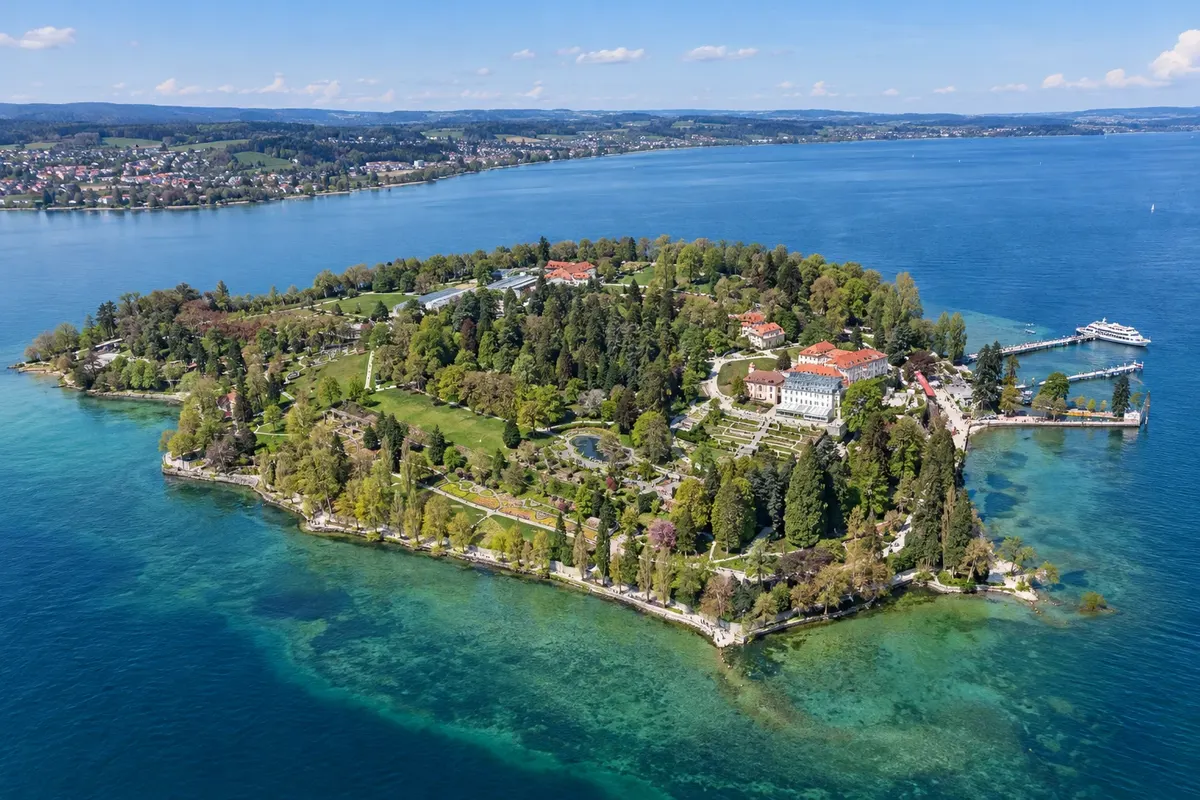
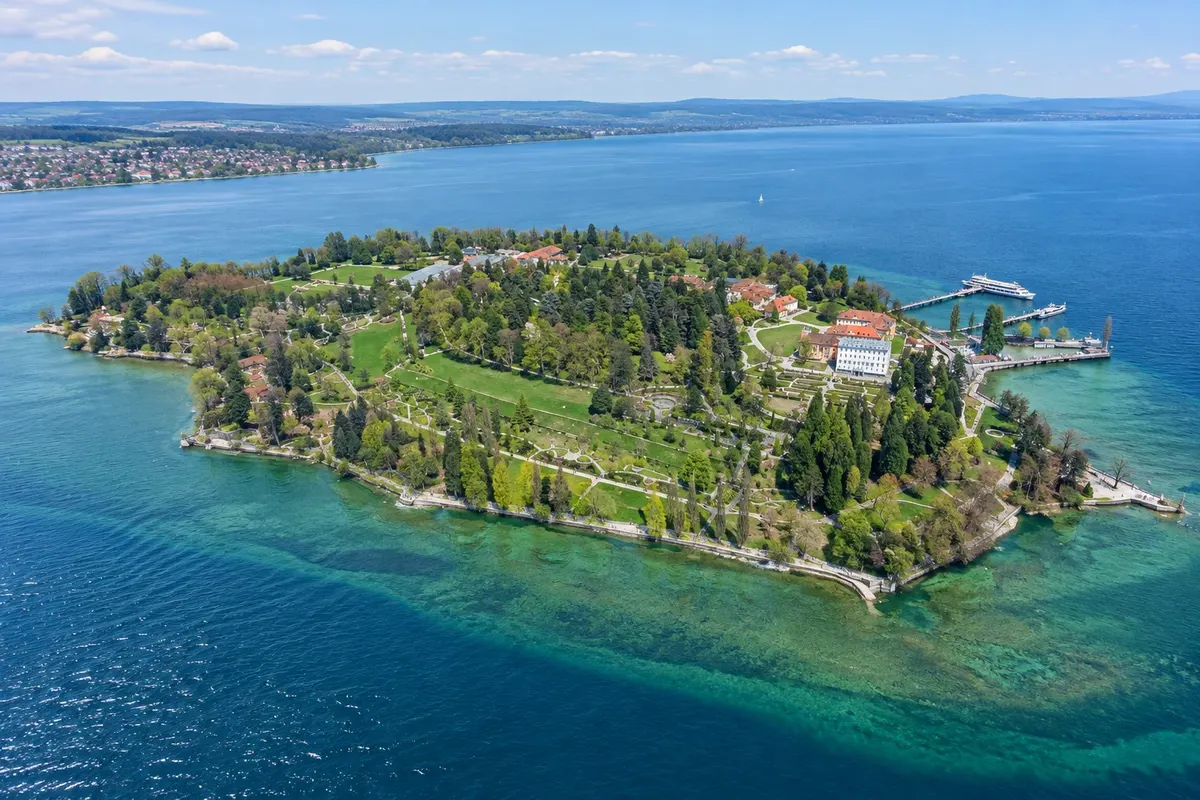
Na fotografiji: Insel Mainau, Lago de Constança

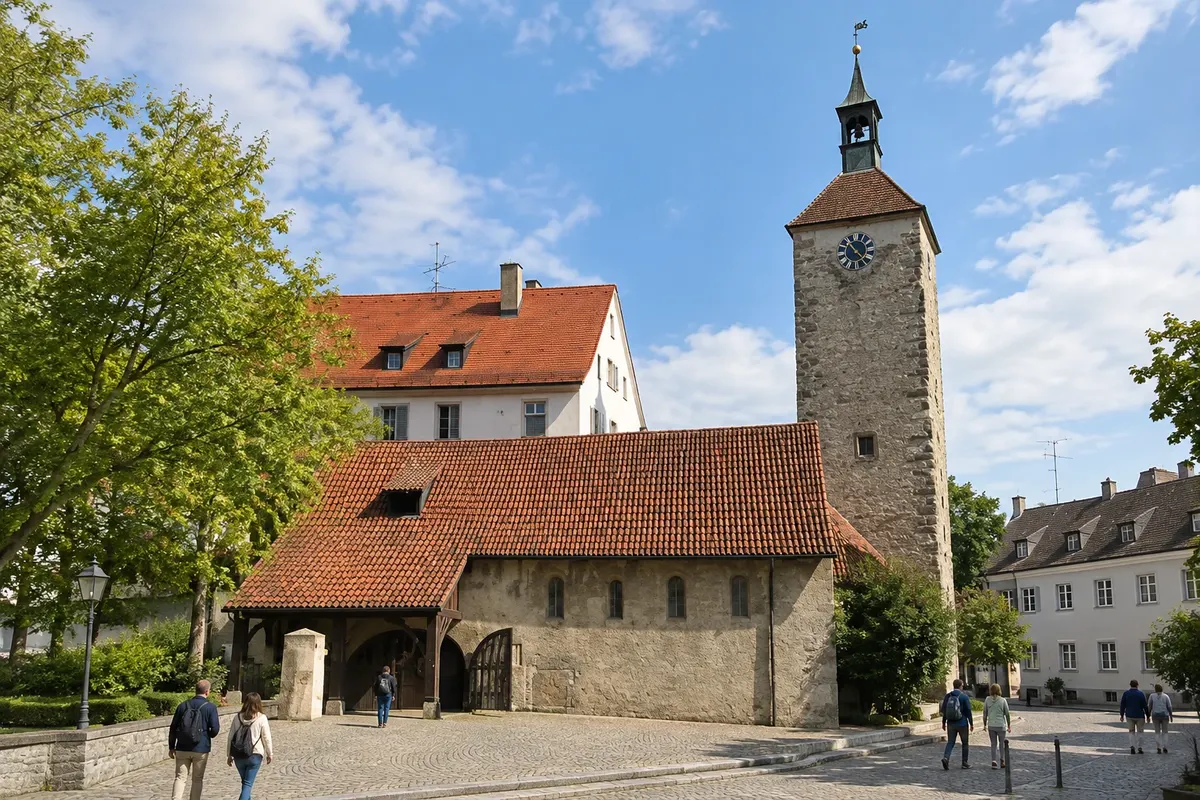
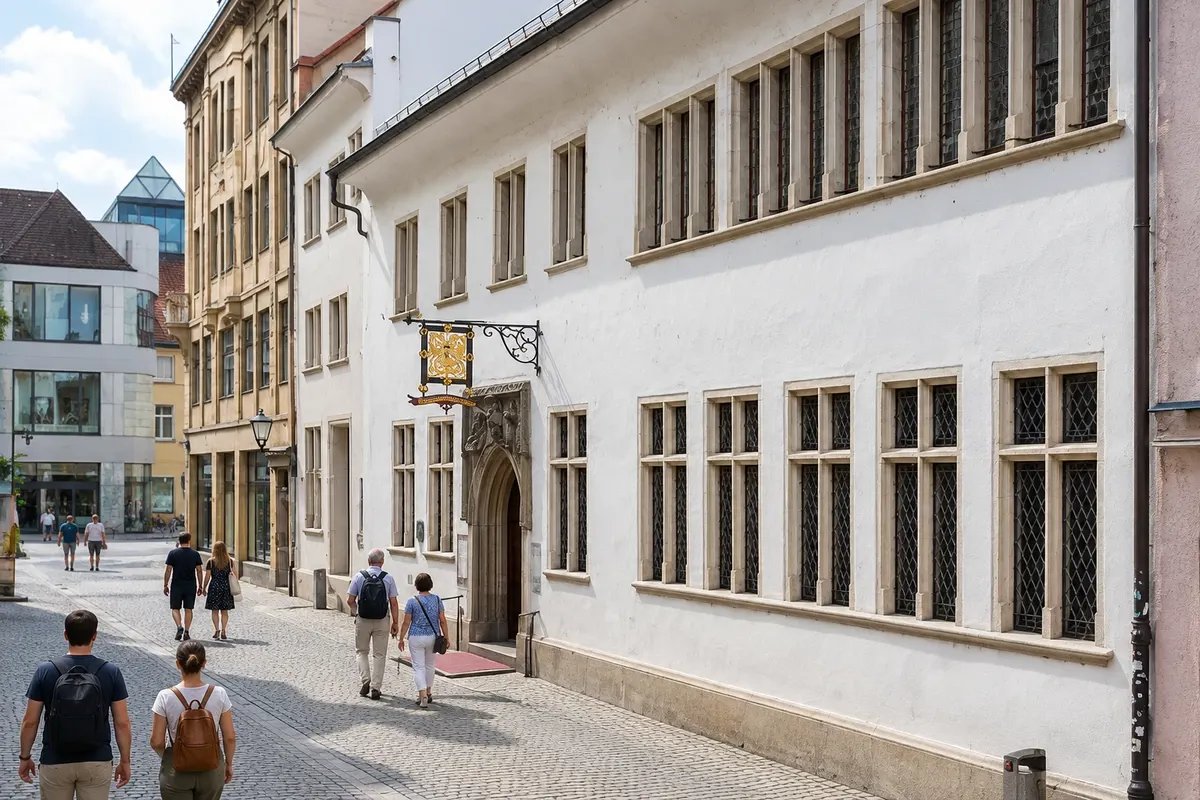
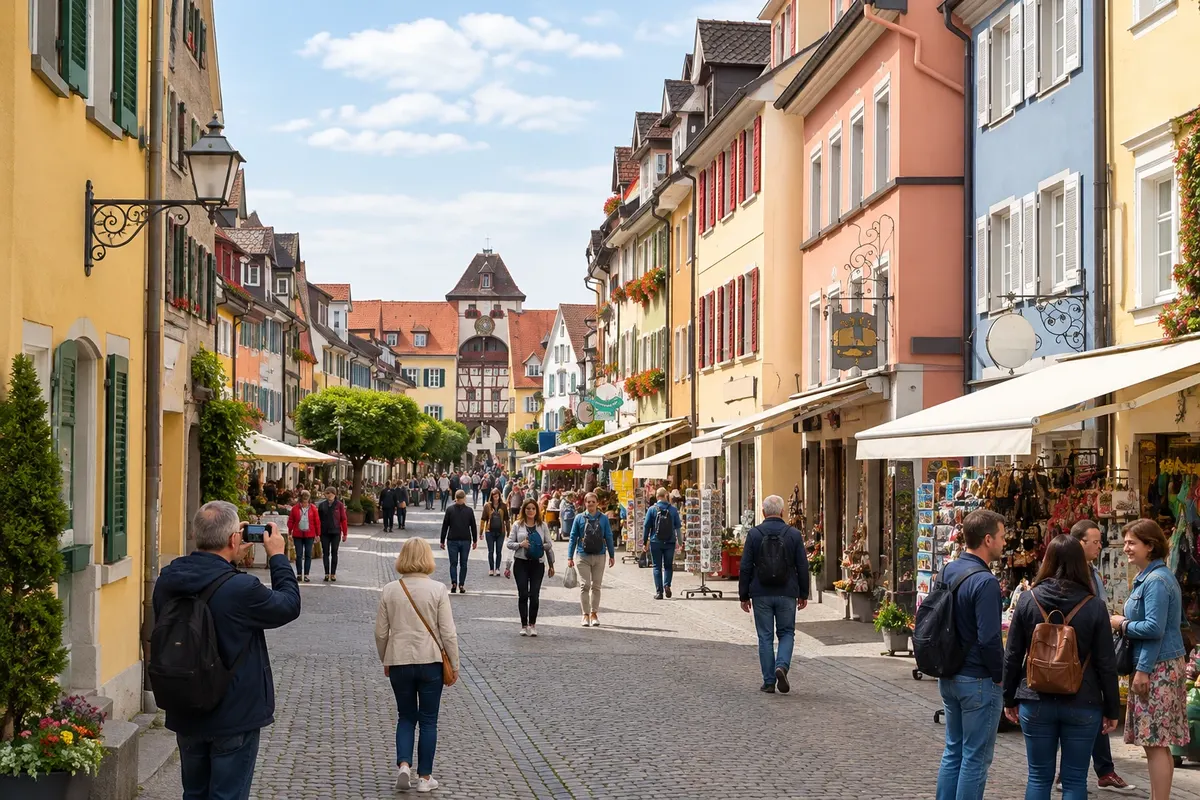
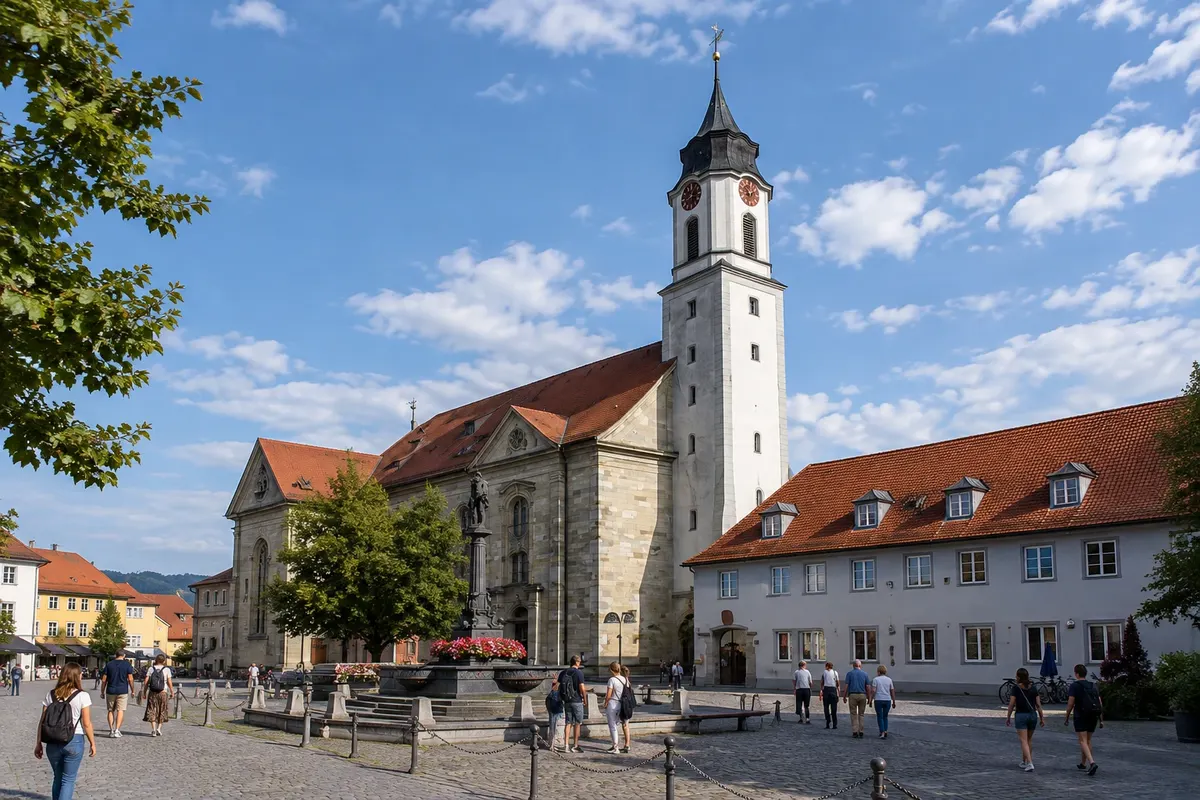
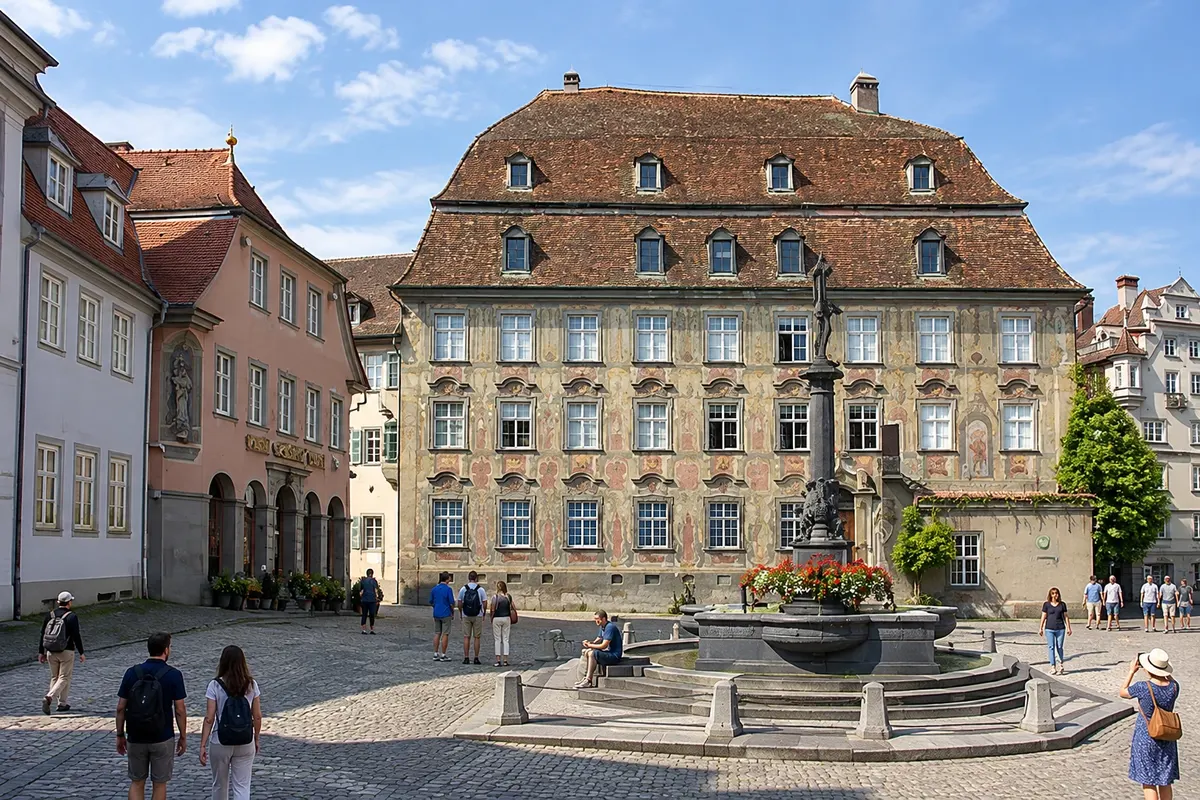
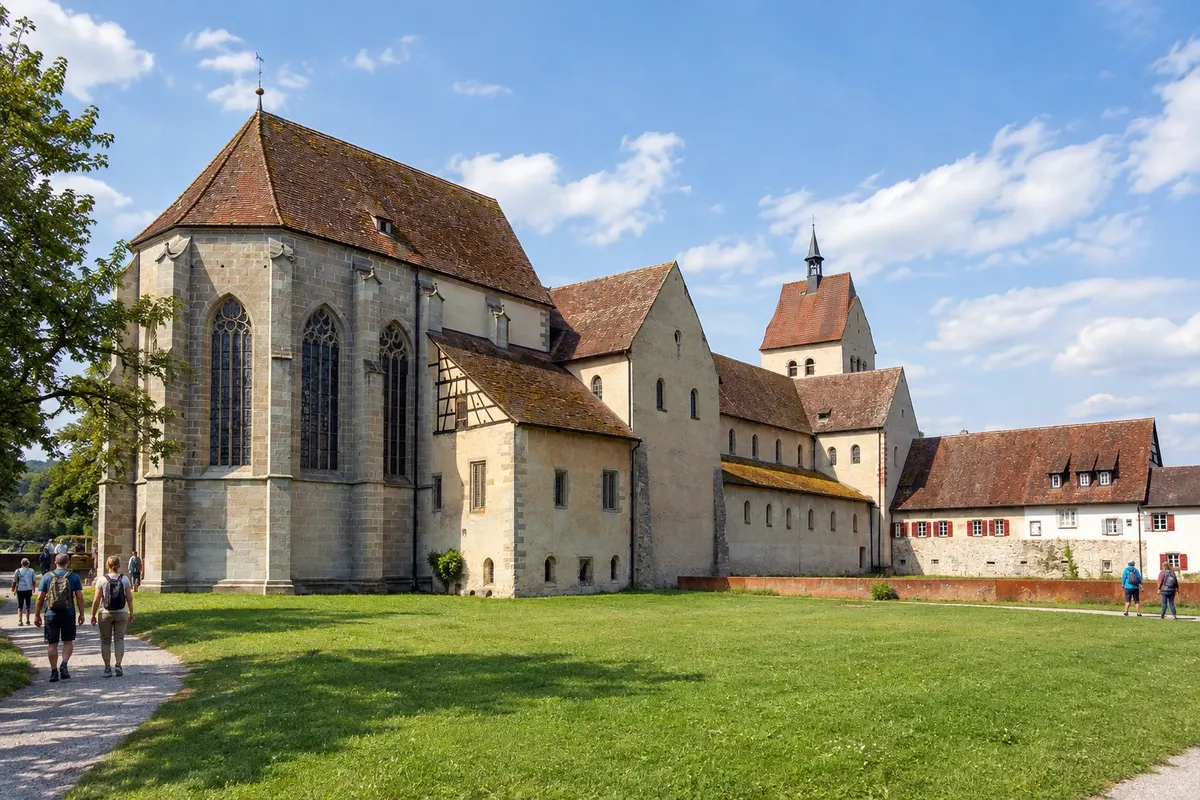
Illustrative images. The pictures in this guide are illustrations based on the real place, not photographs, and may differ from it.

Na voljo v trgovini Google Play Pošljite svoje fotografije

Spoznajte kraj

Pokrajina, ki jo doživite
v svojem ritmu.

Lago de Constança, the Bodensee to the Germans, lies at the meeting point of three countries: Germany, Suíça and Austria. The Rhine enters the lake on the Austrian side and leaves at Constança, the largest town on the shores. On the German side the waterfront is divided between Baden-Württemberg, with Constança and Meersburg, and Bavaria, with Lindau on an eastern tip.

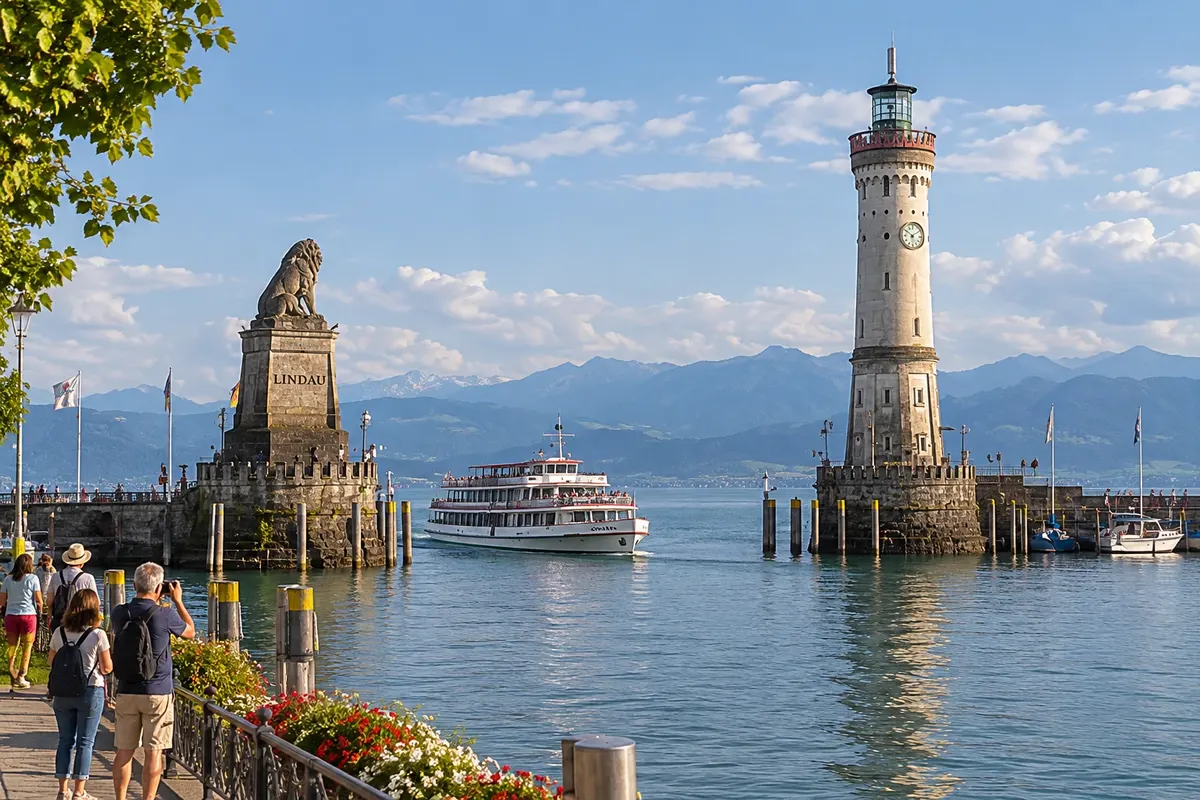
Lindau's entire old town is on an island connected to the mainland by a bridge and a railway causeway. At the harbour entrance stand the Bavarian lion and a lighthouse that can be climbed in season. Constança was the seat of bishops for more than a thousand years and hosted the Council from 1414 to 1418; the statue Imperia turns in the harbour and recalls that chapter with irony.

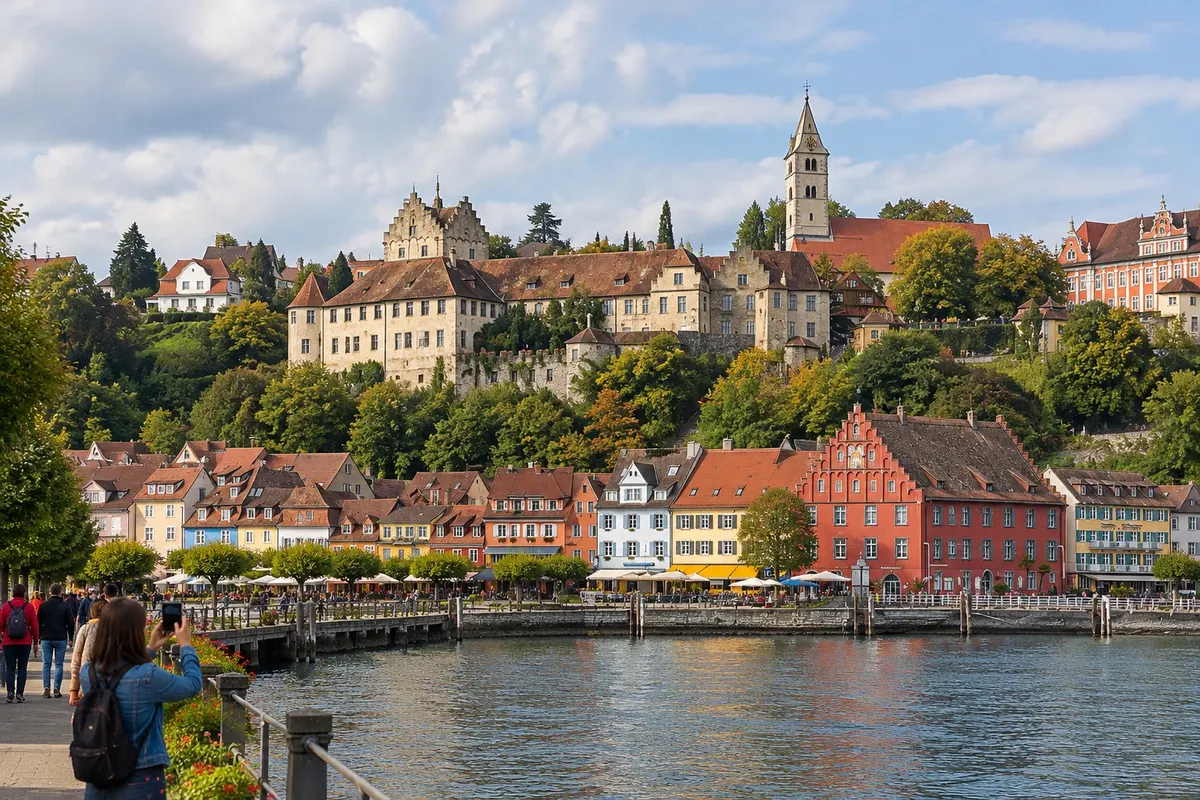
Meersburg sits on the north shore opposite Constança, with a medieval castle atop the cliff, a Baroque palace beside it and vineyards sloping down to the water. Nearby are the reconstructed pile dwellings of Unteruhldingen and the Baroque church of Birnau. On the Constança side, the islands of Mainau, of the gardens, and Reichenau, of the monasteries, complete the trip.

Regular boat services link the towns in season, and the ferry between Constança and Meersburg runs year-round.

This destination brings together 3 cities: Konstanz, Lindau, Meersburg.

Delite: WhatsApp
Delite svoja popotniška doživetja s fotografijami Pošljite fotografije vsakega kraja, ki ste ga obiskali. Največje število fotografij na kraj: 5.

Ena destinacija, več poti

Mesta na tej poti

Začnite v enem mestu ali v načrt poti vključite več mest.

Lake Constance – lega
LindauConstançaMeersburg

Obrisi: © BKG (2026), dl-de/by-2-0. Priredba: Cidade Turismo.

Kako do tja:Lake Constance

✈ Flughafen Zürich (ZRH), kraj: Zurique (Suíça)· 70 km do cilja (Konstanz)

Confirm before buying. For Lindau, the most common route is to take the train from Munique. For Constança and Meersburg, many people use the airport of Zurique, in Suíça, and continue by train or car. There are also trains to Constança from Stuttgart.

Predlagana točka prihoda:Konstanz

Konstanz
Baden-Württemberg · Lake Constance Predlagana točka prihoda

Konstanz

Constança is the largest town on Lago de Constança, at the point where the Rhine leaves the lake, adjoining Suíça. It was the seat of bishops for more than a thousand years and hosted the Council from 1414 to 1418. Little damaged in the Second World War, the old town preserves the Konstanzer Münster, the Konzilgebäude on the harbour, the statue Imperia and the lanes of the Niederburg. Boats leave from here to the island of flowers Mainau, the island of monasteries Reichenau and the ferry to Meersburg.

Meersburg
Baden-Württemberg · Lake Constance

Meersburg

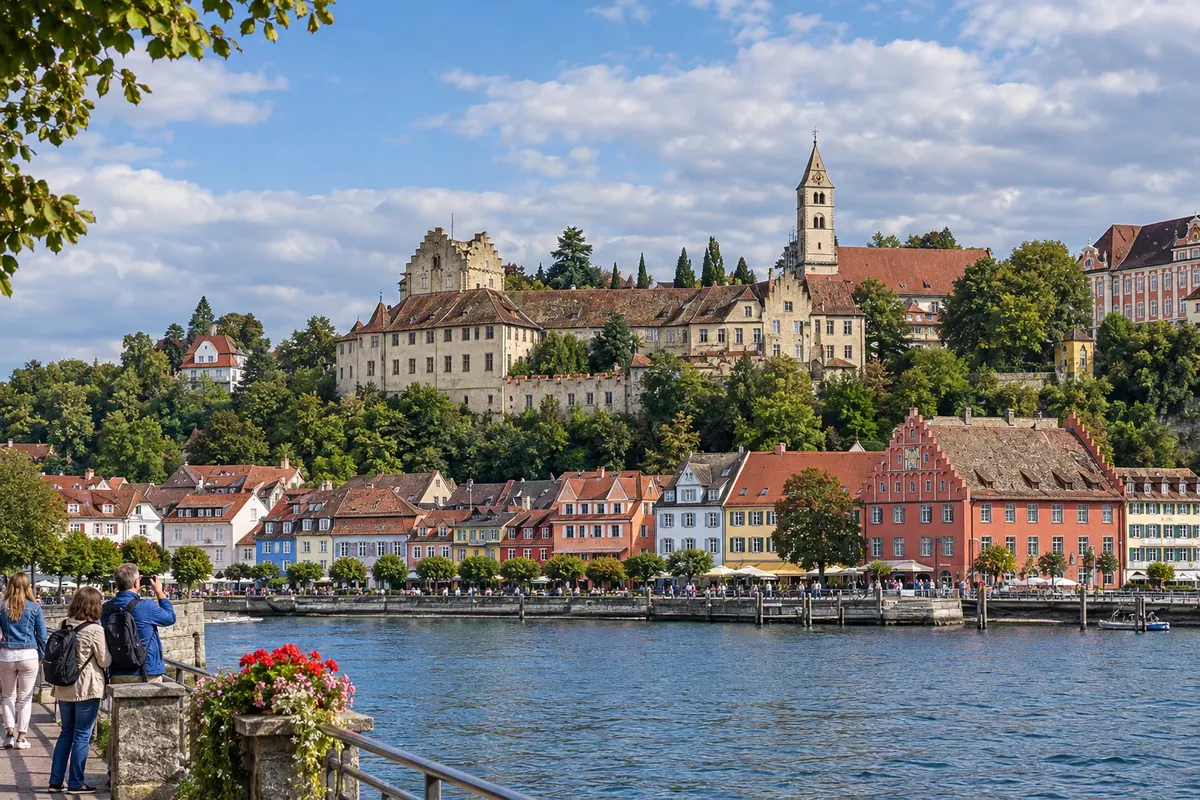
Meersburg lies on the northern shore of Lago de Constança, opposite Constança, and is divided into two parts: the Unterstadt, next to the water, and the Oberstadt, atop the cliff. Up there are Burg Meersburg, a medieval castle presented as the oldest still inhabited castle in Germany, and the Neues Schloss, a Baroque palace of the prince-bishops. Vineyards slope down to the lake, and near the town are the pile dwellings of Unteruhldingen and the Baroque church of Birnau.

Doživite kraj

Kaj početi – Lake Constance

Meersburg Castle
Meersburg · Baden-Württemberg · Grad

Meersburg Castle

Medieval castle atop Meersburg, presented as the oldest inhabited castle in Germany. It houses a museum with furnished halls, a dungeon, and the rooms of the poet Annette von Droste-Hülshoff.

Lindau Harbour Entrance (Bavarian Lion and Lighthouse)
Lindau · Bavaria · Harbor

Lindau Harbour Entrance (Bavarian Lion and Lighthouse)

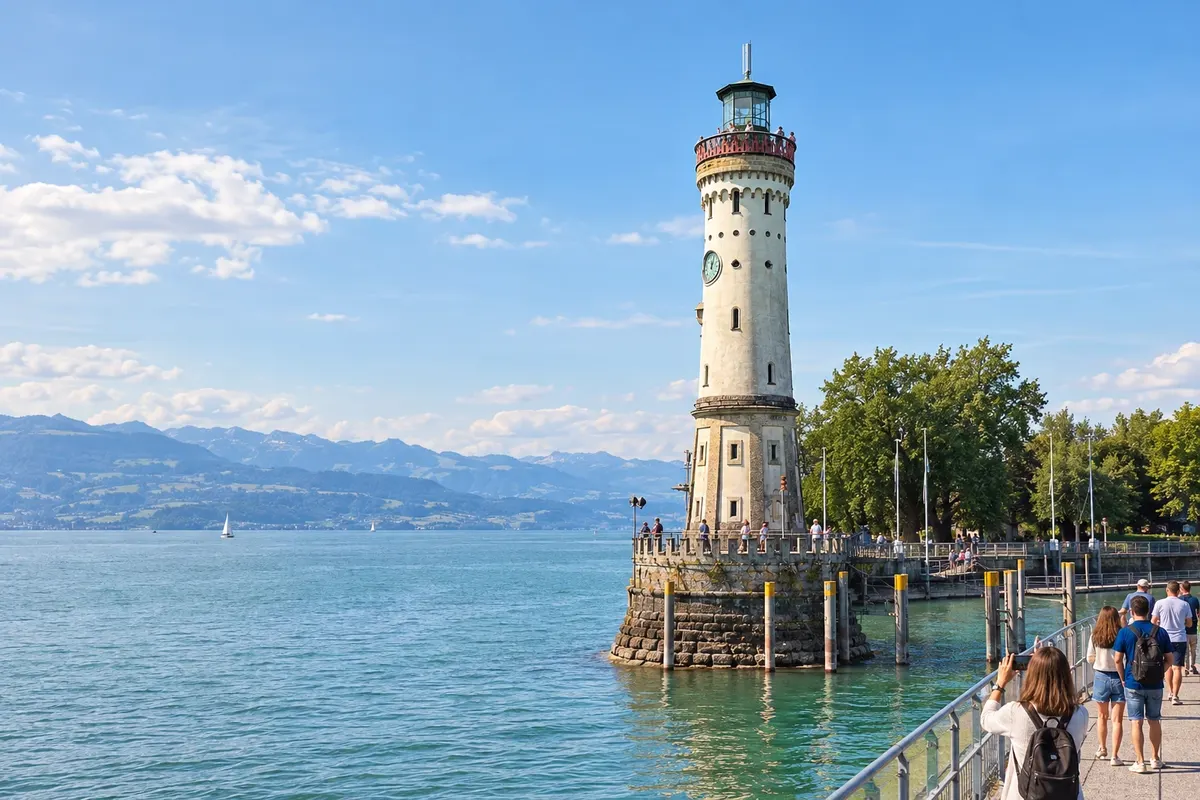
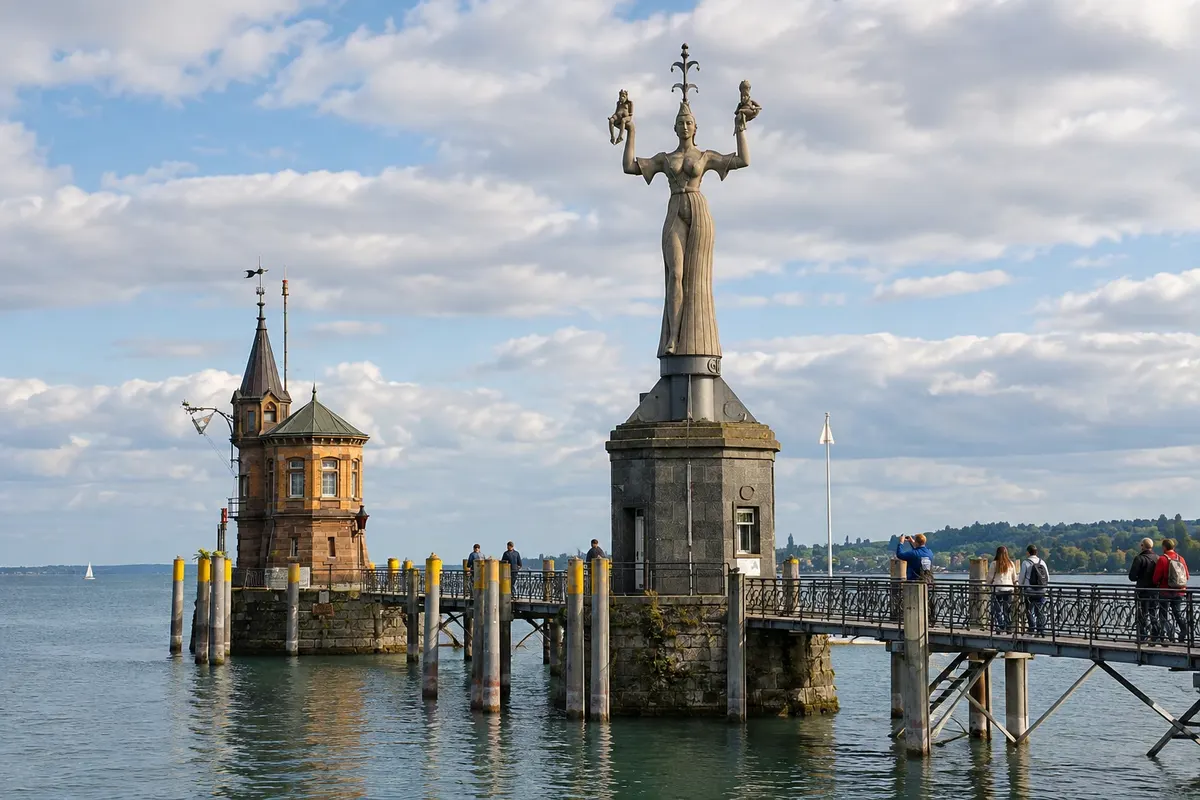
The entrance to Lindau's harbor, with the six-metre león da Baviera on a jetty and the Neuer Leuchtturm of 1856 on the other side. The lighthouse, the only one in Baviera, can be climbed in season.

Konstanz Cathedral
Konstanz · Baden-Württemberg · Stolnica

Konstanz Cathedral

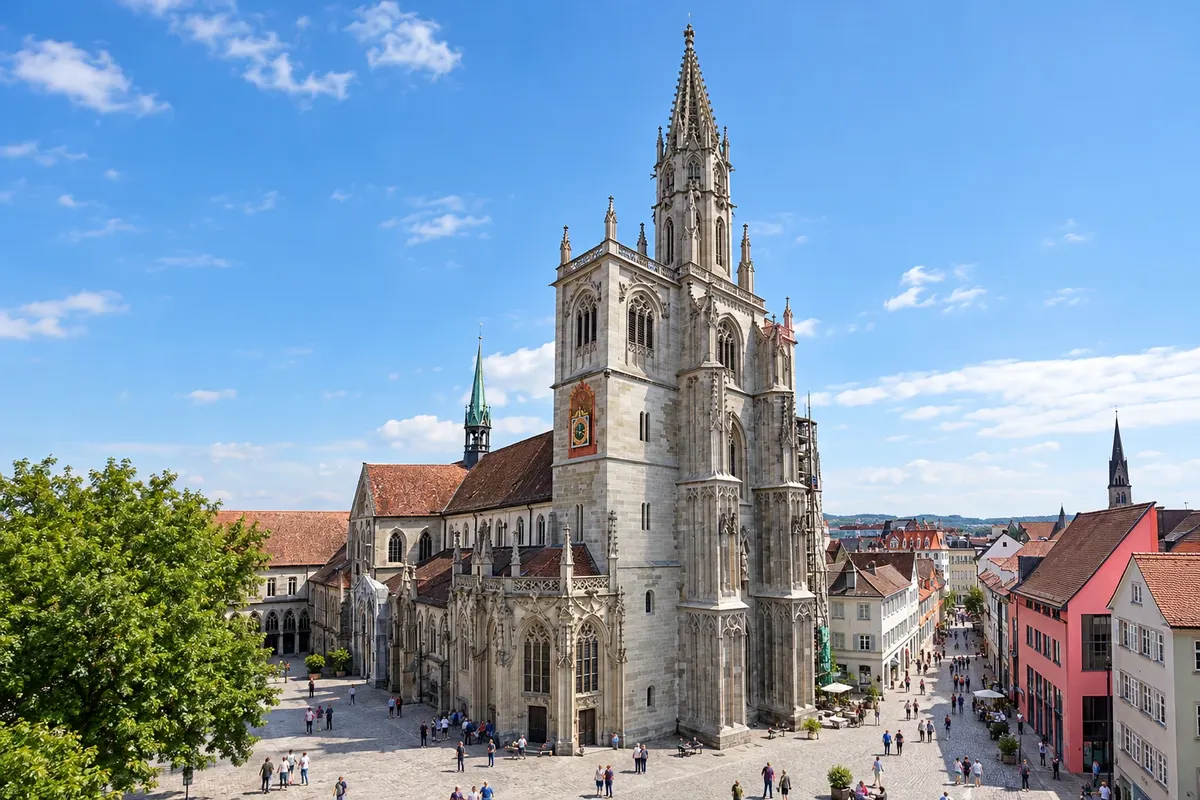
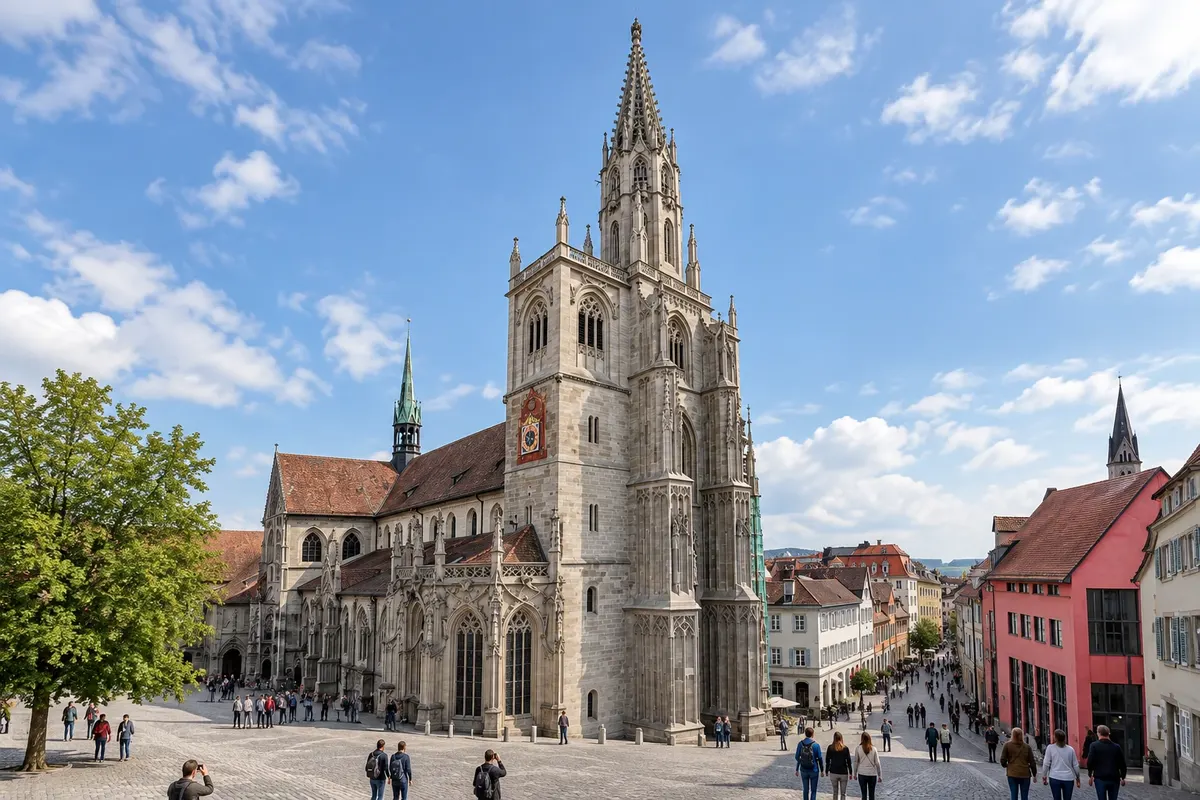
The former cathedral of the bishops of Constança, one of the largest Romanesque churches in southwest Germany, consecrated in 1089. It hosted sessions of the Council from 1414 to 1418 and has a tower with a viewpoint.

Konzilgebäude
Konstanz · Baden-Württemberg · Historic site

Konzilgebäude

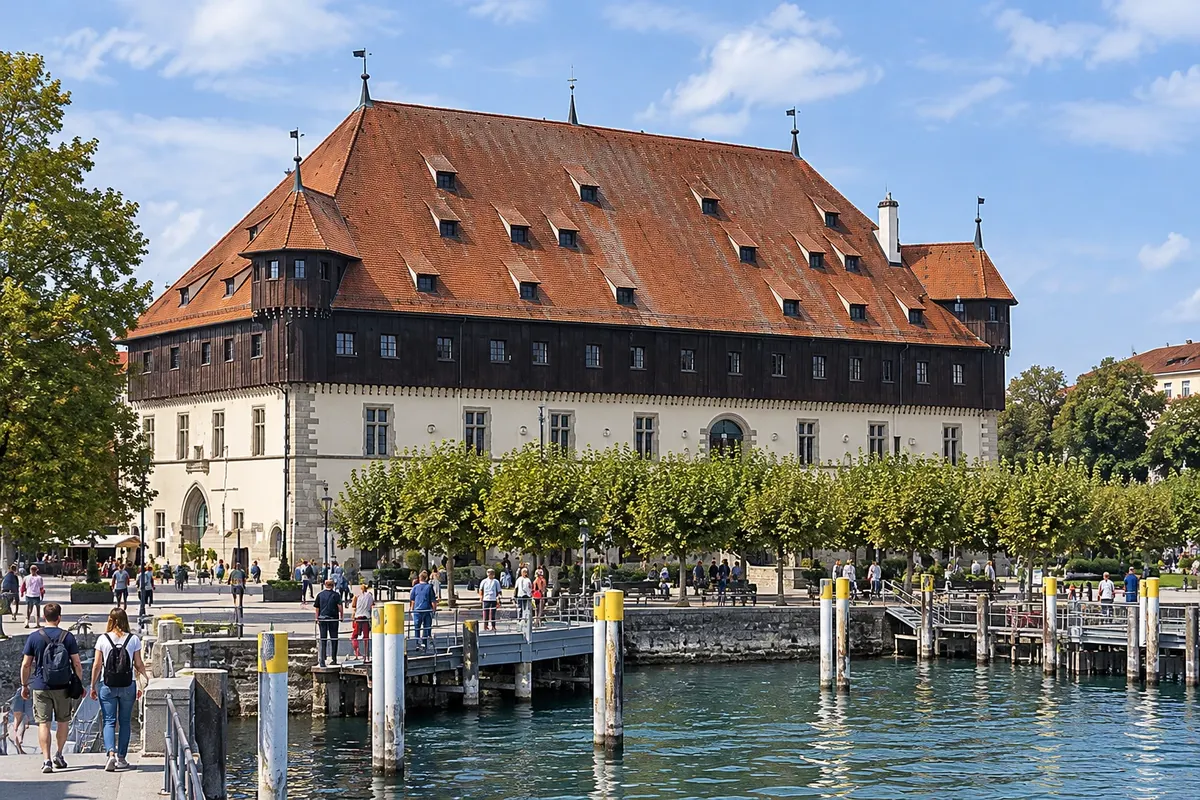
Large stone warehouse from 1388 in the harbor of Constança, where in 1417 Pope Martin V was elected during the Council. It is regarded as the largest preserved medieval civic building in southern Germany.

Lake Constance – prikaži dodatne kraje (15)
Mangturm
Lindau · Bavaria · Historic tower

Mangturm

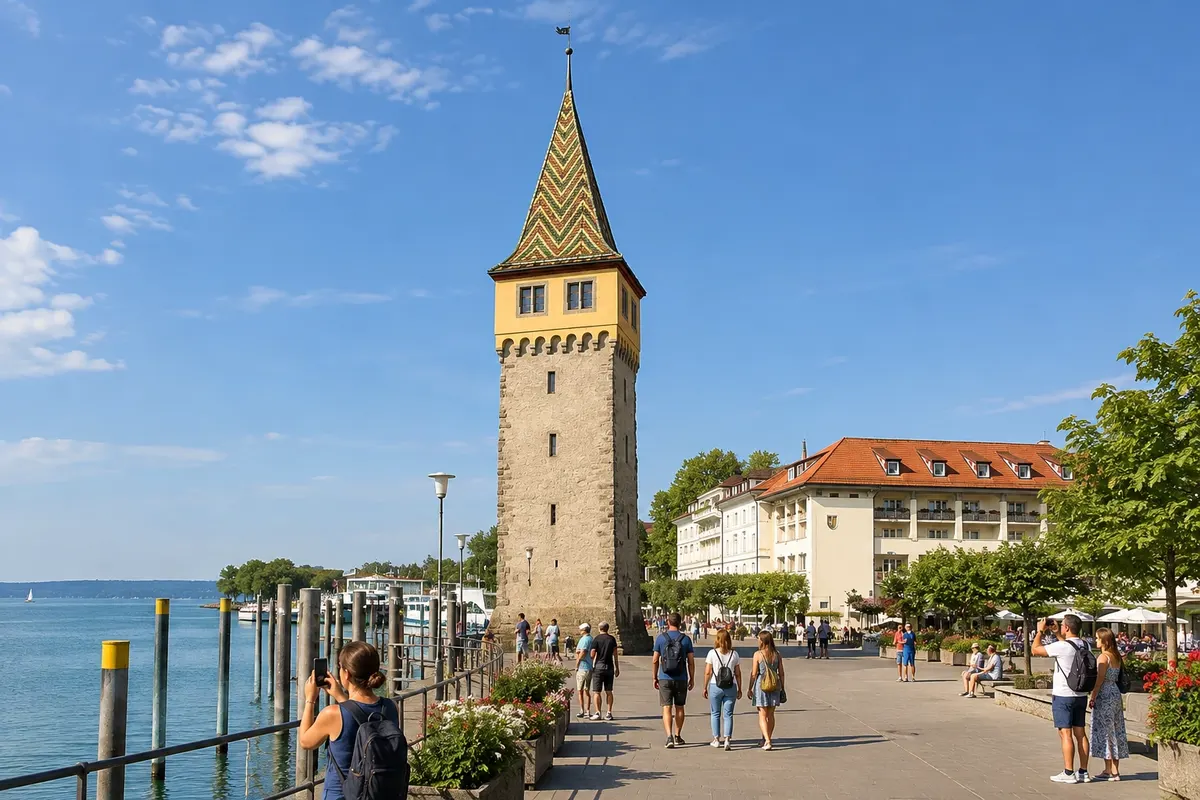
Square tower from the 12th century on Lindau's quay, a former watch and signaling tower for the harbor until 1856. The roof of glazed, colored tiles is one of the island's symbols.

Neues Schloss Meersburg
Meersburg · Baden-Württemberg · Palace

Neues Schloss Meersburg

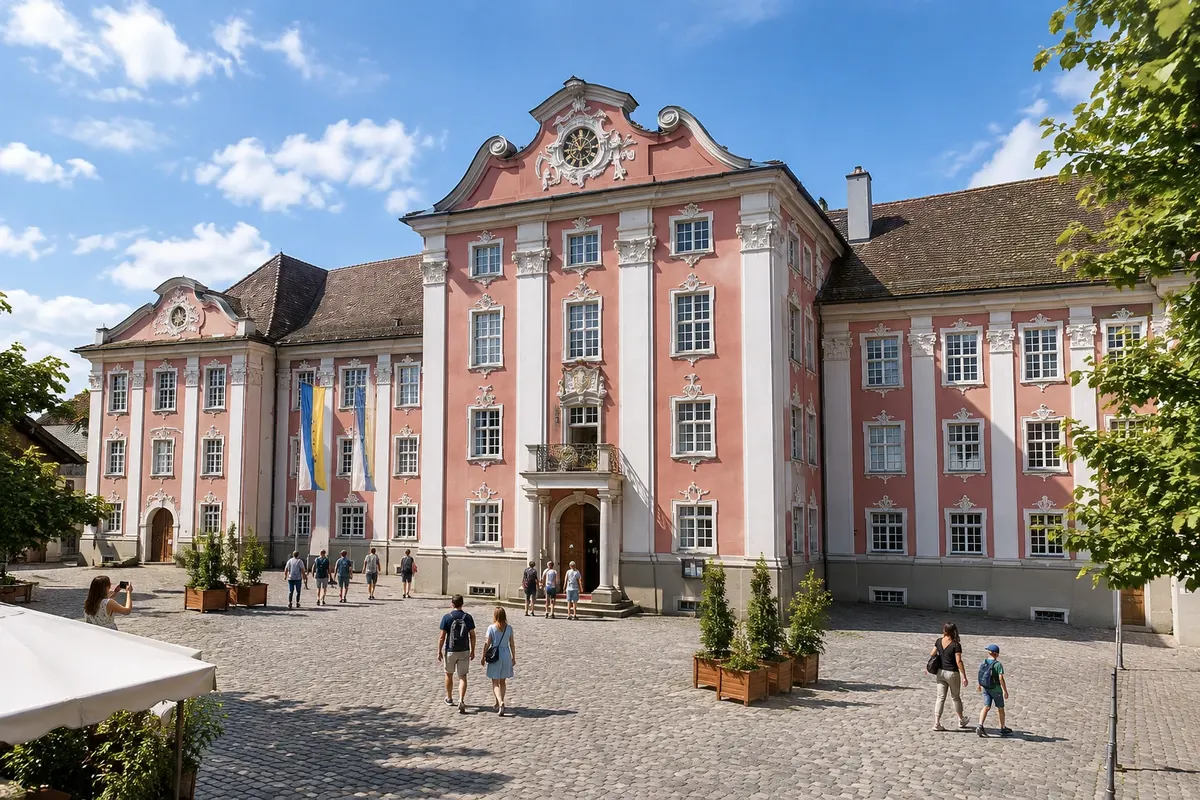
Baroque palace that was the residence of the prince-bishops of Constança from 1750 to 1803, with a staircase designed by Balthasar Neumann, a chapel with frescoes and a terrace overlooking the lake.

Imperia
Konstanz · Baden-Württemberg · Monument

Imperia

A nine-metre concrete statue at the end of the port jetty in Constança, by Peter Lenk (1993). It turns slowly and satirises the power of the emperor and the pope at the time of the Council.

Maximilianstrasse
Lindau · Bavaria · Street

Maximilianstrasse

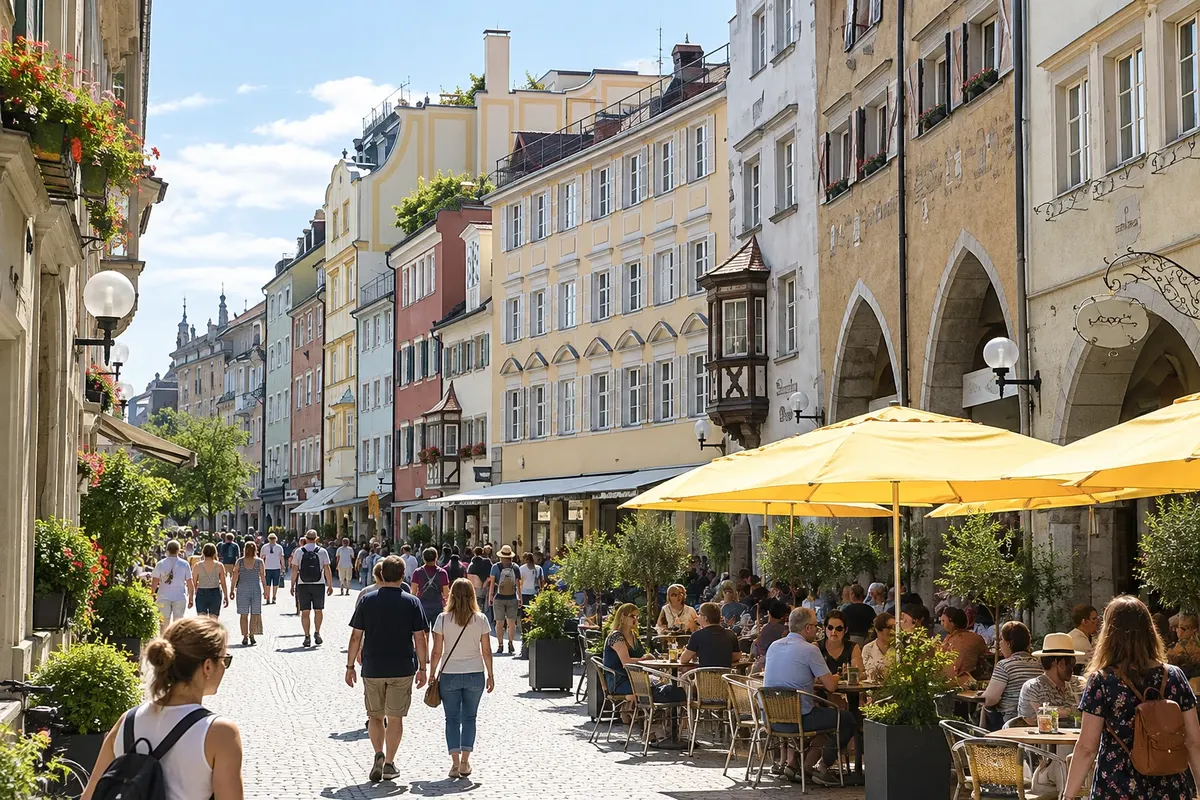
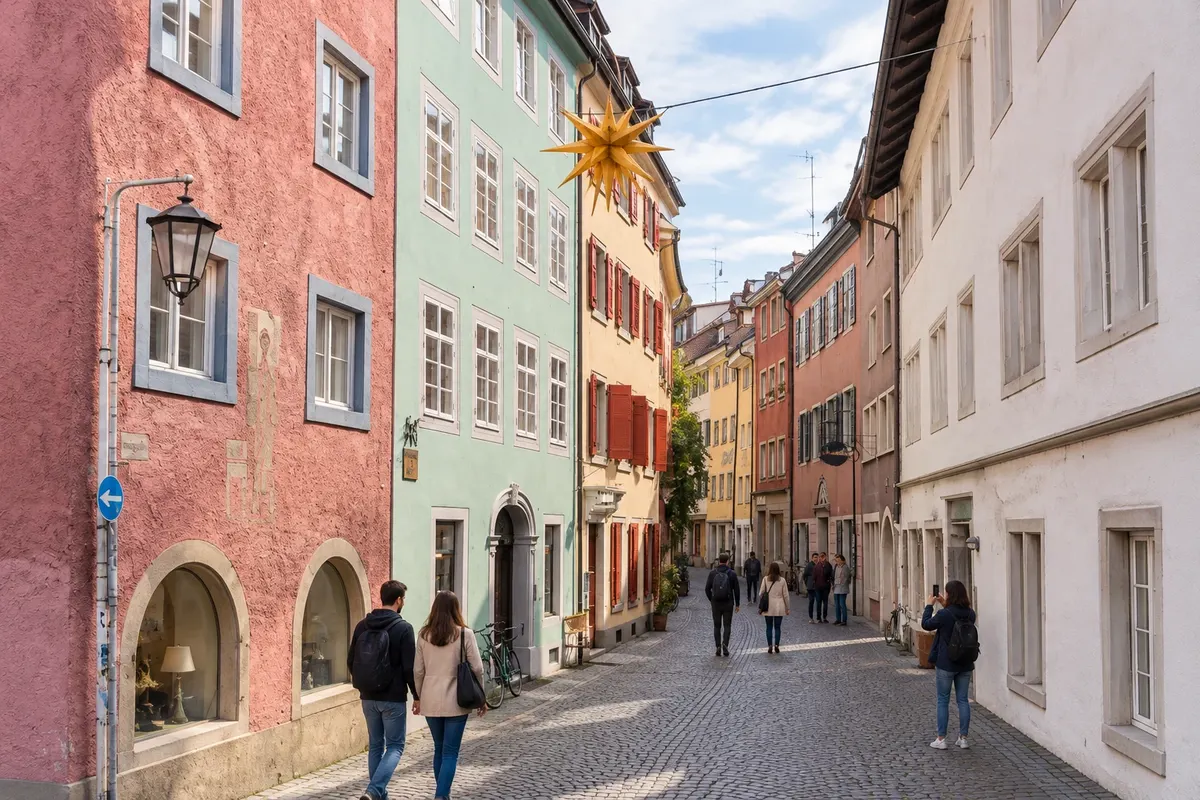
The island’s main street, for pedestrians only, with merchant and artisan houses from the 16th and 17th centuries, arcades, bay windows and old hoists on the roofs.

Pfahlbaumuseum Unteruhldingen
Meersburg · Baden-Württemberg · Muzej

Pfahlbaumuseum Unteruhldingen

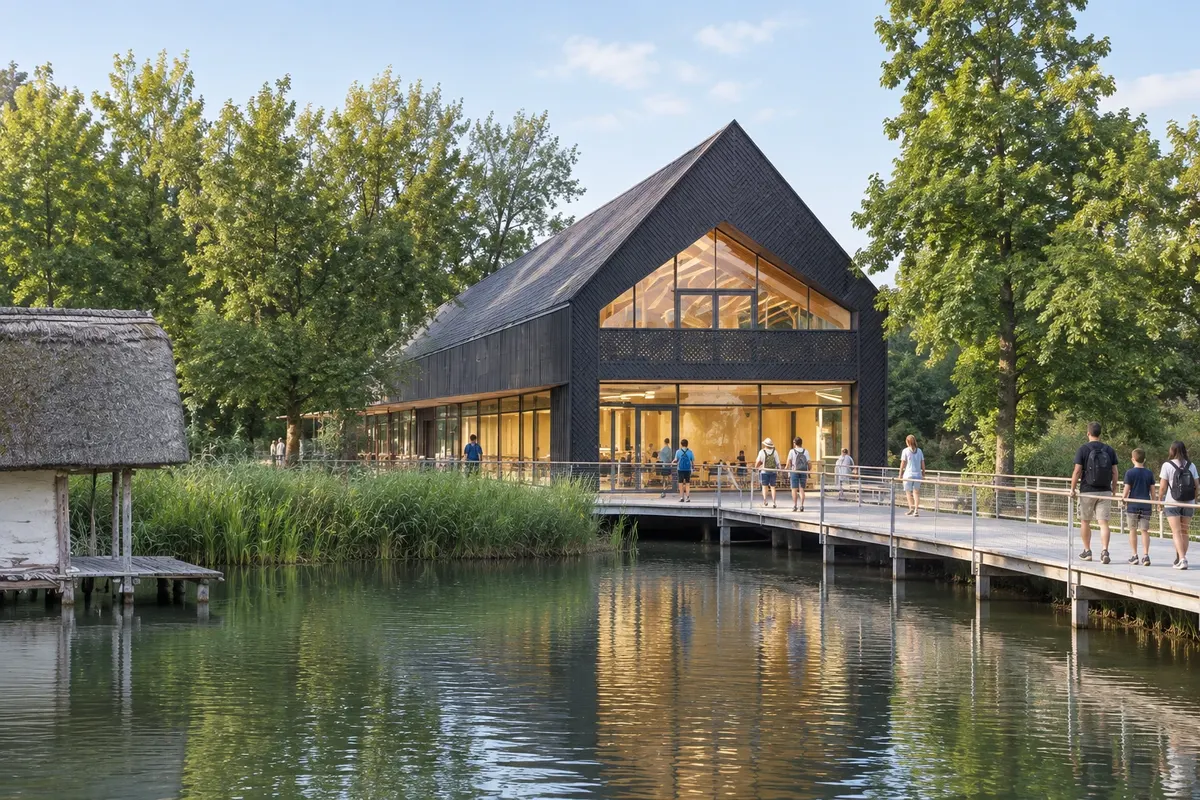
Open-air museum with 23 stilt houses reconstructed over the water, showing how people lived on the shores of the lake in the Stone Age and the Bronze Age. It is about 6 km from Meersburg.

Altes Rathaus
Lindau · Bavaria · Architecture

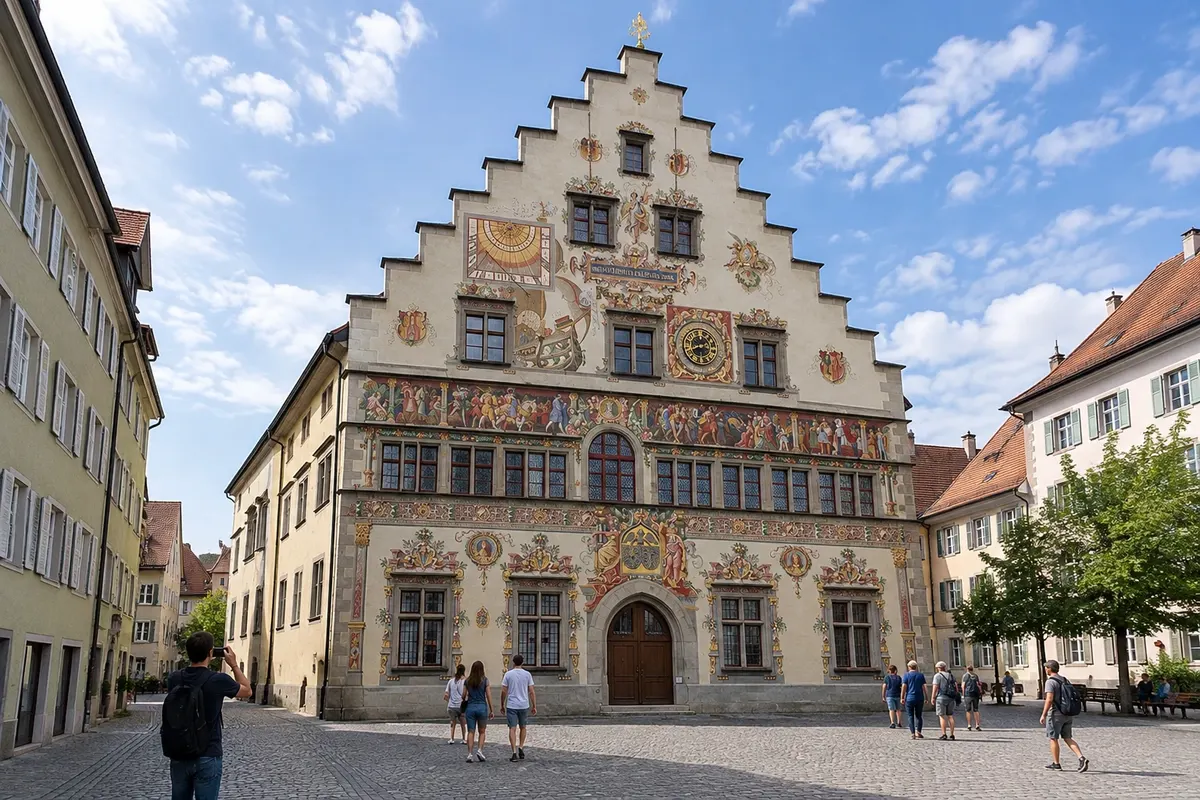
Altes Rathaus

The old town hall of Lindau, built from 1422 in the Gothic style and remodelled in the Renaissance, with stepped gables, a covered staircase and a painted façade depicting scenes from the town’s history.

Niederburg
Konstanz · Baden-Württemberg · Zgodovinska mestna četrt

Niederburg

The oldest neighbourhood of Constança, between the Münster and the Reno, with winding lanes, medieval houses bearing names and dates on their façades, wine taverns and artisan workshops.

Birnau Pilgrimage Church
Meersburg · Baden-Württemberg · Cerkev

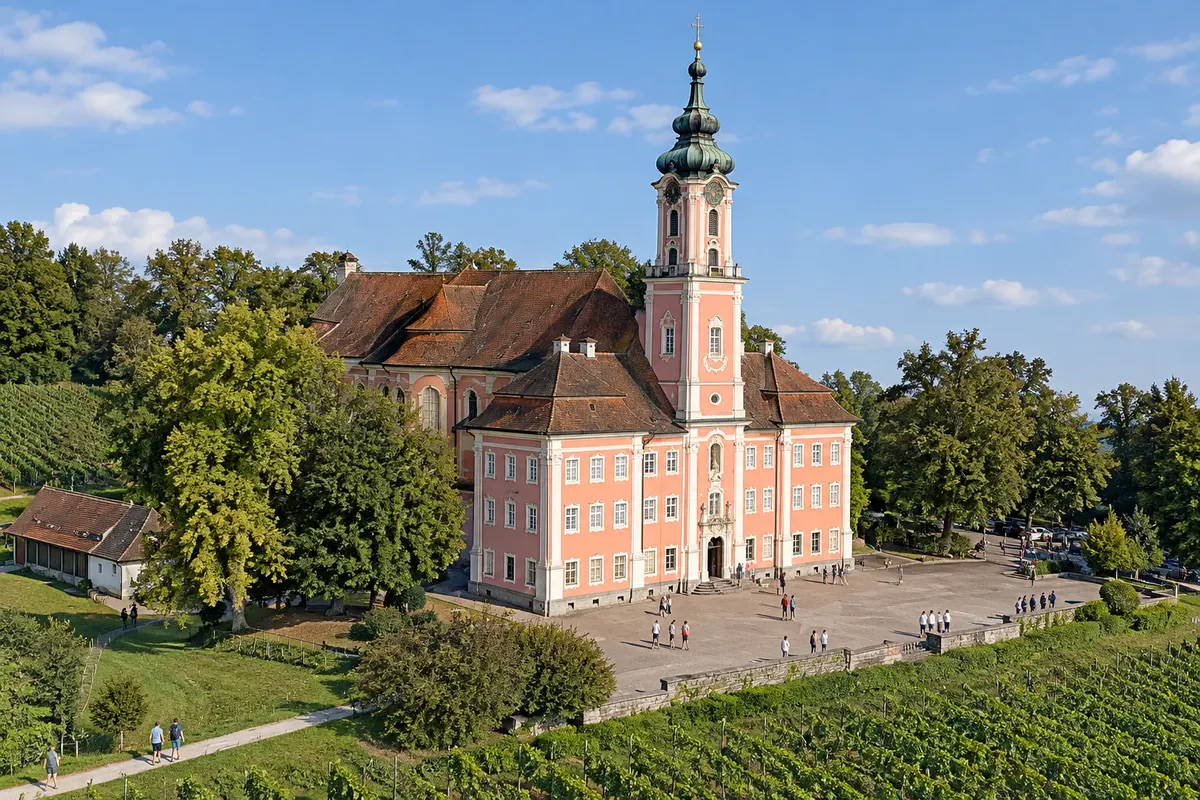
Birnau Pilgrimage Church

Baroque pilgrimage church built between 1746 and 1749 on the vineyards of the north shore, with frescoes by Gottfried Bernhard Göz and sculptures by Joseph Anton Feuchtmayer, such as the little putto Honigschlecker.

Peterskirche
Lindau · Bavaria · Cerkev

Peterskirche

The oldest church in Lindau, in the former fishermen’s quarter, with Passion of Christ frescoes from the late 15th century. Today it serves as a memorial to the victims of the wars.

Rosgartenmuseum
Konstanz · Baden-Württemberg · Muzej

Rosgartenmuseum

Museum of art and history of Constança and the lake region, founded in 1870 in a former guild house. It ranges from Stone Age finds to paintings and objects from the time of the Council.

Lower Town and Lake Promenade (Unterstadt und Seepromenade)
Meersburg · Baden-Württemberg · Zgodovinska mestna četrt

Lower Town and Lake Promenade (Unterstadt und Seepromenade)

The lower part of Meersburg, by the lake, with the Seepromenade, the boat harbour and old houses, linked to the upper town by the Steigstraße, a steep street of half-timbered houses.

Mainau Island
Konstanz · Baden-Württemberg · Garden

Mainau Island

Constança's flower island: 45 hectares of gardens, an arboretum, a butterfly house and a baroque palace, about 7 km from the centre. Open year-round, with the flower season from March to October.

Münster Unserer Lieben Frau (Lindau Minster)
Lindau · Bavaria · Cerkev

Münster Unserer Lieben Frau (Lindau Minster)

Baroque church on Lindau’s market square, rebuilt between 1748 and 1752 by Johann Caspar Bagnato. Opposite stands St. Stephan, the town’s largest church, with a bulbous cupola tower.

Haus zum Cavazzen
Lindau · Bavaria · Muzej

Haus zum Cavazzen

Baroque mansion from 1729–1730 on the market square, with a tall curved roof and painted façade. It houses the city museum, with Lindau's history and temporary art exhibitions.

Reichenau Island (Reichenau Monastery)
Konstanz · Baden-Württemberg · Historic site

Reichenau Island (Reichenau Monastery)

The largest island on the lake, a UNESCO World Heritage site because of the former Benedictine monastery, with three Romanesque churches such as St. Georg, which has wall paintings over a thousand years old. It is about 10 km from Constança.

Kaj izbrati pred odhodom

Izleti – Lake Constance

Izhodišče, trajanje, potek, vključene storitve in okvirna cena vsakega izleta.

Old town of Konstanz: Münster, Niederburg and Rheintorturm on foot

Odhod: Konstanz station, next to the harbor Peš po starem mestnem jedru Približno 3 ure Dopoldne ali popoldne easy (stairs in the tower)

Konstanz (Constanza) sits on the southwest tip of the Bodensee (Lake Constance), where the Rhein (Rhine) flows out of the lake, attached to the Swiss town of Kreuzlingen. The old town (Altstadt) was not bombed in World War II, and the medieval streets begin a few steps from the station. Walk up the Marktstätte and the Münsterhügel, the hill that holds the Konstanzer Münster, the former cathedral. A church on this site is mentioned as early as 615; the crypt, the oldest surviving part, houses relics from the 9th century, and the rotunda of Saint Maurice, from around 940, is a smaller-scale imitation of the Holy Sepulchre in Jerusalem. The Council of Constance (1414–1418) held its 45 sessions here, and Jan Hus was condemned here in 1415. The 78 m neo-Gothic tower has a viewing platform at about 40 m, generally open from Easter until the end of October: check before you go. Behind the Münster the Niederburg begins, the city’s oldest neighborhood, with deliberately winding lanes designed to hinder enemy fire. In the houses with painted names you’ll find upholsterers, stained-glass workshops and wine taverns. The Rheingasse descends to the Rheintorturm, the tower of the old bridge over the Rhine, overlooking the Seerhein, the river stretch that links the Obersee to the Untersee. Return via Hussenstraße, where the Jan Hus house-museum is located, and the Schnetztor, another city-gate.

Kraji na poti: Konstanzer Münster, Niederburg.

Vključuje: Free walk through the streets and free entry to the church. The climb to the Münster tower and the Jan Hus museum require separate tickets; check the current prices. The tourist office at the station sells paid guided tours separately.

Nasvet: Climb the Münster tower early, before the lines and with morning light over the lake. Carry your passport in your bag: the border with Switzerland runs through the town and you can walk into Kreuzlingen in a few minutes, without routine controls.

Najboljši čas za obisk: Year-round. From April to October the tower is usually open and tables fill the streets; in December there is a Christmas market between the harbor and the center.

Konstanz harbor: Imperia, Konzilgebäude, Stadtgarten and the pedestrian crossing to Switzerland

Odhod: Konstanz station, next to the harbor Walk along the harbor promenade Približno 2 uri late afternoon Lahka, ravna pot

The port of Konstanz is behind the station, and the waterfront walk starts at the Konzilgebäude, the long building with a high roof built between 1388 and 1391 as the port’s grain warehouse. In November 1417, the cardinals were locked in there during the conclave that elected Pope Martin V and ended the Great Schism; today the building hosts events and a restaurant. At the tip of the pier turns the Imperia, a 9 m, 18-ton concrete statue by Peter Lenk, installed in 1993: a courtesan holds in her hands two little men wearing a papal tiara and an imperial crown, a satire of the Council, and its base makes a full rotation every four minutes. From there you can see the lake, the scheduled boats and, on a clear day, the Alps in the background. Continue through the Stadtgarten, the waterside park with Ferdinand von Zeppelin’s bronze zeppelin — he was born in Konstanz — and along Seestraße, the 19th-century villa-lined avenue on the shore. In the other direction, Seestraße and the bridge over the Seerhein lead to the Petershausen neighborhood. To finish, walk to Switzerland: Kreuzlingen’s center is about a 15-minute walk from the port via Seeburgpark, with no routine border control.

Kraji na poti: Imperia, Konzilgebäude.

Vključuje: Free stroll: the promenade, the Imperia and the Stadtgarten are open and free of charge. The Konzilgebäude can only be seen inside during events or at the restaurant. Scheduled boats that depart from the harbor are paid separately.

Nasvet: Late afternoon is the right time, with the sun setting behind the town and the Imperia facing the lake. In December the Christmas market often occupies the promenade between the station and the harbor, with a bar‑boat moored there; check the dates.

Najboljši čas za obisk: All year round. From April to October scheduled boats keep the harbor active; from June to August the evenings are long.

Rosgartenmuseum: the chronicle of the Council and the history of the lake

Odhod: Konstanz, old town (Rosgartenstraße) Museum visit, on foot Približno 1 uro in 30 minut morning, afternoon or rainy day Lahko

The Rosgartenmuseum is the history museum of Konstanz and the lake region. It was founded in 1870 by pharmacist and councilor Ludwig Leiner and occupies the old house of the butchers’ guild, mentioned from 1324 and enlarged in 1454 with the neighboring house. The collection comprises about 50,000 items, from the Stone Age to the 20th century. The centerpiece is the Chronicle of Richental, an illustrated account of the Council of Constance written by Ulrich von Richental, who lived in the town at the time; the manuscript on display dates to around 1464 and shows the processions, the trial of Jan Hus and everyday life in a town full of cardinals, merchants and craftsmen. The Leinersaal, a museum room kept as in the 19th century with wooden display cases, gathers fossils, geology and finds from the lake pile dwellings. There are annual temporary exhibitions on local history. The visit completes the walk around the harbour: the Konzilgebäude, where the conclave took place, is a few minutes on foot, and the museum helps to understand what you see in the streets. The texts are in German, with leaflets in other languages; allow time for the chronicle, which is the reason to visit.

Kraji na poti: Rosgartenmuseum, Konzilgebäude.

Vključuje: Separate paid admission; check the schedule and opening days. There is an English leaflet and guided tours on selected dates. The building has stairs; ask at the entrance about access.

Nasvet: Save the museum for a rainy day — common from May to August — or for early afternoon. Combine it with the Jan Hus museum on Hussenstraße to complete the Council’s story on the same day.

Najboljši čas za obisk: All year; it’s the right option for rainy days, more frequent from May to August.

Insel Mainau: the island of flowers, the palace and the butterfly house

Odhod: Konstanz, main station (bus) or harbor (boat) City bus 4/13 or scheduled boat half day to full day morning to afternoon easy (paths with a gentle slope)

Insel Mainau is an island of about 45 hectares in the northwest arm of the lake, the Überlinger See, connected to the shore by a pedestrian bridge. It belonged to the Teutonic Order, which built the baroque palace and the palace church in the 18th century, and in 1856 it passed to Grand Duke Friedrich I of Baden, who planted the arboretum, now with about 500 tree species, and the Italian rose garden, geometric, with pergolas and fountains. In 1932 the Swedish prince Lennart Bernadotte received the island, called it a ship of flowers and transformed it into the park that exists today; since 1974 it has been run by a family foundation. The visit is a walk along paths between beds that change with the season: tulips and bulbs in spring, with more than 150 varieties; roses in June, with over 1,200 varieties in total; and dahlias in late summer and autumn. The butterfly house is a tropical greenhouse with thousands of free‑flying butterflies, and the palm house is next to the palace. There is a freshwater beach, a playground and restaurants. The island is open year round; from mid‑autumn visitor numbers fall and part of the greenhouses close earlier.

Kraji na poti: Insel Mainau.

Vključuje: Separate paid admission, with the butterfly house and the palm house included; check the current price list, which varies between summer and winter. Bus and boat are paid separately; the Deutschlandticket is valid on the bus. Bicycles are not allowed on the island; there is parking at the entrance.

Nasvet: Take the bus in the morning and return by boat in the afternoon, in season, to see the island from the water. On weekends in May and June the island fills up; arrive at opening. Allow at least three hours and bring water: there is little shade in the flower beds.

Najboljši čas za obisk: From April to October: tulips in April and May, roses in June, dahlias from September to October. In winter the island is open, but there are few flowers.

Klosterinsel Reichenau: the three World Heritage churches, by train or by bike

Odhod: Konstanz station (train) or Bodensee-Radweg (bike) Regional train to Reichenau (Baden) and bus, or bicycle Pol dneva Dopoldne ali popoldne easy (flat island)

Klosterinsel Reichenau is an island of about 4.3 km² in the Untersee, the western part of the lake, roughly 10 km from Konstanz and connected to the shore by an 1838 causeway lined with poplars. The monk Pirmin founded the Benedictine monastery in 724, and in the 10th and 11th centuries the abbey was one of Europe’s centers for art and manuscript copying. That is why the island has been a World Heritage site since 2000. Three churches remain, spread across three villages. In Mittelzell, the Münster of St. Mary and St. Mark is a Carolingian basilica consecrated in 816, with a transept and an apse from 1048 and a treasury containing reliquaries, including that of St. Mark brought in 830. In Oberzell, the church of St. Georg preserves on the nave walls the only set of murals from before the year 1000 north of the Alps, depicting the miracles of Christ; in summer, to protect the paintings, interior visits may be limited to scheduled times or guided tours: confirm before you go. In Niederzell, St. Peter und Paul has a 12th-century apse painting. Today the island’s economy is based on vegetable gardens, and glasshouse vegetable production fills its center. The lakeside bike path, part of the Bodensee-Radweg, starts in Konstanz and reaches the island in about 40 minutes; by train, Reichenau (Baden) station is on the shore, with a bus to the villages.

Kraji na poti: Klosterinsel Reichenau.

Vključuje: Churches do not charge an entrance fee; the Münster treasury and the island museum require separate tickets. The regional train and the bus are covered by the Deutschlandticket. Bicycle rental in Konstanz is paid separately.

Nasvet: Start at Oberzell, the first village after the causeway, and finish in Mittelzell, where there are restaurants. Climb Hochwart, the island’s highest point, to see the Untersee and the Alps. From November to March the museum is open only on weekends.

Najboljši čas za obisk: From April to October, when the museum and the treasury are open daily and boats usually run on the Untersee. The churches are open year-round.

Konstanz–Meersburg ferry, Burg Meersburg and the lower town

Odhod: Konstanz-Staad (ferry; bus 1 from the station) Car and foot ferry, then walk Pol dneva Dopoldne ali popoldne easy (hills and stairs)

The Konstanz–Meersburg ferry has crossed the lake since September 30, 1928; it was the Bodensee’s first car ferry and is operated by Konstanz’s municipal company. It departs from Konstanz‑Staad, a neighbourhood northeast of the centre, crosses 4.25 km in about 15 minutes and runs day and night, every 15 minutes during the day and hourly overnight. From the deck you can see the north shore rising in vineyards toward Meersburg, a town of about 6,000 inhabitants divided into Unterstadt (lower town), at the water’s edge, and Oberstadt (upper town), connected by two stairways and the steep half‑timbered Steigstraße. From the Seepromenade, the harbour promenade, you climb to Burg Meersburg, one of Germany’s oldest inhabited castles: the central tower, the Dagobertsturm, is traditionally attributed to the Merovingian king Dagobert in the 7th century, and the complex served as the residence of the prince‑bishops of Konstanz until the 18th century. Since 1838 it has belonged to a private family, which opened more than 30 rooms to visitors: kitchen, armory, dungeon, chapel and the rooms where the poet Annette von Droste‑Hülshoff lived from 1841 until her death in 1848. The visit is self‑guided, with information panels, and ends at the castle café, with a terrace over the lake.

Kraji na poti: Burg Meersburg, Unterstadt and Seepromenade.

Vključuje: The ferry charges fares per person and per car; the castle has a separate ticket, with self-guided visits and themed guided tours on scheduled dates. Check the current price list. In the Unterstadt the walk is free.

Nasvet: Take the ferry in the morning and return late afternoon, when the sun hits the façades of the Unterstadt. There is a schedule for foot passengers without cars; bus 1 links Konstanz station to the Staad ferry terminal. The castle is open year-round, including winter.

Najboljši čas za obisk: All year. From April to October tables line the Seepromenade; in September and October grapes are harvested in the vineyards.

Prikaži dodatne izlete (8)

Neues Schloss Meersburg, the vineyards and the Vineum

Odhod: Meersburg, ferry embarkation or boat harbor Walk through the Oberstadt and the vineyards Približno 3 ure Popoldne easy to moderate (ascent to the vineyards)

Next to the old castle, in Meersburg’s upper town, stands the Neues Schloss, the Baroque residence the prince-bishops of Konstanz began building from 1710, designed by Christoph Gessinger, to replace the medieval fortress with a palace. The monumental staircase followed plans by Balthasar Neumann around 1740, and the painted ceilings are by Giuseppe Appiani; the chapel contains sculptures by Joseph Anton Feuchtmayer. Today the palace is maintained by the state of Baden-Württemberg and houses the prince-bishops’ museum, the city gallery, and a museum dedicated to Claude Dornier, the aircraft engineer from Friedrichshafen. The garden terrace, freely accessible, faces the lake and the Alps. From the upper town, waymarked paths through the vineyards lead down to the water: Meersburg has cultivated wine since 1324, and the bishops’ former vineyard became in 1802 the Staatsweingut, now 63 hectares, mainly Müller-Thurgau and Spätburgunder. The visit here is to the landscape and the history: on Vorburggasse, the Vineum Bodensee, opened in 2016 in the old Holy Spirit hospital, presents the region’s wine culture and displays a press from 1607. At the end, descend the Steigstraße to the Seepromenade.

Kraji na poti: Neues Schloss Meersburg, Unterstadt and Seepromenade.

Vključuje: The palace terrace and garden are open; the palace museum and the Vineum require separate tickets, and the guided palace tour in the afternoon is usually daily only from April to early November. Check the current schedule. The vineyard paths are freely accessible.

Nasvet: Do the palace in the morning and the vineyards in the afternoon, when the sun lights the slopes. The garden pavilion only opens for special visits. In September and October the vineyards turn golden; in December the palace often opens only on Sundays.

Najboljši čas za obisk: From April to October, with the palace open daily; September and October for the vineyard colors.

Pfahlbaumuseum Unteruhldingen: the Neolithic and Bronze Age stilt houses

Odhod: Meersburg (bus or boat) or Uhldingen-Mühlhofen station Regional bus, scheduled boat or train and walk Približno 2 uri Dopoldne ali popoldne easy (wooden boardwalks)

In Unteruhldingen, about 7 km from Meersburg along the north shore, 23 reconstructed stilt houses extend over the water on wooden boardwalks. The Pfahlbaumuseum opened in 1922 with the first two houses and expanded in phases until 2002; it is an open‑air museum and a research institute, showing how fishing and farming villages lived on the lake shores between roughly 4000 and 850 BC, in the Neolithic and Bronze Age. The original villages lie submerged in front of the museum, and since 2011 they have been part of the Prehistoric Pile Dwellings around the Alps World Heritage Site, with 111 sites in six countries, nine of them in the Bodensee. The visit follows three groups of houses, with guides explaining daily life and the finds: pots, nets, stone axes and a dugout canoe. The Archaeorama is a 3D presentation about underwater research at Unteruhldingen‑Stollenwiesen, and the new wooden lakeside museum serves as a visitor center. In summer there are workshops for children. About 2 km away, up the slope, is the church of Birnau, which fits into the same day.

Kraji na poti: Pfahlbaumuseum Unteruhldingen.

Vključuje: Separate admission fee, which includes the return through the houses and the Archaeorama; check the current pricing. Open daily from late March to early November; in winter only weekends and guided visits at fixed times. Regional buses and trains are covered by the Deutschlandticket.

Nasvet: Arrive at opening time: the tour of the houses runs in groups, and in summer groups fill up by midmorning. The lake level rises and falls through the year, and at low water the houses rest on the sand, which does not interfere with the visit. Combine it with Birnau and Meersburg on the same day.

Najboljši čas za obisk: From April to October, with the museum open daily; avoid weekends in July and August, which are the busiest.

Wallfahrtskirche Birnau: the rococo church above the vineyards

Odhod: Unteruhldingen (on foot or by bus) or Meersburg (bus) About 2 km walk or regional bus Približno 1 uro in 30 minut Dopoldne ali pozno popoldne Lahko do zmerno zahtevno zaradi kratkega vzpona

The Wallfahrtskirche Birnau is the pilgrimage church the Cistercian abbey of Salem had built between 1746 and 1749 on a hill above the lake, between Nußdorf and Uhldingen, with a pink façade and a single tower visible from afar, from boats and the opposite shore. The architect was Peter Thumb, master of the Vorarlberg school; the altars and sculptures are by Joseph Anton Feuchtmayer, and the ceiling paintings by Gottfried Bernhard Göz. Inside, the single nave is bright, with white and gold stucco, and the most photographed figure is the Honigschlecker, a little angel by Feuchtmayer who licks his finger after putting his hand in a beehive, a tribute to Saint Bernard of Clairvaux, called the mellifluous doctor. In 1971 Pope Paul VI elevated it to a minor basilica; today a small Cistercian priory cares for the church. In front, the forecourt faces the abbey vineyards that slope down to the water, and the lake with the Alps in the background. The church lies on the B 31 road and on the Oberschwäbische Barockstraße, the route of Swabian baroque churches. From Unteruhldingen it is about a thirty-minute walk uphill; there is a regional bus with a stop nearby.

Kraji na poti: Wallfahrtskirche Birnau.

Vključuje: Admission is free; it is a church in use, with masses and weddings that can close the visit for some hours. Guided tours take place on scheduled dates and cost extra.

Nasvet: Go early in the morning or at late afternoon, when the forecourt is empty and light comes through the nave windows. Speak quietly and avoid photos during services. Combine it with the pile dwellings of Unteruhldingen in the same half day.

Najboljši čas za obisk: All year; from April to October the vineyards are green and then golden, and scheduled boats stop at Unteruhldingen.

Scheduled boat on the Überlinger See: Konstanz, Mainau, Meersburg, Unteruhldingen and Überlingen

Odhod: Konstanz, harbor (next to the station) BSB scheduled boat, with request stops half day to full day morning until late afternoon Lahko

Bodensee-Schiffsbetriebe (BSB), the so-called white fleet, belongs to Konstanz’s municipal company and operates 13 scheduled boats on the German side of the lake, in partnership with the Swiss and Austrian companies. The main season usually runs from April to mid-October: check the timetable for the specific year. The classic cruise departs from Konstanz harbor, next to the station, and goes up the Überlinger See, the northwest arm of the lake, with stops at Insel Mainau, Meersburg, Unteruhldingen by the stilt houses, and Überlingen, a walled town with a promenade and the Gothic Münster of St. Nikolaus. A line ticket lets you disembark, visit, and catch the next boat; from the deck you can see Birnau high on the slope, Meersburg’s vineyards and, beyond them, the Alps. In summer, generally from mid-June to early September, there is also a fast service from Bregenz, Austria, via Lindau, Meersburg and Mainau to Konstanz, linking the two ends of the lake on one boat. On the Untersee, to Reichenau and Radolfzell, services depend on the water level and can be suspended in drought years: check before you go. Outside the season BSB runs autumn and winter cruises from Konstanz.

Kraji na poti: Insel Mainau, Unterstadt und Seepromenade, Pfahlbaumuseum Unteruhldingen.

Vključuje: Ticket per section or day ticket; the Bodensee Card PLUS includes scheduled boats on part of its validity days. Check the current price list. Admission to Mainau and the stilt houses is separate, with combined tickets sold by BSB.

Nasvet: Sit on the right-hand side when heading upriver to have Mainau and the north shore in view. With strong wind and waves the boat can be delayed; bring a jacket even in summer (June to August). The first boat of the morning is the least crowded.

Najboljši čas za obisk: From April to mid‑October, the white fleet season; the fast service Bregenz–Konstanz usually runs from mid‑June to early September.

Lindau harbor: the Bavarian lion, the new lighthouse and the Mangturm

Odhod: Lindau-Insel, island station Walk along the harbor Približno 2 uri Dopoldne ali pozno popoldne easy (narrow staircase in the lighthouse)

Lindau sits at the eastern tip of the lake, already in Bavaria, and the historic center occupies an island of about 70 hectares connected to the shore by a road bridge and a railway causeway. Lindau-Insel station is a few steps from the harbor, and this is where you start. The Hafeneinfahrt, the harbor entrance, is guarded by two 1856 monuments commissioned by King Maximilian II: on one side the Bavarian Lion, a roughly 6 m, 50-ton statue by sculptor Johann von Halbig; on the other, the Neuer Leuchtturm, a 36 m lighthouse built between 1853 and 1856, the only one in Bavaria and the southernmost in Germany, with a staircase leading to the gallery where you can see the island, the lake and the Austrian and Swiss mountains. At the end of the quay stands the Mangturm, the 20 m 12th-century tower that served as a lighthouse and watch post; the top floor and the multicolored tile roof were added after the new lighthouse put it out of service. The Seepromenade, between the two, has cafés, the line-boat pier and the historic-boat jetty. On the far side of the water, the Pfänder, a 1,064 m mountain above Bregenz in Austria, has a cable car that climbs in about 6 minutes from the Austrian town; it’s a good extension for anyone with an extra day.

Kraji na poti: Hafeneinfahrt Lindau, Mangturm.

Vključuje: The port and promenade are open. The climb to the lighthouse requires a separate ticket, generally from April to October; the Mangturm opens only for events. Check the current schedule.

Nasvet: The best light for the lion and the lighthouse is late afternoon, with the sun behind the town. In December the port usually hosts the Hafenweihnacht, the waterfront Christmas market; confirm the dates. Boats to Bregenz depart from here.

Najboljši čas za obisk: From April to October, when the lighthouse is open and boats are in the port; July and August are the busiest months.

Old town of Lindau: Maximilianstraße, Altes Rathaus and Haus zum Cavazzen

Odhod: Lindau, harbor Walk around the island Približno 2 uri in pol Dopoldne ali popoldne easy (flat, stone paving)

From the harbor, two blocks lead to Maximilianstraße, the island’s main street: 230 m of stone paving, pedestrian-only, lined by patrician houses with gables, arcades and painted façades, many with cafés at street level. In its middle stands the Altes Rathaus, the old town hall, built in 1422 in the Gothic style; in 1496 Emperor Maximilian I held the Imperial Diet there in the wooden council chamber. The painted façade, featuring the Ten Commandments and scenes from the city’s history, was done by Josef Widmann between 1885 and 1887, and the external covered staircase is a popular photo spot. Lindau was a free imperial city until 1802, and trade with Italy across the Alps paid for the houses on the street. On the Marktplatz, the market square, is the Haus zum Cavazzen, a Baroque mansion of 1728–1729 designed by Swiss builder Jakob Grubenmann, erected after a fire that destroyed part of the town in 1728; since 1930 it has been the city museum, with paintings, furniture, mechanical musical instruments and Lindau’s history, reopened after restoration. On the same square are the two main churches, side by side. Finish with the remains of the town wall: the Diebsturm, a tower from around 1380 about 35 m high that once served as a prison, and the Pulverturm, from 1508, at the island’s western tip.

Kraji na poti: Maximilianstraße, Altes Rathaus, Haus zum Cavazzen.

Vključuje: Self-guided walk. The Haus zum Cavazzen has a separate entrance fee, and the council chamber of the Altes Rathaus opens on guided tours on scheduled dates; check the current timetable. The tourist office, opposite the station, sells paid guided tours separately.

Nasvet: Walk along Maximilianstraße early in the morning, before tables and boat groups arrive, and return in the afternoon for the cafés. On Saturday mornings there is a market at the Marktplatz. The Diebsturm and the Pulverturm are only visible from the outside.

Najboljši čas za obisk: All year; from April to October tables spill into the street, and in December there are Christmas decorations.

Churches of Lindau: Peterskirche, with Holbein’s frescoes, and the Münster Unserer Lieben Frau

Odhod: Lindau, Marktplatz Short walk between the two churches Približno 1 uro Dopoldne ali popoldne Lahko

Two churches sum up a thousand years of Lindau. Peterskirche, near the Diebsturm, is the town’s oldest church, founded around the year 1000 and dedicated to Saint Peter, patron of fishermen. Inside it is plain, made of stone and wood, and since 1928 it has served as a memorial to the war dead. The reason to visit are the frescoes from the decades around 1500, partly attributed to Hans Holbein the Elder, father of Henry VIII’s portraitist: the Passion of Christ and the life of Saint Peter, painted on the nave walls, are considered the only frescoes attributed to him that have survived. On the Marktplatz, on the other side of the island, stands the Münster Unserer Lieben Frau, the Catholic church of Our Lady, which for almost a thousand years was the church of Lindau’s convent of canonesses. The present building was erected between 1748 and 1752 after the fire of 1728, to designs by Johann Caspar Bagnato, and has a light rococo interior with stucco and ceiling paintings. In 1987 part of the nave ceiling collapsed and destroyed pews and the organ; the church reopened in 1992 after five years of restoration and became a Münster in 2002. Beside it, St. Stephan, a Lutheran church of Romanesque origin, completes the square.

Kraji na poti: Peterskirche, Münster Unserer Lieben Frau.

Vključuje: There is no entrance fee for either church; Peterskirche usually opens in the morning and closes on days with ceremonies, and the Münster closes during Masses. Check before you go.

Nasvet: Peterskirche is dim: go in the morning, when light enters through the south windows, and allow time for the frescoes, which are high on the walls. Speak quietly: both are functioning churches.

Najboljši čas za obisk: All year round; in the winter months (December to February) the churches are the island’s main indoor option.

Return trip to Friedrichshafen: Zeppelin Museum, the harbor and the catamaran

Odhod: Lindau, harbor (boat) or Lindau-Insel station (train) BSB scheduled boat or regional train, plus walking Pol dneva Dopoldne ali popoldne Lahko

Friedrichshafen, on the northern shore between Lindau and Meersburg, is the city of Zeppelins: it was here that Count Ferdinand von Zeppelin launched his first airship over the lake in 1900. In season, the scheduled boat departs from Lindau harbor, calls at the villages of Wasserburg, Nonnenhorn, Kressbronn and Langenargen and reaches Friedrichshafen harbor, where the Zeppelin Museum occupies the Hafenbahnhof, the former port station from 1933; out of season, the regional train takes about 25 to 45 minutes, direct or with a change. The museum, reopened in this building in 1996, houses one of the world’s largest collections on airships. The centerpiece is a full-size reconstruction of a 33 m section of the LZ 129 Hindenburg, the 1936 airship that crashed at Lakehurst in 1937: you can go up into the passenger cabin, with cabins, the lounge and the slanted-window walkway. The technical route explains how a Zeppelin was built and flown, with engines, gondolas and the history of Luftschiffbau Zeppelin and Dornier. Upstairs is the city’s art collection, including Otto Dix and other artists persecuted by Nazism. From the museum you reach the harbor promenade and, on the adjacent quay, the catamaran that crosses the lake to Konstanz in about 52 minutes, hourly, year-round, and the ferry to Romanshorn in Switzerland.

Kraji na poti: Lindau harbor entrance.

Vključuje: Museum admission is paid separately, with an app audio guide; check the price list and opening days. Boat, train and catamaran are charged separately; the regional train is covered by the Deutschlandticket, the catamaran is not.

Nasvet: On windy days with waves over 1.2 m the catamaran does not operate; keep the train as a backup. In July and August, during the European summer, flights of the current Zeppelin depart from the town airfield; it is an expensive excursion and requires advance booking, so confirm before you go.

Najboljši čas za obisk: Year-round for the museum; April to October to travel by boat via Lindau. In January the museum often has closed days: check in advance.


Po dnevih

Lake Constance – načrt poti. Število dni: 2, 3in5

Predlogi za načrtovanje poti. Vrstni red dni prilagodite vremenu in razpoložljivosti izletov.

2 dni · Lake Constance in 2 days: Konstanz, Mainau and Meersburg

ZaFor those coming from Frankfurt or Zurich with little time who want Konstanz’s old town, the island of flowers and the ferry crossing. · Izhodišče:Konstanz, near the central station and the harbour
  1. Dan 1 · Arrival, Konstanz harbor and old town

    The overnight flight from Brazil arrives in the morning at Frankfurt. From the long-distance station at the airport, the train takes about 4 h 30 to Konstanz, with one change; if you arrive via Zurich with a European connection, you can take the direct train from the airport and arrive in about 1 hour. In the early afternoon drop off your bags and take the walk through the old town: the Münster, the Niederburg and the Rheintorturm. At sunset, stroll the harbor promenade with the Imperia and the Konzilgebäude, and, if your legs allow, walk to Kreuzlingen in Switzerland. Sleep early: the time difference is 4 or 5 hours.

  2. Dan 2 · Insel Mainau in the morning, ferry and Burg Meersburg in the afternoon

    Take bus 4/13 to Insel Mainau at opening and allow three hours for the gardens, the butterfly house and the palace. In season, from April to October, return by scheduled boat to Meersburg, or, out of season, go back to Konstanz and cross by ferry from Staad in 15 minutes. In Meersburg climb to Burg Meersburg and descend the Steigstraße to the Seepromenade. Return by ferry in the late afternoon, with the sun on the lower town facades. If it rains, swap Mainau for the Rosgartenmuseum.

3 dni · Lake Constance in 3 days from Lindau: harbor, Friedrichshafen and Konstanz
ZaFor those arriving on the direct flight to Munich who want to use the island of Lindau as a base, with one day for a museum and one day by boat to Konstanz. · Izhodišče:Lindau, on the island, near the harbour and Lindau-Insel station
  1. Dan 1 · Arrival via Munich, Lindau harbor and old town

    The overnight flight from São Paulo arrives in the morning at Munich. The S-Bahn S1 or S8 takes you to the Hauptbahnhof in about 40 minutes, and from there the train to Lindau takes roughly 2 h 15; the ECE stops at Lindau-Reutin on the mainland, with a short regional train to Lindau-Insel. In the afternoon walk around the harbor, with the lion, the lighthouse and the Mangturm, and along Maximilianstraße to the Altes Rathaus. Dine on the Seepromenade and sleep early.

  2. Dan 2 · Friedrichshafen and the Zeppelin Museum, Lindau churches

    In the morning take the scheduled boat (in season) or train to Friedrichshafen for the Zeppelin Museum, featuring the Hindenburg reconstruction, and the harbor promenade. Return in the early afternoon and visit the Peterskirche, with Holbein frescoes, the Münster Unserer Lieben Frau and the Haus zum Cavazzen. If you prefer mountains, swap the museum for the boat to Bregenz in Austria and the Pfänder cable car; bring your passport.

  3. Dan 3 · By boat or train to Konstanz: Mainau, harbor and old town

    In summer, from mid-June to early September, the BSB fast service departs Lindau and reaches Konstanz via Meersburg and Mainau; outside that period the regional train along the northern shore takes about 2 hours, or you can take a train to Friedrichshafen and a catamaran. Get off at Insel Mainau for two to three hours in the gardens and then continue to Konstanz: the Münster, the Niederburg and, late afternoon, the Imperia in the harbor. From Konstanz the direct train to Zurich Airport takes about 1 hour if you return via Zurich; for Munich or Frankfurt, return by train the next day.

5 dni · Lake Constance in 5 days: Konstanz, Reichenau, Meersburg, Lindau and Friedrichshafen
ZaFirst trip allowing time for both shores: three nights in Konstanz and two in Lindau, with boat, ferry and train. · Izhodišče:Konstanz (days 1–3) and Lindau (days 4–5)
  1. Dan 1 · Arrival via Frankfurt and Konstanz old town

    The overnight flight from Brazil arrives in the morning at Frankfurt; from the airport station the train takes about 4 h 30 to Konstanz, with a change. In the afternoon keep it light: the old town with the Münster and the Niederburg, and the harbor shore with the Imperia and the Konzilgebäude at sunset. Dine near the station and sleep early because of the time difference.

  2. Dan 2 · Reichenau in the morning, Mainau in the afternoon

    Leave early by train to Reichenau (Baden) and bus to the island, or by bike along the Bodensee-Radweg, to visit the three churches of the Klosterinsel Reichenau: St. Georg in Oberzell, the Münster of Mittelzell with its treasury and St. Peter und Paul in Niederzell. Have lunch in Mittelzell and return to Konstanz. In the afternoon take bus 4/13 to Insel Mainau for the gardens and the butterfly house; in season return by boat to Konstanz harbor.

  3. Dan 3 · Ferry to Meersburg, castles, Unteruhldingen and Birnau

    Take the ferry from Konstanz-Staad early and climb Burg Meersburg before the tour groups; then visit the Neues Schloss with Neumann’s stairway and the terrace. Bus or boat to Unteruhldingen for the pile-dwelling houses of the Pfahlbaumuseum and, on foot or by bus, the Birnau church above the vineyards. Return to Meersburg, descend the Steigstraße to the Seepromenade and catch the ferry back at sunset.

  4. Dan 4 · Transfer to Lindau by lake; harbor and Maximilianstraße

    With your luggage, take the scheduled boat from Konstanz to Lindau in season (the fast service, from mid-June to early September, takes less time) or go by train with a change in about 2 hours; another option is the catamaran to Friedrichshafen and the regional train. In the afternoon, visit Lindau harbor with the lion, the lighthouse and the Mangturm, then Maximilianstraße, the Altes Rathaus and the Haus zum Cavazzen. Dine on the Seepromenade.

  5. Dan 5 · Zeppelin Museum, Lindau churches and departure via Munich

    In the morning, take the train or boat to Friedrichshafen for the Zeppelin Museum and the harbor promenade; return to Lindau for Peterskirche, with Holbein’s frescoes, and the Münster Unserer Lieben Frau. If you have the afternoon free, cross by boat to Bregenz and take the cable car up the Pfänder. From Lindau-Reutin, the train to Munich takes about 2 h 15, and the direct flight to São Paulo departs in the evening; if the flight is in the morning, stay overnight in Munich.

Najboljši čas za obisk

Kdaj se odpraviti:Lake Constance po mesecih

From May to September the days are long, boats run more frequently and the gardens of Mainau are at their peak. April and October are quieter, with mist over the water on many mornings. In winter, from December to February, it's cold, there are fewer boats and the Christmas markets usually run from the end of November until near Christmas.

The seasons shown are the most usual ones; nature doesn't always follow the calendar.

januar Malo padavin

winter · gray lake and museums

At the DWD station in Konstanz (428 m), average 1 °C and about 46 mm of rain; in Friedrichshafen (394 m), 1 °C and 53 mm; in Lindau (405 m), around 79 mm. Fog and low cloud are common over the lake, with snow on a few days. Scheduled boats are stopped, except for winter cruises; the Konstanz–Meersburg ferry and the catamaran operate. Mainau is open, but without flowers; Meersburg Castle, the Zeppelin Museum and the Rosgartenmuseum are the program. Low activity after New Year’s.

februar Malo padavin

winter · Fasnacht

Winter, the driest month in Konstanz (428 m): about 45 mm and an average of 2 °C; Friedrichshafen (394 m) has 2 °C and 53 mm, and Lindau (405 m), 75 mm. Short, cold days with wind in the harbor. In February or early March Fasnacht, the Alemannic carnival, usually takes place, with masked parades in Konstanz and the lakeside towns; confirm dates. Scheduled boats are still not running; the Münster tower is closed. Bring a heavy coat, hat and gloves.

marec Zmerne padavine

late winter · start of the season

Konstanz (428 m) averages 6 °C and about 51 mm of rain; Friedrichshafen (394 m), 6 °C and 62 mm; Lindau (405 m), 88 mm. The first bulbs appear on Mainau in the second half of the month, and the stilt houses of Unteruhldingen reopen daily at the end of the month. The white fleet usually starts the season at Easter or in April. Visitor numbers still low; the days lengthen quickly.

april Zmerne padavine

spring · tulips on Mainau

Spring. Konstanz (428 m): average 10 °C and about 57 mm; Friedrichshafen (394 m), 10 °C and 65 mm; Meersburg (460 m), 60 mm; Lindau (405 m), 88 mm. It’s tulip month on Mainau, with beds at their peak, and the start of the scheduled boat season, the Münster tower opening and daily visits to Neues Schloss. Weather changes quickly, with sunny days and cold rainy days; bring a raincoat. At Easter, when it falls in April, visitor numbers increase on long weekends.

maj Veliko padavin

spring · orchards in blossom

Full spring, with the apple trees on the north shore in blossom at the start of the month. Konstanz (428 m) averages 14 °C and about 89 mm, the year’s rainfall peak; Friedrichshafen (394 m), 14 °C and 109 mm; Lindau (405 m), 143 mm. Showers come in the afternoon and usually do not last; the boats, Mainau and Reichenau operate in full. May holidays (May 1, Ascension, Pentecost) bring Germans and Swiss on long weekends; book accommodation in advance.

junij Veliko padavin

early summer · roses on Mainau

Konstanz (428 m): average 18 °C and about 100 mm, the rainiest month of the season; Friedrichshafen (394 m), 18 °C and 119 mm; Meersburg (460 m), 105 mm; Lindau (405 m), 166 mm. Days are the longest of the year, with daylight until after 9 p.m. The roses on Mainau begin to open, the lake water starts to be good for swimming, and the fast service Bregenz–Konstanz usually begins in the second half of the month. Bring an umbrella and a light jacket: rain comes in heavy showers, with sunny spells in between.

julij Veliko padavin

summer · Seebühne in Bregenz

Summer. Konstanz (428 m) averages 20 °C, with afternoons near 25 °C, and about 96 mm of rain in showers; Friedrichshafen (394 m), 20 °C and 119 mm; Lindau (405 m), 171 mm. It is high season: crowded boats, lake beaches open, outdoor tables on the Seepromenade in Lindau and Meersburg. In Bregenz, Austria, the festival with a stage over the lake usually runs from late July through August. German school holidays start in some states; book months in advance.

avgust Veliko padavin

summer · Seenachtfest

Summer, the hottest month together with July. Konstanz (428 m): average 20 °C and about 98 mm; Friedrichshafen (394 m), 19 °C and 113 mm; Meersburg (460 m), 98 mm; Lindau (405 m), 167 mm. Warm afternoons with showers and sometimes storms with strong winds, when boats and the catamaran are delayed or suspended. On the second weekend of August, Konstanz and Kreuzlingen usually hold the Seenachtfest, the lakeside night festival with fireworks; check the exact date. Activity is at its peak, with holidays in Bavaria and Baden-Württemberg.

september Zmerne padavine

late summer · harvest

Konstanz (428 m) averages 15 °C and about 69 mm; Friedrichshafen (394 m), 15 °C and 87 mm; Meersburg (460 m), 75 mm; Lindau (405 m), 130 mm. Weather becomes more stable, the lake water is still warm at the start of the month, and the grape harvest fills Meersburg’s vineyards, with wine festivals in towns on the northern shore; the attraction is the landscape. Dahlias on Mainau start to bloom. Traffic is high until the end of the school holidays, then falls.

oktober Zmerne padavine

autumn · end of the boat season

Autumn. Konstanz (428 m): average 10 °C and about 63 mm; Friedrichshafen (394 m), 10 °C and 71 mm; Lindau (405 m), 103 mm. The leaves on the vineyards and the poplars of Reichenau turn yellow, and misty mornings over the lake open up into sunny afternoons. The white fleet ends the season in mid-month, Mainau reduces opening hours at the end of October and the Münster tower closes; the ferry and the catamaran continue to run. Moderate activity.

november Zmerne padavine

autumn · mist and museums

Late autumn. Konstanz (428 m) averages 5 °C and about 58 mm; Friedrichshafen (394 m), 5 °C and 71 mm; Lindau (405 m), 102 mm. It’s the quietest month: scheduled boats are out of service, Neues Schloss open only for Sunday visits, the stilt houses open only on weekends and for guided tours. Thick fog over the lake on many days. The museums in Konstanz, Friedrichshafen and Lindau and Burg Meersburg remain open. At the end of the month the Christmas markets of Konstanz and Lindau harbor are usually set up; confirm dates.

december Zmerne padavine

winter · Christmas markets

Konstanz (428 m): average 2 °C and about 63 mm, partly as snow that rarely sticks; Friedrichshafen (394 m), 2 °C and 74 mm; Lindau (405 m), 103 mm. Short days, with darkness before 5 p.m. Konstanz’s Christmas market usually occupies the harborfront until shortly before Christmas, and Lindau’s Hafenweihnacht takes place on weekends at the harbor, with the island lit up; confirm dates. The ferry operates year-round, and the BSB runs Advent cruises. High traffic on December weekends and low between Christmas and New Year’s.

Načrtujte pot

Kako do tja:Lake Constance

By train (Deutsche Bahn and SBB) from Munich, Frankfurt and Zurich

Train is the main mode. From München Hauptbahnhof (Munich central), ECE and regional trains reach Lindau in about 2 h 15, with roughly 20 connections per day; the Munich–Zurich ECE stops at Lindau‑Reutin on the mainland, from where a short regional train takes you to Lindau‑Insel, the island station by the harbour. From Frankfurt (Hauptbahnhof or Flughafen Fernbahnhof), the ICE goes to Konstanz in about 4 h 30, typically with one transfer in Karlsruhe or Offenburg on the Black Forest route, and there are about 58 combinations per day. From Berlin, allow about 7–8 hours with a transfer. From Zürich HB (Zurich), SBB InterRegio 75 is direct to Konstanz in roughly 1 h 15 and stops at Zurich Airport; Konstanz’s German and Swiss stations are side by side. Between Konstanz and Lindau, the regional train along the northern shore via Friedrichshafen takes about 2 hours with a transfer; between Konstanz and Reichenau, about 10 minutes; between Lindau and Friedrichshafen, 25–45 minutes depending on the schedule. The Deutschlandticket, a monthly pass, is valid on regional trains, buses and most urban transport in the region, but not on ICE, ECE or boats; compare before buying.

By car: highways, distances and the drive around the lake

From Munich to Lindau is about 180 km via the A 96, which ends at the Austrian border beside Lindau; about 2 hours. From Stuttgart to Konstanz, the A 81 drops to Singen, and federal road B 33 continues via Radolfzell and Allensbach to Konstanz, crossing the Reichenau causeway; roughly 180 km and 2 hours. From Frankfurt, via the A 5 and A 81, allow about 400 km and 4 hours. The northern shore is served by B 31, from Lindau to Überlingen via Friedrichshafen, Meersburg and Birnau; in summer it bottlenecks on weekends. The Konstanz–Meersburg ferry carries cars day and night, every 15 minutes in daytime, shortening the drive around the lake. Konstanz, Lindau and the shore towns have car-free old towns and park-and-ride lots at the entrances; Lindau island has parking at the bridge approach. If you enter Switzerland by car you must pay the Swiss annual motorway vignette. Several German cities have environmental zones (Umweltzone); rental cars in Germany usually already carry the green sticker.

How to get around: ferry, line boats, catamaran, bus and bicycle

The lake is transport itself. The Konstanz–Meersburg ferry, run by Konstanz’s municipal company, has crossed the 4.25 km between Konstanz-Staad and Meersburg since 1928 in about 15 minutes, day and night, every 15 minutes in daytime and hourly overnight; bus 1 links Konstanz station to the ferry. The Friedrichshafen–Konstanz catamaran takes about 52 minutes, hourly, year‑round except in strong winds. Line boats from BSB and Swiss and Austrian companies connect Konstanz, Mainau, Meersburg, Unteruhldingen, Überlingen, Friedrichshafen, Lindau and Bregenz in season, usually April to mid‑October, with on‑demand stops; the Friedrichshafen–Romanshorn ferry to Switzerland runs year‑round, hourly. On land, Konstanz city buses reach Mainau (lines 4/13) and Staad (line 1); regional trains and buses serve the northern shore. The Bodensee Card PLUS, for 3 or 7 days, includes entry to about 160 attractions in the four countries and line boats on some days; compare it to what you plan to visit. The Bodensee‑Radweg, a cycle path of roughly 260 km, circles the lake and there are bike rentals in the towns.

Tickets, seasons and what closes in winter

Almost everything on the lake is seasonal, and what applies in July does not apply in January. BSB line boats usually run from April to mid‑October, and the fast Bregenz–Konstanz service only from mid‑June to early September; outside those periods the ferry, catamaran and train remain. Mainau is open year‑round, with reduced hours from mid‑October to March and no flowers in winter; the butterfly house may close during that period. The tower of Konstanz Münster generally opens from Easter to the end of October. Neues Schloss Meersburg has daily visits from April to early November and only on Sundays in winter; Burg Meersburg is open every day of the year. The Pfahlbaumuseum is open daily from late March to early November and, in winter, only on weekends and by guided tours at fixed times. The Zeppelin Museum and the Rosgartenmuseum close some weekdays in winter. At museums, tickets are bought on site or online; at Mainau and the pile dwellings there are combined boat tickets. Check the current schedule of each place before you go, and remember that in strong winds boats and the catamaran may not run.

Pred odhodom

Praktične informacije

Z nekaj načrtovanja boste imeli več časa za uživanje na poti.

Kdaj se odpraviti

From May to September the days are long, boats run more frequently and the gardens of Mainau are at their peak. April and October are quieter, with mist over the water on many mornings. In winter, from December to February, it's cold, there are fewer boats and the Christmas markets usually run from the end of November until near Christmas.

The seasons shown are the most usual ones; nature doesn't always follow the calendar.

Koliko dni ostati

With 3 days you can see the essentials: one day in Lindau, one in Constança and one in Meersburg, crossing by ferry. With 4 or 5 days you'll have time for the island of Mainau, the island of Reichenau, the pile dwellings of Unteruhldingen and a long boat trip on the lake.

V katerem mestu prenočiti

Constança is the most practical base: it has the train station in the old town, boats to the whole lake and the ferry to Meersburg. Sleeping in the old town or near the harbour keeps everything within walking distance. Lindau is worth a night on the island itself, with the harbour lit up. Meersburg is small and crowded with day visitors, but becomes peaceful at night in the lower part by the lake.

Spoštujte kraj

Odnesite svoje odpadke, upoštevajte oznake in podprite lokalne ponudnike. V naravi upoštevajte navodila za obiskovalce.

Odgovori na vaša vprašanja

Pogosta vprašanja – Lake Constance

How many days to allocate for the lake?

Three days cover Lindau, Constança and Meersburg without rushing. If you want to include the islands of Mainau and Reichenau, the pile dwellings of Unteruhldingen and a long boat crossing, plan on 4 or 5 days. Since the towns are on different shores, it's worth choosing a base and doing the rest as day trips.

Do I need a car to get around the lake?

No. Regional trains link Lindau, Friedrichshafen and Constança, buses serve Meersburg and Unteruhldingen, and in season regular boats connect the shores. The Constança–Meersburg ferry carries pedestrians and cars year-round. A car only helps if you want to stop in small villages and wineries off the boat routes.

Do the boats operate all year?

Not all year. The main season for regular boat services usually runs from April to October, with fewer departures at the start and end. In winter the service drops sharply. The ferry between Constança and Meersburg is the exception: it runs day and night all year. In years with very low water levels some docks may be left without boat service. Confirm before you go.

Is it possible to do a day trip from Munique or from Zurique?

From Zurique, Constança is just over an hour by train, and a day trip works well. From Munique, Lindau is about 2 hours by train; you can go and return the same day, but there's little time left for the rest of the lake. To see all three towns it's ideal to stay at least two nights in the region.

Can I cross into Suíça or Austria during the visit?

Yes. Constança is adjacent to Kreuzlingen, in Suíça, and you can cross on foot. Lindau is a few kilometres from Bregenz, in Austria. Take your passport for the crossings. In Suíça the currency is the Swiss franc, and many places accept cards.

Odkrijte druge destinacije Iskanje po zvezni državi in mestu

Več kot vodnik